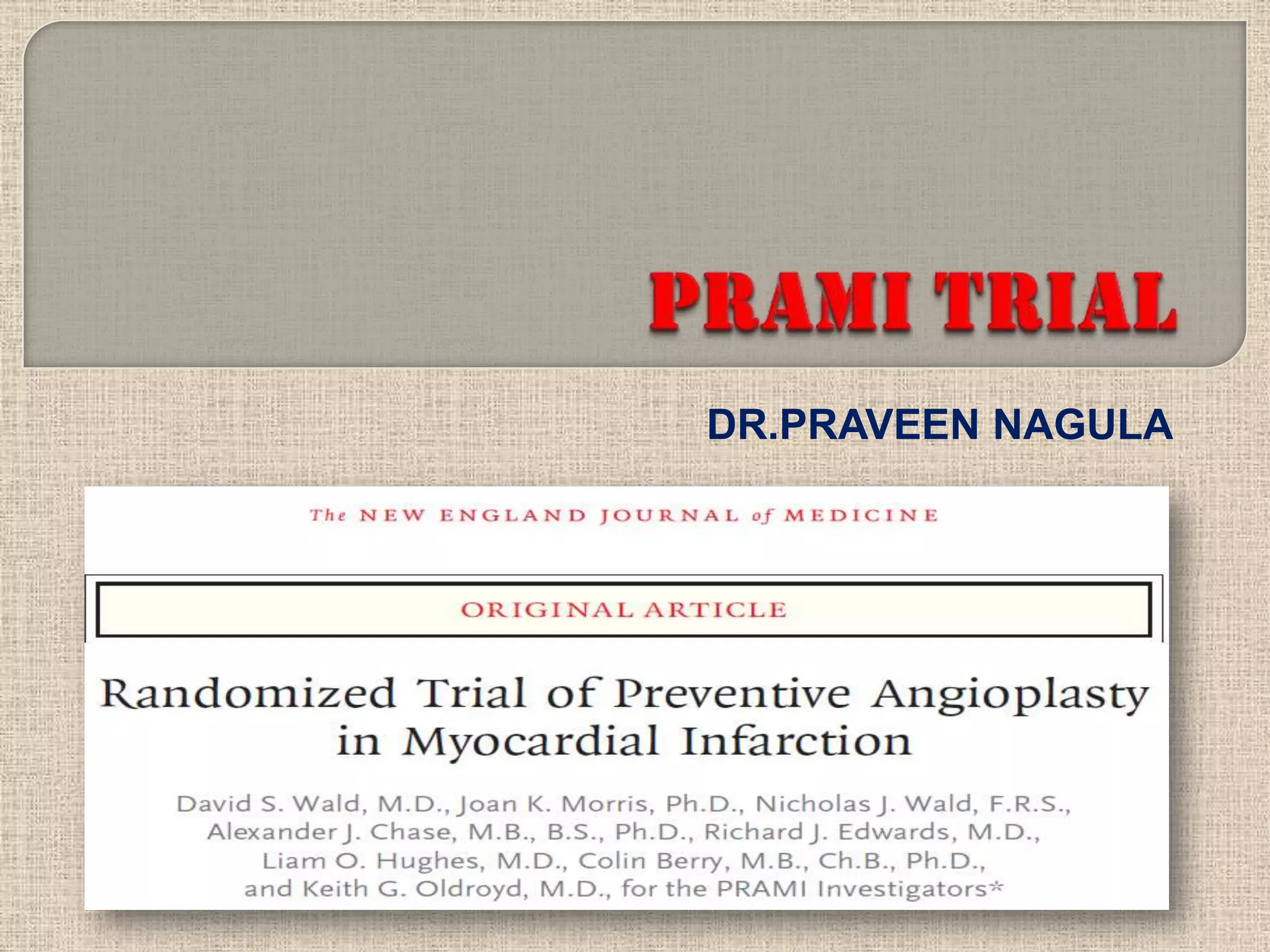
DR.PRAVEEN NAGULA
Single blind randomized study

David S Wald et al,
NEJM 2013;369:1115-23


In acute ST segment elevation myocardial infarction(STEMI),the
use of percutaneous coronary intervention(PCI) to treat the artery
responsible for the infarct(infarct or culprit artery) improves
prognosis.
THE PREVENTIVE PCI







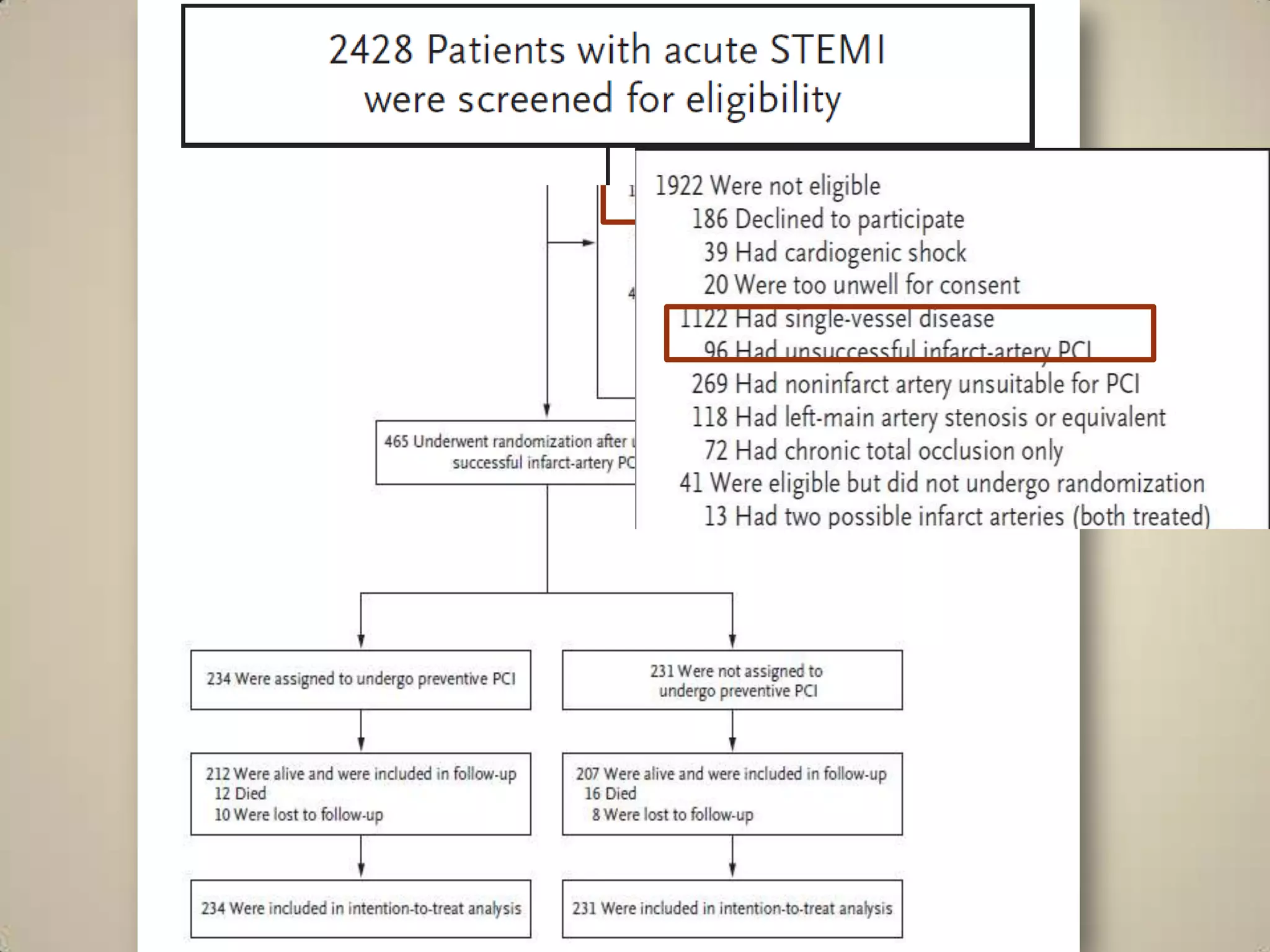
From 2008 through 2013
465 patients at five coronary care centers in UK.
Consecutive patients of any age with acute STEMI and
multivessel coronary disease detected at the time of emergency
PCI.
Trial was limited to patients with STEMI.


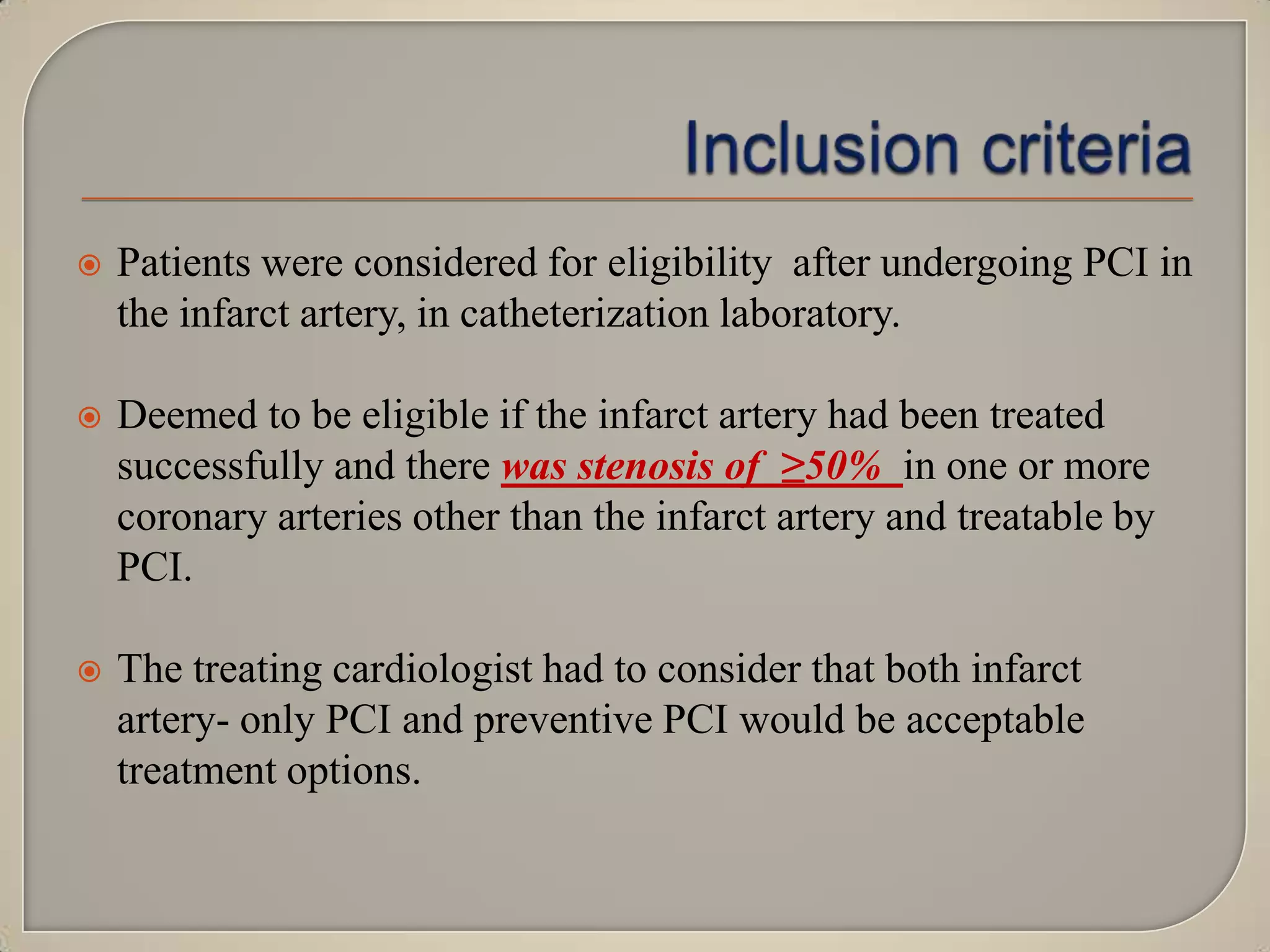
Patients were considered for eligibility after undergoing PCI in
the infarct artery, in catheterization laboratory.



Deemed to be eligible if the infarct artery had been treated
successfully and there was stenosis of ≥50% in one or more
coronary arteries other than the infarct artery and treatable by
PCI.



The treating cardiologist had to consider that both infarct
artery- only PCI and preventive PCI would be acceptable
treatment options.
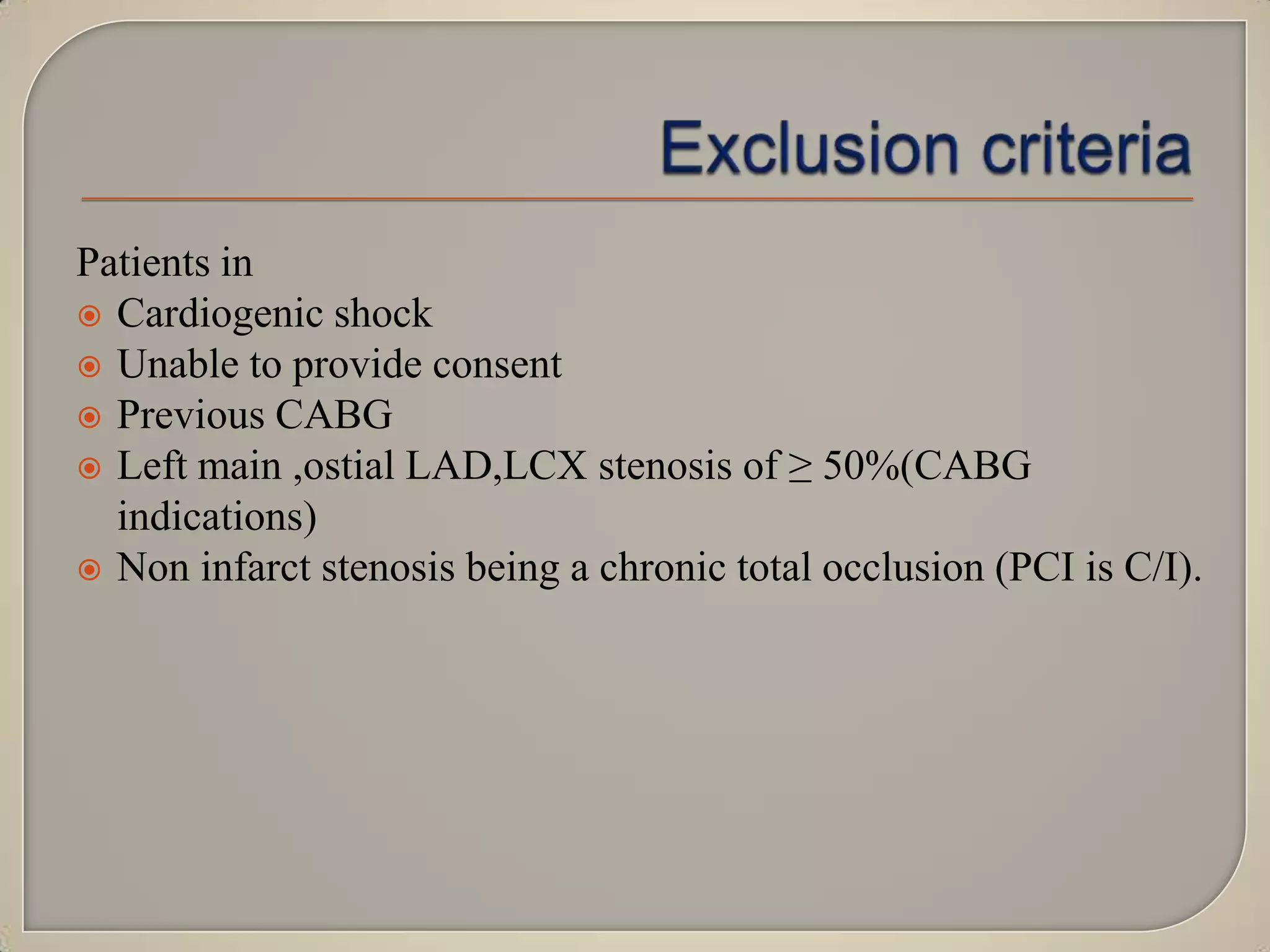
Patients in
 Cardiogenic shock
 Unable to provide consent
 Previous CABG
 Left main ,ostial LAD,LCX stenosis of ≥ 50%(CABG
indications)
 Non infarct stenosis being a chronic total occlusion (PCI is C/I).
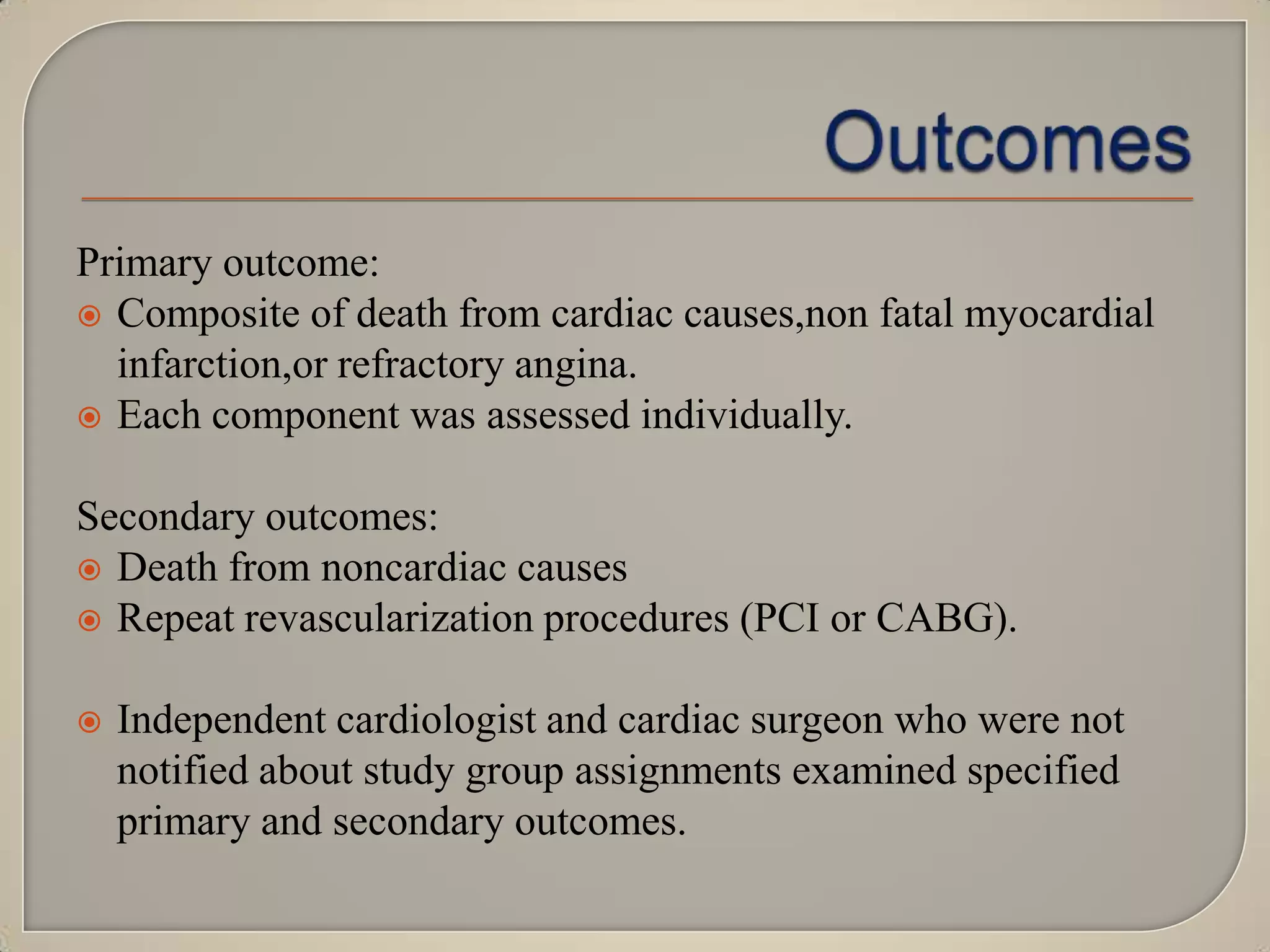
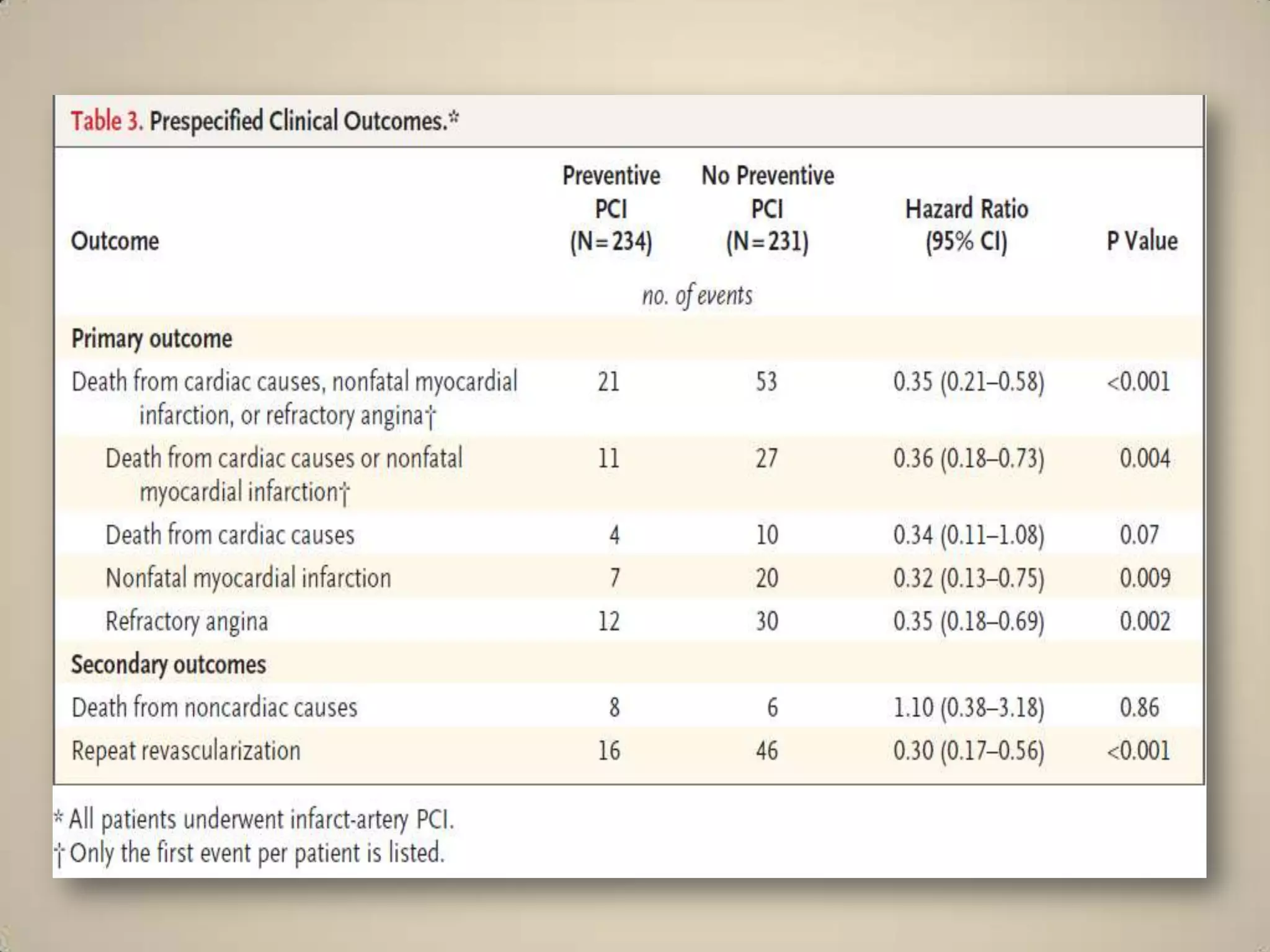
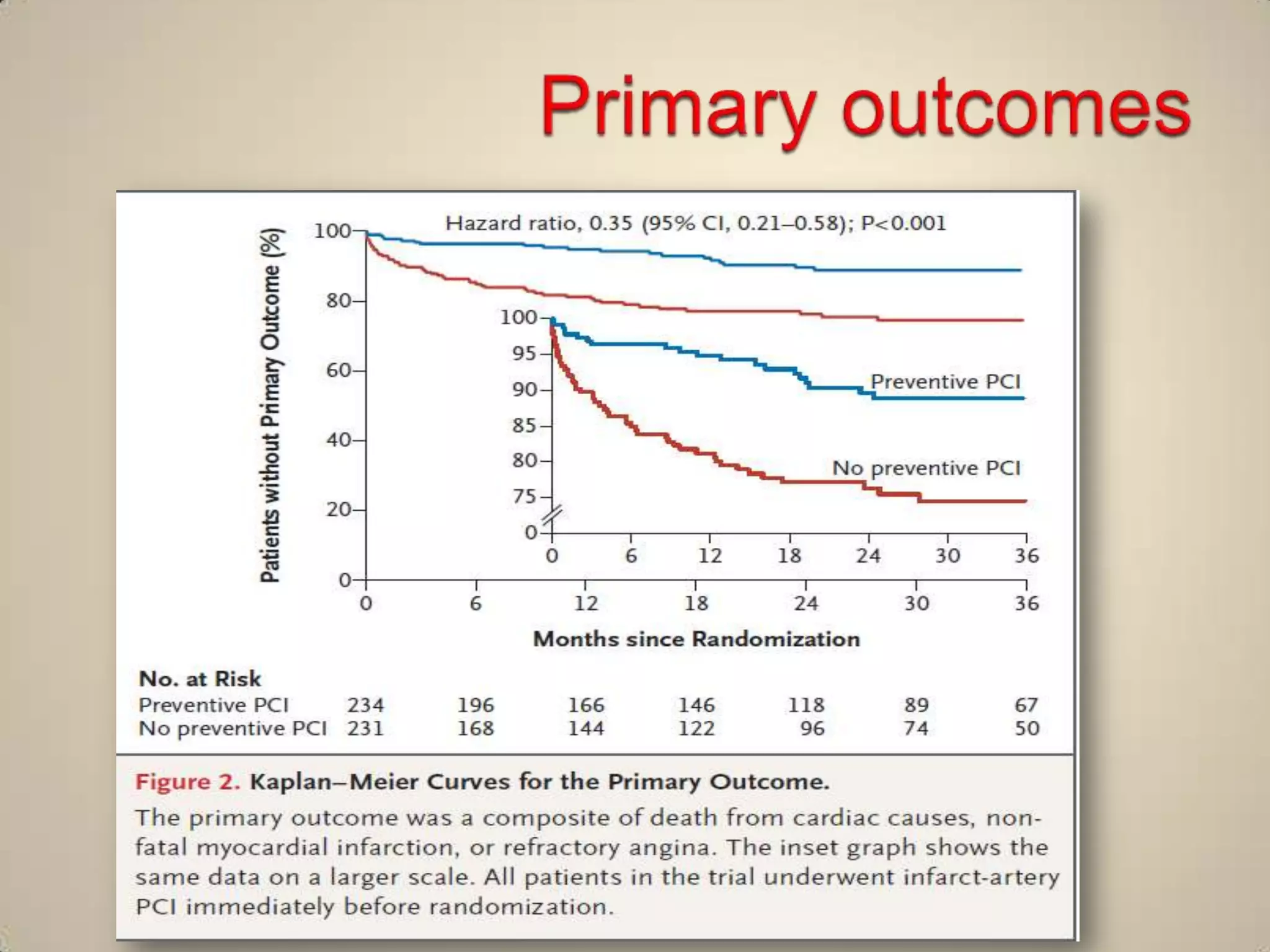
Primary outcome:
 Composite of death from cardiac causes,non fatal myocardial
infarction,or refractory angina.
 Each component was assessed individually.

Secondary outcomes:
 Death from noncardiac causes
 Repeat revascularization procedures (PCI or CABG).


Independent cardiologist and cardiac surgeon who were not
notified about study group assignments examined specified
primary and secondary outcomes.


For a power of at least 80% to detect a reduction in risk of 30% in
the preventive PCI group,as compared with other,at a level of 5%
significance, assuming a 20% annual rate of the primary outcome
in the latter group – 600 patients to be enrolled.




Survival outcomes by log rank statistic.
Stopping criteria included a clear answer to the trial question from
the emerging literature or from the results of the trial,(P<0.001).



All were included in analysis on an intention to treat basis.


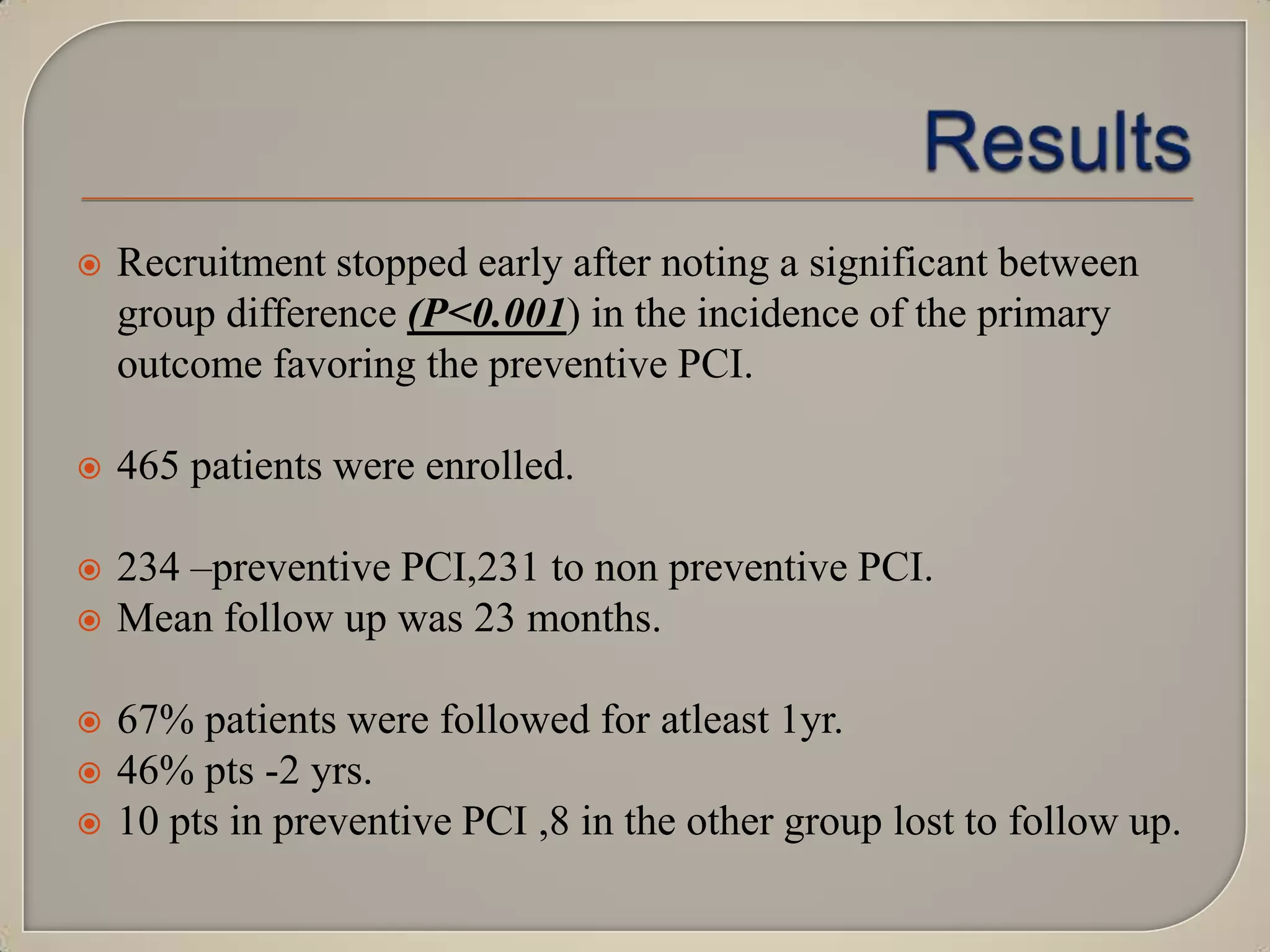
Recruitment stopped early after noting a significant between
group difference (P<0.001) in the incidence of the primary
outcome favoring the preventive PCI.



465 patients were enrolled.



234 –preventive PCI,231 to non preventive PCI.
Mean follow up was 23 months.






67% patients were followed for atleast 1yr.
46% pts -2 yrs.
10 pts in preventive PCI ,8 in the other group lost to follow up.
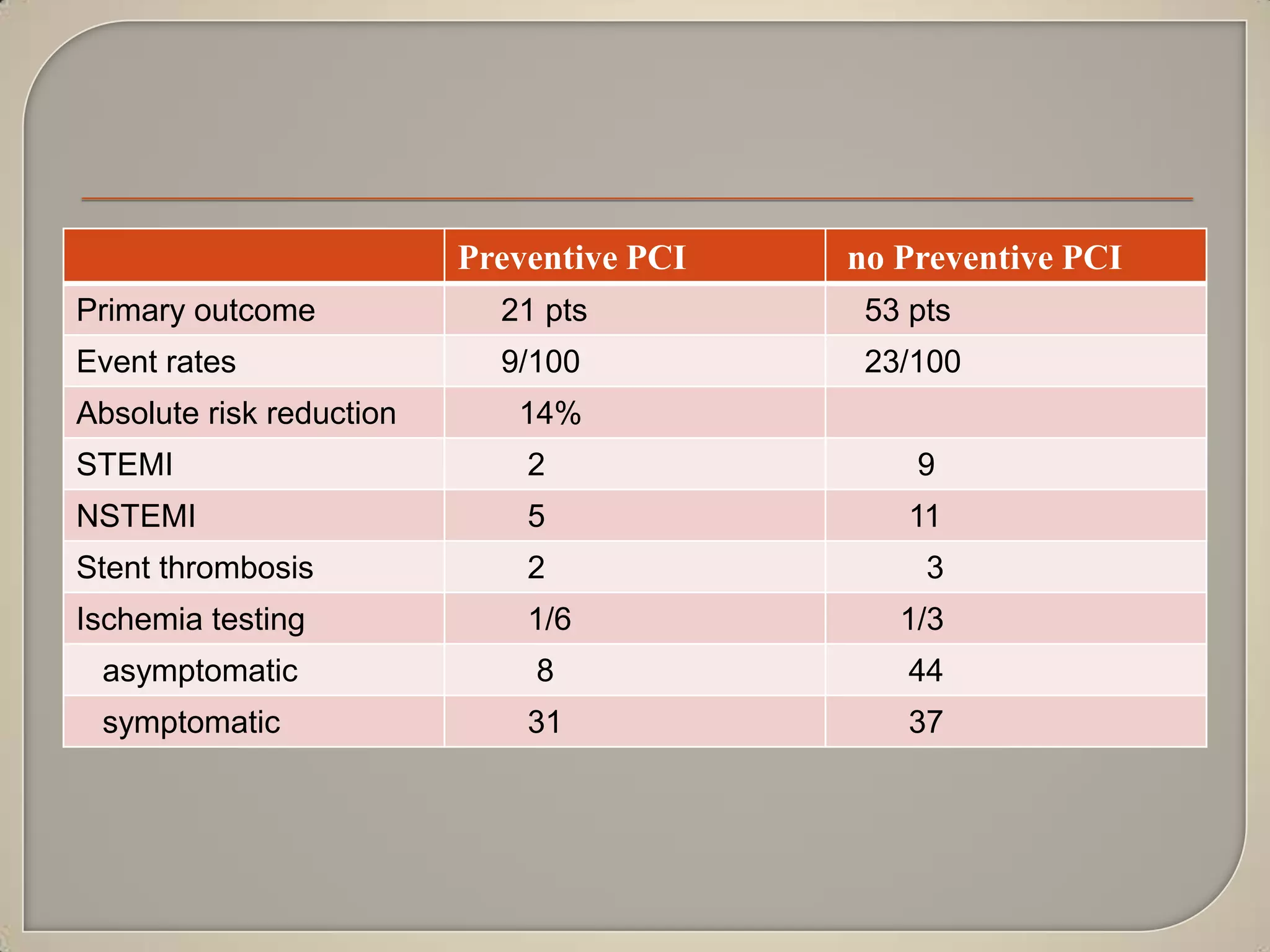
Preventive PCI

no Preventive PCI

Primary outcome

21 pts

53 pts

Event rates

9/100

23/100

Absolute risk reduction

14%

STEMI

2

9

NSTEMI

5

11

Stent thrombosis

2

3

Ischemia testing

1/6

1/3

asymptomatic

8

44

symptomatic

31

37


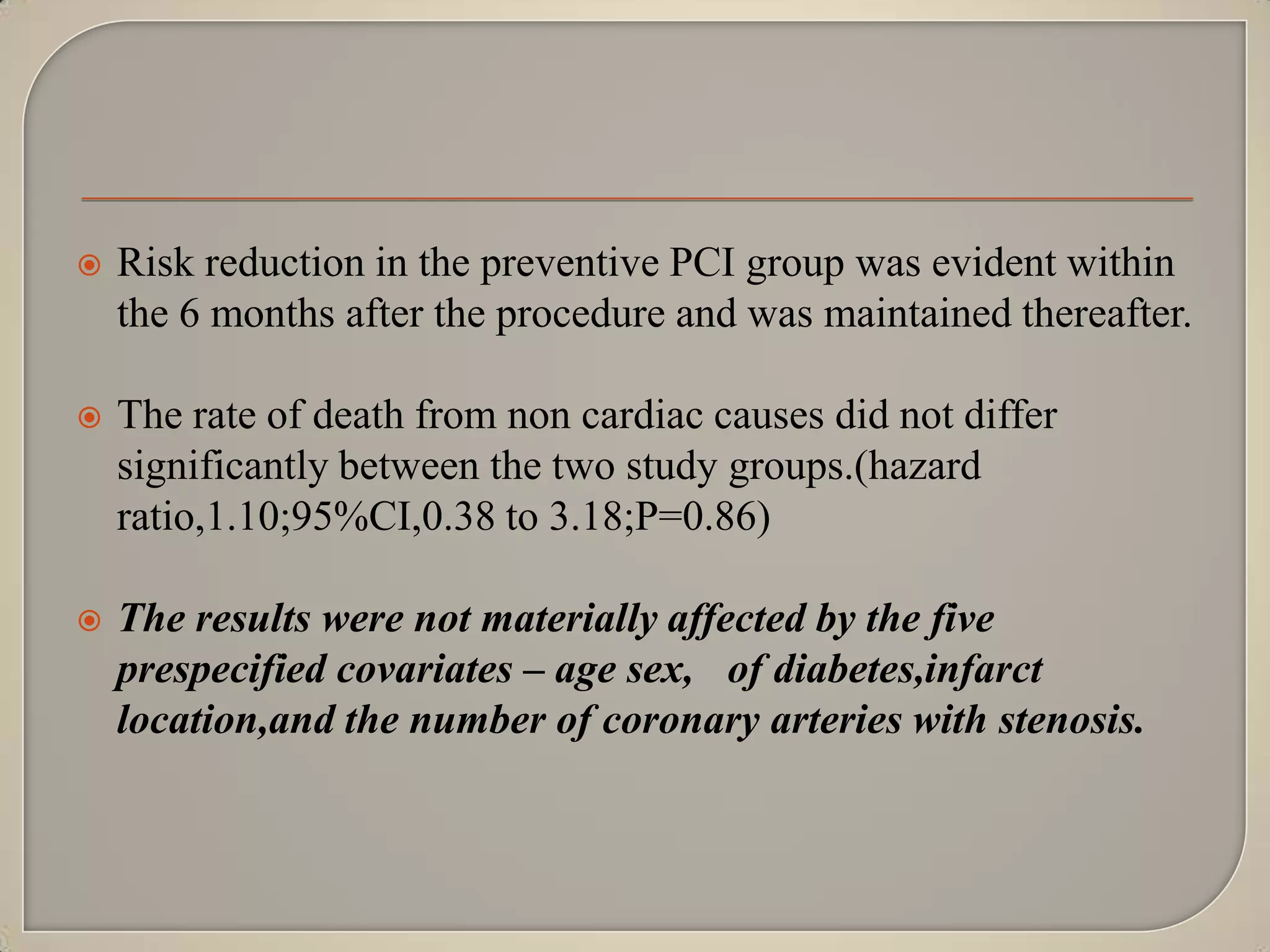
Risk reduction in the preventive PCI group was evident within
the 6 months after the procedure and was maintained thereafter.



The rate of death from non cardiac causes did not differ
significantly between the two study groups.(hazard
ratio,1.10;95%CI,0.38 to 3.18;P=0.86)



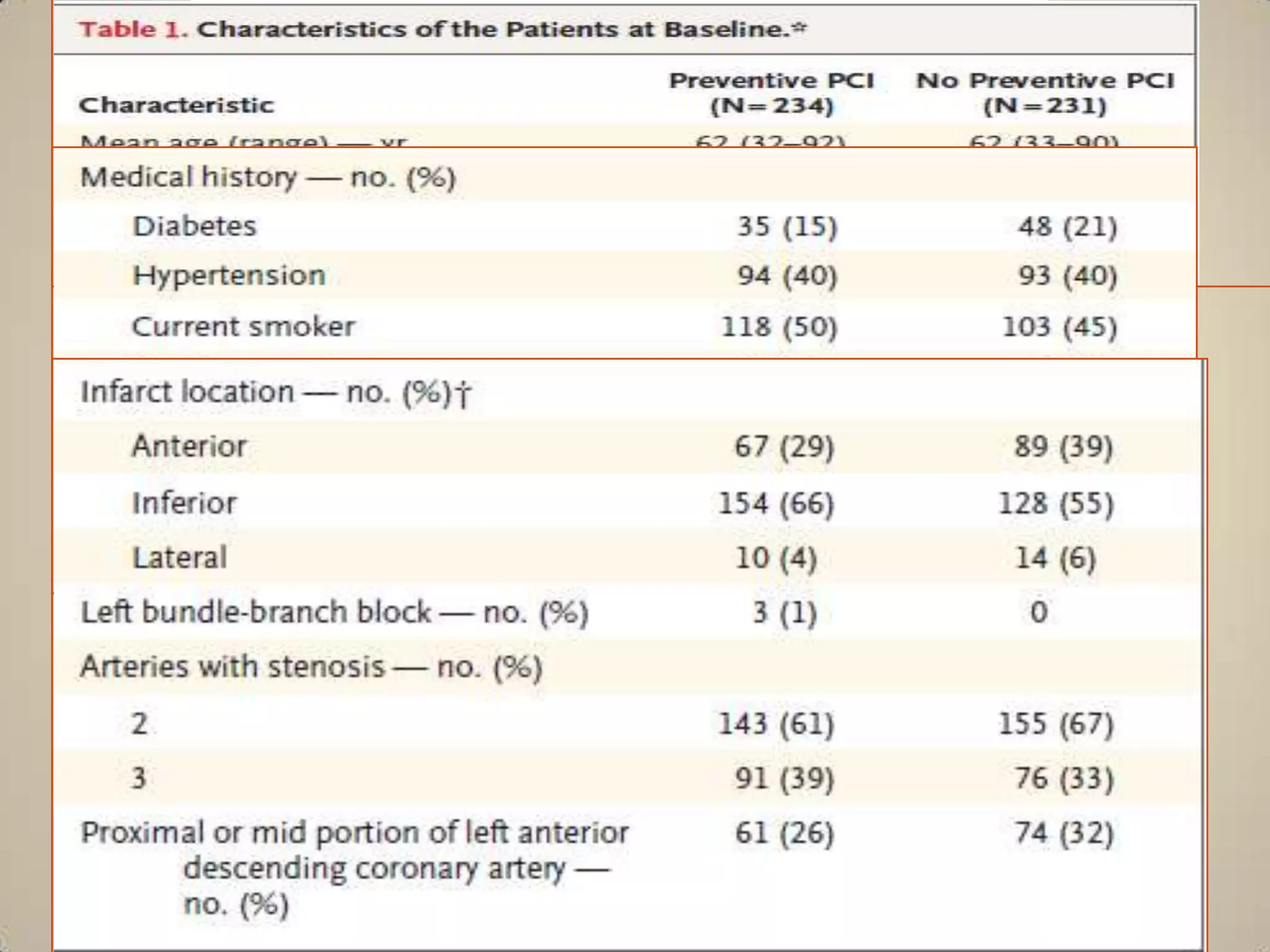
The results were not materially affected by the five
prespecified covariates – age sex, of diabetes,infarct
location,and the number of coronary arteries with stenosis.


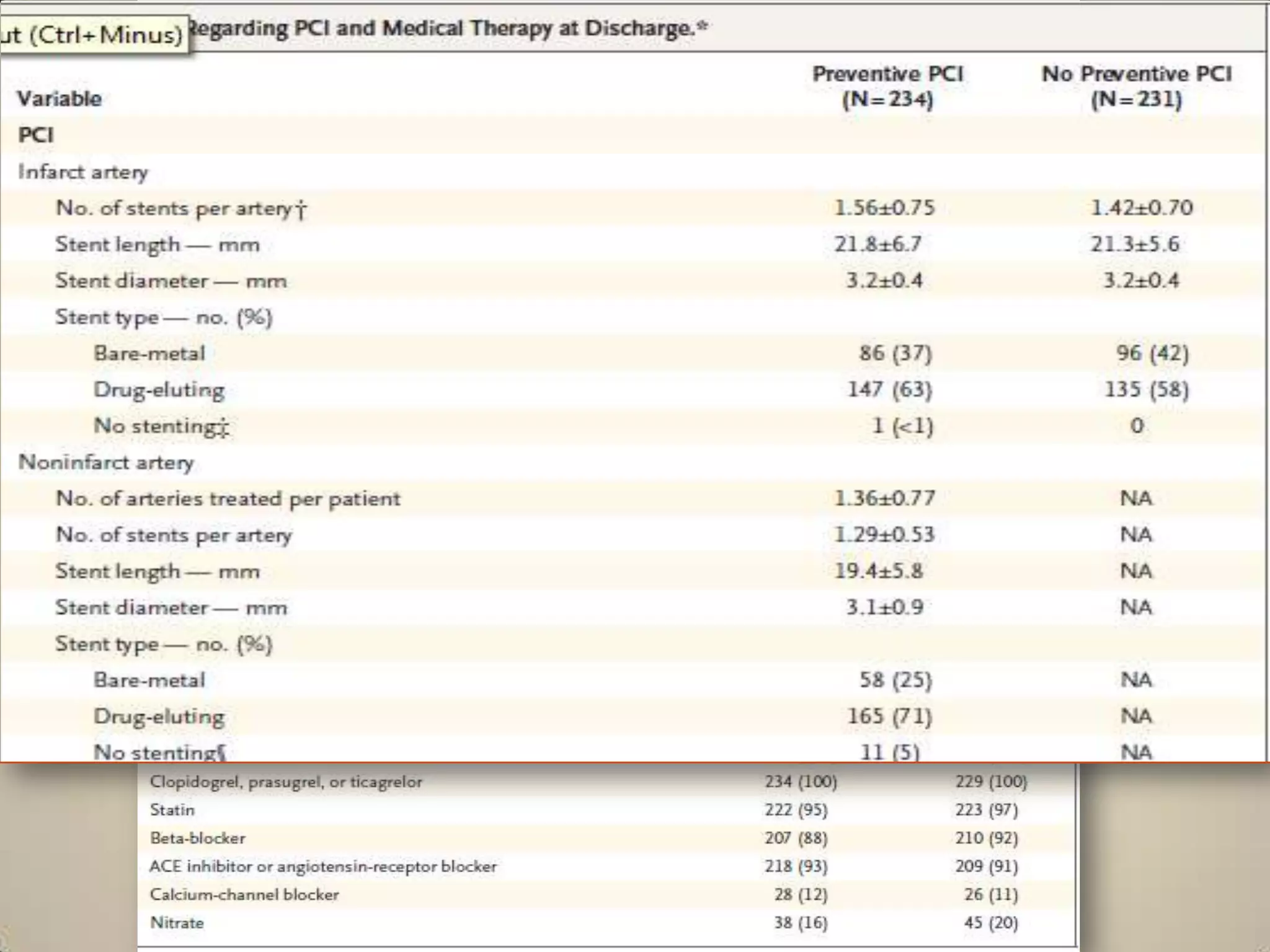
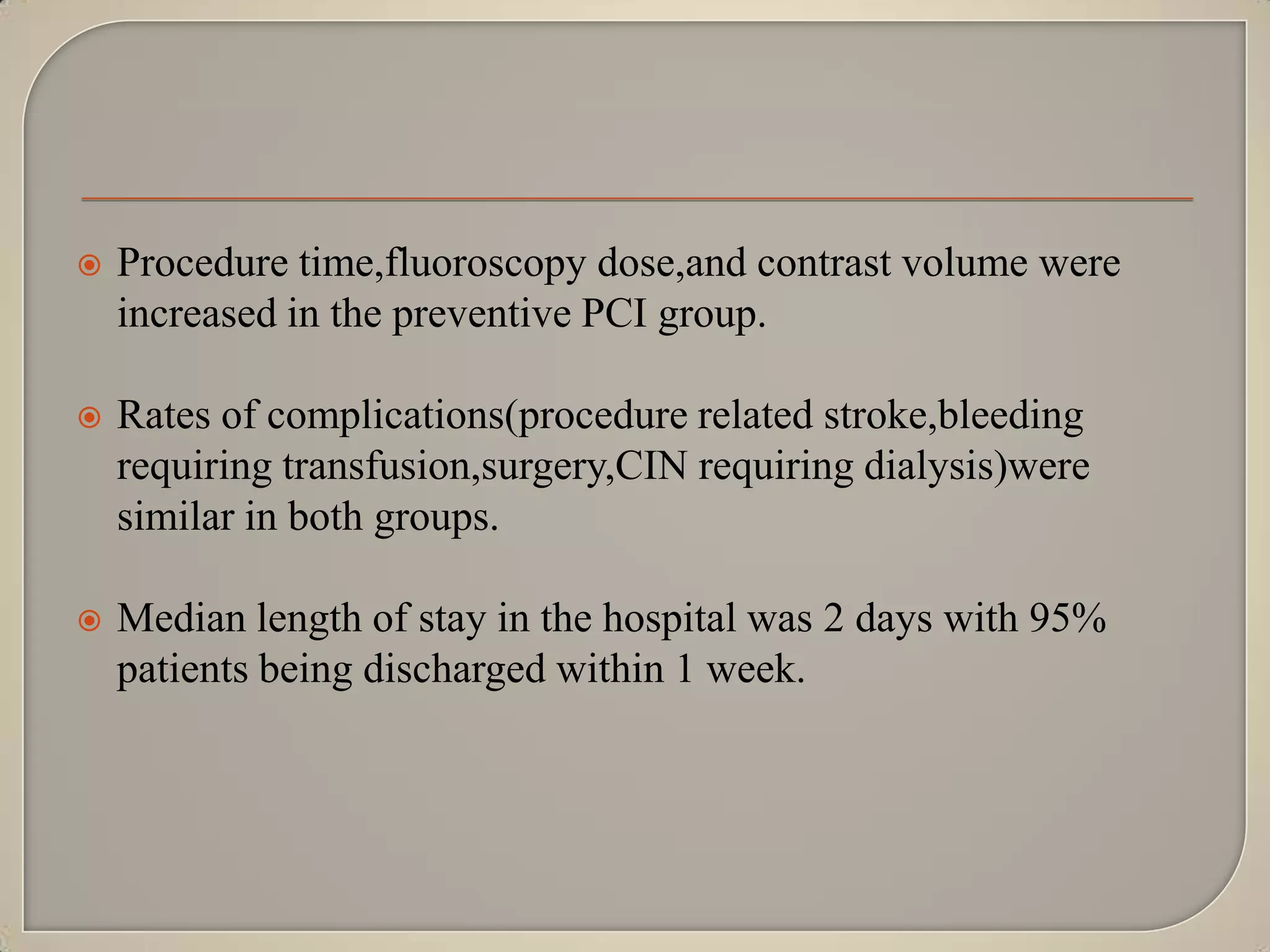
Procedure time,fluoroscopy dose,and contrast volume were
increased in the preventive PCI group.



Rates of complications(procedure related stroke,bleeding
requiring transfusion,surgery,CIN requiring dialysis)were
similar in both groups.



Median length of stay in the hospital was 2 days with 95%
patients being discharged within 1 week.
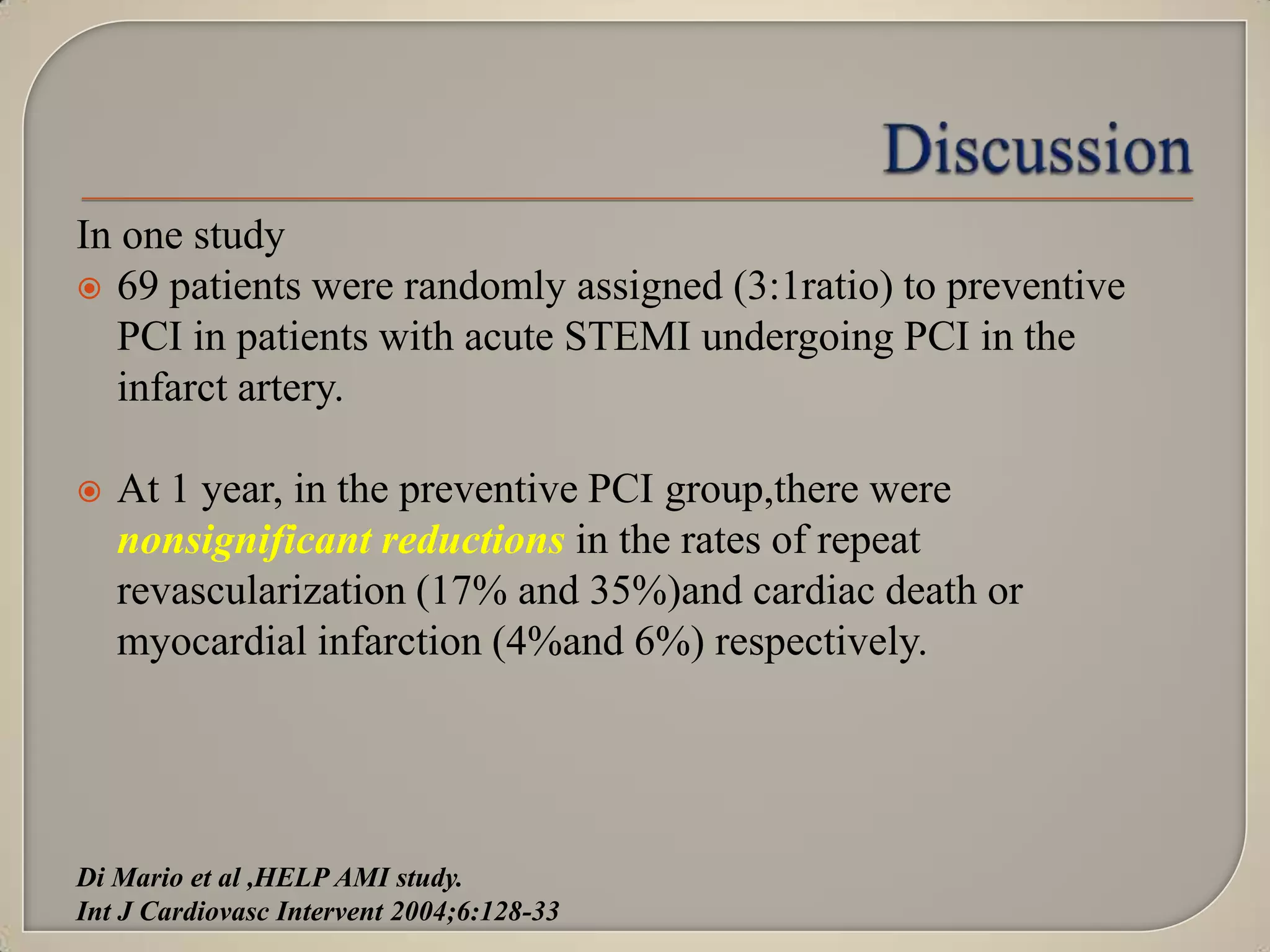
In one study
 69 patients were randomly assigned (3:1ratio) to preventive
PCI in patients with acute STEMI undergoing PCI in the
infarct artery.


At 1 year, in the preventive PCI group,there were
nonsignificant reductions in the rates of repeat
revascularization (17% and 35%)and cardiac death or
myocardial infarction (4%and 6%) respectively.

Di Mario et al ,HELP AMI study.
Int J Cardiovasc Intervent 2004;6:128-33
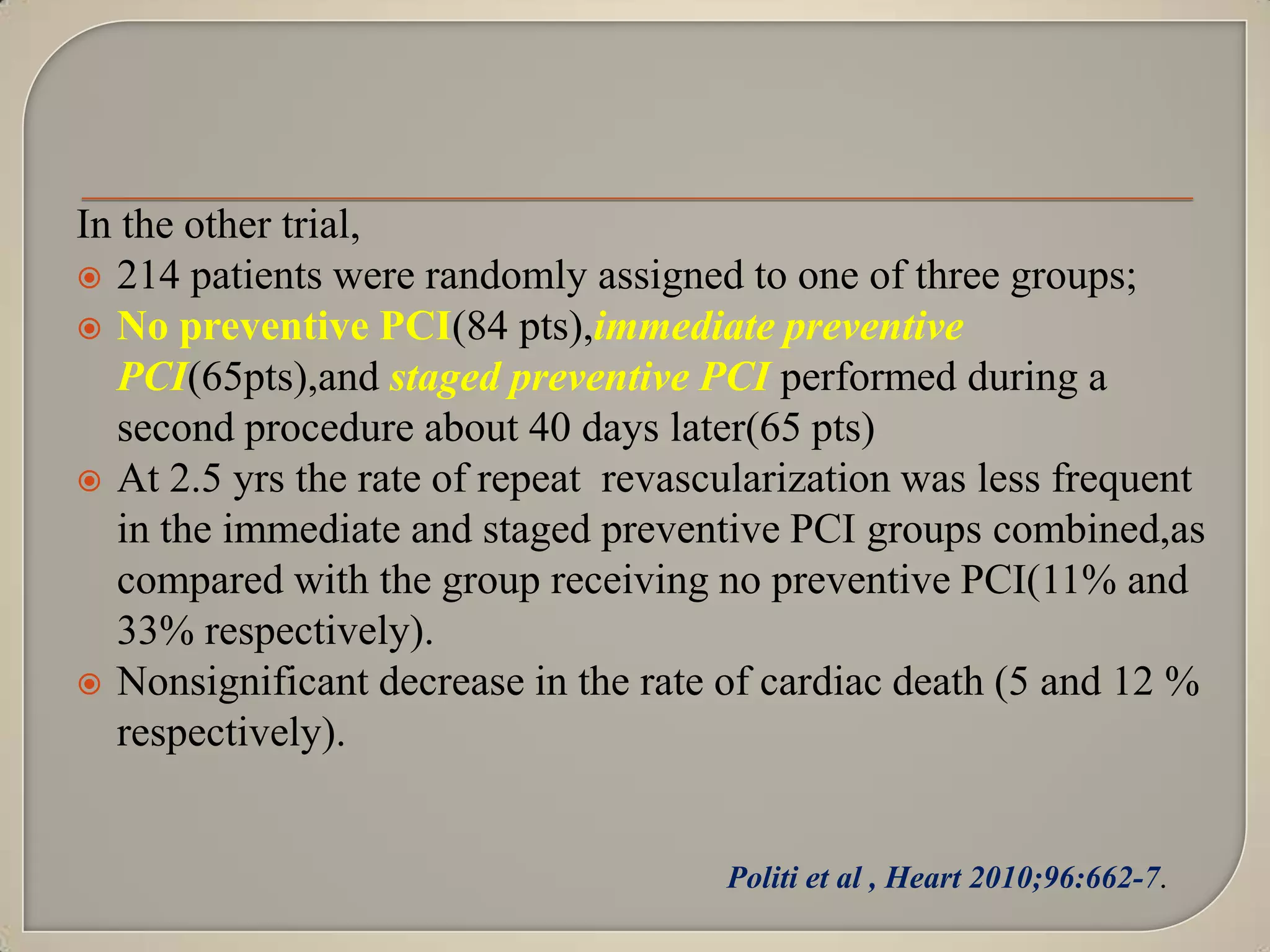
In the other trial,
 214 patients were randomly assigned to one of three groups;
 No preventive PCI(84 pts),immediate preventive
PCI(65pts),and staged preventive PCI performed during a
second procedure about 40 days later(65 pts)
 At 2.5 yrs the rate of repeat revascularization was less frequent
in the immediate and staged preventive PCI groups combined,as
compared with the group receiving no preventive PCI(11% and
33% respectively).
 Nonsignificant decrease in the rate of cardiac death (5 and 12 %
respectively).

Politi et al , Heart 2010;96:662-7.
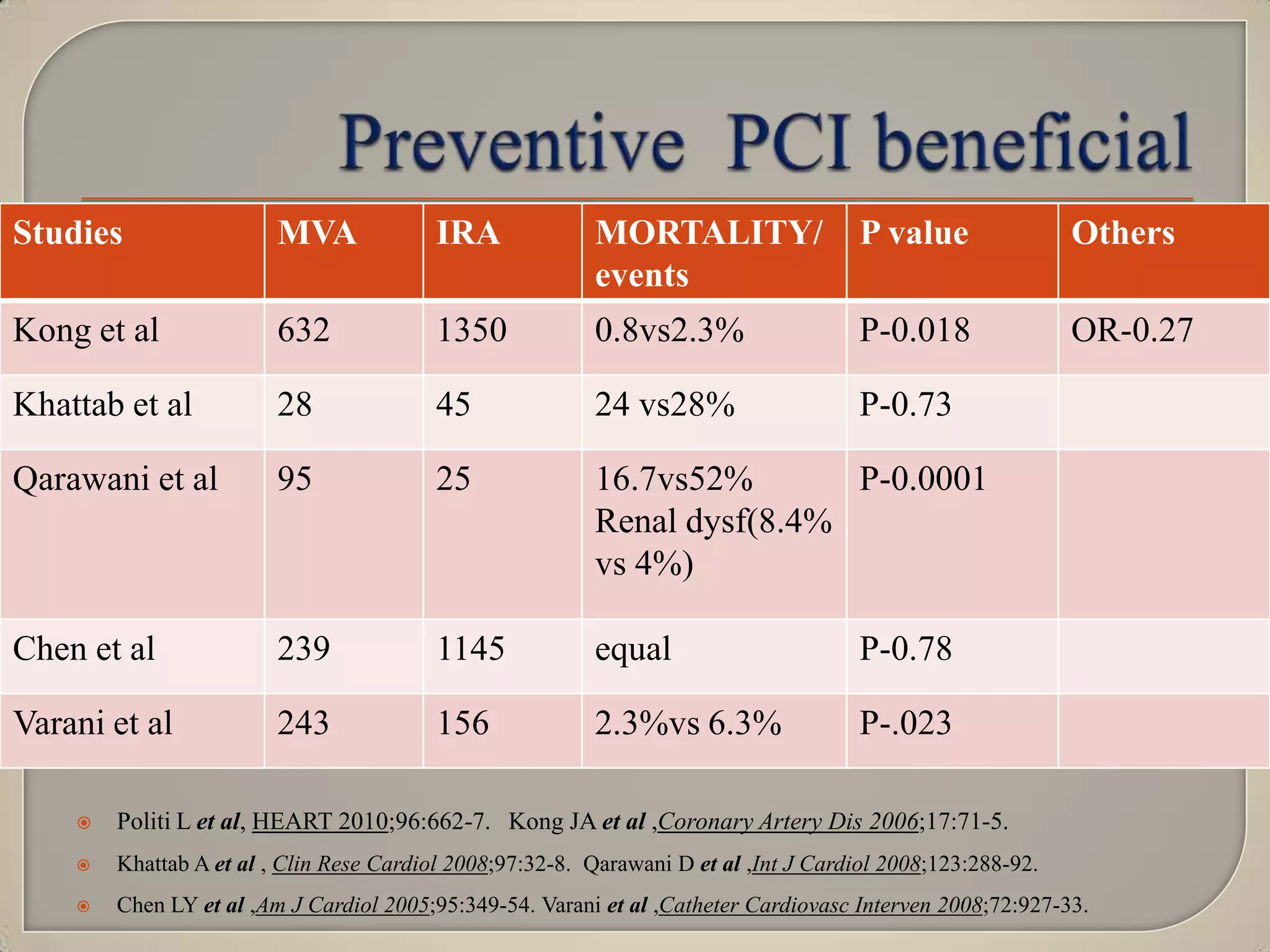
Studies

MVA

IRA

MORTALITY/
events

P value

Others

Kong et al

632

1350

0.8vs2.3%

P-0.018

OR-0.27

Khattab et al

28

45

24 vs28%

P-0.73

Qarawani et al

95

25

16.7vs52%
P-0.0001
Renal dysf(8.4%
vs 4%)

Chen et al

239

1145

equal

P-0.78

Varani et al

243

156

2.3%vs 6.3%

P-.023



Politi L et al, HEART 2010;96:662-7. Kong JA et al ,Coronary Artery Dis 2006;17:71-5.



Khattab A et al , Clin Rese Cardiol 2008;97:32-8. Qarawani D et al ,Int J Cardiol 2008;123:288-92.



Chen LY et al ,Am J Cardiol 2005;95:349-54. Varani et al ,Catheter Cardiovasc Interven 2008;72:927-33.
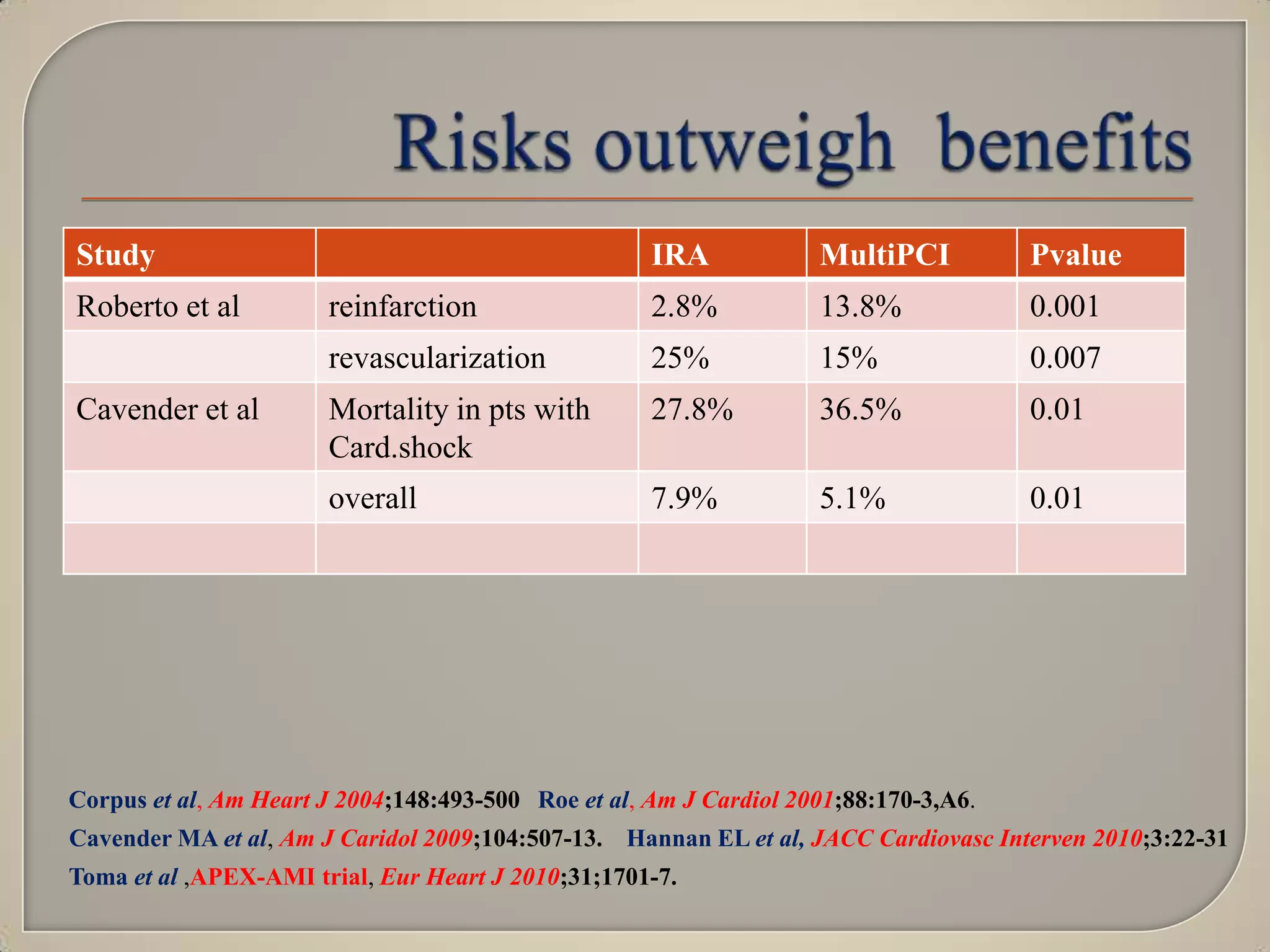
Study

Pvalue

reinfarction

2.8%

13.8%

0.001

25%

15%

0.007

Mortality in pts with
Card.shock

27.8%

36.5%

0.01

overall

Cavender et al

MultiPCI

revascularization

Roberto et al

IRA

7.9%

5.1%

0.01

Corpus et al, Am Heart J 2004;148:493-500 Roe et al, Am J Cardiol 2001;88:170-3,A6.
Cavender MA et al, Am J Caridol 2009;104:507-13. Hannan EL et al, JACC Cardiovasc Interven 2010;3:22-31
Toma et al ,APEX-AMI trial, Eur Heart J 2010;31;1701-7.
Lack of statistical power
Reliance on repeat revascularization
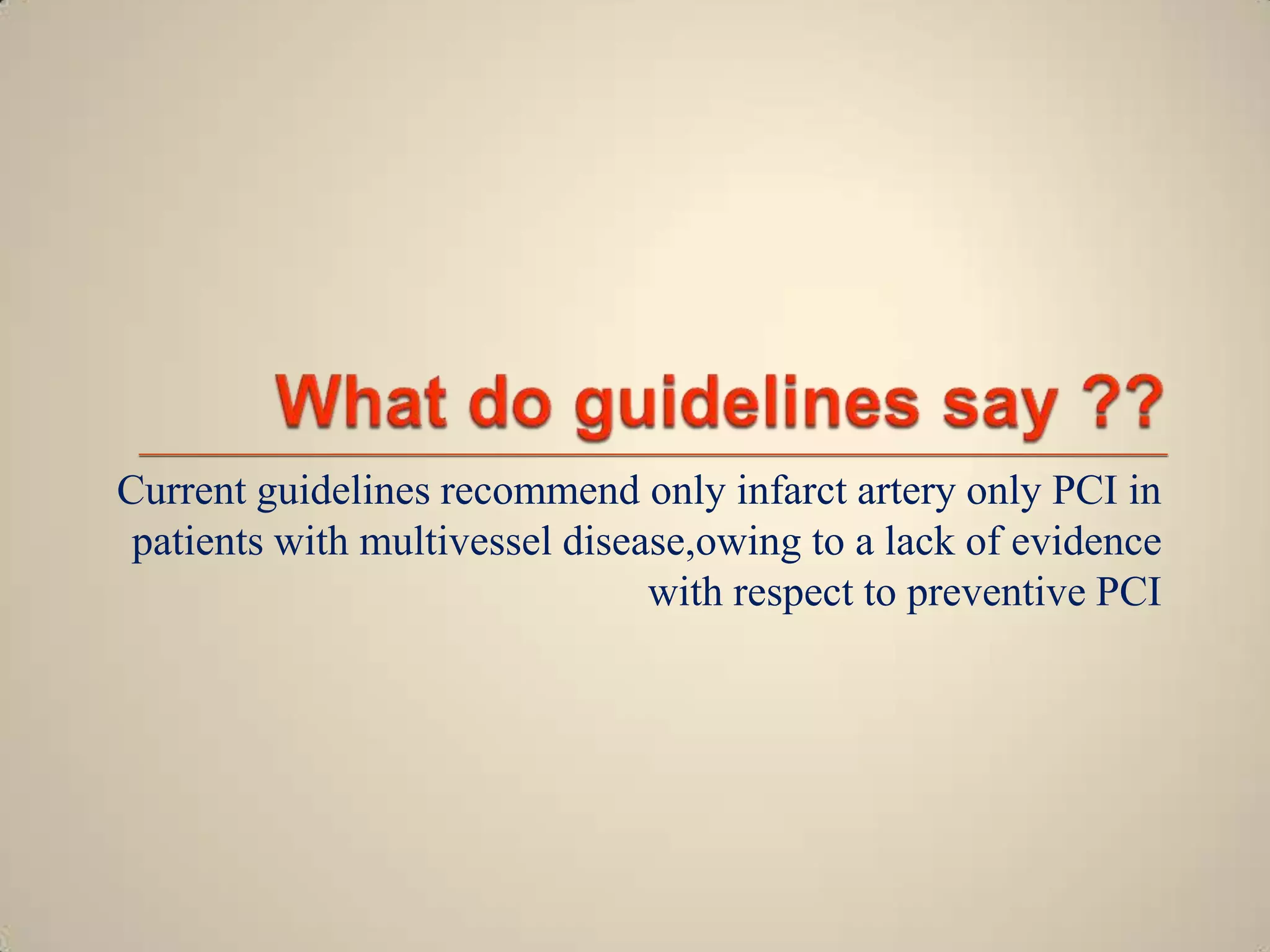
Current guidelines recommend only infarct artery only PCI in
patients with multivessel disease,owing to a lack of evidence
with respect to preventive PCI
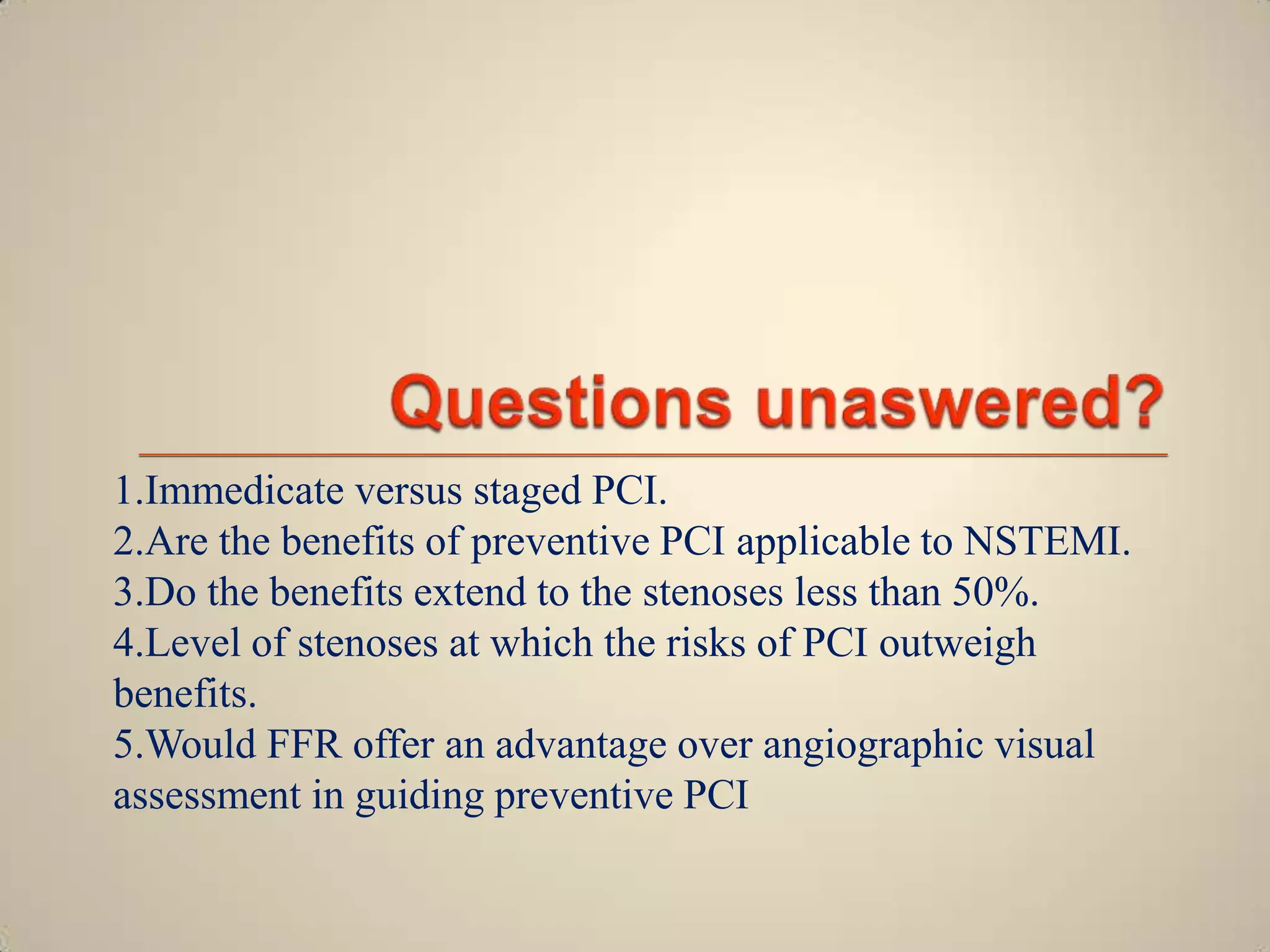
1.Immedicate versus staged PCI.
2.Are the benefits of preventive PCI applicable to NSTEMI.
3.Do the benefits extend to the stenoses less than 50%.
4.Level of stenoses at which the risks of PCI outweigh
benefits.
5.Would FFR offer an advantage over angiographic visual
assessment in guiding preventive PCI


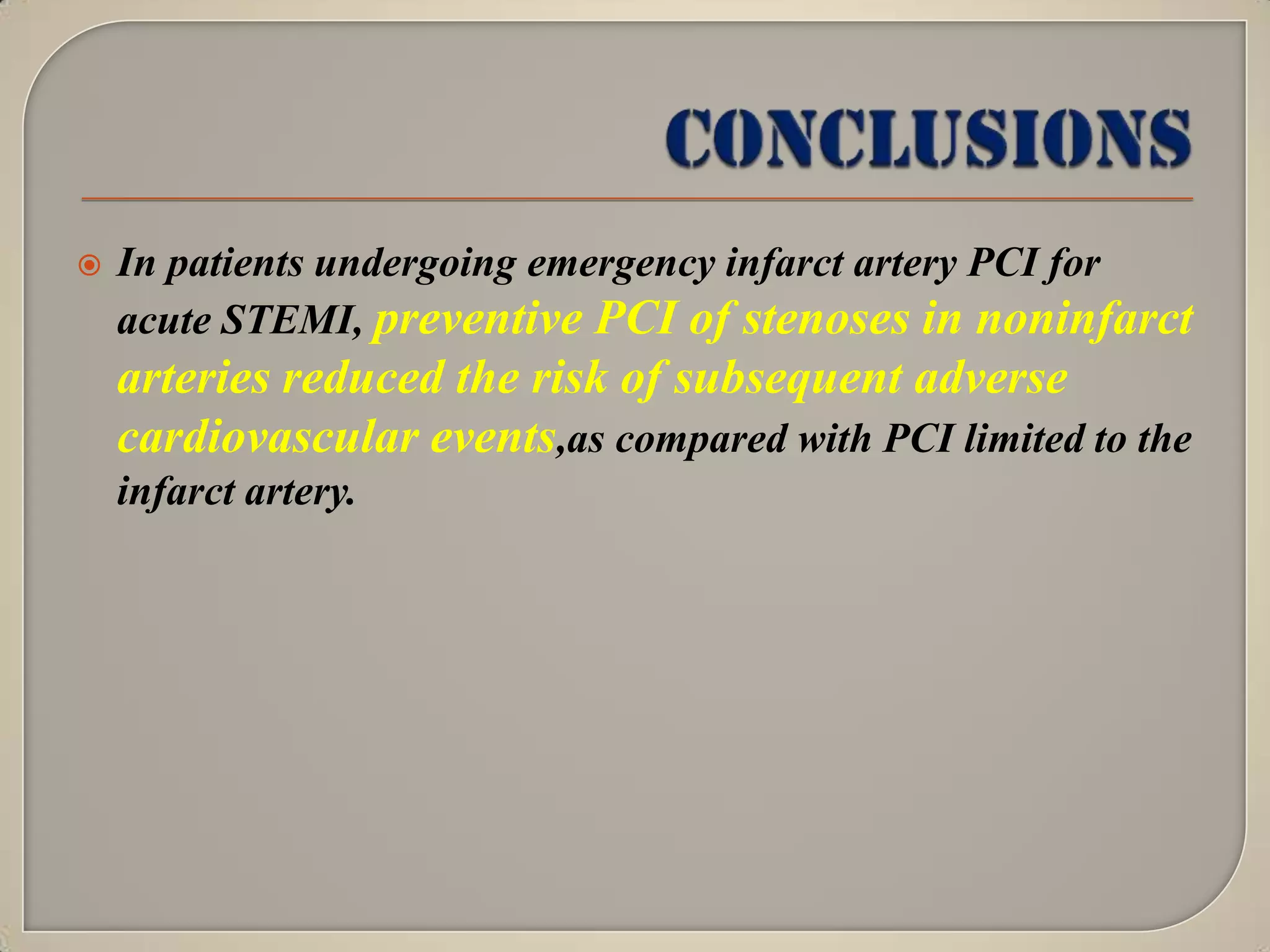
In patients undergoing emergency infarct artery PCI for
acute STEMI, preventive PCI of stenoses in noninfarct

arteries reduced the risk of subsequent adverse
cardiovascular events,as compared with PCI limited to the
infarct artery.
Prami trial

Prami trial

  • 1.
  • 2.
    Single blind randomizedstudy David S Wald et al, NEJM 2013;369:1115-23
  • 3.
     In acute STsegment elevation myocardial infarction(STEMI),the use of percutaneous coronary intervention(PCI) to treat the artery responsible for the infarct(infarct or culprit artery) improves prognosis.
  • 4.
  • 5.
        From 2008 through2013 465 patients at five coronary care centers in UK. Consecutive patients of any age with acute STEMI and multivessel coronary disease detected at the time of emergency PCI. Trial was limited to patients with STEMI.
  • 7.
     Patients were consideredfor eligibility after undergoing PCI in the infarct artery, in catheterization laboratory.  Deemed to be eligible if the infarct artery had been treated successfully and there was stenosis of ≥50% in one or more coronary arteries other than the infarct artery and treatable by PCI.  The treating cardiologist had to consider that both infarct artery- only PCI and preventive PCI would be acceptable treatment options.
  • 8.
    Patients in  Cardiogenicshock  Unable to provide consent  Previous CABG  Left main ,ostial LAD,LCX stenosis of ≥ 50%(CABG indications)  Non infarct stenosis being a chronic total occlusion (PCI is C/I).
  • 9.
    Primary outcome:  Compositeof death from cardiac causes,non fatal myocardial infarction,or refractory angina.  Each component was assessed individually. Secondary outcomes:  Death from noncardiac causes  Repeat revascularization procedures (PCI or CABG).  Independent cardiologist and cardiac surgeon who were not notified about study group assignments examined specified primary and secondary outcomes.
  • 10.
     For a powerof at least 80% to detect a reduction in risk of 30% in the preventive PCI group,as compared with other,at a level of 5% significance, assuming a 20% annual rate of the primary outcome in the latter group – 600 patients to be enrolled.   Survival outcomes by log rank statistic. Stopping criteria included a clear answer to the trial question from the emerging literature or from the results of the trial,(P<0.001).  All were included in analysis on an intention to treat basis.
  • 11.
     Recruitment stopped earlyafter noting a significant between group difference (P<0.001) in the incidence of the primary outcome favoring the preventive PCI.  465 patients were enrolled.  234 –preventive PCI,231 to non preventive PCI. Mean follow up was 23 months.     67% patients were followed for atleast 1yr. 46% pts -2 yrs. 10 pts in preventive PCI ,8 in the other group lost to follow up.
  • 14.
    Preventive PCI no PreventivePCI Primary outcome 21 pts 53 pts Event rates 9/100 23/100 Absolute risk reduction 14% STEMI 2 9 NSTEMI 5 11 Stent thrombosis 2 3 Ischemia testing 1/6 1/3 asymptomatic 8 44 symptomatic 31 37
  • 15.
     Risk reduction inthe preventive PCI group was evident within the 6 months after the procedure and was maintained thereafter.  The rate of death from non cardiac causes did not differ significantly between the two study groups.(hazard ratio,1.10;95%CI,0.38 to 3.18;P=0.86)  The results were not materially affected by the five prespecified covariates – age sex, of diabetes,infarct location,and the number of coronary arteries with stenosis.
  • 16.
     Procedure time,fluoroscopy dose,andcontrast volume were increased in the preventive PCI group.  Rates of complications(procedure related stroke,bleeding requiring transfusion,surgery,CIN requiring dialysis)were similar in both groups.  Median length of stay in the hospital was 2 days with 95% patients being discharged within 1 week.
  • 19.
    In one study 69 patients were randomly assigned (3:1ratio) to preventive PCI in patients with acute STEMI undergoing PCI in the infarct artery.  At 1 year, in the preventive PCI group,there were nonsignificant reductions in the rates of repeat revascularization (17% and 35%)and cardiac death or myocardial infarction (4%and 6%) respectively. Di Mario et al ,HELP AMI study. Int J Cardiovasc Intervent 2004;6:128-33
  • 20.
    In the othertrial,  214 patients were randomly assigned to one of three groups;  No preventive PCI(84 pts),immediate preventive PCI(65pts),and staged preventive PCI performed during a second procedure about 40 days later(65 pts)  At 2.5 yrs the rate of repeat revascularization was less frequent in the immediate and staged preventive PCI groups combined,as compared with the group receiving no preventive PCI(11% and 33% respectively).  Nonsignificant decrease in the rate of cardiac death (5 and 12 % respectively). Politi et al , Heart 2010;96:662-7.
  • 21.
    Studies MVA IRA MORTALITY/ events P value Others Kong etal 632 1350 0.8vs2.3% P-0.018 OR-0.27 Khattab et al 28 45 24 vs28% P-0.73 Qarawani et al 95 25 16.7vs52% P-0.0001 Renal dysf(8.4% vs 4%) Chen et al 239 1145 equal P-0.78 Varani et al 243 156 2.3%vs 6.3% P-.023  Politi L et al, HEART 2010;96:662-7. Kong JA et al ,Coronary Artery Dis 2006;17:71-5.  Khattab A et al , Clin Rese Cardiol 2008;97:32-8. Qarawani D et al ,Int J Cardiol 2008;123:288-92.  Chen LY et al ,Am J Cardiol 2005;95:349-54. Varani et al ,Catheter Cardiovasc Interven 2008;72:927-33.
  • 22.
    Study Pvalue reinfarction 2.8% 13.8% 0.001 25% 15% 0.007 Mortality in ptswith Card.shock 27.8% 36.5% 0.01 overall Cavender et al MultiPCI revascularization Roberto et al IRA 7.9% 5.1% 0.01 Corpus et al, Am Heart J 2004;148:493-500 Roe et al, Am J Cardiol 2001;88:170-3,A6. Cavender MA et al, Am J Caridol 2009;104:507-13. Hannan EL et al, JACC Cardiovasc Interven 2010;3:22-31 Toma et al ,APEX-AMI trial, Eur Heart J 2010;31;1701-7.
  • 23.
    Lack of statisticalpower Reliance on repeat revascularization
  • 24.
    Current guidelines recommendonly infarct artery only PCI in patients with multivessel disease,owing to a lack of evidence with respect to preventive PCI
  • 25.
    1.Immedicate versus stagedPCI. 2.Are the benefits of preventive PCI applicable to NSTEMI. 3.Do the benefits extend to the stenoses less than 50%. 4.Level of stenoses at which the risks of PCI outweigh benefits. 5.Would FFR offer an advantage over angiographic visual assessment in guiding preventive PCI
  • 26.
     In patients undergoingemergency infarct artery PCI for acute STEMI, preventive PCI of stenoses in noninfarct arteries reduced the risk of subsequent adverse cardiovascular events,as compared with PCI limited to the infarct artery.