Understanding Joint
Classification
Dr.Ayesha
(physiotherapist)
Introduction to Joints: Classification and
Functions
• Definition:
• A joint, also known as an articulation, refers to the point where two or
more bones meet in the body.
• Importance:
• Joints play a crucial role in enabling movement and providing
structural support to the body.
Fibrous Joints :
• Description:
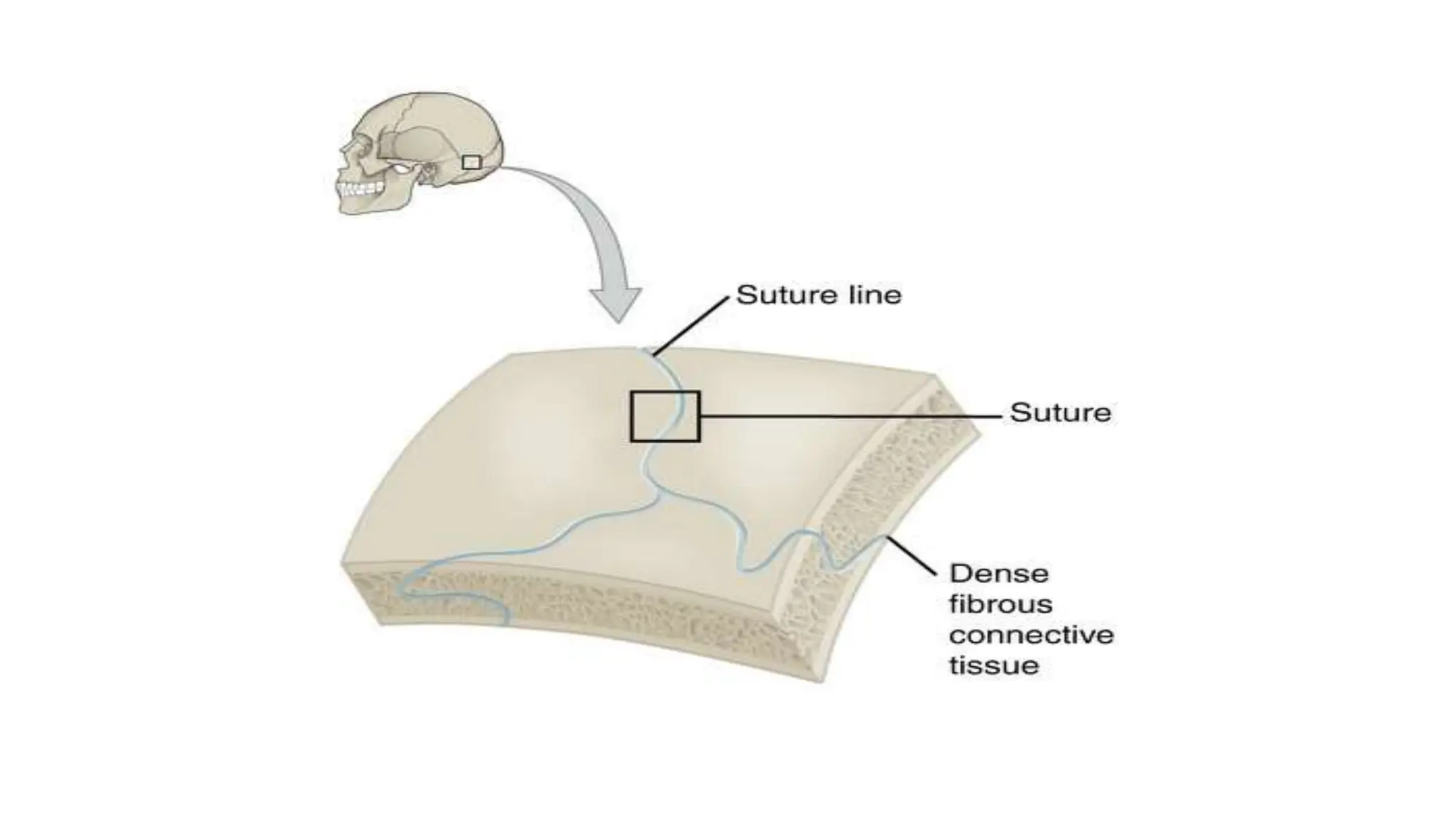
• Fibrous joints are characterized by the presence of fibrous connective
tissue that tightly holds the bones together.
• Movement:
• These joints allow for very little to no movement.
• Examples:
• Skull sutures and the joints between the bones of the lower leg
(inferior tibiofibular joints).
Cartilage Joints
• Description:
• Cartilage joints contain cartilaginous tissue between the articulating
bones.
• Types:
• Synchondroses:
• Temporary joints where bones are connected by hyaline cartilage, like
the epiphyseal plate in growing bones.
• Symphyses:
• Permanent joints where bones are connected by fibrocartilage,
allowing limited movement, such as the pubic symphysis.
• Movement:
• Synchondroses typically allow no movement, while symphyses permit
slight movement.
Synovial Joints
• Description:
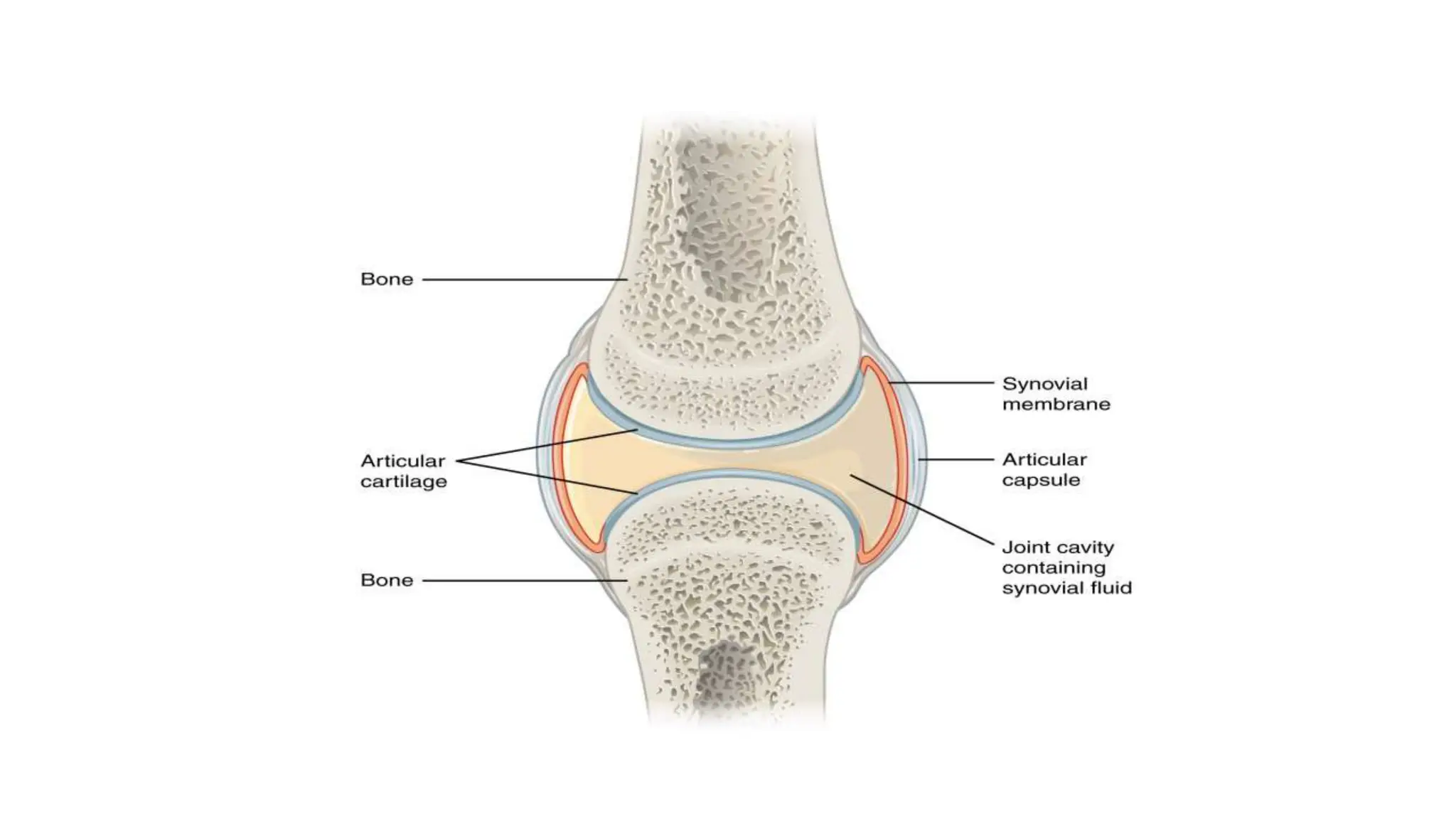
• Synovial joints are the most common type of joints in the body and are
characterized by a synovial cavity filled with synovial fluid.
• Structure:
• Articular Surfaces: Covered with hyaline cartilage.
• Synovial Membrane:
• Lines the joint cavity and produces synovial fluid for lubrication.
• Capsule:
• Surrounds the joint, consisting of an outer fibrous layer and an inner
synovial membrane.
• Function:
• Synovial joints allow for a wide range of movements due to their
unique structure and lubrication.
Function of Synovial Joints
• Movement: Synovial joints facilitate various types of movements,
including flexion, extension, abduction, adduction, rotation, and
circumduction.
• Structures Aiding Movement:
• Articular Discs/Wedges:
• Found in some synovial joints like the knee, providing stability and
shock absorption.
• Fatty Pads:
• Serve as cushions between the synovial membrane and bones,
enhancing joint stability.
• Ligaments:
• Fibrous bands that reinforce the joint capsule, limiting excessive
movement and providing stability.
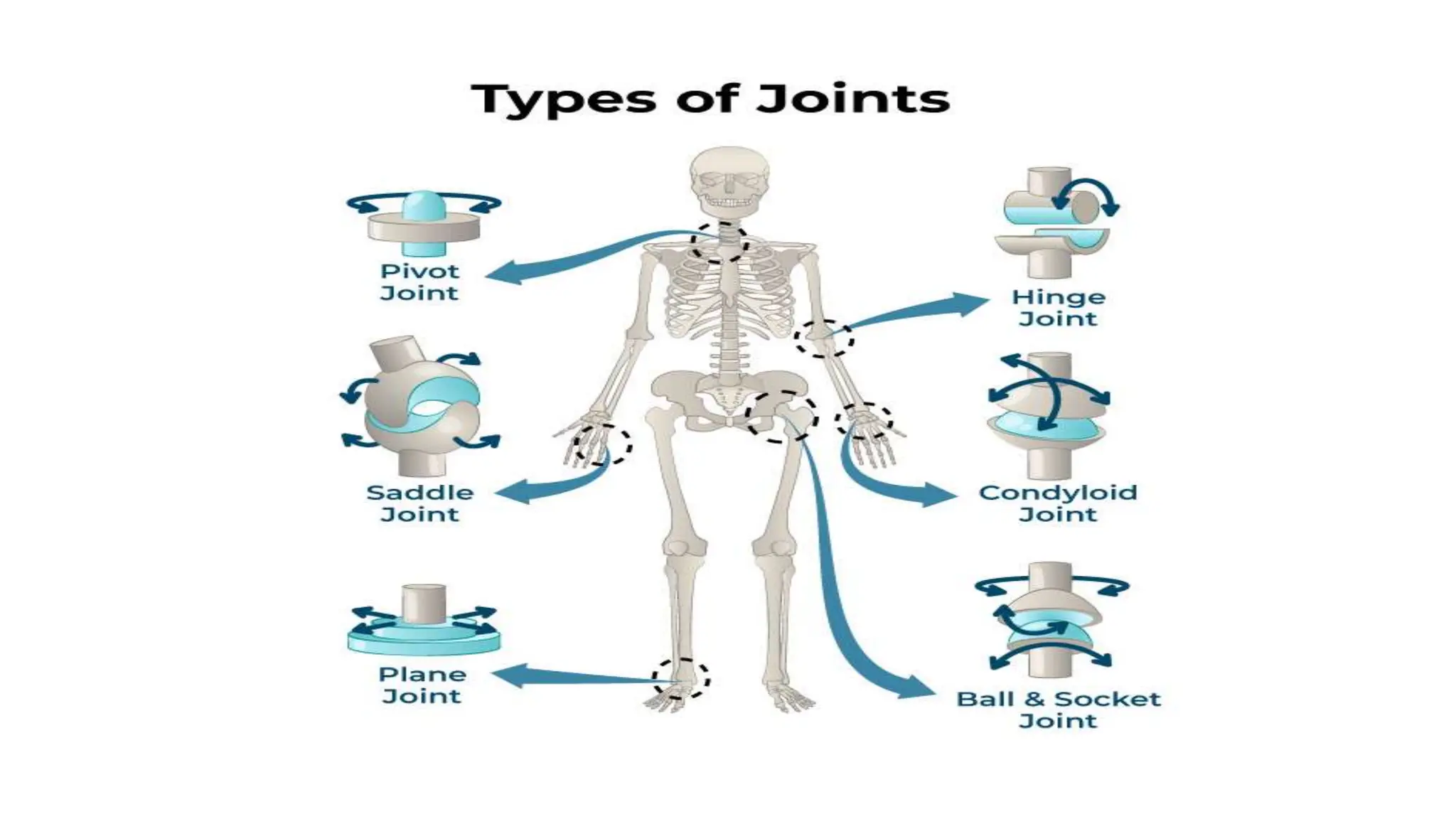
Types of Synovial Joints
• Plane Joint:
• Articular surfaces are flat or nearly flat, allowing sliding movements in multiple directions
(e.g., intercarpal joints).
• Hinge Joint:
• Resembles the hinge of a door, permitting uniaxial flexion-extension movements (e.g.,
elbow joint).
• Pivot Joint:
• Rotation is the only movement possible around a central pivot (e.g., atlantoaxial joint).
• Condyloid Joint:
• Articular surfaces are convex and concave, allowing biaxial movements (e.g.,
metacarpophalangeal joints).
• Ellipsoid Joint:
• Allows mainly biaxial movements due to elliptical articulating surfaces (e.g.,
radiocarpal joint).
• Saddle Joint:
• Articular surfaces resemble a rider on a saddle, enabling multiaxial movements
(e.g., carpometacarpal joint of the thumb).
• Ball-and-Socket Joint:
• One bone has a spherical head that fits into a socket-like depression in another
bone, allowing multiaxial movements (e.g., hip joint).
**Joint Classification: Simplifying Types and Functions**

**Joint Classification: Simplifying Types and Functions**

  • 1.
  • 2.
    Introduction to Joints:Classification and Functions • Definition: • A joint, also known as an articulation, refers to the point where two or more bones meet in the body. • Importance: • Joints play a crucial role in enabling movement and providing structural support to the body.
  • 3.
    Fibrous Joints : •Description: • Fibrous joints are characterized by the presence of fibrous connective tissue that tightly holds the bones together. • Movement: • These joints allow for very little to no movement. • Examples: • Skull sutures and the joints between the bones of the lower leg (inferior tibiofibular joints).
  • 5.
    Cartilage Joints • Description: •Cartilage joints contain cartilaginous tissue between the articulating bones. • Types: • Synchondroses: • Temporary joints where bones are connected by hyaline cartilage, like the epiphyseal plate in growing bones.
  • 7.
    • Symphyses: • Permanentjoints where bones are connected by fibrocartilage, allowing limited movement, such as the pubic symphysis. • Movement: • Synchondroses typically allow no movement, while symphyses permit slight movement.
  • 8.
    Synovial Joints • Description: •Synovial joints are the most common type of joints in the body and are characterized by a synovial cavity filled with synovial fluid. • Structure: • Articular Surfaces: Covered with hyaline cartilage.
  • 10.
    • Synovial Membrane: •Lines the joint cavity and produces synovial fluid for lubrication. • Capsule: • Surrounds the joint, consisting of an outer fibrous layer and an inner synovial membrane. • Function: • Synovial joints allow for a wide range of movements due to their unique structure and lubrication.
  • 11.
    Function of SynovialJoints • Movement: Synovial joints facilitate various types of movements, including flexion, extension, abduction, adduction, rotation, and circumduction. • Structures Aiding Movement: • Articular Discs/Wedges: • Found in some synovial joints like the knee, providing stability and shock absorption.
  • 12.
    • Fatty Pads: •Serve as cushions between the synovial membrane and bones, enhancing joint stability. • Ligaments: • Fibrous bands that reinforce the joint capsule, limiting excessive movement and providing stability.
  • 13.
    Types of SynovialJoints • Plane Joint: • Articular surfaces are flat or nearly flat, allowing sliding movements in multiple directions (e.g., intercarpal joints). • Hinge Joint: • Resembles the hinge of a door, permitting uniaxial flexion-extension movements (e.g., elbow joint). • Pivot Joint: • Rotation is the only movement possible around a central pivot (e.g., atlantoaxial joint). • Condyloid Joint: • Articular surfaces are convex and concave, allowing biaxial movements (e.g., metacarpophalangeal joints).
  • 14.
    • Ellipsoid Joint: •Allows mainly biaxial movements due to elliptical articulating surfaces (e.g., radiocarpal joint). • Saddle Joint: • Articular surfaces resemble a rider on a saddle, enabling multiaxial movements (e.g., carpometacarpal joint of the thumb). • Ball-and-Socket Joint: • One bone has a spherical head that fits into a socket-like depression in another bone, allowing multiaxial movements (e.g., hip joint).