Learning is alifelong process.
This process is influenced by a variety of
factors related to the learner, the teacher,
the process and the content.
The factors are:
1.Physiological Factors
2. Psychological Factors
3. Environmental Factors
4. Methodology of Instructions
3.
1. Physiological Factors:
A.Sense perception
B. Physical health
C. Time and day of learning
D. Food and drink
E. Atmospheric conditions
F. Age
4.
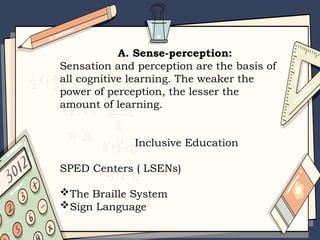
A. Sense-perception:
Sensation andperception are the basis of
all cognitive learning. The weaker the
power of perception, the lesser the
amount of learning.
Inclusive Education
SPED Centers ( LSENs)
The Braille System
Sign Language
5.
B. Physical Health
Illhealth hampers learning. Sound mind is
only in a sound body.
C. Time of Learning
Experiments on children have shown that
there are great variations in learning
efficiency during the different hours of the
day.
D. Food and drink
Nutrition is responsible for efficient mental
activity. Poor nutrition adversely affects
learning.
6.
D. Atmospheric conditions
Lowventilation, lack of proper illumination,
noise and physical discomfort (as we find in
factories and overcrowded schools) hamper
the learning capacity.
E. Age
Learning proceeds rapidly between 18 and 20,
remains stagnant till 25, and declines up to 35.
Age accompanies mental maturation. So some
complex problems cannot be solved till the
person is sufficiently mature.
A. Mental Health:
Mentaltension, complexes, conflicts, mental
illnesses and mental diseases hamper learning.
B. Motivation and Interest:
No learning take place unless it is motivated.
Purposeless learning is no learning at all.
Intrinsic
Extrinsic
C. Rewards and Punishment:
Rewards of all sorts are powerful incentives to
learn. Punishments, arousing fear in
anticipation, may influence the pupil to work
and learn, but not in all the cases.
A. Working conditions:
Thelocation of the school, the internal set-up,
the accommodation, decoration and healthful
and sanitary conditions are very important for
efficient learning.
B. Organizational set-up:
Difficult subjects should be taught in the
morning. There should be interval after some
periods.
Guidance in the selection of subjects and
activities in accordance with age and ability
and aptitude of the pupils should be provided.
11.
4. Methodology ofInstructions
A. Presentation and Organization of Material
B. Learning by Doing
C. Assessment and Feedback
12.
A. Presentation andOrganization of
Material
The learning material should be properly
planned and organized. It should be
graded to suit the mental level of the
learners. It should be presented in a
meaningful and interesting manner.
13.
B. Learning byDoing
The pupils must be encouraged to
learn through activities. Theoretical
teaching should be replaced by
practical application of knowledge,
experimentation and personal
application. Children learn better
through personal experience.
14.
C. Assessment andFeedback
Through tests, the learners know their
exact achievement, and there is no
scope for over-estimation or
underestimation. Occasional and
periodical testing motivates the
learners to be consistent or become
better in their studies.