§ a social science that deals with the production, distribution, and
consumption of goods and services.
§ It is the study of proper allocation and efficient use of scarce resources
to produce commodities for the maximum satisfaction of unlimited
human needs and wants.
§ studies the decisions of individuals and firms to
allocate resources of production, exchange, and
consumption.
§ studies how an overall
economy—the market or
other systems that operate on
a large scale—behaves
Macro economics studies the concept of national income, its methods
and measurement.
Macro economics studies the problems related to employment and
unemployment.
Macro economics studies functions of money and theories relating to
it. Banks and other financial institutions are also a part of its study.
Study of problems relating to economic growth or increase in per
capita real income forms part of macro economics
Macro economics also studies trade among different countries.
Theory of international trade, tariff, protection etc. are subjects of
great significance to macro economics.
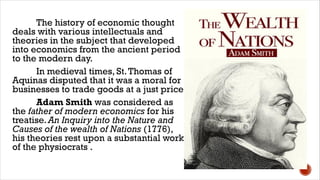
The history of economic thought
deals with various intellectuals and
theories in the subject that developed
into economics from the ancient period
to the modern day.
In medieval times, St.Thomas of
Aquinas disputed that it was a moral for
businesses to trade goods at a just price.
Adam Smith was considered as
the father of modern economics for his
treatise. An Inquiry into the Nature and
Causes of the wealth of Nations (1776),
his theories rest upon a substantial work
of the physiocrats .
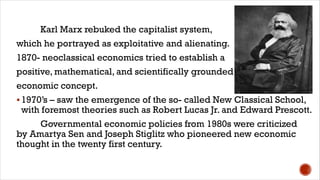
Karl Marx rebuked the capitalist system,
which he portrayed as exploitative and alienating.
1870- neoclassical economics tried to establish a
positive, mathematical, and scientifically grounded
economic concept.
§1970’s – saw the emergence of the so- called New Classical School,
with foremost theories such as Robert Lucas Jr. and Edward Prescott.
Governmental economic policies from 1980s were criticized
by Amartya Sen and Joseph Stiglitz who pioneered new economic
thought in the twenty first century.
According to Adam Smith,“ selfish behavior by
individuals leads to an outcome that benefits everyone in
society”.This statement summarize the most important idea
that serves as basis of classical economics.
The classical economists observed economic and
social transformation brought by the industrial revolution.
They also posted many questions about value, economic,
growth, and money.They maintain a free-market economy,
disputing a natural system based on freedom and property.
But these economists were at odds and cannot arrive at a
specific thought.
Classical economics can be divided into two branches:
the general equilibrium theory and the quantity theory of
money.
General equilibrium theory- advanced in 1874 by Leon
Walras, explained how much of each good is created and how
the price of each good is related to every other good.
Quantity theory of Money – was developed by David
Hume, a Scottish philosopher and economist who was a
contemporary of Adam Smith.This theory is about money
prices as opposed to real quantities and relative prices.
Neoclassical economists presumed an element of irrationality
in the context of inner-temporal decision making.
William Stanley Jevons, Irving Fisher, Alfred Marshall and
Arthur Cecil Pigou- observed a preference for present over future
consumption and each took this as evidence that consumer foresight
or will power was defective.
The laboring classes were said to discount future consumption
to reflect uncertainty and such discounting is regarded as rational .
But each of these economists focused on an additional, and
purportedly “irrational”, reason for discounting ; impatience .
Consumers are thus said to make persistent miscalculations when it
comes to decisions involving time.
It is commonly held that neoclassical economics has two
main interpretations of rationality : internal consistency and
the maximization of self- interest.
For each economist considered here, inter-temporal
decision making is in some way harder to get right than
decisions made at a point in time. Because they purportedly
overvalued the present relative to future consumption ,
laborers were unable to make correct savings and family size
choices.
The major policy theme in Jevons, Fisher, Marshall, and
Pigou is that a broad system of education is required to
correct what Jevons called the “ one great defect” of the
working classes; their “ want of thrift and providence “,
underlying the analysis is a conviction that these problems
are not self-correcting instead only widespread and
significant intervention will ensure that correct inter-
temporal decisions are forthcoming.
§John Maynard Keynes is considered as the father of
macroeconomics.
Before the birth of Keynesianism, the prevailing notion was the
economy is a stable self-correcting machine. Random
(unpredictable) events might cause a disturbance to the
economy that would temporarily put some workers out of job.
But hundreds of millions of selfish individuals would be guided,
in the words of Adam Smith, "by an invisible hand," to move the
economy quickly back to full employment.
Keynes was much more sceptical of the self-correcting
features of the economy because he saw no evidence of it in Great
Britain during the 1920s, when unemployment remained high for a
decade.
According to Keynes, the force that caused the Great
Depression was an impulsive fall in confidence about the future a
kind of mass panic affecting all stock market participants
simultaneously, It was the stock market crash that caused the Great
Depression.The economy did not revert back to full employment
because there 15 no Self-correcting mechanism. In Keynes view,
any unemployment rate can persist indefinitely because the forces
that tend to bring back equilibrium are either missing or so weak
that we would not expect to see them operating in finite time.
According to Farmer (2010), "Keynes' theory of what went
wrong in the Great Depression is based on the twin concepts
of aggregate demand and aggregate suppiy. Aggregate
demand and supply are similar to, but distinct from, Marshall's
theory of demand and supply in a single market. Aggregate
demand explains the total money value of goods and services
that all households and firms would like to spend in a given
period of time. Aggregate supply explains how many workers
are needed to produce the goods and services necessary to
meet that demand.
The most important tenet of monetarism is that money matters-
and it matters a lot. It is the crucial determinant of how the overall
economy performs. Monetarism talks about the supply of money,
that is, the total quantity of money in the system and how fast it is
rising or falling. Monetarists are normally not very interested in
interest rate.
Keynes, on the other hand, put less emphasis on monetary
variables and focused on interest rates.The precise definition of
money supply is far less important to the monetarists than how it
changes over time. Movements in money are major determinants of
both price level and total economic activities. Over the longer run
with a lag, any increase in the money supply faster than the trend
growth of the money causes inflation.
In the short-run, and with shorter lag, fluctuations in the growth
of money generate business cycle. Slower money growth causes
recession; accelerating money growth brings about recovery and
boom.The central policy prescription of the monetarists is to have
money supply growth fixed on an absolutely rock-steady path (which
is adjusted accordingly).This rule is usually proposed in terms of the
narrow money supply (M1), and its growth rate is to be fixed at
approximately the trend growth of the economy.
§Rational expectations theory (conceptualized by Robert Lucas
and Thomas Sargent) states that people understand how the
economy works and use all information available to them in
making their economic decisions.Thus, when the government
changes its economic policy, people anticipate the consequences
of the change and alter their behaviour accordingly which
signifies the intent of the policy change.
§ For example, the BSP decided to speed up the growth of money in order
to increase employment. Rational expectations argues that business
executives, workers, and consumers in anticipation of the effects of a
larger money supply, would all raise prices and wages proportionately. As
a result, the intended effect of higher employment would be vitiated, and
the only effect would be the unintended effect of a higher price level

Macroeconomics intro

  • 3.
    § a socialscience that deals with the production, distribution, and consumption of goods and services. § It is the study of proper allocation and efficient use of scarce resources to produce commodities for the maximum satisfaction of unlimited human needs and wants.
  • 4.
    § studies thedecisions of individuals and firms to allocate resources of production, exchange, and consumption. § studies how an overall economy—the market or other systems that operate on a large scale—behaves
  • 5.
    Macro economics studiesthe concept of national income, its methods and measurement. Macro economics studies the problems related to employment and unemployment. Macro economics studies functions of money and theories relating to it. Banks and other financial institutions are also a part of its study. Study of problems relating to economic growth or increase in per capita real income forms part of macro economics Macro economics also studies trade among different countries. Theory of international trade, tariff, protection etc. are subjects of great significance to macro economics.
  • 7.
    The history ofeconomic thought deals with various intellectuals and theories in the subject that developed into economics from the ancient period to the modern day. In medieval times, St.Thomas of Aquinas disputed that it was a moral for businesses to trade goods at a just price. Adam Smith was considered as the father of modern economics for his treatise. An Inquiry into the Nature and Causes of the wealth of Nations (1776), his theories rest upon a substantial work of the physiocrats .
  • 8.
    Karl Marx rebukedthe capitalist system, which he portrayed as exploitative and alienating. 1870- neoclassical economics tried to establish a positive, mathematical, and scientifically grounded economic concept. §1970’s – saw the emergence of the so- called New Classical School, with foremost theories such as Robert Lucas Jr. and Edward Prescott. Governmental economic policies from 1980s were criticized by Amartya Sen and Joseph Stiglitz who pioneered new economic thought in the twenty first century.
  • 9.
    According to AdamSmith,“ selfish behavior by individuals leads to an outcome that benefits everyone in society”.This statement summarize the most important idea that serves as basis of classical economics. The classical economists observed economic and social transformation brought by the industrial revolution. They also posted many questions about value, economic, growth, and money.They maintain a free-market economy, disputing a natural system based on freedom and property. But these economists were at odds and cannot arrive at a specific thought.
  • 10.
    Classical economics canbe divided into two branches: the general equilibrium theory and the quantity theory of money. General equilibrium theory- advanced in 1874 by Leon Walras, explained how much of each good is created and how the price of each good is related to every other good. Quantity theory of Money – was developed by David Hume, a Scottish philosopher and economist who was a contemporary of Adam Smith.This theory is about money prices as opposed to real quantities and relative prices.
  • 11.
    Neoclassical economists presumedan element of irrationality in the context of inner-temporal decision making. William Stanley Jevons, Irving Fisher, Alfred Marshall and Arthur Cecil Pigou- observed a preference for present over future consumption and each took this as evidence that consumer foresight or will power was defective. The laboring classes were said to discount future consumption to reflect uncertainty and such discounting is regarded as rational . But each of these economists focused on an additional, and purportedly “irrational”, reason for discounting ; impatience . Consumers are thus said to make persistent miscalculations when it comes to decisions involving time.
  • 12.
    It is commonlyheld that neoclassical economics has two main interpretations of rationality : internal consistency and the maximization of self- interest. For each economist considered here, inter-temporal decision making is in some way harder to get right than decisions made at a point in time. Because they purportedly overvalued the present relative to future consumption , laborers were unable to make correct savings and family size choices.
  • 13.
    The major policytheme in Jevons, Fisher, Marshall, and Pigou is that a broad system of education is required to correct what Jevons called the “ one great defect” of the working classes; their “ want of thrift and providence “, underlying the analysis is a conviction that these problems are not self-correcting instead only widespread and significant intervention will ensure that correct inter- temporal decisions are forthcoming.
  • 14.
    §John Maynard Keynesis considered as the father of macroeconomics. Before the birth of Keynesianism, the prevailing notion was the economy is a stable self-correcting machine. Random (unpredictable) events might cause a disturbance to the economy that would temporarily put some workers out of job. But hundreds of millions of selfish individuals would be guided, in the words of Adam Smith, "by an invisible hand," to move the economy quickly back to full employment.
  • 15.
    Keynes was muchmore sceptical of the self-correcting features of the economy because he saw no evidence of it in Great Britain during the 1920s, when unemployment remained high for a decade. According to Keynes, the force that caused the Great Depression was an impulsive fall in confidence about the future a kind of mass panic affecting all stock market participants simultaneously, It was the stock market crash that caused the Great Depression.The economy did not revert back to full employment because there 15 no Self-correcting mechanism. In Keynes view, any unemployment rate can persist indefinitely because the forces that tend to bring back equilibrium are either missing or so weak that we would not expect to see them operating in finite time.
  • 16.
    According to Farmer(2010), "Keynes' theory of what went wrong in the Great Depression is based on the twin concepts of aggregate demand and aggregate suppiy. Aggregate demand and supply are similar to, but distinct from, Marshall's theory of demand and supply in a single market. Aggregate demand explains the total money value of goods and services that all households and firms would like to spend in a given period of time. Aggregate supply explains how many workers are needed to produce the goods and services necessary to meet that demand.
  • 17.
    The most importanttenet of monetarism is that money matters- and it matters a lot. It is the crucial determinant of how the overall economy performs. Monetarism talks about the supply of money, that is, the total quantity of money in the system and how fast it is rising or falling. Monetarists are normally not very interested in interest rate. Keynes, on the other hand, put less emphasis on monetary variables and focused on interest rates.The precise definition of money supply is far less important to the monetarists than how it changes over time. Movements in money are major determinants of both price level and total economic activities. Over the longer run with a lag, any increase in the money supply faster than the trend growth of the money causes inflation.
  • 18.
    In the short-run,and with shorter lag, fluctuations in the growth of money generate business cycle. Slower money growth causes recession; accelerating money growth brings about recovery and boom.The central policy prescription of the monetarists is to have money supply growth fixed on an absolutely rock-steady path (which is adjusted accordingly).This rule is usually proposed in terms of the narrow money supply (M1), and its growth rate is to be fixed at approximately the trend growth of the economy.
  • 19.
    §Rational expectations theory(conceptualized by Robert Lucas and Thomas Sargent) states that people understand how the economy works and use all information available to them in making their economic decisions.Thus, when the government changes its economic policy, people anticipate the consequences of the change and alter their behaviour accordingly which signifies the intent of the policy change. § For example, the BSP decided to speed up the growth of money in order to increase employment. Rational expectations argues that business executives, workers, and consumers in anticipation of the effects of a larger money supply, would all raise prices and wages proportionately. As a result, the intended effect of higher employment would be vitiated, and the only effect would be the unintended effect of a higher price level