JOHN DALTON
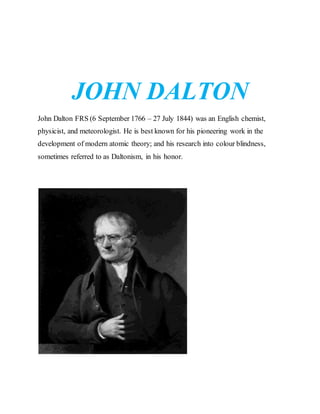
John Dalton FRS (6 September 1766 – 27 July 1844) was an English chemist,
physicist, and meteorologist. He is best known for his pioneering work in the
development of modern atomic theory; and his research into colour blindness,
sometimes referred to as Daltonism, in his honor.
Born : 6 September 1766 Eagles field, Cumberland, England
Died : 27 July 1844 (aged 77) Manchester, England
Nationality : British
Notable students : James PrescottJoule
Known for : Atomic theory, Law of Multiple Proportions,
Dalton's Law of Partial Pressures, Daltonism
Notable awards : Royal Medal (1826)
Author abbrev. : Jn.Dalton
Scientific contributions
Gas laws
In 1800, at age 34 Dalton became a secretary of the Manchester Literary and
Philosophical Society, and in the following year he orally presented an important
series of papers, entitled "Experimental Essays" on the constitution of mixed gases;
on the pressure of steam and other vapours at different temperatures, bothin a
vacuum and in air; on evaporation; and on the thermal expansion of gases. These
four essays were published in the Memoirs of the Lit & Phil in 1802.
The second ofthese essays opens with the striking remark,
There can scarcely be a doubtentertained respecting the reducibility of all elastic
fluids of whatever kind, into liquids; and we ought not to despair of affecting it in
low temperatures and by strong pressures exerted upon the unmixed gases further.
After describing experiments to ascertain the pressure of steam at various points
between 0 and 100 °C (32 and 212 °F), Dalton concluded from observations on the
vapour pressureof six different liquids, that the variation of vapor pressure for all
liquids is equivalent, for the same variation of temperature, reckoning from vapour
of any given pressure.
In the fourth essay he remarks
I see no sufficient reason why we may not conclude that all elastic fluids under the
same pressure expand equally by heat and that for any given expansion of mercury,
the corresponding expansion of air is proportionally something less, the higher the
temperature. It seems, therefore, that general laws respecting the absolute quantity
and the nature of heat are more likely to be derived from elastic fluids than from
other substances.
He thus enunciated Gay-Lussac's law or J.A.C. Charles's law, published in 1802 at
age 36 by Joseph Louis Gay-Lussac. In the two or three years following the
reading of these essays, Dalton published several papers on similar topics, that on
the absorption of gases by water and other liquids (1803), containing his law of
partial pressures now known as Dalton's law.
Atomic theory
The most important of all Dalton's investigations are those concerned with the
atomic theory in chemistry. While his name is inseparably associated with this
theory, the origin of Dalton's atomic theory is not fully understood It has been
proposedthat this theory was suggested to him either by researches on ethylene
(olefiant gas) and methane (carburetted hydrogen) or by analysis of nitrous oxide
(protoxide of azote) and nitrogen dioxide (deutoxide of azotes), both views resting
on the authority of Thomas Thomson. However, a study of Dalton's own laboratory
notebooks, discovered in the rooms of the Lit & Phil, concluded that so far from
Dalton being led by his search for an explanation of the law of multiple
proportions to the idea that chemical combination consists in the interaction of
atoms of definite and characteristic weight, the idea of atoms arose in his mind as a
purely physical concept, forced upon him by study of the physical properties of the
atmosphere and other gases. The first published indications of this idea are to be
found at the end of his paper on the absorption of gases already mentioned, which
was read on 21 October1803, though not published until 1805. Here he says:
Why does not water admit its bulk of every kind of gas alike? This question I have
duly considered, and though I am not able to satisfy myself completely I am nearly
persuaded that the circumstance depends on the weight and number of the ultimate
particles of the several gases.
The main points of Dalton's atomic theory were:
Elements are made of extremely small particles called atoms.1. Atoms of a given
element are identical in size, mass, and other properties; atoms of different
elements differ in size, mass, and other properties. 2. Atoms cannot be subdivided,
created, or destroyed.3. Atoms of different elements combine in simple whole-
number ratios to form chemical compounds.4. In chemical reactions, atoms are
combined, separated, or rearranged.5.
Dalton proposed an additional "rule of greatest simplicity" that created
controversy, since it could not be independently confirmed.
When atoms combine in only one ratio, "...Itmust be presumed to be a binary one,
unless some cause appears to the contrary".
This was merely an assumption, derived from faith in the simplicity of nature. No
evidence was then available to scientists to deduce how many atoms of each
element combine to form compound molecules. But this or some other such rule
was absolutely necessary to any incipient theory, since one needed an assumed
molecular formula in order to calculate relative atomic weights. In any case,
Dalton's "rule of greatest simplicity" caused him to assume that the formula for
water was OH and ammonia was NH, quite different from our modern
understanding (H2O, NH3).
Despite the uncertainty at the heart of Dalton's atomic theory, the principles of the
theory survived. To be sure, the conviction that atoms cannot be subdivided,
created, or destroyed into smaller particles when they are combined, separated, or
rearranged in chemical reactions is inconsistent with the existence of nuclear
fusion and nuclear fission, but such processes are nuclear reactions and not
chemical reactions. In addition, the idea that all atoms of a given element are
identical in their physical and chemical properties is not precisely true, as we now
know that different isotopes of an element have slightly varying weights. However,
Dalton had created a theory of immense power and importance. Indeed, Dalton's
innovation was fully as important for the future of the science as Antoine Laurent
Lavoisier's oxygen-based chemistry had been.
Atomic weights
Dalton proceeded to print his first published table of relative atomic weights. Six
elements appear in this table, namely hydrogen, oxygen, nitrogen, carbon, sulfur,
and phosphorus,with the atom of hydrogen conventionally assumed to weigh 1.
Dalton provided no indication in this first paper how he had arrived at these
numbers. However, in his laboratory notebookunder the date 6 September 180]
there appears a list in which he sets out the relative weights of the atoms of a
number of elements, derived from analysis of water, ammonia, carbondioxide, etc.
by chemists of the time.
It appears, then, that confronted with the problem of calculating the relative
diameter of the atoms of which, he was convinced, all gases were made, he used
the results of chemical analysis. Assisted by the assumption that combination
always takes place in the simplest possible way, he thus arrived at the idea that
chemical combination takes place between particles of different weights, and it
was this which differentiated his theory from the historic speculations of the
Greeks, such as Democritus and Lucretius.
The extension of this idea to substances in general necessarily led him to the law of
multiple proportions, and the comparison with experiment brilliantly confirmed his
deduction. It may be noted that in a paper on the proportion of the gases or elastic
fluids constituting the atmosphere, read by him in November 1802, the law of
multiple proportions appears to be anticipated in the words: "The elements of
oxygen may combine with a certain portion of nitrous gas or with twice that
portion, but with no intermediate quantity", but there is reason to suspectthat this
sentence may have been added some time after the reading of the paper, which was
not published until 1805.
Compounds were listed as binary, ternary, quaternary, etc. (molecules composed of
two, three, four, etc. atoms) in the New System of Chemical Philosophy depending
on the number of atoms a compound had in its simplest, empirical form.
He hypothesized the structure of compounds can be represented in whole number
ratios. So, one atom of element X combining with one atom of element Y is a
binary compound. Furthermore, one atom of element X combining with two
elements of Y or vice versa, is a ternary compound. Many of the first compounds
listed in the New System of Chemical Philosophy correspond to modern views,
although many others do not.
Dalton used his own symbols to visually represent the atomic structure of
compounds. Thesewere depicted in the New System of Chemical Philosophy,
where Dalton listed twenty elements and seventeen simple molecules.
Experimental approach
As an investigator, Dalton was often content with rough and inaccurate
instruments, even though better ones were obtainable. Sir Humphrey Davy
described him as "a very coarseexperimenter", who almost always found the
results he required, trusting to his head rather than his hands. On the other hand,
historians who have replicated some of his crucial experiments have confirmed
Dalton's skill and precision.
In the preface to the second part of Volume I of his New System, he says he had so
often been misled by taking for granted the results of others that he determined to
write "as little as possible but what I can attest by my own experience", but this
independence he carried so far that it sometimes resembled lack of receptivity.
Thus he distrusted, and probably never fully accepted, Gay-Lussac's conclusions as
to the combining volumes of gases.
He held unconventional views on chlorine. Even after its elementary character had
been settled by Davy, he persisted in using the atomic weights he himself had
adopted, even when they had been superseded by the more accurate determinations
of other chemists.
He always objected to the chemical notation devised by Jones Jacob Berzelius,
although most thought that it was much simpler and more convenient than his own
cumbersome system of circular symbols.
Legacy
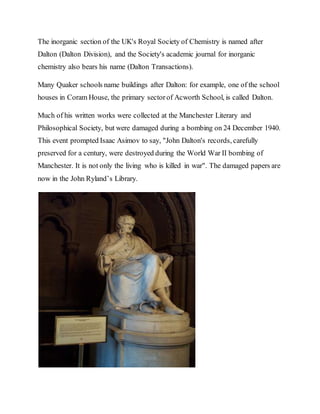
A bust of Dalton, by Chantrey, was publicly subscribed for and placed in the
entrance hall of the Royal Manchester Institution. Chantrey also crafted a large
statue of Dalton: it was erected while Dalton was still alive and it has been said:
"He is probably the only scientist who got a statue in his lifetime". It was placed in
Manchester Town Hall after its construction in 1877 and remains there today.
In honor of Dalton's work, many chemists and biochemists use the (as yet
unofficial) designation Dalton (Abbreviated Da) to denote one atomic mass unit
(1/12 the weight of a neutral atom of carbon-12).
There is a John Dalton Street connecting Deansgate and Albert Square in the centre
of Manchester.
Manchester Metropolitan University named a building after John Dalton; it is
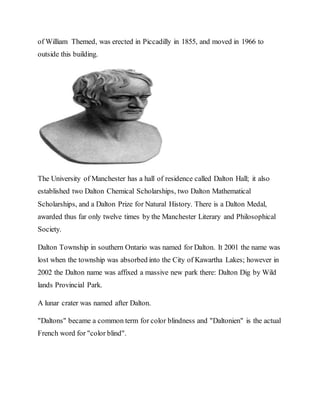
occupied by the Faculty of Science and Engineering. A statue of Dalton, the work
of William Themed, was erected in Piccadilly in 1855, and moved in 1966 to
outside this building.
The University of Manchester has a hall of residence called Dalton Hall; it also
established two Dalton Chemical Scholarships, two Dalton Mathematical
Scholarships, and a Dalton Prize for Natural History. There is a Dalton Medal,
awarded thus far only twelve times by the Manchester Literary and Philosophical
Society.
Dalton Township in southern Ontario was named for Dalton. It 2001 the name was
lost when the township was absorbed into the City of Kawartha Lakes; however in
2002 the Dalton name was affixed a massive new park there: Dalton Dig by Wild
lands Provincial Park.
A lunar crater was named after Dalton.
"Daltons" became a common term for color blindness and "Daltonien" is the actual
French word for "color blind".
The inorganic section of the UK's Royal Society of Chemistry is named after
Dalton (Dalton Division), and the Society's academic journal for inorganic
chemistry also bears his name (Dalton Transactions).
Many Quaker schools name buildings after Dalton: for example, one of the school
houses in Coram House, the primary sectorof Acworth School, is called Dalton.
Much of his written works were collected at the Manchester Literary and
Philosophical Society, but were damaged during a bombing on 24 December 1940.
This event prompted Isaac Asimov to say, "John Dalton's records, carefully
preserved for a century, were destroyed during the World War II bombing of
Manchester. It is not only the living who is killed in war". The damaged papers are
now in the John Ryland’s Library.

John dalton

  • 1.
    JOHN DALTON John DaltonFRS (6 September 1766 – 27 July 1844) was an English chemist, physicist, and meteorologist. He is best known for his pioneering work in the development of modern atomic theory; and his research into colour blindness, sometimes referred to as Daltonism, in his honor.
  • 2.
    Born : 6September 1766 Eagles field, Cumberland, England Died : 27 July 1844 (aged 77) Manchester, England Nationality : British Notable students : James PrescottJoule Known for : Atomic theory, Law of Multiple Proportions, Dalton's Law of Partial Pressures, Daltonism Notable awards : Royal Medal (1826) Author abbrev. : Jn.Dalton Scientific contributions Gas laws In 1800, at age 34 Dalton became a secretary of the Manchester Literary and Philosophical Society, and in the following year he orally presented an important series of papers, entitled "Experimental Essays" on the constitution of mixed gases; on the pressure of steam and other vapours at different temperatures, bothin a vacuum and in air; on evaporation; and on the thermal expansion of gases. These four essays were published in the Memoirs of the Lit & Phil in 1802. The second ofthese essays opens with the striking remark, There can scarcely be a doubtentertained respecting the reducibility of all elastic fluids of whatever kind, into liquids; and we ought not to despair of affecting it in low temperatures and by strong pressures exerted upon the unmixed gases further.
  • 3.
    After describing experimentsto ascertain the pressure of steam at various points between 0 and 100 °C (32 and 212 °F), Dalton concluded from observations on the vapour pressureof six different liquids, that the variation of vapor pressure for all liquids is equivalent, for the same variation of temperature, reckoning from vapour of any given pressure. In the fourth essay he remarks I see no sufficient reason why we may not conclude that all elastic fluids under the same pressure expand equally by heat and that for any given expansion of mercury, the corresponding expansion of air is proportionally something less, the higher the temperature. It seems, therefore, that general laws respecting the absolute quantity and the nature of heat are more likely to be derived from elastic fluids than from other substances. He thus enunciated Gay-Lussac's law or J.A.C. Charles's law, published in 1802 at age 36 by Joseph Louis Gay-Lussac. In the two or three years following the reading of these essays, Dalton published several papers on similar topics, that on the absorption of gases by water and other liquids (1803), containing his law of partial pressures now known as Dalton's law. Atomic theory The most important of all Dalton's investigations are those concerned with the atomic theory in chemistry. While his name is inseparably associated with this theory, the origin of Dalton's atomic theory is not fully understood It has been proposedthat this theory was suggested to him either by researches on ethylene (olefiant gas) and methane (carburetted hydrogen) or by analysis of nitrous oxide (protoxide of azote) and nitrogen dioxide (deutoxide of azotes), both views resting
  • 4.
    on the authorityof Thomas Thomson. However, a study of Dalton's own laboratory notebooks, discovered in the rooms of the Lit & Phil, concluded that so far from Dalton being led by his search for an explanation of the law of multiple proportions to the idea that chemical combination consists in the interaction of atoms of definite and characteristic weight, the idea of atoms arose in his mind as a purely physical concept, forced upon him by study of the physical properties of the atmosphere and other gases. The first published indications of this idea are to be found at the end of his paper on the absorption of gases already mentioned, which was read on 21 October1803, though not published until 1805. Here he says: Why does not water admit its bulk of every kind of gas alike? This question I have duly considered, and though I am not able to satisfy myself completely I am nearly persuaded that the circumstance depends on the weight and number of the ultimate particles of the several gases. The main points of Dalton's atomic theory were: Elements are made of extremely small particles called atoms.1. Atoms of a given element are identical in size, mass, and other properties; atoms of different elements differ in size, mass, and other properties. 2. Atoms cannot be subdivided, created, or destroyed.3. Atoms of different elements combine in simple whole- number ratios to form chemical compounds.4. In chemical reactions, atoms are combined, separated, or rearranged.5. Dalton proposed an additional "rule of greatest simplicity" that created controversy, since it could not be independently confirmed.
  • 5.
    When atoms combinein only one ratio, "...Itmust be presumed to be a binary one, unless some cause appears to the contrary". This was merely an assumption, derived from faith in the simplicity of nature. No evidence was then available to scientists to deduce how many atoms of each element combine to form compound molecules. But this or some other such rule was absolutely necessary to any incipient theory, since one needed an assumed molecular formula in order to calculate relative atomic weights. In any case, Dalton's "rule of greatest simplicity" caused him to assume that the formula for water was OH and ammonia was NH, quite different from our modern understanding (H2O, NH3). Despite the uncertainty at the heart of Dalton's atomic theory, the principles of the theory survived. To be sure, the conviction that atoms cannot be subdivided, created, or destroyed into smaller particles when they are combined, separated, or rearranged in chemical reactions is inconsistent with the existence of nuclear fusion and nuclear fission, but such processes are nuclear reactions and not chemical reactions. In addition, the idea that all atoms of a given element are identical in their physical and chemical properties is not precisely true, as we now know that different isotopes of an element have slightly varying weights. However, Dalton had created a theory of immense power and importance. Indeed, Dalton's innovation was fully as important for the future of the science as Antoine Laurent Lavoisier's oxygen-based chemistry had been.
  • 6.
    Atomic weights Dalton proceededto print his first published table of relative atomic weights. Six elements appear in this table, namely hydrogen, oxygen, nitrogen, carbon, sulfur, and phosphorus,with the atom of hydrogen conventionally assumed to weigh 1. Dalton provided no indication in this first paper how he had arrived at these numbers. However, in his laboratory notebookunder the date 6 September 180] there appears a list in which he sets out the relative weights of the atoms of a number of elements, derived from analysis of water, ammonia, carbondioxide, etc. by chemists of the time. It appears, then, that confronted with the problem of calculating the relative diameter of the atoms of which, he was convinced, all gases were made, he used the results of chemical analysis. Assisted by the assumption that combination always takes place in the simplest possible way, he thus arrived at the idea that chemical combination takes place between particles of different weights, and it was this which differentiated his theory from the historic speculations of the Greeks, such as Democritus and Lucretius. The extension of this idea to substances in general necessarily led him to the law of multiple proportions, and the comparison with experiment brilliantly confirmed his deduction. It may be noted that in a paper on the proportion of the gases or elastic fluids constituting the atmosphere, read by him in November 1802, the law of multiple proportions appears to be anticipated in the words: "The elements of oxygen may combine with a certain portion of nitrous gas or with twice that portion, but with no intermediate quantity", but there is reason to suspectthat this sentence may have been added some time after the reading of the paper, which was not published until 1805.
  • 7.
    Compounds were listedas binary, ternary, quaternary, etc. (molecules composed of two, three, four, etc. atoms) in the New System of Chemical Philosophy depending on the number of atoms a compound had in its simplest, empirical form. He hypothesized the structure of compounds can be represented in whole number ratios. So, one atom of element X combining with one atom of element Y is a binary compound. Furthermore, one atom of element X combining with two elements of Y or vice versa, is a ternary compound. Many of the first compounds listed in the New System of Chemical Philosophy correspond to modern views, although many others do not. Dalton used his own symbols to visually represent the atomic structure of compounds. Thesewere depicted in the New System of Chemical Philosophy, where Dalton listed twenty elements and seventeen simple molecules. Experimental approach As an investigator, Dalton was often content with rough and inaccurate instruments, even though better ones were obtainable. Sir Humphrey Davy described him as "a very coarseexperimenter", who almost always found the results he required, trusting to his head rather than his hands. On the other hand, historians who have replicated some of his crucial experiments have confirmed Dalton's skill and precision. In the preface to the second part of Volume I of his New System, he says he had so often been misled by taking for granted the results of others that he determined to write "as little as possible but what I can attest by my own experience", but this independence he carried so far that it sometimes resembled lack of receptivity.
  • 8.
    Thus he distrusted,and probably never fully accepted, Gay-Lussac's conclusions as to the combining volumes of gases. He held unconventional views on chlorine. Even after its elementary character had been settled by Davy, he persisted in using the atomic weights he himself had adopted, even when they had been superseded by the more accurate determinations of other chemists. He always objected to the chemical notation devised by Jones Jacob Berzelius, although most thought that it was much simpler and more convenient than his own cumbersome system of circular symbols. Legacy A bust of Dalton, by Chantrey, was publicly subscribed for and placed in the entrance hall of the Royal Manchester Institution. Chantrey also crafted a large statue of Dalton: it was erected while Dalton was still alive and it has been said: "He is probably the only scientist who got a statue in his lifetime". It was placed in Manchester Town Hall after its construction in 1877 and remains there today. In honor of Dalton's work, many chemists and biochemists use the (as yet unofficial) designation Dalton (Abbreviated Da) to denote one atomic mass unit (1/12 the weight of a neutral atom of carbon-12). There is a John Dalton Street connecting Deansgate and Albert Square in the centre of Manchester. Manchester Metropolitan University named a building after John Dalton; it is occupied by the Faculty of Science and Engineering. A statue of Dalton, the work
  • 9.
    of William Themed,was erected in Piccadilly in 1855, and moved in 1966 to outside this building. The University of Manchester has a hall of residence called Dalton Hall; it also established two Dalton Chemical Scholarships, two Dalton Mathematical Scholarships, and a Dalton Prize for Natural History. There is a Dalton Medal, awarded thus far only twelve times by the Manchester Literary and Philosophical Society. Dalton Township in southern Ontario was named for Dalton. It 2001 the name was lost when the township was absorbed into the City of Kawartha Lakes; however in 2002 the Dalton name was affixed a massive new park there: Dalton Dig by Wild lands Provincial Park. A lunar crater was named after Dalton. "Daltons" became a common term for color blindness and "Daltonien" is the actual French word for "color blind".
  • 10.
    The inorganic sectionof the UK's Royal Society of Chemistry is named after Dalton (Dalton Division), and the Society's academic journal for inorganic chemistry also bears his name (Dalton Transactions). Many Quaker schools name buildings after Dalton: for example, one of the school houses in Coram House, the primary sectorof Acworth School, is called Dalton. Much of his written works were collected at the Manchester Literary and Philosophical Society, but were damaged during a bombing on 24 December 1940. This event prompted Isaac Asimov to say, "John Dalton's records, carefully preserved for a century, were destroyed during the World War II bombing of Manchester. It is not only the living who is killed in war". The damaged papers are now in the John Ryland’s Library.