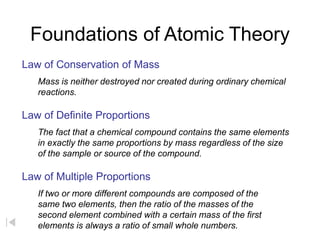
Foundations of Atomic Theory
Law of Definite Proportions
The fact that a chemical compound contains the same elements
in exactly the same proportions by mass regardless of the size
of the sample or source of the compound.
Law of Multiple Proportions
If two or more different compounds are composed of the
same two elements, then the ratio of the masses of the
second element combined with a certain mass of the first
elements is always a ratio of small whole numbers.
Law of Conservation of Mass
Mass is neither destroyed nor created during ordinary chemical
reactions.
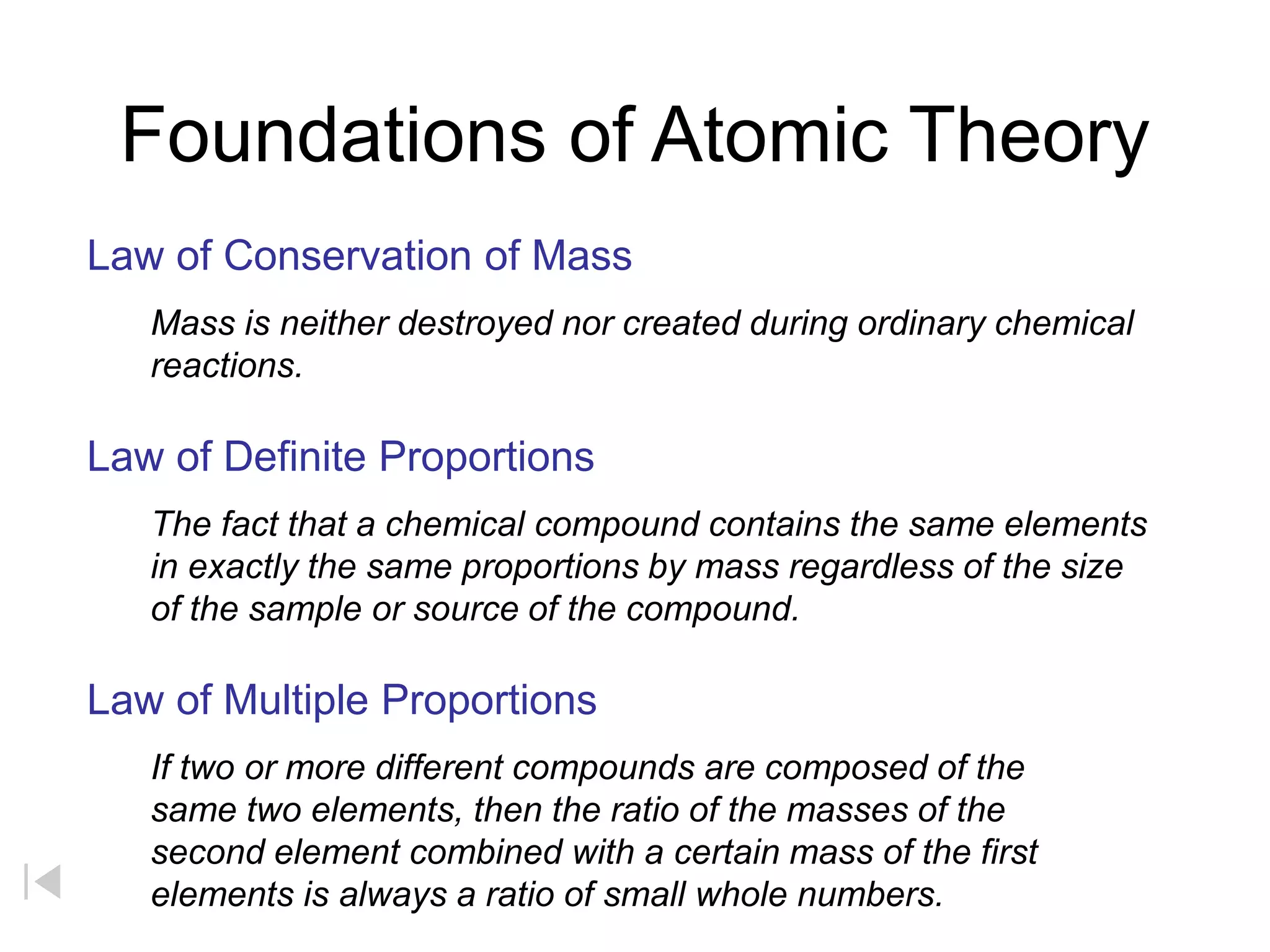
Conservation of Atoms
John Dalton
Dorin, Demmin, Gabel, Chemistry The Study of Matter , 3rd Edition, 1990, page 204
2 H2 + O2 2 H2O
4 atoms hydrogen
2 atoms oxygen
4 atoms hydrogen
2 atoms oxygen
H
H
O
O
O
O
H
H
H
H
H
H
H2
H2
O2
H2O
H2O
+
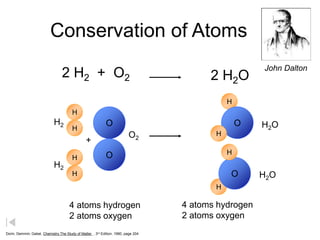
Legos are Similar to Atoms
Lego's can be taken apart and built into many different things.
H
H
O
O
O
O
H
H
H
H
H
H
H2
H2
O2
H2O
H2O
+
Atoms can be rearranged into different substances.
45 g H2O
? g H2O
Conservation of Mass
Dorin, Demmin, Gabel, Chemistry The Study of Matter , 3rd Edition, 1990, page 204
High
voltage
Before reaction
electrodes
glass
chamber
5.0 g H2
80 g O2
300 g (mass
of chamber)
+
385 g total
H2
O2
High
voltage
After reaction
0 g H2
40 g O2
300 g (mass
of chamber)
+
385 g total
O2
H2O
Law of Definite Proportions
Joseph Louis Proust (1754 – 1826)
• Each compound has a specific ratio of
elements
• It is a ratio by mass
• Water is always 8 grams of oxygen for
every one gram of hydrogen
The Law of Multiple Proportions
• Dalton could not use his theory to determine the
elemental compositions of chemical compounds
because he had no reliable scale of atomic masses.
• Dalton’s data led to a general statement known as the
law of multiple proportions.
• Law states that when two elements form a series of
compounds, the ratios of the masses of the second
element that are present per gram of the first element
can almost always be expressed as the ratios of
integers.
Copyright © 2007 Pearson Benjamin Cummings. All rights reserved.
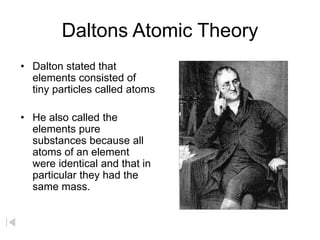
Daltons Atomic Theory
• Dalton stated that
elements consisted of
tiny particles called atoms
• He also called the
elements pure
substances because all
atoms of an element
were identical and that in
particular they had the
same mass.
Dalton’s Atomic Theory
1. All matter consists of tiny particles.
Dalton, like the Greeks, called these particles “atoms”.
2. Atoms of one element can neither be subdivided nor changed into
atoms of any other element.
3. Atoms can neither be created nor destroyed.
4. All atoms of the same element are identical in mass, size, and
other properties.
6. In compounds, atoms of different elements combine in simple, whole
number ratios.
5. Atoms of one element differ in mass and other properties from
atoms of other elements.
Dalton’s Symbols
John Dalton
1808
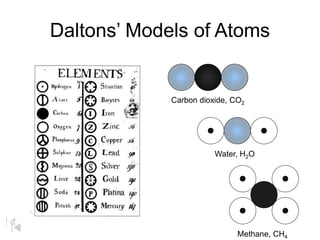
Daltons’ Models of Atoms
Carbon dioxide, CO2
Water, H2O
Methane, CH4

Dalton Model of the Atom.ppt

  • 1.
    Foundations of AtomicTheory Law of Definite Proportions The fact that a chemical compound contains the same elements in exactly the same proportions by mass regardless of the size of the sample or source of the compound. Law of Multiple Proportions If two or more different compounds are composed of the same two elements, then the ratio of the masses of the second element combined with a certain mass of the first elements is always a ratio of small whole numbers. Law of Conservation of Mass Mass is neither destroyed nor created during ordinary chemical reactions.
  • 2.
    Conservation of Atoms JohnDalton Dorin, Demmin, Gabel, Chemistry The Study of Matter , 3rd Edition, 1990, page 204 2 H2 + O2 2 H2O 4 atoms hydrogen 2 atoms oxygen 4 atoms hydrogen 2 atoms oxygen H H O O O O H H H H H H H2 H2 O2 H2O H2O +
  • 3.
    Legos are Similarto Atoms Lego's can be taken apart and built into many different things. H H O O O O H H H H H H H2 H2 O2 H2O H2O + Atoms can be rearranged into different substances.
  • 4.
    45 g H2O ?g H2O Conservation of Mass Dorin, Demmin, Gabel, Chemistry The Study of Matter , 3rd Edition, 1990, page 204 High voltage Before reaction electrodes glass chamber 5.0 g H2 80 g O2 300 g (mass of chamber) + 385 g total H2 O2 High voltage After reaction 0 g H2 40 g O2 300 g (mass of chamber) + 385 g total O2 H2O
  • 5.
    Law of DefiniteProportions Joseph Louis Proust (1754 – 1826) • Each compound has a specific ratio of elements • It is a ratio by mass • Water is always 8 grams of oxygen for every one gram of hydrogen
  • 6.
    The Law ofMultiple Proportions • Dalton could not use his theory to determine the elemental compositions of chemical compounds because he had no reliable scale of atomic masses. • Dalton’s data led to a general statement known as the law of multiple proportions. • Law states that when two elements form a series of compounds, the ratios of the masses of the second element that are present per gram of the first element can almost always be expressed as the ratios of integers. Copyright © 2007 Pearson Benjamin Cummings. All rights reserved.
  • 7.
    Daltons Atomic Theory •Dalton stated that elements consisted of tiny particles called atoms • He also called the elements pure substances because all atoms of an element were identical and that in particular they had the same mass.
  • 8.
    Dalton’s Atomic Theory 1.All matter consists of tiny particles. Dalton, like the Greeks, called these particles “atoms”. 2. Atoms of one element can neither be subdivided nor changed into atoms of any other element. 3. Atoms can neither be created nor destroyed. 4. All atoms of the same element are identical in mass, size, and other properties. 6. In compounds, atoms of different elements combine in simple, whole number ratios. 5. Atoms of one element differ in mass and other properties from atoms of other elements.
  • 9.
  • 10.
    Daltons’ Models ofAtoms Carbon dioxide, CO2 Water, H2O Methane, CH4