Johari Window
By: Miss Yoshita Rawal
Introduction:
The Johari Window model was devised by
American psychologists Joseph Luft and Harry
Ingham in 1955.
It is a simple and useful tool for illustrating and
improving self-awareness, and mutual
understanding between individuals within a
group. The Johari Window model can also be
used to assess and improve a group's
relationship with other groups.
Introduction:
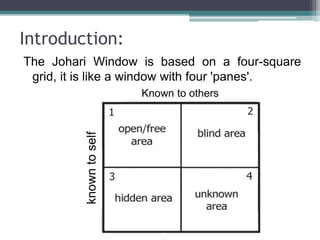
The Johari Window is based on a four-square
grid, it is like a window with four 'panes'.
Known to othersknowntoself
Quadrants
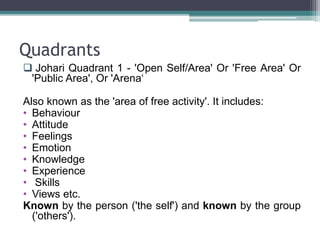
 Johari Quadrant 1 - 'Open Self/Area' Or 'Free Area' Or
'Public Area', Or 'Arena‘
Also known as the 'area of free activity'. It includes:
• Behaviour
• Attitude
• Feelings
• Emotion
• Knowledge
• Experience
• Skills
• Views etc.
Known by the person ('the self') and known by the group
('others').
Quadrants
Johari quadrant 2 - 'blind self' or 'blind area' or
'blindspot‘
Known about a person by others in the group, but
is unknown by the person him/herself.
Quadrants
Johari quadrant 3 – Known as 'hidden self' or
'hidden area' or 'avoided self/area' or 'facade‘
 It icludes:
• Sensitivities
• Fears
• Hidden agendas
• Manipulative intentions
• Secrets
Known by ‘Self’ but unknown by ‘group’.
Quadrants
Johari quadrant 4 - 'unknown self' or 'area of
unknown activity' or 'unknown area'
• Feelings
• Latent abilities
• Aptitudes
• Experiences etc
Unknown to the person him/herself
and unknown to others in the group
Working on Arena
• The size of the open area can be expanded
horizontally into the blind space
• by seeking and actively listening to feedback
from other group memberas.
• This process is known as 'feedback solicitation'
Working on Blind Spot
• By giving sensitive feedback and encouraging
disclosure.
• Managers should promote a climate of non-
judgemental feedback, and
• Group response to individual disclosure, which
reduces fear and therefore encourages both
processes to happen
Working on Hidden Area
• Process of 'disclosure‘
• Disclosing and exposing relevant information
and feelings
• Telling others how we feel and other information
about ourselves reduces the hidden area, and
increase the open area.
Working on Unknown Self
• Through self-discovery
• Observation by others
• Collective or mutual discovery,
• Counselling
Advantages:
• Easy to grasp.
• Flexible outcomes.
• The JW method catalyses open information
sharing.
Disadvantages:
• Some things are perhaps better not
communicated. (sexual behavior, mental health
problems or past failures)
• Some people may pass on the information they
received furthur than you desire.
• Some people may react negatively.
THANK YOU

Johari window

  • 1.
  • 2.
    Introduction: The Johari Windowmodel was devised by American psychologists Joseph Luft and Harry Ingham in 1955. It is a simple and useful tool for illustrating and improving self-awareness, and mutual understanding between individuals within a group. The Johari Window model can also be used to assess and improve a group's relationship with other groups.
  • 3.
    Introduction: The Johari Windowis based on a four-square grid, it is like a window with four 'panes'. Known to othersknowntoself
  • 4.
    Quadrants  Johari Quadrant1 - 'Open Self/Area' Or 'Free Area' Or 'Public Area', Or 'Arena‘ Also known as the 'area of free activity'. It includes: • Behaviour • Attitude • Feelings • Emotion • Knowledge • Experience • Skills • Views etc. Known by the person ('the self') and known by the group ('others').
  • 5.
    Quadrants Johari quadrant 2- 'blind self' or 'blind area' or 'blindspot‘ Known about a person by others in the group, but is unknown by the person him/herself.
  • 6.
    Quadrants Johari quadrant 3– Known as 'hidden self' or 'hidden area' or 'avoided self/area' or 'facade‘  It icludes: • Sensitivities • Fears • Hidden agendas • Manipulative intentions • Secrets Known by ‘Self’ but unknown by ‘group’.
  • 7.
    Quadrants Johari quadrant 4- 'unknown self' or 'area of unknown activity' or 'unknown area' • Feelings • Latent abilities • Aptitudes • Experiences etc Unknown to the person him/herself and unknown to others in the group
  • 8.
    Working on Arena •The size of the open area can be expanded horizontally into the blind space • by seeking and actively listening to feedback from other group memberas. • This process is known as 'feedback solicitation'
  • 9.
    Working on BlindSpot • By giving sensitive feedback and encouraging disclosure. • Managers should promote a climate of non- judgemental feedback, and • Group response to individual disclosure, which reduces fear and therefore encourages both processes to happen
  • 10.
    Working on HiddenArea • Process of 'disclosure‘ • Disclosing and exposing relevant information and feelings • Telling others how we feel and other information about ourselves reduces the hidden area, and increase the open area.
  • 11.
    Working on UnknownSelf • Through self-discovery • Observation by others • Collective or mutual discovery, • Counselling
  • 12.
    Advantages: • Easy tograsp. • Flexible outcomes. • The JW method catalyses open information sharing.
  • 13.
    Disadvantages: • Some thingsare perhaps better not communicated. (sexual behavior, mental health problems or past failures) • Some people may pass on the information they received furthur than you desire. • Some people may react negatively.
  • 14.