Unlocking
the Secrets
of the
Johari
Window:
A Fun Dive
into Self-
Discovery!
Presented by:
Shafneet Kaur
The Johari Window
model
 A model for:
 self-awareness
 personal development
 group development
 improving communications
 understanding interpersonal relationships
 Developed by American psychologists Joseph Luft and Harry
Ingham in the 1950's, calling it 'Johari' after combining their
first names, Joe and Harry.
The Johari Window
model
 Especially relevant due to emphasis on and influence of,
 'soft' skills
 behaviour
 empathy
 cooperation
 inter-group development
 interpersonal development
 It helps in understanding your relationship with yourself and
others.
Main Goal of Johari
Model
“Self-awareness is the first
step to personal growth.”
Terminol
ogy
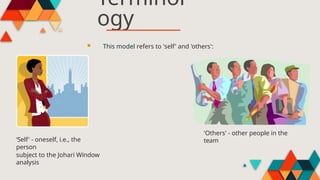
 This model refers to 'self' and 'others':
‘Self' - oneself, i.e., the
person
subject to the Johari Window
analysis
'Others' - other people in the
team
Johari Window: 4
perspectives
 Called 'regions' or 'areas' or 'quadrants’.
 Each contains and represents the information:
 feelings,
 motivation, etc..
in terms of whether the information is known or unknown by
the person, and by others in the team.
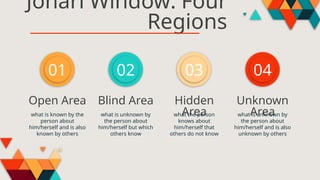
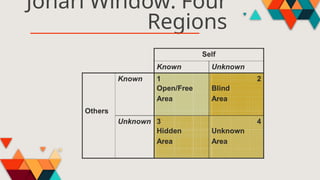
Johari Window: Four
Regions
 Based on a four-square grid
 Like a window with four 'panes'
03
Open Area
01
Blind Area
02
Hidden
Area
Unknown
Area
04
what is known by the
person about
him/herself and is also
known by others
what is unknown by
the person about
him/herself and is also
unknown by others
what the person
knows about
him/herself that
others do not know
what is unknown by
the person about
him/herself but which
others know
Johari Window: Four
Regions
Johari Window: Four
Regions
Open Area
1
 Area of free activity
 Information about the person - behaviour,
attitude, feelings, emotion, knowledge,
experience, skills, views, etc.. - known by the
person ('the self') and known by the team
('others’).
 Expanding this area can enhance trust and
collaboration in relationships.
Open Area
1
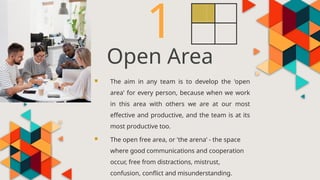
 The aim in any team is to develop the 'open
area' for every person, because when we work
in this area with others we are at our most
effective and productive, and the team is at its
most productive too.
 The open free area, or 'the arena‘ - the space
where good communications and cooperation
occur, free from distractions, mistrust,
confusion, conflict and misunderstanding.
Increasing open area
through feedback
solicitation
1
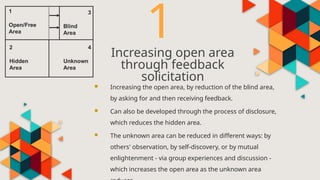
 Increasing the open area, by reduction of the blind area,
by asking for and then receiving feedback.
 Can also be developed through the process of disclosure,
which reduces the hidden area.
 The unknown area can be reduced in different ways: by
others' observation, by self-discovery, or by mutual
enlightenment - via group experiences and discussion -
which increases the open area as the unknown area
— Socrates
"To know thyself is the
beginning of wisdom."
Blind Area
2
 What is known about a person by others in the
group, but is unknown by the person
him/herself.
 Could also be referred to as ignorance about
oneself, or issues in which one is deluded.
 Not an effective or productive space for
individuals or groups.
 Also include issues that others are
deliberately withholding from a person.
Blind Area
2
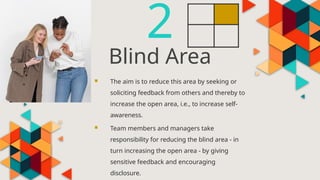
 The aim is to reduce this area by seeking or
soliciting feedback from others and thereby to
increase the open area, i.e., to increase self-
awareness.
 Team members and managers take
responsibility for reducing the blind area - in
turn increasing the open area - by giving
sensitive feedback and encouraging
disclosure.
Blind Area
2
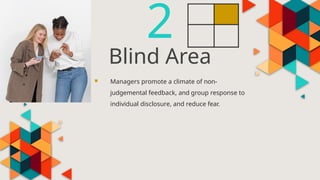
 Managers promote a climate of non-
judgemental feedback, and group response to
individual disclosure, and reduce fear.
— Anaïs Nin
"We see things not as they are,
but as we are."
 What is known to ourselves but kept hidden
from, and therefore unknown, to others.
 Represents information, feelings, etc..,
anything that a person knows about himself,
but which is not revealed or is kept hidden from
others.
 Also include sensitivities, fears, hidden
agendas, manipulative intentions, secrets -
anything that a person knows but does not
0
3
Hidden Area
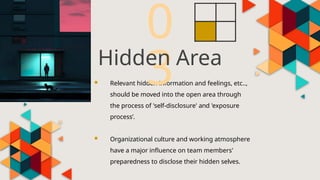
 Relevant hidden information and feelings, etc..,
should be moved into the open area through
the process of 'self-disclosure' and 'exposure
process’.
 Organizational culture and working atmosphere
have a major influence on team members'
preparedness to disclose their hidden selves.
0
3
Hidden Area
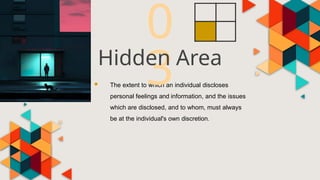
 The extent to which an individual discloses
personal feelings and information, and the issues
which are disclosed, and to whom, must always
be at the individual's own discretion.
0
3
Hidden Area
— Anonymous
"The greatest battles are
fought within."
0
3
Hidden Area
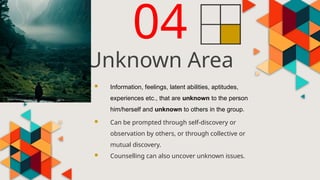
 Information, feelings, latent abilities, aptitudes,
experiences etc., that are unknown to the person
him/herself and unknown to others in the group.
 Can be prompted through self-discovery or
observation by others, or through collective or
mutual discovery.
 Counselling can also uncover unknown issues.
Unknown Area
04
 Again as with disclosure and soliciting
feedback, the process of self discovery is a
sensitive one.
 Uncovering 'hidden talents' - that is
unknown aptitudes and skills, not to be
confused with developing the Johari 'hidden
area' - is another aspect of developing the
unknown area, and is not so sensitive as
04
Unknown Area
 Managers and leaders can create an environment
that encourages self- discovery, and to promote the
processes of self discovery, constructive observation
and feedback among team members.
 The unknown area could also include repressed or
subconscious feelings rooted in formative events
and traumatic past experiences, which can stay
unknown for a lifetime.
04
Unknown Area
—SOMEONE
FAMOUS
“The more you know,
the more you realise you
don’t know.”
04
Unknown Area
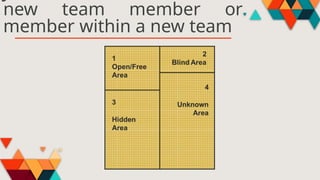
new team member or
member within a new team
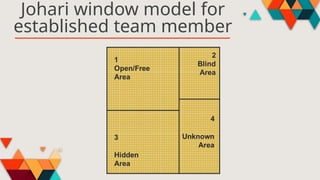
Johari window model for
established team member
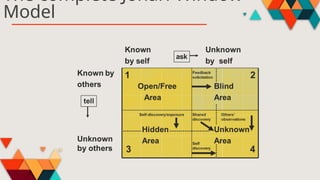
The complete Johari Window
Model
Professional
Development
 Alex is a manager in a marketing department.
 Attributes of Alex:
1) Creativity
2) Poor Feedback Skills
3) High Emotional Intelligence
4) Unaware of the impact of lacking feedback
Q1) In which quadrant
do you think Alex's
creativity fits?
1) Open Area (known to self and others)
2) Blind Area (known to others, not to self)
3) Hidden Area (known to self, not to others)
4) Unknown Area (unknown to self and others)
A) Open
Area
Q1) In which quadrant
do you think Alex's
creativity fits?
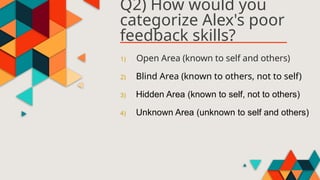
Q2) How would you
categorize Alex's poor
feedback skills?
1) Open Area (known to self and others)
2) Blind Area (known to others, not to self)
3) Hidden Area (known to self, not to others)
4) Unknown Area (unknown to self and others)
Q2) How would you
categorize Alex's poor
feedback skills?
B) Blind
Area
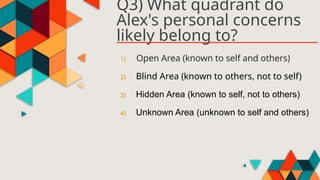
Q3) What quadrant do
Alex's personal concerns
likely belong to?
1) Open Area (known to self and others)
2) Blind Area (known to others, not to self)
3) Hidden Area (known to self, not to others)
4) Unknown Area (unknown to self and others)
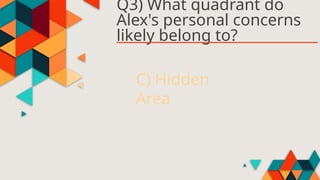
Q3) What quadrant do
Alex's personal concerns
likely belong to?
C) Hidden
Area
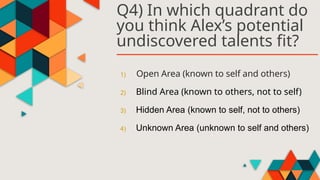
Q4) In which quadrant do
you think Alex’s potential
undiscovered talents fit?
1) Open Area (known to self and others)
2) Blind Area (known to others, not to self)
3) Hidden Area (known to self, not to others)
4) Unknown Area (unknown to self and others)
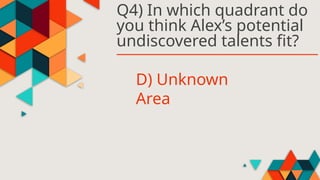
Q4) In which quadrant do
you think Alex’s potential
undiscovered talents fit?
D) Unknown
Area
THANK
YOU!

Johari Window (Organizational Behaviour)

  • 1.
    Unlocking the Secrets of the Johari Window: AFun Dive into Self- Discovery! Presented by: Shafneet Kaur
  • 2.
    The Johari Window model A model for:  self-awareness  personal development  group development  improving communications  understanding interpersonal relationships  Developed by American psychologists Joseph Luft and Harry Ingham in the 1950's, calling it 'Johari' after combining their first names, Joe and Harry.
  • 3.
    The Johari Window model Especially relevant due to emphasis on and influence of,  'soft' skills  behaviour  empathy  cooperation  inter-group development  interpersonal development  It helps in understanding your relationship with yourself and others.
  • 4.
    Main Goal ofJohari Model “Self-awareness is the first step to personal growth.”
  • 5.
    Terminol ogy  This modelrefers to 'self' and 'others': ‘Self' - oneself, i.e., the person subject to the Johari Window analysis 'Others' - other people in the team
  • 6.
    Johari Window: 4 perspectives Called 'regions' or 'areas' or 'quadrants’.  Each contains and represents the information:  feelings,  motivation, etc.. in terms of whether the information is known or unknown by the person, and by others in the team.
  • 7.
    Johari Window: Four Regions Based on a four-square grid  Like a window with four 'panes'
  • 8.
    03 Open Area 01 Blind Area 02 Hidden Area Unknown Area 04 whatis known by the person about him/herself and is also known by others what is unknown by the person about him/herself and is also unknown by others what the person knows about him/herself that others do not know what is unknown by the person about him/herself but which others know Johari Window: Four Regions
  • 9.
  • 10.
    Open Area 1  Areaof free activity  Information about the person - behaviour, attitude, feelings, emotion, knowledge, experience, skills, views, etc.. - known by the person ('the self') and known by the team ('others’).  Expanding this area can enhance trust and collaboration in relationships.
  • 11.
    Open Area 1  Theaim in any team is to develop the 'open area' for every person, because when we work in this area with others we are at our most effective and productive, and the team is at its most productive too.  The open free area, or 'the arena‘ - the space where good communications and cooperation occur, free from distractions, mistrust, confusion, conflict and misunderstanding.
  • 12.
    Increasing open area throughfeedback solicitation 1  Increasing the open area, by reduction of the blind area, by asking for and then receiving feedback.  Can also be developed through the process of disclosure, which reduces the hidden area.  The unknown area can be reduced in different ways: by others' observation, by self-discovery, or by mutual enlightenment - via group experiences and discussion - which increases the open area as the unknown area
  • 13.
    — Socrates "To knowthyself is the beginning of wisdom."
  • 14.
    Blind Area 2  Whatis known about a person by others in the group, but is unknown by the person him/herself.  Could also be referred to as ignorance about oneself, or issues in which one is deluded.  Not an effective or productive space for individuals or groups.  Also include issues that others are deliberately withholding from a person.
  • 15.
    Blind Area 2  Theaim is to reduce this area by seeking or soliciting feedback from others and thereby to increase the open area, i.e., to increase self- awareness.  Team members and managers take responsibility for reducing the blind area - in turn increasing the open area - by giving sensitive feedback and encouraging disclosure.
  • 16.
    Blind Area 2  Managerspromote a climate of non- judgemental feedback, and group response to individual disclosure, and reduce fear.
  • 17.
    — Anaïs Nin "Wesee things not as they are, but as we are."
  • 18.
     What isknown to ourselves but kept hidden from, and therefore unknown, to others.  Represents information, feelings, etc.., anything that a person knows about himself, but which is not revealed or is kept hidden from others.  Also include sensitivities, fears, hidden agendas, manipulative intentions, secrets - anything that a person knows but does not 0 3 Hidden Area
  • 19.
     Relevant hiddeninformation and feelings, etc.., should be moved into the open area through the process of 'self-disclosure' and 'exposure process’.  Organizational culture and working atmosphere have a major influence on team members' preparedness to disclose their hidden selves. 0 3 Hidden Area
  • 20.
     The extentto which an individual discloses personal feelings and information, and the issues which are disclosed, and to whom, must always be at the individual's own discretion. 0 3 Hidden Area
  • 21.
    — Anonymous "The greatestbattles are fought within." 0 3 Hidden Area
  • 22.
     Information, feelings,latent abilities, aptitudes, experiences etc., that are unknown to the person him/herself and unknown to others in the group.  Can be prompted through self-discovery or observation by others, or through collective or mutual discovery.  Counselling can also uncover unknown issues. Unknown Area 04
  • 23.
     Again aswith disclosure and soliciting feedback, the process of self discovery is a sensitive one.  Uncovering 'hidden talents' - that is unknown aptitudes and skills, not to be confused with developing the Johari 'hidden area' - is another aspect of developing the unknown area, and is not so sensitive as 04 Unknown Area
  • 24.
     Managers andleaders can create an environment that encourages self- discovery, and to promote the processes of self discovery, constructive observation and feedback among team members.  The unknown area could also include repressed or subconscious feelings rooted in formative events and traumatic past experiences, which can stay unknown for a lifetime. 04 Unknown Area
  • 25.
    —SOMEONE FAMOUS “The more youknow, the more you realise you don’t know.” 04 Unknown Area
  • 26.
    new team memberor member within a new team
  • 27.
    Johari window modelfor established team member
  • 28.
    The complete JohariWindow Model
  • 29.
    Professional Development  Alex isa manager in a marketing department.  Attributes of Alex: 1) Creativity 2) Poor Feedback Skills 3) High Emotional Intelligence 4) Unaware of the impact of lacking feedback
  • 30.
    Q1) In whichquadrant do you think Alex's creativity fits? 1) Open Area (known to self and others) 2) Blind Area (known to others, not to self) 3) Hidden Area (known to self, not to others) 4) Unknown Area (unknown to self and others)
  • 31.
    A) Open Area Q1) Inwhich quadrant do you think Alex's creativity fits?
  • 32.
    Q2) How wouldyou categorize Alex's poor feedback skills? 1) Open Area (known to self and others) 2) Blind Area (known to others, not to self) 3) Hidden Area (known to self, not to others) 4) Unknown Area (unknown to self and others)
  • 33.
    Q2) How wouldyou categorize Alex's poor feedback skills? B) Blind Area
  • 34.
    Q3) What quadrantdo Alex's personal concerns likely belong to? 1) Open Area (known to self and others) 2) Blind Area (known to others, not to self) 3) Hidden Area (known to self, not to others) 4) Unknown Area (unknown to self and others)
  • 35.
    Q3) What quadrantdo Alex's personal concerns likely belong to? C) Hidden Area
  • 36.
    Q4) In whichquadrant do you think Alex’s potential undiscovered talents fit? 1) Open Area (known to self and others) 2) Blind Area (known to others, not to self) 3) Hidden Area (known to self, not to others) 4) Unknown Area (unknown to self and others)
  • 37.
    Q4) In whichquadrant do you think Alex’s potential undiscovered talents fit? D) Unknown Area
  • 38.