


Jobs and professions Positive Sentences in Present tense By Profr. José M. Jaramillo S. September, 2008
Vocabulary
Actor
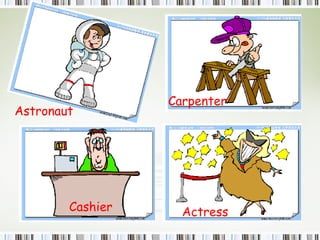
Actress Astronaut Carpenter Cashier
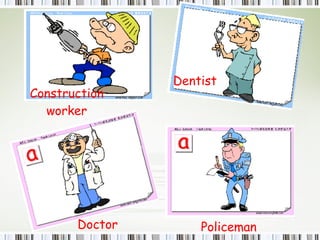
Construction worker Dentist Doctor Policeman
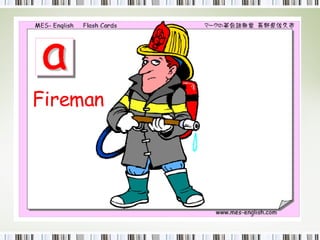
Fireman
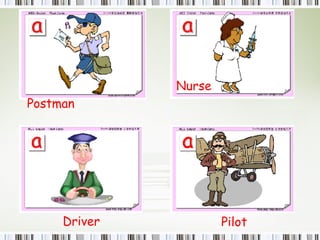
Postman Nurse Driver Pilot
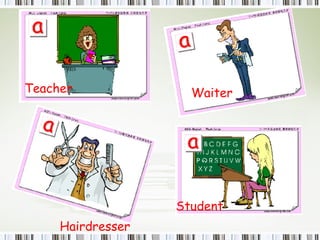
Teacher Waiter Hairdresser Student
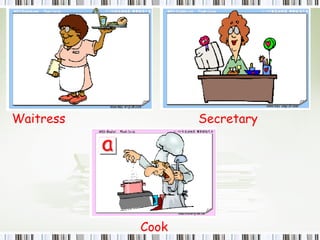
Cook Waitress Secretary
Verbs
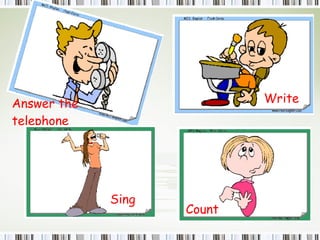
Answer the telephone  Write  Count  Sing
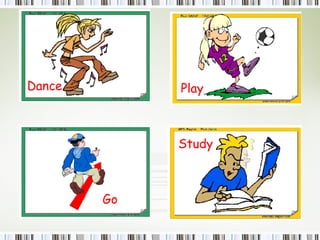
Dance  Play Go  Study  Play
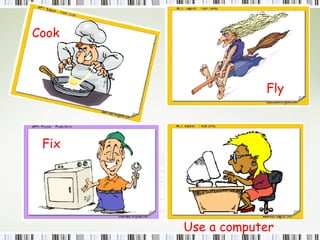
Cook  Use a computer Fly  Fix
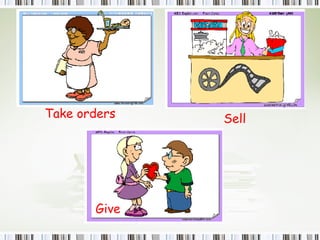
Give  Take orders Sell
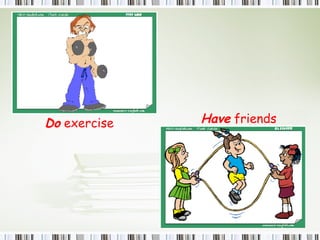
Do  exercise Have  friends
Present Tense The Simple Present is used to make statements about the present time. It is used in the following ways: I  work  in the school. You  study  English in the CAADI. We  listen  music every afternoon. They  sing  in a dance club on weekends. I  teach  Mathematics in the school.
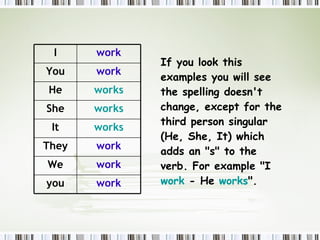
If you look this examples you will see the spelling doesn't change, except for the third person singular  (He, She, It)  which adds an " s " to the verb. For example "I  work  - He  works ".  work you work We work They works It works She works He work You work I
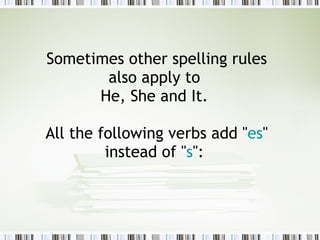
Sometimes other spelling rules also apply to  He, She and It.  All the following verbs add " es " instead of " s ":
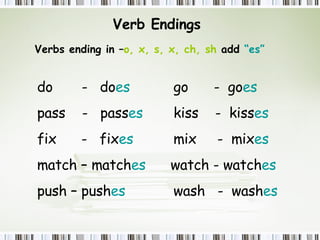
Verb Endings   Verbs ending in – o, x, s, x, ch, sh  add  “es”   do    -  do es      go    -  go es   pass  -  pass es   kiss  -  kiss es   fix  -  fix es   mix  -  mix es match – match es  watch - watch es   push – push es   wash  -  wash es
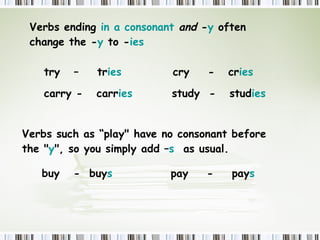
Verbs ending  in a consonant   and  - y  often change the - y  to - ies  try  –  tr ies    cry  -  cr ies   carry -  carr ies   study  -  stud ies Verbs such as “play" have no consonant before the " y ", so you simply add – s  as usual. buy  -  buy s     pay  -  pay s
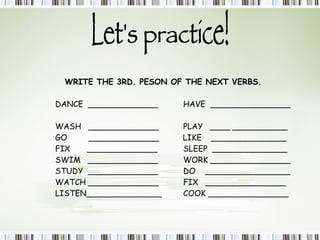
Let's practice! WRITE THE 3RD. PESON OF THE NEXT VERBS. DANCE  ______________ HAVE  ________________  WASH  ______________ PLAY  ____ ___________ GO  ______________  LIKE  _______________ FIX  ______________ SLEEP  _______________  SWIM  ______________ WORK ________________  STUDY  ______________  DO  _________________ WATCH ______________ FIX  ________________ LISTEN_______________ COOK ________________
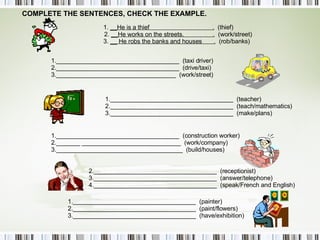
COMPLETE THE SENTENCES, CHECK THE EXAMPLE. 1.  __He is a thief  .   (thief) 2.  __He works on the streets.  .   (work/street) 3.  __ He robs the banks and houses  .   (rob/banks) 1.____________________________________  (taxi driver) 2.____________________________________  (drive/taxi) 3.___________________________________  (work/street) 1.____________________________________  (teacher) 2.____________________________________  (teach/mathematics) 3.____________________________________  (make/plans) ____________________________________  (construction worker) _______  _____________________________  (work/company) 3.________ _____________________________  (build/houses) ____________________________________  (receptionist) ____________________________________  (answer/telephone) ____________________________________  (speak/French and English) ____________________________________  (painter) ____________________________________  (paint/flowers) ____________________________________  (have/exhibition)
Let’s continue in your books!! More information:  [email_address]
What do you do? Negative statements and Questions in Present Tense By Profr. Jose M. Jaramillo S. September, 2008
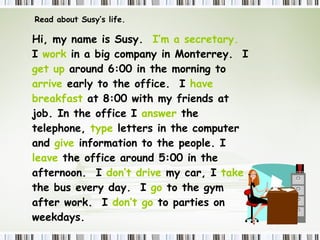
Read about Susy’s life. Hi, my name is Susy.  I’m a secretary.   I  work  in a big company in Monterrey.  I  get up  around 6:00 in the morning to  arrive  early to the office.  I  have breakfast  at 8:00 with my friends at job. In the office I  answer  the telephone,  type  letters in the computer and  give  information to the people. I  leave  the office around 5:00 in the afternoon.  I  don’t drive  my car, I  take  the bus every day.  I  go  to the gym after work.  I  don’t go  to parties on weekdays.
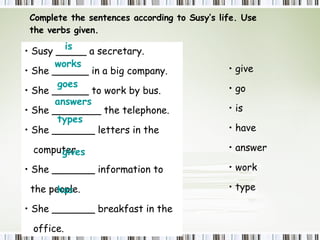
Complete the sentences according to Susy’s life. Use the verbs given. Susy _____ a secretary. She ______ in a big company. She ______ to work by bus. She ________ the telephone. She _______ letters in the computer. She _______ information to the people. She _______ breakfast in the office. is works goes answers types gives has give go is have answer work type
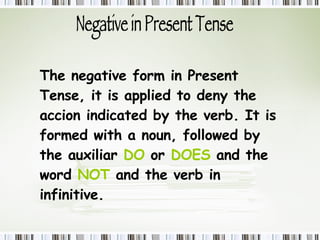
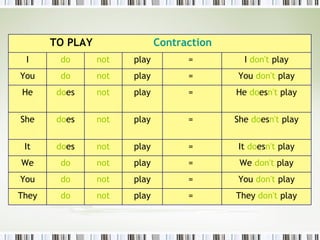
Negative in Present Tense The negative form in Present Tense,  it is applied to deny the accion indicated by the verb. It is formed with a noun, followed by the auxiliar  DO   or  DOES  and the word  NOT  and the verb in infinitive.
They  don't  play =  play not do They You  don't  play =  play not do You We  don't  play =  play not do We It  do es n't  play =  play not do es It She  do es n't  play =  play not do es She He  do es n't  play =  play not do es He You  don't  play =  play not do You I  don't  play =  play not do I TO PLAY  Contraction
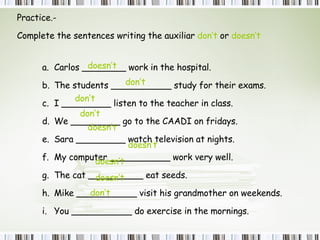
Practice.-  Complete the sentences writing the auxiliar  don’t  or  doesn’t Carlos ________ work in the hospital.  The students ___________ study for their exams. I _________ listen to the teacher in class. We _________ go to the CAADI on fridays. Sara _________ watch television at nights. My computer ___________ work very well. The cat __________ eat seeds. Mike ___________ visit his grandmother on weekends. You ___________ do exercise in the mornings. doesn’t doesn’t doesn’t doesn’t doesn’t don’t don’t don’t don’t
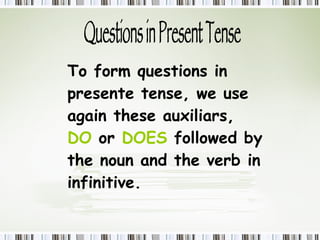
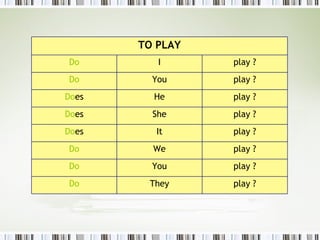
Questions in Present Tense To form questions in presente tense, we use again these auxiliars,   DO   or  DOES  followed by the noun and the verb in infinitive.
play ? They Do play ? You Do play ? We Do play ? It Do es play ? She Do es play ? He Do es play ? You Do play ? I Do TO PLAY
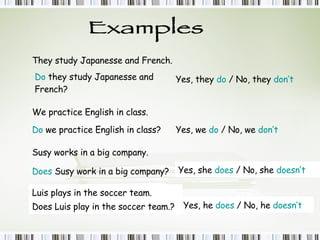
Examples They study Japanesse and French. Do  they study Japanesse and French? Yes, they  do  / No, they  don’t We practice English in class. Do  we practice English in class? Yes, we  do  / No, we  don’t Susy work s  in a big company. Does  Susy work in a big company? Yes, she  does  / No, she  doesn’t Luis play s  in the soccer team. Does Luis play in the soccer team.? Yes, he  does  / No, he  doesn’t
Time to  practice!
Wh-Questions  in Present Tense
What  do  you do? I’m a teacher Where  do  you work? I work in schools.  What  do  you do there? I teach English.  How  do  you like your job? I like it a lot.
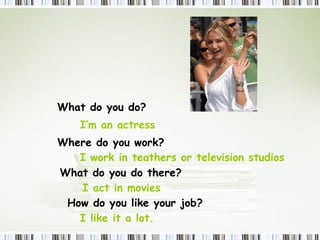
What  do  you do? I’m an actress Where  do  you work? I work in teathers or television studios  What  do  you do there? I act in movies  How  do  you like your job? I like it a lot.
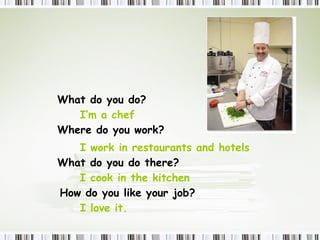
What  do  you do? I’m a chef Where  do  you work? I work in restaurants and hotels  What  do  you do there? I cook in the kitchen  How  do  you like your job? I love it.
What  does  she do? She’s a nurse Where  does  she work? She work s  in the hospital  What  does  she do exactly? She takes care of patients.  How  does  she like her job? She hates it.
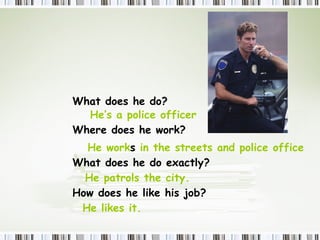
What  does  he do? He’s a police officer Where  does  he work? He work s  in the streets and police office  What  does  he do exactly? He patrols the city.  How  does  he like his job? He likes it.
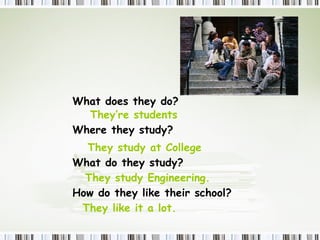
What  does  they do? They’re students Where  they study ? They study at College  What  do they study? They study Engineering.  How  do they  like their school? They like it a lot.
Time to  practice!
Let’s continue in your books!! More information:  [email_address]

Jobs And Professions

  • 1.
    Jobs and professionsPositive Sentences in Present tense By Profr. José M. Jaramillo S. September, 2008
  • 2.
  • 3.
  • 4.
  • 5.
  • 6.
  • 7.
  • 8.
  • 9.
  • 10.
  • 11.
    Answer the telephone Write Count Sing
  • 12.
    Dance PlayGo Study Play
  • 13.
    Cook Usea computer Fly Fix
  • 14.
    Give Takeorders Sell
  • 15.
    Do exerciseHave friends
  • 16.
    Present Tense TheSimple Present is used to make statements about the present time. It is used in the following ways: I work in the school. You study English in the CAADI. We listen music every afternoon. They sing in a dance club on weekends. I teach Mathematics in the school.
  • 17.
    If you lookthis examples you will see the spelling doesn't change, except for the third person singular (He, She, It) which adds an " s " to the verb. For example "I work - He works ". work you work We work They works It works She works He work You work I
  • 18.
    Sometimes other spellingrules also apply to He, She and It. All the following verbs add " es " instead of " s ":
  • 19.
    Verb Endings Verbs ending in – o, x, s, x, ch, sh add “es” do - do es   go - go es pass - pass es kiss - kiss es fix - fix es mix - mix es match – match es watch - watch es push – push es wash - wash es
  • 20.
    Verbs ending in a consonant and - y often change the - y to - ies try – tr ies   cry - cr ies carry - carr ies study - stud ies Verbs such as “play" have no consonant before the " y ", so you simply add – s as usual. buy - buy s  pay - pay s
  • 21.
    Let's practice! WRITETHE 3RD. PESON OF THE NEXT VERBS. DANCE ______________ HAVE ________________ WASH ______________ PLAY ____ ___________ GO ______________ LIKE _______________ FIX ______________ SLEEP _______________ SWIM ______________ WORK ________________ STUDY ______________ DO _________________ WATCH ______________ FIX ________________ LISTEN_______________ COOK ________________
  • 22.
    COMPLETE THE SENTENCES,CHECK THE EXAMPLE. 1. __He is a thief . (thief) 2. __He works on the streets. . (work/street) 3. __ He robs the banks and houses . (rob/banks) 1.____________________________________ (taxi driver) 2.____________________________________ (drive/taxi) 3.___________________________________ (work/street) 1.____________________________________ (teacher) 2.____________________________________ (teach/mathematics) 3.____________________________________ (make/plans) ____________________________________ (construction worker) _______ _____________________________ (work/company) 3.________ _____________________________ (build/houses) ____________________________________ (receptionist) ____________________________________ (answer/telephone) ____________________________________ (speak/French and English) ____________________________________ (painter) ____________________________________ (paint/flowers) ____________________________________ (have/exhibition)
  • 23.
    Let’s continue inyour books!! More information: [email_address]
  • 24.
    What do youdo? Negative statements and Questions in Present Tense By Profr. Jose M. Jaramillo S. September, 2008
  • 25.
    Read about Susy’slife. Hi, my name is Susy. I’m a secretary. I work in a big company in Monterrey. I get up around 6:00 in the morning to arrive early to the office. I have breakfast at 8:00 with my friends at job. In the office I answer the telephone, type letters in the computer and give information to the people. I leave the office around 5:00 in the afternoon. I don’t drive my car, I take the bus every day. I go to the gym after work. I don’t go to parties on weekdays.
  • 26.
    Complete the sentencesaccording to Susy’s life. Use the verbs given. Susy _____ a secretary. She ______ in a big company. She ______ to work by bus. She ________ the telephone. She _______ letters in the computer. She _______ information to the people. She _______ breakfast in the office. is works goes answers types gives has give go is have answer work type
  • 27.
    Negative in PresentTense The negative form in Present Tense, it is applied to deny the accion indicated by the verb. It is formed with a noun, followed by the auxiliar DO or DOES and the word NOT and the verb in infinitive.
  • 28.
    They don't play =  play not do They You don't play =  play not do You We don't play =  play not do We It do es n't play =  play not do es It She do es n't play =  play not do es She He do es n't play =  play not do es He You don't play =  play not do You I don't play =  play not do I TO PLAY Contraction
  • 29.
    Practice.- Completethe sentences writing the auxiliar don’t or doesn’t Carlos ________ work in the hospital. The students ___________ study for their exams. I _________ listen to the teacher in class. We _________ go to the CAADI on fridays. Sara _________ watch television at nights. My computer ___________ work very well. The cat __________ eat seeds. Mike ___________ visit his grandmother on weekends. You ___________ do exercise in the mornings. doesn’t doesn’t doesn’t doesn’t doesn’t don’t don’t don’t don’t
  • 30.
    Questions in PresentTense To form questions in presente tense, we use again these auxiliars, DO or DOES followed by the noun and the verb in infinitive.
  • 31.
    play ? TheyDo play ? You Do play ? We Do play ? It Do es play ? She Do es play ? He Do es play ? You Do play ? I Do TO PLAY
  • 32.
    Examples They studyJapanesse and French. Do they study Japanesse and French? Yes, they do / No, they don’t We practice English in class. Do we practice English in class? Yes, we do / No, we don’t Susy work s in a big company. Does Susy work in a big company? Yes, she does / No, she doesn’t Luis play s in the soccer team. Does Luis play in the soccer team.? Yes, he does / No, he doesn’t
  • 33.
    Time to practice!
  • 34.
    Wh-Questions inPresent Tense
  • 35.
    What do you do? I’m a teacher Where do you work? I work in schools. What do you do there? I teach English. How do you like your job? I like it a lot.
  • 36.
    What do you do? I’m an actress Where do you work? I work in teathers or television studios What do you do there? I act in movies How do you like your job? I like it a lot.
  • 37.
    What do you do? I’m a chef Where do you work? I work in restaurants and hotels What do you do there? I cook in the kitchen How do you like your job? I love it.
  • 38.
    What does she do? She’s a nurse Where does she work? She work s in the hospital What does she do exactly? She takes care of patients. How does she like her job? She hates it.
  • 39.
    What does he do? He’s a police officer Where does he work? He work s in the streets and police office What does he do exactly? He patrols the city. How does he like his job? He likes it.
  • 40.
    What does they do? They’re students Where they study ? They study at College What do they study? They study Engineering. How do they like their school? They like it a lot.
  • 41.
    Time to practice!
  • 42.
    Let’s continue inyour books!! More information: [email_address]