English lecture - 1


                                                         1
  lecturer E.Delgermurun /FOREIGN LANGUAGE DEPARTMENT/
Today’s lecture:
 Use the simple present and present of be
Give responses with too and either
 Verb forms
 Object pronouns and pronouns everybody
 and nobody
 Use really and not really to make statements
 stronger or softer
Friendly conversation

                 lecturer E.Delgermurun /FOREIGN
                                                   2
                     LANGUAGE DEPARTMENT/
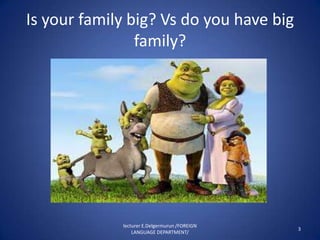
Is your family big? Vs do you have big
                family?


             lecturer E.Delgermurun /FOREIGN
                                               3
                 LANGUAGE DEPARTMENT/
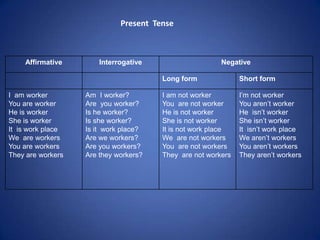
Present Tense


    Affirmative        Interrogative                    Negative

                                       Long form              Short form

I am worker        Am I worker?        I am not worker        I’m not worker
You are worker     Are you worker?     You are not worker     You aren’t worker
He is worker       Is he worker?       He is not worker       He isn’t worker
She is worker      Is she worker?      She is not worker      She isn’t worker
It is work place   Is it work place?   It is not work place   It isn’t work place
We are workers     Are we workers?     We are not workers     We aren’t workers
You are workers    Are you workers?    You are not workers    You aren’t workers
They are workers   Are they workers?   They are not workers   They aren’t workers
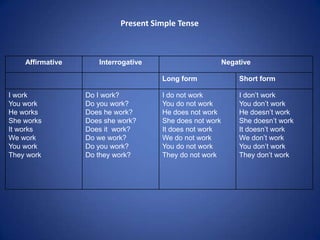
Present Simple Tense


    Affirmative      Interrogative                       Negative

                                     Long form               Short form

I work            Do I work?         I do not work           I don’t work
You work          Do you work?       You do not work         You don’t work
He works          Does he work?      He does not work        He doesn’t work
She works         Does she work?     She does not work       She doesn’t work
It works          Does it work?      It does not work        It doesn’t work
We work           Do we work?        We do not work          We don’t work
You work          Do you work?       You do not work         You don’t work
They work         Do they work?      They do not work        They don’t work
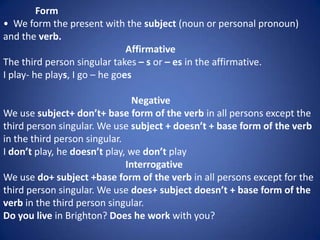
Form
• We form the present with the subject (noun or personal pronoun)
and the verb.
                               Affirmative
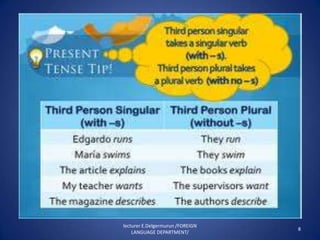
The third person singular takes – s or – es in the affirmative.
I play- he plays, I go – he goes

                                Negative
We use subject+ don’t+ base form of the verb in all persons except the
third person singular. We use subject + doesn’t + base form of the verb
in the third person singular.
I don’t play, he doesn’t play, we don’t play
                              Interrogative
We use do+ subject +base form of the verb in all persons except for the
third person singular. We use does+ subject doesn’t + base form of the
verb in the third person singular.
Do you live in Brighton? Does he work with you?
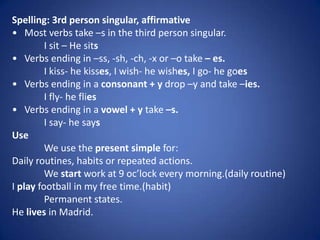
Spelling: 3rd person singular, affirmative
• Most verbs take –s in the third person singular.
         I sit – He sits
• Verbs ending in –ss, -sh, -ch, -x or –o take – es.
         I kiss- he kisses, I wish- he wishes, I go- he goes
• Verbs ending in a consonant + y drop –y and take –ies.
         I fly- he flies
• Verbs ending in a vowel + y take –s.
         I say- he says
Use
         We use the present simple for:
Daily routines, habits or repeated actions.
         We start work at 9 oc’lock every morning.(daily routine)
I play football in my free time.(habit)
         Permanent states.
He lives in Madrid.
lecturer E.Delgermurun /FOREIGN
                                  8
    LANGUAGE DEPARTMENT/
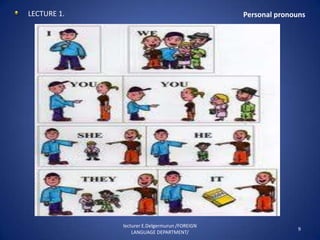
LECTURE 1.                                     Personal pronouns


             lecturer E.Delgermurun /FOREIGN
                                                              9
                 LANGUAGE DEPARTMENT/
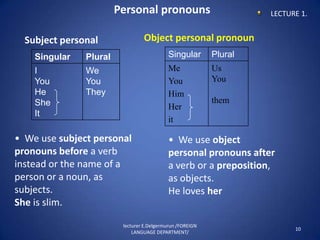
Personal pronouns                           LECTURE 1.


  Subject personal               Object personal pronoun
    Singular   Plural                      Singular        Plural
    I          We                          Me              Us
    You        You                         You             You
    He         They                        Him
    She                                                    them
                                           Her
    It
                                           it

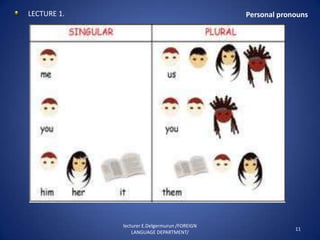
• We use subject personal                  • We use object
pronouns before a verb                     personal pronouns after
instead or the name of a                   a verb or a preposition,
person or a noun, as                       as objects.
subjects.                                  He loves her
She is slim.

                         lecturer E.Delgermurun /FOREIGN
                                                                          10
                             LANGUAGE DEPARTMENT/
LECTURE 1.                                     Personal pronouns


             lecturer E.Delgermurun /FOREIGN
                                                            11
                 LANGUAGE DEPARTMENT/
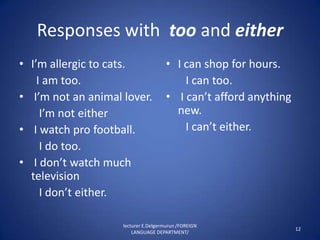
Responses with too and either
• I’m allergic to cats.              • I can shop for hours.
    I am too.                            I can too.
• I’m not an animal lover.           • I can’t afford anything
     I’m not either                    new.
• I watch pro football.                  I can’t either.
     I do too.
• I don’t watch much
  television
     I don’t either.

                    lecturer E.Delgermurun /FOREIGN
                                                                 12
                        LANGUAGE DEPARTMENT/
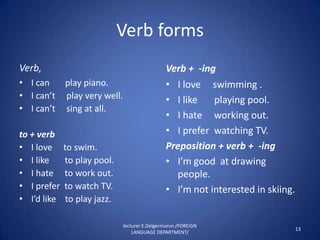
Verb forms
Verb,                                           Verb + -ing
• I can      play piano.                        • I love swimming .
• I can’t    play very well.                    • I like   playing pool.
• I can’t    sing at all.
                                                • I hate working out.
to + verb                                       • I prefer watching TV.
• I love     to swim.                           Preposition + verb + -ing
• I like     to play pool.                      • I’m good at drawing
• I hate     to work out.                         people.
• I prefer   to watch TV.                       • I’m not interested in skiing.
• I’d like    to play jazz.

                               lecturer E.Delgermurun /FOREIGN
                                                                                  13
                                   LANGUAGE DEPARTMENT/
THANK YOU AND DO YOUR
    HOMEWORK!!!


      lecturer E.Delgermurun /FOREIGN
                                        14
          LANGUAGE DEPARTMENT/

El102 lecture1

  • 1.
    English lecture -1 1 lecturer E.Delgermurun /FOREIGN LANGUAGE DEPARTMENT/
  • 2.
    Today’s lecture:  Usethe simple present and present of be Give responses with too and either  Verb forms  Object pronouns and pronouns everybody and nobody  Use really and not really to make statements stronger or softer Friendly conversation lecturer E.Delgermurun /FOREIGN 2 LANGUAGE DEPARTMENT/
  • 3.
    Is your familybig? Vs do you have big family? lecturer E.Delgermurun /FOREIGN 3 LANGUAGE DEPARTMENT/
  • 4.
    Present Tense Affirmative Interrogative Negative Long form Short form I am worker Am I worker? I am not worker I’m not worker You are worker Are you worker? You are not worker You aren’t worker He is worker Is he worker? He is not worker He isn’t worker She is worker Is she worker? She is not worker She isn’t worker It is work place Is it work place? It is not work place It isn’t work place We are workers Are we workers? We are not workers We aren’t workers You are workers Are you workers? You are not workers You aren’t workers They are workers Are they workers? They are not workers They aren’t workers
  • 5.
    Present Simple Tense Affirmative Interrogative Negative Long form Short form I work Do I work? I do not work I don’t work You work Do you work? You do not work You don’t work He works Does he work? He does not work He doesn’t work She works Does she work? She does not work She doesn’t work It works Does it work? It does not work It doesn’t work We work Do we work? We do not work We don’t work You work Do you work? You do not work You don’t work They work Do they work? They do not work They don’t work
  • 6.
    Form • We formthe present with the subject (noun or personal pronoun) and the verb. Affirmative The third person singular takes – s or – es in the affirmative. I play- he plays, I go – he goes Negative We use subject+ don’t+ base form of the verb in all persons except the third person singular. We use subject + doesn’t + base form of the verb in the third person singular. I don’t play, he doesn’t play, we don’t play Interrogative We use do+ subject +base form of the verb in all persons except for the third person singular. We use does+ subject doesn’t + base form of the verb in the third person singular. Do you live in Brighton? Does he work with you?
  • 7.
    Spelling: 3rd personsingular, affirmative • Most verbs take –s in the third person singular. I sit – He sits • Verbs ending in –ss, -sh, -ch, -x or –o take – es. I kiss- he kisses, I wish- he wishes, I go- he goes • Verbs ending in a consonant + y drop –y and take –ies. I fly- he flies • Verbs ending in a vowel + y take –s. I say- he says Use We use the present simple for: Daily routines, habits or repeated actions. We start work at 9 oc’lock every morning.(daily routine) I play football in my free time.(habit) Permanent states. He lives in Madrid.
  • 8.
    lecturer E.Delgermurun /FOREIGN 8 LANGUAGE DEPARTMENT/
  • 9.
    LECTURE 1. Personal pronouns lecturer E.Delgermurun /FOREIGN 9 LANGUAGE DEPARTMENT/
  • 10.
    Personal pronouns LECTURE 1. Subject personal Object personal pronoun Singular Plural Singular Plural I We Me Us You You You You He They Him She them Her It it • We use subject personal • We use object pronouns before a verb personal pronouns after instead or the name of a a verb or a preposition, person or a noun, as as objects. subjects. He loves her She is slim. lecturer E.Delgermurun /FOREIGN 10 LANGUAGE DEPARTMENT/
  • 11.
    LECTURE 1. Personal pronouns lecturer E.Delgermurun /FOREIGN 11 LANGUAGE DEPARTMENT/
  • 12.
    Responses with tooand either • I’m allergic to cats. • I can shop for hours. I am too. I can too. • I’m not an animal lover. • I can’t afford anything I’m not either new. • I watch pro football. I can’t either. I do too. • I don’t watch much television I don’t either. lecturer E.Delgermurun /FOREIGN 12 LANGUAGE DEPARTMENT/
  • 13.
    Verb forms Verb, Verb + -ing • I can play piano. • I love swimming . • I can’t play very well. • I like playing pool. • I can’t sing at all. • I hate working out. to + verb • I prefer watching TV. • I love to swim. Preposition + verb + -ing • I like to play pool. • I’m good at drawing • I hate to work out. people. • I prefer to watch TV. • I’m not interested in skiing. • I’d like to play jazz. lecturer E.Delgermurun /FOREIGN 13 LANGUAGE DEPARTMENT/
  • 14.
    THANK YOU ANDDO YOUR HOMEWORK!!! lecturer E.Delgermurun /FOREIGN 14 LANGUAGE DEPARTMENT/