Indirect questions
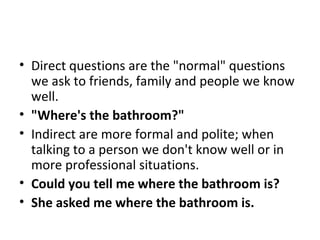
• Direct questions are the "normal" questions
we ask to friends, family and people we know
well.
• "Where's the bathroom?"
• Indirect are more formal and polite; when
talking to a person we don't know well or in
more professional situations.
• Could you tell me where the bathroom is?
• She asked me where the bathroom is.
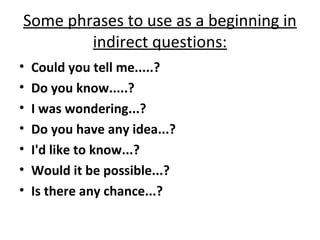
Some phrases to use as a beginning in
indirect questions:
• Could you tell me.....?
• Do you know.....?
• I was wondering...?
• Do you have any idea...?
• I'd like to know...?
• Would it be possible...?
• Is there any chance...?
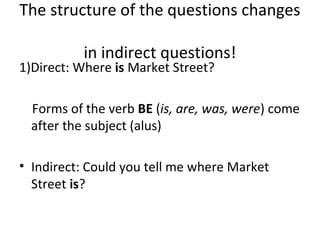
The structure of the questions changes
in indirect questions!
1)Direct: Where is Market Street?
Forms of the verb BE (is, are, was, were) come
after the subject (alus)
• Indirect: Could you tell me where Market
Street is?
2)Direct: What time does the bank open?
We don't use the auxiliary verb (do, does, did)
• Indirect: Do you know what time the bank
opens?
• 3)Direct: Why did you move to Europe?
There's no auxiliary verb (did) as a result we
say moved (not move)
• Indirect: I was wondering why you moved to
Europe?
4)Direct: How has he managed to get in shape
so quickly?
Auxiliary verbs have/has/had come after the
subject
• Indirect: Do you have any idea how he has
managed to get into shape so quickly?
5)Direct: Can you finish the project by
tomorrow?
For questions with the word can, we use
Would it be possible in ID questions and we
say to finish (not finish)
• Indirect: Would it be possible for you to finish
the project by tomorrow?
YES/NO QUESTIONS (KAS- küsimused)
1)Direct: Does Tom like Italian food?
• Indirect: Do you know if Tom likes Italian
food?
2)Direct: Are your parent joining us for dinner?
• Indirect: Could you tell me if your parents are
joining us for dinner?
3)Direct: Do they speak English
• Indirect: I was wondering if they speak
English?
4)Direct: Do you plan on travelling this summer?
• Indirect: I'd like to know if you plan on
travelling this summer?
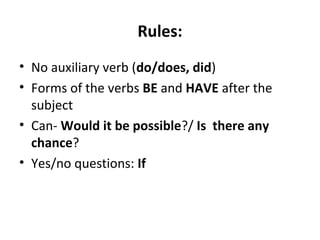
Rules:
• No auxiliary verb (do/does, did)
• Forms of the verbs BE and HAVE after the
subject
• Can- Would it be possible?/ Is there any
chance?
• Yes/no questions: If

Indirect questions

  • 1.
  • 2.
    • Direct questionsare the "normal" questions we ask to friends, family and people we know well. • "Where's the bathroom?" • Indirect are more formal and polite; when talking to a person we don't know well or in more professional situations. • Could you tell me where the bathroom is? • She asked me where the bathroom is.
  • 3.
    Some phrases touse as a beginning in indirect questions: • Could you tell me.....? • Do you know.....? • I was wondering...? • Do you have any idea...? • I'd like to know...? • Would it be possible...? • Is there any chance...?
  • 4.
    The structure ofthe questions changes in indirect questions! 1)Direct: Where is Market Street? Forms of the verb BE (is, are, was, were) come after the subject (alus) • Indirect: Could you tell me where Market Street is?
  • 5.
    2)Direct: What timedoes the bank open? We don't use the auxiliary verb (do, does, did) • Indirect: Do you know what time the bank opens?
  • 6.
    • 3)Direct: Whydid you move to Europe? There's no auxiliary verb (did) as a result we say moved (not move) • Indirect: I was wondering why you moved to Europe?
  • 7.
    4)Direct: How hashe managed to get in shape so quickly? Auxiliary verbs have/has/had come after the subject • Indirect: Do you have any idea how he has managed to get into shape so quickly?
  • 8.
    5)Direct: Can youfinish the project by tomorrow? For questions with the word can, we use Would it be possible in ID questions and we say to finish (not finish) • Indirect: Would it be possible for you to finish the project by tomorrow?
  • 9.
    YES/NO QUESTIONS (KAS-küsimused) 1)Direct: Does Tom like Italian food? • Indirect: Do you know if Tom likes Italian food?
  • 10.
    2)Direct: Are yourparent joining us for dinner? • Indirect: Could you tell me if your parents are joining us for dinner?
  • 11.
    3)Direct: Do theyspeak English • Indirect: I was wondering if they speak English?
  • 12.
    4)Direct: Do youplan on travelling this summer? • Indirect: I'd like to know if you plan on travelling this summer?
  • 13.
    Rules: • No auxiliaryverb (do/does, did) • Forms of the verbs BE and HAVE after the subject • Can- Would it be possible?/ Is there any chance? • Yes/no questions: If