1
Job
A group of related activities andduties.
Position
The different duties and responsibilitiesperformed by only one employee.
Job Family
A group of individual jobs with similar characteristics.
Job Vacancy
A paid post that is newly created, unoccupied, or about to become vacant
2Beenish Tariq Zuberi
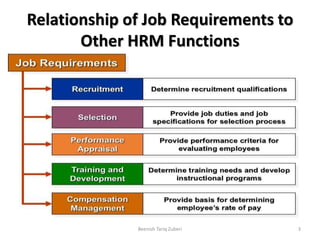
Relationship of Job Requirements to
Other HRM Functions
3Beenish Tariq Zuberi
Approaches to understanding Job
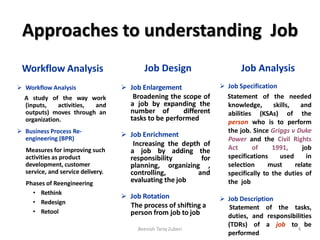
Workflow Analysis
 Workflow Analysis
A study of the way work
(inputs, activities, and
outputs) moves through an
organization.
 Business Process Re-
engineering (BPR)
Measures for improving such
activities as product
development, customer
service, and service delivery.
Phases of Reengineering
• Rethink
• Redesign
• Retool
Job Analysis
 Job Enlargement
Broadening the scope of
a job by expanding the
number of different
tasks to be performed
 Job Enrichment
Increasing the depth of
a job by adding the
responsibility for
planning, organizing ,
controlling, and
evaluating the job
 Job Rotation
The process of shifting a
person from job to job
Job Design
 Job Specification
Statement of the needed
knowledge, skills, and
abilities (KSAs) of the
person who is to perform
the job. Since Griggs v Duke
Power and the Civil Rights
Act of 1991, job
specifications used in
selection must relate
specifically to the duties of
the job
 Job Description
Statement of the tasks,
duties, and responsibilities
(TDRs) of a job to be
performed
4Beenish Tariq Zuberi
Organization Hierarchy
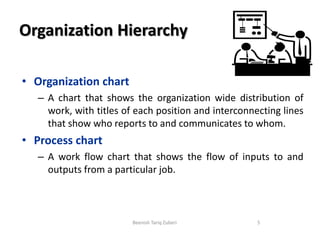
• Organization chart
– A chart that shows the organization wide distribution of
work, with titles of each position and interconnecting lines
that show who reports to and communicates to whom.
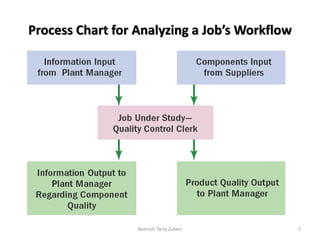
• Process chart
– A work flow chart that shows the flow of inputs to and
outputs from a particular job.
5Beenish Tariq Zuberi
Types of Information Collected for Job
• Work activities
• Human behaviors
• Machines, tools, equipment, and work aids
• Performance standards
• Job context
• Human requirements
6
Beenish Tariq Zuberi
Process Chart for Analyzing a Job’s Workflow
7Beenish Tariq Zuberi
Recruitment
The Process of generating a pool of qualified
candidates for a particular job.
Internal Recruitment
• Internal recruitment is
when the business looks to
fill the vacancy from within
its existing workforce.
External Recruitment
• External recruitment is
when the business looks to
fill the vacancy from any
suitable applicant outside
the business.
Beenish Tariq Zuberi 8
Internal Recruitment
Advantages
• Cheaper and quicker to recruit
• People already familiar with
the business and how it
operates
• Provides opportunities for
promotion with in the
business – can be motivating
• Business already knows the
strengths and weaknesses of
candidates
Disadvantages
• Limits the number of potential
applicants
• No new ideas can be introduced
from outside
• May cause resentment amongst
candidates not appointed
• Creates another vacancy which
needs to be filled
Beenish Tariq Zuberi 9
External Recruitment
Advantages
• Outside people bring in new
ideas
• Larger pool of workers from
which to find the best
candidate
• People have a wider range of
experience
Disadvantages
• Longer process
• More expensive process due
to advertising and interviews
required
• Selection process may not be
effective enough to reveal the
best candidate
Beenish Tariq Zuberi 10
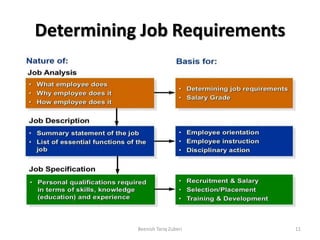
Determining Job Requirements
11Beenish Tariq Zuberi
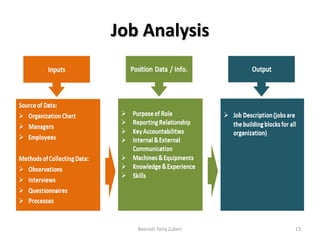
Job Analysis
The procedure for determining the duties and skill requirements of a
job and the kind of person who should be hired for it.
The process of obtaining information about jobs by determining what
the duties, tasks, or activities of jobs.
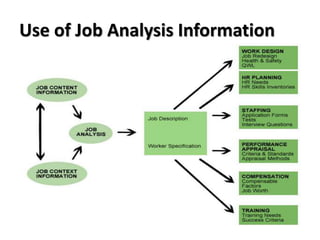
HR managers use the data to develop job descriptions and job
specifications that are the basis for recruitment, training, employee
performance appraisal and career development.
The ultimate purpose of job analysis is to improve organizational
performance and productivity.
12Beenish Tariq Zuberi
Job Analysis
Beenish Tariq Zuberi 13
Beenish Tariq Zuberi 14
Use of Job Analysis Information
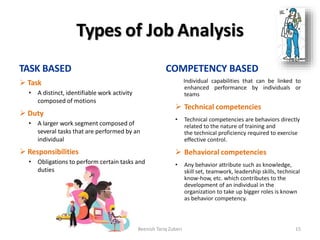
Types of Job Analysis
TASK BASED
 Task
• A distinct, identifiable work activity
composed of motions
 Duty
• A larger work segment composed of
several tasks that are performed by an
individual
 Responsibilities
• Obligations to perform certain tasks and
duties
COMPETENCY BASED
Individual capabilities that can be linked to
enhanced performance by individuals or
teams
 Technical competencies
• Technical competencies are behaviors directly
related to the nature of training and
the technical proficiency required to exercise
effective control.
 Behavioral competencies
• Any behavior attribute such as knowledge,
skill set, teamwork, leadership skills, technical
know-how, etc. which contributes to the
development of an individual in the
organization to take up bigger roles is known
as behavior competency.
15Beenish Tariq Zuberi
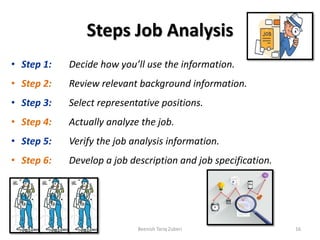
Steps Job Analysis
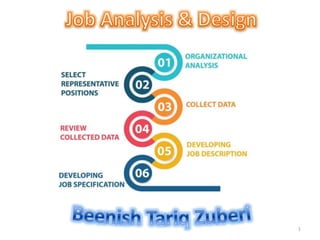
• Step 1: Decide how you’ll use the information.
• Step 2: Review relevant background information.
• Step 3: Select representative positions.
• Step 4: Actually analyze the job.
• Step 5: Verify the job analysis information.
• Step 6: Develop a job description and job specification.
16Beenish Tariq Zuberi
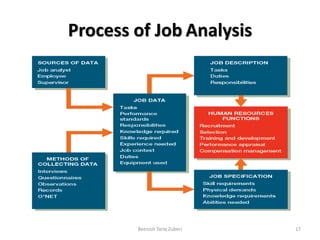
Process of Job Analysis
17Beenish Tariq Zuberi
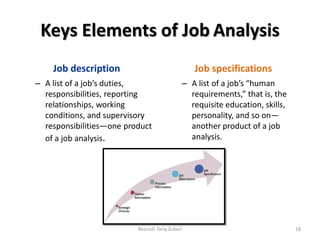
Keys Elements of Job Analysis
Job description
– A list of a job’s duties,
responsibilities, reporting
relationships, working
conditions, and supervisory
responsibilities—one product
of a job analysis.
Job specifications
– A list of a job’s “human
requirements,” that is, the
requisite education, skills,
personality, and so on—
another product of a job
analysis.
18Beenish Tariq Zuberi
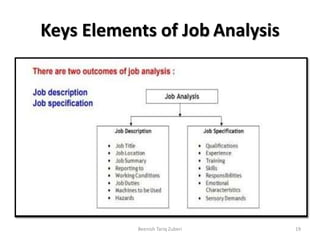
Keys Elements of Job Analysis
Beenish Tariq Zuberi 19
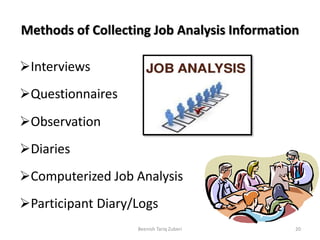
Methods of Collecting Job Analysis Information
Interviews
Questionnaires
Observation
Diaries
Computerized Job Analysis
Participant Diary/Logs
20Beenish Tariq Zuberi
21

Job analysis and design btz

  • 1.
  • 2.
    Job A group ofrelated activities andduties. Position The different duties and responsibilitiesperformed by only one employee. Job Family A group of individual jobs with similar characteristics. Job Vacancy A paid post that is newly created, unoccupied, or about to become vacant 2Beenish Tariq Zuberi
  • 3.
    Relationship of JobRequirements to Other HRM Functions 3Beenish Tariq Zuberi
  • 4.
    Approaches to understandingJob Workflow Analysis  Workflow Analysis A study of the way work (inputs, activities, and outputs) moves through an organization.  Business Process Re- engineering (BPR) Measures for improving such activities as product development, customer service, and service delivery. Phases of Reengineering • Rethink • Redesign • Retool Job Analysis  Job Enlargement Broadening the scope of a job by expanding the number of different tasks to be performed  Job Enrichment Increasing the depth of a job by adding the responsibility for planning, organizing , controlling, and evaluating the job  Job Rotation The process of shifting a person from job to job Job Design  Job Specification Statement of the needed knowledge, skills, and abilities (KSAs) of the person who is to perform the job. Since Griggs v Duke Power and the Civil Rights Act of 1991, job specifications used in selection must relate specifically to the duties of the job  Job Description Statement of the tasks, duties, and responsibilities (TDRs) of a job to be performed 4Beenish Tariq Zuberi
  • 5.
    Organization Hierarchy • Organizationchart – A chart that shows the organization wide distribution of work, with titles of each position and interconnecting lines that show who reports to and communicates to whom. • Process chart – A work flow chart that shows the flow of inputs to and outputs from a particular job. 5Beenish Tariq Zuberi
  • 6.
    Types of InformationCollected for Job • Work activities • Human behaviors • Machines, tools, equipment, and work aids • Performance standards • Job context • Human requirements 6 Beenish Tariq Zuberi
  • 7.
    Process Chart forAnalyzing a Job’s Workflow 7Beenish Tariq Zuberi
  • 8.
    Recruitment The Process ofgenerating a pool of qualified candidates for a particular job. Internal Recruitment • Internal recruitment is when the business looks to fill the vacancy from within its existing workforce. External Recruitment • External recruitment is when the business looks to fill the vacancy from any suitable applicant outside the business. Beenish Tariq Zuberi 8
  • 9.
    Internal Recruitment Advantages • Cheaperand quicker to recruit • People already familiar with the business and how it operates • Provides opportunities for promotion with in the business – can be motivating • Business already knows the strengths and weaknesses of candidates Disadvantages • Limits the number of potential applicants • No new ideas can be introduced from outside • May cause resentment amongst candidates not appointed • Creates another vacancy which needs to be filled Beenish Tariq Zuberi 9
  • 10.
    External Recruitment Advantages • Outsidepeople bring in new ideas • Larger pool of workers from which to find the best candidate • People have a wider range of experience Disadvantages • Longer process • More expensive process due to advertising and interviews required • Selection process may not be effective enough to reveal the best candidate Beenish Tariq Zuberi 10
  • 11.
  • 12.
    Job Analysis The procedurefor determining the duties and skill requirements of a job and the kind of person who should be hired for it. The process of obtaining information about jobs by determining what the duties, tasks, or activities of jobs. HR managers use the data to develop job descriptions and job specifications that are the basis for recruitment, training, employee performance appraisal and career development. The ultimate purpose of job analysis is to improve organizational performance and productivity. 12Beenish Tariq Zuberi
  • 13.
  • 14.
    Beenish Tariq Zuberi14 Use of Job Analysis Information
  • 15.
    Types of JobAnalysis TASK BASED  Task • A distinct, identifiable work activity composed of motions  Duty • A larger work segment composed of several tasks that are performed by an individual  Responsibilities • Obligations to perform certain tasks and duties COMPETENCY BASED Individual capabilities that can be linked to enhanced performance by individuals or teams  Technical competencies • Technical competencies are behaviors directly related to the nature of training and the technical proficiency required to exercise effective control.  Behavioral competencies • Any behavior attribute such as knowledge, skill set, teamwork, leadership skills, technical know-how, etc. which contributes to the development of an individual in the organization to take up bigger roles is known as behavior competency. 15Beenish Tariq Zuberi
  • 16.
    Steps Job Analysis •Step 1: Decide how you’ll use the information. • Step 2: Review relevant background information. • Step 3: Select representative positions. • Step 4: Actually analyze the job. • Step 5: Verify the job analysis information. • Step 6: Develop a job description and job specification. 16Beenish Tariq Zuberi
  • 17.
    Process of JobAnalysis 17Beenish Tariq Zuberi
  • 18.
    Keys Elements ofJob Analysis Job description – A list of a job’s duties, responsibilities, reporting relationships, working conditions, and supervisory responsibilities—one product of a job analysis. Job specifications – A list of a job’s “human requirements,” that is, the requisite education, skills, personality, and so on— another product of a job analysis. 18Beenish Tariq Zuberi
  • 19.
    Keys Elements ofJob Analysis Beenish Tariq Zuberi 19
  • 20.
    Methods of CollectingJob Analysis Information Interviews Questionnaires Observation Diaries Computerized Job Analysis Participant Diary/Logs 20Beenish Tariq Zuberi
  • 21.