1
JVM JIT-compiler
overview
Vladimir Ivanov
HotSpot JVM Compiler
Oracle Corp.
2
Agenda
§  about compilers in general
–  … and JIT-compilers in particular
§  about JIT-compilers in HotSpot JVM
§  monitoring JIT-compilers in HotSpot JVM
3
Static vs Dynamic
AOT vs JIT
4
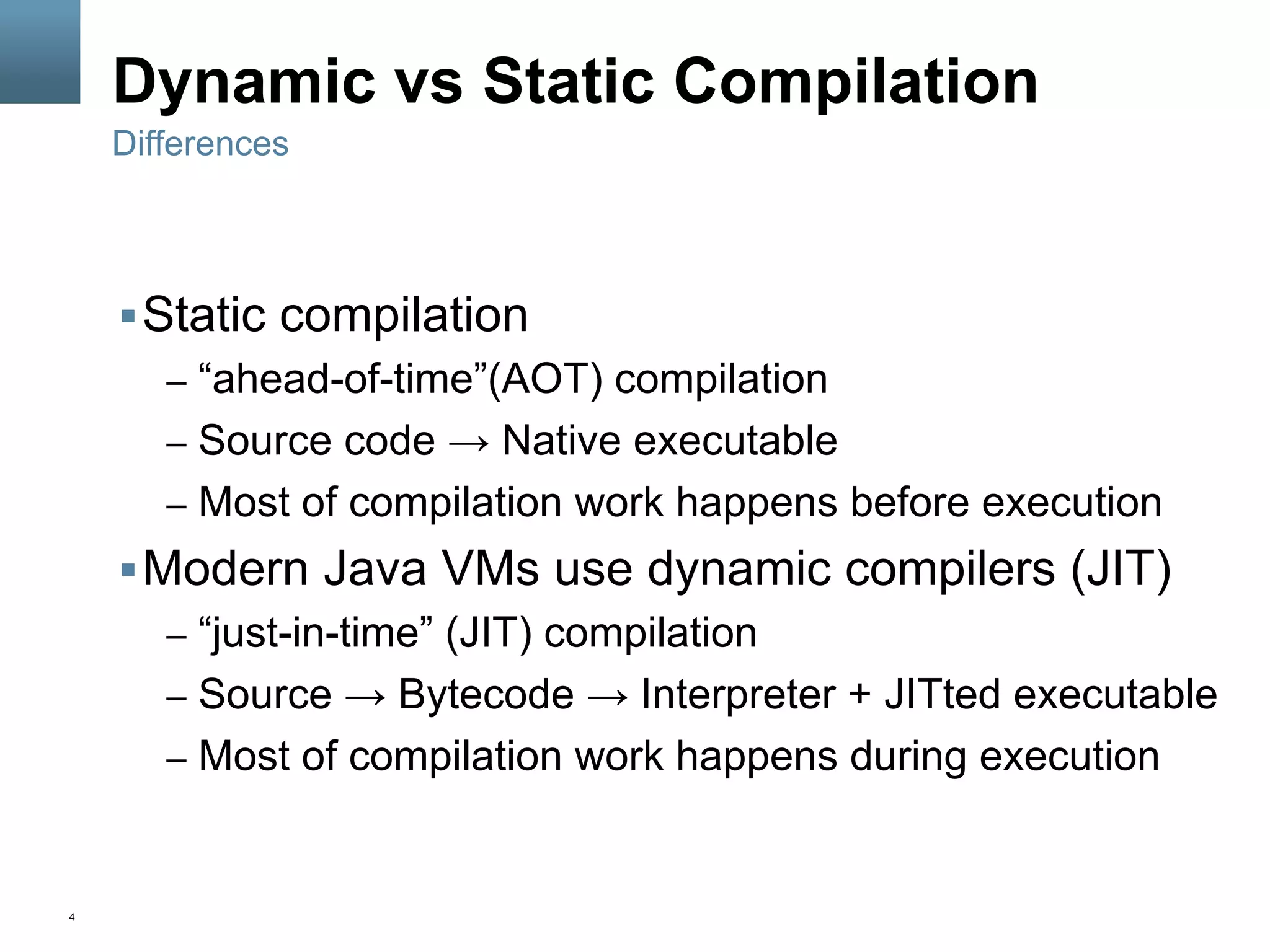
Dynamic vs Static Compilation
§ Static compilation
–  “ahead-of-time”(AOT) compilation
–  Source code → Native executable
–  Most of compilation work happens before execution
§ Modern Java VMs use dynamic compilers (JIT)
–  “just-in-time” (JIT) compilation
–  Source → Bytecode → Interpreter + JITted executable
–  Most of compilation work happens during execution
Differences
5
Dynamic vs Static Compilation
§ Static compilation (AOT)
–  can utilize complex and heavy analyses and
optimizations
–  … but static information sometimes isn’t enough
–  … and it’s hard to rely on profiling info, if any
–  moreover, how to utilize specific platform features
(like SSE 4.2)?
Differences
6
Dynamic vs Static Compilation
§ Modern Java VMs use dynamic compilers (JIT)
–  aggressive optimistic optimizations
§ through extensive usage of profiling info
–  … but budget is limited and shared with an application
–  startup speed suffers
–  peak performance may suffer as well (not necessary)
Differences
7
Dynamic Compilation
in JVM
8
JVM
§ Runtime
–  class loading, bytecode verification, synchronization
§ JIT
–  profiling, compilation plans, OSR
–  aggressive optimizations
§ GC
–  different algorithms: throughput vs. response time
§ Serviceability
–  JVMTI, JFR, Serviceability Agent
Subsystems
9
Dynamic Compilation (JIT)
§ Just-In-Time compilation
§ Compiled when needed
§ Maybe immediately before execution
–  ...or when we decide it’s important
–  ...or never?
10
Dynamic Compilation (JIT)
§ Knows about
–  loaded classes, methods the program has executed
§ Makes optimization decisions based on code
paths executed
–  Code generation depends on what is observed:
§ loaded classes, code paths executed, branches taken
§ May re-optimize if assumption was wrong, or
alternative code paths taken
–  Instruction path length may change between invocations of
methods as a result of de-optimization / re-compilation
11
Dynamic Compilation (JIT)
§ Can do non-conservative optimizations in dynamic
§ Separates optimization from product delivery cycle
–  Update JVM, run the same application,
realize improved performance!
–  Can be "tuned" to the target platform
12
JVM: Makes Bytecodes Fast
§ JVMs eventually JIT bytecodes
–  To make them fast
–  Some JITs are high quality optimizing compilers
§ But cannot use existing static compilers directly:
–  Tracking OOPs (ptrs) for GC
–  Java Memory Model (volatile reordering & fences)
–  New code patterns to optimize
–  Time & resource constraints (CPU, memory)
13
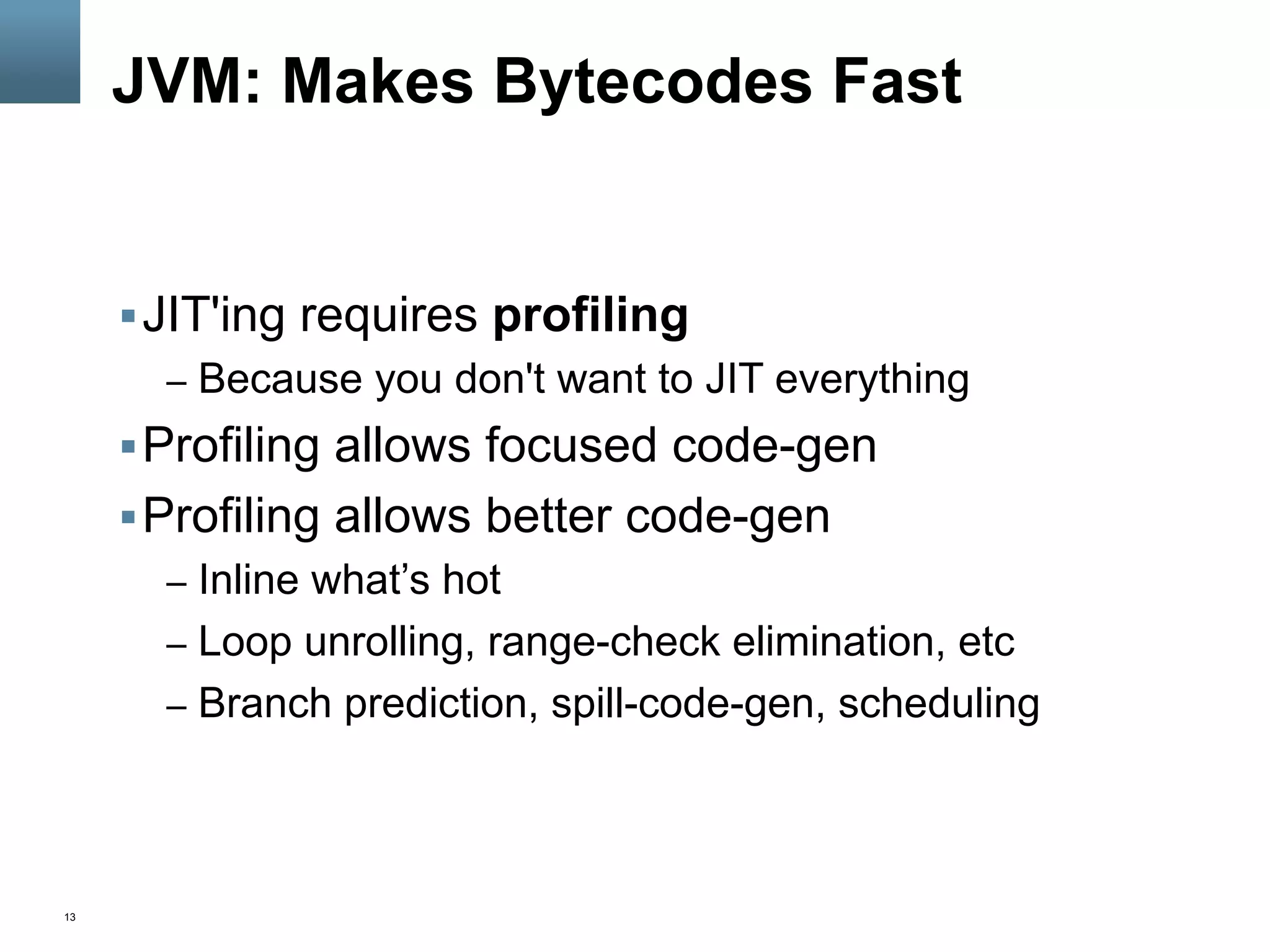
JVM: Makes Bytecodes Fast
§ JIT'ing requires profiling
–  Because you don't want to JIT everything
§ Profiling allows focused code-gen
§ Profiling allows better code-gen
–  Inline what’s hot
–  Loop unrolling, range-check elimination, etc
–  Branch prediction, spill-code-gen, scheduling
14
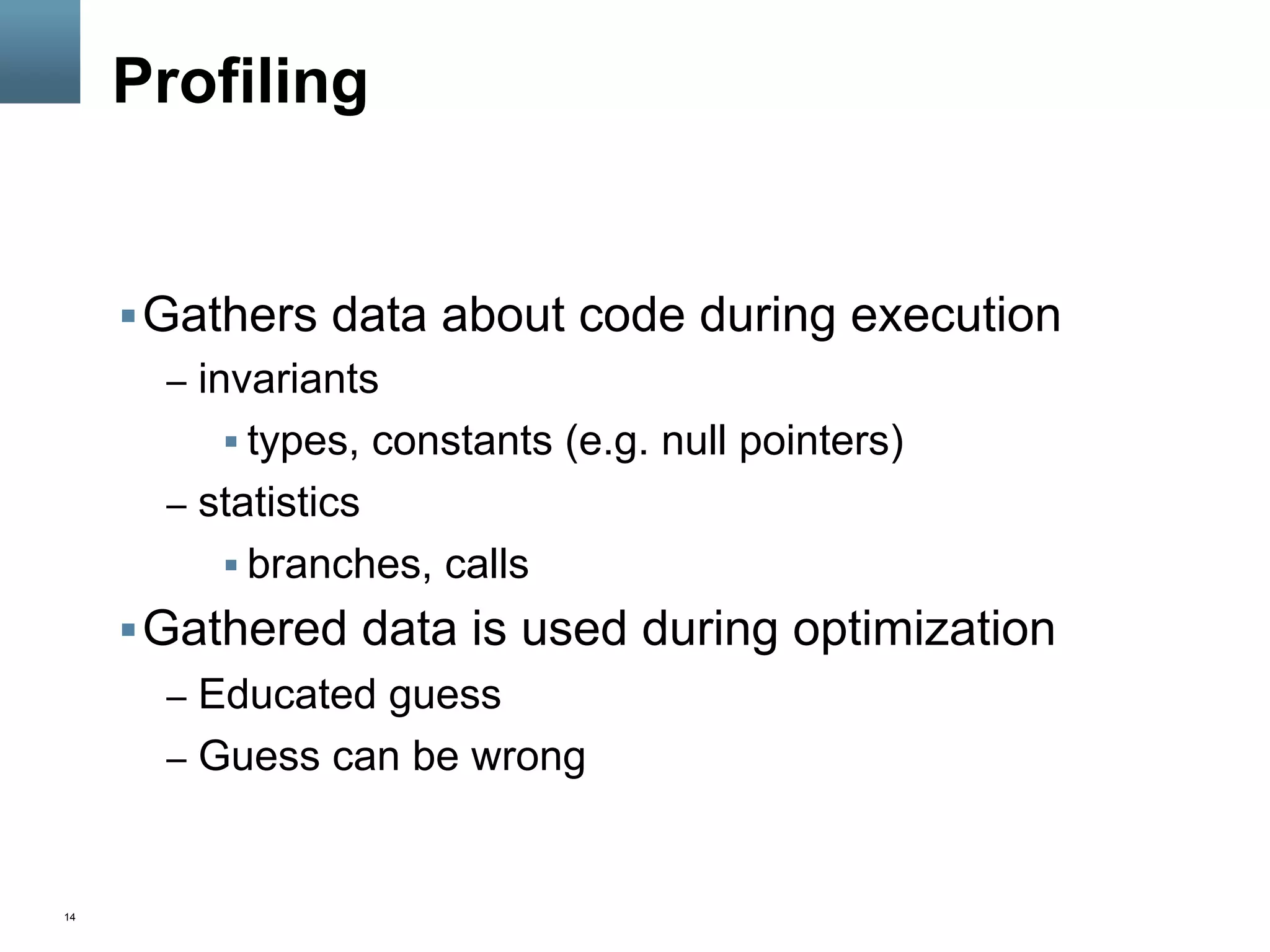
Profiling
§ Gathers data about code during execution
–  invariants
§ types, constants (e.g. null pointers)
–  statistics
§ branches, calls
§ Gathered data is used during optimization
–  Educated guess
–  Guess can be wrong
15
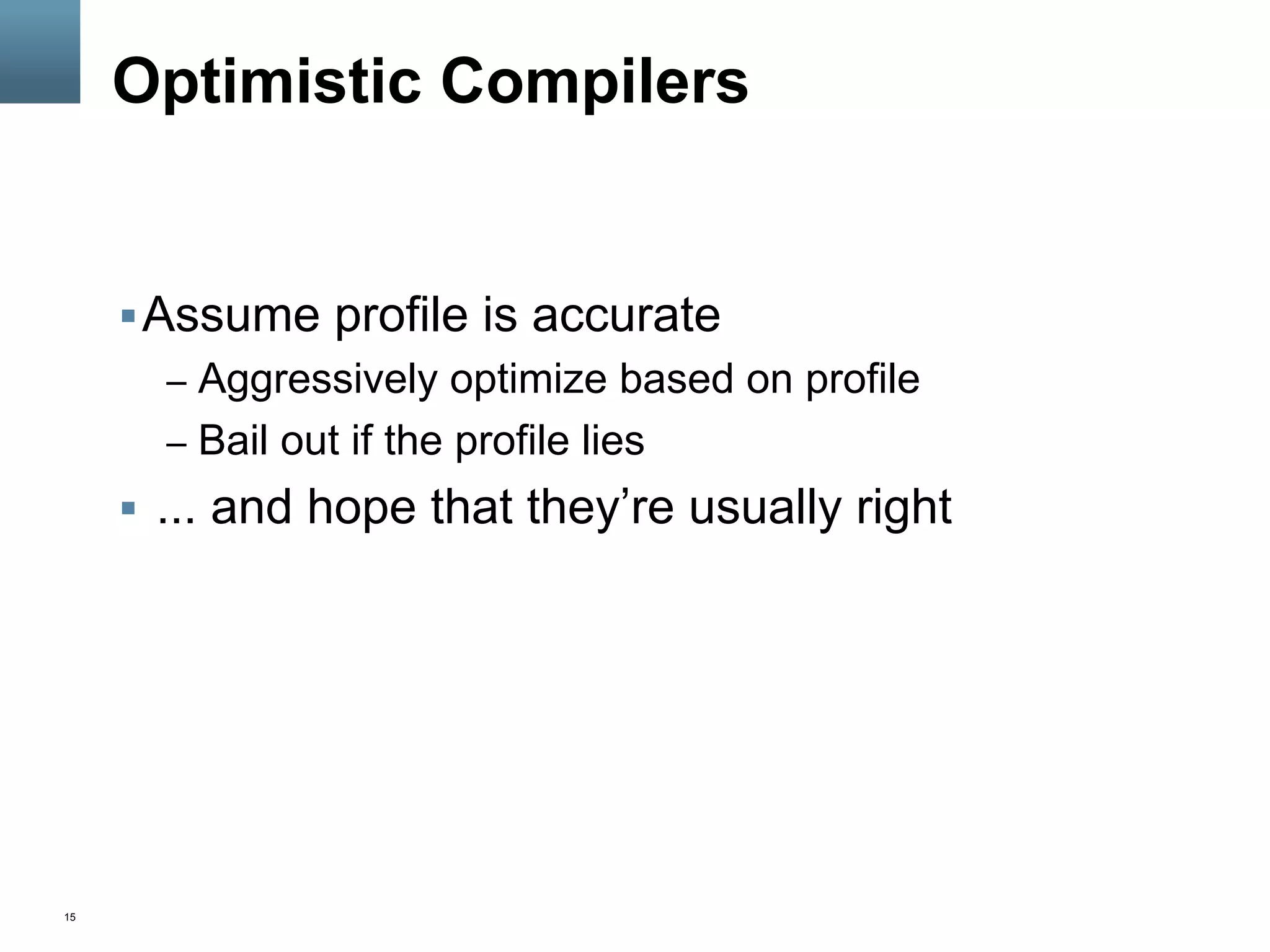
Optimistic Compilers
§ Assume profile is accurate
–  Aggressively optimize based on profile
–  Bail out if the profile lies
§  ... and hope that they’re usually right
16
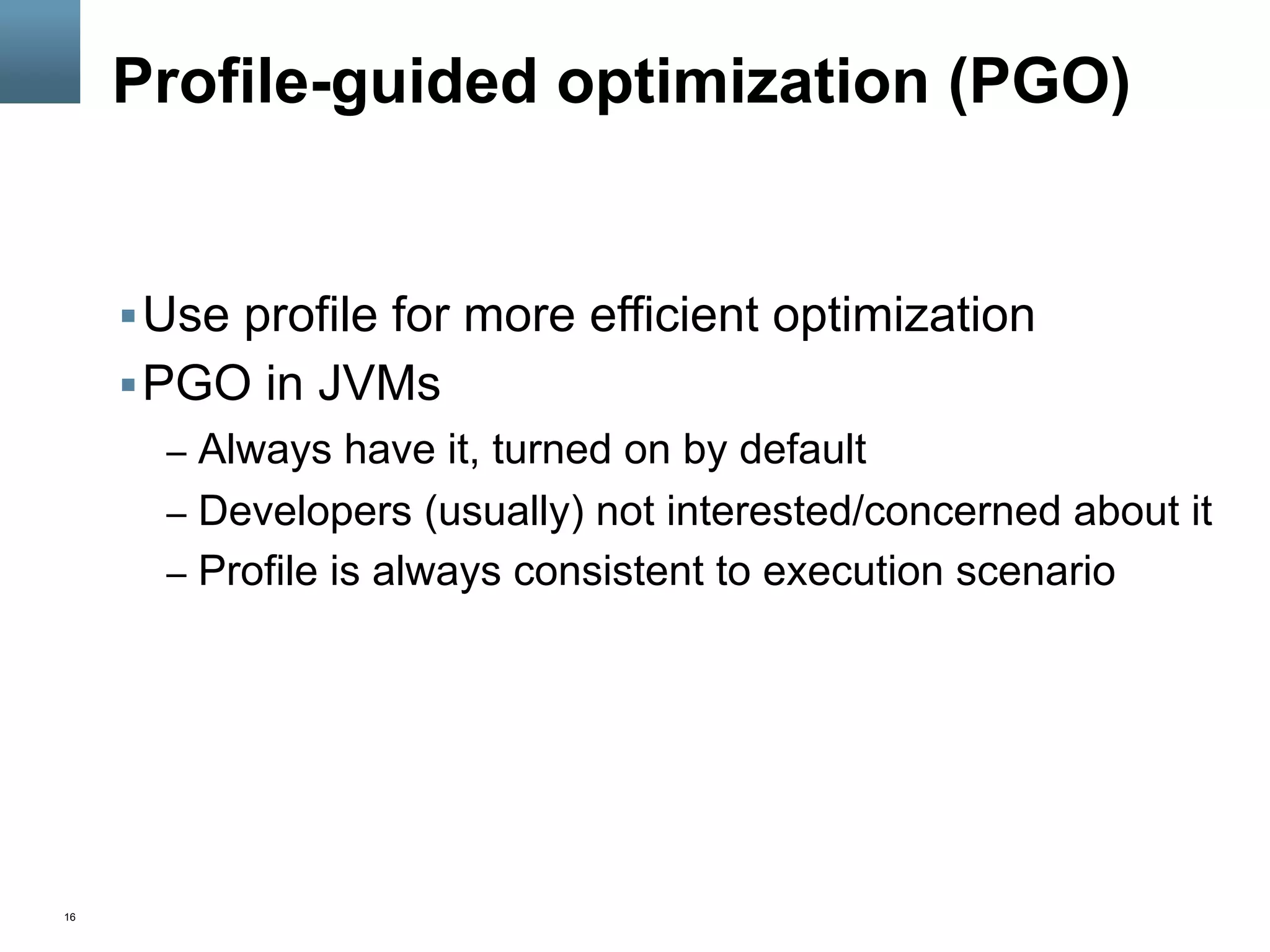
Profile-guided optimization (PGO)
§ Use profile for more efficient optimization
§ PGO in JVMs
–  Always have it, turned on by default
–  Developers (usually) not interested/concerned about it
–  Profile is always consistent to execution scenario
17
Dynamic Compilation (JIT)
§ Is dynamic compilation overhead essential?
–  The longer your application runs, the less the overhead
§ Trading off compilation time, not application time
–  Steal some cycles very early in execution
–  Done “automagically” and transparently to application
§ Most of “perceived” overhead is compiler waiting
for more data
–  ... thus running semi-optimal code for time being
Overhead
18
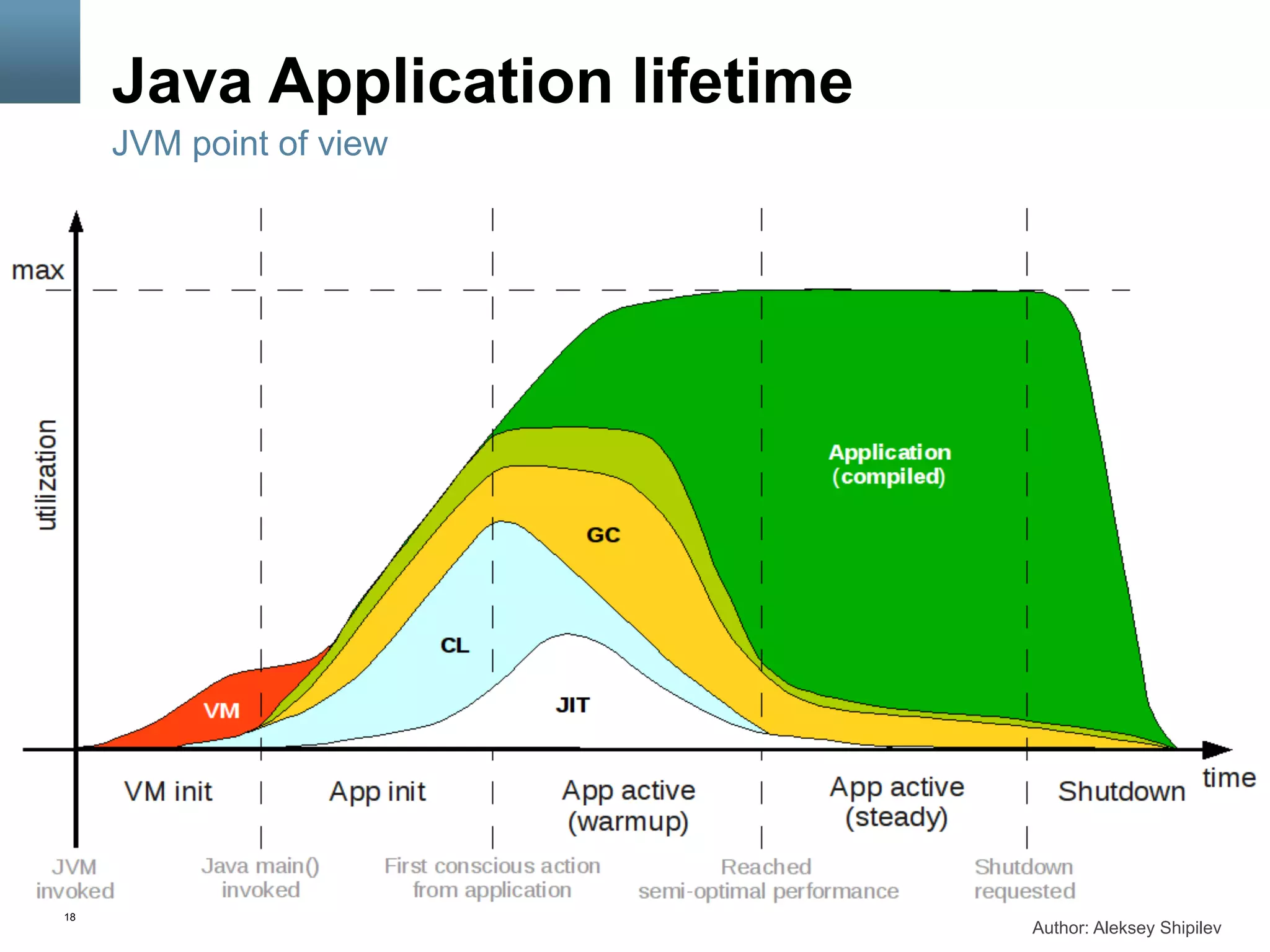
Java Application lifetime
JVM point of view
Author: Aleksey Shipilev
19
Mixed-Mode Execution
§ Interpreted
–  Bytecode-walking
–  Artificial stack machine
§ Compiled
–  Direct native operations
–  Native register machine
20
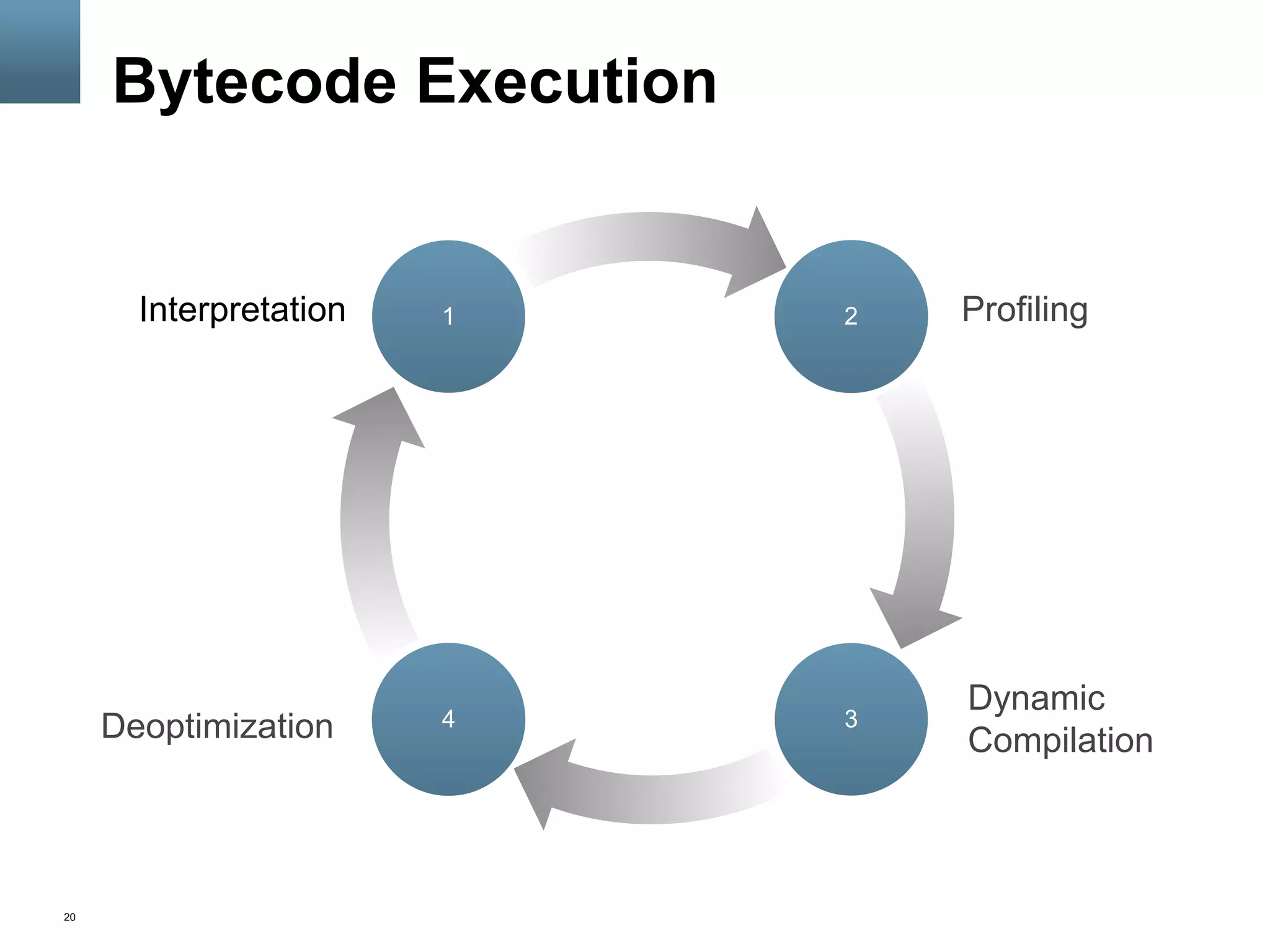
Bytecode Execution
1 2
34
Interpretation Profiling
Dynamic
CompilationDeoptimization
21
Deoptimization
§ Bail out of running native code
–  stop executing native (JIT-generated) code
–  start interpreting bytecode
§ It’s a complicated operation at runtime…
22
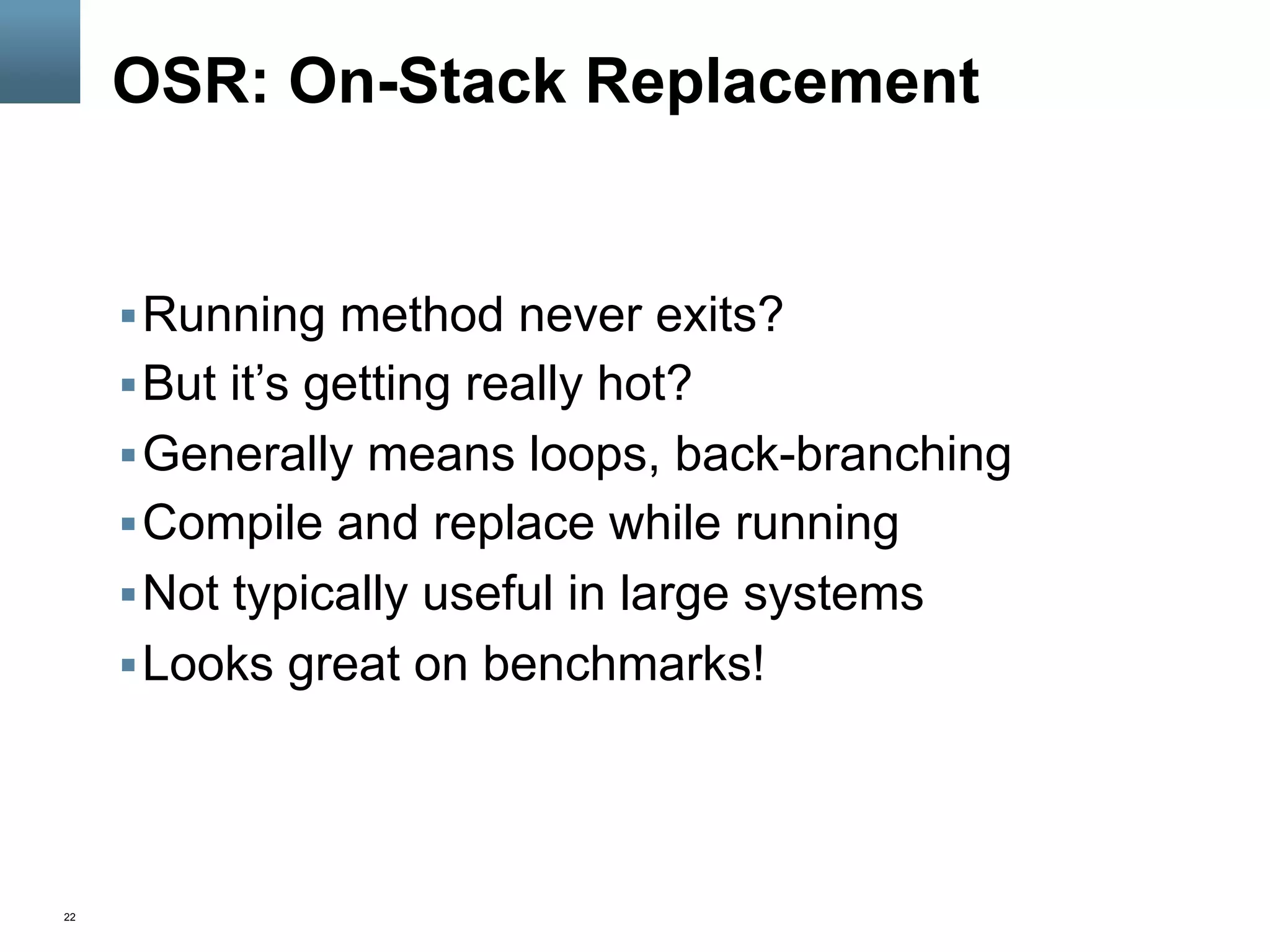
OSR: On-Stack Replacement
§ Running method never exits?
§ But it’s getting really hot?
§ Generally means loops, back-branching
§ Compile and replace while running
§ Not typically useful in large systems
§ Looks great on benchmarks!
23
Optimizations
24
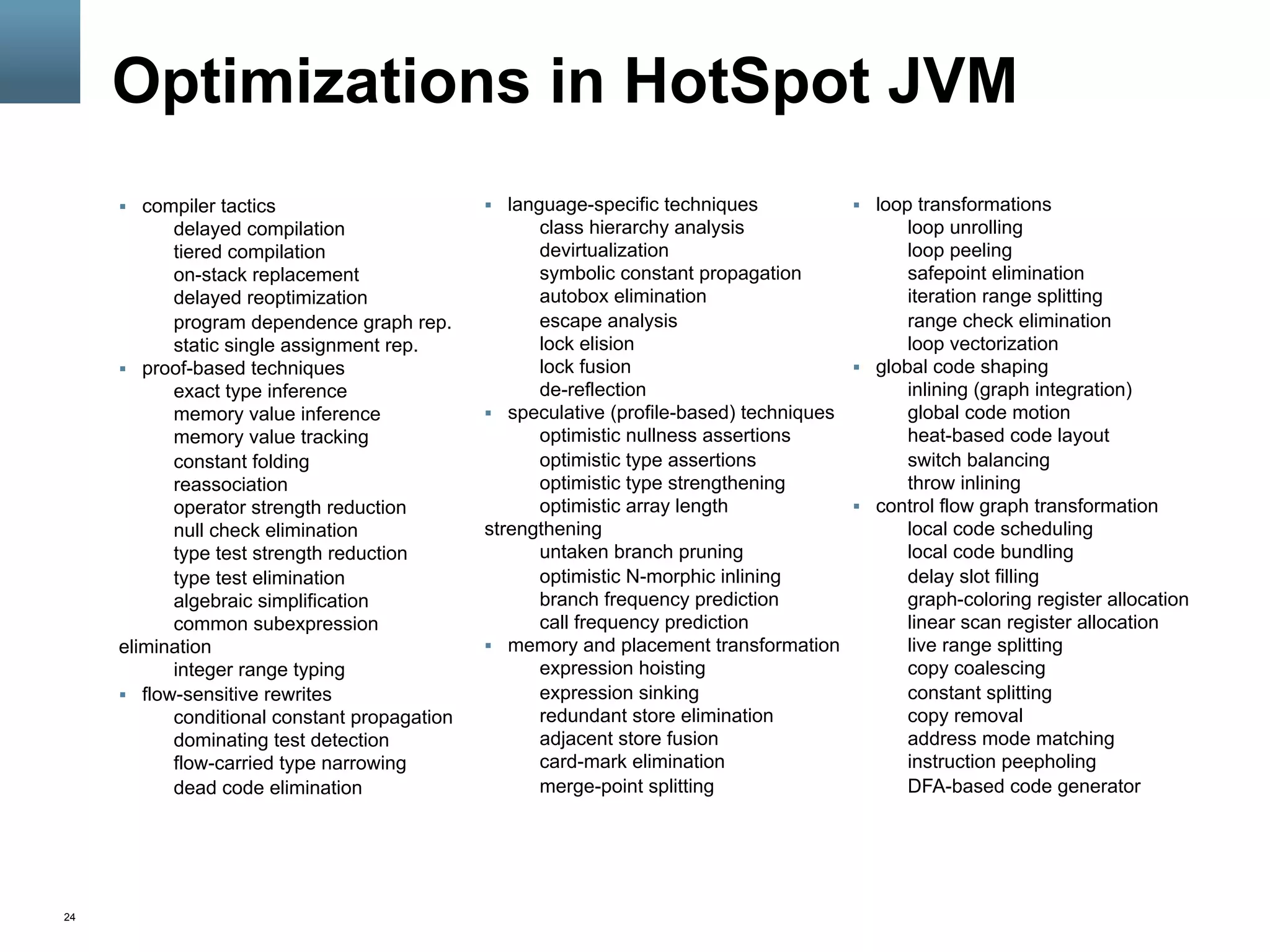
Optimizations in HotSpot JVM
§  compiler tactics
delayed compilation
tiered compilation
on-stack replacement
delayed reoptimization
program dependence graph rep.
static single assignment rep.
§  proof-based techniques
exact type inference
memory value inference
memory value tracking
constant folding
reassociation
operator strength reduction
null check elimination
type test strength reduction
type test elimination
algebraic simplification
common subexpression
elimination
integer range typing
§  flow-sensitive rewrites
conditional constant propagation
dominating test detection
flow-carried type narrowing
dead code elimination
§  language-specific techniques
class hierarchy analysis
devirtualization
symbolic constant propagation
autobox elimination
escape analysis
lock elision
lock fusion
de-reflection
§  speculative (profile-based) techniques
optimistic nullness assertions
optimistic type assertions
optimistic type strengthening
optimistic array length
strengthening
untaken branch pruning
optimistic N-morphic inlining
branch frequency prediction
call frequency prediction
§  memory and placement transformation
expression hoisting
expression sinking
redundant store elimination
adjacent store fusion
card-mark elimination
merge-point splitting
§  loop transformations
loop unrolling
loop peeling
safepoint elimination
iteration range splitting
range check elimination
loop vectorization
§  global code shaping
inlining (graph integration)
global code motion
heat-based code layout
switch balancing
throw inlining
§  control flow graph transformation
local code scheduling
local code bundling
delay slot filling
graph-coloring register allocation
linear scan register allocation
live range splitting
copy coalescing
constant splitting
copy removal
address mode matching
instruction peepholing
DFA-based code generator
25
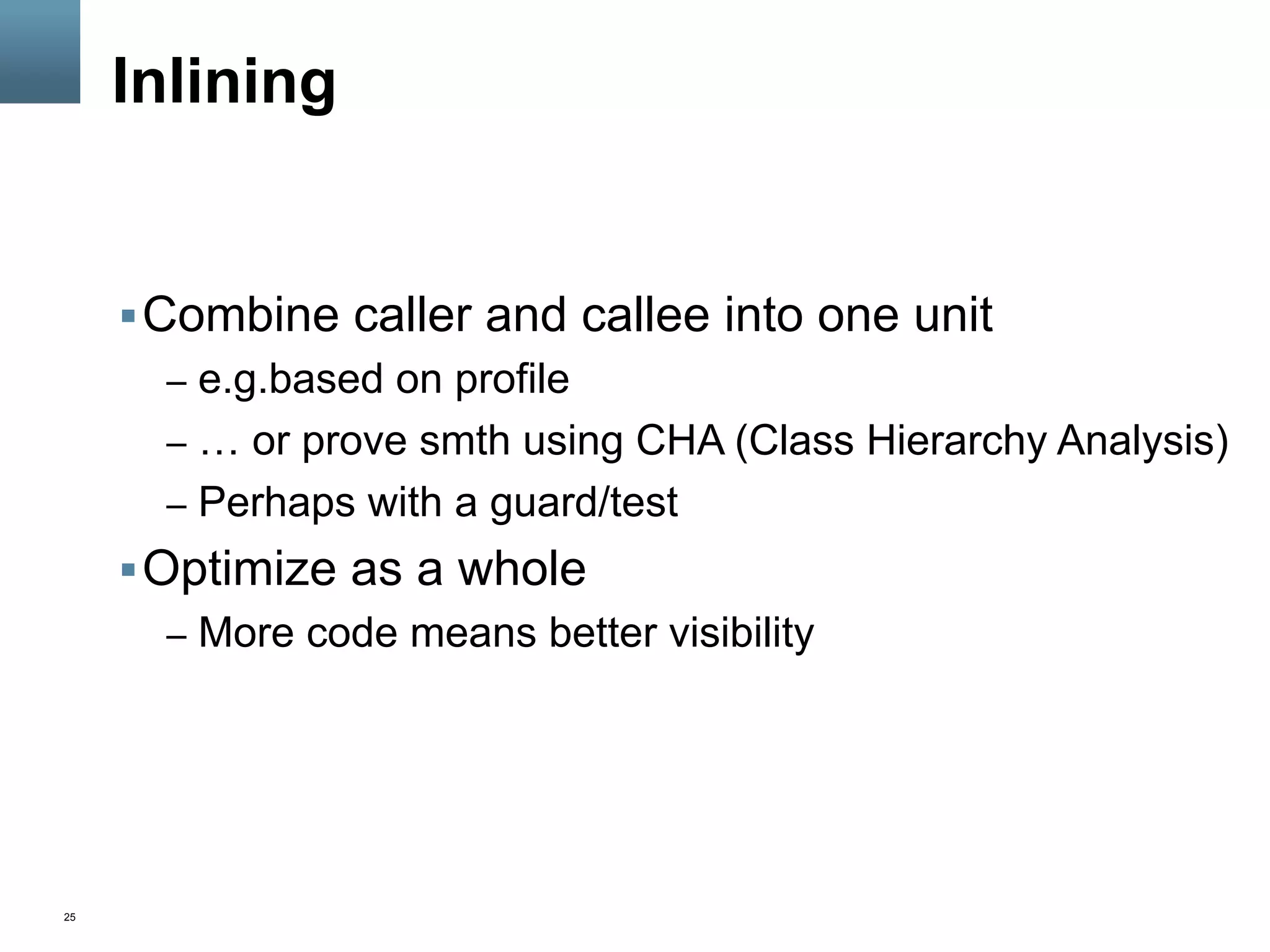
Inlining
§ Combine caller and callee into one unit
–  e.g.based on profile
–  … or prove smth using CHA (Class Hierarchy Analysis)
–  Perhaps with a guard/test
§ Optimize as a whole
–  More code means better visibility
26
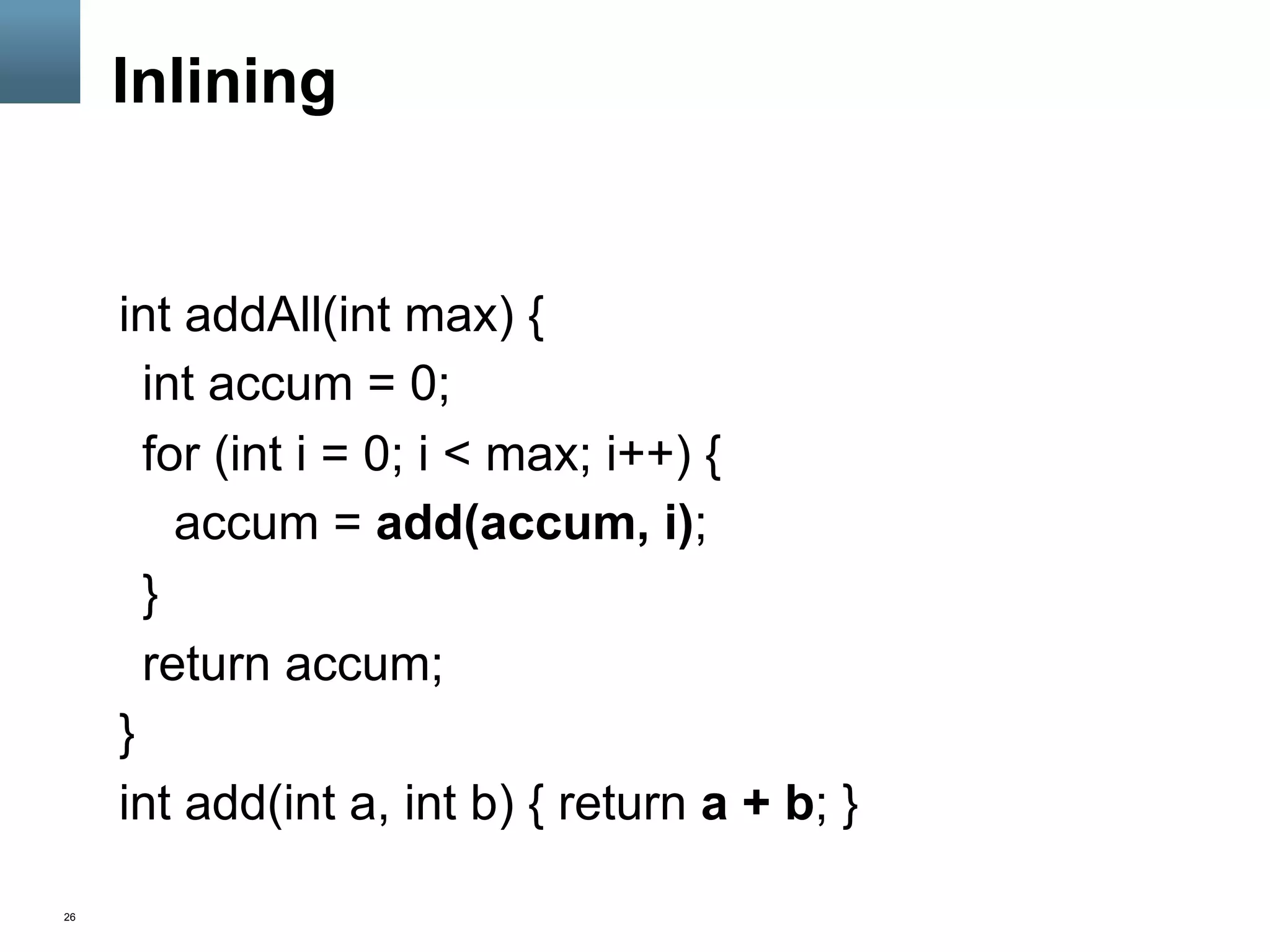
Inlining
int addAll(int max) {
int accum = 0;
for (int i = 0; i < max; i++) {
accum = add(accum, i);
}
return accum;
}
int add(int a, int b) { return a + b; }
27
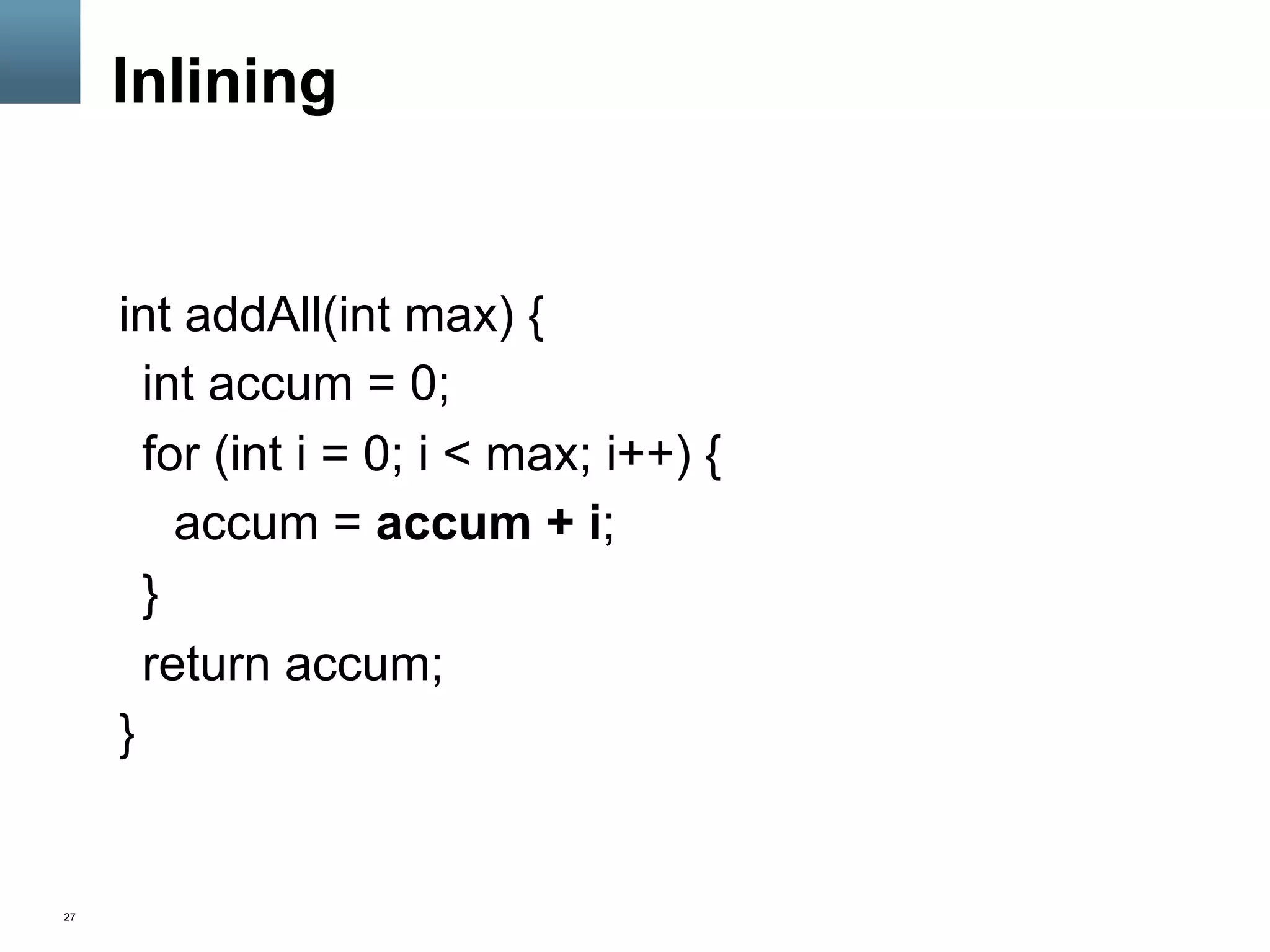
Inlining
int addAll(int max) {
int accum = 0;
for (int i = 0; i < max; i++) {
accum = accum + i;
}
return accum;
}
28
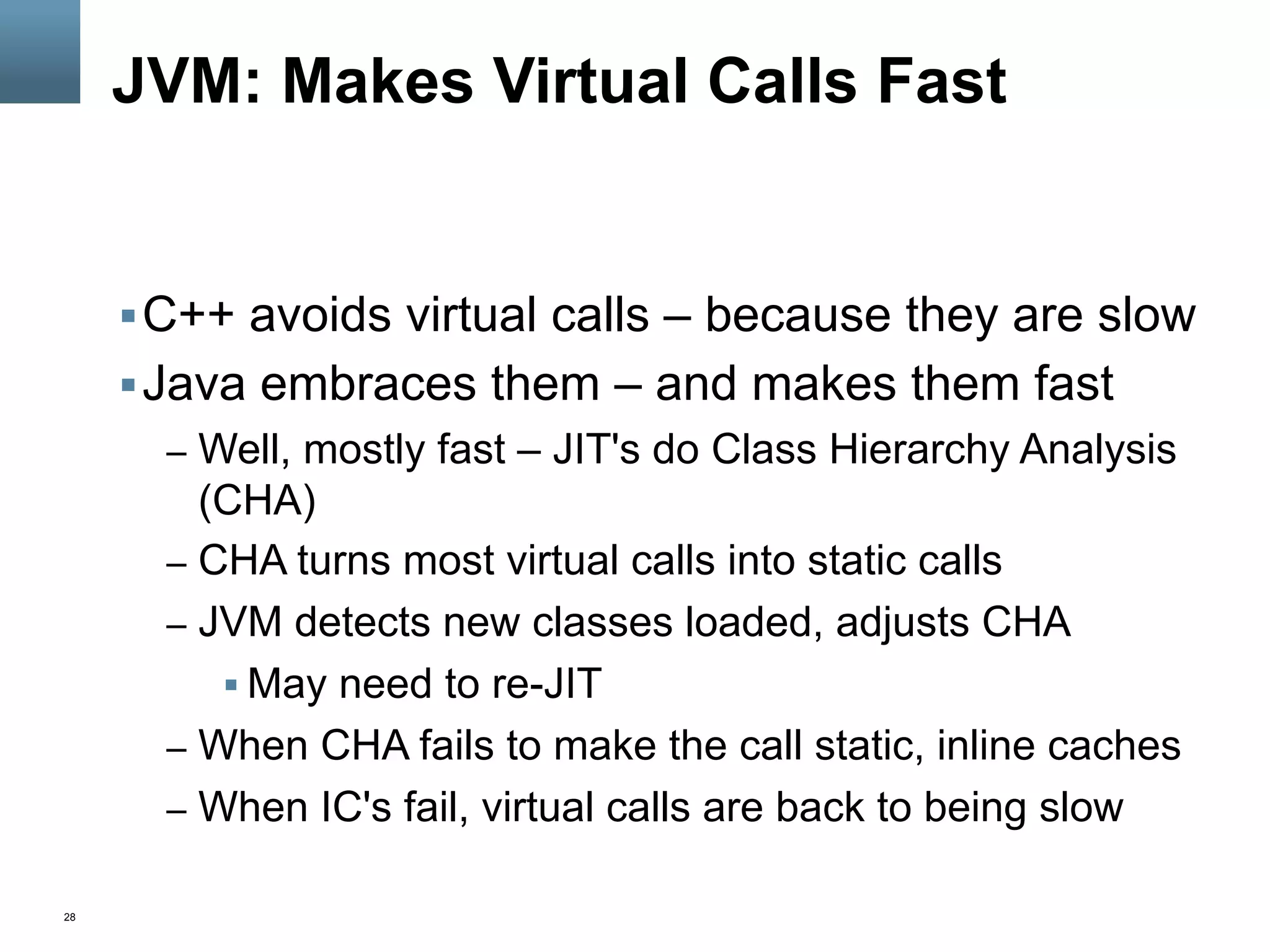
JVM: Makes Virtual Calls Fast
§ C++ avoids virtual calls – because they are slow
§ Java embraces them – and makes them fast
–  Well, mostly fast – JIT's do Class Hierarchy Analysis
(CHA)
–  CHA turns most virtual calls into static calls
–  JVM detects new classes loaded, adjusts CHA
§ May need to re-JIT
–  When CHA fails to make the call static, inline caches
–  When IC's fail, virtual calls are back to being slow
29
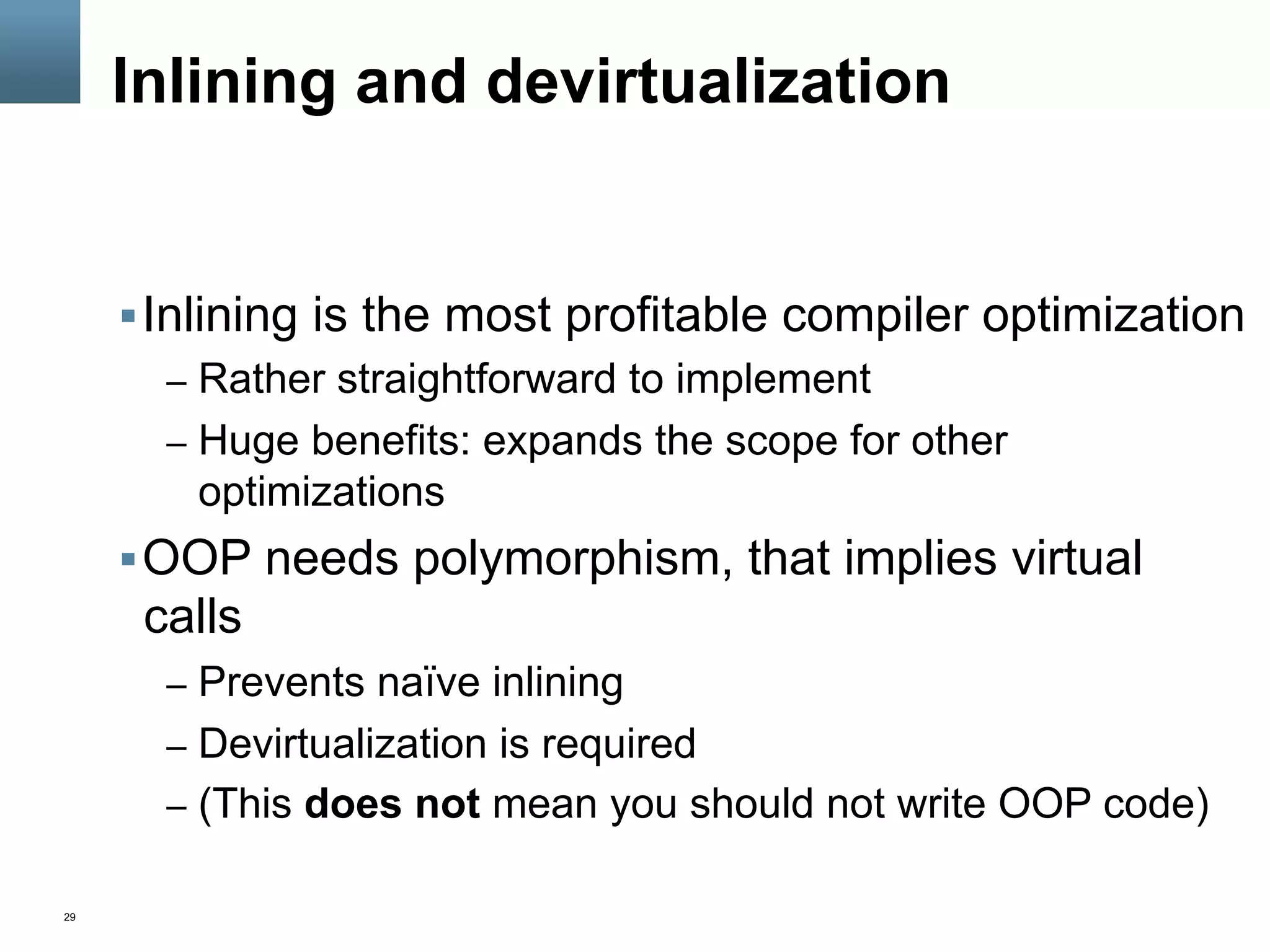
Inlining and devirtualization
§ Inlining is the most profitable compiler optimization
–  Rather straightforward to implement
–  Huge benefits: expands the scope for other
optimizations
§ OOP needs polymorphism, that implies virtual
calls
–  Prevents naïve inlining
–  Devirtualization is required
–  (This does not mean you should not write OOP code)
30
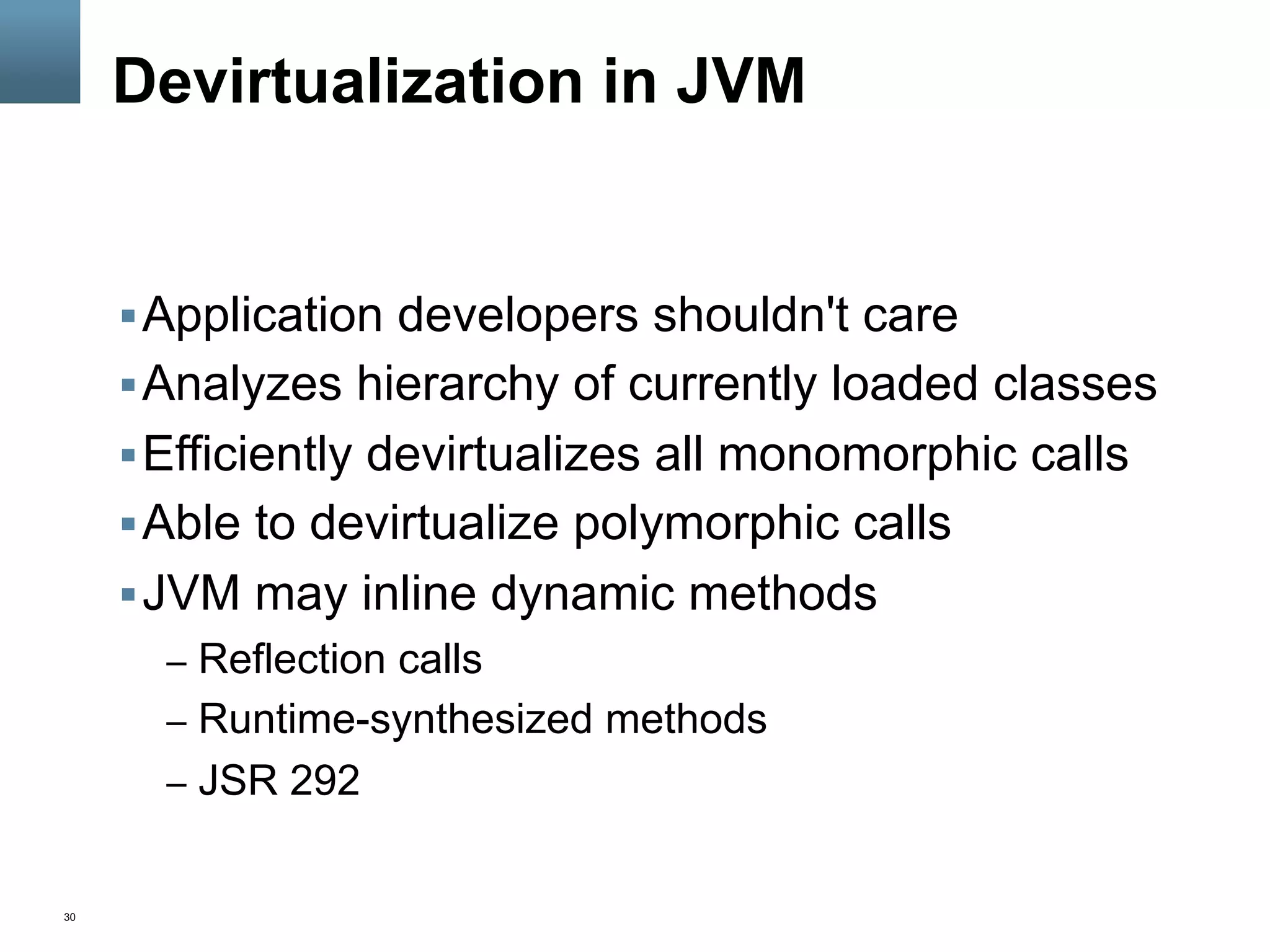
Devirtualization in JVM
§ Application developers shouldn't care
§ Analyzes hierarchy of currently loaded classes
§ Efficiently devirtualizes all monomorphic calls
§ Able to devirtualize polymorphic calls
§ JVM may inline dynamic methods
–  Reflection calls
–  Runtime-synthesized methods
–  JSR 292
31
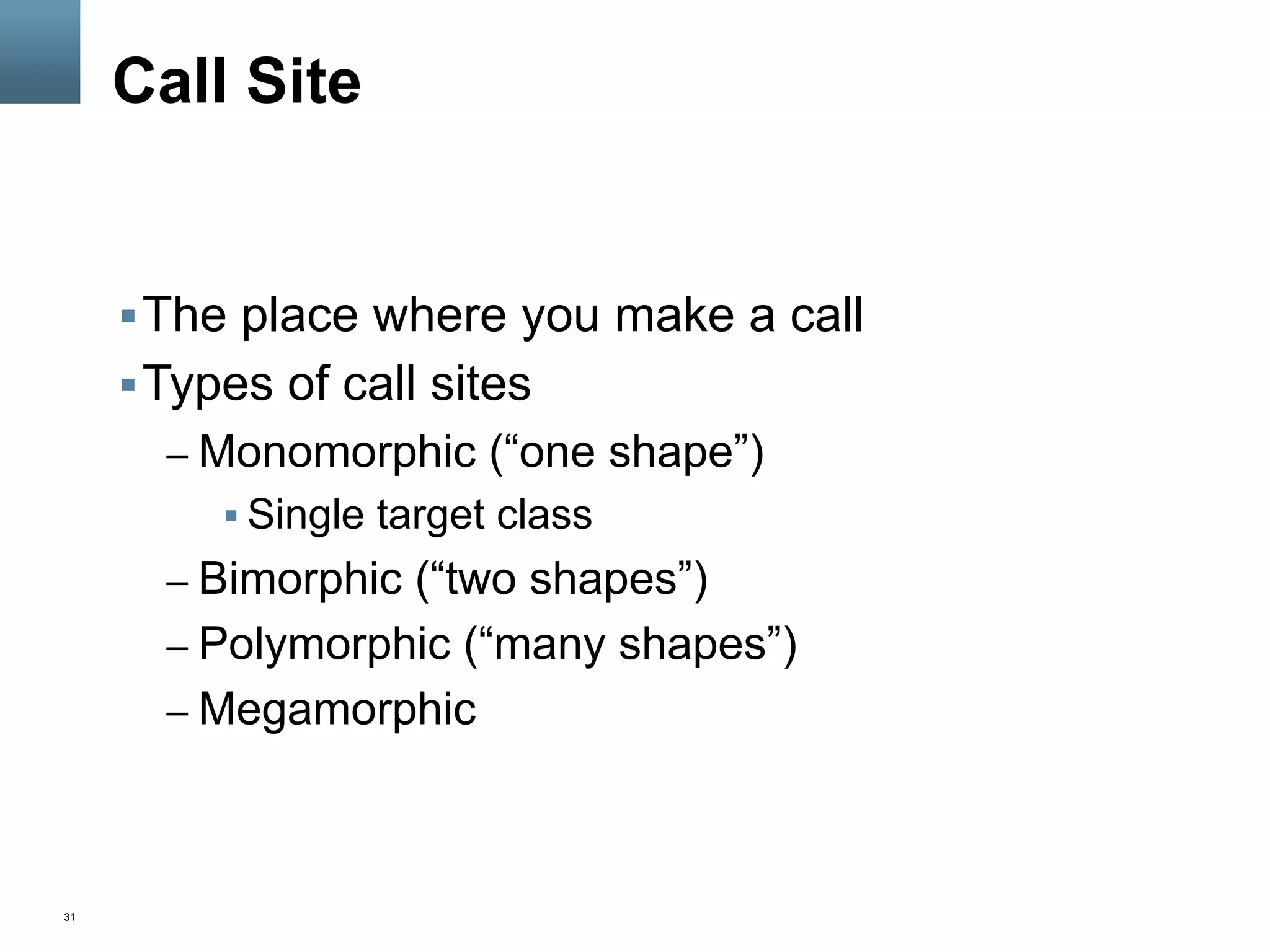
Call Site
§ The place where you make a call
§ Types of call sites
– Monomorphic (“one shape”)
§ Single target class
– Bimorphic (“two shapes”)
– Polymorphic (“many shapes”)
– Megamorphic
32
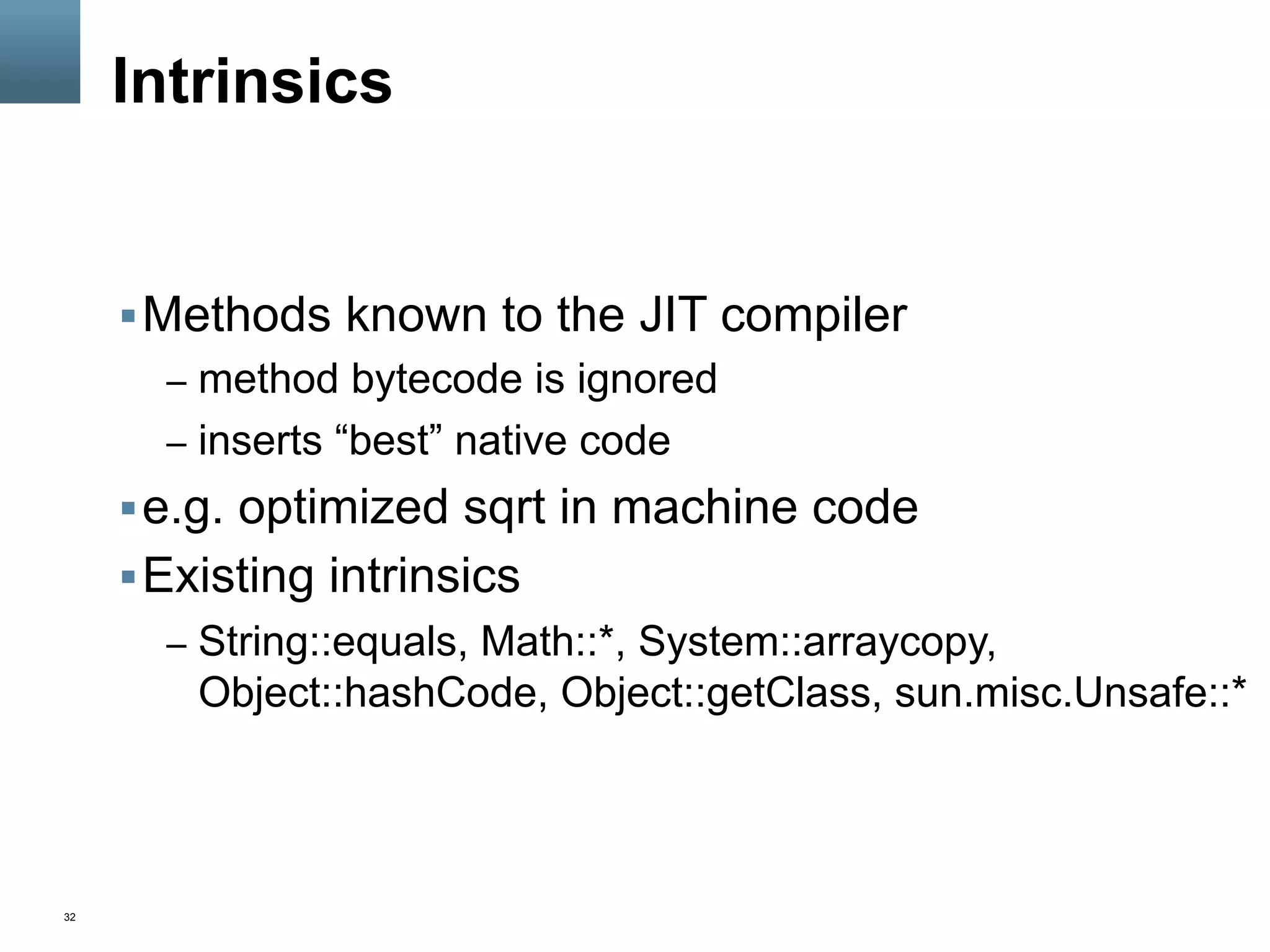
Intrinsics
§ Methods known to the JIT compiler
–  method bytecode is ignored
–  inserts “best” native code
§ e.g. optimized sqrt in machine code
§ Existing intrinsics
–  String::equals, Math::*, System::arraycopy,
Object::hashCode, Object::getClass, sun.misc.Unsafe::*
33
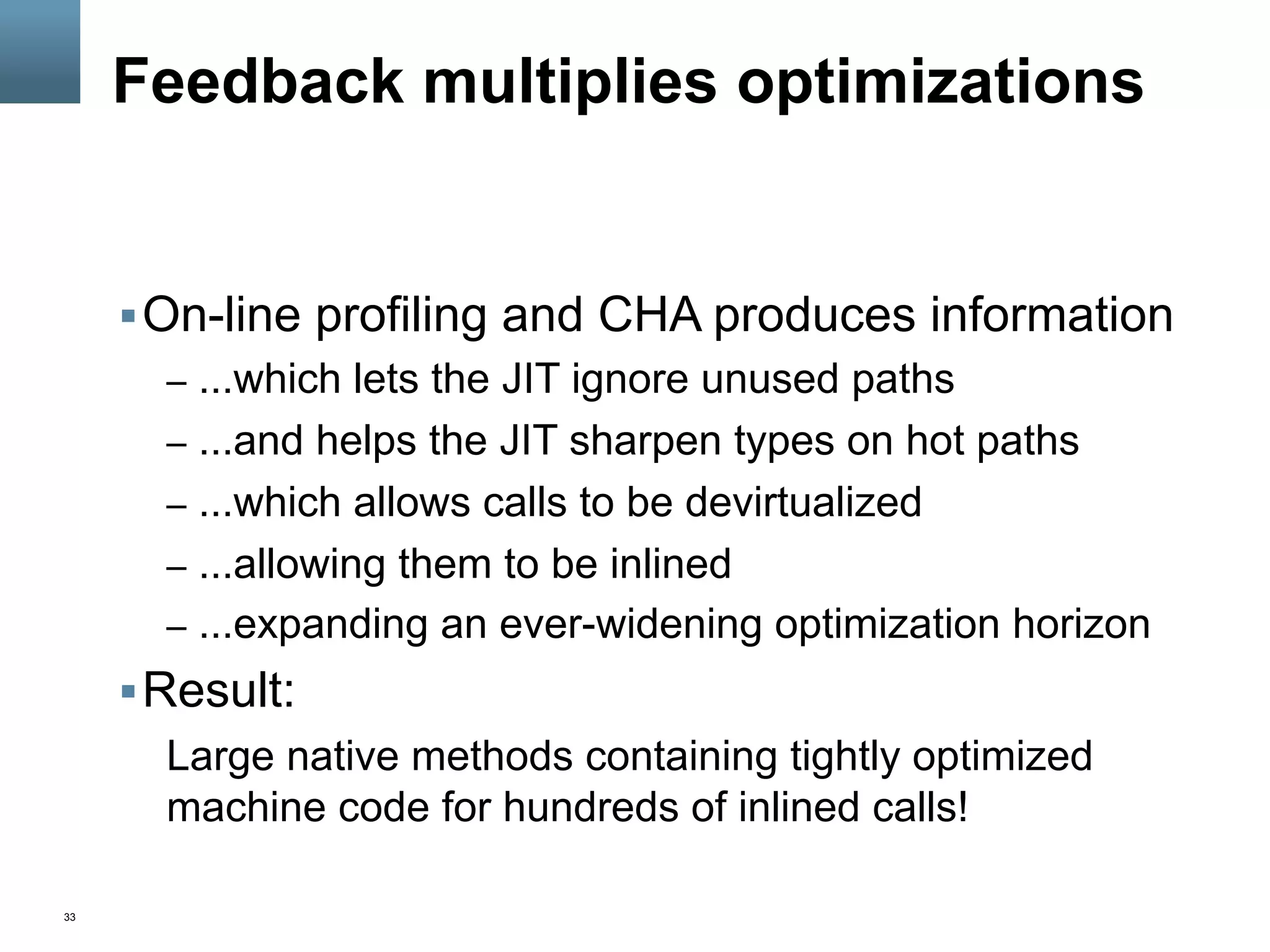
Feedback multiplies optimizations
§ On-line profiling and CHA produces information
–  ...which lets the JIT ignore unused paths
–  ...and helps the JIT sharpen types on hot paths
–  ...which allows calls to be devirtualized
–  ...allowing them to be inlined
–  ...expanding an ever-widening optimization horizon
§ Result:
Large native methods containing tightly optimized
machine code for hundreds of inlined calls!
34
HotSpot JVM
35
JVMs
§ Oracle HotSpot
§ IBM J9
§ Oracle JRockit
§ Azul Zing
§ Excelsior JET
§ Jikes RVM
Implementations
36
HotSpot JVM
§ client / C1
§ server / C2
§ tiered mode (C1 + C2)
JIT-compilers
37
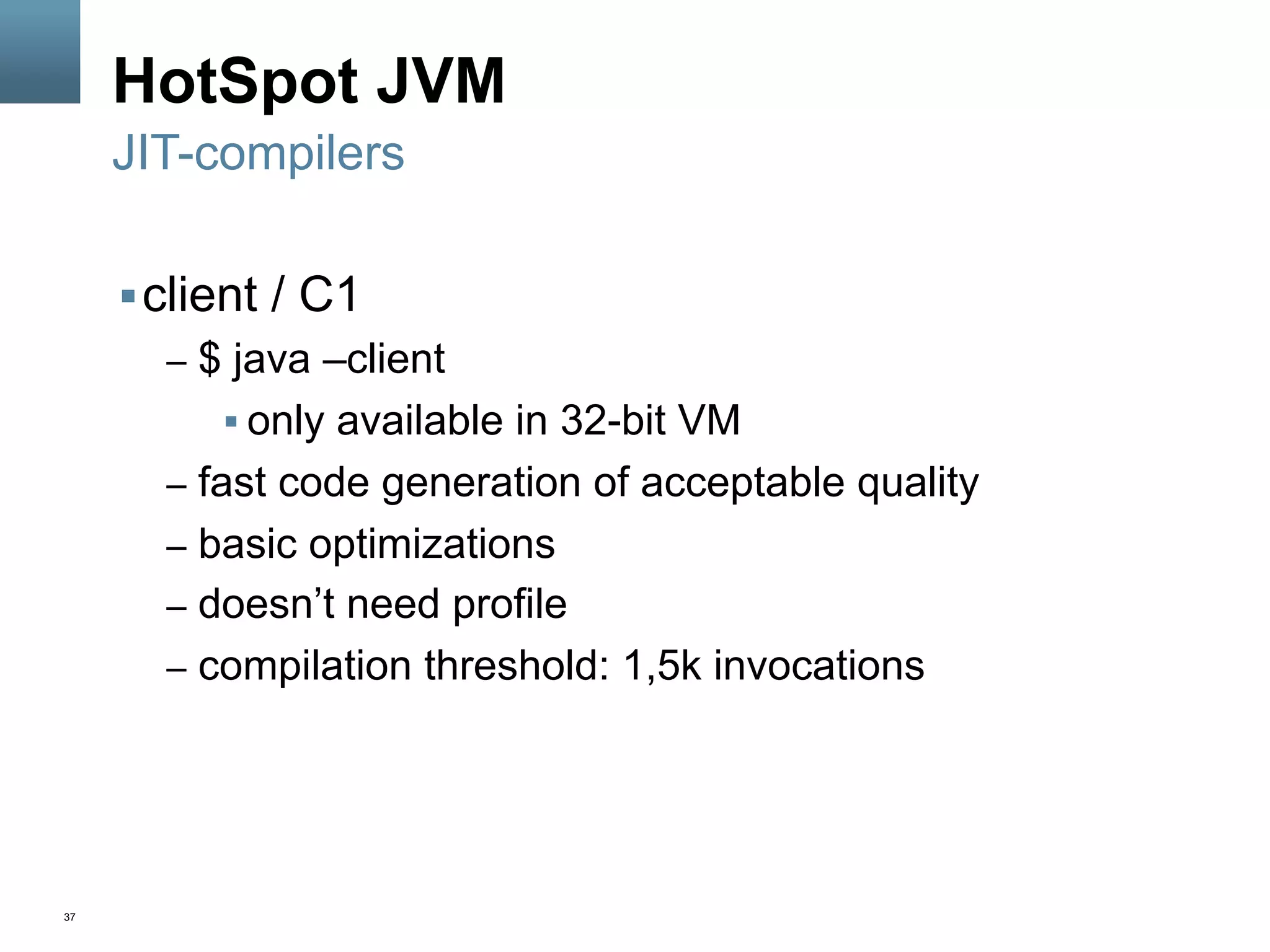
HotSpot JVM
§ client / C1
–  $ java –client
§ only available in 32-bit VM
–  fast code generation of acceptable quality
–  basic optimizations
–  doesn’t need profile
–  compilation threshold: 1,5k invocations
JIT-compilers
38
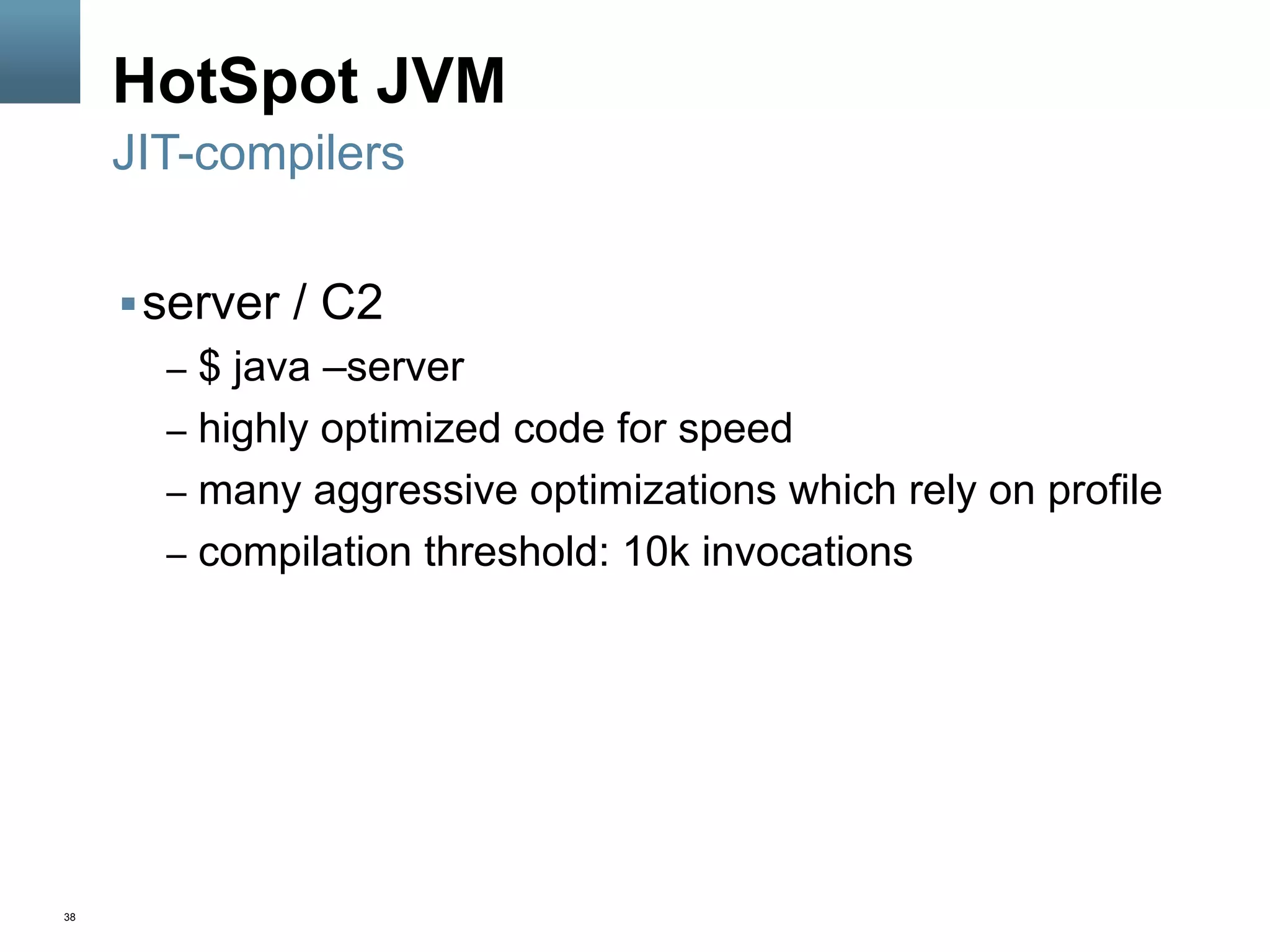
HotSpot JVM
§ server / C2
–  $ java –server
–  highly optimized code for speed
–  many aggressive optimizations which rely on profile
–  compilation threshold: 10k invocations
JIT-compilers
39
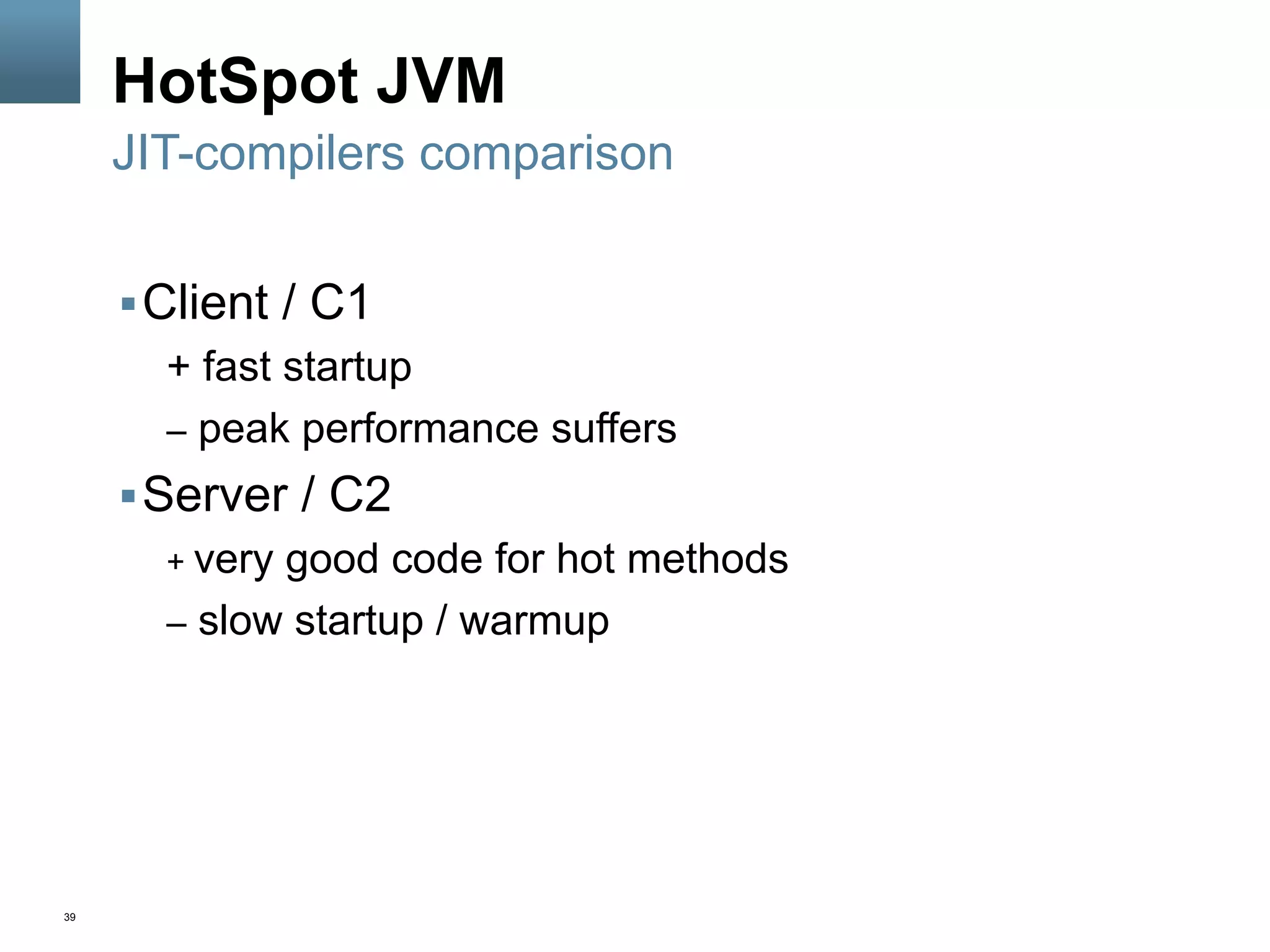
HotSpot JVM
§ Client / C1
+ fast startup
–  peak performance suffers
§ Server / C2
+ very good code for hot methods
–  slow startup / warmup
JIT-compilers comparison
40
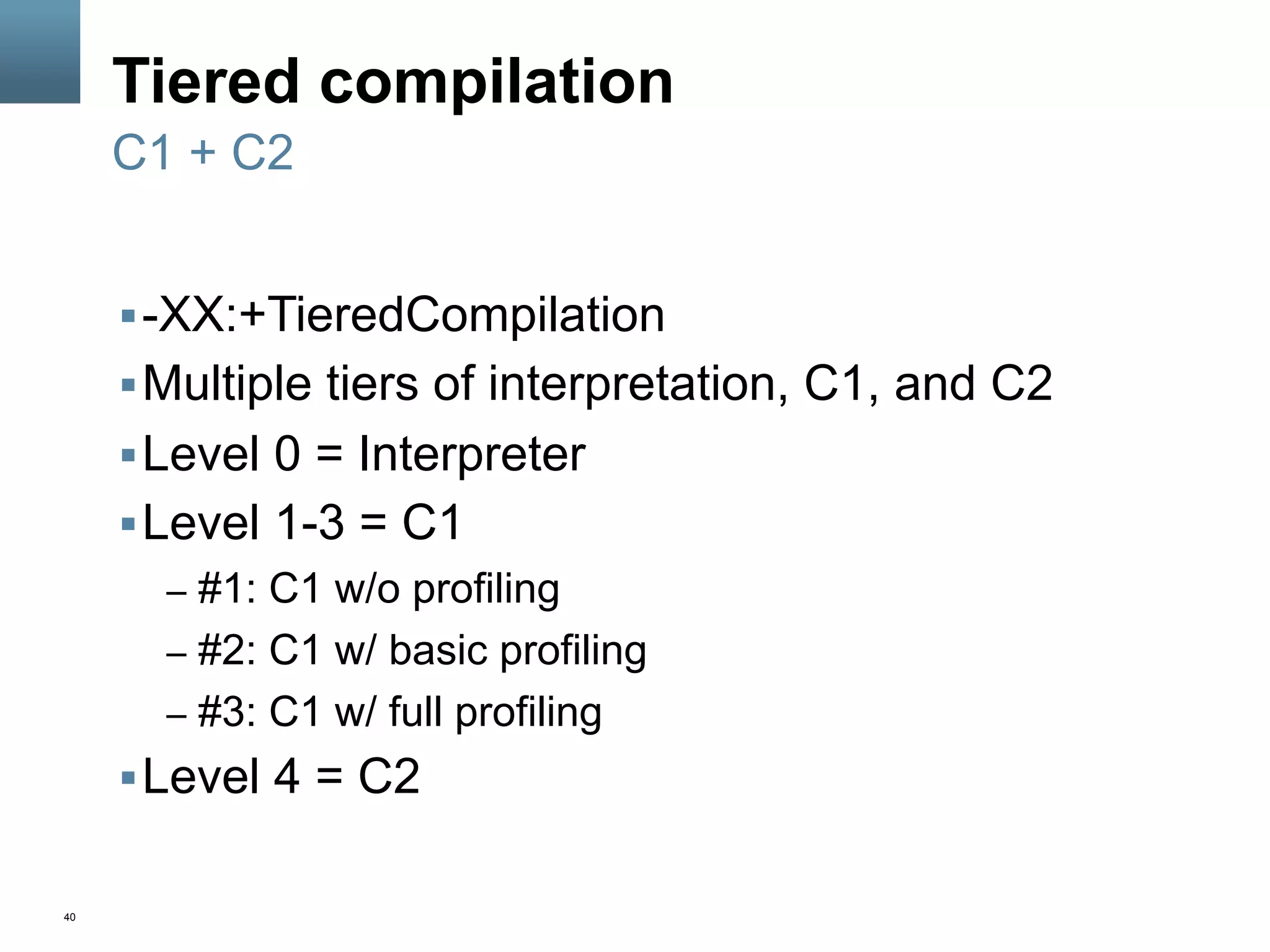
Tiered compilation
§ -XX:+TieredCompilation
§ Multiple tiers of interpretation, C1, and C2
§ Level 0 = Interpreter
§ Level 1-3 = C1
–  #1: C1 w/o profiling
–  #2: C1 w/ basic profiling
–  #3: C1 w/ full profiling
§ Level 4 = C2
C1 + C2
41
Monitoring JIT
42
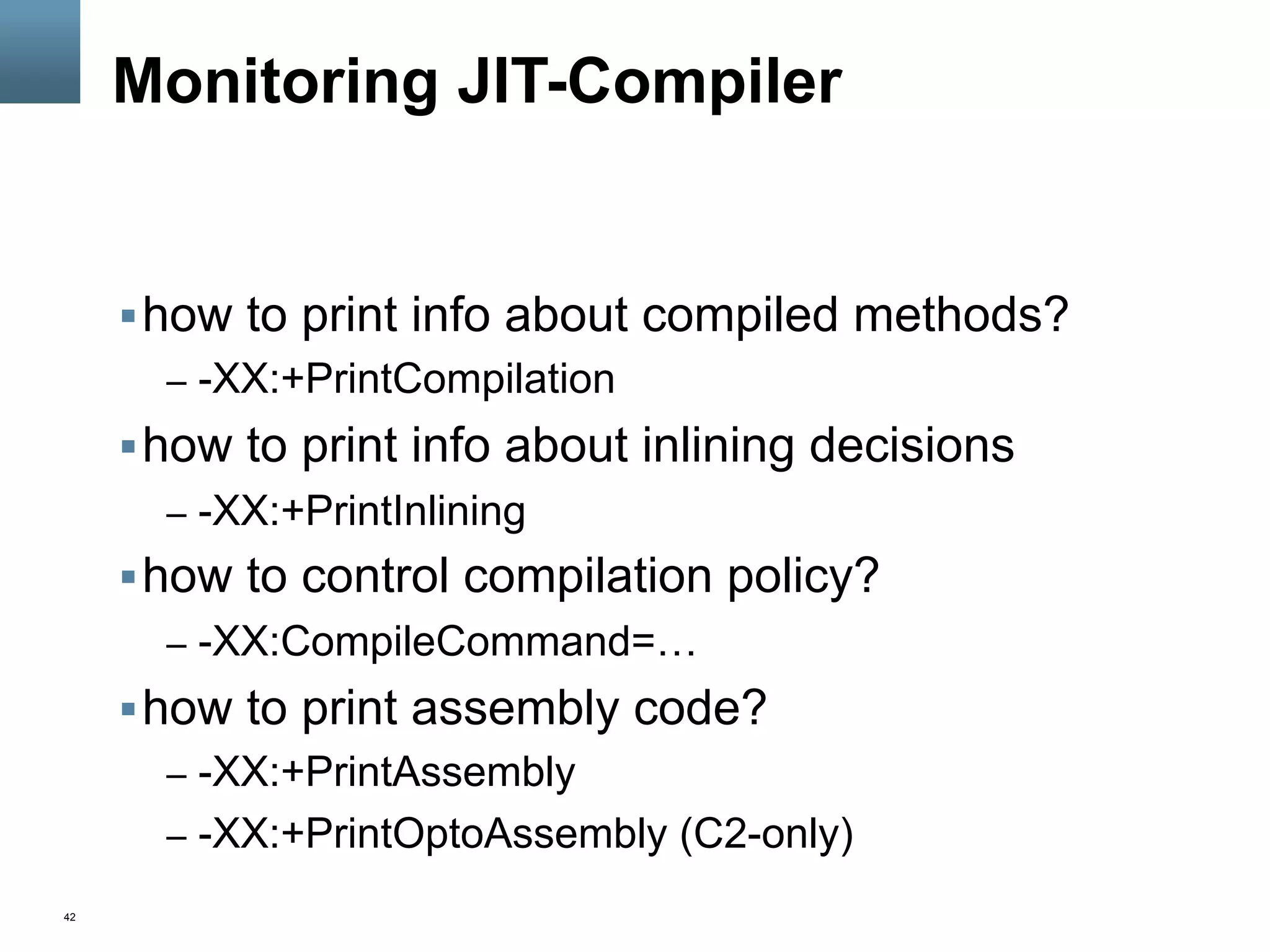
Monitoring JIT-Compiler
§ how to print info about compiled methods?
–  -XX:+PrintCompilation
§ how to print info about inlining decisions
–  -XX:+PrintInlining
§ how to control compilation policy?
–  -XX:CompileCommand=…
§ how to print assembly code?
–  -XX:+PrintAssembly
–  -XX:+PrintOptoAssembly (C2-only)
43
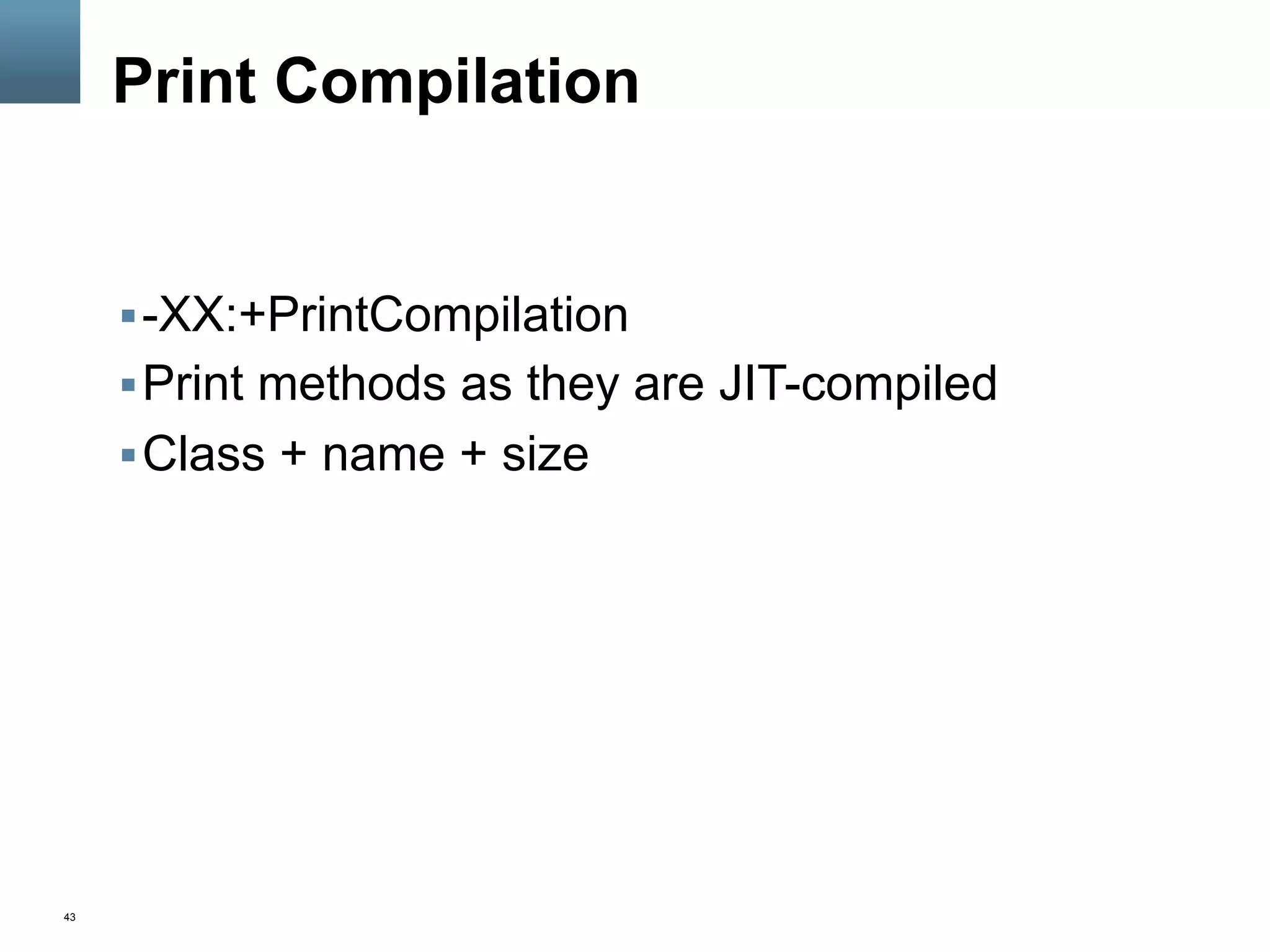
Print Compilation
§ -XX:+PrintCompilation
§ Print methods as they are JIT-compiled
§ Class + name + size
44
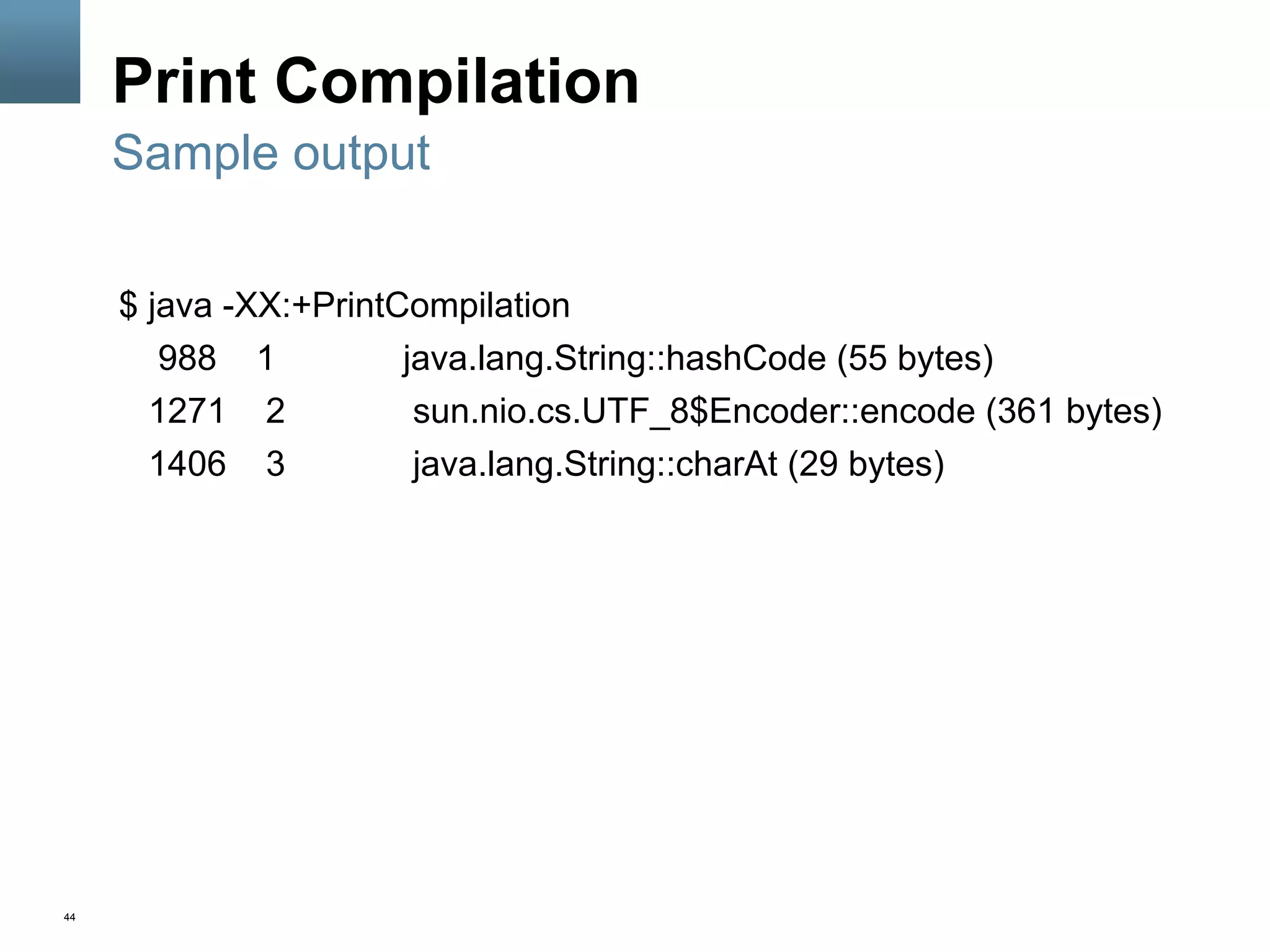
Print Compilation
$ java -XX:+PrintCompilation
988 1 java.lang.String::hashCode (55 bytes)
1271 2 sun.nio.cs.UTF_8$Encoder::encode (361 bytes)
1406 3 java.lang.String::charAt (29 bytes)
Sample output
45
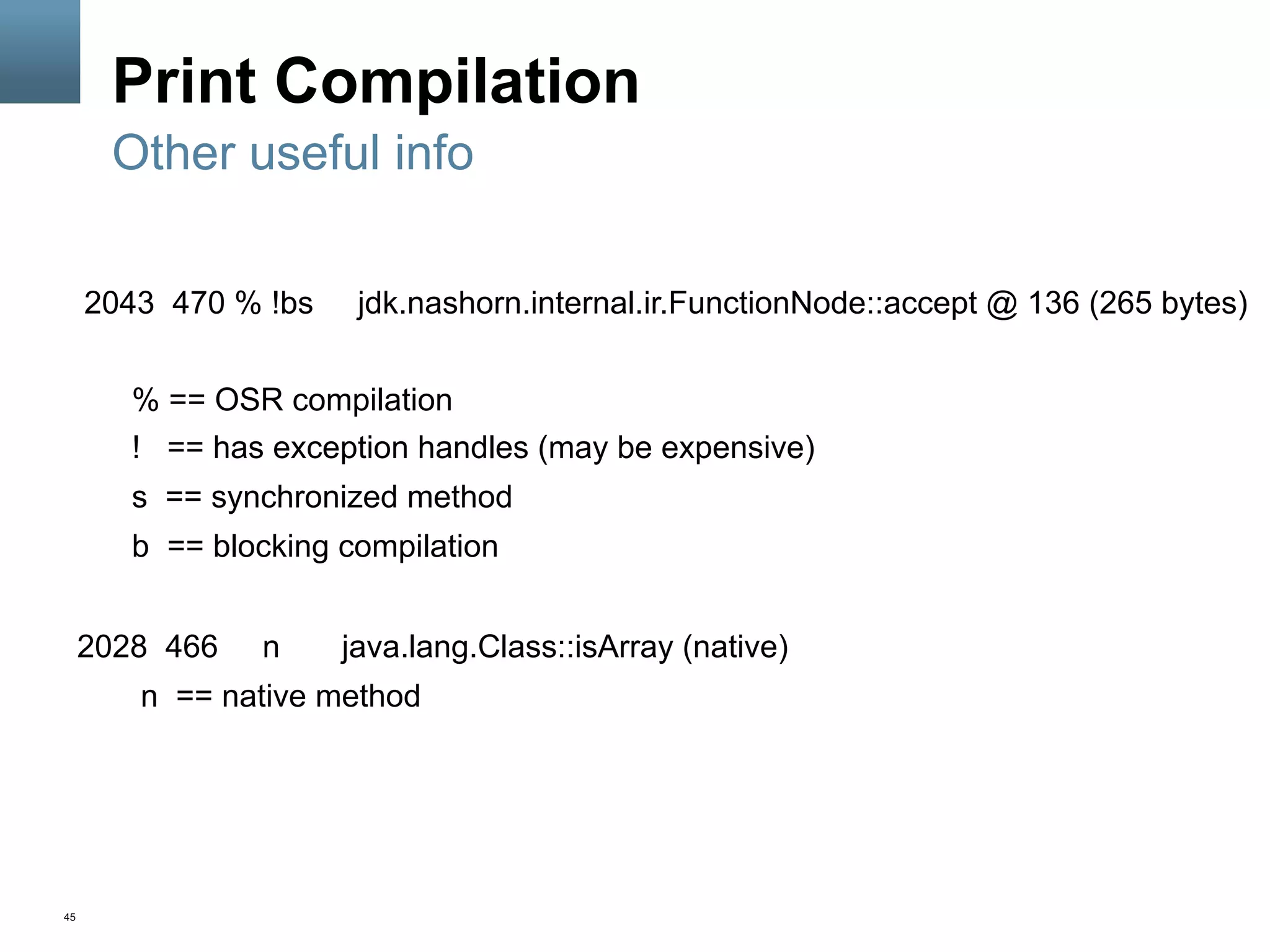
Print Compilation
2043 470 % !bs jdk.nashorn.internal.ir.FunctionNode::accept @ 136 (265 bytes)
% == OSR compilation
! == has exception handles (may be expensive)
s == synchronized method
b == blocking compilation
2028 466 n java.lang.Class::isArray (native)
n == native method
Other useful info
46
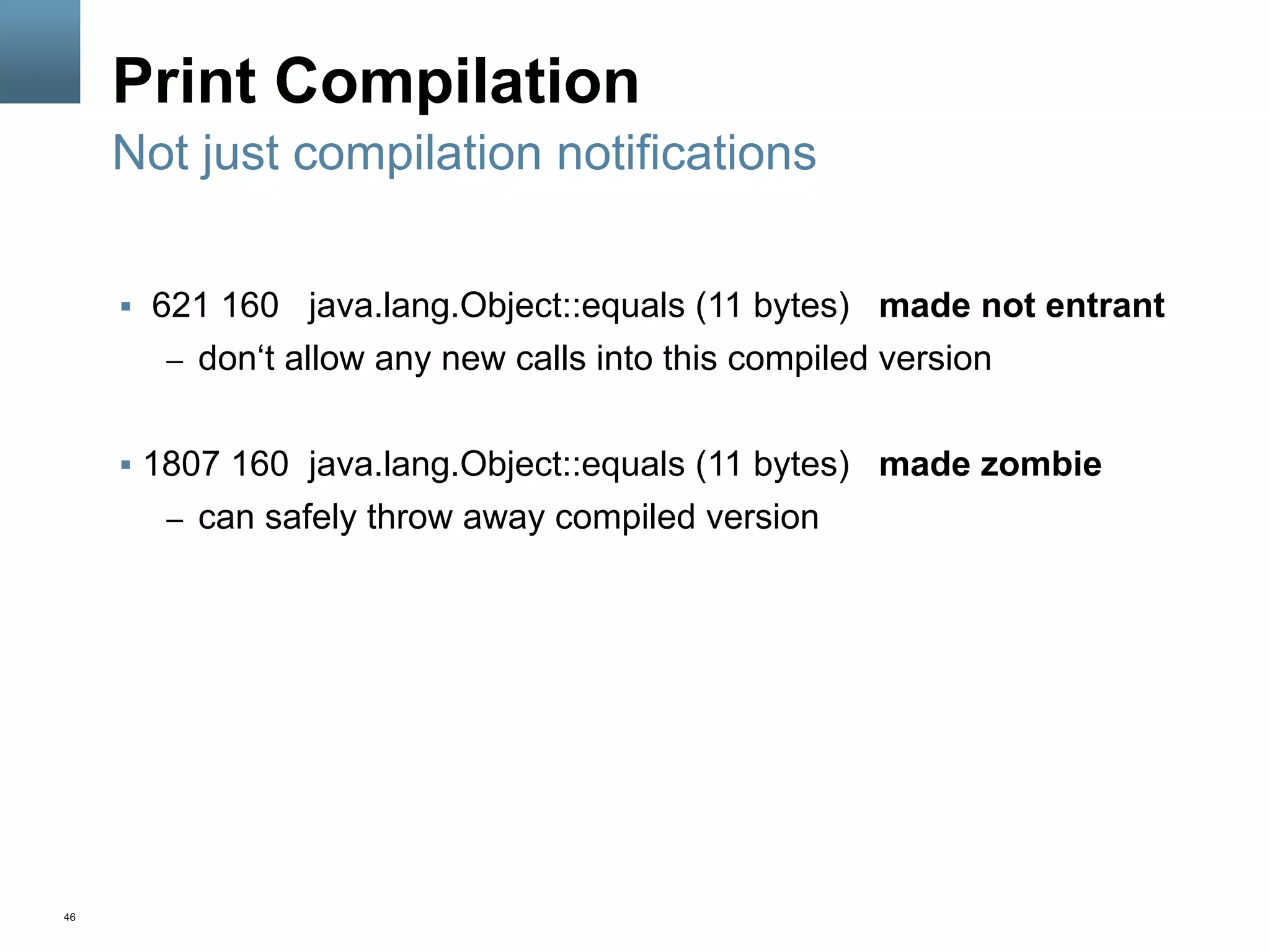
Print Compilation
§  621 160 java.lang.Object::equals (11 bytes) made not entrant
–  don‘t allow any new calls into this compiled version
§  1807 160 java.lang.Object::equals (11 bytes) made zombie
–  can safely throw away compiled version
Not just compilation notifications
47
No JIT At All?
§ Code is too large
§ Code isn’t too «hot»
–  executed not too often
48
Print Inlining
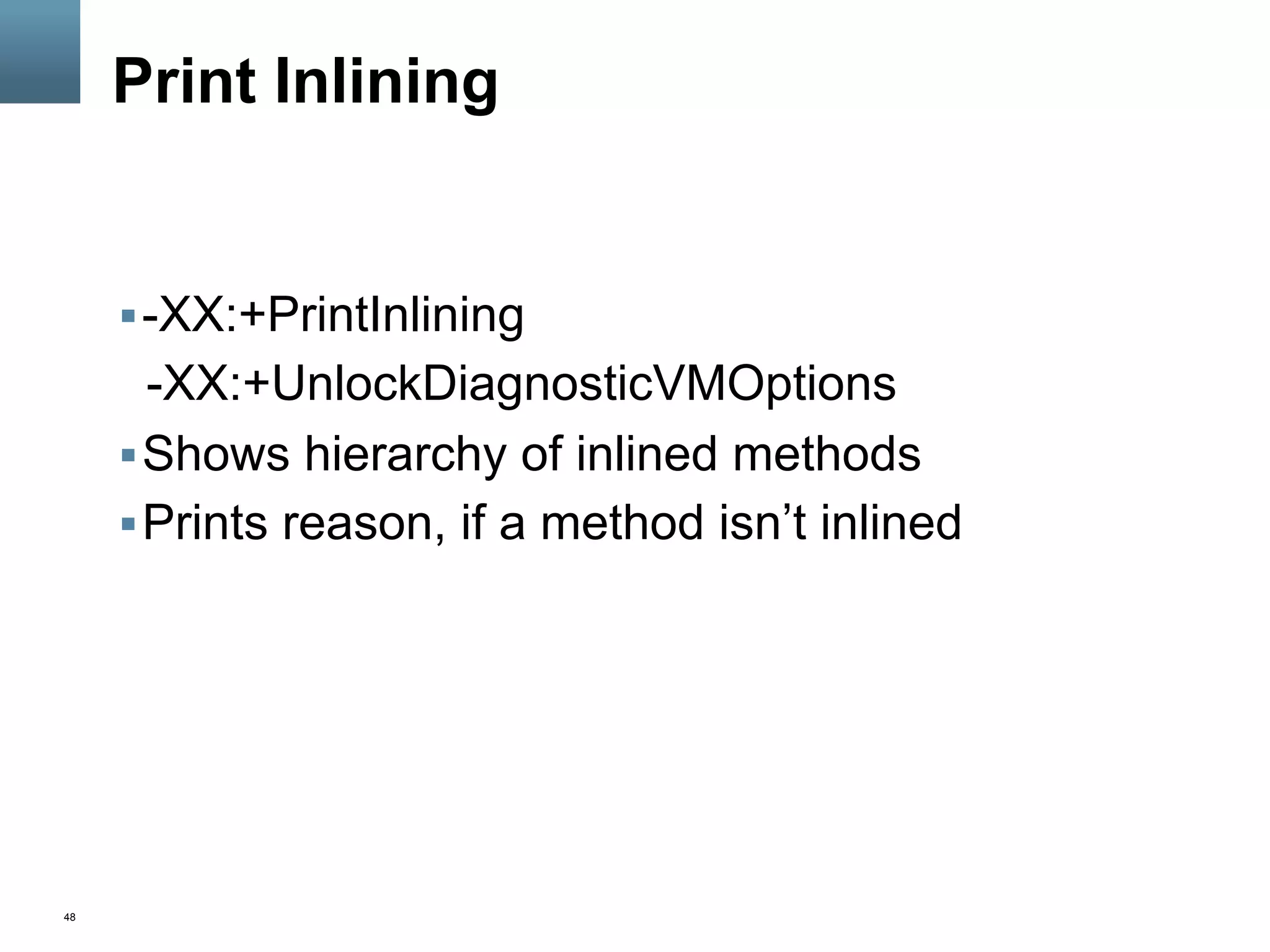
§ -XX:+PrintInlining
-XX:+UnlockDiagnosticVMOptions
§ Shows hierarchy of inlined methods
§ Prints reason, if a method isn’t inlined
49
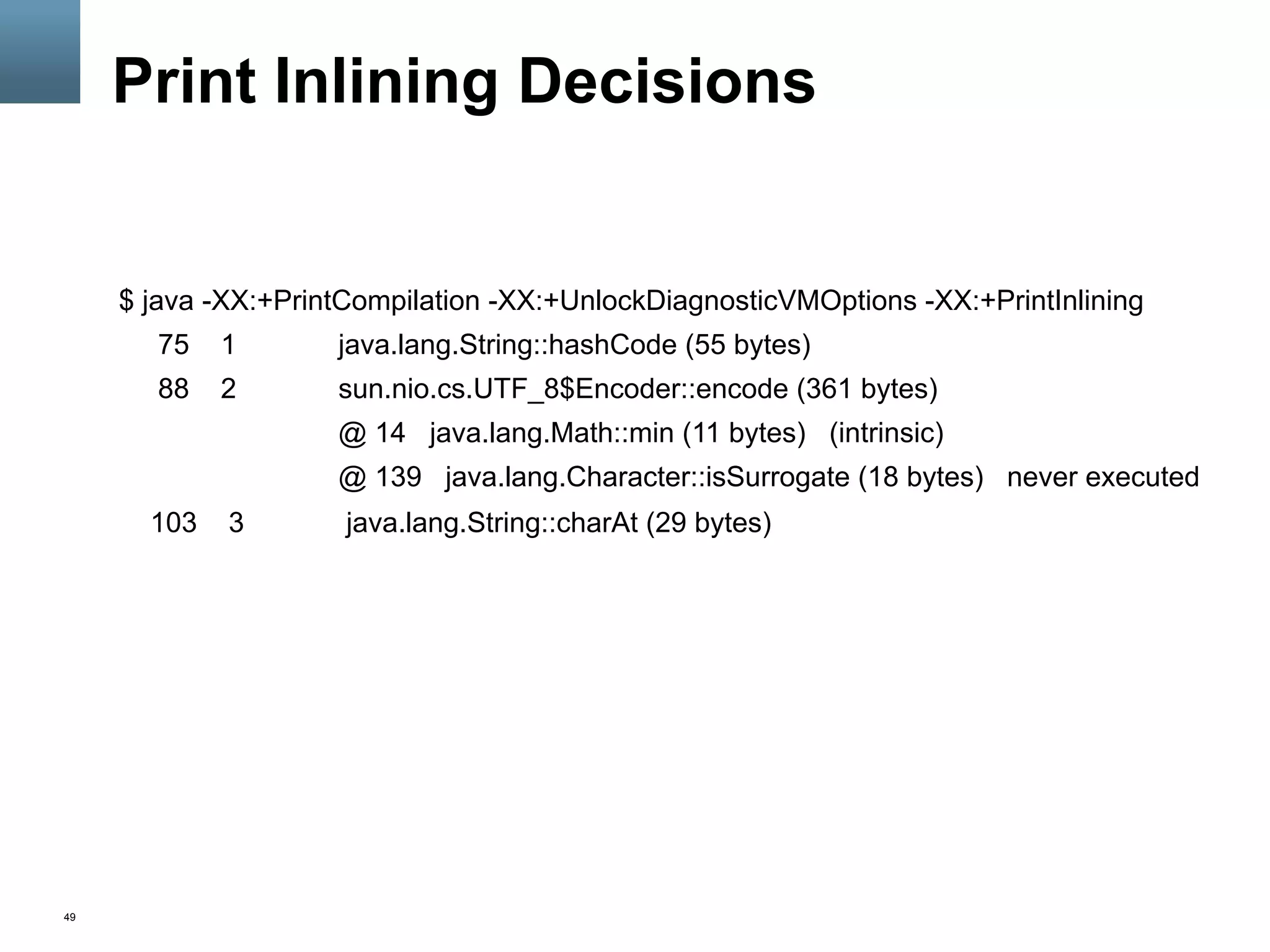
Print Inlining Decisions
$ java -XX:+PrintCompilation -XX:+UnlockDiagnosticVMOptions -XX:+PrintInlining
75 1 java.lang.String::hashCode (55 bytes)
88 2 sun.nio.cs.UTF_8$Encoder::encode (361 bytes)
@ 14 java.lang.Math::min (11 bytes) (intrinsic)
@ 139 java.lang.Character::isSurrogate (18 bytes) never executed
103 3 java.lang.String::charAt (29 bytes)
50
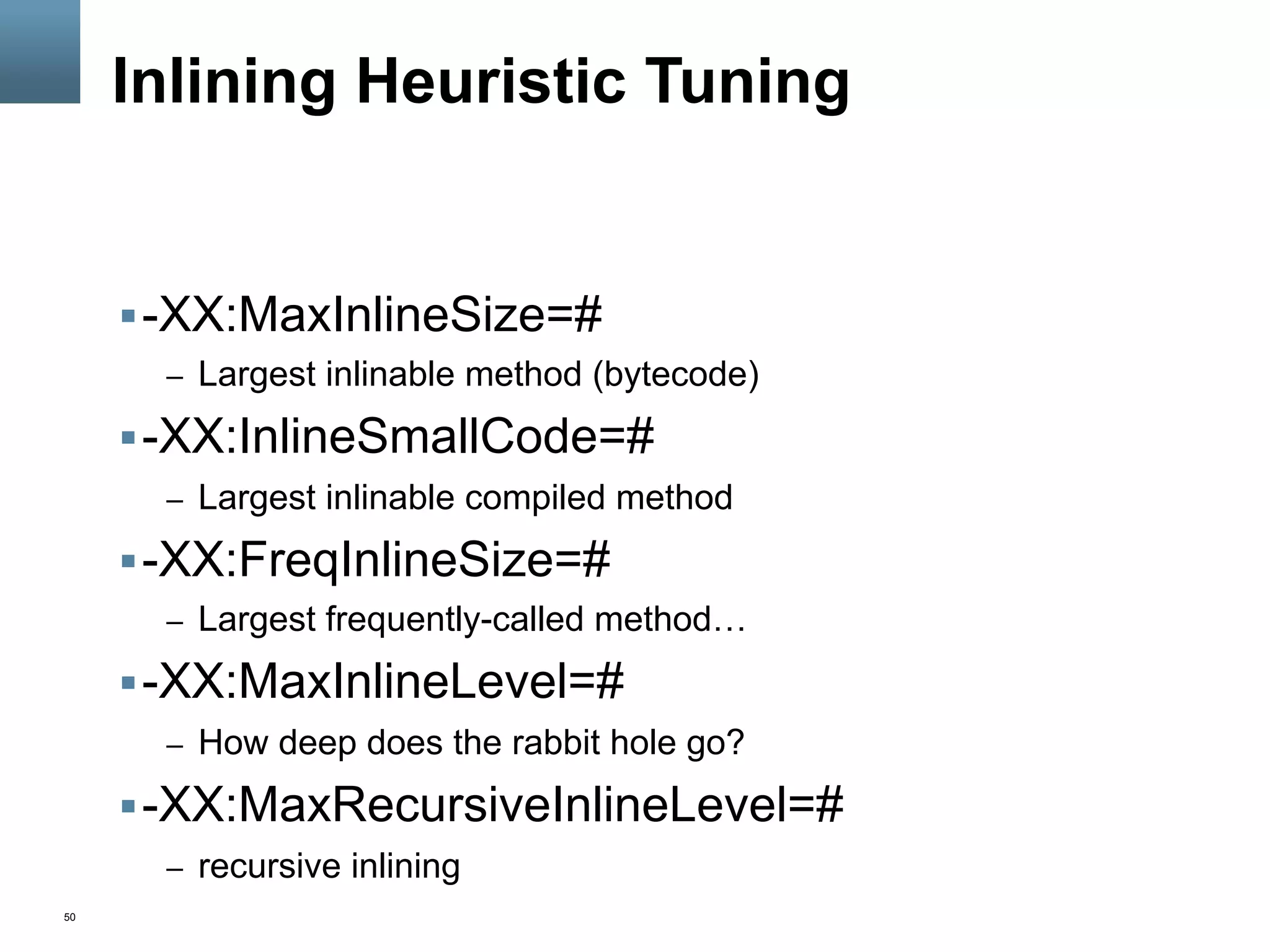
Inlining Heuristic Tuning
§ -XX:MaxInlineSize=#
–  Largest inlinable method (bytecode)
§ -XX:InlineSmallCode=#
–  Largest inlinable compiled method
§ -XX:FreqInlineSize=#
–  Largest frequently-called method…
§ -XX:MaxInlineLevel=#
–  How deep does the rabbit hole go?
§ -XX:MaxRecursiveInlineLevel=#
–  recursive inlining
51
Machine Code
§ -XX:+PrintAssembly
§ http://wikis.sun.com/display/HotSpotInternals/
PrintAssembly
§ Knowing code compiles is good
§ Knowing code inlines is better
§ Seeing the actual assembly is best!
52
-XX:CompileCommand=
§ Syntax
–  “[command] [method] [signature]”
§ Supported commands
–  exclude – never compile
–  inline – always inline
–  dontinline – never inline
§ Method reference
–  class.name::methodName
§ Method signature is optional
53
What Have We Learned?
§ How JIT compilers work
§ How HotSpot’s JIT works
§ How to monitor the JIT in HotSpot
54
Questions?
vladimir.x.ivanov@oracle.com
@iwanowww
55
Graphic Section Divider

"JIT compiler overview" @ JEEConf 2013, Kiev, Ukraine

  • 1.
  • 2.
    2 Agenda §  about compilersin general –  … and JIT-compilers in particular §  about JIT-compilers in HotSpot JVM §  monitoring JIT-compilers in HotSpot JVM
  • 3.
  • 4.
    4 Dynamic vs StaticCompilation § Static compilation –  “ahead-of-time”(AOT) compilation –  Source code → Native executable –  Most of compilation work happens before execution § Modern Java VMs use dynamic compilers (JIT) –  “just-in-time” (JIT) compilation –  Source → Bytecode → Interpreter + JITted executable –  Most of compilation work happens during execution Differences
  • 5.
    5 Dynamic vs StaticCompilation § Static compilation (AOT) –  can utilize complex and heavy analyses and optimizations –  … but static information sometimes isn’t enough –  … and it’s hard to rely on profiling info, if any –  moreover, how to utilize specific platform features (like SSE 4.2)? Differences
  • 6.
    6 Dynamic vs StaticCompilation § Modern Java VMs use dynamic compilers (JIT) –  aggressive optimistic optimizations § through extensive usage of profiling info –  … but budget is limited and shared with an application –  startup speed suffers –  peak performance may suffer as well (not necessary) Differences
  • 7.
  • 8.
    8 JVM § Runtime –  class loading,bytecode verification, synchronization § JIT –  profiling, compilation plans, OSR –  aggressive optimizations § GC –  different algorithms: throughput vs. response time § Serviceability –  JVMTI, JFR, Serviceability Agent Subsystems
  • 9.
    9 Dynamic Compilation (JIT) § Just-In-Timecompilation § Compiled when needed § Maybe immediately before execution –  ...or when we decide it’s important –  ...or never?
  • 10.
    10 Dynamic Compilation (JIT) § Knowsabout –  loaded classes, methods the program has executed § Makes optimization decisions based on code paths executed –  Code generation depends on what is observed: § loaded classes, code paths executed, branches taken § May re-optimize if assumption was wrong, or alternative code paths taken –  Instruction path length may change between invocations of methods as a result of de-optimization / re-compilation
  • 11.
    11 Dynamic Compilation (JIT) § Cando non-conservative optimizations in dynamic § Separates optimization from product delivery cycle –  Update JVM, run the same application, realize improved performance! –  Can be "tuned" to the target platform
  • 12.
    12 JVM: Makes BytecodesFast § JVMs eventually JIT bytecodes –  To make them fast –  Some JITs are high quality optimizing compilers § But cannot use existing static compilers directly: –  Tracking OOPs (ptrs) for GC –  Java Memory Model (volatile reordering & fences) –  New code patterns to optimize –  Time & resource constraints (CPU, memory)
  • 13.
    13 JVM: Makes BytecodesFast § JIT'ing requires profiling –  Because you don't want to JIT everything § Profiling allows focused code-gen § Profiling allows better code-gen –  Inline what’s hot –  Loop unrolling, range-check elimination, etc –  Branch prediction, spill-code-gen, scheduling
  • 14.
    14 Profiling § Gathers data aboutcode during execution –  invariants § types, constants (e.g. null pointers) –  statistics § branches, calls § Gathered data is used during optimization –  Educated guess –  Guess can be wrong
  • 15.
    15 Optimistic Compilers § Assume profileis accurate –  Aggressively optimize based on profile –  Bail out if the profile lies §  ... and hope that they’re usually right
  • 16.
    16 Profile-guided optimization (PGO) § Useprofile for more efficient optimization § PGO in JVMs –  Always have it, turned on by default –  Developers (usually) not interested/concerned about it –  Profile is always consistent to execution scenario
  • 17.
    17 Dynamic Compilation (JIT) § Isdynamic compilation overhead essential? –  The longer your application runs, the less the overhead § Trading off compilation time, not application time –  Steal some cycles very early in execution –  Done “automagically” and transparently to application § Most of “perceived” overhead is compiler waiting for more data –  ... thus running semi-optimal code for time being Overhead
  • 18.
    18 Java Application lifetime JVMpoint of view Author: Aleksey Shipilev
  • 19.
    19 Mixed-Mode Execution § Interpreted –  Bytecode-walking – Artificial stack machine § Compiled –  Direct native operations –  Native register machine
  • 20.
    20 Bytecode Execution 1 2 34 InterpretationProfiling Dynamic CompilationDeoptimization
  • 21.
    21 Deoptimization § Bail out ofrunning native code –  stop executing native (JIT-generated) code –  start interpreting bytecode § It’s a complicated operation at runtime…
  • 22.
    22 OSR: On-Stack Replacement § Runningmethod never exits? § But it’s getting really hot? § Generally means loops, back-branching § Compile and replace while running § Not typically useful in large systems § Looks great on benchmarks!
  • 23.
  • 24.
    24 Optimizations in HotSpotJVM §  compiler tactics delayed compilation tiered compilation on-stack replacement delayed reoptimization program dependence graph rep. static single assignment rep. §  proof-based techniques exact type inference memory value inference memory value tracking constant folding reassociation operator strength reduction null check elimination type test strength reduction type test elimination algebraic simplification common subexpression elimination integer range typing §  flow-sensitive rewrites conditional constant propagation dominating test detection flow-carried type narrowing dead code elimination §  language-specific techniques class hierarchy analysis devirtualization symbolic constant propagation autobox elimination escape analysis lock elision lock fusion de-reflection §  speculative (profile-based) techniques optimistic nullness assertions optimistic type assertions optimistic type strengthening optimistic array length strengthening untaken branch pruning optimistic N-morphic inlining branch frequency prediction call frequency prediction §  memory and placement transformation expression hoisting expression sinking redundant store elimination adjacent store fusion card-mark elimination merge-point splitting §  loop transformations loop unrolling loop peeling safepoint elimination iteration range splitting range check elimination loop vectorization §  global code shaping inlining (graph integration) global code motion heat-based code layout switch balancing throw inlining §  control flow graph transformation local code scheduling local code bundling delay slot filling graph-coloring register allocation linear scan register allocation live range splitting copy coalescing constant splitting copy removal address mode matching instruction peepholing DFA-based code generator
  • 25.
    25 Inlining § Combine caller andcallee into one unit –  e.g.based on profile –  … or prove smth using CHA (Class Hierarchy Analysis) –  Perhaps with a guard/test § Optimize as a whole –  More code means better visibility
  • 26.
    26 Inlining int addAll(int max){ int accum = 0; for (int i = 0; i < max; i++) { accum = add(accum, i); } return accum; } int add(int a, int b) { return a + b; }
  • 27.
    27 Inlining int addAll(int max){ int accum = 0; for (int i = 0; i < max; i++) { accum = accum + i; } return accum; }
  • 28.
    28 JVM: Makes VirtualCalls Fast § C++ avoids virtual calls – because they are slow § Java embraces them – and makes them fast –  Well, mostly fast – JIT's do Class Hierarchy Analysis (CHA) –  CHA turns most virtual calls into static calls –  JVM detects new classes loaded, adjusts CHA § May need to re-JIT –  When CHA fails to make the call static, inline caches –  When IC's fail, virtual calls are back to being slow
  • 29.
    29 Inlining and devirtualization § Inliningis the most profitable compiler optimization –  Rather straightforward to implement –  Huge benefits: expands the scope for other optimizations § OOP needs polymorphism, that implies virtual calls –  Prevents naïve inlining –  Devirtualization is required –  (This does not mean you should not write OOP code)
  • 30.
    30 Devirtualization in JVM § Applicationdevelopers shouldn't care § Analyzes hierarchy of currently loaded classes § Efficiently devirtualizes all monomorphic calls § Able to devirtualize polymorphic calls § JVM may inline dynamic methods –  Reflection calls –  Runtime-synthesized methods –  JSR 292
  • 31.
    31 Call Site § The placewhere you make a call § Types of call sites – Monomorphic (“one shape”) § Single target class – Bimorphic (“two shapes”) – Polymorphic (“many shapes”) – Megamorphic
  • 32.
    32 Intrinsics § Methods known tothe JIT compiler –  method bytecode is ignored –  inserts “best” native code § e.g. optimized sqrt in machine code § Existing intrinsics –  String::equals, Math::*, System::arraycopy, Object::hashCode, Object::getClass, sun.misc.Unsafe::*
  • 33.
    33 Feedback multiplies optimizations § On-lineprofiling and CHA produces information –  ...which lets the JIT ignore unused paths –  ...and helps the JIT sharpen types on hot paths –  ...which allows calls to be devirtualized –  ...allowing them to be inlined –  ...expanding an ever-widening optimization horizon § Result: Large native methods containing tightly optimized machine code for hundreds of inlined calls!
  • 34.
  • 35.
    35 JVMs § Oracle HotSpot § IBM J9 § OracleJRockit § Azul Zing § Excelsior JET § Jikes RVM Implementations
  • 36.
    36 HotSpot JVM § client /C1 § server / C2 § tiered mode (C1 + C2) JIT-compilers
  • 37.
    37 HotSpot JVM § client /C1 –  $ java –client § only available in 32-bit VM –  fast code generation of acceptable quality –  basic optimizations –  doesn’t need profile –  compilation threshold: 1,5k invocations JIT-compilers
  • 38.
    38 HotSpot JVM § server /C2 –  $ java –server –  highly optimized code for speed –  many aggressive optimizations which rely on profile –  compilation threshold: 10k invocations JIT-compilers
  • 39.
    39 HotSpot JVM § Client /C1 + fast startup –  peak performance suffers § Server / C2 + very good code for hot methods –  slow startup / warmup JIT-compilers comparison
  • 40.
    40 Tiered compilation § -XX:+TieredCompilation § Multiple tiersof interpretation, C1, and C2 § Level 0 = Interpreter § Level 1-3 = C1 –  #1: C1 w/o profiling –  #2: C1 w/ basic profiling –  #3: C1 w/ full profiling § Level 4 = C2 C1 + C2
  • 41.
  • 42.
    42 Monitoring JIT-Compiler § how toprint info about compiled methods? –  -XX:+PrintCompilation § how to print info about inlining decisions –  -XX:+PrintInlining § how to control compilation policy? –  -XX:CompileCommand=… § how to print assembly code? –  -XX:+PrintAssembly –  -XX:+PrintOptoAssembly (C2-only)
  • 43.
    43 Print Compilation § -XX:+PrintCompilation § Print methodsas they are JIT-compiled § Class + name + size
  • 44.
    44 Print Compilation $ java-XX:+PrintCompilation 988 1 java.lang.String::hashCode (55 bytes) 1271 2 sun.nio.cs.UTF_8$Encoder::encode (361 bytes) 1406 3 java.lang.String::charAt (29 bytes) Sample output
  • 45.
    45 Print Compilation 2043 470% !bs jdk.nashorn.internal.ir.FunctionNode::accept @ 136 (265 bytes) % == OSR compilation ! == has exception handles (may be expensive) s == synchronized method b == blocking compilation 2028 466 n java.lang.Class::isArray (native) n == native method Other useful info
  • 46.
    46 Print Compilation §  621160 java.lang.Object::equals (11 bytes) made not entrant –  don‘t allow any new calls into this compiled version §  1807 160 java.lang.Object::equals (11 bytes) made zombie –  can safely throw away compiled version Not just compilation notifications
  • 47.
    47 No JIT AtAll? § Code is too large § Code isn’t too «hot» –  executed not too often
  • 48.
    48 Print Inlining § -XX:+PrintInlining -XX:+UnlockDiagnosticVMOptions § Shows hierarchyof inlined methods § Prints reason, if a method isn’t inlined
  • 49.
    49 Print Inlining Decisions $java -XX:+PrintCompilation -XX:+UnlockDiagnosticVMOptions -XX:+PrintInlining 75 1 java.lang.String::hashCode (55 bytes) 88 2 sun.nio.cs.UTF_8$Encoder::encode (361 bytes) @ 14 java.lang.Math::min (11 bytes) (intrinsic) @ 139 java.lang.Character::isSurrogate (18 bytes) never executed 103 3 java.lang.String::charAt (29 bytes)
  • 50.
    50 Inlining Heuristic Tuning § -XX:MaxInlineSize=# – Largest inlinable method (bytecode) § -XX:InlineSmallCode=# –  Largest inlinable compiled method § -XX:FreqInlineSize=# –  Largest frequently-called method… § -XX:MaxInlineLevel=# –  How deep does the rabbit hole go? § -XX:MaxRecursiveInlineLevel=# –  recursive inlining
  • 51.
    51 Machine Code § -XX:+PrintAssembly § http://wikis.sun.com/display/HotSpotInternals/ PrintAssembly § Knowing codecompiles is good § Knowing code inlines is better § Seeing the actual assembly is best!
  • 52.
    52 -XX:CompileCommand= § Syntax –  “[command] [method][signature]” § Supported commands –  exclude – never compile –  inline – always inline –  dontinline – never inline § Method reference –  class.name::methodName § Method signature is optional
  • 53.
    53 What Have WeLearned? § How JIT compilers work § How HotSpot’s JIT works § How to monitor the JIT in HotSpot
  • 54.
  • 55.