The Cloud Native Compiler:
JIT-as-a-Service
Presented by Simon Ritter, Deputy CTO | Azul
2
Why Is Java So Popular?
• It's a great language
o Easy to write, easy to read
• It has great libraries
o Pretty much anything you can think off, almost always a FOSS version as well as commercial
• It has a great community
o JUGs, Champions, conferences, etc, etc
o Easy to find Java programmers
• But really, it's the Java Virtual Machine
o Write once, run anywhere
o Excellent backwards compatibility
o A managed runtime environment
3
JVM Performance Warmup
• Classfiles contain bytecodes (instructions for a Virtual Machine)
• Initially, these are interpreted
o Each bytecode is converted to equivalent native instructions
• Frequently used methods (hotspots) are identified and compiled
o Just-in-Time (JIT) compilation
o Uses two compilers, C1 (fast compile, low optimisation) and C2 (slow compile, high optimisation)
• Each time the application is started, the same process begins again
o Profile code looking for hot methods
o Compile using C1 JIT, recompile using C2 JIT when hot enough
4
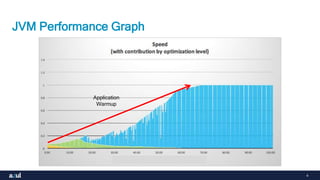
JVM Performance Graph
Application
Warmup
5
The Way JVMs Work Now
• Isolated
• Not connected to other instances
o No memory of past runs
• Entirely self-reliant
o Limited to local resources
o Limited to local functionality
o Results in multiple trade-offs
• No Magic Cloud
• Limited compute power
• Limited storage
• Limited local functionality
• Limited analytical capabilities
• Limited knowledge
6
Microservice-Based Application
7
Microservice-Based Application
8
Microservice-Based Application
9
JVMs In The Cloud
• Connected to vast networks
• Can leverage and rely on…
o external resources
o external functionality
o external experience
• Can leverage (and contribute to) additional value
• Assume access to a “magic cloud”
o “unlimited” compute power
o “unlimited” data storage
o “unlimited” analytical capabilities
o “knowledge”, “experience”, …
10
Cloud Native JVMs
• Has all the functionality of a JVM
• Outsources some of that core functionality to the cloud
• Delivers value to the cloud and to other JVMs that use that cloud
11
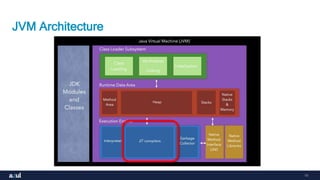
JVM Architecture
12
Basic Theory of JIT Compiler
• JVM provides “here is code I’d like to make better”
• JIT Compiler asks many “what do you know about X?” questions
• JIT Compiler eventually provides “here is code for your situation”
• JVM replaces existing code with new (hopefully better) code
• This is (currently) done with in-JVM JIT compilers
Speculative Optimisation

(The Secret of Java's Speed)
14
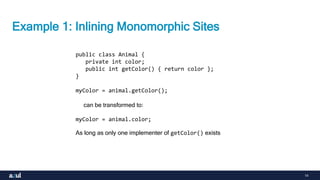
Example 1: Inlining Monomorphic Sites
public class Animal {
private int color;
public int getColor() { return color };
}
myColor = animal.getColor();
can be transformed to:
myColor = animal.color;
As long as only one implementer of getColor() existslic
class Animal {
15
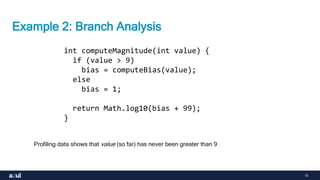
Example 2: Branch Analysis
int computeMagnitude(int value) {
if (value > 9)
bias = computeBias(value);
else
bias = 1;
return Math.log10(bias + 99);
}
Profiling data shows that value (so far) has never been greater than 9
16
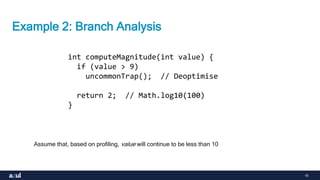
Example 2: Branch Analysis
Assume that, based on profiling, value will continue to be less than 10
int computeMagnitude(int value) {
if (value > 9)
uncommonTrap(); // Deoptimise
return 2; // Math.log10(100)
}
17
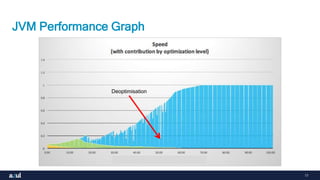
JVM Performance Graph
Deoptimisation
18
Speculatively Optimised Code
Optimised Code
Assumptions
(That must hold true
for code to work)
Only one getColor()
method exists
value is less than 10
19
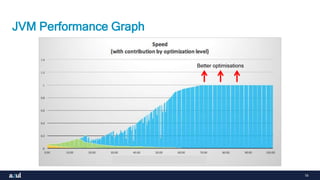
JVM Performance Graph
Better optimisations
20
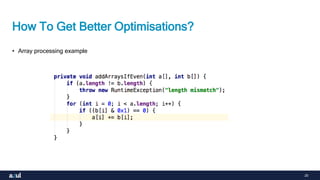
How To Get Better Optimisations?
• Array processing example
21
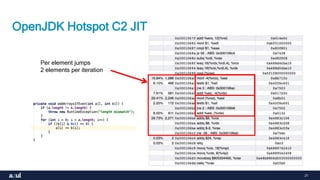
OpenJDK Hotspot C2 JIT
Per element jumps
2 elements per iteration
22
Azul Prime JVM Falcon JIT
Using AVX2 vector instructions
32 elements per iteration
Broadwell E5-2690-v4
23
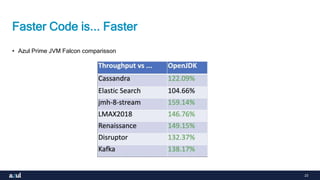
Faster Code is... Faster
• Azul Prime JVM Falcon comparisson
24
The Reality Of Better JIT
25
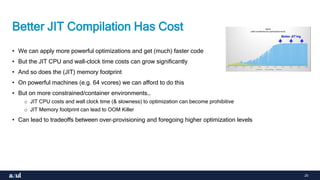
Better JIT Compilation Has Cost
• We can apply more powerful optimizations and get (much) faster code
• But the JIT CPU and wall-clock time costs can grow significantly
• And so does the (JIT) memory footprint
• On powerful machines (e.g. 64 vcores) we can afford to do this
• But on more constrained/container environments…
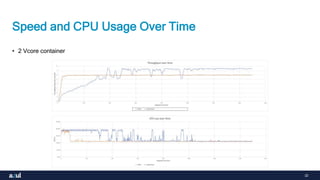
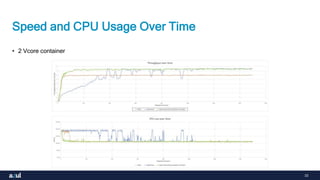
o JIT CPU costs and wall clock time (& slowness) to optimization can become prohibitive
o JIT Memory footprint can lead to OOM Killer
• Can lead to tradeoffs between over-provisioning and foregoing higher optimization levels
26
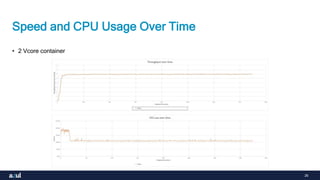
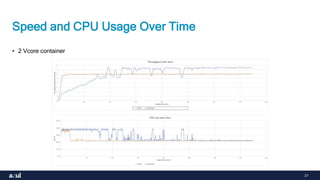
Speed and CPU Usage Over Time
• 2 Vcore container
27
Speed and CPU Usage Over Time
• 2 Vcore container
28
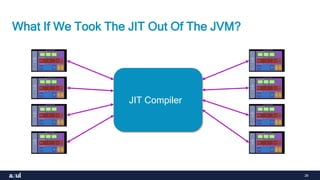
What If We Took The JIT Out Of The JVM?
JIT Compiler
29
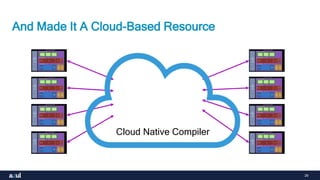
And Made It A Cloud-Based Resource
Cloud Native Compiler
30
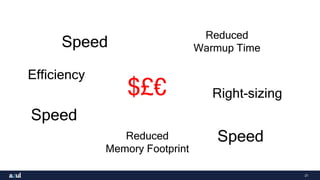
Why?
31
Efficiency
Speed
Speed
Speed
Reduced
Warmup Time
Reduced
Memory Footprint
Right-sizing
$£€
32
Speed and CPU Usage Over Time
• 2 Vcore container
33
Speed and CPU Usage Over Time
• 2 Vcore container
34
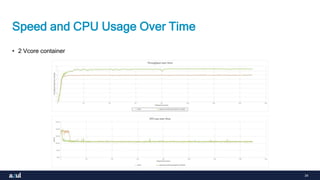
Speed and CPU Usage Over Time
• 2 Vcore container
35
Isn't This Just Shifting The Cost?
• Well, Yes…
• But we are shifting it to a much more efficient place
• optimization resources are used for a tiny fraction of wall clock time
• When a JVM optimizes locally, it must carry dedicated resources to do so
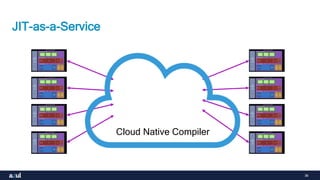
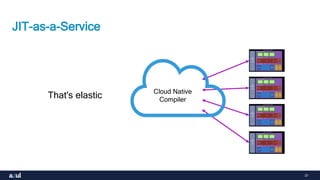
• When outsourced to a Cloud Native Compiler
o The resources are shared and reused
o The resources can be elastic
36
JIT-as-a-Service
Cloud Native Compiler
37
JIT-as-a-Service
Cloud Native
Compiler
That's elastic
38
There's More...
39
Application Code Realities
• The vast majority of application code:
o Executes more than once
o Runs on more than one device
o Repeats the same tasks across runs and devices
o Has a limited set of common behavior profiles
• This is true even for rapidly changing applications…
• This is “lost” when JVMs do their own local, ephemeral optimizations
40
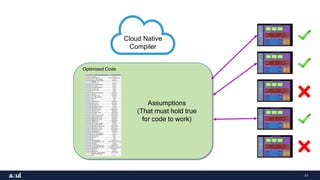
Code Can Be Reused
Even with speculative optimisations
41
Optimised Code
Assumptions
(That must hold true
for code to work)
Cloud Native
Compiler
42
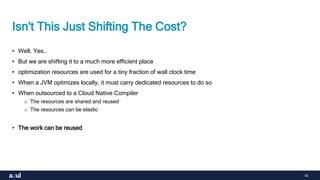
Isn't This Just Shifting The Cost?
• Well, Yes…
• But we are shifting it to a much more efficient place
• optimization resources are used for a tiny fraction of wall clock time
• When a JVM optimizes locally, it must carry dedicated resources to do so
• When outsourced to a Cloud Native Compiler
o The resources are shared and reused
o The resources can be elastic
• The work can be reused
43
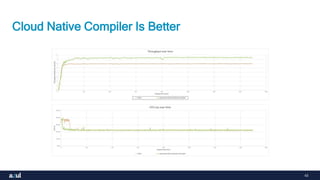
Cloud Native Compiler Is Better
44
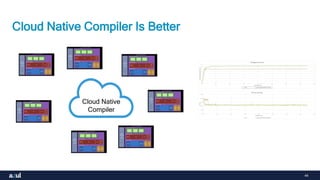
Cloud Native Compiler Is Better
Cloud Native
Compiler
45
Summary
46
Cloud Native Compiler
• Decoupling the JIT from the JVM has many advantages
o Better resource utilisation
o Better optimised code reuse
o Faster warmup
o and more...
• The cloud Native Compiler exists today
• Azul Platform Prime
• Try for free
https://www.azul.com/products/prime/stream-download/
Thank You.
Simon Ritter, Deputy CTO
@speakjava

Cloud Native Compiler

  • 1.
    The Cloud NativeCompiler: JIT-as-a-Service Presented by Simon Ritter, Deputy CTO | Azul
  • 2.
    2 Why Is JavaSo Popular? • It's a great language o Easy to write, easy to read • It has great libraries o Pretty much anything you can think off, almost always a FOSS version as well as commercial • It has a great community o JUGs, Champions, conferences, etc, etc o Easy to find Java programmers • But really, it's the Java Virtual Machine o Write once, run anywhere o Excellent backwards compatibility o A managed runtime environment
  • 3.
    3 JVM Performance Warmup •Classfiles contain bytecodes (instructions for a Virtual Machine) • Initially, these are interpreted o Each bytecode is converted to equivalent native instructions • Frequently used methods (hotspots) are identified and compiled o Just-in-Time (JIT) compilation o Uses two compilers, C1 (fast compile, low optimisation) and C2 (slow compile, high optimisation) • Each time the application is started, the same process begins again o Profile code looking for hot methods o Compile using C1 JIT, recompile using C2 JIT when hot enough
  • 4.
  • 5.
    5 The Way JVMsWork Now • Isolated • Not connected to other instances o No memory of past runs • Entirely self-reliant o Limited to local resources o Limited to local functionality o Results in multiple trade-offs • No Magic Cloud • Limited compute power • Limited storage • Limited local functionality • Limited analytical capabilities • Limited knowledge
  • 6.
  • 7.
  • 8.
  • 9.
    9 JVMs In TheCloud • Connected to vast networks • Can leverage and rely on… o external resources o external functionality o external experience • Can leverage (and contribute to) additional value • Assume access to a “magic cloud” o “unlimited” compute power o “unlimited” data storage o “unlimited” analytical capabilities o “knowledge”, “experience”, …
  • 10.
    10 Cloud Native JVMs •Has all the functionality of a JVM • Outsources some of that core functionality to the cloud • Delivers value to the cloud and to other JVMs that use that cloud
  • 11.
  • 12.
    12 Basic Theory ofJIT Compiler • JVM provides “here is code I’d like to make better” • JIT Compiler asks many “what do you know about X?” questions • JIT Compiler eventually provides “here is code for your situation” • JVM replaces existing code with new (hopefully better) code • This is (currently) done with in-JVM JIT compilers
  • 13.
  • 14.
    14 Example 1: InliningMonomorphic Sites public class Animal { private int color; public int getColor() { return color }; } myColor = animal.getColor(); can be transformed to: myColor = animal.color; As long as only one implementer of getColor() existslic class Animal {
  • 15.
    15 Example 2: BranchAnalysis int computeMagnitude(int value) { if (value > 9) bias = computeBias(value); else bias = 1; return Math.log10(bias + 99); } Profiling data shows that value (so far) has never been greater than 9
  • 16.
    16 Example 2: BranchAnalysis Assume that, based on profiling, value will continue to be less than 10 int computeMagnitude(int value) { if (value > 9) uncommonTrap(); // Deoptimise return 2; // Math.log10(100) }
  • 17.
  • 18.
    18 Speculatively Optimised Code OptimisedCode Assumptions (That must hold true for code to work) Only one getColor() method exists value is less than 10
  • 19.
  • 20.
    20 How To GetBetter Optimisations? • Array processing example
  • 21.
    21 OpenJDK Hotspot C2JIT Per element jumps 2 elements per iteration
  • 22.
    22 Azul Prime JVMFalcon JIT Using AVX2 vector instructions 32 elements per iteration Broadwell E5-2690-v4
  • 23.
    23 Faster Code is...Faster • Azul Prime JVM Falcon comparisson
  • 24.
  • 25.
    25 Better JIT CompilationHas Cost • We can apply more powerful optimizations and get (much) faster code • But the JIT CPU and wall-clock time costs can grow significantly • And so does the (JIT) memory footprint • On powerful machines (e.g. 64 vcores) we can afford to do this • But on more constrained/container environments… o JIT CPU costs and wall clock time (& slowness) to optimization can become prohibitive o JIT Memory footprint can lead to OOM Killer • Can lead to tradeoffs between over-provisioning and foregoing higher optimization levels
  • 26.
    26 Speed and CPUUsage Over Time • 2 Vcore container
  • 27.
    27 Speed and CPUUsage Over Time • 2 Vcore container
  • 28.
    28 What If WeTook The JIT Out Of The JVM? JIT Compiler
  • 29.
    29 And Made ItA Cloud-Based Resource Cloud Native Compiler
  • 30.
  • 31.
  • 32.
    32 Speed and CPUUsage Over Time • 2 Vcore container
  • 33.
    33 Speed and CPUUsage Over Time • 2 Vcore container
  • 34.
    34 Speed and CPUUsage Over Time • 2 Vcore container
  • 35.
    35 Isn't This JustShifting The Cost? • Well, Yes… • But we are shifting it to a much more efficient place • optimization resources are used for a tiny fraction of wall clock time • When a JVM optimizes locally, it must carry dedicated resources to do so • When outsourced to a Cloud Native Compiler o The resources are shared and reused o The resources can be elastic
  • 36.
  • 37.
  • 38.
  • 39.
    39 Application Code Realities •The vast majority of application code: o Executes more than once o Runs on more than one device o Repeats the same tasks across runs and devices o Has a limited set of common behavior profiles • This is true even for rapidly changing applications… • This is “lost” when JVMs do their own local, ephemeral optimizations
  • 40.
    40 Code Can BeReused Even with speculative optimisations
  • 41.
    41 Optimised Code Assumptions (That musthold true for code to work) Cloud Native Compiler
  • 42.
    42 Isn't This JustShifting The Cost? • Well, Yes… • But we are shifting it to a much more efficient place • optimization resources are used for a tiny fraction of wall clock time • When a JVM optimizes locally, it must carry dedicated resources to do so • When outsourced to a Cloud Native Compiler o The resources are shared and reused o The resources can be elastic • The work can be reused
  • 43.
  • 44.
    44 Cloud Native CompilerIs Better Cloud Native Compiler
  • 45.
  • 46.
    46 Cloud Native Compiler •Decoupling the JIT from the JVM has many advantages o Better resource utilisation o Better optimised code reuse o Faster warmup o and more... • The cloud Native Compiler exists today • Azul Platform Prime • Try for free https://www.azul.com/products/prime/stream-download/
  • 47.
    Thank You. Simon Ritter,Deputy CTO @speakjava