A PERSONAL JOURNEY
THROUGH CALL
COMPUTER-ASSISTED LANGUAGE LEARNING
TERESA MACKINNON
@WARWICKLANGUAGE
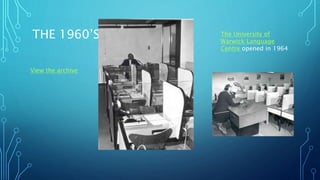
THE 1960’S The University of
Warwick Language
Centre opened in 1964
View the archive
WHAT IS CALL?
• "the search for and study of applications of the computer in
language teaching and learning“ (Levy, 1997)
• Early CALL favoured an approach that drew heavily on practices
associated with programmed instruction.
• Started with university experimentation using mainframe
computers, democratised by the arrival of the personal
computer and the internet.
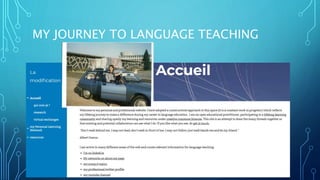
MY JOURNEY TO LANGUAGE TEACHING
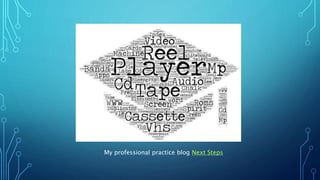
My professional practice blog Next Steps
OF TOOLS AND THEIR USES:
• Behaviouristic CALL: language labs, drills, translation tests
• Communicative CALL: CD-ROMs, multimedia applications,
structured interaction, early gamification.
• Integrated CALL: devices for internet use (MALL), Online
Intercultural Exchange, task based learning.
UBIQUITOUS TECHNOLOGY
• "In a statistical sense, we may one day communicate with each
other far more via computer mediation than in direct
interaction.” Crystal (2001, p.241)
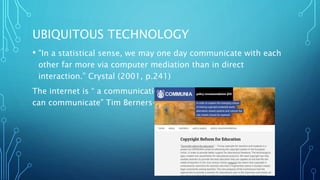
The internet is “ a communication space through which people
can communicate” Tim Berners-Lee.
APPROACHES AND PEDAGOGIES
• Importance of teacher attitude and confidence (Levy, 1997)
Importance of shifting the locus of control: (Benson & Voller,
1997)
• Teaching practices should be based on negotiation with
learners
• Teachers should monitor and reflect upon their practices
CALL AND TRANSFORMATION
“networked multimedia environments provide opportunities for
asynchronous and synchronous dialogue in which meaning can
be negotiated in modes other than written or printed text. The
interactions between and among learners… enhance the
“learning as knowledge” process.”
Warshauer, 2000
Virtual Exchange: “technology-enabled, sustained, people to
people education programmes”
REFERENCES
• Benson, P and Voller, P. (1997) Autonomy and Independence in
Language Learning. Routledge.
• Levy, M. (1997). CALL: Context and Conceptualisation. Oxford:
Oxford University Press.
• Warschauer, M., & Healey, D. (1998). Computers and language
learning: An overview. Language Teaching, 31, 57-71.

A personal journey through CALL

  • 1.
    A PERSONAL JOURNEY THROUGHCALL COMPUTER-ASSISTED LANGUAGE LEARNING TERESA MACKINNON @WARWICKLANGUAGE
  • 2.
    THE 1960’S TheUniversity of Warwick Language Centre opened in 1964 View the archive
  • 3.
    WHAT IS CALL? •"the search for and study of applications of the computer in language teaching and learning“ (Levy, 1997) • Early CALL favoured an approach that drew heavily on practices associated with programmed instruction. • Started with university experimentation using mainframe computers, democratised by the arrival of the personal computer and the internet.
  • 4.
    MY JOURNEY TOLANGUAGE TEACHING
  • 5.
    My professional practiceblog Next Steps
  • 6.
    OF TOOLS ANDTHEIR USES: • Behaviouristic CALL: language labs, drills, translation tests • Communicative CALL: CD-ROMs, multimedia applications, structured interaction, early gamification. • Integrated CALL: devices for internet use (MALL), Online Intercultural Exchange, task based learning.
  • 7.
    UBIQUITOUS TECHNOLOGY • "Ina statistical sense, we may one day communicate with each other far more via computer mediation than in direct interaction.” Crystal (2001, p.241) The internet is “ a communication space through which people can communicate” Tim Berners-Lee.
  • 8.
    APPROACHES AND PEDAGOGIES •Importance of teacher attitude and confidence (Levy, 1997) Importance of shifting the locus of control: (Benson & Voller, 1997) • Teaching practices should be based on negotiation with learners • Teachers should monitor and reflect upon their practices
  • 9.
    CALL AND TRANSFORMATION “networkedmultimedia environments provide opportunities for asynchronous and synchronous dialogue in which meaning can be negotiated in modes other than written or printed text. The interactions between and among learners… enhance the “learning as knowledge” process.” Warshauer, 2000 Virtual Exchange: “technology-enabled, sustained, people to people education programmes”
  • 10.
    REFERENCES • Benson, Pand Voller, P. (1997) Autonomy and Independence in Language Learning. Routledge. • Levy, M. (1997). CALL: Context and Conceptualisation. Oxford: Oxford University Press. • Warschauer, M., & Healey, D. (1998). Computers and language learning: An overview. Language Teaching, 31, 57-71.

Editor's Notes

  • #6 Started blogging as part of a Warwick WELA course in 2004 Use of office tools in teaching GRASS database
  • #9 Autonomy,