an overview
Agenda

• What is jclouds?
• What does it do?
• Relationship to other projects
• Code examples
What is jclouds?
• OSS Java framework for cloud enablement
  and inter-cloud integration
 • b 3/2009; ~100k loc; 5 active devs
• API-based approach to connect tools to
  services via a REST-based model
• Over 10 cloud services modeled
• BETA status
What does it do?
• Helps projects become cloud projects, and
  developers become cloud developers.
 • through consistency in
  • Tools vs Services
  • Services vs Model
  • API approach
Tools vs Services
• jclouds helps existing tools connect to
  cloud services
  • a consistent integration pattern and
    configuration
  • adjustable library dependencies
  • sample patterns, integrations, and
    abstractions
Services vs Model
• jclouds simplifies modeling of cloud
  services
  • Standards focus with pragmatic
    extensions. (JSR-330, 311)
  • Clean means of addressing service quirks
  • pluggable strategies for error/retry
    handling
API Approach

• REST modeling before abstraction
 •   allows for proprietary features

 •   multiple abstractions are possible

• Async/Sync api mirroring
 •   scalably deal with 400ms-3m response time
Relationship to other
        projects
• Alternatives to jclouds
• Tools we provide
• Projects who use us
• Project integrations in progress
Alternatives to jclouds
• Roll-your-own
 • Jersey, RESTEasy
• EC2-based cloud apis
 • typica,jets3t
• Dasein Cloud API
• Service provided SDKs
Tools we provide
• jclouds abstractions
 • BlobStore ( atmos, azure, rackspace, s3 )
 • Compute ( vcloud, ec2, rackspace, rimu )
• Third-party library integration
 • Apache ant, commons vfs
 • jets3t (experimental)
Projects who use
              jclouds
•   Infinispan                   •   Makara

    •   persist the state of        •   application
        the grid to many                management of
        clouds.                         Terremark

•   Dasein Cloud                •   GigaSpaces

    •   rackspace, azure, and       •   integrate monitoring
        terremark integration           and management with
                                        Terremark
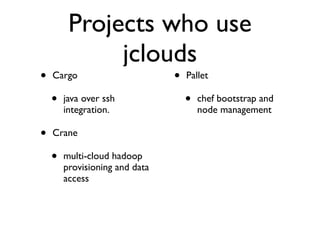
Projects who use
              jclouds
•   Cargo                       •   Pallet

    •   java over ssh               •   chef bootstrap and
        integration.                    node management

•   Crane

    •   multi-cloud hadoop
        provisioning and data
        access
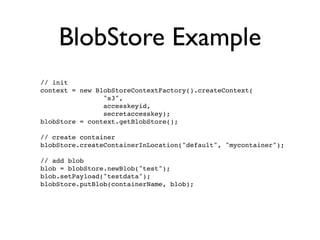
BlobStore Example
// init
context = new BlobStoreContextFactory().createContext(
                "s3",
                accesskeyid,
                secretaccesskey);
blobStore = context.getBlobStore();

// create container
blobStore.createContainerInLocation("default", "mycontainer");

// add blob
blob = blobStore.newBlob("test");
blob.setPayload("testdata");
blobStore.putBlob(containerName, blob);
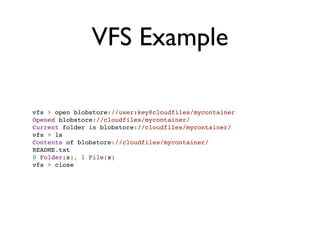
VFS Example

vfs > open blobstore://user:key@cloudfiles/mycontainer
Opened blobstore://cloudfiles/mycontainer/
Current folder is blobstore://cloudfiles/mycontainer/
vfs > ls
Contents of blobstore://cloudfiles/mycontainer/
README.txt
0 Folder(s), 1 File(s)
vfs > close
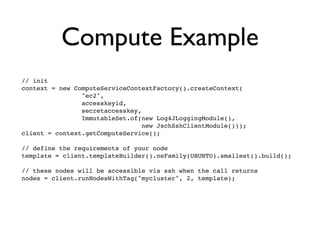
Compute Example
// init
context = new ComputeServiceContextFactory().createContext(
                "ec2",
                accesskeyid,
                secretaccesskey,
                ImmutableSet.of(new Log4JLoggingModule(),
                                 new JschSshClientModule()));
client = context.getComputeService();

// define the requirements of your node
template = client.templateBuilder().osFamily(UBUNTU).smallest().build();

// these nodes will be accessible via ssh when the call returns
nodes = client.runNodesWithTag("mycluster", 2, template);
Pallet Example
;; http://hugoduncan.github.com/pallet/

;; create a session by verifying credentials
(def cs (crane.compute/compute-context
          cloudservers-compute-name cloudservers-user cloudservers-password
          (crane.compute/modules :log4j :ssh :enterprise)))

;; Describe a user to be used for admin on the machine.
;; make-user uses current user's id_rsa key by default.
(def user (pallet/make-user "admin-user" "admin-password"))

;; Template for describing the node image to be used
(def server-template [:ubuntu :X86_32 :smallest :os-description-matches "[^J]+9.10[^64]+"])

;; map from tags to templates
(def templates { :combined server-template :monitor server-template})

;; declare the nodes required
(def required-nodes { :combined 2 :monitor 1})

;; create and provision the nodes
(pallet/with-chef-repository "path_to_your_chef_repository"
  (pallet/with-node-templates templates
    (pallet/converge cs required-nodes user)))

Jclouds Intro

  • 1.
  • 2.
    Agenda • What isjclouds? • What does it do? • Relationship to other projects • Code examples
  • 3.
    What is jclouds? •OSS Java framework for cloud enablement and inter-cloud integration • b 3/2009; ~100k loc; 5 active devs • API-based approach to connect tools to services via a REST-based model • Over 10 cloud services modeled • BETA status
  • 4.
    What does itdo? • Helps projects become cloud projects, and developers become cloud developers. • through consistency in • Tools vs Services • Services vs Model • API approach
  • 5.
    Tools vs Services •jclouds helps existing tools connect to cloud services • a consistent integration pattern and configuration • adjustable library dependencies • sample patterns, integrations, and abstractions
  • 6.
    Services vs Model •jclouds simplifies modeling of cloud services • Standards focus with pragmatic extensions. (JSR-330, 311) • Clean means of addressing service quirks • pluggable strategies for error/retry handling
  • 7.
    API Approach • RESTmodeling before abstraction • allows for proprietary features • multiple abstractions are possible • Async/Sync api mirroring • scalably deal with 400ms-3m response time
  • 8.
    Relationship to other projects • Alternatives to jclouds • Tools we provide • Projects who use us • Project integrations in progress
  • 9.
    Alternatives to jclouds •Roll-your-own • Jersey, RESTEasy • EC2-based cloud apis • typica,jets3t • Dasein Cloud API • Service provided SDKs
  • 10.
    Tools we provide •jclouds abstractions • BlobStore ( atmos, azure, rackspace, s3 ) • Compute ( vcloud, ec2, rackspace, rimu ) • Third-party library integration • Apache ant, commons vfs • jets3t (experimental)
  • 11.
    Projects who use jclouds • Infinispan • Makara • persist the state of • application the grid to many management of clouds. Terremark • Dasein Cloud • GigaSpaces • rackspace, azure, and • integrate monitoring terremark integration and management with Terremark
  • 12.
    Projects who use jclouds • Cargo • Pallet • java over ssh • chef bootstrap and integration. node management • Crane • multi-cloud hadoop provisioning and data access
  • 13.
    BlobStore Example // init context= new BlobStoreContextFactory().createContext( "s3", accesskeyid, secretaccesskey); blobStore = context.getBlobStore(); // create container blobStore.createContainerInLocation("default", "mycontainer"); // add blob blob = blobStore.newBlob("test"); blob.setPayload("testdata"); blobStore.putBlob(containerName, blob);
  • 14.
    VFS Example vfs >open blobstore://user:key@cloudfiles/mycontainer Opened blobstore://cloudfiles/mycontainer/ Current folder is blobstore://cloudfiles/mycontainer/ vfs > ls Contents of blobstore://cloudfiles/mycontainer/ README.txt 0 Folder(s), 1 File(s) vfs > close
  • 15.
    Compute Example // init context= new ComputeServiceContextFactory().createContext( "ec2", accesskeyid, secretaccesskey, ImmutableSet.of(new Log4JLoggingModule(), new JschSshClientModule())); client = context.getComputeService(); // define the requirements of your node template = client.templateBuilder().osFamily(UBUNTU).smallest().build(); // these nodes will be accessible via ssh when the call returns nodes = client.runNodesWithTag("mycluster", 2, template);
  • 16.
    Pallet Example ;; http://hugoduncan.github.com/pallet/ ;;create a session by verifying credentials (def cs (crane.compute/compute-context cloudservers-compute-name cloudservers-user cloudservers-password (crane.compute/modules :log4j :ssh :enterprise))) ;; Describe a user to be used for admin on the machine. ;; make-user uses current user's id_rsa key by default. (def user (pallet/make-user "admin-user" "admin-password")) ;; Template for describing the node image to be used (def server-template [:ubuntu :X86_32 :smallest :os-description-matches "[^J]+9.10[^64]+"]) ;; map from tags to templates (def templates { :combined server-template :monitor server-template}) ;; declare the nodes required (def required-nodes { :combined 2 :monitor 1}) ;; create and provision the nodes (pallet/with-chef-repository "path_to_your_chef_repository" (pallet/with-node-templates templates (pallet/converge cs required-nodes user)))

Editor's Notes

  • #4 ant, vfs, infinispan plugins;used by dasein cloud & gigaspaces used by webappvm, gigaspaces, qlf4j, enstratus ( via dasein)
  • #6 ant, vfs plugins, examples for spring, jruby, simple usage, google appengine