Container as a Service
support for Apache libcloud
Anthony Shaw, Apache LibCloud PMC
Overview of the LibCloud project
 Python library, supports 2.5+, 3.0+
 Formed in 2009
 Graduated to Apache TLP in May 2011
 200k+ downloads a month on PyPi
 154 contributors
LibCloud is an open-source library providing a single interface to
communicate with multiple clouds, public or private. Supports IaaS,
LBaaS, DNS and Storage.
About me
@anthonypjshaw
@tonybaloney
anthonyshaw@apache.org
Based in Sydney, Australia
Head of Innovation for
Dimension Data
Why should you use LibCloud?
My workloads run in private and
public clouds, I’ve got scripts for
both
LibCloud supports all major
public clouds and private
hypervisor APIs. Consolidate
your scripts into 1 tool
Supported Clouds (IaaS)
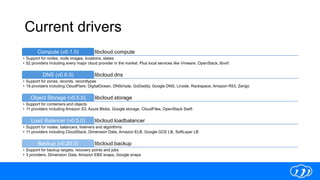
Current drivers
libcloud.computeCompute (v0.1.0)
• Support for nodes, node images, locations, states
• 52 providers including every major cloud provider in the market. Plus local services like Vmware, OpenStack, libvirt
libcloud.dnsDNS (v0.6.0)
• Support for zones, records, recordtypes
• 19 providers including CloudFlare, DigitalOcean, DNSimple, GoDaddy, Google DNS, Linode, Rackspace, Amazon R53, Zerigo
libcloud.storageObject Storage (v0.5.0)
• Support for containers and objects
• 11 providers including Amazon S3, Azure Blobs, Google storage, CloudFiles, OpenStack Swift
libcloud.loadbalancerLoad Balancer (v0.5.0)
• Support for nodes, balancers, listeners and algorithms
• 11 providers including CloudStack, Dimension Data, Amazon ELB, Google GCE LB, SoftLayer LB
libcloud.backupBackup (v0.20.0)
• Support for backup targets, recovery points and jobs
• 3 providers, Dimension Data, Amazon EBS snaps, Google snaps
Why would we need a container API?
 The API is for Container-as-a-Service providers, these new
types of cloud services offer container management and hosting
as a service.
 The new services are already providing proprietary APIs, giving
the need for a tool like Libcloud if you want to provision to any
cloud provider
Isn’t Docker a standard?
Well, yes and no.
Docker has been the main technology adopted by these
providers as the host system for the containers and also
as the specification of the containers themselves.
But, Docker is not a provisioning system, it is a
virtualization host. Also there are alternatives, like
CoreOS Rkt.
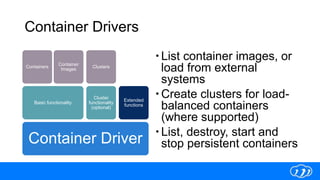
Container Drivers
List container images, or
load from external
systems
Create clusters for load-
balanced containers
(where supported)
List, destroy, start and
stop persistent containersContainer Driver
Basic functionality
Containers
Container
Images
Cluster
functionality
(optional)
Clusters
Extended
functions
Example Code
from libcloud.container.providers import get_driver
from libcloud.container.types import Provider
Cls = get_driver(Provider.DOCKER)
driver = Cls('user', 'api key')
image = driver.install_image('tomcat:8.0')
container = driver.deploy_container('tomcat', image)
container.restart()
Docker Registry
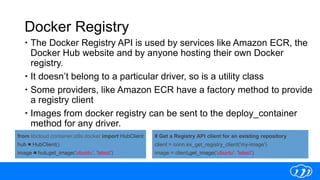
 The Docker Registry API is used by services like Amazon ECR, the
Docker Hub website and by anyone hosting their own Docker
registry.
 It doesn’t belong to a particular driver, so is a utility class
 Some providers, like Amazon ECR have a factory method to provide
a registry client
 Images from docker registry can be sent to the deploy_container
method for any driver.
from libcloud.container.utils.docker import HubClient
hub = HubClient()
image = hub.get_image('ubuntu', 'latest')
# Get a Registry API client for an existing repository
client = conn.ex_get_registry_client('my-image')
image = client.get_image('ubuntu', 'latest')
Driver : Docker
from libcloud.container.types import Provider
from libcloud.container.providers import get_driver
cls = get_driver(Provider.DOCKER)
conn = cls(host='https://198.61.239.128', port=4243,
key_file='key.pem', cert_file='cert.pem')
conn.list_containers()
Extra functionality:
• Get logs for container
• Delete an image
• List processes running inside a container
• Rename a container
• Search for images on docker.io
Base functionality
• Install an image from docker hub, or a private
repository
• Deploy a container from image
• Start, Stop, Restart, Delete a container
Driver : Joyent Triton
from libcloud.container.types import Provider
from libcloud.container.providers import get_driver
cls = get_driver(Provider.JOYENT)
conn = cls(host='us-east-1.docker.joyent.com', port=2376,
key_file='key.pem', cert_file='~/.sdc/docker/admin/ca.pem')
conn.list_containers()
Extra functionality:
• Get logs for container
• Delete an image
• List processes running inside a container
• Rename a container
• Search for images on docker.io
Base functionality
• Install an image from docker hub, or a private
repository
• Deploy a container from image
• Start, Stop, Restart, Delete a container
Joyent provide hosted and managed Docker hosts as a service
Driver : Amazon ECS
from libcloud.container.types import Provider
from libcloud.container.providers import get_driver
cls = get_driver(Provider.ECS)
conn = cls(access_id='SDHFISJDIFJSIDFJ',
secret='THIS_IS)+_MY_SECRET_KEY+I6TVkv68o4H',
region='ap-southeast-2')
conn.list_containers()
Extra functionality:
• Create a service (a collection of containers in a
cluster).
• Describe existing services
• Get ECR registry client
Base functionality
• Install an image from docker hub, or a private
repository, or from Amazon ECR (registry)
• Set CPU and memory reservations for
containers
• Deploy a container from image
• Start, Stop, Restart, Delete a container
Elastic Container Service is a container-as-a-service feature of AWS
Cluster functionality
• Create a cluster
• Deploy a container into a cluster
• Destroy an existing cluster
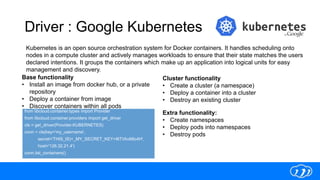
Driver : Google Kubernetes
from libcloud.container.types import Provider
from libcloud.container.providers import get_driver
cls = get_driver(Provider.KUBERNETES)
conn = cls(key='my_username',
secret='THIS_IS)+_MY_SECRET_KEY+I6TVkv68o4H',
host='126.32.21.4')
conn.list_containers()
Extra functionality:
• Create namespaces
• Deploy pods into namespaces
• Destroy pods
Base functionality
• Install an image from docker hub, or a private
repository
• Deploy a container from image
• Discover containers within all pods
Kubernetes is an open source orchestration system for Docker containers. It handles scheduling onto
nodes in a compute cluster and actively manages workloads to ensure that their state matches the users
declared intentions. It groups the containers which make up an application into logical units for easy
management and discovery.
Cluster functionality
• Create a cluster (a namespace)
• Deploy a container into a cluster
• Destroy an existing cluster
What now?
 Support for Google Cloud’s Container Engine (based on
Kubernetes so most of the way there)
https://cloud.google.com/container-engine/
 Extend Kubernetes support to allow multiple containers to be
provisioned to a single pod
 Create a CoreOS/Rkt driver
 Support other providers as they join the market
The Libcloud ecosystem
Mix and match
Compute Storage DNS
Application workload
To take full advantage of the LibCloud ecosystem, deploy your application across multiple providers,
choose the best platform(s) for the job.
Compute DNS Storage
Load
Balancer
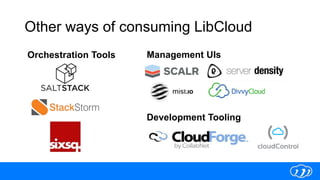
Other ways of consuming LibCloud
Orchestration Tools Management UIs
Development Tooling
Salt Stack Cloud
Leverage the flexibility and
breadth of the LibCloud
driver support from Salt
Stack
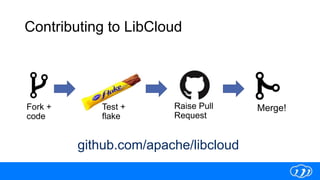
Contributing to LibCloud
Fork +
code
Raise Pull
Request
Merge!Test +
flake
github.com/apache/libcloud

Introducing container as-a-service support to apache libcloud

  • 1.
    Container as aService support for Apache libcloud Anthony Shaw, Apache LibCloud PMC
  • 2.
    Overview of theLibCloud project  Python library, supports 2.5+, 3.0+  Formed in 2009  Graduated to Apache TLP in May 2011  200k+ downloads a month on PyPi  154 contributors LibCloud is an open-source library providing a single interface to communicate with multiple clouds, public or private. Supports IaaS, LBaaS, DNS and Storage.
  • 3.
    About me @anthonypjshaw @tonybaloney anthonyshaw@apache.org Based inSydney, Australia Head of Innovation for Dimension Data
  • 4.
    Why should youuse LibCloud? My workloads run in private and public clouds, I’ve got scripts for both LibCloud supports all major public clouds and private hypervisor APIs. Consolidate your scripts into 1 tool
  • 5.
  • 6.
    Current drivers libcloud.computeCompute (v0.1.0) •Support for nodes, node images, locations, states • 52 providers including every major cloud provider in the market. Plus local services like Vmware, OpenStack, libvirt libcloud.dnsDNS (v0.6.0) • Support for zones, records, recordtypes • 19 providers including CloudFlare, DigitalOcean, DNSimple, GoDaddy, Google DNS, Linode, Rackspace, Amazon R53, Zerigo libcloud.storageObject Storage (v0.5.0) • Support for containers and objects • 11 providers including Amazon S3, Azure Blobs, Google storage, CloudFiles, OpenStack Swift libcloud.loadbalancerLoad Balancer (v0.5.0) • Support for nodes, balancers, listeners and algorithms • 11 providers including CloudStack, Dimension Data, Amazon ELB, Google GCE LB, SoftLayer LB libcloud.backupBackup (v0.20.0) • Support for backup targets, recovery points and jobs • 3 providers, Dimension Data, Amazon EBS snaps, Google snaps
  • 7.
    Why would weneed a container API?  The API is for Container-as-a-Service providers, these new types of cloud services offer container management and hosting as a service.  The new services are already providing proprietary APIs, giving the need for a tool like Libcloud if you want to provision to any cloud provider
  • 8.
    Isn’t Docker astandard? Well, yes and no. Docker has been the main technology adopted by these providers as the host system for the containers and also as the specification of the containers themselves. But, Docker is not a provisioning system, it is a virtualization host. Also there are alternatives, like CoreOS Rkt.
  • 9.
    Container Drivers List containerimages, or load from external systems Create clusters for load- balanced containers (where supported) List, destroy, start and stop persistent containersContainer Driver Basic functionality Containers Container Images Cluster functionality (optional) Clusters Extended functions
  • 10.
    Example Code from libcloud.container.providersimport get_driver from libcloud.container.types import Provider Cls = get_driver(Provider.DOCKER) driver = Cls('user', 'api key') image = driver.install_image('tomcat:8.0') container = driver.deploy_container('tomcat', image) container.restart()
  • 11.
    Docker Registry  TheDocker Registry API is used by services like Amazon ECR, the Docker Hub website and by anyone hosting their own Docker registry.  It doesn’t belong to a particular driver, so is a utility class  Some providers, like Amazon ECR have a factory method to provide a registry client  Images from docker registry can be sent to the deploy_container method for any driver. from libcloud.container.utils.docker import HubClient hub = HubClient() image = hub.get_image('ubuntu', 'latest') # Get a Registry API client for an existing repository client = conn.ex_get_registry_client('my-image') image = client.get_image('ubuntu', 'latest')
  • 12.
    Driver : Docker fromlibcloud.container.types import Provider from libcloud.container.providers import get_driver cls = get_driver(Provider.DOCKER) conn = cls(host='https://198.61.239.128', port=4243, key_file='key.pem', cert_file='cert.pem') conn.list_containers() Extra functionality: • Get logs for container • Delete an image • List processes running inside a container • Rename a container • Search for images on docker.io Base functionality • Install an image from docker hub, or a private repository • Deploy a container from image • Start, Stop, Restart, Delete a container
  • 13.
    Driver : JoyentTriton from libcloud.container.types import Provider from libcloud.container.providers import get_driver cls = get_driver(Provider.JOYENT) conn = cls(host='us-east-1.docker.joyent.com', port=2376, key_file='key.pem', cert_file='~/.sdc/docker/admin/ca.pem') conn.list_containers() Extra functionality: • Get logs for container • Delete an image • List processes running inside a container • Rename a container • Search for images on docker.io Base functionality • Install an image from docker hub, or a private repository • Deploy a container from image • Start, Stop, Restart, Delete a container Joyent provide hosted and managed Docker hosts as a service
  • 14.
    Driver : AmazonECS from libcloud.container.types import Provider from libcloud.container.providers import get_driver cls = get_driver(Provider.ECS) conn = cls(access_id='SDHFISJDIFJSIDFJ', secret='THIS_IS)+_MY_SECRET_KEY+I6TVkv68o4H', region='ap-southeast-2') conn.list_containers() Extra functionality: • Create a service (a collection of containers in a cluster). • Describe existing services • Get ECR registry client Base functionality • Install an image from docker hub, or a private repository, or from Amazon ECR (registry) • Set CPU and memory reservations for containers • Deploy a container from image • Start, Stop, Restart, Delete a container Elastic Container Service is a container-as-a-service feature of AWS Cluster functionality • Create a cluster • Deploy a container into a cluster • Destroy an existing cluster
  • 15.
    Driver : GoogleKubernetes from libcloud.container.types import Provider from libcloud.container.providers import get_driver cls = get_driver(Provider.KUBERNETES) conn = cls(key='my_username', secret='THIS_IS)+_MY_SECRET_KEY+I6TVkv68o4H', host='126.32.21.4') conn.list_containers() Extra functionality: • Create namespaces • Deploy pods into namespaces • Destroy pods Base functionality • Install an image from docker hub, or a private repository • Deploy a container from image • Discover containers within all pods Kubernetes is an open source orchestration system for Docker containers. It handles scheduling onto nodes in a compute cluster and actively manages workloads to ensure that their state matches the users declared intentions. It groups the containers which make up an application into logical units for easy management and discovery. Cluster functionality • Create a cluster (a namespace) • Deploy a container into a cluster • Destroy an existing cluster
  • 16.
    What now?  Supportfor Google Cloud’s Container Engine (based on Kubernetes so most of the way there) https://cloud.google.com/container-engine/  Extend Kubernetes support to allow multiple containers to be provisioned to a single pod  Create a CoreOS/Rkt driver  Support other providers as they join the market
  • 17.
  • 18.
    Mix and match ComputeStorage DNS Application workload To take full advantage of the LibCloud ecosystem, deploy your application across multiple providers, choose the best platform(s) for the job. Compute DNS Storage Load Balancer
  • 19.
    Other ways ofconsuming LibCloud Orchestration Tools Management UIs Development Tooling
  • 20.
    Salt Stack Cloud Leveragethe flexibility and breadth of the LibCloud driver support from Salt Stack
  • 21.
    Contributing to LibCloud Fork+ code Raise Pull Request Merge!Test + flake github.com/apache/libcloud