Java SE Beyond Basics:  Generics, Annotation, Concurrency, and JMX Sang Shin [email_address] www.javapassion.com Sun Microsystems Inc.
Agenda Generics Annotation  Concurrency JMX (Management & Monitoring) Performance Summary
Hands-on Labs Generics www.javapassion.com/handsonlabs/1110_tigergenerics.zip Annotation www.javapassion.com/handsonlabs/1111_javase5generics.zip  Concurrency www.javapassion.com/handsonlabs/1108_javase5concurrency.zip  JMX (Management & Monitoring) www.netbeans.org/kb/articles/jmx-tutorial.html
Generics
Sub-topics of Generics What is and why use Generics? Usage of Generics Generics and sub-typing Wildcard Type erasure Interoperability Creating your own Generic class
Generics: What is it? How do define it? How to use it?  Why use it?
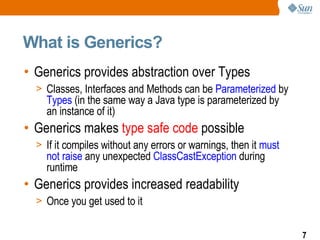
What is Generics? Generics provides abstraction over Types Classes, Interfaces and Methods can be  Parameterized  by  Types  (in the same way a Java type is parameterized by an instance of it) Generics makes  type safe code  possible If it compiles without any errors or warnings, then it  must not raise  any unexpected  ClassCastException  during runtime Generics provides increased readability Once you get used to it
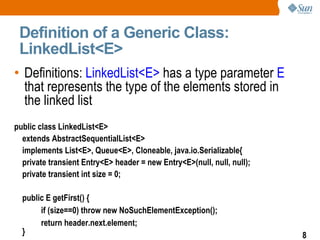
Definition of a Generic Class: LinkedList<E> Definitions:   LinkedList<E>  has a type parameter  E  that represents the type of the elements stored in the linked list public class LinkedList<E> extends AbstractSequentialList<E> implements List<E>, Queue<E>, Cloneable, java.io.Serializable{ private transient Entry<E> header = new Entry<E>(null, null, null); private transient int size = 0; public E getFirst() { if (size==0) throw new NoSuchElementException(); return header.next.element; } ...
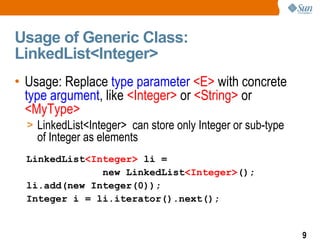
Usage of Generic Class:  LinkedList<Integer> Usage:  Replace  type parameter   <E>  with concrete  type argument , like  <Integer>  or  <String>  or  <MyType>   LinkedList<Integer>  can store only Integer or sub-type of Integer as elements LinkedList <Integer>  li =  new LinkedList <Integer> (); li.add(new Integer(0)); Integer i = li.iterator().next();
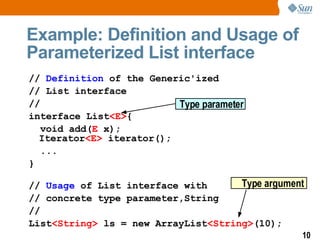
Example: Definition and Usage of Parameterized List interface //  Definition  of the Generic'ized  // List interface // interface List <E> {  void add( E  x);  Iterator <E>  iterator();  ...  }  //  Usage  of List interface with  // concrete type parameter,String //  List <String>  ls = new ArrayList <String> (10);
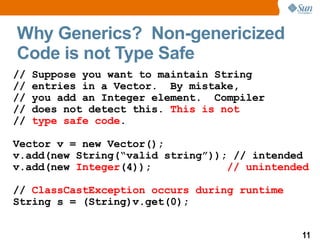
Why Generics?  Non-genericized Code is not Type Safe // Suppose you want to maintain String  // entries in a Vector.  By mistake,  // you add an Integer element.  Compiler  // does not detect this.  This is not //  type safe code . Vector v = new Vector(); v.add(new String(“valid string”)); // intended v.add(new  Integer (4));  // unintended //  ClassCastException occurs during runtime String s = (String)v.get(0);
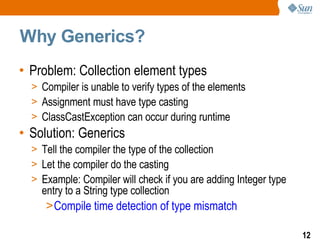
Why Generics?  Problem: Collection element types Compiler is unable to verify types of the elements Assignment must have type casting ClassCastException can occur during runtime  Solution: Generics Tell the compiler the type of the collection  Let the compiler do the casting Example: Compiler will check if you are adding Integer type entry to a String type collection  Compile time detection of type mismatch
Generics: Usage of Generics
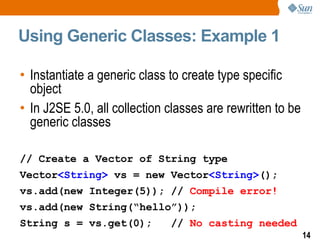
Using Generic Classes: Example 1 Instantiate a generic class to create type specific object In J2SE 5.0, all collection classes are rewritten to be generic classes  // Create a Vector of String type Vector <String>  vs = new Vector <String> (); vs.add(new Integer(5)); //  Compile error! vs.add(new String(“hello”)); String s = vs.get(0);  //  No casting needed
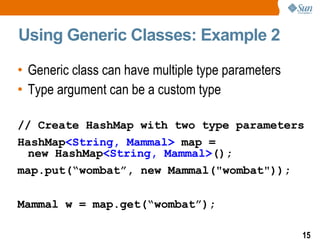
Using Generic Classes: Example 2 Generic class can have multiple type parameters Type argument can be a custom type // Create HashMap with two type parameters HashMap <String, Mammal>  map =  new HashMap <String, Mammal> (); map.put(“wombat”, new Mammal(&quot;wombat&quot;)); Mammal w = map.get(“wombat”);
Generics: Sub-typing
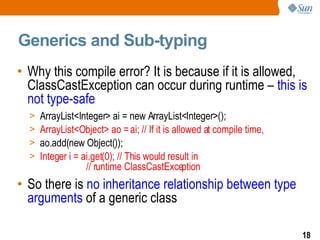
Generics and Sub-typing You can do this (using pre-J2SE 5.0 Java) Object o = new Integer(5);  You can even do this (using pre-J2SE 5.0 Java) Object[] or = new Integer[5]; So you would expect to be able to do this  (Well, you can't do this!!!) ArrayList<Object> ao = new ArrayList<Integer>(); This is counter-intuitive at the first glance
Generics and Sub-typing Why this compile error? It is because if it is allowed, ClassCastException can occur during runtime –  this is not type-safe ArrayList<Integer> ai = new ArrayList<Integer>(); ArrayList<Object> ao = ai; // If it is allowed at compile time, ao.add(new Object()); Integer i = ai.get(0); // This would result in  // runtime ClassCastException  So there is  no inheritance relationship between type arguments  of a generic class
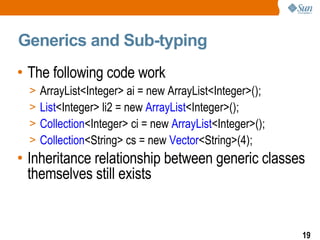
Generics and Sub-typing The following code work ArrayList<Integer> ai = new ArrayList<Integer>(); List <Integer> li2 = new  ArrayList <Integer>(); Collection <Integer> ci = new  ArrayList <Integer>(); Collection <String> cs = new  Vector <String>(4); Inheritance relationship between generic classes themselves still exists
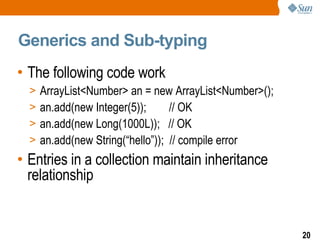
Generics and Sub-typing The following code work ArrayList<Number> an = new ArrayList<Number>(); an.add(new Integer(5));  // OK an.add(new Long(1000L));  // OK an.add(new String(“hello”));  // compile error Entries in a collection maintain inheritance relationship
Generics: Wild card
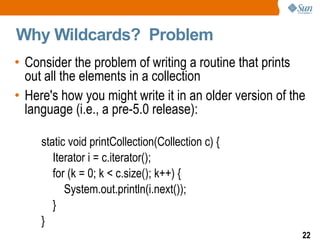
Why Wildcards?  Problem Consider the problem of writing a routine that prints out all the elements in a collection Here's how you might write it in an older version of the language (i.e., a pre-5.0 release): static void printCollection(Collection c) { Iterator i = c.iterator(); for (k = 0; k < c.size(); k++) { System.out.println(i.next()); } }
Why Wildcards?  Problem And here is a naive attempt at writing it using generics (and the new for loop syntax):  Well.. You can't do this! static void printCollection(Collection <Object>  c) { for (Object o : c)  System.out.println(o); } public static void main(String[] args) { Collection<String> cs = new Vector<String>(); printCollection(cs); // Compile error  List<Integer> li = new ArrayList<Integer>(10); printCollection(li); // Compile error   }
Why Wildcards?  Solution Use Wildcard type argument <?> Collection<?> means  Collection of unknown type Accessing entries of Collection of unknown type with  Object  type is safe static void printCollection(Collection <?>  c) { for ( Object  o : c)  System.out.println(o); } public static void main(String[] args) { Collection<String> cs = new Vector<String>(); printCollection(cs); // No Compile error   List<Integer> li = new ArrayList<Integer>(10); printCollection(li); // No Compile error   }
More on Wildcards You cannot access entries of Collection of unknown type other than  Object  type static void printCollection(Collection <?>  c) { for ( String  o : c)  // Compile error System.out.println(o); } public static void main(String[] args) { Collection<String> cs = new Vector<String>(); printCollection(cs); // No Compile error   List<Integer> li = new ArrayList<Integer>(10); printCollection(li); // No Compile error   }
More on Wildcards It isn't safe to add arbitrary objects to it however, since we don't know what the element type of c stands for, we cannot add objects to it.  static void printCollection(Collection <?>  c) { c.add(new Object()); // Compile time error  c.add(new String()); // Compile time error   } public static void main(String[] args) { Collection<String> cs = new Vector<String>(); printCollection(cs); // No Compile error   List<Integer> li = new ArrayList<Integer>(10); printCollection(li); // No Compile error   }
Bounded Wildcard If you want to bound the unknown type to be a subtype of another type, use Bounded Wildcard static void printCollection( Collection <? extends Number>  c) { for (Object o : c)  System.out.println(o); } public static void main(String[] args) { Collection<String> cs = new Vector<String>(); printCollection(cs); // Compile error  List<Integer> li = new ArrayList<Integer>(10); printCollection(li); // No Compile error   }
Generics: Raw Type &  Type Erasure
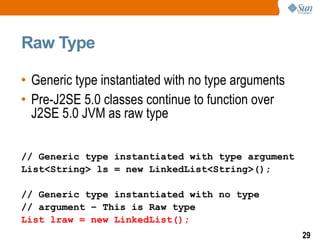
Raw Type Generic type instantiated with no type arguments Pre-J2SE 5.0 classes continue to function over J2SE 5.0 JVM as raw type // Generic type instantiated with type argument List<String> ls = new LinkedList<String>(); // Generic type instantiated with no type  // argument – This is Raw type List lraw = new LinkedList();
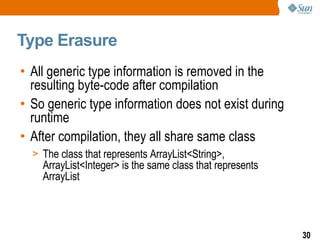
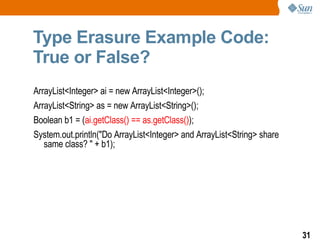
Type Erasure All generic type information is removed in the resulting byte-code after compilation So generic type information does not exist during runtime After compilation, they all share same class The class that represents ArrayList<String>, ArrayList<Integer> is the same class that represents  ArrayList
Type Erasure Example Code:  True or False? ArrayList<Integer> ai = new ArrayList<Integer>(); ArrayList<String> as = new ArrayList<String>(); Boolean b1 = ( ai.getClass() == as.getClass() ); System.out.println(&quot;Do ArrayList<Integer> and ArrayList<String> share same class? &quot; + b1);
Type-safe Code Again  The compiler guarantees that either: the code it generates will be type-correct at run time, or it will output a warning (using Raw type) at compile time – in this case, you are responsible to make sure the warning is a benign one What is “type-safe code” again? If your code compiles without any compile errors and without warnings (or with warnings on safe operations), then you will never get a ClassCastException during runtime
Generics: Interoperability
What Happens to the following Code? import java.util.LinkedList; import java.util.List; public class GenericsInteroperability { public static void main(String[] args) { List<String> ls = new LinkedList<String>(); List lraw = ls; lraw.add(new Integer(4)); String s = ls.iterator().next(); } }
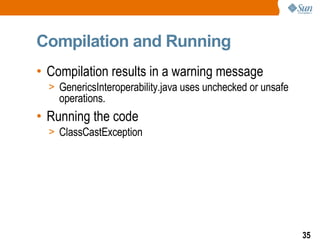
Compilation and Running Compilation results in a warning message GenericsInteroperability.java uses unchecked or unsafe operations. Running the code ClassCastException
Generics: Creating Your Own Generic Class
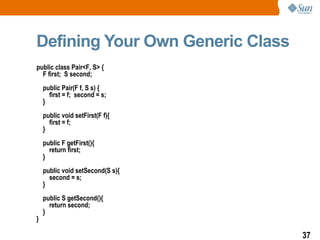
Defining Your Own Generic Class public class Pair<F, S> { F first;  S second; public Pair(F f, S s) { first = f;  second = s; } public void setFirst(F f){ first = f; } public F getFirst(){ return first; } public void setSecond(S s){ second = s; } public S getSecond(){ return second; } }
Using Your Own Generic Class public class MyOwnGenericClass { public static void main(String[] args) { // Create an instance of Pair <F, S> class.  Let's call it p1. Number n1 = new Integer(5); String s1 = new String(&quot;Sun&quot;); Pair<Number,String> p1 = new Pair<Number,String>(n1, s1); System.out.println(&quot;first of p1 (right after creation) = &quot; + p1.getFirst()); System.out.println(&quot;second of p2  (right after creation) = &quot; + p1.getSecond()); // Set internal variables of p1. p1.setFirst(new Long(6L)); p1.setSecond(new String(&quot;rises&quot;)); System.out.println(&quot;first of p1(after setting values) = &quot; + p1.getFirst()); System.out.println(&quot;second of p1 (after setting values) = &quot; + p1.getSecond()); } }
Annotation
Sub-topics of Annotations What is and Why annotation? How to define and use Annotations? 3 different kinds of Annotations Meta-Annotations
How Annotation Are Used? Annotations are used to affect the way programs are treated by tools and libraries Annotations are used by tools to produce derived files Tools: Compiler, IDE, Runtime tools  Derived files : New Java code, deployment descriptor, class files
Ad-hoc Annotation-like Examples in pre-J2SE 5.0 Platform Ad-hoc Annotation-like examples in pre-J2SE 5.0 platform Transient Serializable  interface @deprecated javadoc comments  Xdoclet J2SE 5.0 Annotation provides a standard, general purpose, more powerful annotation scheme
Why Annotation? Enables “declarative programming” style Less coding since tool will generate the boliler plate code from annotations in the source code Easier to change Eliminates the need for maintaining &quot;side files&quot; that must be kept up to date with changes in source files Information is kept in the source file example) Eliminate the need of deployment descriptor
Annotation: How do you define & use annotations?
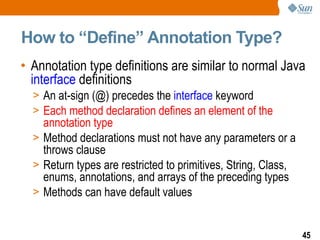
How to “Define” Annotation Type?  Annotation type definitions are similar to normal Java  interface  definitions An at-sign (@) precedes the  interface  keyword Each method declaration defines an element of the annotation type Method declarations must not have any parameters or a throws clause Return types are restricted to primitives, String, Class, enums, annotations, and arrays of the preceding types Methods can have default values
Example: Annotation Type Definition /** * Describes the Request-For-Enhancement(RFE) that led * to the presence of the annotated API element. */ public  @interface   RequestForEnhancement  { int  id(); String synopsis(); String engineer() default &quot;[unassigned]&quot;;  String date() default &quot;[unimplemented]&quot;;  }
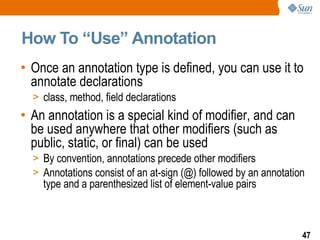
How To “Use” Annotation  Once an annotation type is defined, you can use it to annotate declarations class, method, field declarations An annotation is a special kind of modifier, and can be used anywhere that other modifiers (such as public, static, or final) can be used By convention, annotations precede other modifiers Annotations consist of an at-sign (@) followed by an annotation type and a parenthesized list of element-value pairs
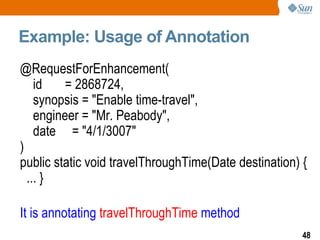
Example: Usage of Annotation @RequestForEnhancement( id  = 2868724, synopsis = &quot;Enable time-travel&quot;, engineer = &quot;Mr. Peabody&quot;, date  = &quot;4/1/3007&quot; ) public static void travelThroughTime(Date destination) {  ... } It is annotating  travelThroughTime  method
Annotation: 3 Types of Annotations (in terms of Sophistication)
3 Different Kinds of Annotations Marker annotation Single value annotation Normal annotation
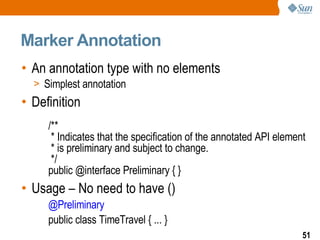
Marker Annotation An annotation type with no elements Simplest annotation Definition /** * Indicates that the specification of the annotated API element * is preliminary and subject to change. */ public @interface Preliminary { } Usage – No need to have () @Preliminary   public class TimeTravel { ... }
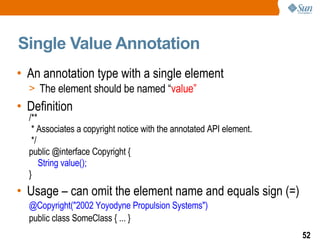
Single Value Annotation An annotation type with a single element The element should be named “ value” Definition /** * Associates a copyright notice with the annotated API element. */ public @interface Copyright { String value(); } Usage – can omit the element name and equals sign (=) @Copyright(&quot;2002 Yoyodyne Propulsion Systems&quot;) public class SomeClass { ... }
Normal Annotation We already have seen an example Definition public @interface RequestForEnhancement { int  id(); String synopsis(); String engineer() default &quot;[unassigned]&quot;;  String date();  default &quot;[unimplemented]&quot;;  } Usage @RequestForEnhancement( id  = 2868724, synopsis = &quot;Enable time-travel&quot;, engineer = &quot;Mr. Peabody&quot;, date  = &quot;4/1/3007&quot; ) public static void travelThroughTime(Date destination) { ... }
Annotation: Meta-Annotations
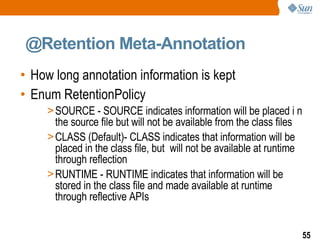
@Retention Meta-Annotation How long annotation information is kept Enum RetentionPolicy SOURCE -  SOURCE indicates information will be placed i n the source file but will not be available from the class files CLASS (Default)- CLASS indicates that information will be placed in the class file, but  will not be available at runtime through reflection RUNTIME - RUNTIME indicates that information will be stored in the class file and made available at runtime through reflective APIs
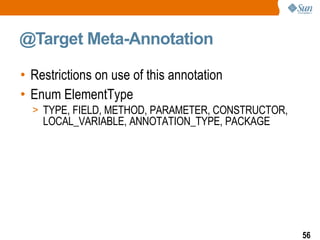
@Target Meta-Annotation  Restrictions on use of this annotation Enum ElementType TYPE, FIELD, METHOD, PARAMETER, CONSTRUCTOR, LOCAL_VARIABLE, ANNOTATION_TYPE, PACKAGE
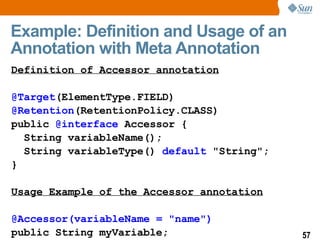
Example: Definition and Usage of an Annotation with Meta Annotation  Definition of Accessor annotation @Target (ElementType.FIELD) @Retention (RetentionPolicy.CLASS) public  @interface  Accessor { String variableName(); String variableType()  default  &quot;String&quot;; } Usage Example of the Accessor annotation @Accessor(variableName = &quot;name&quot;) public String myVariable;
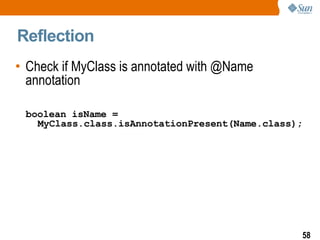
Reflection  Check if MyClass is annotated with @Name annotation boolean isName = MyClass.class.isAnnotationPresent(Name.class);
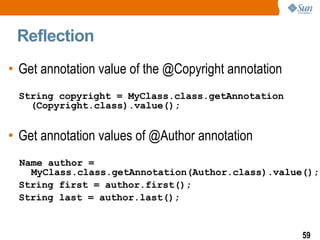
Reflection  Get annotation value of the @Copyright annotation String copyright = MyClass.class.getAnnotation  (Copyright.class).value(); Get annotation values of @Author annotation Name author = MyClass.class.getAnnotation(Author.class).value(); String first = author.first(); String last = author.last();
Concurrency
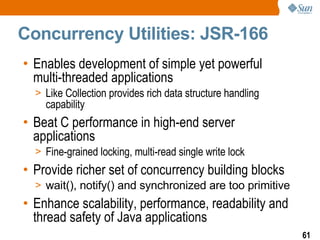
Concurrency Utilities: JSR-166 Enables development of simple yet powerful multi-threaded applications Like Collection provides rich data structure handling capability Beat C performance in high-end server applications Fine-grained locking, multi-read single write lock Provide richer set of concurrency building blocks wait(), notify() and synchronized are too primitive Enhance scalability, performance, readability and thread safety of Java applications
Why Use Concurrency Utilities? Reduced programming effort Increased performance Increased reliability Eliminate threading hazards such as deadlock, starvation, race conditions, or excessive context switching are eliminated Improved maintainability Increased productivity
Concurrency Utilities Task Scheduling Framework Callable's and Future's Synchronizers Concurrent Collections Atomic Variables Locks Nanosecond-granularity timing
Concurrency: Task Scheduling  Framework
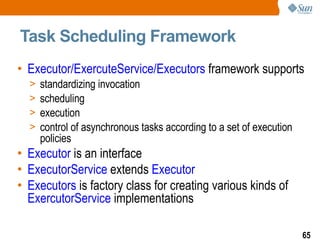
Task Scheduling Framework  Executor/ExercuteService/Executors  framework supports standardizing invocation scheduling execution control of asynchronous tasks according to a set of execution policies Executor  is an interface ExecutorService  extends  Executor Executors  is factory class for creating various kinds of  ExercutorService  implementations
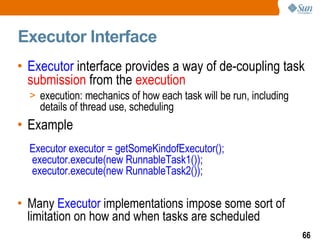
Executor Interface  Executor  interface provides a way of de-coupling task  submission  from the  execution execution: mechanics of how each task will be run, including details of thread use, scheduling  Example Executor executor = getSomeKindofExecutor(); executor.execute(new RunnableTask1()); executor.execute(new RunnableTask2()); Many  Executor  implementations impose some sort of limitation on how and when tasks are scheduled
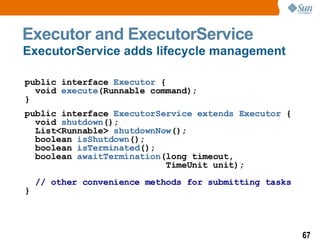
Executor and ExecutorService public interface  Executor  {    void  execute (Runnable command); } public interface  ExecutorService extends Executor  {   void  shutdown ();   List<Runnable>  shutdownNow ();   boolean  isShutdown ();   boolean  isTerminated ();   boolean  awaitTermination (long timeout,   TimeUnit unit);     // other convenience methods for submitting tasks } ExecutorService adds lifecycle management
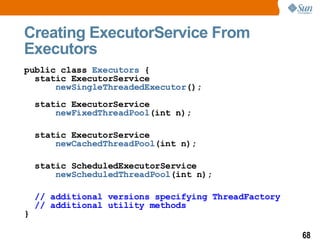
Creating ExecutorService From Executors public class  Executors  {  static ExecutorService  newSingleThreadedExecutor (); static ExecutorService    newFixedThreadPool (int n); static ExecutorService  newCachedThreadPool (int n); static ScheduledExecutorService newScheduledThreadPool (int n); // additional versions specifying ThreadFactory // additional utility methods }
pre-J2SE 5.0 Code class WebServer {    public static void main(String[] args) {   ServerSocket socket = new ServerSocket(80); while (true) {   final Socket connection = socket.accept();   Runnable r = new Runnable() {   public void run() {   handleRequest(connection);   }   };   // Don't do this!   new Thread(r).start();   }   } } Web Server—poor resource management
Executors Example class WebServer {    Executor pool =   Executors.newFixedThreadPool(7); public static void main(String[] args) {   ServerSocket socket = new ServerSocket(80); while (true) {   final Socket connection = socket.accept();   Runnable r = new Runnable() {   public void run() {   handleRequest(connection);   }   };   pool.execute(r);   }   } } Web Server—better resource management
Concurrency: Callables and Futures
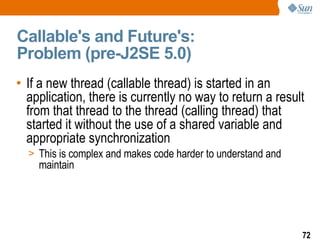
Callable's and Future's:  Problem (pre-J2SE 5.0) If a new thread (callable thread) is started in an application, there is currently no way to return a result from that thread to the thread (calling thread) that started it without the use of a shared variable and appropriate synchronization  This is complex and makes code harder to understand and maintain
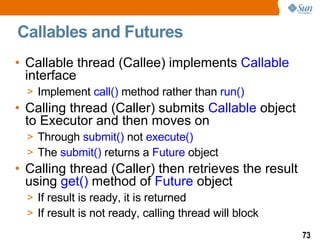
Callables and Futures C allable thread (Callee) implements  Callable  interface Implement  call()  method rather than  run() Calling thread (Caller) submits  Callable  object to Executor and then moves on Through  submit()  not  execute() The  submit()  returns a  Future  object Calling thread (Caller) then retrieves the result using  get()  method of  Future  object If result is ready, it is returned If result is not ready, calling thread will block
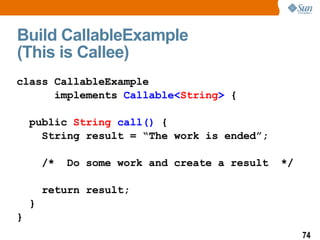
Build CallableExample  (This is Callee) class CallableExample  implements  Callable< String >  { public  String   call()  { String result = “The work is ended”; /*  Do some work and create a result  */ return result; } }
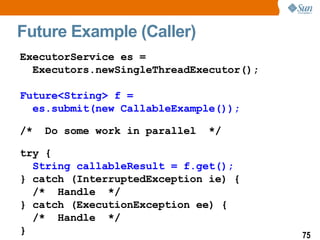
Future Example (Caller) ExecutorService es =  Executors.newSingleThreadExecutor(); Future<String> f   =  es.submit(new CallableExample()); /*  Do some work in parallel  */ try { String callableResult = f.get(); } catch (InterruptedException ie) { /*  Handle  */ } catch (ExecutionException ee) { /*  Handle  */ }
Concurrency: Synchronizers: Semaphore
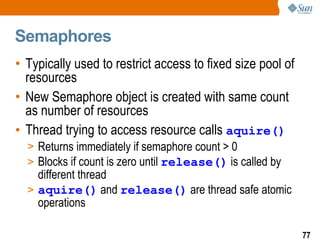
Semaphores Typically used to restrict access to fixed size pool of resources New Semaphore object is created with same count as number of resources Thread trying to access resource calls  aquire() Returns immediately if semaphore count > 0 Blocks if count is zero until  release()  is called by different thread aquire()  and  release()  are thread safe atomic operations
Semaphore Example private  Semaphore available ; private Resource[] resources; private boolean[] used; public Resource(int poolSize) { available = new  Semaphore(poolSize) ; /*  Initialise resource pool  */ } public Resource getResource() { try {  available.aquire()  } catch (IE) {} /*  Acquire resource  */ } public void returnResource(Resource r) { /*  Return resource to pool  */ available.release() ; }
Concurrency: Concurrent Collections
BlockingQueue Interface Provides thread safe way for multiple threads to manipulate collection ArrayBlockingQueue  is simplest concrete implementation Full set of methods put() offer()  [non-blocking] peek() [non-blocking] take() poll()  [non-blocking and fixed time blocking]
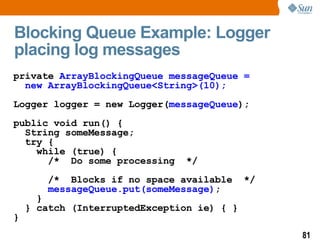
Blocking Queue Example: Logger placing log messages private  ArrayBlockingQueue messageQueue =  new ArrayBlockingQueue<String>(10); Logger logger = new Logger( messageQueue ); public void run() { String someMessage; try { while (true) { /*  Do some processing  */ /*  Blocks if no space available  */ messageQueue.put(someMessage) ; } } catch (InterruptedException ie) { } }
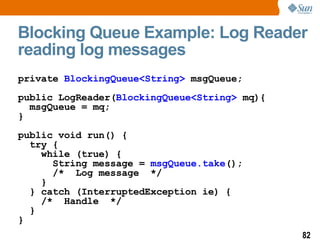
Blocking Queue Example: Log Reader reading log messages private  BlockingQueue<String>  msgQueue; public LogReader( BlockingQueue<String>  mq){ msgQueue = mq; } public void run() { try { while (true) { String message =  msgQueue.take (); /*  Log message  */ } } catch (InterruptedException ie) {  /*  Handle  */ } }
Concurrency: Atomic Variables
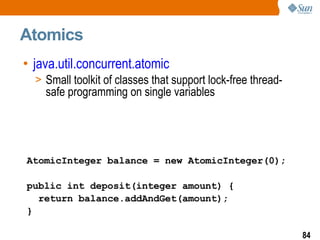
Atomics java.util.concurrent.atomic Small toolkit of classes that support lock-free thread-safe programming on single variables AtomicInteger balance = new AtomicInteger(0); public int deposit(integer amount) { return balance.addAndGet(amount); }
Concurrency: Locks
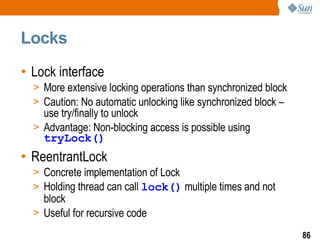
Locks Lock interface More extensive locking operations than synchronized block Caution: No automatic unlocking like synchronized block – use try/finally to unlock  Advantage: Non-blocking access is possible using  tryLock() ReentrantLock Concrete implementation of Lock Holding thread can call  lock()  multiple times and not block Useful for recursive code
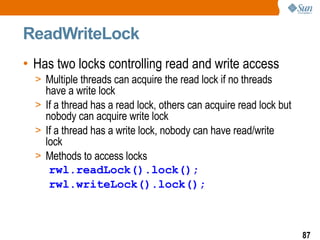
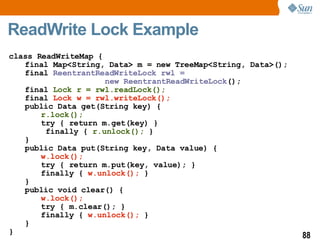
ReadWriteLock Has two locks controlling read and write access Multiple threads can acquire the read lock if no threads have a write lock If a thread has a read lock, others can acquire read lock but nobody can acquire write lock If a thread has a write lock, nobody can have read/write lock Methods to access locks rwl.readLock().lock(); rwl.writeLock().lock();
ReadWrite Lock Example class ReadWriteMap { final Map<String, Data> m = new TreeMap<String, Data>(); final  ReentrantReadWriteLock rwl =  new ReentrantReadWriteLock (); final  Lock r = rwl.readLock(); final  Lock w = rwl.writeLock(); public Data get(String key) { r.lock(); try { return m.get(key) }   finally {  r.unlock();  } } public Data put(String key, Data value) { w.lock(); try { return m.put(key, value); } finally {  w.unlock();  } } public void clear() { w.lock(); try { m.clear(); } finally {  w.unlock();  } } }
JMX (Java Management Extension)
JMX Introduction Overview of JMX Instrument you Application Accessing your instrumentation remotely What's coming in JDK 6
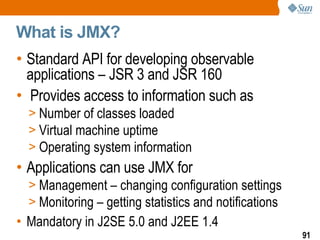
What is JMX? Standard API for developing observable applications – JSR 3 and JSR 160 Provides access to information such as Number of classes loaded Virtual machine uptime Operating system information Applications can use JMX for Management – changing configuration settings Monitoring – getting statistics and notifications Mandatory in J2SE 5.0 and J2EE 1.4
JMX: Architecture
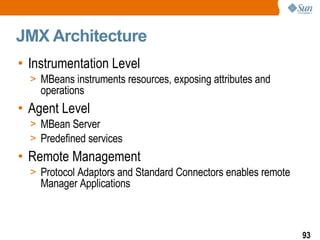
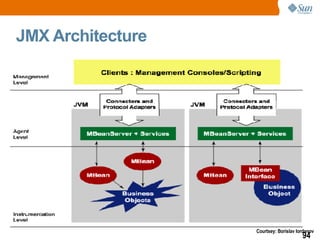
JMX Architecture Instrumentation Level MBeans instruments resources, exposing attributes and operations Agent Level MBean Server Predefined services Remote Management Protocol Adaptors and Standard Connectors enables remote Manager Applications
JMX Architecture Courtsey: Borislav Iordanov
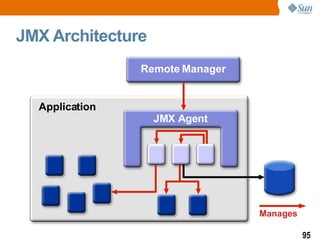
JMX Architecture Application JMX Agent Manages Remote Manager
JMX: MBean
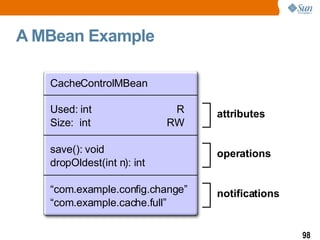
Managed Beans(MBeans) A MBean is a named  managed object  representing a  resource An application configuration setting Device Etc. A MBean can have Attributes that can be read and/or written Operations that can be invoked Notifications that the MBean can broadcast
A MBean Example  CacheControlMBean Used: int Size:  int save(): void dropOldest(int n): int attributes operations “ com.example.config.change” “ com.example.cache.full” notifications R RW
Standard MBean Standard MBean is the simplest model to use Quickest and Easiest way to instrument static manageable resources  Steps to create a standard MBean Create an Java interface call  Fred MBean Follows JavaBeans naming convention Implement the interface in a class call  Fred An instance of  Fred  is the MBean
Dynamic MBean Expose attributes and operations at  Runtime Provides more flexible instrumentations Step to create Dynamic MBeans Implements  DynamicMBeans  interface Method returns all Attributes & Operations  The same capability as Standard MBeans from Agent’s perspective
DynamicMBean Interface <<Interface>> DynamicMBean getMBeanInfo():MBeanInfo getAttribute(attribute:String):Object getAttributes(attributes:String[]):AttributeList setAttribute(attribute:Attribute):void setAttributes(attributes:AttributeList):AttributeList invoke(actionName:String, params:Object[], signature:String[]):Object
JMX Notification JMX notifications consists of the following NotificationEmitter  – event generator, typically your MBean NotificationListener  – event listener Notification  – the event NotificationBroadcasterSupport  – helper class Register with MBean server to receive events
JMX: MBean Server
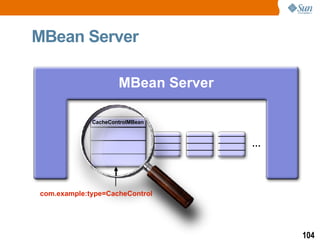
MBean Server  MBean Server CacheControlMBean com.example:type=CacheControl …
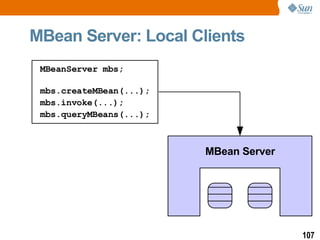
MBean Server To be useful, an MBean must be registered in an MBean Server Usually, the only access to MBeans is through the MBean Server You can have more than one MBean Server per Java ™  Virtual Machine (JVM ™ machine) But usually, as of Java SE 5, everyone uses the Platform MBean Server java.lang.management.ManagementFactory. getPlatformMBeanServer()
JMX: Client Types
MBean Server: Local Clients MBean Server
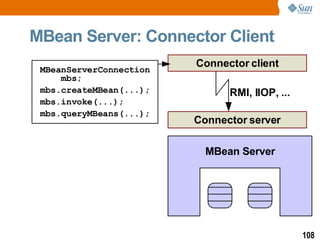
MBean Server: Connector Client MBean Server RMI, IIOP, ...
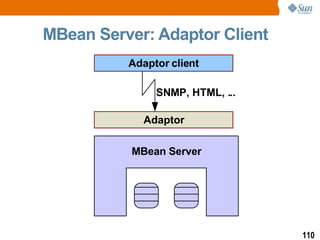
MBean Server: Connector Connectors defined by the JMX Remote API (JSR 160) Unrelated to the J2EE ™  Connector Architecture Java SE architecture includes RMI and RMI/IIOP connectors JSR 160 also defines a purpose-built protocol, JMXMP Future work: a SOAP-based connector for the Web Services world (JSR 262)
MBean Server: Adaptor Client MBean Server SNMP, HTML, ...
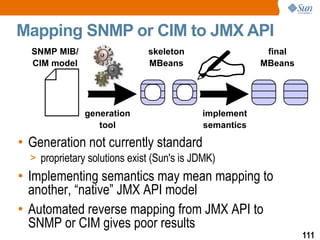
Mapping SNMP or CIM to JMX API SNMP MIB/ CIM model generation tool skeleton MBeans implement semantics final MBeans Generation not currently standard proprietary solutions exist (Sun's is JDMK) Implementing semantics may mean mapping to another, “native” JMX API model Automated reverse mapping from JMX API to SNMP or CIM gives poor results
JMX: JMX API Services
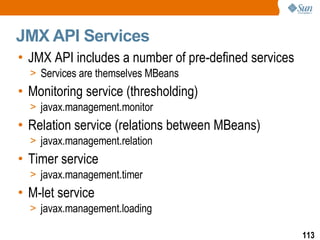
JMX API Services JMX API includes a number of pre-defined services Services are themselves MBeans Monitoring service (thresholding) javax.management.monitor Relation service (relations between MBeans) javax.management.relation Timer service javax.management.timer M-let service javax.management.loading
JMX: Steps of instrumenting  Your Application
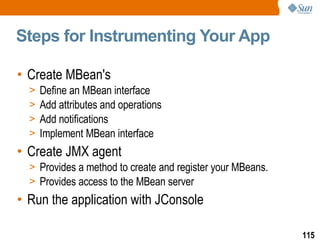
Steps for Instrumenting Your App Create MBean's Define an MBean interface Add attributes and operations Add notifications Implement MBean interface Create JMX agent Provides a method to create and register your MBeans. Provides access to the MBean server Run the application with JConsole
JMX: Demo – Running  Anagram application with JMX support
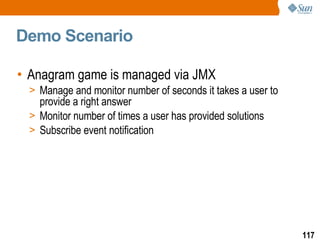
Demo Scenario Anagram game is managed via JMX  Manage and monitor number of seconds it takes a user to provide a right answer Monitor number of times a user has provided solutions Subscribe event notification
Java SE Beyond Basics:  Generics, Annotation, JMX Sang Shin [email_address] www.javapassion.com Sun Microsystems Inc.
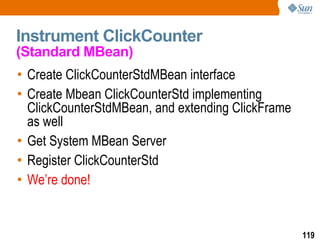
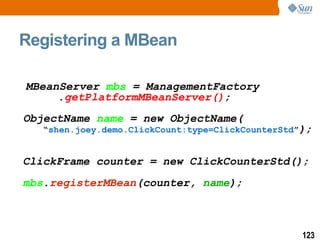
Instrument ClickCounter  (Standard MBean) Create ClickCounterStdMBean interface Create Mbean ClickCounterStd implementing ClickCounterStdMBean, and extending ClickFrame as well Get System MBean Server Register ClickCounterStd We’re done!
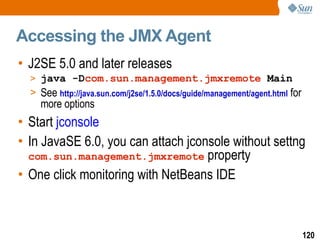
Accessing the JMX Agent J2SE 5.0 and later releases java -D com.sun.management.jmxremote  Main See  http://java.sun.com/j2se/1.5.0/docs/guide/management/agent.html  for more options Start  jconsole   In JavaSE 6.0, you can attach jconsole without settng  com.sun.management.jmxremote  property One click monitoring with NetBeans IDE
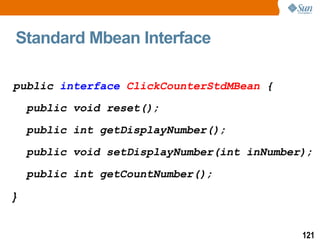
Standard Mbean Interface public  interface   ClickCounterStdMBean  { public void reset(); public int getDisplayNumber(); public void setDisplayNumber(int inNumber); public int getCountNumber(); }
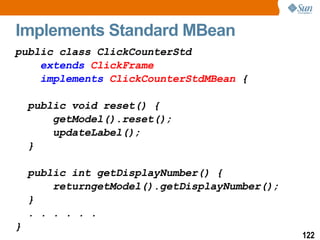
Implements Standard MBean public class ClickCounterStd  extends   ClickFrame implements   ClickCounterStdMBean  { public void reset() { getModel().reset(); updateLabel(); } public int getDisplayNumber() { returngetModel().getDisplayNumber(); } . . . . . . }
Registering a MBean MBeanServer  mbs  = ManagementFactory  . getPlatformMBeanServer() ; ObjectName  name  = new ObjectName( “ shen.joey.demo.ClickCount:type=ClickCounterStd ” );   ClickFrame counter = new ClickCounterStd(); mbs . registerMBean (counter,  name );
JMX: Roadmap
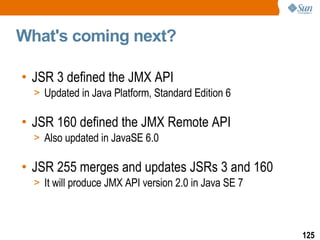
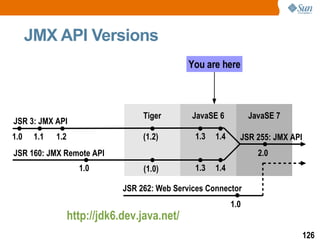
What's coming next? JSR 3 defined the JMX API Updated in Java Platform, Standard Edition 6  JSR 160 defined the JMX Remote API Also updated in JavaSE 6.0 JSR 255 merges and updates JSRs 3 and 160 It will produce JMX API version 2.0 in Java SE 7
JMX API Versions JSR 3: JMX API 1.0 1.1 1.2 (1.2) 1.0 JSR 160: JMX Remote API JSR 255: JMX API (1.0) 2.0 1.0 JSR 262: Web Services Connector http://jdk6.dev.java.net/ You are here
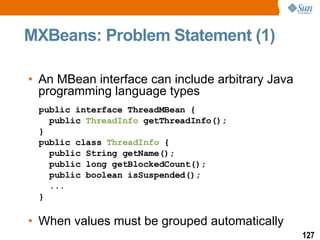
MXBeans: Problem Statement (1) An MBean interface can include arbitrary Java  programming language types When values must be grouped automatically public interface ThreadMBean {   public  ThreadInfo  getThreadInfo(); } public class  ThreadInfo  {   public String getName();   public long getBlockedCount();   public boolean isSuspended();   ... }
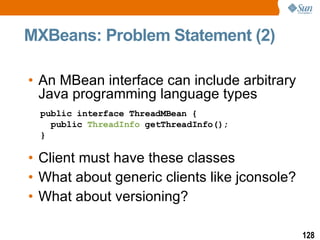
MXBeans: Problem Statement (2) An MBean interface can include arbitrary Java  programming language types Client must have these classes What about generic clients like jconsole? What about versioning? public interface ThreadMBean {   public  ThreadInfo  getThreadInfo(); }
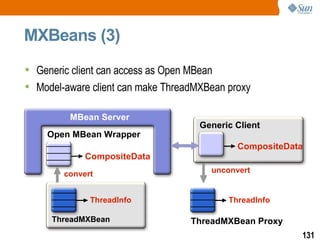
MXBeans (1) MXBeans were designed for the  instrumentation of the VM itself (JSR 174) Already exist in java.lang.management User-defined MXBeans are new in Mustang Management interface still a bean interface Can reference arbitrary types,  with some restrictions
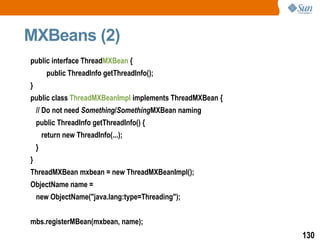
MXBeans (2) public interface Thread MXBean  { public ThreadInfo getThreadInfo(); } public class  ThreadMXBeanImpl   implements   ThreadMXBean { // Do not need  Something / Something MXBean naming public ThreadInfo getThreadInfo() { return new ThreadInfo(...); } } ThreadMXBean mxbean = new ThreadMXBeanImpl(); ObjectName name = new ObjectName(&quot;java.lang:type=Threading&quot;); mbs.registerMBean(mxbean, name);
MXBeans (3) MBean Server Generic client can access as Open MBean Model-aware client can make ThreadMXBean proxy ThreadMXBean ThreadInfo CompositeData Generic Client ThreadInfo ThreadMXBean Proxy unconvert CompositeData Open MBean Wrapper convert ThreadMXBean ThreadInfo
MXBean References (1) ProductMXBean ModuleMXBean ModuleMXBean[ ] public interface ProductMXBean { ModuleMXBean[] getModules(); }
MXBean References (2) MBean Server ModuleMXBean ProductMXBean ModuleMXBean[ ] ObjectName[ ] “ P1” “ M1” “ M2” ModuleMXBean ProductMXBean ModuleMXBean[ ] Generic Client ObjectName[ ] {“M1”, “M2”} “ P1” ModuleMXBean Proxy ModuleMXBean[ ] ProductMXBean Proxy
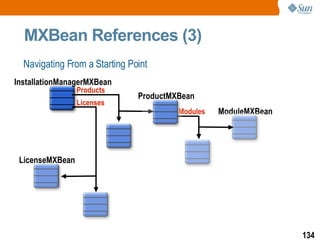
MXBean References (3) Modules Products Licenses Navigating From a Starting Point ProductMXBean ModuleMXBean InstallationManagerMXBean LicenseMXBean
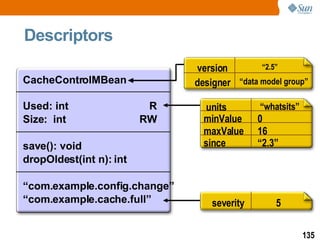
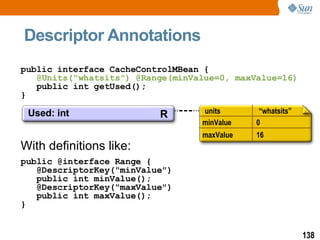
Descriptors CacheControlMBean Used: int Size:  int save(): void dropOldest(int n): int “ com.example.config.change” “ com.example.cache.full” R RW severity 5 units minValue maxValue since “ whatsits” 0 16 “2.3” version designer “ 2.5” “ data model group”
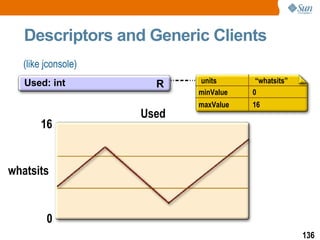
Descriptors and Generic Clients 0 16 whatsits Used Used: int R units minValue maxValue “ whatsits” 0 16 (like jconsole)
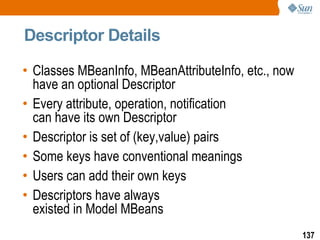
Descriptor Details Classes MBeanInfo, MBeanAttributeInfo, etc., now have an optional Descriptor Every attribute, operation, notification  can have its own Descriptor Descriptor is set of (key,value) pairs Some keys have conventional meanings Users can add their own keys Descriptors have always  existed in Model MBeans
Descriptor Annotations public interface CacheControlMBean {   @Units(&quot;whatsits&quot;) @Range(minValue=0, maxValue=16)   public int getUsed(); } With definitions like: public @interface Range {   @DescriptorKey(&quot;minValue&quot;)   public int minValue();   @DescriptorKey(&quot;maxValue&quot;)   public int maxValue(); } Used: int R units minValue maxValue “ whatsits” 0 16
Some Other Mustang changes Generified at last! Set <ObjectName>  queryNames(...) More-general ObjectName wildcards domain:type=Dir,path=&quot;/root/ * &quot; Simpler Notification use NotificationBroadcasterSupport( MBeanNotificationInfo[] ) class  StandardEmitterMBean  extends StandardMBean Monitor attributes of complex type MonitorMBean.setObservedAttribute( &quot;ThreadInfo.size&quot; ) http://jdk6.dev.java.net
JMX Summary JMX core concept MBean, MXBean, MBeanServer  Instrument App with JMX Create MBean Register to MBeanServer  Coming Next MXBean Descriptor
Performance
GC  A lgorithms Reference Counting It’s straightforward and easy Need support of compilers Circularly referenced detection Tracing collectors Root Objects: Local Variable, Static Variable, Registers
Mark-Sweep Collector Behavior Stop the world Mark all the reachable objects Exam all the heap, Sweep the unreachable objects Advantage Simple to implement Dose not depend on compilers Limitation Every allocated object is visited Heap fragment
Copying Collector Advantage Visit only live objects Compact in the new space Greatly reduces the cost of object allocation Easy reclaim Limitation Larger memory footprint Overhead of copying Long live objects Adjust reference address
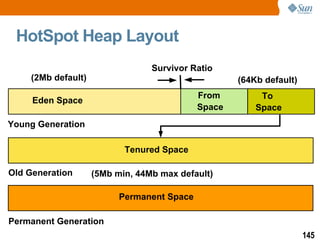
HotSpot Heap Layout Tenured Space Permanent Space Permanent Generation Old Generation Young Generation Eden Space From  Space To  Space Survivor Ratio (2Mb default) (64Kb default) (5Mb min, 44Mb max default)
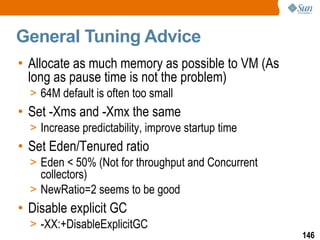
General Tuning Advice Allocate as much memory as possible to VM (As long as pause time is not the problem) 64M default is often too small Set -Xms and -Xmx the same Increase predictability, improve startup time Set Eden/Tenured ratio Eden < 50% (Not for throughput and Concurrent collectors) NewRatio=2 seems to be good Disable explicit GC -XX:+DisableExplicitGC
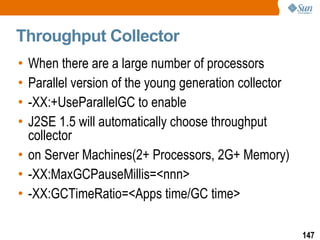
Throughput Collector When there are a large number of processors Parallel version of the young generation collector -XX:+UseParallelGC to enable J2SE 1.5 will automatically choose throughput collector on Server Machines(2+ Processors, 2G+ Memory) -XX:MaxGCPauseMillis=<nnn> -XX:GCTimeRatio=<Apps time/GC time>
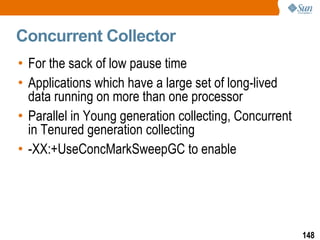
Concurrent Collector For the sack of low pause time Applications which have a large set of long-lived data running on more than one processor Parallel in Young generation collecting, Concurrent in Tenured generation collecting -XX:+UseConcMarkSweepGC to enable
Resources http://java.sun.com/j2se/1.5.0/docs/guide/jmx/tutorial/tutorialTOC.html http://java.sun.com/docs/performance/ http://java.sun.com/j2se/1.5.0/docs/guide/concurrency/index.html

javasebeyondbasics

  • 1.
    Java SE BeyondBasics: Generics, Annotation, Concurrency, and JMX Sang Shin [email_address] www.javapassion.com Sun Microsystems Inc.
  • 2.
    Agenda Generics Annotation Concurrency JMX (Management & Monitoring) Performance Summary
  • 3.
    Hands-on Labs Genericswww.javapassion.com/handsonlabs/1110_tigergenerics.zip Annotation www.javapassion.com/handsonlabs/1111_javase5generics.zip Concurrency www.javapassion.com/handsonlabs/1108_javase5concurrency.zip JMX (Management & Monitoring) www.netbeans.org/kb/articles/jmx-tutorial.html
  • 4.
  • 5.
    Sub-topics of GenericsWhat is and why use Generics? Usage of Generics Generics and sub-typing Wildcard Type erasure Interoperability Creating your own Generic class
  • 6.
    Generics: What isit? How do define it? How to use it? Why use it?
  • 7.
    What is Generics?Generics provides abstraction over Types Classes, Interfaces and Methods can be Parameterized by Types (in the same way a Java type is parameterized by an instance of it) Generics makes type safe code possible If it compiles without any errors or warnings, then it must not raise any unexpected ClassCastException during runtime Generics provides increased readability Once you get used to it
  • 8.
    Definition of aGeneric Class: LinkedList<E> Definitions: LinkedList<E> has a type parameter E that represents the type of the elements stored in the linked list public class LinkedList<E> extends AbstractSequentialList<E> implements List<E>, Queue<E>, Cloneable, java.io.Serializable{ private transient Entry<E> header = new Entry<E>(null, null, null); private transient int size = 0; public E getFirst() { if (size==0) throw new NoSuchElementException(); return header.next.element; } ...
  • 9.
    Usage of GenericClass: LinkedList<Integer> Usage: Replace type parameter <E> with concrete type argument , like <Integer> or <String> or <MyType> LinkedList<Integer> can store only Integer or sub-type of Integer as elements LinkedList <Integer> li = new LinkedList <Integer> (); li.add(new Integer(0)); Integer i = li.iterator().next();
  • 10.
    Example: Definition andUsage of Parameterized List interface // Definition of the Generic'ized // List interface // interface List <E> { void add( E x); Iterator <E> iterator(); ... } // Usage of List interface with // concrete type parameter,String // List <String> ls = new ArrayList <String> (10);
  • 11.
    Why Generics? Non-genericized Code is not Type Safe // Suppose you want to maintain String // entries in a Vector. By mistake, // you add an Integer element. Compiler // does not detect this. This is not // type safe code . Vector v = new Vector(); v.add(new String(“valid string”)); // intended v.add(new Integer (4)); // unintended // ClassCastException occurs during runtime String s = (String)v.get(0);
  • 12.
    Why Generics? Problem: Collection element types Compiler is unable to verify types of the elements Assignment must have type casting ClassCastException can occur during runtime Solution: Generics Tell the compiler the type of the collection Let the compiler do the casting Example: Compiler will check if you are adding Integer type entry to a String type collection Compile time detection of type mismatch
  • 13.
  • 14.
    Using Generic Classes:Example 1 Instantiate a generic class to create type specific object In J2SE 5.0, all collection classes are rewritten to be generic classes // Create a Vector of String type Vector <String> vs = new Vector <String> (); vs.add(new Integer(5)); // Compile error! vs.add(new String(“hello”)); String s = vs.get(0); // No casting needed
  • 15.
    Using Generic Classes:Example 2 Generic class can have multiple type parameters Type argument can be a custom type // Create HashMap with two type parameters HashMap <String, Mammal> map = new HashMap <String, Mammal> (); map.put(“wombat”, new Mammal(&quot;wombat&quot;)); Mammal w = map.get(“wombat”);
  • 16.
  • 17.
    Generics and Sub-typingYou can do this (using pre-J2SE 5.0 Java) Object o = new Integer(5); You can even do this (using pre-J2SE 5.0 Java) Object[] or = new Integer[5]; So you would expect to be able to do this (Well, you can't do this!!!) ArrayList<Object> ao = new ArrayList<Integer>(); This is counter-intuitive at the first glance
  • 18.
    Generics and Sub-typingWhy this compile error? It is because if it is allowed, ClassCastException can occur during runtime – this is not type-safe ArrayList<Integer> ai = new ArrayList<Integer>(); ArrayList<Object> ao = ai; // If it is allowed at compile time, ao.add(new Object()); Integer i = ai.get(0); // This would result in // runtime ClassCastException So there is no inheritance relationship between type arguments of a generic class
  • 19.
    Generics and Sub-typingThe following code work ArrayList<Integer> ai = new ArrayList<Integer>(); List <Integer> li2 = new ArrayList <Integer>(); Collection <Integer> ci = new ArrayList <Integer>(); Collection <String> cs = new Vector <String>(4); Inheritance relationship between generic classes themselves still exists
  • 20.
    Generics and Sub-typingThe following code work ArrayList<Number> an = new ArrayList<Number>(); an.add(new Integer(5)); // OK an.add(new Long(1000L)); // OK an.add(new String(“hello”)); // compile error Entries in a collection maintain inheritance relationship
  • 21.
  • 22.
    Why Wildcards? Problem Consider the problem of writing a routine that prints out all the elements in a collection Here's how you might write it in an older version of the language (i.e., a pre-5.0 release): static void printCollection(Collection c) { Iterator i = c.iterator(); for (k = 0; k < c.size(); k++) { System.out.println(i.next()); } }
  • 23.
    Why Wildcards? Problem And here is a naive attempt at writing it using generics (and the new for loop syntax): Well.. You can't do this! static void printCollection(Collection <Object> c) { for (Object o : c) System.out.println(o); } public static void main(String[] args) { Collection<String> cs = new Vector<String>(); printCollection(cs); // Compile error List<Integer> li = new ArrayList<Integer>(10); printCollection(li); // Compile error }
  • 24.
    Why Wildcards? Solution Use Wildcard type argument <?> Collection<?> means Collection of unknown type Accessing entries of Collection of unknown type with Object type is safe static void printCollection(Collection <?> c) { for ( Object o : c) System.out.println(o); } public static void main(String[] args) { Collection<String> cs = new Vector<String>(); printCollection(cs); // No Compile error List<Integer> li = new ArrayList<Integer>(10); printCollection(li); // No Compile error }
  • 25.
    More on WildcardsYou cannot access entries of Collection of unknown type other than Object type static void printCollection(Collection <?> c) { for ( String o : c) // Compile error System.out.println(o); } public static void main(String[] args) { Collection<String> cs = new Vector<String>(); printCollection(cs); // No Compile error List<Integer> li = new ArrayList<Integer>(10); printCollection(li); // No Compile error }
  • 26.
    More on WildcardsIt isn't safe to add arbitrary objects to it however, since we don't know what the element type of c stands for, we cannot add objects to it. static void printCollection(Collection <?> c) { c.add(new Object()); // Compile time error c.add(new String()); // Compile time error } public static void main(String[] args) { Collection<String> cs = new Vector<String>(); printCollection(cs); // No Compile error List<Integer> li = new ArrayList<Integer>(10); printCollection(li); // No Compile error }
  • 27.
    Bounded Wildcard Ifyou want to bound the unknown type to be a subtype of another type, use Bounded Wildcard static void printCollection( Collection <? extends Number> c) { for (Object o : c) System.out.println(o); } public static void main(String[] args) { Collection<String> cs = new Vector<String>(); printCollection(cs); // Compile error List<Integer> li = new ArrayList<Integer>(10); printCollection(li); // No Compile error }
  • 28.
    Generics: Raw Type& Type Erasure
  • 29.
    Raw Type Generictype instantiated with no type arguments Pre-J2SE 5.0 classes continue to function over J2SE 5.0 JVM as raw type // Generic type instantiated with type argument List<String> ls = new LinkedList<String>(); // Generic type instantiated with no type // argument – This is Raw type List lraw = new LinkedList();
  • 30.
    Type Erasure Allgeneric type information is removed in the resulting byte-code after compilation So generic type information does not exist during runtime After compilation, they all share same class The class that represents ArrayList<String>, ArrayList<Integer> is the same class that represents ArrayList
  • 31.
    Type Erasure ExampleCode: True or False? ArrayList<Integer> ai = new ArrayList<Integer>(); ArrayList<String> as = new ArrayList<String>(); Boolean b1 = ( ai.getClass() == as.getClass() ); System.out.println(&quot;Do ArrayList<Integer> and ArrayList<String> share same class? &quot; + b1);
  • 32.
    Type-safe Code Again The compiler guarantees that either: the code it generates will be type-correct at run time, or it will output a warning (using Raw type) at compile time – in this case, you are responsible to make sure the warning is a benign one What is “type-safe code” again? If your code compiles without any compile errors and without warnings (or with warnings on safe operations), then you will never get a ClassCastException during runtime
  • 33.
  • 34.
    What Happens tothe following Code? import java.util.LinkedList; import java.util.List; public class GenericsInteroperability { public static void main(String[] args) { List<String> ls = new LinkedList<String>(); List lraw = ls; lraw.add(new Integer(4)); String s = ls.iterator().next(); } }
  • 35.
    Compilation and RunningCompilation results in a warning message GenericsInteroperability.java uses unchecked or unsafe operations. Running the code ClassCastException
  • 36.
    Generics: Creating YourOwn Generic Class
  • 37.
    Defining Your OwnGeneric Class public class Pair<F, S> { F first; S second; public Pair(F f, S s) { first = f; second = s; } public void setFirst(F f){ first = f; } public F getFirst(){ return first; } public void setSecond(S s){ second = s; } public S getSecond(){ return second; } }
  • 38.
    Using Your OwnGeneric Class public class MyOwnGenericClass { public static void main(String[] args) { // Create an instance of Pair <F, S> class. Let's call it p1. Number n1 = new Integer(5); String s1 = new String(&quot;Sun&quot;); Pair<Number,String> p1 = new Pair<Number,String>(n1, s1); System.out.println(&quot;first of p1 (right after creation) = &quot; + p1.getFirst()); System.out.println(&quot;second of p2 (right after creation) = &quot; + p1.getSecond()); // Set internal variables of p1. p1.setFirst(new Long(6L)); p1.setSecond(new String(&quot;rises&quot;)); System.out.println(&quot;first of p1(after setting values) = &quot; + p1.getFirst()); System.out.println(&quot;second of p1 (after setting values) = &quot; + p1.getSecond()); } }
  • 39.
  • 40.
    Sub-topics of AnnotationsWhat is and Why annotation? How to define and use Annotations? 3 different kinds of Annotations Meta-Annotations
  • 41.
    How Annotation AreUsed? Annotations are used to affect the way programs are treated by tools and libraries Annotations are used by tools to produce derived files Tools: Compiler, IDE, Runtime tools Derived files : New Java code, deployment descriptor, class files
  • 42.
    Ad-hoc Annotation-like Examplesin pre-J2SE 5.0 Platform Ad-hoc Annotation-like examples in pre-J2SE 5.0 platform Transient Serializable interface @deprecated javadoc comments Xdoclet J2SE 5.0 Annotation provides a standard, general purpose, more powerful annotation scheme
  • 43.
    Why Annotation? Enables“declarative programming” style Less coding since tool will generate the boliler plate code from annotations in the source code Easier to change Eliminates the need for maintaining &quot;side files&quot; that must be kept up to date with changes in source files Information is kept in the source file example) Eliminate the need of deployment descriptor
  • 44.
    Annotation: How doyou define & use annotations?
  • 45.
    How to “Define”Annotation Type? Annotation type definitions are similar to normal Java interface definitions An at-sign (@) precedes the interface keyword Each method declaration defines an element of the annotation type Method declarations must not have any parameters or a throws clause Return types are restricted to primitives, String, Class, enums, annotations, and arrays of the preceding types Methods can have default values
  • 46.
    Example: Annotation TypeDefinition /** * Describes the Request-For-Enhancement(RFE) that led * to the presence of the annotated API element. */ public @interface RequestForEnhancement { int id(); String synopsis(); String engineer() default &quot;[unassigned]&quot;; String date() default &quot;[unimplemented]&quot;; }
  • 47.
    How To “Use”Annotation Once an annotation type is defined, you can use it to annotate declarations class, method, field declarations An annotation is a special kind of modifier, and can be used anywhere that other modifiers (such as public, static, or final) can be used By convention, annotations precede other modifiers Annotations consist of an at-sign (@) followed by an annotation type and a parenthesized list of element-value pairs
  • 48.
    Example: Usage ofAnnotation @RequestForEnhancement( id = 2868724, synopsis = &quot;Enable time-travel&quot;, engineer = &quot;Mr. Peabody&quot;, date = &quot;4/1/3007&quot; ) public static void travelThroughTime(Date destination) { ... } It is annotating travelThroughTime method
  • 49.
    Annotation: 3 Typesof Annotations (in terms of Sophistication)
  • 50.
    3 Different Kindsof Annotations Marker annotation Single value annotation Normal annotation
  • 51.
    Marker Annotation Anannotation type with no elements Simplest annotation Definition /** * Indicates that the specification of the annotated API element * is preliminary and subject to change. */ public @interface Preliminary { } Usage – No need to have () @Preliminary public class TimeTravel { ... }
  • 52.
    Single Value AnnotationAn annotation type with a single element The element should be named “ value” Definition /** * Associates a copyright notice with the annotated API element. */ public @interface Copyright { String value(); } Usage – can omit the element name and equals sign (=) @Copyright(&quot;2002 Yoyodyne Propulsion Systems&quot;) public class SomeClass { ... }
  • 53.
    Normal Annotation Wealready have seen an example Definition public @interface RequestForEnhancement { int id(); String synopsis(); String engineer() default &quot;[unassigned]&quot;; String date(); default &quot;[unimplemented]&quot;; } Usage @RequestForEnhancement( id = 2868724, synopsis = &quot;Enable time-travel&quot;, engineer = &quot;Mr. Peabody&quot;, date = &quot;4/1/3007&quot; ) public static void travelThroughTime(Date destination) { ... }
  • 54.
  • 55.
    @Retention Meta-Annotation Howlong annotation information is kept Enum RetentionPolicy SOURCE - SOURCE indicates information will be placed i n the source file but will not be available from the class files CLASS (Default)- CLASS indicates that information will be placed in the class file, but will not be available at runtime through reflection RUNTIME - RUNTIME indicates that information will be stored in the class file and made available at runtime through reflective APIs
  • 56.
    @Target Meta-Annotation Restrictions on use of this annotation Enum ElementType TYPE, FIELD, METHOD, PARAMETER, CONSTRUCTOR, LOCAL_VARIABLE, ANNOTATION_TYPE, PACKAGE
  • 57.
    Example: Definition andUsage of an Annotation with Meta Annotation Definition of Accessor annotation @Target (ElementType.FIELD) @Retention (RetentionPolicy.CLASS) public @interface Accessor { String variableName(); String variableType() default &quot;String&quot;; } Usage Example of the Accessor annotation @Accessor(variableName = &quot;name&quot;) public String myVariable;
  • 58.
    Reflection Checkif MyClass is annotated with @Name annotation boolean isName = MyClass.class.isAnnotationPresent(Name.class);
  • 59.
    Reflection Getannotation value of the @Copyright annotation String copyright = MyClass.class.getAnnotation (Copyright.class).value(); Get annotation values of @Author annotation Name author = MyClass.class.getAnnotation(Author.class).value(); String first = author.first(); String last = author.last();
  • 60.
  • 61.
    Concurrency Utilities: JSR-166Enables development of simple yet powerful multi-threaded applications Like Collection provides rich data structure handling capability Beat C performance in high-end server applications Fine-grained locking, multi-read single write lock Provide richer set of concurrency building blocks wait(), notify() and synchronized are too primitive Enhance scalability, performance, readability and thread safety of Java applications
  • 62.
    Why Use ConcurrencyUtilities? Reduced programming effort Increased performance Increased reliability Eliminate threading hazards such as deadlock, starvation, race conditions, or excessive context switching are eliminated Improved maintainability Increased productivity
  • 63.
    Concurrency Utilities TaskScheduling Framework Callable's and Future's Synchronizers Concurrent Collections Atomic Variables Locks Nanosecond-granularity timing
  • 64.
  • 65.
    Task Scheduling Framework Executor/ExercuteService/Executors framework supports standardizing invocation scheduling execution control of asynchronous tasks according to a set of execution policies Executor is an interface ExecutorService extends Executor Executors is factory class for creating various kinds of ExercutorService implementations
  • 66.
    Executor Interface Executor interface provides a way of de-coupling task submission from the execution execution: mechanics of how each task will be run, including details of thread use, scheduling Example Executor executor = getSomeKindofExecutor(); executor.execute(new RunnableTask1()); executor.execute(new RunnableTask2()); Many Executor implementations impose some sort of limitation on how and when tasks are scheduled
  • 67.
    Executor and ExecutorServicepublic interface Executor { void execute (Runnable command); } public interface ExecutorService extends Executor { void shutdown (); List<Runnable> shutdownNow (); boolean isShutdown (); boolean isTerminated (); boolean awaitTermination (long timeout, TimeUnit unit); // other convenience methods for submitting tasks } ExecutorService adds lifecycle management
  • 68.
    Creating ExecutorService FromExecutors public class Executors { static ExecutorService newSingleThreadedExecutor (); static ExecutorService newFixedThreadPool (int n); static ExecutorService newCachedThreadPool (int n); static ScheduledExecutorService newScheduledThreadPool (int n); // additional versions specifying ThreadFactory // additional utility methods }
  • 69.
    pre-J2SE 5.0 Codeclass WebServer { public static void main(String[] args) { ServerSocket socket = new ServerSocket(80); while (true) { final Socket connection = socket.accept(); Runnable r = new Runnable() { public void run() { handleRequest(connection); } }; // Don't do this! new Thread(r).start(); } } } Web Server—poor resource management
  • 70.
    Executors Example classWebServer { Executor pool = Executors.newFixedThreadPool(7); public static void main(String[] args) { ServerSocket socket = new ServerSocket(80); while (true) { final Socket connection = socket.accept(); Runnable r = new Runnable() { public void run() { handleRequest(connection); } }; pool.execute(r); } } } Web Server—better resource management
  • 71.
  • 72.
    Callable's and Future's: Problem (pre-J2SE 5.0) If a new thread (callable thread) is started in an application, there is currently no way to return a result from that thread to the thread (calling thread) that started it without the use of a shared variable and appropriate synchronization This is complex and makes code harder to understand and maintain
  • 73.
    Callables and FuturesC allable thread (Callee) implements Callable interface Implement call() method rather than run() Calling thread (Caller) submits Callable object to Executor and then moves on Through submit() not execute() The submit() returns a Future object Calling thread (Caller) then retrieves the result using get() method of Future object If result is ready, it is returned If result is not ready, calling thread will block
  • 74.
    Build CallableExample (This is Callee) class CallableExample implements Callable< String > { public String call() { String result = “The work is ended”; /* Do some work and create a result */ return result; } }
  • 75.
    Future Example (Caller)ExecutorService es = Executors.newSingleThreadExecutor(); Future<String> f = es.submit(new CallableExample()); /* Do some work in parallel */ try { String callableResult = f.get(); } catch (InterruptedException ie) { /* Handle */ } catch (ExecutionException ee) { /* Handle */ }
  • 76.
  • 77.
    Semaphores Typically usedto restrict access to fixed size pool of resources New Semaphore object is created with same count as number of resources Thread trying to access resource calls aquire() Returns immediately if semaphore count > 0 Blocks if count is zero until release() is called by different thread aquire() and release() are thread safe atomic operations
  • 78.
    Semaphore Example private Semaphore available ; private Resource[] resources; private boolean[] used; public Resource(int poolSize) { available = new Semaphore(poolSize) ; /* Initialise resource pool */ } public Resource getResource() { try { available.aquire() } catch (IE) {} /* Acquire resource */ } public void returnResource(Resource r) { /* Return resource to pool */ available.release() ; }
  • 79.
  • 80.
    BlockingQueue Interface Providesthread safe way for multiple threads to manipulate collection ArrayBlockingQueue is simplest concrete implementation Full set of methods put() offer() [non-blocking] peek() [non-blocking] take() poll() [non-blocking and fixed time blocking]
  • 81.
    Blocking Queue Example:Logger placing log messages private ArrayBlockingQueue messageQueue = new ArrayBlockingQueue<String>(10); Logger logger = new Logger( messageQueue ); public void run() { String someMessage; try { while (true) { /* Do some processing */ /* Blocks if no space available */ messageQueue.put(someMessage) ; } } catch (InterruptedException ie) { } }
  • 82.
    Blocking Queue Example:Log Reader reading log messages private BlockingQueue<String> msgQueue; public LogReader( BlockingQueue<String> mq){ msgQueue = mq; } public void run() { try { while (true) { String message = msgQueue.take (); /* Log message */ } } catch (InterruptedException ie) { /* Handle */ } }
  • 83.
  • 84.
    Atomics java.util.concurrent.atomic Smalltoolkit of classes that support lock-free thread-safe programming on single variables AtomicInteger balance = new AtomicInteger(0); public int deposit(integer amount) { return balance.addAndGet(amount); }
  • 85.
  • 86.
    Locks Lock interfaceMore extensive locking operations than synchronized block Caution: No automatic unlocking like synchronized block – use try/finally to unlock Advantage: Non-blocking access is possible using tryLock() ReentrantLock Concrete implementation of Lock Holding thread can call lock() multiple times and not block Useful for recursive code
  • 87.
    ReadWriteLock Has twolocks controlling read and write access Multiple threads can acquire the read lock if no threads have a write lock If a thread has a read lock, others can acquire read lock but nobody can acquire write lock If a thread has a write lock, nobody can have read/write lock Methods to access locks rwl.readLock().lock(); rwl.writeLock().lock();
  • 88.
    ReadWrite Lock Exampleclass ReadWriteMap { final Map<String, Data> m = new TreeMap<String, Data>(); final ReentrantReadWriteLock rwl = new ReentrantReadWriteLock (); final Lock r = rwl.readLock(); final Lock w = rwl.writeLock(); public Data get(String key) { r.lock(); try { return m.get(key) } finally { r.unlock(); } } public Data put(String key, Data value) { w.lock(); try { return m.put(key, value); } finally { w.unlock(); } } public void clear() { w.lock(); try { m.clear(); } finally { w.unlock(); } } }
  • 89.
  • 90.
    JMX Introduction Overviewof JMX Instrument you Application Accessing your instrumentation remotely What's coming in JDK 6
  • 91.
    What is JMX?Standard API for developing observable applications – JSR 3 and JSR 160 Provides access to information such as Number of classes loaded Virtual machine uptime Operating system information Applications can use JMX for Management – changing configuration settings Monitoring – getting statistics and notifications Mandatory in J2SE 5.0 and J2EE 1.4
  • 92.
  • 93.
    JMX Architecture InstrumentationLevel MBeans instruments resources, exposing attributes and operations Agent Level MBean Server Predefined services Remote Management Protocol Adaptors and Standard Connectors enables remote Manager Applications
  • 94.
    JMX Architecture Courtsey:Borislav Iordanov
  • 95.
    JMX Architecture ApplicationJMX Agent Manages Remote Manager
  • 96.
  • 97.
    Managed Beans(MBeans) AMBean is a named managed object representing a resource An application configuration setting Device Etc. A MBean can have Attributes that can be read and/or written Operations that can be invoked Notifications that the MBean can broadcast
  • 98.
    A MBean Example CacheControlMBean Used: int Size: int save(): void dropOldest(int n): int attributes operations “ com.example.config.change” “ com.example.cache.full” notifications R RW
  • 99.
    Standard MBean StandardMBean is the simplest model to use Quickest and Easiest way to instrument static manageable resources Steps to create a standard MBean Create an Java interface call Fred MBean Follows JavaBeans naming convention Implement the interface in a class call Fred An instance of Fred is the MBean
  • 100.
    Dynamic MBean Exposeattributes and operations at Runtime Provides more flexible instrumentations Step to create Dynamic MBeans Implements DynamicMBeans interface Method returns all Attributes & Operations The same capability as Standard MBeans from Agent’s perspective
  • 101.
    DynamicMBean Interface <<Interface>>DynamicMBean getMBeanInfo():MBeanInfo getAttribute(attribute:String):Object getAttributes(attributes:String[]):AttributeList setAttribute(attribute:Attribute):void setAttributes(attributes:AttributeList):AttributeList invoke(actionName:String, params:Object[], signature:String[]):Object
  • 102.
    JMX Notification JMXnotifications consists of the following NotificationEmitter – event generator, typically your MBean NotificationListener – event listener Notification – the event NotificationBroadcasterSupport – helper class Register with MBean server to receive events
  • 103.
  • 104.
    MBean Server MBean Server CacheControlMBean com.example:type=CacheControl …
  • 105.
    MBean Server Tobe useful, an MBean must be registered in an MBean Server Usually, the only access to MBeans is through the MBean Server You can have more than one MBean Server per Java ™ Virtual Machine (JVM ™ machine) But usually, as of Java SE 5, everyone uses the Platform MBean Server java.lang.management.ManagementFactory. getPlatformMBeanServer()
  • 106.
  • 107.
    MBean Server: LocalClients MBean Server
  • 108.
    MBean Server: ConnectorClient MBean Server RMI, IIOP, ...
  • 109.
    MBean Server: ConnectorConnectors defined by the JMX Remote API (JSR 160) Unrelated to the J2EE ™ Connector Architecture Java SE architecture includes RMI and RMI/IIOP connectors JSR 160 also defines a purpose-built protocol, JMXMP Future work: a SOAP-based connector for the Web Services world (JSR 262)
  • 110.
    MBean Server: AdaptorClient MBean Server SNMP, HTML, ...
  • 111.
    Mapping SNMP orCIM to JMX API SNMP MIB/ CIM model generation tool skeleton MBeans implement semantics final MBeans Generation not currently standard proprietary solutions exist (Sun's is JDMK) Implementing semantics may mean mapping to another, “native” JMX API model Automated reverse mapping from JMX API to SNMP or CIM gives poor results
  • 112.
    JMX: JMX APIServices
  • 113.
    JMX API ServicesJMX API includes a number of pre-defined services Services are themselves MBeans Monitoring service (thresholding) javax.management.monitor Relation service (relations between MBeans) javax.management.relation Timer service javax.management.timer M-let service javax.management.loading
  • 114.
    JMX: Steps ofinstrumenting Your Application
  • 115.
    Steps for InstrumentingYour App Create MBean's Define an MBean interface Add attributes and operations Add notifications Implement MBean interface Create JMX agent Provides a method to create and register your MBeans. Provides access to the MBean server Run the application with JConsole
  • 116.
    JMX: Demo –Running Anagram application with JMX support
  • 117.
    Demo Scenario Anagramgame is managed via JMX Manage and monitor number of seconds it takes a user to provide a right answer Monitor number of times a user has provided solutions Subscribe event notification
  • 118.
    Java SE BeyondBasics: Generics, Annotation, JMX Sang Shin [email_address] www.javapassion.com Sun Microsystems Inc.
  • 119.
    Instrument ClickCounter (Standard MBean) Create ClickCounterStdMBean interface Create Mbean ClickCounterStd implementing ClickCounterStdMBean, and extending ClickFrame as well Get System MBean Server Register ClickCounterStd We’re done!
  • 120.
    Accessing the JMXAgent J2SE 5.0 and later releases java -D com.sun.management.jmxremote Main See http://java.sun.com/j2se/1.5.0/docs/guide/management/agent.html for more options Start jconsole In JavaSE 6.0, you can attach jconsole without settng com.sun.management.jmxremote property One click monitoring with NetBeans IDE
  • 121.
    Standard Mbean Interfacepublic interface ClickCounterStdMBean { public void reset(); public int getDisplayNumber(); public void setDisplayNumber(int inNumber); public int getCountNumber(); }
  • 122.
    Implements Standard MBeanpublic class ClickCounterStd extends ClickFrame implements ClickCounterStdMBean { public void reset() { getModel().reset(); updateLabel(); } public int getDisplayNumber() { returngetModel().getDisplayNumber(); } . . . . . . }
  • 123.
    Registering a MBeanMBeanServer mbs = ManagementFactory . getPlatformMBeanServer() ; ObjectName name = new ObjectName( “ shen.joey.demo.ClickCount:type=ClickCounterStd ” ); ClickFrame counter = new ClickCounterStd(); mbs . registerMBean (counter, name );
  • 124.
  • 125.
    What's coming next?JSR 3 defined the JMX API Updated in Java Platform, Standard Edition 6 JSR 160 defined the JMX Remote API Also updated in JavaSE 6.0 JSR 255 merges and updates JSRs 3 and 160 It will produce JMX API version 2.0 in Java SE 7
  • 126.
    JMX API VersionsJSR 3: JMX API 1.0 1.1 1.2 (1.2) 1.0 JSR 160: JMX Remote API JSR 255: JMX API (1.0) 2.0 1.0 JSR 262: Web Services Connector http://jdk6.dev.java.net/ You are here
  • 127.
    MXBeans: Problem Statement(1) An MBean interface can include arbitrary Java programming language types When values must be grouped automatically public interface ThreadMBean { public ThreadInfo getThreadInfo(); } public class ThreadInfo { public String getName(); public long getBlockedCount(); public boolean isSuspended(); ... }
  • 128.
    MXBeans: Problem Statement(2) An MBean interface can include arbitrary Java programming language types Client must have these classes What about generic clients like jconsole? What about versioning? public interface ThreadMBean { public ThreadInfo getThreadInfo(); }
  • 129.
    MXBeans (1) MXBeanswere designed for the instrumentation of the VM itself (JSR 174) Already exist in java.lang.management User-defined MXBeans are new in Mustang Management interface still a bean interface Can reference arbitrary types, with some restrictions
  • 130.
    MXBeans (2) publicinterface Thread MXBean { public ThreadInfo getThreadInfo(); } public class ThreadMXBeanImpl implements ThreadMXBean { // Do not need Something / Something MXBean naming public ThreadInfo getThreadInfo() { return new ThreadInfo(...); } } ThreadMXBean mxbean = new ThreadMXBeanImpl(); ObjectName name = new ObjectName(&quot;java.lang:type=Threading&quot;); mbs.registerMBean(mxbean, name);
  • 131.
    MXBeans (3) MBeanServer Generic client can access as Open MBean Model-aware client can make ThreadMXBean proxy ThreadMXBean ThreadInfo CompositeData Generic Client ThreadInfo ThreadMXBean Proxy unconvert CompositeData Open MBean Wrapper convert ThreadMXBean ThreadInfo
  • 132.
    MXBean References (1)ProductMXBean ModuleMXBean ModuleMXBean[ ] public interface ProductMXBean { ModuleMXBean[] getModules(); }
  • 133.
    MXBean References (2)MBean Server ModuleMXBean ProductMXBean ModuleMXBean[ ] ObjectName[ ] “ P1” “ M1” “ M2” ModuleMXBean ProductMXBean ModuleMXBean[ ] Generic Client ObjectName[ ] {“M1”, “M2”} “ P1” ModuleMXBean Proxy ModuleMXBean[ ] ProductMXBean Proxy
  • 134.
    MXBean References (3)Modules Products Licenses Navigating From a Starting Point ProductMXBean ModuleMXBean InstallationManagerMXBean LicenseMXBean
  • 135.
    Descriptors CacheControlMBean Used:int Size: int save(): void dropOldest(int n): int “ com.example.config.change” “ com.example.cache.full” R RW severity 5 units minValue maxValue since “ whatsits” 0 16 “2.3” version designer “ 2.5” “ data model group”
  • 136.
    Descriptors and GenericClients 0 16 whatsits Used Used: int R units minValue maxValue “ whatsits” 0 16 (like jconsole)
  • 137.
    Descriptor Details ClassesMBeanInfo, MBeanAttributeInfo, etc., now have an optional Descriptor Every attribute, operation, notification can have its own Descriptor Descriptor is set of (key,value) pairs Some keys have conventional meanings Users can add their own keys Descriptors have always existed in Model MBeans
  • 138.
    Descriptor Annotations publicinterface CacheControlMBean { @Units(&quot;whatsits&quot;) @Range(minValue=0, maxValue=16) public int getUsed(); } With definitions like: public @interface Range { @DescriptorKey(&quot;minValue&quot;) public int minValue(); @DescriptorKey(&quot;maxValue&quot;) public int maxValue(); } Used: int R units minValue maxValue “ whatsits” 0 16
  • 139.
    Some Other Mustangchanges Generified at last! Set <ObjectName> queryNames(...) More-general ObjectName wildcards domain:type=Dir,path=&quot;/root/ * &quot; Simpler Notification use NotificationBroadcasterSupport( MBeanNotificationInfo[] ) class StandardEmitterMBean extends StandardMBean Monitor attributes of complex type MonitorMBean.setObservedAttribute( &quot;ThreadInfo.size&quot; ) http://jdk6.dev.java.net
  • 140.
    JMX Summary JMXcore concept MBean, MXBean, MBeanServer Instrument App with JMX Create MBean Register to MBeanServer Coming Next MXBean Descriptor
  • 141.
  • 142.
    GC Algorithms Reference Counting It’s straightforward and easy Need support of compilers Circularly referenced detection Tracing collectors Root Objects: Local Variable, Static Variable, Registers
  • 143.
    Mark-Sweep Collector BehaviorStop the world Mark all the reachable objects Exam all the heap, Sweep the unreachable objects Advantage Simple to implement Dose not depend on compilers Limitation Every allocated object is visited Heap fragment
  • 144.
    Copying Collector AdvantageVisit only live objects Compact in the new space Greatly reduces the cost of object allocation Easy reclaim Limitation Larger memory footprint Overhead of copying Long live objects Adjust reference address
  • 145.
    HotSpot Heap LayoutTenured Space Permanent Space Permanent Generation Old Generation Young Generation Eden Space From Space To Space Survivor Ratio (2Mb default) (64Kb default) (5Mb min, 44Mb max default)
  • 146.
    General Tuning AdviceAllocate as much memory as possible to VM (As long as pause time is not the problem) 64M default is often too small Set -Xms and -Xmx the same Increase predictability, improve startup time Set Eden/Tenured ratio Eden < 50% (Not for throughput and Concurrent collectors) NewRatio=2 seems to be good Disable explicit GC -XX:+DisableExplicitGC
  • 147.
    Throughput Collector Whenthere are a large number of processors Parallel version of the young generation collector -XX:+UseParallelGC to enable J2SE 1.5 will automatically choose throughput collector on Server Machines(2+ Processors, 2G+ Memory) -XX:MaxGCPauseMillis=<nnn> -XX:GCTimeRatio=<Apps time/GC time>
  • 148.
    Concurrent Collector Forthe sack of low pause time Applications which have a large set of long-lived data running on more than one processor Parallel in Young generation collecting, Concurrent in Tenured generation collecting -XX:+UseConcMarkSweepGC to enable
  • 149.