Java Generics
Zülfikar Karakaya
Agenda
• History
• Terms
• Erasure-Reification-Subtyping
• Generification
• Generic Methods (Get and Put Principal)
• Wildcards in Detail
History
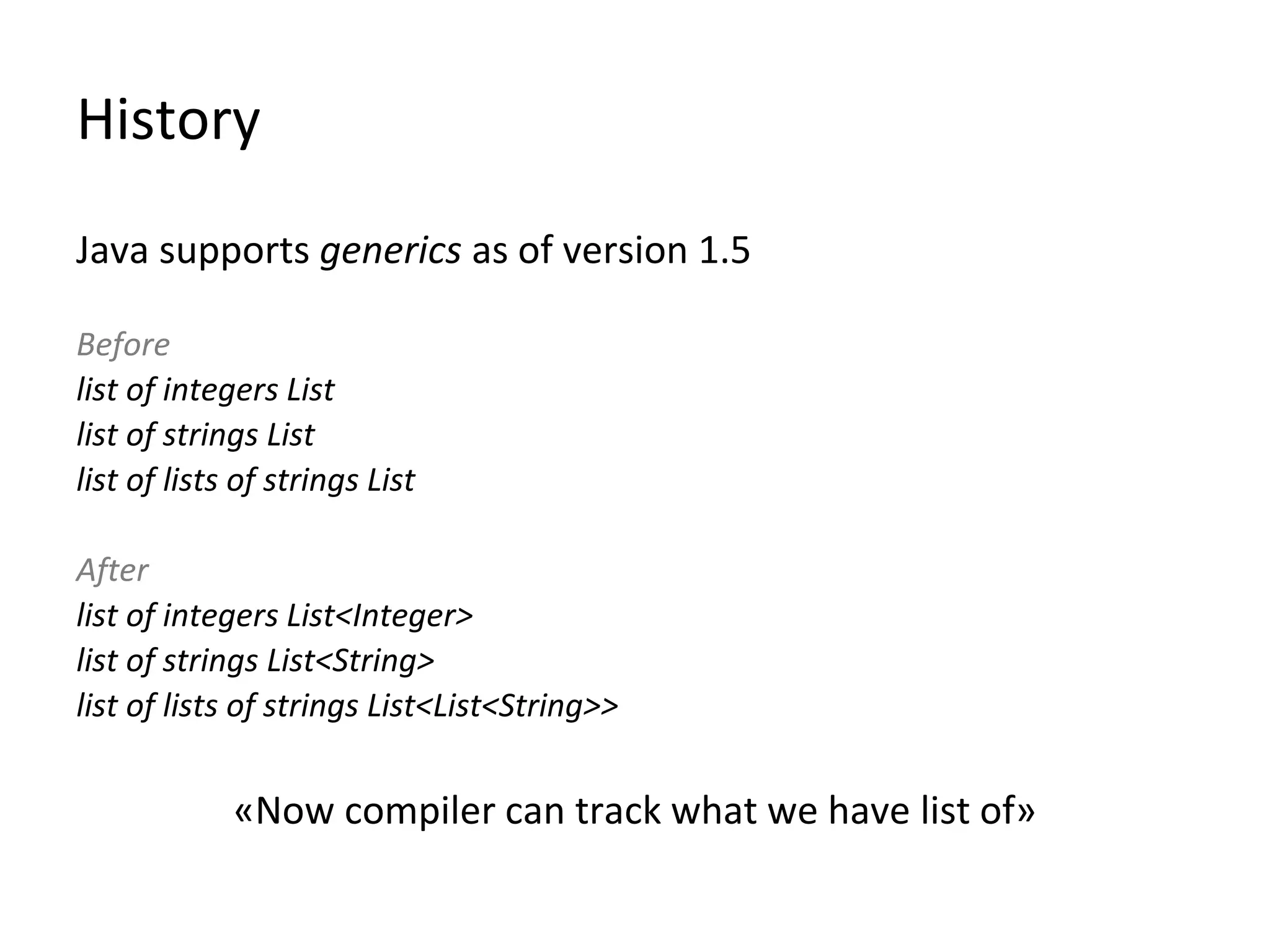
Java supports generics as of version 1.5
Before
list of integers List
list of strings List
list of lists of strings List
After
list of integers List<Integer>
list of strings List<String>
list of lists of strings List<List<String>>
«Now compiler can track what we have list of»
Terms
Term Example
Parameterized type List<String>
Actual type parameter String
Generic type List<E>
Formal type parameter E
Unbounded wildcard type List<?>
Raw type List
Bounded type parameter <E extends Number>
Recursive type bound <T extends Comparable<T>>
Bounded wildcard type List<? extends Number>
Generic method static <E> List<E> asList (E[] a)
Type token List.class
Before-after generics
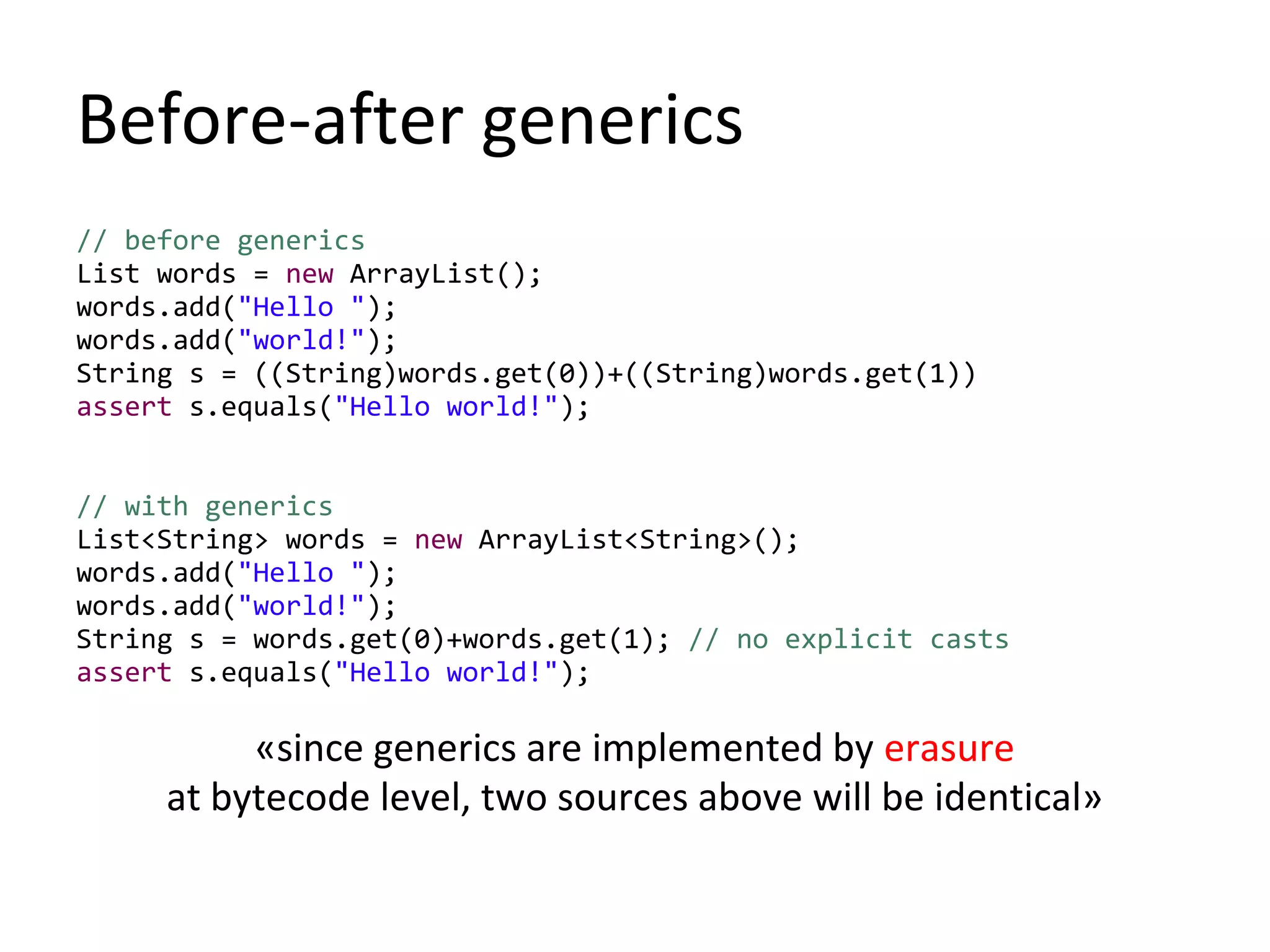
// before generics
List words = new ArrayList();
words.add("Hello ");
words.add("world!");
String s = ((String)words.get(0))+((String)words.get(1))
assert s.equals("Hello world!");
// with generics
List<String> words = new ArrayList<String>();
words.add("Hello ");
words.add("world!");
String s = words.get(0)+words.get(1); // no explicit casts
assert s.equals("Hello world!");
«since generics are implemented by erasure
at bytecode level, two sources above will be identical»
Use raw types in..
class literals
List.class // legal
String[].class // legal
int.class // legal
List<String>.class // illegal since erasure
List<?>.class // illegal
instanceof operator
if (o instanceof Set) {
Set<?> set = (Set<?>) o; // checked cast, no warning
}
Reification
// allocates an array that its components are type of String,
// so we say that it is reified
String[] aStringArray = new String[10];
// allocates a list with no type information,
// Java does not reify generic types
List<String> aStringList = new ArrayList<String>();
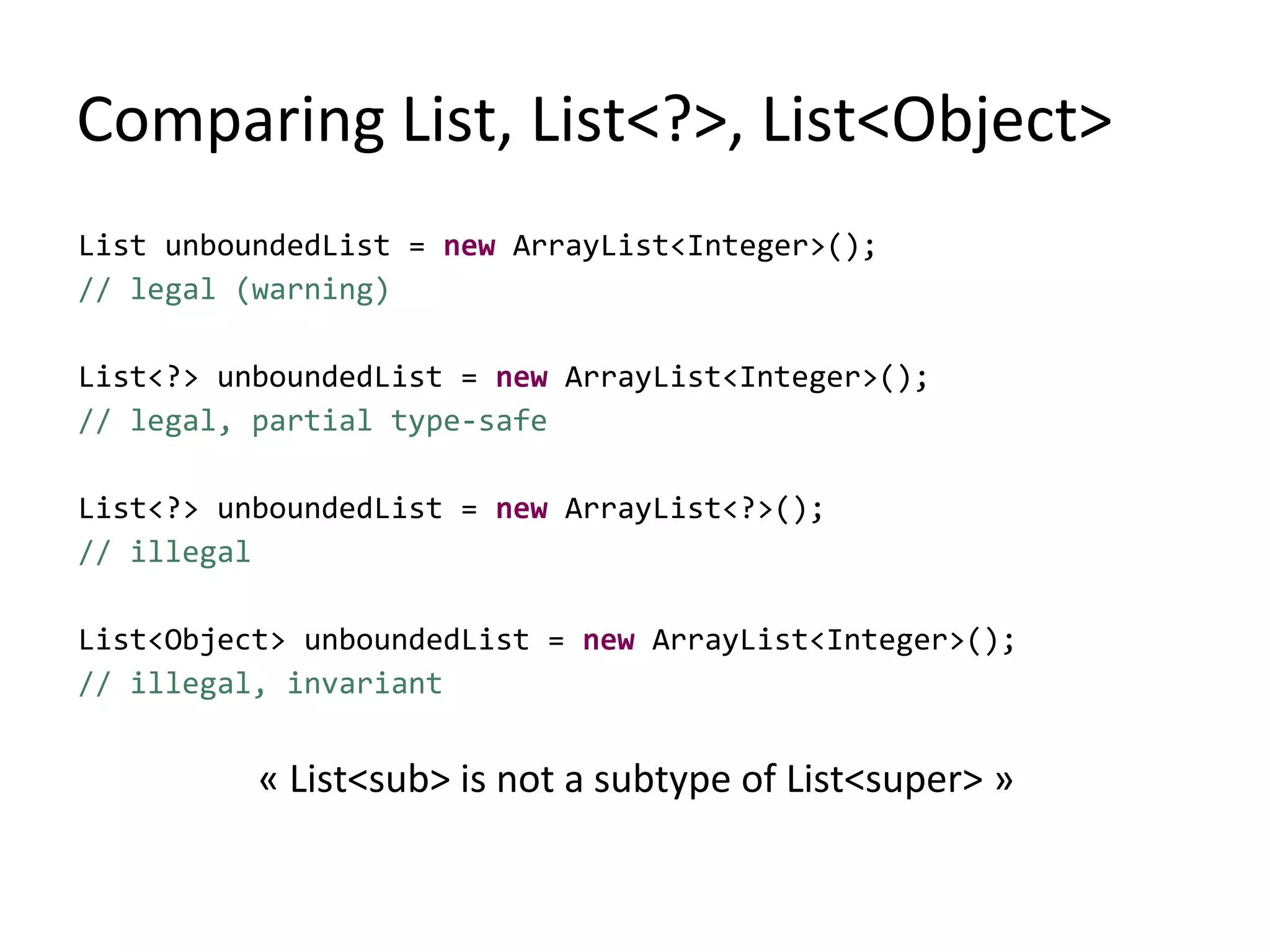
Comparing List, List<?>, List<Object>
List unboundedList = new ArrayList<Integer>();
// legal (warning)
List<?> unboundedList = new ArrayList<Integer>();
// legal, partial type-safe
List<?> unboundedList = new ArrayList<?>();
// illegal
List<Object> unboundedList = new ArrayList<Integer>();
// illegal, invariant
« List<sub> is not a subtype of List<super> »
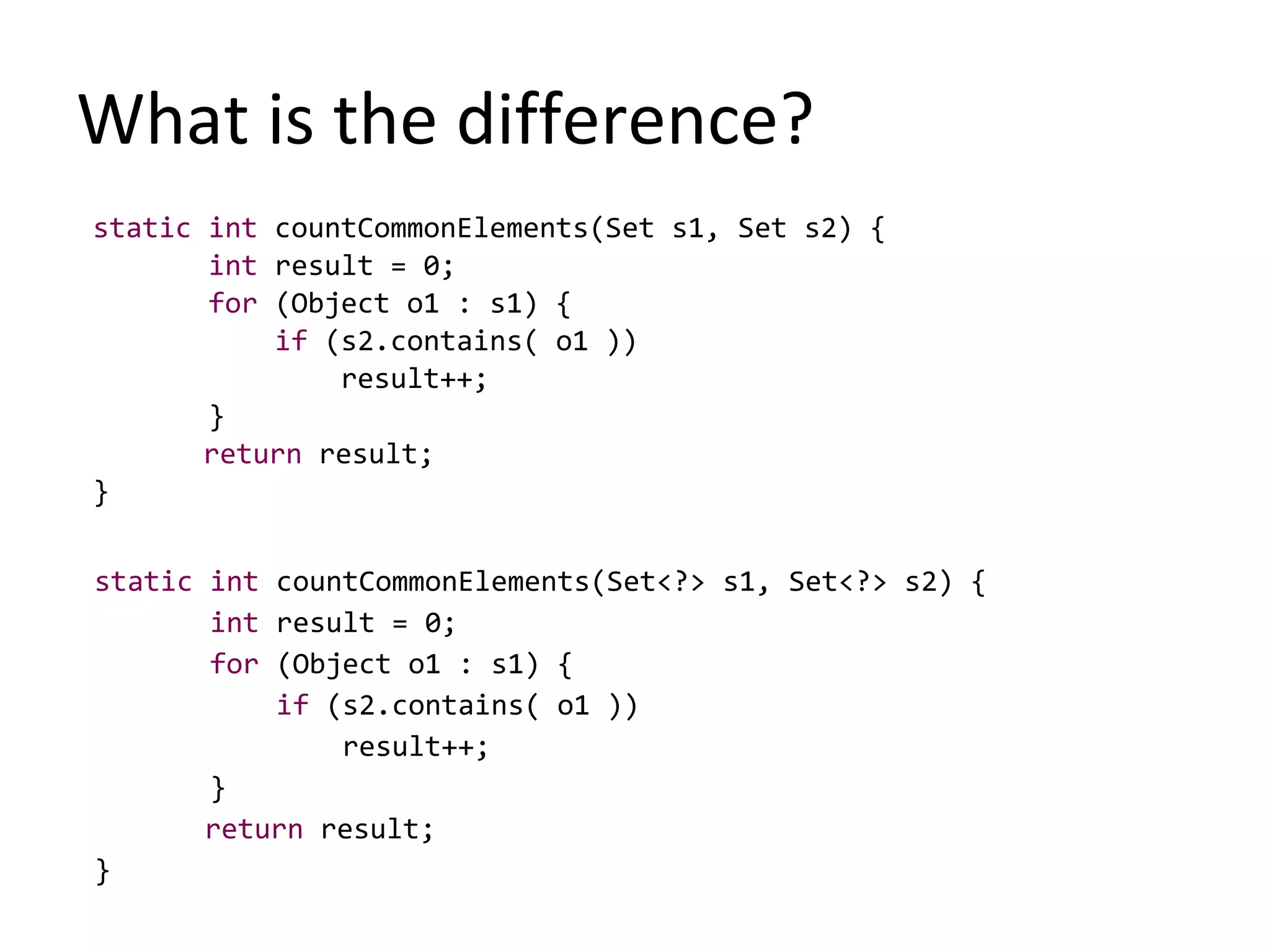
What is the difference?
static int countCommonElements(Set s1, Set s2) {
int result = 0;
for (Object o1 : s1) {
if (s2.contains( o1 ))
result++;
}
return result;
}
static int countCommonElements(Set<?> s1, Set<?> s2) {
int result = 0;
for (Object o1 : s1) {
if (s2.contains( o1 ))
result++;
}
return result;
}
Arrays
« sub[] is a subtype of super[], so its covariant »
Object[] anObjectArray = new Integer[10];
// legal, covariant
anObjectArray[0] = new String("abc");
// no type safety, causes runtime exception
// like arrays, raw collection types arent’n type-safe
List list = new ArrayList();
list.add("one");
list.add(new Integer(1));
String s = (String) list.get(1); // ClassCastException
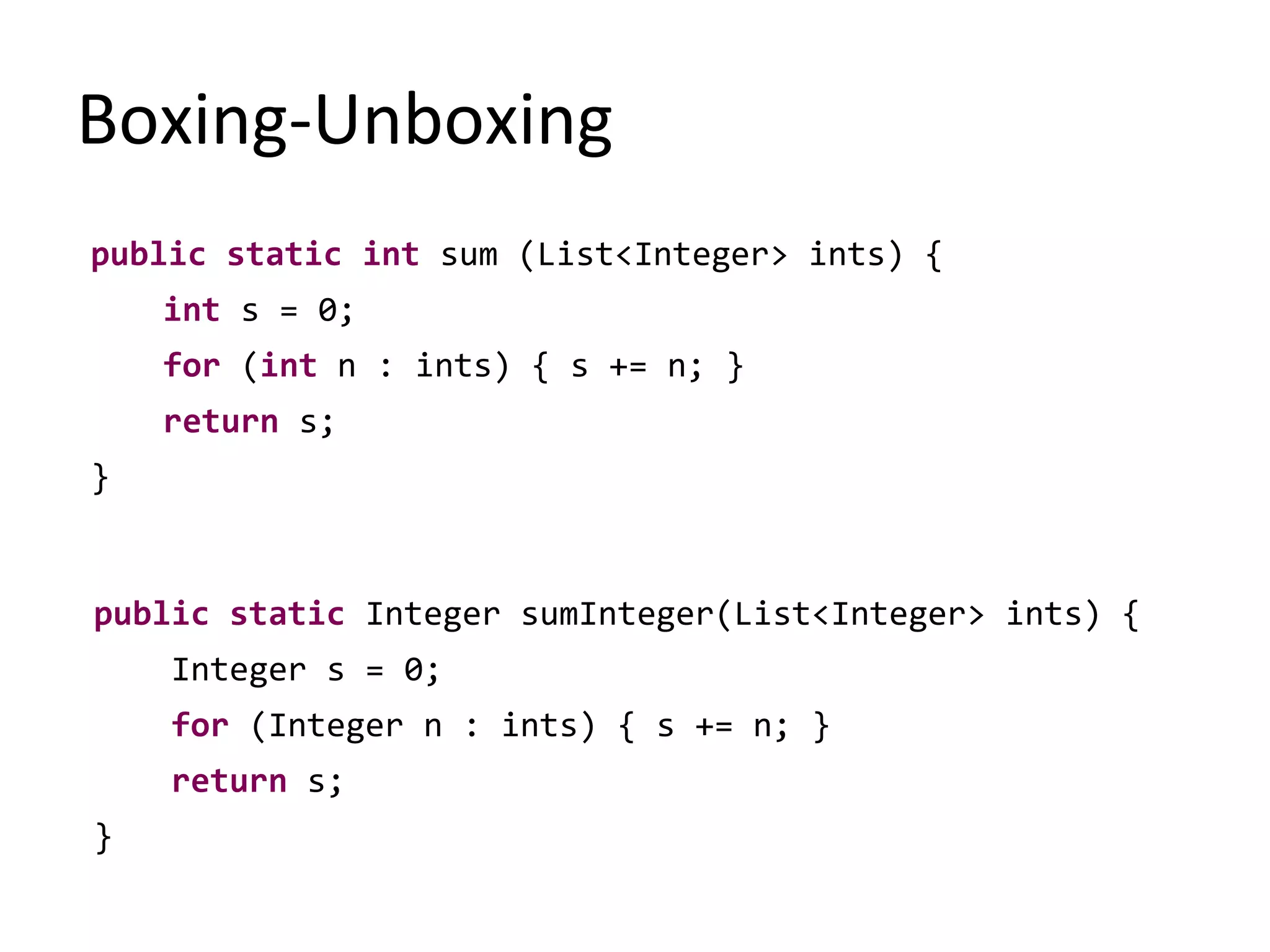
Boxing-Unboxing
public static int sum (List<Integer> ints) {
int s = 0;
for (int n : ints) { s += n; }
return s;
}
public static Integer sumInteger(List<Integer> ints) {
Integer s = 0;
for (Integer n : ints) { s += n; }
return s;
}
public class Stack {
private Object[] stack;
private int top = 0;
private static final int INITIAL_CAPACITY = 8;
public Stack() {
stack = new Object[INITIAL_CAPACITY];
}
public void push(Object obj) {
ensureCapacity();
stack[top++] = obj;
}
public Object pop() {
if (top == 0) // stack is empty
throw new EmptyStackException();
Object temp = stack[--top];
stack[top]=null;
return temp;
}
public boolean isEmpty(){
return top == 0;
}
public void ensureCapacity() {
if (stack.length == top)
stack = Arrays.copyOf(stack, 2 * top + 1);
}
}
public class GenericStack<E> {
private E[] stack;
private int top = 0;
private static final int INITIAL_CAPACITY = 8;
@SuppressWarnings( "unchecked" )
public GenericStack() {
stack = (E[]) new Object[INITIAL_CAPACITY];
}
public void push(E obj) {
ensureCapacity();
stack[top++] = obj;
}
public E pop() {
if (top == 0) // stack is empty
return null;
E temp = stack[--top];
stack[top]=null;
return temp;
}
public boolean isEmpty(){
return top == 0;
}
public void ensureCapacity() {
if (stack.length == top)
stack = Arrays.copyOf(stack, 2 * top + 1);
}
}
Generify legacy codes
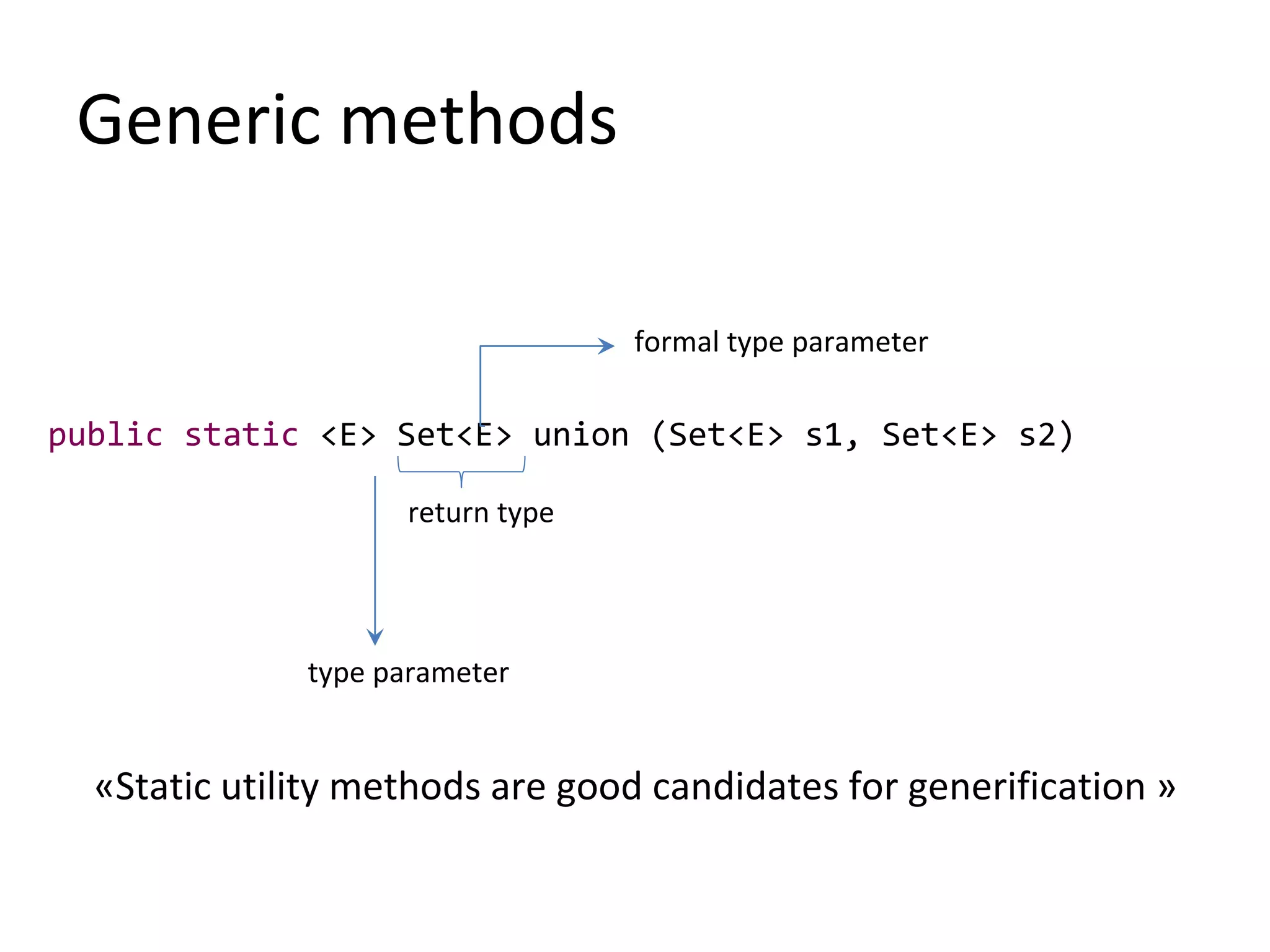
Generic methods
public static <E> Set<E> union (Set<E> s1, Set<E> s2)
«Static utility methods are good candidates for generification »
formal type parameter
return type
type parameter
Get and Put Principal
// PECS (producer extends, consumer super) principal
public static <T> void copy(
List<? super T> dst, List<? extends T> src ) {
for ( int i = 0; i < src.size(); i++ ) {
dst.set( i, src.get( i ) );
}
}
// usage
List<Object> objs = Arrays.<Object>asList(2, 3.14, "four");
List<Integer> ints = Arrays.asList(5, 6);
Collections.copy(objs, ints); // type inference
assert objs.toString().equals("[5, 6, four]");
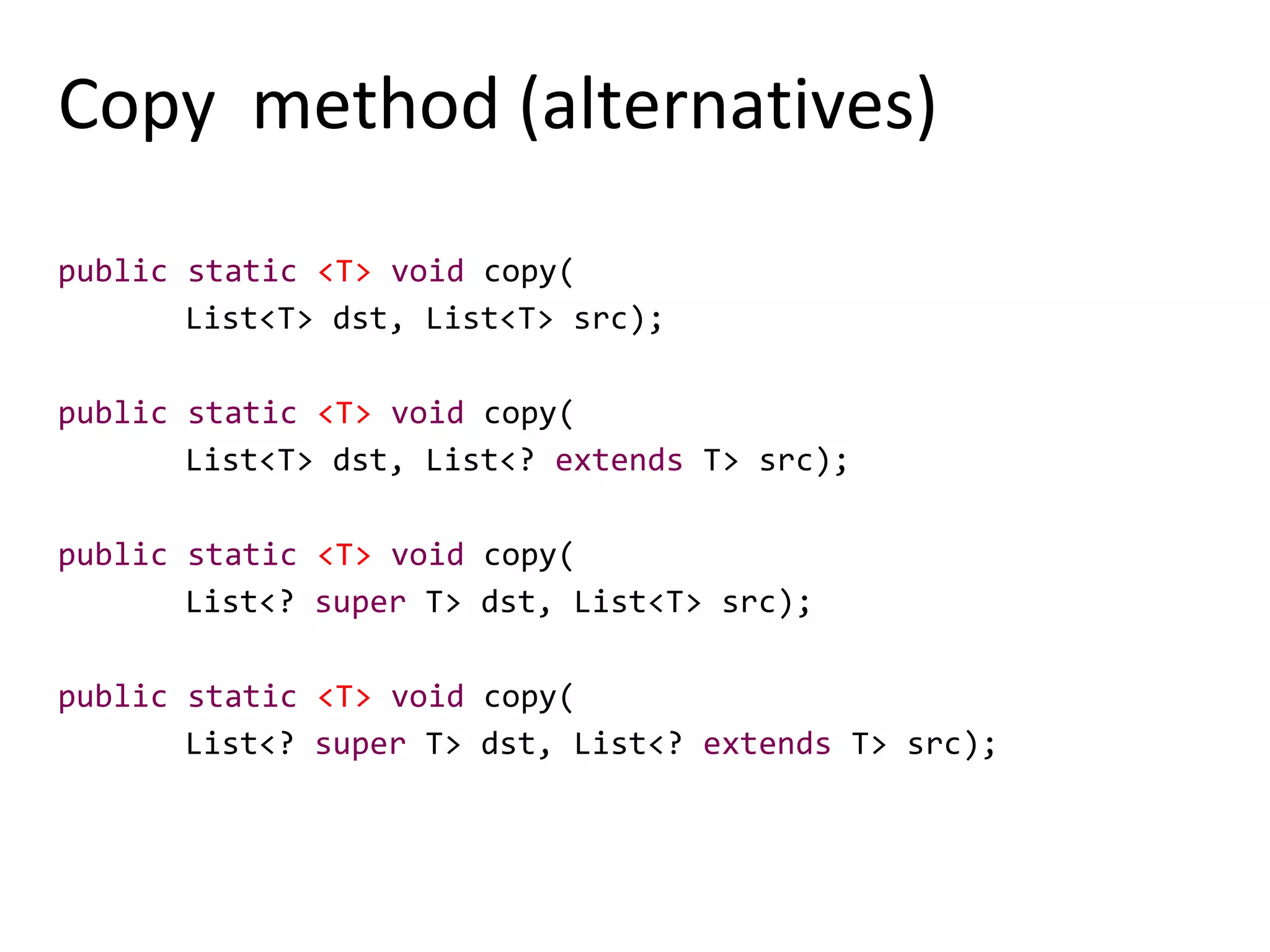
Copy method (alternatives)
public static <T> void copy(
List<T> dst, List<T> src);
public static <T> void copy(
List<T> dst, List<? extends T> src);
public static <T> void copy(
List<? super T> dst, List<T> src);
public static <T> void copy(
List<? super T> dst, List<? extends T> src);
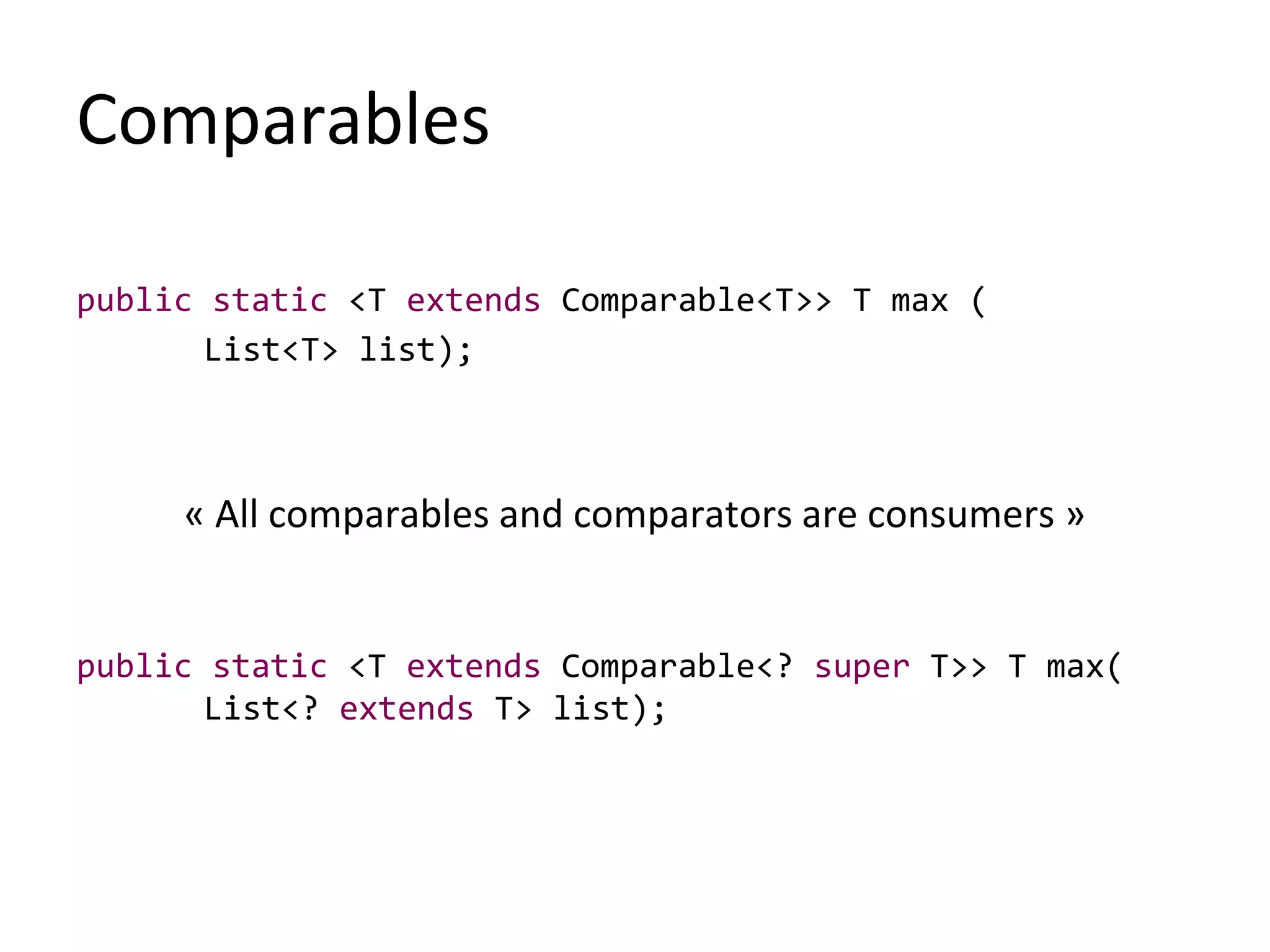
Comparables
public static <T extends Comparable<T>> T max (
List<T> list);
« All comparables and comparators are consumers »
public static <T extends Comparable<? super T>> T max(
List<? extends T> list);
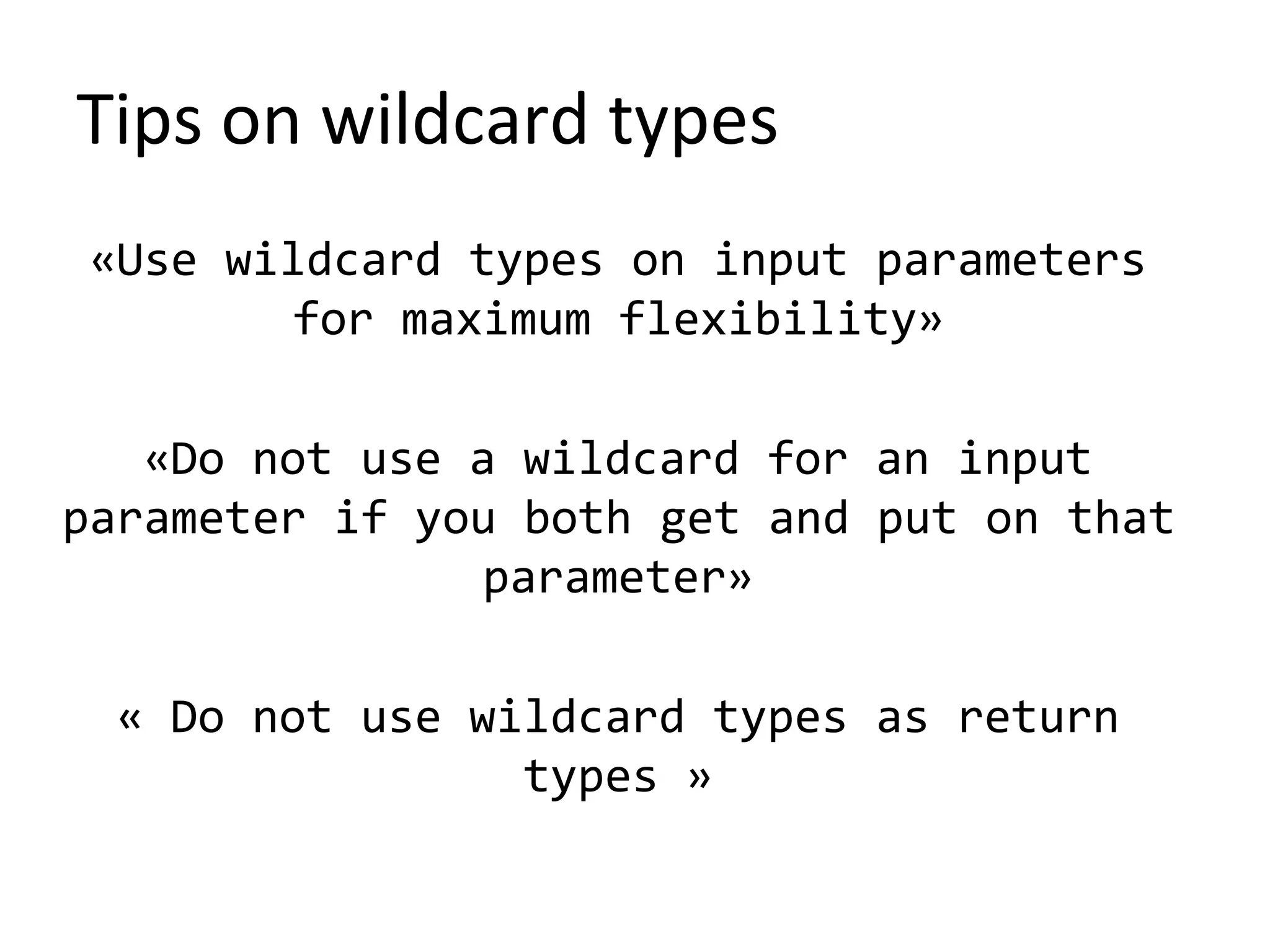
Tips on wildcard types
«Use wildcard types on input parameters
for maximum flexibility»
«Do not use a wildcard for an input
parameter if you both get and put on that
parameter»
« Do not use wildcard types as return
types »
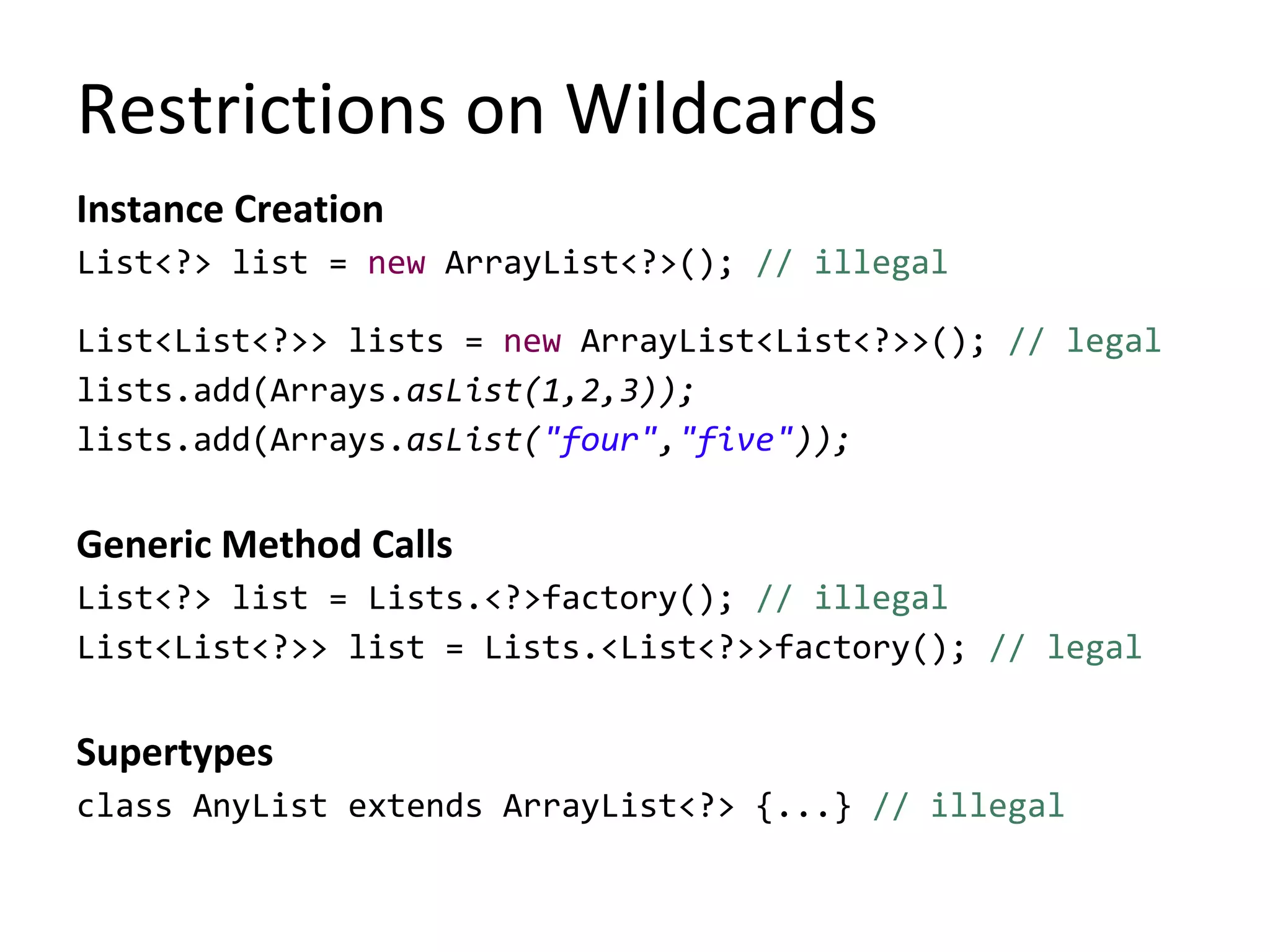
Restrictions on Wildcards
Instance Creation
List<?> list = new ArrayList<?>(); // illegal
List<List<?>> lists = new ArrayList<List<?>>(); // legal
lists.add(Arrays.asList(1,2,3));
lists.add(Arrays.asList("four","five"));
Generic Method Calls
List<?> list = Lists.<?>factory(); // illegal
List<List<?>> list = Lists.<List<?>>factory(); // legal
Supertypes
class AnyList extends ArrayList<?> {...} // illegal
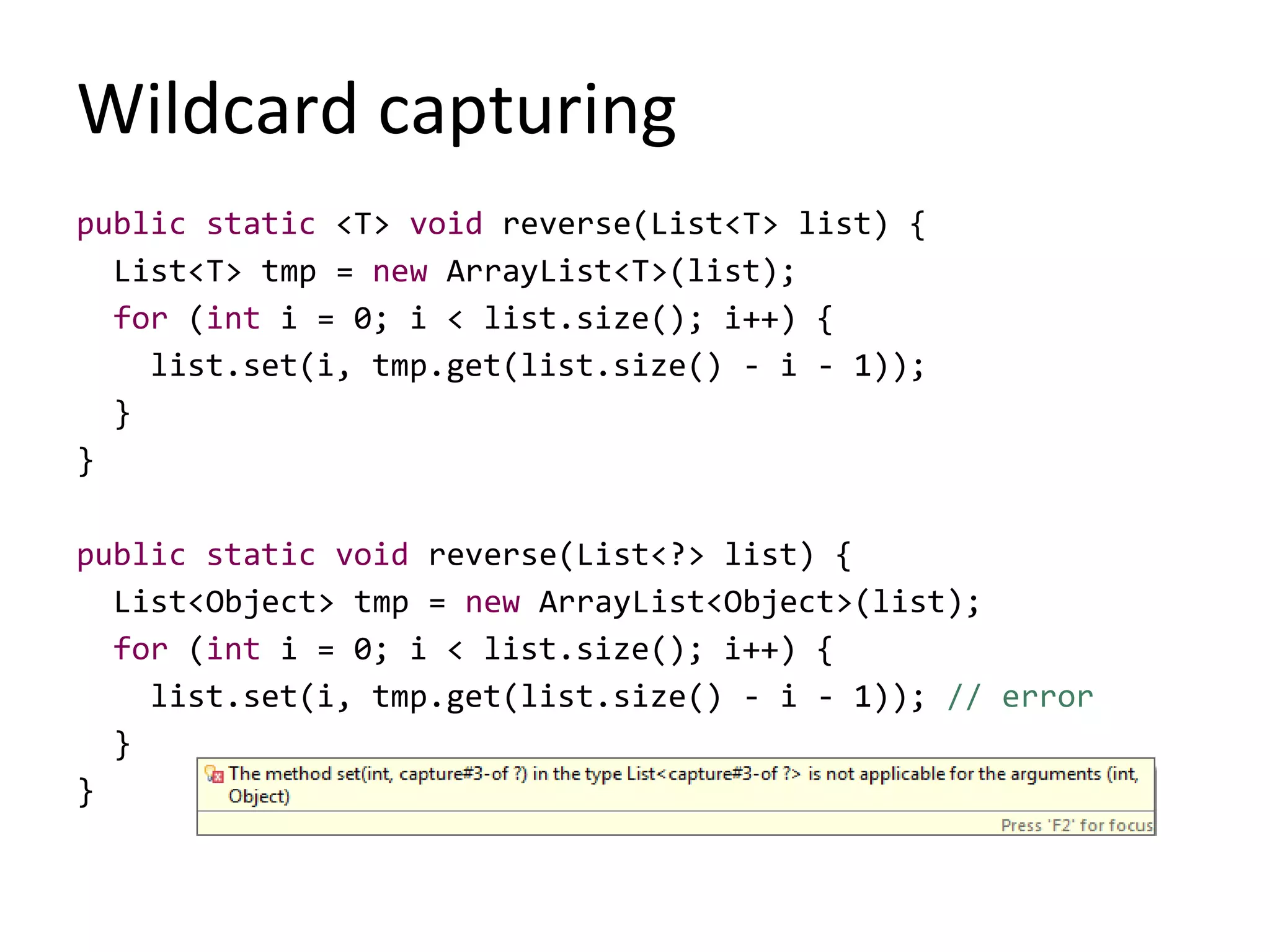
Wildcard capturing
public static <T> void reverse(List<T> list) {
List<T> tmp = new ArrayList<T>(list);
for (int i = 0; i < list.size(); i++) {
list.set(i, tmp.get(list.size() - i - 1));
}
}
public static void reverse(List<?> list) {
List<Object> tmp = new ArrayList<Object>(list);
for (int i = 0; i < list.size(); i++) {
list.set(i, tmp.get(list.size() - i - 1)); // error
}
}
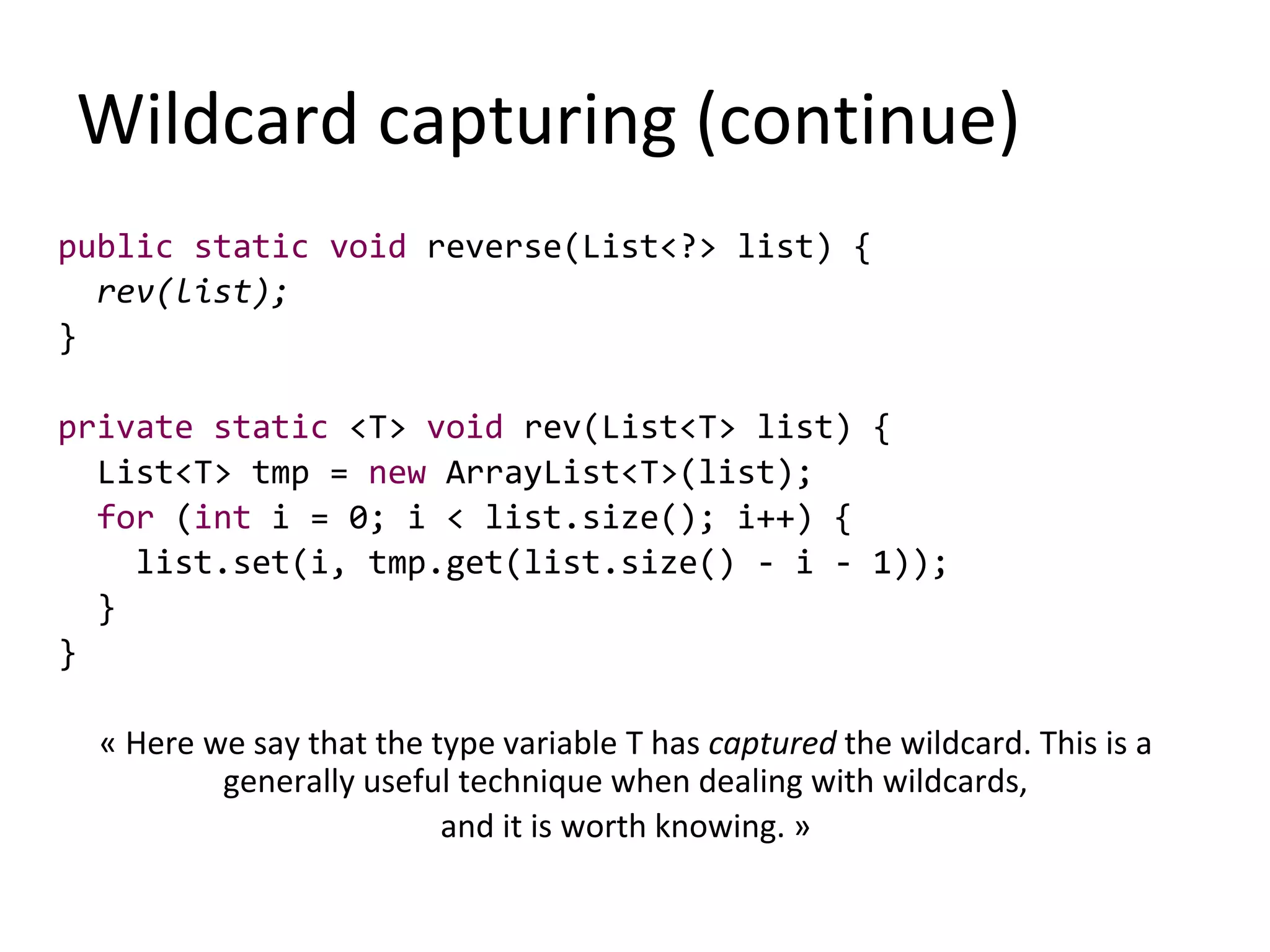
Wildcard capturing (continue)
public static void reverse(List<?> list) {
rev(list);
}
private static <T> void rev(List<T> list) {
List<T> tmp = new ArrayList<T>(list);
for (int i = 0; i < list.size(); i++) {
list.set(i, tmp.get(list.size() - i - 1));
}
}
« Here we say that the type variable T has captured the wildcard. This is a
generally useful technique when dealing with wildcards,
and it is worth knowing. »
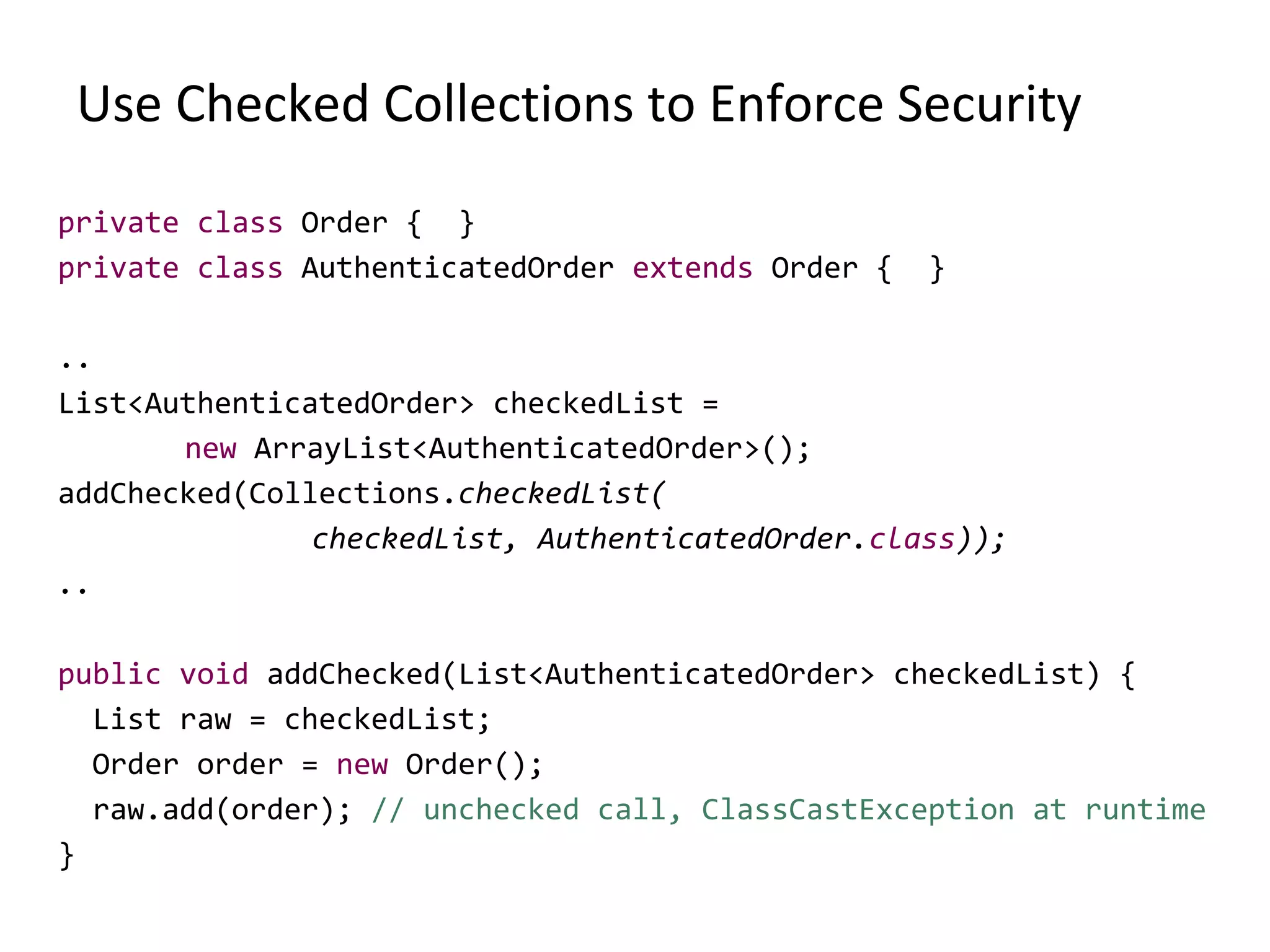
Use Checked Collections to Enforce Security
private class Order { }
private class AuthenticatedOrder extends Order { }
..
List<AuthenticatedOrder> checkedList =
new ArrayList<AuthenticatedOrder>();
addChecked(Collections.checkedList(
checkedList, AuthenticatedOrder.class));
..
public void addChecked(List<AuthenticatedOrder> checkedList) {
List raw = checkedList;
Order order = new Order();
raw.add(order); // unchecked call, ClassCastException at runtime
}
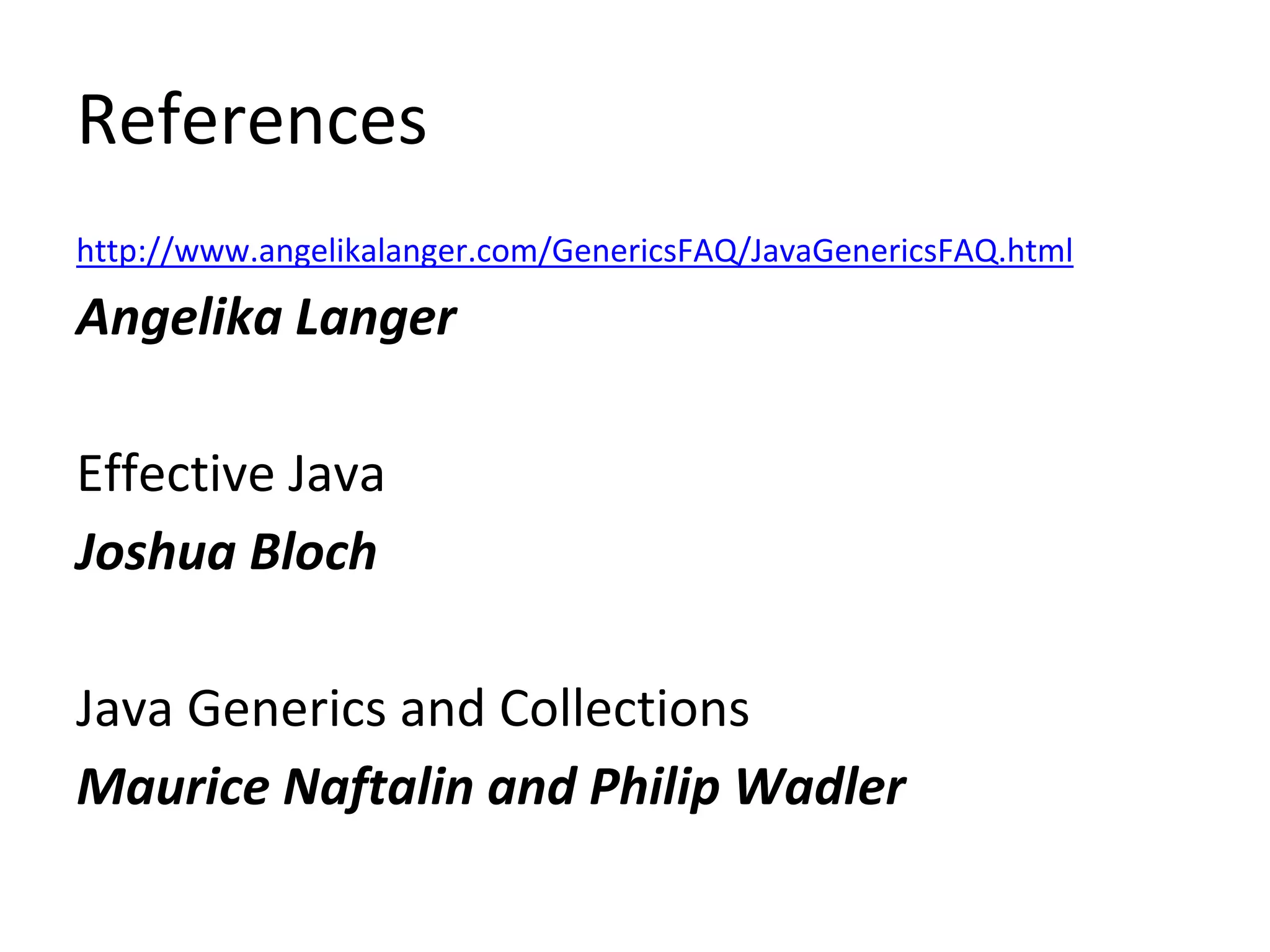
References
http://www.angelikalanger.com/GenericsFAQ/JavaGenericsFAQ.html
Angelika Langer
Effective Java
Joshua Bloch
Java Generics and Collections
Maurice Naftalin and Philip Wadler
Java Generics
Zülfikar Karakaya

Java Generics

  • 1.
  • 2.
    Agenda • History • Terms •Erasure-Reification-Subtyping • Generification • Generic Methods (Get and Put Principal) • Wildcards in Detail
  • 3.
    History Java supports genericsas of version 1.5 Before list of integers List list of strings List list of lists of strings List After list of integers List<Integer> list of strings List<String> list of lists of strings List<List<String>> «Now compiler can track what we have list of»
  • 4.
    Terms Term Example Parameterized typeList<String> Actual type parameter String Generic type List<E> Formal type parameter E Unbounded wildcard type List<?> Raw type List Bounded type parameter <E extends Number> Recursive type bound <T extends Comparable<T>> Bounded wildcard type List<? extends Number> Generic method static <E> List<E> asList (E[] a) Type token List.class
  • 5.
    Before-after generics // beforegenerics List words = new ArrayList(); words.add("Hello "); words.add("world!"); String s = ((String)words.get(0))+((String)words.get(1)) assert s.equals("Hello world!"); // with generics List<String> words = new ArrayList<String>(); words.add("Hello "); words.add("world!"); String s = words.get(0)+words.get(1); // no explicit casts assert s.equals("Hello world!"); «since generics are implemented by erasure at bytecode level, two sources above will be identical»
  • 6.
    Use raw typesin.. class literals List.class // legal String[].class // legal int.class // legal List<String>.class // illegal since erasure List<?>.class // illegal instanceof operator if (o instanceof Set) { Set<?> set = (Set<?>) o; // checked cast, no warning }
  • 7.
    Reification // allocates anarray that its components are type of String, // so we say that it is reified String[] aStringArray = new String[10]; // allocates a list with no type information, // Java does not reify generic types List<String> aStringList = new ArrayList<String>();
  • 8.
    Comparing List, List<?>,List<Object> List unboundedList = new ArrayList<Integer>(); // legal (warning) List<?> unboundedList = new ArrayList<Integer>(); // legal, partial type-safe List<?> unboundedList = new ArrayList<?>(); // illegal List<Object> unboundedList = new ArrayList<Integer>(); // illegal, invariant « List<sub> is not a subtype of List<super> »
  • 9.
    What is thedifference? static int countCommonElements(Set s1, Set s2) { int result = 0; for (Object o1 : s1) { if (s2.contains( o1 )) result++; } return result; } static int countCommonElements(Set<?> s1, Set<?> s2) { int result = 0; for (Object o1 : s1) { if (s2.contains( o1 )) result++; } return result; }
  • 10.
    Arrays « sub[] isa subtype of super[], so its covariant » Object[] anObjectArray = new Integer[10]; // legal, covariant anObjectArray[0] = new String("abc"); // no type safety, causes runtime exception // like arrays, raw collection types arent’n type-safe List list = new ArrayList(); list.add("one"); list.add(new Integer(1)); String s = (String) list.get(1); // ClassCastException
  • 11.
    Boxing-Unboxing public static intsum (List<Integer> ints) { int s = 0; for (int n : ints) { s += n; } return s; } public static Integer sumInteger(List<Integer> ints) { Integer s = 0; for (Integer n : ints) { s += n; } return s; }
  • 12.
    public class Stack{ private Object[] stack; private int top = 0; private static final int INITIAL_CAPACITY = 8; public Stack() { stack = new Object[INITIAL_CAPACITY]; } public void push(Object obj) { ensureCapacity(); stack[top++] = obj; } public Object pop() { if (top == 0) // stack is empty throw new EmptyStackException(); Object temp = stack[--top]; stack[top]=null; return temp; } public boolean isEmpty(){ return top == 0; } public void ensureCapacity() { if (stack.length == top) stack = Arrays.copyOf(stack, 2 * top + 1); } } public class GenericStack<E> { private E[] stack; private int top = 0; private static final int INITIAL_CAPACITY = 8; @SuppressWarnings( "unchecked" ) public GenericStack() { stack = (E[]) new Object[INITIAL_CAPACITY]; } public void push(E obj) { ensureCapacity(); stack[top++] = obj; } public E pop() { if (top == 0) // stack is empty return null; E temp = stack[--top]; stack[top]=null; return temp; } public boolean isEmpty(){ return top == 0; } public void ensureCapacity() { if (stack.length == top) stack = Arrays.copyOf(stack, 2 * top + 1); } } Generify legacy codes
  • 13.
    Generic methods public static<E> Set<E> union (Set<E> s1, Set<E> s2) «Static utility methods are good candidates for generification » formal type parameter return type type parameter
  • 14.
    Get and PutPrincipal // PECS (producer extends, consumer super) principal public static <T> void copy( List<? super T> dst, List<? extends T> src ) { for ( int i = 0; i < src.size(); i++ ) { dst.set( i, src.get( i ) ); } } // usage List<Object> objs = Arrays.<Object>asList(2, 3.14, "four"); List<Integer> ints = Arrays.asList(5, 6); Collections.copy(objs, ints); // type inference assert objs.toString().equals("[5, 6, four]");
  • 15.
    Copy method (alternatives) publicstatic <T> void copy( List<T> dst, List<T> src); public static <T> void copy( List<T> dst, List<? extends T> src); public static <T> void copy( List<? super T> dst, List<T> src); public static <T> void copy( List<? super T> dst, List<? extends T> src);
  • 16.
    Comparables public static <Textends Comparable<T>> T max ( List<T> list); « All comparables and comparators are consumers » public static <T extends Comparable<? super T>> T max( List<? extends T> list);
  • 17.
    Tips on wildcardtypes «Use wildcard types on input parameters for maximum flexibility» «Do not use a wildcard for an input parameter if you both get and put on that parameter» « Do not use wildcard types as return types »
  • 18.
    Restrictions on Wildcards InstanceCreation List<?> list = new ArrayList<?>(); // illegal List<List<?>> lists = new ArrayList<List<?>>(); // legal lists.add(Arrays.asList(1,2,3)); lists.add(Arrays.asList("four","five")); Generic Method Calls List<?> list = Lists.<?>factory(); // illegal List<List<?>> list = Lists.<List<?>>factory(); // legal Supertypes class AnyList extends ArrayList<?> {...} // illegal
  • 19.
    Wildcard capturing public static<T> void reverse(List<T> list) { List<T> tmp = new ArrayList<T>(list); for (int i = 0; i < list.size(); i++) { list.set(i, tmp.get(list.size() - i - 1)); } } public static void reverse(List<?> list) { List<Object> tmp = new ArrayList<Object>(list); for (int i = 0; i < list.size(); i++) { list.set(i, tmp.get(list.size() - i - 1)); // error } }
  • 20.
    Wildcard capturing (continue) publicstatic void reverse(List<?> list) { rev(list); } private static <T> void rev(List<T> list) { List<T> tmp = new ArrayList<T>(list); for (int i = 0; i < list.size(); i++) { list.set(i, tmp.get(list.size() - i - 1)); } } « Here we say that the type variable T has captured the wildcard. This is a generally useful technique when dealing with wildcards, and it is worth knowing. »
  • 21.
    Use Checked Collectionsto Enforce Security private class Order { } private class AuthenticatedOrder extends Order { } .. List<AuthenticatedOrder> checkedList = new ArrayList<AuthenticatedOrder>(); addChecked(Collections.checkedList( checkedList, AuthenticatedOrder.class)); .. public void addChecked(List<AuthenticatedOrder> checkedList) { List raw = checkedList; Order order = new Order(); raw.add(order); // unchecked call, ClassCastException at runtime }
  • 22.
  • 23.