Easy Data with
Spring-Data JPA
Miya W. Longwe, Tech Lead, Staples Inc.
January 07, 2014
Java Meetup Group, Cambridge, MA , USA
Agenda
 Java DB Access Ordeal
 Enter Spring-Data
 Spring-Data JPA Features
 Code Demo
 Q and A
Java DB Access
The Developer’s Holy Pilgrim!
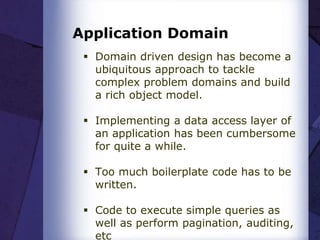
Application Domain
 Domain driven design has become a
ubiquitous approach to tackle
complex problem domains and build
a rich object model.
 Implementing a data access layer of
an application has been cumbersome
for quite a while.
 Too much boilerplate code has to be
written.
 Code to execute simple queries as
well as perform pagination, auditing,
etc
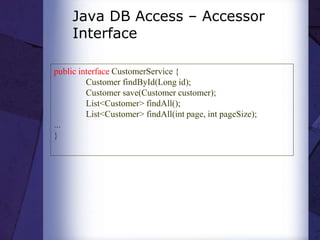
Java DB Access – Accessor
Interface
public interface CustomerService {
Customer findById(Long id);
Customer save(Customer customer);
List<Customer> findAll();
List<Customer> findAll(int page, int pageSize);
...
}
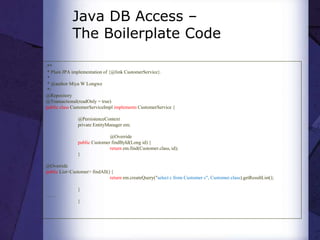
Java DB Access –
The Boilerplate Code
/**
* Plain JPA implementation of {@link CustomerService}.
*
* @author Miya W Longwe
*/
@Repository
@Transactional(readOnly = true)
public class CustomerServiceImpl implements CustomerService {
@PersistenceContext
private EntityManager em;
@Override
public Customer findById(Long id) {
return em.find(Customer.class, id);
}
@Override
public List<Customer> findAll() {
return em.createQuery("select c from Customer c", Customer.class).getResultList();
}
……
}
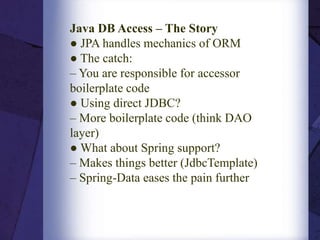
Java DB Access – The Story
● JPA handles mechanics of ORM
● The catch:
– You are responsible for accessor
boilerplate code
● Using direct JDBC?
– More boilerplate code (think DAO
layer)
● What about Spring support?
– Makes things better (JdbcTemplate)
– Spring-Data eases the pain further
Spring-Data to the Rescue!
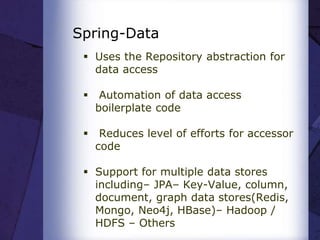
Spring-Data
 Uses the Repository abstraction for
data access
 Automation of data access
boilerplate code
 Reduces level of efforts for accessor
code
 Support for multiple data stores
including– JPA– Key-Value, column,
document, graph data stores(Redis,
Mongo, Neo4j, HBase)– Hadoop /
HDFS – Others
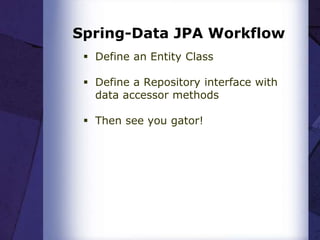
Spring-Data JPA Workflow
 Define an Entity Class
 Define a Repository interface with
data accessor methods
 Then see you gator!
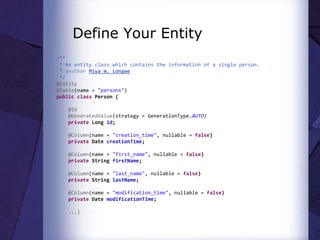
Define Your Entity
/**
* An entity class which contains the information of a single person.
* @author Miya W. Longwe
*/
@Entity
@Table(name = "persons")
public class Person {
@Id
@GeneratedValue(strategy = GenerationType.AUTO)
private Long id;
@Column(name = "creation_time", nullable = false)
private Date creationTime;
@Column(name = "first_name", nullable = false)
private String firstName;
@Column(name = "last_name", nullable = false)
private String lastName;
@Column(name = "modification_time", nullable = false)
private Date modificationTime;
...}
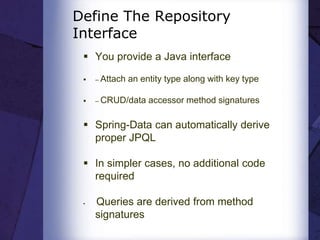
Define The Repository
Interface
 You provide a Java interface
 – Attach an entity type along with key type
 – CRUD/data accessor method signatures
 Spring-Data can automatically derive
proper JPQL
 In simpler cases, no additional code
required
 Queries are derived from method
signatures
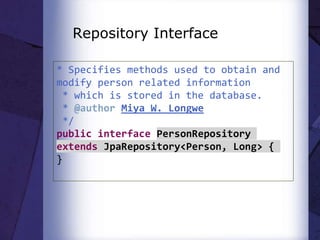
Repository Interface
* Specifies methods used to obtain and
modify person related information
* which is stored in the database.
* @author Miya W. Longwe
*/
public interface PersonRepository
extends JpaRepository<Person, Long> {
}
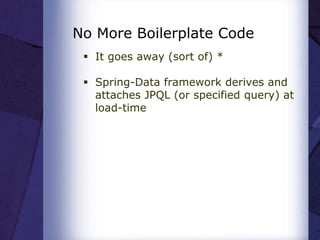
No More Boilerplate Code
 It goes away (sort of) *
 Spring-Data framework derives and
attaches JPQL (or specified query) at
load-time
Spring-Data Features
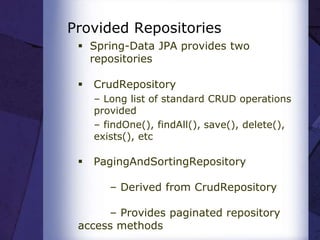
Provided Repositories
 Spring-Data JPA provides two
repositories
 CrudRepository
– Long list of standard CRUD operations
provided
– findOne(), findAll(), save(), delete(),
exists(), etc
 PagingAndSortingRepository
– Derived from CrudRepository
– Provides paginated repository
access methods
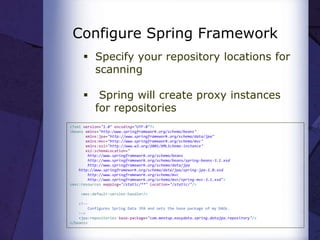
Configure Spring Framework
 Specify your repository locations for
scanning
 Spring will create proxy instances
for repositories
<?xml version="1.0" encoding="UTF-8"?>
<beans xmlns="http:/www.springframework.org/schema/beans"
xmlns:jpa="http://www.springframework.org/schema/data/jpa"
xmlns:mvc="http://www.springframework.org/schema/mvc"
xmlns:xsi="http://www.w3.org/2001/XMLSchema-instance"
xsi:schemaLocation="
http://www.springframework.org/schema/beans
http://www.springframework.org/schema/beans/spring-beans-3.1.xsd
http://www.springframework.org/schema/data/jpa
http://www.springframework.org/schema/data/jpa/spring-jpa-1.0.xsd
http://www.springframework.org/schema/mvc
http://www.springframework.org/schema/mvc/spring-mvc-3.1.xsd">
<mvc:resources mapping="/static/**" location="/static/"/>
<mvc:default-servlet-handler/>
<!--
Configures Spring Data JPA and sets the base package of my DAOs.
-->
<jpa:repositories base-package="com.meetup.easydata.spring.datajpa.repository"/>
</beans>
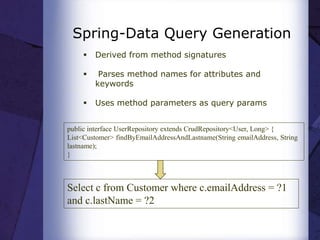
Spring-Data Query Generation
 Derived from method signatures
 Parses method names for attributes and
keywords
 Uses method parameters as query params
public interface UserRepository extends CrudRepository<User, Long> {
List<Customer> findByEmailAddressAndLastname(String emailAddress, String
lastname);
}
Select c from Customer where c.emailAddress = ?1
and c.lastName = ?2
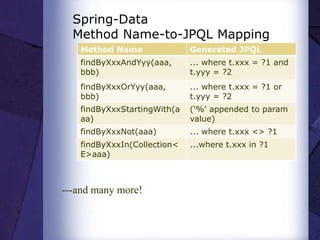
Spring-Data
Method Name-to-JPQL Mapping
Method Name Generated JPQL
findByXxxAndYyy(aaa,
bbb)
... where t.xxx = ?1 and
t.yyy = ?2
findByXxxOrYyy(aaa,
bbb)
... where t.xxx = ?1 or
t.yyy = ?2
findByXxxStartingWith(a
aa)
('%' appended to param
value)
findByXxxNot(aaa) ... where t.xxx <> ?1
findByXxxIn(Collection<
E>aaa)
...where t.xxx in ?1
---and many more!
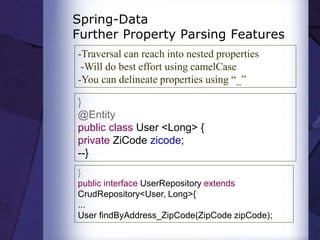
Spring-Data
Further Property Parsing Features
-Traversal can reach into nested properties
-Will do best effort using camelCase
-You can delineate properties using “_”
}
@Entity
public class User <Long> {
private ZiCode zicode;
--}
}
public interface UserRepository extends
CrudRepository<User, Long>{
...
User findByAddress_ZipCode(ZipCode zipCode);
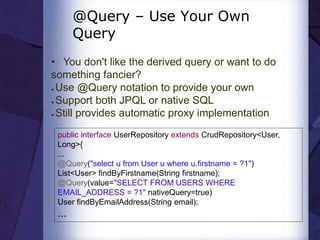
@Query – Use Your Own
Query
• You don't like the derived query or want to do
something fancier?
● Use @Query notation to provide your own
● Support both JPQL or native SQL
● Still provides automatic proxy implementation
public interface UserRepository extends CrudRepository<User,
Long>{
...
@Query("select u from User u where u.firstname = ?1")
List<User> findByFirstname(String firstname);
@Query(value="SELECT FROM USERS WHERE
EMAIL_ADDRESS = ?1" nativeQuery=true)
User findByEmailAddress(String email);
...
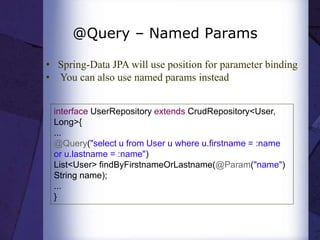
@Query – Named Params
• Spring-Data JPA will use position for parameter binding
• You can also use named params instead
interface UserRepository extends CrudRepository<User,
Long>{
...
@Query("select u from User u where u.firstname = :name
or u.lastname = :name")
List<User> findByFirstnameOrLastname(@Param("name")
String name);
...
}
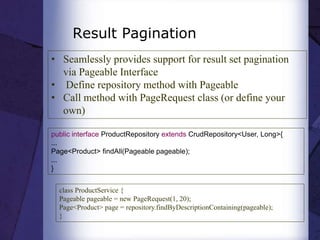
Result Pagination
• Seamlessly provides support for result set pagination
via Pageable Interface
• Define repository method with Pageable
• Call method with PageRequest class (or define your
own)
public interface ProductRepository extends CrudRepository<User, Long>{
...
Page<Product> findAll(Pageable pageable);
...
}
class ProductService {
Pageable pageable = new PageRequest(1, 20);
Page<Product> page = repository.findByDescriptionContaining(pageable);
}
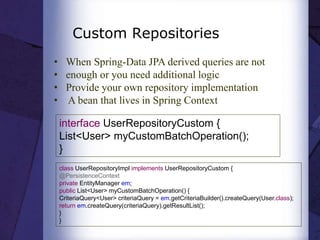
Custom Repositories
• When Spring-Data JPA derived queries are not
• enough or you need additional logic
• Provide your own repository implementation
• A bean that lives in Spring Context
interface UserRepositoryCustom {
List<User> myCustomBatchOperation();
}
class UserRepositoryImpl implements UserRepositoryCustom {
@PersistenceContext
private EntityManager em;
public List<User> myCustomBatchOperation() {
CriteriaQuery<User> criteriaQuery = em.getCriteriaBuilder().createQuery(User.class);
return em.createQuery(criteriaQuery).getResultList();
}
}
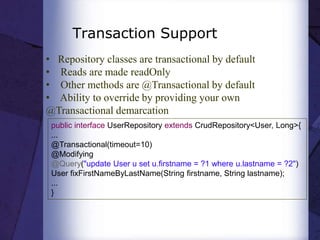
Transaction Support
• Repository classes are transactional by default
• Reads are made readOnly
• Other methods are @Transactional by default
• Ability to override by providing your own
@Transactional demarcation
public interface UserRepository extends CrudRepository<User, Long>{
...
@Transactional(timeout=10)
@Modifying
@Query("update User u set u.firstname = ?1 where u.lastname = ?2")
User fixFirstNameByLastName(String firstname, String lastname);
...
}
Code Demo

Easy data-with-spring-data-jpa

  • 1.
    Easy Data with Spring-DataJPA Miya W. Longwe, Tech Lead, Staples Inc. January 07, 2014 Java Meetup Group, Cambridge, MA , USA
  • 2.
    Agenda  Java DBAccess Ordeal  Enter Spring-Data  Spring-Data JPA Features  Code Demo  Q and A
  • 3.
    Java DB Access TheDeveloper’s Holy Pilgrim!
  • 4.
    Application Domain  Domaindriven design has become a ubiquitous approach to tackle complex problem domains and build a rich object model.  Implementing a data access layer of an application has been cumbersome for quite a while.  Too much boilerplate code has to be written.  Code to execute simple queries as well as perform pagination, auditing, etc
  • 5.
    Java DB Access– Accessor Interface public interface CustomerService { Customer findById(Long id); Customer save(Customer customer); List<Customer> findAll(); List<Customer> findAll(int page, int pageSize); ... }
  • 6.
    Java DB Access– The Boilerplate Code /** * Plain JPA implementation of {@link CustomerService}. * * @author Miya W Longwe */ @Repository @Transactional(readOnly = true) public class CustomerServiceImpl implements CustomerService { @PersistenceContext private EntityManager em; @Override public Customer findById(Long id) { return em.find(Customer.class, id); } @Override public List<Customer> findAll() { return em.createQuery("select c from Customer c", Customer.class).getResultList(); } …… }
  • 7.
    Java DB Access– The Story ● JPA handles mechanics of ORM ● The catch: – You are responsible for accessor boilerplate code ● Using direct JDBC? – More boilerplate code (think DAO layer) ● What about Spring support? – Makes things better (JdbcTemplate) – Spring-Data eases the pain further
  • 8.
  • 9.
    Spring-Data  Uses theRepository abstraction for data access  Automation of data access boilerplate code  Reduces level of efforts for accessor code  Support for multiple data stores including– JPA– Key-Value, column, document, graph data stores(Redis, Mongo, Neo4j, HBase)– Hadoop / HDFS – Others
  • 10.
    Spring-Data JPA Workflow Define an Entity Class  Define a Repository interface with data accessor methods  Then see you gator!
  • 11.
    Define Your Entity /** *An entity class which contains the information of a single person. * @author Miya W. Longwe */ @Entity @Table(name = "persons") public class Person { @Id @GeneratedValue(strategy = GenerationType.AUTO) private Long id; @Column(name = "creation_time", nullable = false) private Date creationTime; @Column(name = "first_name", nullable = false) private String firstName; @Column(name = "last_name", nullable = false) private String lastName; @Column(name = "modification_time", nullable = false) private Date modificationTime; ...}
  • 12.
    Define The Repository Interface You provide a Java interface  – Attach an entity type along with key type  – CRUD/data accessor method signatures  Spring-Data can automatically derive proper JPQL  In simpler cases, no additional code required  Queries are derived from method signatures
  • 13.
    Repository Interface * Specifiesmethods used to obtain and modify person related information * which is stored in the database. * @author Miya W. Longwe */ public interface PersonRepository extends JpaRepository<Person, Long> { }
  • 14.
    No More BoilerplateCode  It goes away (sort of) *  Spring-Data framework derives and attaches JPQL (or specified query) at load-time
  • 15.
  • 16.
    Provided Repositories  Spring-DataJPA provides two repositories  CrudRepository – Long list of standard CRUD operations provided – findOne(), findAll(), save(), delete(), exists(), etc  PagingAndSortingRepository – Derived from CrudRepository – Provides paginated repository access methods
  • 17.
    Configure Spring Framework Specify your repository locations for scanning  Spring will create proxy instances for repositories <?xml version="1.0" encoding="UTF-8"?> <beans xmlns="http:/www.springframework.org/schema/beans" xmlns:jpa="http://www.springframework.org/schema/data/jpa" xmlns:mvc="http://www.springframework.org/schema/mvc" xmlns:xsi="http://www.w3.org/2001/XMLSchema-instance" xsi:schemaLocation=" http://www.springframework.org/schema/beans http://www.springframework.org/schema/beans/spring-beans-3.1.xsd http://www.springframework.org/schema/data/jpa http://www.springframework.org/schema/data/jpa/spring-jpa-1.0.xsd http://www.springframework.org/schema/mvc http://www.springframework.org/schema/mvc/spring-mvc-3.1.xsd"> <mvc:resources mapping="/static/**" location="/static/"/> <mvc:default-servlet-handler/> <!-- Configures Spring Data JPA and sets the base package of my DAOs. --> <jpa:repositories base-package="com.meetup.easydata.spring.datajpa.repository"/> </beans>
  • 18.
    Spring-Data Query Generation Derived from method signatures  Parses method names for attributes and keywords  Uses method parameters as query params public interface UserRepository extends CrudRepository<User, Long> { List<Customer> findByEmailAddressAndLastname(String emailAddress, String lastname); } Select c from Customer where c.emailAddress = ?1 and c.lastName = ?2
  • 19.
    Spring-Data Method Name-to-JPQL Mapping MethodName Generated JPQL findByXxxAndYyy(aaa, bbb) ... where t.xxx = ?1 and t.yyy = ?2 findByXxxOrYyy(aaa, bbb) ... where t.xxx = ?1 or t.yyy = ?2 findByXxxStartingWith(a aa) ('%' appended to param value) findByXxxNot(aaa) ... where t.xxx <> ?1 findByXxxIn(Collection< E>aaa) ...where t.xxx in ?1 ---and many more!
  • 20.
    Spring-Data Further Property ParsingFeatures -Traversal can reach into nested properties -Will do best effort using camelCase -You can delineate properties using “_” } @Entity public class User <Long> { private ZiCode zicode; --} } public interface UserRepository extends CrudRepository<User, Long>{ ... User findByAddress_ZipCode(ZipCode zipCode);
  • 21.
    @Query – UseYour Own Query • You don't like the derived query or want to do something fancier? ● Use @Query notation to provide your own ● Support both JPQL or native SQL ● Still provides automatic proxy implementation public interface UserRepository extends CrudRepository<User, Long>{ ... @Query("select u from User u where u.firstname = ?1") List<User> findByFirstname(String firstname); @Query(value="SELECT FROM USERS WHERE EMAIL_ADDRESS = ?1" nativeQuery=true) User findByEmailAddress(String email); ...
  • 22.
    @Query – NamedParams • Spring-Data JPA will use position for parameter binding • You can also use named params instead interface UserRepository extends CrudRepository<User, Long>{ ... @Query("select u from User u where u.firstname = :name or u.lastname = :name") List<User> findByFirstnameOrLastname(@Param("name") String name); ... }
  • 23.
    Result Pagination • Seamlesslyprovides support for result set pagination via Pageable Interface • Define repository method with Pageable • Call method with PageRequest class (or define your own) public interface ProductRepository extends CrudRepository<User, Long>{ ... Page<Product> findAll(Pageable pageable); ... } class ProductService { Pageable pageable = new PageRequest(1, 20); Page<Product> page = repository.findByDescriptionContaining(pageable); }
  • 24.
    Custom Repositories • WhenSpring-Data JPA derived queries are not • enough or you need additional logic • Provide your own repository implementation • A bean that lives in Spring Context interface UserRepositoryCustom { List<User> myCustomBatchOperation(); } class UserRepositoryImpl implements UserRepositoryCustom { @PersistenceContext private EntityManager em; public List<User> myCustomBatchOperation() { CriteriaQuery<User> criteriaQuery = em.getCriteriaBuilder().createQuery(User.class); return em.createQuery(criteriaQuery).getResultList(); } }
  • 25.
    Transaction Support • Repositoryclasses are transactional by default • Reads are made readOnly • Other methods are @Transactional by default • Ability to override by providing your own @Transactional demarcation public interface UserRepository extends CrudRepository<User, Long>{ ... @Transactional(timeout=10) @Modifying @Query("update User u set u.firstname = ?1 where u.lastname = ?2") User fixFirstNameByLastName(String firstname, String lastname); ... }
  • 26.