Chapter 29:
ACCOUNTING INFORMATION SYSTEM
THE PERSONNEL/
PAYROLL CYCLE
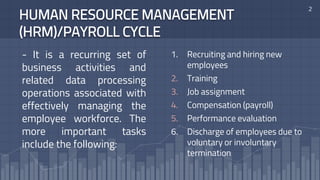
HUMAN RESOURCE MANAGEMENT
(HRM)/PAYROLL CYCLE
1. Recruiting and hiring new
employees
2. Training
3. Job assignment
4. Compensation (payroll)
5. Performance evaluation
6. Discharge of employees due to
voluntary or involuntary
termination
- It is a recurring set of
business activities and
related data processing
operations associated with
effectively managing the
employee workforce. The
more important tasks
include the following:
2
3
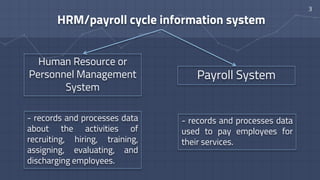
HRM/payroll cycle information system
Human Resource or
Personnel Management
System
Payroll System
- records and processes data
about the activities of
recruiting, hiring, training,
assigning, evaluating, and
discharging employees.
- records and processes data
used to pay employees for
their services.
THE PERSONNEL
MANAGEMENT
FUNCTION
A. THE TOP PERSONNEL EXECUTIVE
Board responsibilities
 Participates in planning allocation of
corporate resources,
 Recommends companywide personnel
policies to top management.
5
6
 Develops organization of personnel
function.
 Delegates authority to manage
personnel activities.
 Monitors and evaluates performance
of those to whom authority was
delegated.
7
 Quantitative information
 Qualitative information
B. INFORMATION NEEDS.
THE PAYROLL DATA
PROCESSING
SYSTEM
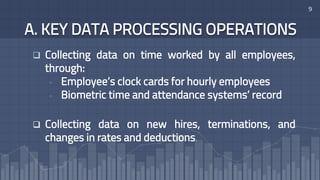
 Collecting data on time worked by all employees,
through:
- Employee’s clock cards for hourly employees
- Biometric time and attendance systems’ record
 Collecting data on new hires, terminations, and
changes in rates and deductions.
A. KEY DATA PROCESSING OPERATIONS
9
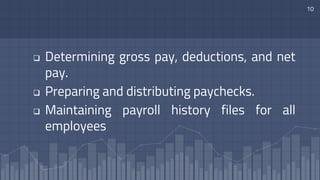
 Determining gross pay, deductions, and net
pay.
 Preparing and distributing paychecks.
 Maintaining payroll history files for all
employees
10
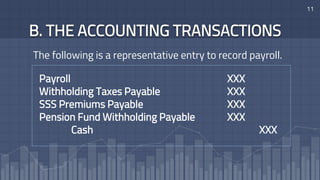
B. THE ACCOUNTING TRANSACTIONS
11
The following is a representative entry to record payroll.
Payroll XXX
Withholding Taxes Payable XXX
SSS Premiums Payable XXX
Pension Fund Withholding Payable XXX
Cash XXX
12
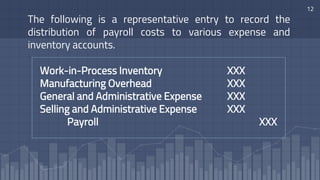
The following is a representative entry to record the
distribution of payroll costs to various expense and
inventory accounts.
Work-in-Process Inventory XXX
Manufacturing Overhead XXX
General and Administrative Expense XXX
Selling and Administrative Expense XXX
Payroll XXX
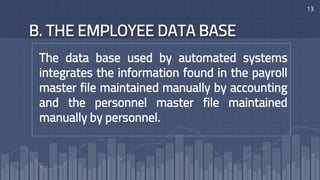
B. THE EMPLOYEE DATA BASE
13
The data base used by automated systems
integrates the information found in the payroll
master file maintained manually by accounting
and the personnel master file maintained
manually by personnel.
A MANUAL SYSTEM
OF PROCESSING
PAYROLL
A. CONTROL OBJECTIVES AND PROCEDURES
15
 All personnel and payroll transactions are properly
authorized on the basis of established criteria.
a. Personnel department reviews and approves
personnel transactions (new hires, pay
changes, terminations, etc.).
b. Departmental supervisors review and approve
time worked by employees.
c. Timekeeping reviews and approves clock cards.
A. CONTROL OBJECTIVES AND PROCEDURES
16
 All employees are assigned to productive work
that matches their capabilities, and carry out
that work effectively and efficiently.
a. Primarily, departmental supervisors discharge
this responsibility
b. Formal employee performance evaluation
reports should be prepared regularly.
A. CONTROL OBJECTIVES AND PROCEDURES
17
 All valid payroll transactions are accurately
recorded and processed.
a. Clock cards and job time tickets are reconciled.
b. The payroll control account has a zero balance
check.
c. Payroll registers are cross-footed.
d. Personnel, timekeeping, and cost distribution
activities are assigned to separate parts of the
organization.
e. Separate payroll bank accounts are used.
COMPUTER-BASED
PAYROLL DATA
PROCESSING
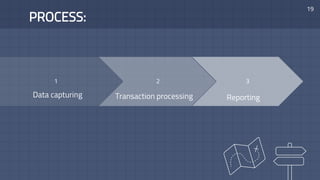
PROCESS:
19
3
Reporting
1
Data capturing
2
Transaction processing
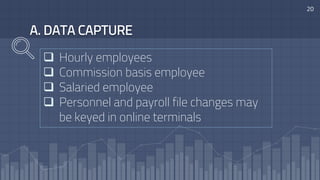
A. DATA CAPTURE
 Hourly employees
 Commission basis employee
 Salaried employee
 Personnel and payroll file changes may
be keyed in online terminals
20
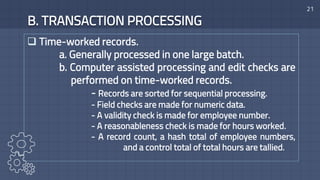
21
B. TRANSACTION PROCESSING
 Time-worked records.
a. Generally processed in one large batch.
b. Computer assisted processing and edit checks are
performed on time-worked records.
- Records are sorted for sequential processing.
- Field checks are made for numeric data.
- A validity check is made for employee number.
- A reasonableness check is made for hours worked.
- A record count, a hash total of employee numbers,
and a control total of total hours are tallied.
22
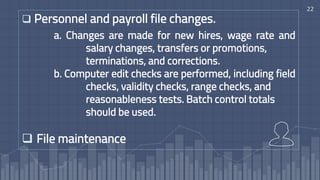
 Personnel and payroll file changes.
a. Changes are made for new hires, wage rate and
salary changes, transfers or promotions,
terminations, and corrections.
b. Computer edit checks are performed, including field
checks, validity checks, range checks, and
reasonableness tests. Batch control totals
should be used.
 File maintenance
23
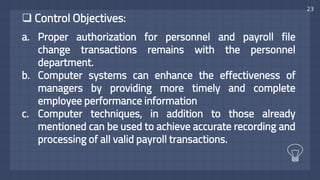
 Control Objectives:
a. Proper authorization for personnel and payroll file
change transactions remains with the personnel
department.
b. Computer systems can enhance the effectiveness of
managers by providing more timely and complete
employee performance information
c. Computer techniques, in addition to those already
mentioned can be used to achieve accurate recording and
processing of all valid payroll transactions.
24
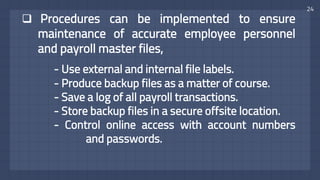
 Procedures can be implemented to ensure
maintenance of accurate employee personnel
and payroll master files,
- Use external and internal file labels.
- Produce backup files as a matter of course.
- Save a log of all payroll transactions.
- Store backup files in a secure offsite location.
- Control online access with account numbers
and passwords.
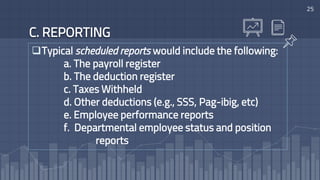
Typical scheduled reports would include the following:
a. The payroll register
b. The deduction register
c. Taxes Withheld
d. Other deductions (e.g., SSS, Pag-ibig, etc)
e. Employee performance reports
f. Departmental employee status and position
reports
C. REPORTING
25
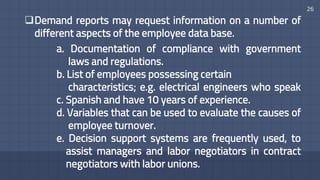
26
Demand reports may request information on a number of
different aspects of the employee data base.
a. Documentation of compliance with government
laws and regulations.
b. List of employees possessing certain
characteristics; e.g. electrical engineers who speak
c. Spanish and have 10 years of experience.
d. Variables that can be used to evaluate the causes of
employee turnover.
e. Decision support systems are frequently used, to
assist managers and labor negotiators in contract
negotiators with labor unions.
27
THANKS!

Mgtcon

  • 1.
    Chapter 29: ACCOUNTING INFORMATIONSYSTEM THE PERSONNEL/ PAYROLL CYCLE
  • 2.
    HUMAN RESOURCE MANAGEMENT (HRM)/PAYROLLCYCLE 1. Recruiting and hiring new employees 2. Training 3. Job assignment 4. Compensation (payroll) 5. Performance evaluation 6. Discharge of employees due to voluntary or involuntary termination - It is a recurring set of business activities and related data processing operations associated with effectively managing the employee workforce. The more important tasks include the following: 2
  • 3.
    3 HRM/payroll cycle informationsystem Human Resource or Personnel Management System Payroll System - records and processes data about the activities of recruiting, hiring, training, assigning, evaluating, and discharging employees. - records and processes data used to pay employees for their services.
  • 4.
  • 5.
    A. THE TOPPERSONNEL EXECUTIVE Board responsibilities  Participates in planning allocation of corporate resources,  Recommends companywide personnel policies to top management. 5
  • 6.
    6  Develops organizationof personnel function.  Delegates authority to manage personnel activities.  Monitors and evaluates performance of those to whom authority was delegated.
  • 7.
    7  Quantitative information Qualitative information B. INFORMATION NEEDS.
  • 8.
  • 9.
     Collecting dataon time worked by all employees, through: - Employee’s clock cards for hourly employees - Biometric time and attendance systems’ record  Collecting data on new hires, terminations, and changes in rates and deductions. A. KEY DATA PROCESSING OPERATIONS 9
  • 10.
     Determining grosspay, deductions, and net pay.  Preparing and distributing paychecks.  Maintaining payroll history files for all employees 10
  • 11.
    B. THE ACCOUNTINGTRANSACTIONS 11 The following is a representative entry to record payroll. Payroll XXX Withholding Taxes Payable XXX SSS Premiums Payable XXX Pension Fund Withholding Payable XXX Cash XXX
  • 12.
    12 The following isa representative entry to record the distribution of payroll costs to various expense and inventory accounts. Work-in-Process Inventory XXX Manufacturing Overhead XXX General and Administrative Expense XXX Selling and Administrative Expense XXX Payroll XXX
  • 13.
    B. THE EMPLOYEEDATA BASE 13 The data base used by automated systems integrates the information found in the payroll master file maintained manually by accounting and the personnel master file maintained manually by personnel.
  • 14.
    A MANUAL SYSTEM OFPROCESSING PAYROLL
  • 15.
    A. CONTROL OBJECTIVESAND PROCEDURES 15  All personnel and payroll transactions are properly authorized on the basis of established criteria. a. Personnel department reviews and approves personnel transactions (new hires, pay changes, terminations, etc.). b. Departmental supervisors review and approve time worked by employees. c. Timekeeping reviews and approves clock cards.
  • 16.
    A. CONTROL OBJECTIVESAND PROCEDURES 16  All employees are assigned to productive work that matches their capabilities, and carry out that work effectively and efficiently. a. Primarily, departmental supervisors discharge this responsibility b. Formal employee performance evaluation reports should be prepared regularly.
  • 17.
    A. CONTROL OBJECTIVESAND PROCEDURES 17  All valid payroll transactions are accurately recorded and processed. a. Clock cards and job time tickets are reconciled. b. The payroll control account has a zero balance check. c. Payroll registers are cross-footed. d. Personnel, timekeeping, and cost distribution activities are assigned to separate parts of the organization. e. Separate payroll bank accounts are used.
  • 18.
  • 19.
  • 20.
    A. DATA CAPTURE Hourly employees  Commission basis employee  Salaried employee  Personnel and payroll file changes may be keyed in online terminals 20
  • 21.
    21 B. TRANSACTION PROCESSING Time-worked records. a. Generally processed in one large batch. b. Computer assisted processing and edit checks are performed on time-worked records. - Records are sorted for sequential processing. - Field checks are made for numeric data. - A validity check is made for employee number. - A reasonableness check is made for hours worked. - A record count, a hash total of employee numbers, and a control total of total hours are tallied.
  • 22.
    22  Personnel andpayroll file changes. a. Changes are made for new hires, wage rate and salary changes, transfers or promotions, terminations, and corrections. b. Computer edit checks are performed, including field checks, validity checks, range checks, and reasonableness tests. Batch control totals should be used.  File maintenance
  • 23.
    23  Control Objectives: a.Proper authorization for personnel and payroll file change transactions remains with the personnel department. b. Computer systems can enhance the effectiveness of managers by providing more timely and complete employee performance information c. Computer techniques, in addition to those already mentioned can be used to achieve accurate recording and processing of all valid payroll transactions.
  • 24.
    24  Procedures canbe implemented to ensure maintenance of accurate employee personnel and payroll master files, - Use external and internal file labels. - Produce backup files as a matter of course. - Save a log of all payroll transactions. - Store backup files in a secure offsite location. - Control online access with account numbers and passwords.
  • 25.
    Typical scheduled reportswould include the following: a. The payroll register b. The deduction register c. Taxes Withheld d. Other deductions (e.g., SSS, Pag-ibig, etc) e. Employee performance reports f. Departmental employee status and position reports C. REPORTING 25
  • 26.
    26 Demand reports mayrequest information on a number of different aspects of the employee data base. a. Documentation of compliance with government laws and regulations. b. List of employees possessing certain characteristics; e.g. electrical engineers who speak c. Spanish and have 10 years of experience. d. Variables that can be used to evaluate the causes of employee turnover. e. Decision support systems are frequently used, to assist managers and labor negotiators in contract negotiators with labor unions.
  • 27.