Collaborating with students to
understand their motivations
Glen A. Hill
Obihiro University of Agriculture and
Veterinary Medicine
Etsuko Shimo
Kinki University, Faculty of Applied Sociology
Matthew Apple
Ritsumeikan University, Dept of Communication
Joseph Falout
Nihon University, College of Science and Technology
Overview
•Introducing CPL (Critical Participatory Looping)
•Stage 1 (Large quantitative study)
•Stage 2 (CPL)
•Stage 3 (Analysis and augmentation)
•Summary and conclusion
Critical Participatory Looping (CPL)
• (Falout & Murphey, 2010;
Murphey & Falout, 2010)
Students reflect on data that is “looped,” or
returned to them for further feedback
Stage One - 2012 Spring
•Kaken-funded research into the L2 Motivational Selves
of science and engineering students (SES)
•2400+ students from 19 institutions across Japan
•Nine separate psychological constructs
Stage One - Psychological constructs
Abbrev Construct name
SA Speaking anxiety
SC Perceived speaking competence
CA Classroom atmosphere
IC Interest in English culture
IF International friendship
SV Perceived social values
IS Ideal L2 Self
PS Probable L2 Self
OS Ought-to L2 Self
Stage One - Structural equation model
• Hypothesized model
Stage One - Structural equation model
• Final model (N = 2412)
(Apple, Falout, & Hill, in progress)
Stage One - Structural equation model
• Final model (N = 2412)
Stage Two – Critical Participatory Looping
(CPL)
•Descriptive data and the model from the N = 2412
study were “looped” back to a smaller sample
•608 students at three institutions (technical college,
undergrad, grad)
•Students asked to evaluate the data results from fellow
science and engineering classmates
 3 demographic items
 4 Likert-scale questions
 3 open response questions
Stage Three - Analysis of CPL Likert-scale
answers
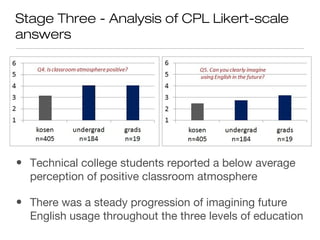
• Technical college students reported a below average
perception of positive classroom atmosphere
• There was a steady progression of imagining future
English usage throughout the three levels of education
Stage Three - Analysis of CPL Likert-scale
answers
• While above average, there were virtually no differences
between technical college students’ and undergraduate
students’ perceptions of the need for English
• Graduate students had a stronger sense of the need for
English following their formal studies
Stage Three - Analysis of CPL open
responses
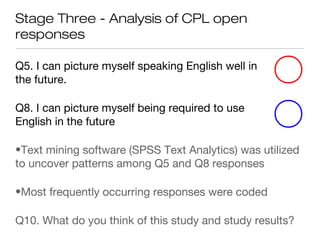
Q5. I can picture myself speaking English well in
the future.
Q8. I can picture myself being required to use
English in the future
•Text mining software (SPSS Text Analytics) was utilized
to uncover patterns among Q5 and Q8 responses
•Most frequently occurring responses were coded
Q10. What do you think of this study and study results?
Stage Three - Analysis of CPL open
responses
Q5. I can picture myself speaking English well in
the future.
Q8. I can picture myself being required to use
English in the future
•Text mining software (SPSS Text Analytics) was utilized
to uncover patterns among Q5 and Q8 responses
•Most frequently occurring responses were coded
Q10. What do you think of this study and study results?Q10. What do you think of this study and study results?
Stage Three - Analysis of CPL open
responses
Q5. I can picture myself speaking English well in the
future. (1-6 Likert Scale response and reason)
Q8. I can picture myself being required to use English in
the future. (1-6 Likert Scale response and reason)
Q10 (Comments about research): Comparison between
three groups
Low Visionaries
(71)
Mixed Visionaries
(129)
High Visionaries
(54)
Res to Q5 1 or 2 1 or 2 5 or 6
Res to Q8 1 or 2 5 or 6 5 or 6
Stage Three - Analysis of CPL open
responses
Q5. I can picture myself speaking English well in the
future. (1-6 Likert Scale response and reason)
Q8. I can picture myself being required to use English in
the future. (1-6 Likert Scale response and reason)
Q10 (Comments about research): Comparison between
three groups
Low Visionaries
(71)
Mixed Visionaries
(129)
High Visionaries
(54)
Res to Q5 1 or 2 1 or 2 5 or 6
Res to Q8 1 or 2 5 or 6 5 or 6
LV MV
HV
Stage Three - Analysis of CPL open
responses
LV MV HV
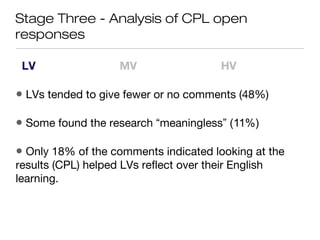
• LVs tended to give fewer or no comments (48%)
• Some found the research “meaningless” (11%)
• Only 18% of the comments indicated looking at the
results (CPL) helped LVs reflect over their English
learning.
Stage Three - Analysis of CPL open
responses
LV MV HV
• Many people around me are poor at English and I
hope that educational methods should be improved by
finding out the background reasons, so I think this [CPL]
is a wonderful study.” (Category A)
• I thought the research results show Japanese
people's characteristics well. (Category B)
• This gave me a chance to think about my feelings
towards English. (Category B)
Stage Three - Analysis of CPL open
responses
LV MV HV
• I think [the research results indicate] there are not so
many [students] who want to get an international job or
get a job that requires foreign languages including English
in the future. (Category B)
• I didn‘t think this is necessary enough to do by
cutting the class time short.” (Category D)
Stage Three - Analysis of CPL open
responses
LV MV HV
• MVs often did not respond in detail, but were more
similar to responses from HV than LV.
• MVs wrote more comments showing their reflection
about their English learning (37%).
Stage Three - Analysis of CPL open
responses
LV MV HV
• I think it‘s good because you can understand the
students’ perceptions about learning English. (Category
A)
• I kind of thought that it would be nice if you could
provide even better English education based on this
research. (Category A)
Stage Three - Analysis of CPL open
responses
LV MV HV
• The items regarding speaking competence show our
weak points, so I think it is necessary to have more
opportunities than now to speak with native speakers
and to use English if we want to improve our speaking
competence. (Category B)
• I‘m very much interested in the fact that a study is done
about English. I certainly feel resistance to speaking
English, and I care if my grammar is correct (because I
don’t have confidence). If we can speak English, our
future self will be different, and it is cool if we can
speak English. (Category B)
Stage Three - Analysis of CPL open
responses
LV MV HV
• HVs had a relatively high percentage (37%) of comments
showing their reflection with detailed comments.
• HVs also had the highest percentage (13%) of responses
about research purposes and designs
• While lower than other groups, many students (31%) still
did not respond.
Stage Three - Analysis of CPL open
responses
LV MV HV
•I think this [CPL study] is meaningful in terms of
reflecting over how English education should be done.
(Category A)
•Why (SV) ave was high? I think, in Japan we need
to speak English a little in daily life. So,
if we can talk more English with
many people, Japanese will study more harder
and more popular.” (original in English) (Category B)
Stage Three - Analysis of CPL open
responses
LV MV HV
•I think many Japanese people cannot speak
English because we are not in situations or
contexts where we have to speak English. Such
opportunities should be implemented
in education. (Category B)
•I can agree with the research results because I
think that it is true that having an interest
and enjoying it is the first step to be
able to speak English. (Category B)
Stage Three: Augmentation
•Interview stages of kaken-funded study now in progress
(2013 - 2014+)
•Analysis of CPL gives additional perspective
•Specific variables mentioned in CPL can be examined
in interviews
Stage Three: Augmentation - Student
suggestions
•Analysis of CPL gives additional perspective
• “In terms of English learning, I feel that there is a big difference between the way
motivated students engage themselves in improving their English abilities and in
doing class activities and the way non motivated students do. I also think classes at
school do not offer enough time for us to practice English expressions such as
writing in English and conversations.” (HV)
• “We should have more opportunities to speak English, increase chances to study
abroad. It is necessary to strengthen our ideal L2 selves. It is because English is
used as a second language in other countries.” (HV)
• “From the results, it looks like many people will lose confidence about this unfamiliar
English language. I thought that it was the right answer to keep on learning it over a
long period of time because we cannot get the outcome so soon.” (HV)
Stage Three: Augmentation - Follow-up
questions
•Specific variables mentioned in CPL can be examined
in follow-up interviews with select study participants
• “[Languages] besides English is necessary. My own study field is more important
than English.” (LV)
• “I know English will be useful for the society, but many people cannot have a picture
of themselves speaking English in the future, and I felt that that‘s the case for me,
too.” (MV)
• “I think speaking anxiety occurs because the person thinks English is a kind of code
rather than a language. The person is afraid that the slightest mistake will make
his /her utterance a series of sounds with no meaning and so his/her utterance has
to be perfect.” (LV)
Stage Three: Augmentation - Follow-up
questions
•(cont.)
• “I think that, because they haven‘t been used to doing English activities
since childhood, many students have speaking anxiety. It's often difficult to
start studying English in a new field, so I'd like to get use to English in areas
familiar to me.” (MV)
• “There seems to be a lot of students who are fully aware of the importance
of English but responded that they don't have speaking competence.
I am one of them.” (MV)
Summary and conclusion
Coritical Participatory Looping (CPL) provides:
•additional opportunities to reflect on English learning processes
and motivations; but seems to have worked for certain groups of
students better than others
•triangulation of quantitative (e.g., Likert-scale) and qualitative
(e.g., interview) data
•a deeper understanding and interpretation of the Model
presented in the previous study
Thank you
for your attention
Glen A. Hill
Obihiro University of Agriculture and
Veterinary Medicine
Etsuko Shimo
Kinki University, Faculty of Applied Sociology
Matthew Apple
Ritsumeikan University, Dept of Communication
Joseph Falout
Nihon University, College of Science and Technology
Collaborating with students to
understand their motivations

Collaborating with students to understand their motivation

  • 1.
    Collaborating with studentsto understand their motivations Glen A. Hill Obihiro University of Agriculture and Veterinary Medicine Etsuko Shimo Kinki University, Faculty of Applied Sociology Matthew Apple Ritsumeikan University, Dept of Communication Joseph Falout Nihon University, College of Science and Technology
  • 2.
    Overview •Introducing CPL (CriticalParticipatory Looping) •Stage 1 (Large quantitative study) •Stage 2 (CPL) •Stage 3 (Analysis and augmentation) •Summary and conclusion
  • 3.
    Critical Participatory Looping(CPL) • (Falout & Murphey, 2010; Murphey & Falout, 2010) Students reflect on data that is “looped,” or returned to them for further feedback
  • 4.
    Stage One -2012 Spring •Kaken-funded research into the L2 Motivational Selves of science and engineering students (SES) •2400+ students from 19 institutions across Japan •Nine separate psychological constructs
  • 5.
    Stage One -Psychological constructs Abbrev Construct name SA Speaking anxiety SC Perceived speaking competence CA Classroom atmosphere IC Interest in English culture IF International friendship SV Perceived social values IS Ideal L2 Self PS Probable L2 Self OS Ought-to L2 Self
  • 6.
    Stage One -Structural equation model • Hypothesized model
  • 7.
    Stage One -Structural equation model • Final model (N = 2412) (Apple, Falout, & Hill, in progress)
  • 8.
    Stage One -Structural equation model • Final model (N = 2412)
  • 9.
    Stage Two –Critical Participatory Looping (CPL) •Descriptive data and the model from the N = 2412 study were “looped” back to a smaller sample •608 students at three institutions (technical college, undergrad, grad) •Students asked to evaluate the data results from fellow science and engineering classmates  3 demographic items  4 Likert-scale questions  3 open response questions
  • 10.
    Stage Three -Analysis of CPL Likert-scale answers • Technical college students reported a below average perception of positive classroom atmosphere • There was a steady progression of imagining future English usage throughout the three levels of education
  • 11.
    Stage Three -Analysis of CPL Likert-scale answers • While above average, there were virtually no differences between technical college students’ and undergraduate students’ perceptions of the need for English • Graduate students had a stronger sense of the need for English following their formal studies
  • 12.
    Stage Three -Analysis of CPL open responses Q5. I can picture myself speaking English well in the future. Q8. I can picture myself being required to use English in the future •Text mining software (SPSS Text Analytics) was utilized to uncover patterns among Q5 and Q8 responses •Most frequently occurring responses were coded Q10. What do you think of this study and study results?
  • 13.
    Stage Three -Analysis of CPL open responses Q5. I can picture myself speaking English well in the future. Q8. I can picture myself being required to use English in the future •Text mining software (SPSS Text Analytics) was utilized to uncover patterns among Q5 and Q8 responses •Most frequently occurring responses were coded Q10. What do you think of this study and study results?Q10. What do you think of this study and study results?
  • 14.
    Stage Three -Analysis of CPL open responses Q5. I can picture myself speaking English well in the future. (1-6 Likert Scale response and reason) Q8. I can picture myself being required to use English in the future. (1-6 Likert Scale response and reason) Q10 (Comments about research): Comparison between three groups Low Visionaries (71) Mixed Visionaries (129) High Visionaries (54) Res to Q5 1 or 2 1 or 2 5 or 6 Res to Q8 1 or 2 5 or 6 5 or 6
  • 15.
    Stage Three -Analysis of CPL open responses Q5. I can picture myself speaking English well in the future. (1-6 Likert Scale response and reason) Q8. I can picture myself being required to use English in the future. (1-6 Likert Scale response and reason) Q10 (Comments about research): Comparison between three groups Low Visionaries (71) Mixed Visionaries (129) High Visionaries (54) Res to Q5 1 or 2 1 or 2 5 or 6 Res to Q8 1 or 2 5 or 6 5 or 6 LV MV HV
  • 16.
    Stage Three -Analysis of CPL open responses LV MV HV • LVs tended to give fewer or no comments (48%) • Some found the research “meaningless” (11%) • Only 18% of the comments indicated looking at the results (CPL) helped LVs reflect over their English learning.
  • 17.
    Stage Three -Analysis of CPL open responses LV MV HV • Many people around me are poor at English and I hope that educational methods should be improved by finding out the background reasons, so I think this [CPL] is a wonderful study.” (Category A) • I thought the research results show Japanese people's characteristics well. (Category B) • This gave me a chance to think about my feelings towards English. (Category B)
  • 18.
    Stage Three -Analysis of CPL open responses LV MV HV • I think [the research results indicate] there are not so many [students] who want to get an international job or get a job that requires foreign languages including English in the future. (Category B) • I didn‘t think this is necessary enough to do by cutting the class time short.” (Category D)
  • 19.
    Stage Three -Analysis of CPL open responses LV MV HV • MVs often did not respond in detail, but were more similar to responses from HV than LV. • MVs wrote more comments showing their reflection about their English learning (37%).
  • 20.
    Stage Three -Analysis of CPL open responses LV MV HV • I think it‘s good because you can understand the students’ perceptions about learning English. (Category A) • I kind of thought that it would be nice if you could provide even better English education based on this research. (Category A)
  • 21.
    Stage Three -Analysis of CPL open responses LV MV HV • The items regarding speaking competence show our weak points, so I think it is necessary to have more opportunities than now to speak with native speakers and to use English if we want to improve our speaking competence. (Category B) • I‘m very much interested in the fact that a study is done about English. I certainly feel resistance to speaking English, and I care if my grammar is correct (because I don’t have confidence). If we can speak English, our future self will be different, and it is cool if we can speak English. (Category B)
  • 22.
    Stage Three -Analysis of CPL open responses LV MV HV • HVs had a relatively high percentage (37%) of comments showing their reflection with detailed comments. • HVs also had the highest percentage (13%) of responses about research purposes and designs • While lower than other groups, many students (31%) still did not respond.
  • 23.
    Stage Three -Analysis of CPL open responses LV MV HV •I think this [CPL study] is meaningful in terms of reflecting over how English education should be done. (Category A) •Why (SV) ave was high? I think, in Japan we need to speak English a little in daily life. So, if we can talk more English with many people, Japanese will study more harder and more popular.” (original in English) (Category B)
  • 24.
    Stage Three -Analysis of CPL open responses LV MV HV •I think many Japanese people cannot speak English because we are not in situations or contexts where we have to speak English. Such opportunities should be implemented in education. (Category B) •I can agree with the research results because I think that it is true that having an interest and enjoying it is the first step to be able to speak English. (Category B)
  • 25.
    Stage Three: Augmentation •Interviewstages of kaken-funded study now in progress (2013 - 2014+) •Analysis of CPL gives additional perspective •Specific variables mentioned in CPL can be examined in interviews
  • 26.
    Stage Three: Augmentation- Student suggestions •Analysis of CPL gives additional perspective • “In terms of English learning, I feel that there is a big difference between the way motivated students engage themselves in improving their English abilities and in doing class activities and the way non motivated students do. I also think classes at school do not offer enough time for us to practice English expressions such as writing in English and conversations.” (HV) • “We should have more opportunities to speak English, increase chances to study abroad. It is necessary to strengthen our ideal L2 selves. It is because English is used as a second language in other countries.” (HV) • “From the results, it looks like many people will lose confidence about this unfamiliar English language. I thought that it was the right answer to keep on learning it over a long period of time because we cannot get the outcome so soon.” (HV)
  • 27.
    Stage Three: Augmentation- Follow-up questions •Specific variables mentioned in CPL can be examined in follow-up interviews with select study participants • “[Languages] besides English is necessary. My own study field is more important than English.” (LV) • “I know English will be useful for the society, but many people cannot have a picture of themselves speaking English in the future, and I felt that that‘s the case for me, too.” (MV) • “I think speaking anxiety occurs because the person thinks English is a kind of code rather than a language. The person is afraid that the slightest mistake will make his /her utterance a series of sounds with no meaning and so his/her utterance has to be perfect.” (LV)
  • 28.
    Stage Three: Augmentation- Follow-up questions •(cont.) • “I think that, because they haven‘t been used to doing English activities since childhood, many students have speaking anxiety. It's often difficult to start studying English in a new field, so I'd like to get use to English in areas familiar to me.” (MV) • “There seems to be a lot of students who are fully aware of the importance of English but responded that they don't have speaking competence. I am one of them.” (MV)
  • 29.
    Summary and conclusion CoriticalParticipatory Looping (CPL) provides: •additional opportunities to reflect on English learning processes and motivations; but seems to have worked for certain groups of students better than others •triangulation of quantitative (e.g., Likert-scale) and qualitative (e.g., interview) data •a deeper understanding and interpretation of the Model presented in the previous study
  • 30.
    Thank you for yourattention Glen A. Hill Obihiro University of Agriculture and Veterinary Medicine Etsuko Shimo Kinki University, Faculty of Applied Sociology Matthew Apple Ritsumeikan University, Dept of Communication Joseph Falout Nihon University, College of Science and Technology Collaborating with students to understand their motivations

Editor's Notes

  • #10 **NOTE – The model was shown WITHOUT any beta weights on the paths. The descriptive “composite mean index scores” for each variable were shown in a table to students.
  • #13 But some words like “English” and “speak” were not considered important to analyze even though the frequency was high. Students simply needed to use those words to describe their reasons. There were some interesting patterns found. For example, students who responded 1 and 2 wrote negative comments about their English abilities while those who responded 5 or 6 said comments to show their higher interests in learning English. But we are hoping to present the analysis about Q5 and Q8 in a different presentation, and we’d like to focus on Q10 in today’s presentation.