The Effectiveness of Applying Cooperative Learning to the EFL Classroom in a Technological University Presenter: Shing-Yu Tsai Advisor: Dr. Chin-Ling Lee Date: May 25, 2009
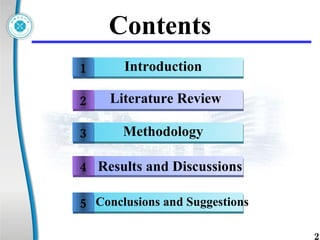
Contents Introduction Literature Review Methodology Results and Discussions Conclusions and Suggestions 1 2 3 4 5
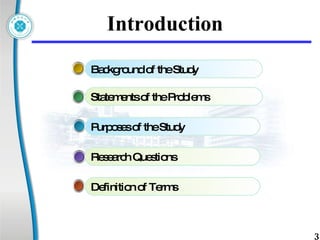
Definition of Terms Research Questions Purposes of the Study Statements of the Problems  Background of the Study Introduction
Background of the Study The globalization phenomenon has undoubtedly  taken place, and  English  has arisen as the most  common language for  worldwide communication .  ( Falits & Hudelson, 1998; McCrum, MacNeil, & Cran, 2002 )
Background of the Study Among the four English language skills,  English  speaking  proficiency has recently drawn a great deal  of attention in Taiwan, since it plays an important  role in tourism, business, and cultural exchange in  the global village.  ( Chang, 2008; Hsu, 2004; Wang, 2008 )
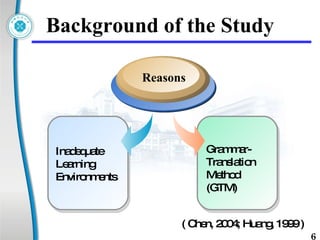
Background of the Study Grammar-Translation Method (GTM) Inadequate Learning Environments Reasons ( Chen, 2004; Huang, 1999 )
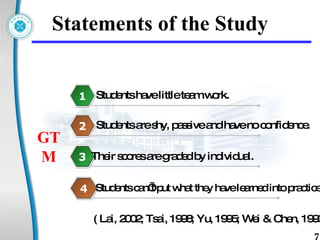
Statements of the Study GTM ( Lai, 2002; Tsai, 1998; Yu, 1995; Wei & Chen, 1993 )  Students have little team work. 1 Students are shy, passive and have no confidence. 2 Their scores are graded by individual. 3 Students can’t put what they have learned into practice. 4
Statements of the Study P revious studies on cooperative learning were mostly focused on various courses in  secondary or elementary  education; its application to English instruction in  higher vocational education  has barely been considered.   ( Lee, 2004 )
Purposes of the Study To investigate the effectiveness of cooperative  learning and traditional lecture-based learning on the  listening  and  oral  achievements of college students majoring in business
Purposes of the Study To examine the differences in conceptual  learning style preferences  and  learning motivation  among students in cooperative learning and traditional lecture-based learning To explore  the  perspectives  toward different teaching methods on cooperative learning and traditional lecture-based learning of EFL learners in the two different classes collected through in-depth interviews
Research Questions Are there any differences between the effects of the  cooperative learning and those of the traditional lecture-based learning on students’  listening  achievement?  2 Are there any differences between the effects of the  cooperative learning and those of the traditional  lecture-based learning on students’  oral  achievement?  1
Research Questions Are there any differences between the effects of the cooperative learning and those of the traditional lecture-based learning on students’  conceptual learning style preferences ? Are there any differences between the effects of the cooperative learning and those of the traditional  lecture-based learning on students’  learning motivation ?  3 4
Research Questions What main  elements  comprise the viewpoints of EFL learners in the cooperative learning class and the traditional lecture-based learning class?    What variables affect the viewpoints of EFL learners in the cooperative learning class and the traditional  lecture-based learning class?  5 6
Definition of Terms High and Low English Achievers   I n the field of  testing and assessment , the  preferred method to compare the higher  and the lower groups is to select samples  from the top and the bottom 25% to 33%;  sampling the top and bottom 27% is  recommended.  ( Chen & Lin, 2009; Wu, 2007 )
Literature Review  Communicative Competence  C ooperative Learning Perceptual  Language Learning Style Preferences L anguage Learning Motivation
Communicative Competence Communicative competence was the expression  of sociolinguistic that regarded language as  social behavior . ( Wellman, 2002 )
Cooperative Learning Cooperative group  made students of different performance levels engage in instructional  methods to pursue  a common goal . ( Ha¨nze & Berger, 2007; Slavin, 1987 )
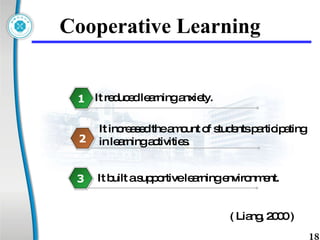
Cooperative Learning ( Liang, 2000 ) It reduced learning anxiety. 1 It increased the amount of students participating  in learning activities. 2 It built a supportive learning environment.  3
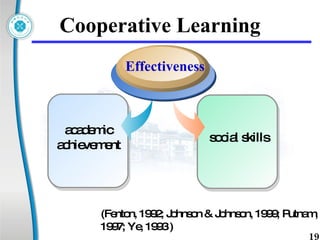
C ooperative Learning social skills academic achievement Effectiveness (Fenton, 1992; Johnson & Johnson, 1999; Putnam, 1997; Ye, 1993 )
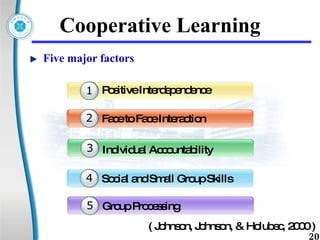
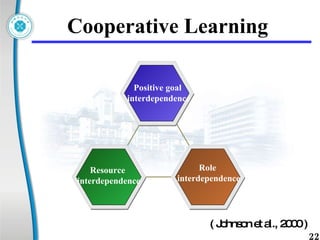
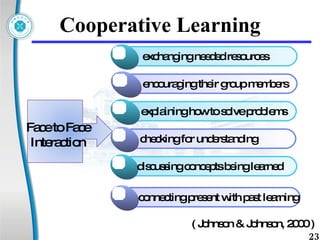
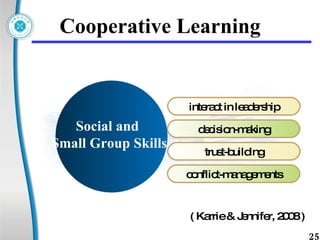
Cooperative Learning Five major factors ( Johnson, Johnson, & Holubec, 2000 )  Social and Small Group Skills 4 Group Processing 5 1 Face to Face Interaction 2 Positive Interdependence 1 1 Individual Accountability 3
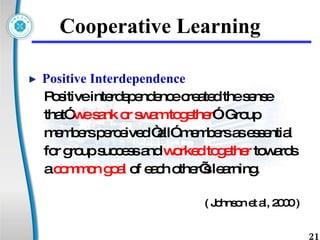
Cooperative Learning Positive Interdependence  Positive interdependence created the sense  that”  we sank or swam together ”. Group  members perceived “all” members as essential  for group success and  worked together  towards  a  common goal  of each other’s learning.  ( Johnson et al, 2000 )
Cooperative Learning Positive goal  interdependence Resource  interdependence Role  interdependence ( Johnson et al., 2000 )
C ooperative Learning Face to Face Interaction ( Johnson & Johnson, 2000 )  Click to add Title 1 exchanging needed resources Click to add Title 2 encouraging their group members Click to add Title 1 explaining how to solve problems Click to add Title 2 checking for understanding Click to add Title 1 discussing concepts being learned Click to add Title 2 connecting present with past learning
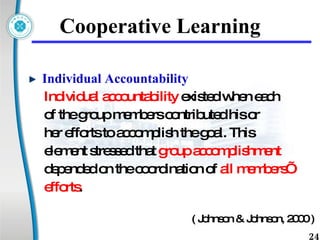
Cooperative Learning Individual Accountability  Individual accountability  existed when each  of the group members contributed his or  her efforts to accomplish the goal. This  element stressed that  group accomplishment  depended on the coordination of  all members’  efforts .  ( Johnson & Johnson, 2000 )
Cooperative Learning interact in leadership decision-making trust-building conflict-managements Social and Small Group Skills ( Karrie & Jennifer, 2008 )
Cooperative Learning Group Processing  Group processing clarified and improved  member  effectiveness  in contributing to  cooperative efforts to attain the group’s  goal . ( Johnson & Johnson, 2000 )
Perceptual Language Learning Style Preferences Foreign language learners claimed that  learners’ learning style  would determine  whether they success in the  academic  performance .  ( Castro & Peck, 2005 )
Language Learning Motivation The correlation between  motivation  and  English  achievements  was very  high .  ( Chou, 1989; Huang, 1990; Liang, 2002 )
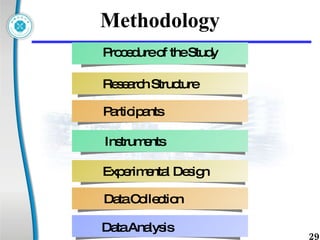
Methodology Instruments Participants Research Structure Experimental Design Data Collection Procedure of the Study Data Analysis
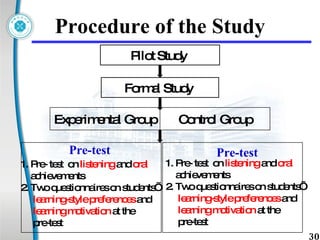
Procedure of the Study Pilot Study  Formal Study   Control Group 1. Pre- test  on  listening  and  oral   achievements 2. Two questionnaires on students’  learning-style preferences  and  learning motivation  at the  pre-test Pre-test  Pre-test  1. Pre- test  on  listening  and  oral   achievements  2. Two questionnaires on students’  learning-style preferences  and  learning motivation  at the  pre-test Experimental Group
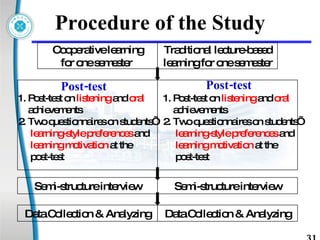
Procedure of the Study Cooperative learning for one semester  Traditional lecture-based learning for one semester Semi-structure interview Post-test   1. Post-test on  listening  and  oral   achievements  2. Two questionnaires on students’  learning-style preferences  and  learning motivation  at the  post-test Post-test   1. Post-test on  listening  and  oral   achievements  2. Two questionnaires on students’  learning-style preferences  and  learning motivation  at the  post-test Semi-structure interview Data Collection & Analyzing Data Collection & Analyzing
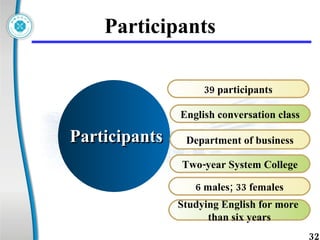
Participants 39 participants English conversation class Department of business Studying English for more  than six years Participants  6 males; 33 females Two-year System College
Instruments A questionnaire 2 An English speaking evaluation form 3 An academic achievement test 1 An interview protocol 4
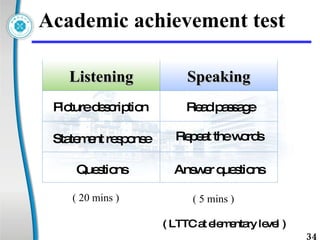
Academic achievement test ( LTTC at elementary level )  Picture description Statement response Questions ( 20 mins ) Read passage Repeat the words Answer questions ( 5 mins ) Listening Speaking
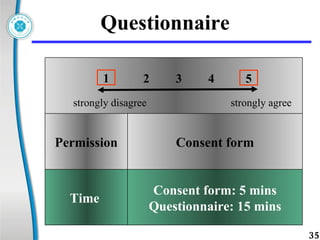
Questionnaire 1 2 3 4 5 strongly disagree  strongly agree  Permission Consent form Time   Consent form: 5 mins Questionnaire: 15 mins
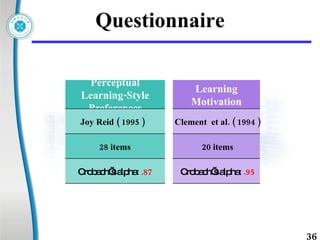
Questionnaire Joy Reid ( 1995 ) Clement  et al. ( 1994 ) 28 items 20 items Crobach’s alpha:  .87 Crobach’s alpha:  .95 Perceptual Learning-Style Preferences  Learning Motivation
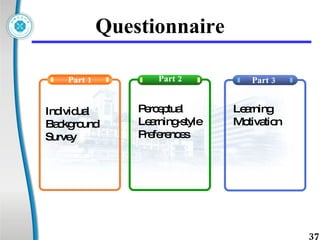
Questionnaire Part 3 Perceptual Learning-style Preferences Learning Motivation Part 2 Part 1 Individual Background Survey
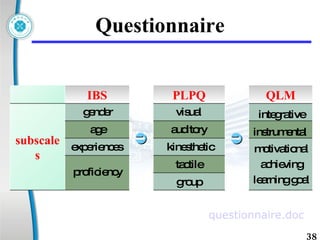
Questionnaire visual auditory tactile kinesthetic group integrative instrumental  motivational achieving  learning goal age gender experiences proficiency questionnaire.doc IBS  PLPQ  QLM subscales
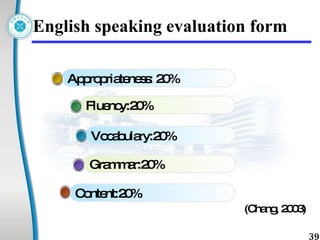
English speaking evaluation form Content:20% Grammar:20% Vocabulary:20% Fluency:20% Appropriateness: 20% (Chang, 2003)
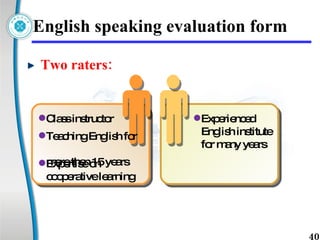
English speaking evaluation form Two raters: Class instructor Teaching English for  more than 15 years Expertise on  cooperative learning Experienced  English institute  for many years
Interview Protocol I nterview concern: ( Johnson, Johnson, & Holubec, 2000 )  social and small group skills 4 group processing 5 1 face to face interaction 2 positive interdependence 1 1 individual accountability 3
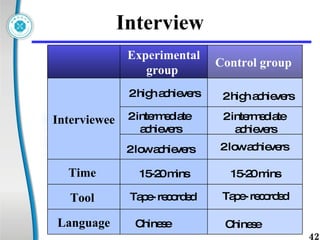
Interview 2 high achievers 2 high achievers 2 intermediate  achievers 2 intermediate  achievers 2 low achievers  2 low achievers  15-20 mins Tape- recorded  15-20 mins Tape- recorded  Chinese  Chinese  Experimental group  Control group  Interviewee   Time  Tool  Language
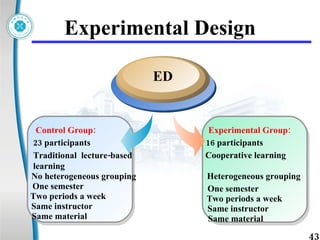
Experimental Design Experimental Group: Control Group:  ED 23 participants 16 participants Traditional  lecture-based learning Cooperative learning One semester One semester Two periods a week Two periods a week Same material Same material Same instructor Same instructor Heterogeneous grouping No heterogeneous grouping
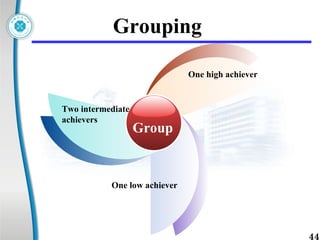
Grouping  Group Two intermediate  achievers  One high achiever One low achiever
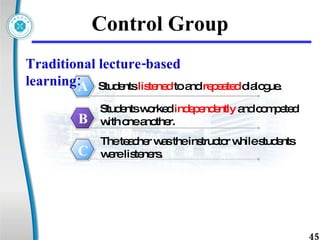
Control Group Traditional lecture-based learning:  Students  listened  to and  repeated  dialogue.  A Students worked  independently  and competed  with one another.  B The teacher was the instructor while students  were listeners. 3 C
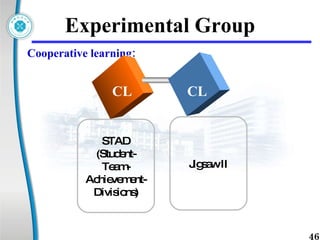
Experimental Group Cooperative learning: Jigsaw II STAD (Student-Team-Achievement- Divisions) CL CL
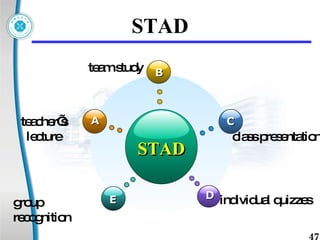
STAD STAD teacher’s lecture team study group recognition class presentation individual quizzes B E C D A
Jigsaw II teacher’s lecture cooperative groups preparation  pairs practice  pairs team performance
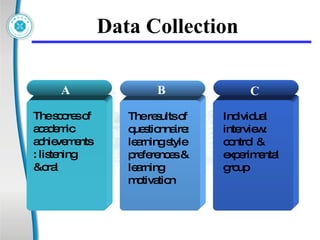
Data Collection A B C The scores of academic achievements : listening &oral The results of questionnaire: learning style preferences & learning motivation Individual interview: control & experimental group
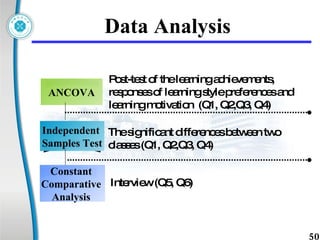
Data Analysis Post-test of the learning achievements,  responses of learning style preferences and learning motivation  (Q1, Q2,Q3, Q4) The significant differences between two classes (Q1, Q2,Q3, Q4) Interview (Q5, Q6) ANCOVA Independent  Samples Test Constant  Comparative  Analysis
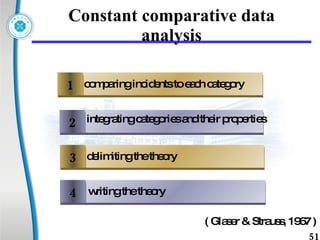
Constant comparative data analysis ( Glaser & Strauss, 1967 )  1 comparing incidents to each category 2 integrating categories and their properties 3 delimiting the theory 4 writing the theory
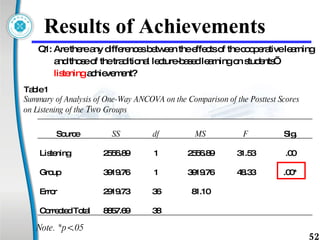
Results of Achievements  Q1: Are there any differences between the effects of the cooperative learning  and those of the traditional lecture-based learning on students’ listening  achievement?  Table 1 Summary of Analysis of One-Way ANCOVA on the Comparison of the Posttest Scores  on Listening of the  Two  Groups  Note. *p<.05 Source SS df MS F Sig. Listening 2556.89 1 2556.89 31.53 .00 Group 3919.76 1 3919.76 48.33 .00* Error 2919.73 36 81.10 Corrected Total 8857.69 38
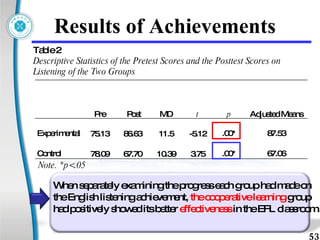
Results of Achievements  Table 2 Descriptive Statistics of the Pretest Scores and the Posttest Scores on Listening of the Two Groups  When separately examining the progress each group had made on  the English listening achievement,  the cooperative learning  group  had positively showed its better  effectiveness  in the EFL classroom. Note. *p<.05 Pre Post MD t p Adjusted Means Experimental 75.13 86.63 11.5 -5.12 .00* 87.53 Control 78.09 67.70 10.39 3.75 .00* 67.06
Results of Achievements  Q2: Are there any differences between the effects of the cooperative learning  and those of the traditional lecture-based learning on students’  oral   achievement?  Table 3  Summary of Analysis of One-Way ANCOVA on the Comparison of the Posttest Scores  on Oral Achievement of the Two Groups  Note. *p<.05 Source SS df MS F Sig. Oral 1572.46 1 1572.46 6.85 .01 Group 1449.19 1 1449.19 6.32 .02* Error 8258.77 36 229.41 Corrected Total 10868.31 38
Results of Achievements  Table 4 Descriptive Statistics of the Pretest Scores and the Posttest Scores on Oral Achievement  of the Two Groups  When separately examining the progress each group had made on  the English oral achievement,  the cooperative learning  group  had positively showed its better  effectiveness  in the EFL classroom Note. *p<.05 Pre Post MD t p Adjusted Means Experimental 62.25 78.88 16.63 -6.31 .00* 80.09 Control 67.74 68.39 0.65 -0.14 .89 67.54
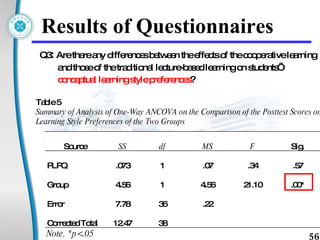
Results of Questionnaires  Q3 :  Are there any differences between the effects of the cooperative learning  and those of the traditional lecture-based learning on students’  conceptual learning style preferences ? Table 5 Summary of Analysis of One-Way ANCOVA on the Comparison of the Posttest Scores on Learning Style Preferences of the Two Groups  Note. *p<.05 Source SS df MS F Sig. PLPQ .073 1 .07 .34 .57 Group 4.56 1 4.56 21.10 .00* Error 7.78 36 .22 Corrected Total 12.47 38
Results of Questionnaires  Table 6 Descriptive Statistics of the Pretest Scores and the Posttest Scores on Learning Style Preferences of the Two Groups   The  experimental group  got higher  significant difference  in their learning style preferences toward learning English after the  intervention of cooperative learning . Note. *p<.05 Pre Post MD t p Adjusted Means Experimental 3.76 3.31 0.45 3.42 .00* 4.00 Control 3.80 3.85 0.04 -.35 .73 3.32
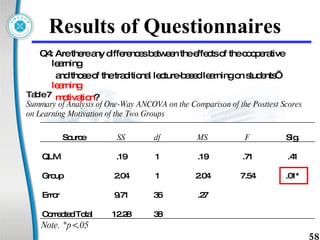
Results of Questionnaires  Q4: Are there any differences between the effects of the cooperative learning  and those of the traditional lecture-based learning on students’  learning  motivation ?  Table 7 Summary of Analysis of One-Way ANCOVA on the Comparison of the Posttest Scores  on Learning Motivation of the Two Groups Note. *p<.05 Source SS df MS F Sig. QLM .19 1 .19 .71 .41 Group 2.04 1 2.04 7.54 .01* Error 9.71 36 .27 Corrected Total 12.28 38
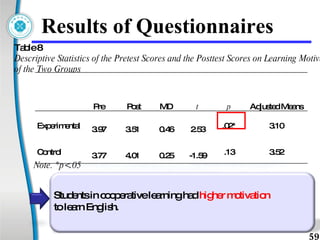
Results of Questionnaires  Table 8 Descriptive Statistics of the Pretest Scores and the Posttest Scores on Learning Motivation  of the Two Groups  Students in cooperative learning had  higher motivation to learn English. Note. *p<.05 Pre Post MD t p Adjusted Means Experimental 3.97 3.51 0.46 2.53 .02* 3.10 Control 3.77 4.01 0.25 -1.59 .13 3.52
Data Analyses of Interviews Table 9  Profile of the participants  Code Gender  Year of English Learning  English Proficiency  Group  I Female  7  Low  Experimental  II Female 6  Low  Experimental  III Female 6  Intermediate  Experimental  IV Male  8  High  Experimental V Female 7  High  Experimental  VI Female 7  Intermediate  Experimental  VII Female 7  Intermediate Control  VIII Male  6  High Control  IX Female 6  High Control  X Female 8  Low Control  XI Female 7  Intermediate Control XII Female 6 Low Control
Interview Protocol How would you describe your learning experiences  toward the instructional strategies and learning activities of the class you attended? Tell me about your view or attitude toward the  teacher and students of English learning? Tell me about the satisfying situations you  found in English learning class? Tell me about the frustrating situations you found in English learning class? Part I: The elements  of students’ viewpoints  in the EFL classroom
Interview Protocol Tell me how to solve the problems in English learning?  Tell me what kind of group dividing can  enhance your English learning?  Part I: The elements  of students’ viewpoints  in the EFL classroom  Would you describe an ideal English learning class?
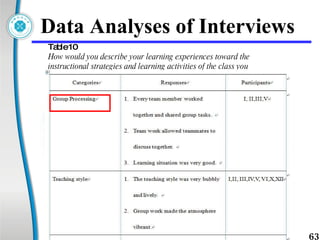
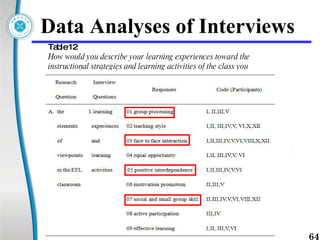
Data Analyses of Interviews Table 10 How would you describe your learning experiences toward the instructional strategies and learning activities of the class you attended?
Data Analyses of Interviews Table 12 How would you describe your learning experiences toward the instructional strategies and learning activities of the class you attended?
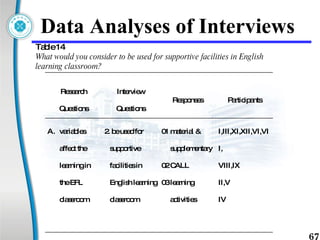
Interview Protocol What influence did learning motivation and style preferences have on your learning in English learning class? What would you consider to be used for supportive facilities in English learning classroom? Would you like the materials or supplementary in English learning classroom?  Would you describe your English learning motivation and how to learn English effectively? Part II:  The Variables affect students’ learning in the EFL classroom
Data Analyses of Interviews Table 13 What would you consider to be used for supportive facilities in English learning classroom?
Data Analyses of Interviews Table 14 What would you consider to be used for supportive facilities in English learning classroom? Research Questions Interview Questions Responses Participants variables affect the learning in the EFL classroom 2. be used for supportive facilities in English learning classroom 01 material &  supplementary 02 CALL 03 learning  activities  I,III,XI,XII,VI,VII, VIII,IX II,V IV
Development of the Conceptual Framework Q5:What  main elements  consist of the viewpoints of EFL learners in the cooperative  learning class and traditional lecture-based method class?
Development of the Model  Q6: What  variables  affect the viewpoints of EFL learners in the cooperative learning class and traditional lecture-based learning class?
Conclusions Suggestions for Future Study  4 Conclusions and Discussions 1 Pedagogical Implications 2 Limitations of the Study  3
Conclusions and Discussions The highly interactive settings would enable learners to gain  better communicative competence  in language learning.  ( Kagan,1995 ) The participants in the experimental class with cooperative learning achieved significant better learning listening and oral than those in the control class with the traditional lecture-based learning.
Conclusions and Discussions The increase of student talk through  comprehensible input ,  interactions , and  output  contributed to the students’ oral communicative competence. ( Chai, 1998; Liang, 2002; Wei, 1997 ) ( Liang, 2002 )  Student’s potentials for English learning could be well inspired through the  frequent exchange of target language  with the classmates.
Conclusions and Discussions In a less threatening learning context as that of cooperative learning, the students in the experimental group were able to  demonstrate higher classroom participation , which was related to their statistical gain in the language achievements. (Lin, 1993; Zhou, 2002)
Conclusions and Discussions ( Castro & Peck, 2005)  The students in the cooperative learning instruction could gain their learning style preferences in the EFL class in the technological institutes. Learning style would determine the success of the learning achievement.
Conclusions and Discussions Factors affect learner’s viewpoints of the EFL class are included as follows,  (a)  learning style preferences , the teacher and students’ help from the classroom learning habit in the past and (b)  motivation , learning  belief about English learning. Participants’ viewpoints on the success of EFL class are based on students’ needs of relevant learning  supplementary materials ,  learning activities  that the teacher designed for the students.
Conclusions and Discussions The students in the experimental class showed higher motivation than those in the control class.  The significant gain in the students’ motivation toward learning English in the experimental complained the significant improvement in their language learning which in the consistence with the effectiveness of cooperative learning in  boosting learners’ motivation . ( Liang, 1999; Wei, 1997; Yu, 1995 )
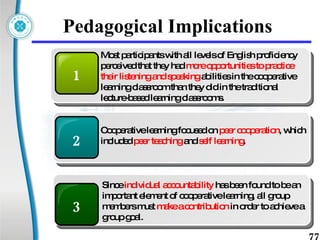
Pedagogical Implications 1 Most participants with all levels of English proficiency  perceived that they had  more opportunities to practice their listening and speaking  abilities in the cooperative learning classroom than they did in the traditional  lecture-based learning classrooms. 2 Cooperative learning focused on  peer cooperation , which included  peer teaching  and  self learning .  3 Since  individual accountability  has been found to be an important element of cooperative learning, all group members must  make a contribution  in order to achieve a group goal.
Limitations of the Study  3. Lack of  class observation 2. T he research time was limited. 1.  The sample size was admittedly small.
Suggestions for Future Study  Future research should be done with  larger samples of students. Further research should be done with longer time for the experiment. Further study should conduct the  Ethnography.
Thank you for your attention!

Ppt for final defense0524 teresa final version

  • 1.
    The Effectiveness ofApplying Cooperative Learning to the EFL Classroom in a Technological University Presenter: Shing-Yu Tsai Advisor: Dr. Chin-Ling Lee Date: May 25, 2009
  • 2.
    Contents Introduction LiteratureReview Methodology Results and Discussions Conclusions and Suggestions 1 2 3 4 5
  • 3.
    Definition of TermsResearch Questions Purposes of the Study Statements of the Problems Background of the Study Introduction
  • 4.
    Background of theStudy The globalization phenomenon has undoubtedly taken place, and English has arisen as the most common language for worldwide communication . ( Falits & Hudelson, 1998; McCrum, MacNeil, & Cran, 2002 )
  • 5.
    Background of theStudy Among the four English language skills, English speaking proficiency has recently drawn a great deal of attention in Taiwan, since it plays an important role in tourism, business, and cultural exchange in the global village. ( Chang, 2008; Hsu, 2004; Wang, 2008 )
  • 6.
    Background of theStudy Grammar-Translation Method (GTM) Inadequate Learning Environments Reasons ( Chen, 2004; Huang, 1999 )
  • 7.
    Statements of theStudy GTM ( Lai, 2002; Tsai, 1998; Yu, 1995; Wei & Chen, 1993 ) Students have little team work. 1 Students are shy, passive and have no confidence. 2 Their scores are graded by individual. 3 Students can’t put what they have learned into practice. 4
  • 8.
    Statements of theStudy P revious studies on cooperative learning were mostly focused on various courses in secondary or elementary education; its application to English instruction in higher vocational education has barely been considered. ( Lee, 2004 )
  • 9.
    Purposes of theStudy To investigate the effectiveness of cooperative learning and traditional lecture-based learning on the listening and oral achievements of college students majoring in business
  • 10.
    Purposes of theStudy To examine the differences in conceptual learning style preferences and learning motivation among students in cooperative learning and traditional lecture-based learning To explore the perspectives toward different teaching methods on cooperative learning and traditional lecture-based learning of EFL learners in the two different classes collected through in-depth interviews
  • 11.
    Research Questions Arethere any differences between the effects of the cooperative learning and those of the traditional lecture-based learning on students’ listening achievement? 2 Are there any differences between the effects of the cooperative learning and those of the traditional lecture-based learning on students’ oral achievement? 1
  • 12.
    Research Questions Arethere any differences between the effects of the cooperative learning and those of the traditional lecture-based learning on students’ conceptual learning style preferences ? Are there any differences between the effects of the cooperative learning and those of the traditional lecture-based learning on students’ learning motivation ? 3 4
  • 13.
    Research Questions Whatmain elements comprise the viewpoints of EFL learners in the cooperative learning class and the traditional lecture-based learning class?   What variables affect the viewpoints of EFL learners in the cooperative learning class and the traditional lecture-based learning class? 5 6
  • 14.
    Definition of TermsHigh and Low English Achievers I n the field of testing and assessment , the preferred method to compare the higher and the lower groups is to select samples from the top and the bottom 25% to 33%; sampling the top and bottom 27% is recommended. ( Chen & Lin, 2009; Wu, 2007 )
  • 15.
    Literature Review Communicative Competence C ooperative Learning Perceptual Language Learning Style Preferences L anguage Learning Motivation
  • 16.
    Communicative Competence Communicativecompetence was the expression of sociolinguistic that regarded language as social behavior . ( Wellman, 2002 )
  • 17.
    Cooperative Learning Cooperativegroup made students of different performance levels engage in instructional methods to pursue a common goal . ( Ha¨nze & Berger, 2007; Slavin, 1987 )
  • 18.
    Cooperative Learning (Liang, 2000 ) It reduced learning anxiety. 1 It increased the amount of students participating in learning activities. 2 It built a supportive learning environment. 3
  • 19.
    C ooperative Learningsocial skills academic achievement Effectiveness (Fenton, 1992; Johnson & Johnson, 1999; Putnam, 1997; Ye, 1993 )
  • 20.
    Cooperative Learning Fivemajor factors ( Johnson, Johnson, & Holubec, 2000 ) Social and Small Group Skills 4 Group Processing 5 1 Face to Face Interaction 2 Positive Interdependence 1 1 Individual Accountability 3
  • 21.
    Cooperative Learning PositiveInterdependence Positive interdependence created the sense that” we sank or swam together ”. Group members perceived “all” members as essential for group success and worked together towards a common goal of each other’s learning. ( Johnson et al, 2000 )
  • 22.
    Cooperative Learning Positivegoal interdependence Resource interdependence Role interdependence ( Johnson et al., 2000 )
  • 23.
    C ooperative LearningFace to Face Interaction ( Johnson & Johnson, 2000 ) Click to add Title 1 exchanging needed resources Click to add Title 2 encouraging their group members Click to add Title 1 explaining how to solve problems Click to add Title 2 checking for understanding Click to add Title 1 discussing concepts being learned Click to add Title 2 connecting present with past learning
  • 24.
    Cooperative Learning IndividualAccountability Individual accountability existed when each of the group members contributed his or her efforts to accomplish the goal. This element stressed that group accomplishment depended on the coordination of all members’ efforts . ( Johnson & Johnson, 2000 )
  • 25.
    Cooperative Learning interactin leadership decision-making trust-building conflict-managements Social and Small Group Skills ( Karrie & Jennifer, 2008 )
  • 26.
    Cooperative Learning GroupProcessing Group processing clarified and improved member effectiveness in contributing to cooperative efforts to attain the group’s goal . ( Johnson & Johnson, 2000 )
  • 27.
    Perceptual Language LearningStyle Preferences Foreign language learners claimed that learners’ learning style would determine whether they success in the academic performance . ( Castro & Peck, 2005 )
  • 28.
    Language Learning MotivationThe correlation between motivation and English achievements was very high . ( Chou, 1989; Huang, 1990; Liang, 2002 )
  • 29.
    Methodology Instruments ParticipantsResearch Structure Experimental Design Data Collection Procedure of the Study Data Analysis
  • 30.
    Procedure of theStudy Pilot Study Formal Study Control Group 1. Pre- test on listening and oral achievements 2. Two questionnaires on students’ learning-style preferences and learning motivation at the pre-test Pre-test Pre-test 1. Pre- test on listening and oral achievements 2. Two questionnaires on students’ learning-style preferences and learning motivation at the pre-test Experimental Group
  • 31.
    Procedure of theStudy Cooperative learning for one semester Traditional lecture-based learning for one semester Semi-structure interview Post-test 1. Post-test on listening and oral achievements 2. Two questionnaires on students’ learning-style preferences and learning motivation at the post-test Post-test 1. Post-test on listening and oral achievements 2. Two questionnaires on students’ learning-style preferences and learning motivation at the post-test Semi-structure interview Data Collection & Analyzing Data Collection & Analyzing
  • 32.
    Participants 39 participantsEnglish conversation class Department of business Studying English for more than six years Participants 6 males; 33 females Two-year System College
  • 33.
    Instruments A questionnaire2 An English speaking evaluation form 3 An academic achievement test 1 An interview protocol 4
  • 34.
    Academic achievement test( LTTC at elementary level ) Picture description Statement response Questions ( 20 mins ) Read passage Repeat the words Answer questions ( 5 mins ) Listening Speaking
  • 35.
    Questionnaire 1 23 4 5 strongly disagree strongly agree Permission Consent form Time Consent form: 5 mins Questionnaire: 15 mins
  • 36.
    Questionnaire Joy Reid( 1995 ) Clement et al. ( 1994 ) 28 items 20 items Crobach’s alpha: .87 Crobach’s alpha: .95 Perceptual Learning-Style Preferences  Learning Motivation
  • 37.
    Questionnaire Part 3Perceptual Learning-style Preferences Learning Motivation Part 2 Part 1 Individual Background Survey
  • 38.
    Questionnaire visual auditorytactile kinesthetic group integrative instrumental motivational achieving learning goal age gender experiences proficiency questionnaire.doc IBS  PLPQ  QLM subscales
  • 39.
    English speaking evaluationform Content:20% Grammar:20% Vocabulary:20% Fluency:20% Appropriateness: 20% (Chang, 2003)
  • 40.
    English speaking evaluationform Two raters: Class instructor Teaching English for more than 15 years Expertise on cooperative learning Experienced English institute for many years
  • 41.
    Interview Protocol Interview concern: ( Johnson, Johnson, & Holubec, 2000 ) social and small group skills 4 group processing 5 1 face to face interaction 2 positive interdependence 1 1 individual accountability 3
  • 42.
    Interview 2 highachievers 2 high achievers 2 intermediate achievers 2 intermediate achievers 2 low achievers 2 low achievers 15-20 mins Tape- recorded 15-20 mins Tape- recorded Chinese Chinese Experimental group Control group Interviewee Time Tool Language
  • 43.
    Experimental Design ExperimentalGroup: Control Group: ED 23 participants 16 participants Traditional lecture-based learning Cooperative learning One semester One semester Two periods a week Two periods a week Same material Same material Same instructor Same instructor Heterogeneous grouping No heterogeneous grouping
  • 44.
    Grouping GroupTwo intermediate achievers One high achiever One low achiever
  • 45.
    Control Group Traditionallecture-based learning: Students listened to and repeated dialogue. A Students worked independently and competed with one another. B The teacher was the instructor while students were listeners. 3 C
  • 46.
    Experimental Group Cooperativelearning: Jigsaw II STAD (Student-Team-Achievement- Divisions) CL CL
  • 47.
    STAD STAD teacher’slecture team study group recognition class presentation individual quizzes B E C D A
  • 48.
    Jigsaw II teacher’slecture cooperative groups preparation pairs practice pairs team performance
  • 49.
    Data Collection AB C The scores of academic achievements : listening &oral The results of questionnaire: learning style preferences & learning motivation Individual interview: control & experimental group
  • 50.
    Data Analysis Post-testof the learning achievements, responses of learning style preferences and learning motivation (Q1, Q2,Q3, Q4) The significant differences between two classes (Q1, Q2,Q3, Q4) Interview (Q5, Q6) ANCOVA Independent Samples Test Constant Comparative Analysis
  • 51.
    Constant comparative dataanalysis ( Glaser & Strauss, 1967 ) 1 comparing incidents to each category 2 integrating categories and their properties 3 delimiting the theory 4 writing the theory
  • 52.
    Results of Achievements Q1: Are there any differences between the effects of the cooperative learning and those of the traditional lecture-based learning on students’ listening achievement? Table 1 Summary of Analysis of One-Way ANCOVA on the Comparison of the Posttest Scores on Listening of the Two Groups Note. *p<.05 Source SS df MS F Sig. Listening 2556.89 1 2556.89 31.53 .00 Group 3919.76 1 3919.76 48.33 .00* Error 2919.73 36 81.10 Corrected Total 8857.69 38
  • 53.
    Results of Achievements Table 2 Descriptive Statistics of the Pretest Scores and the Posttest Scores on Listening of the Two Groups When separately examining the progress each group had made on the English listening achievement, the cooperative learning group had positively showed its better effectiveness in the EFL classroom. Note. *p<.05 Pre Post MD t p Adjusted Means Experimental 75.13 86.63 11.5 -5.12 .00* 87.53 Control 78.09 67.70 10.39 3.75 .00* 67.06
  • 54.
    Results of Achievements Q2: Are there any differences between the effects of the cooperative learning and those of the traditional lecture-based learning on students’ oral achievement? Table 3 Summary of Analysis of One-Way ANCOVA on the Comparison of the Posttest Scores on Oral Achievement of the Two Groups Note. *p<.05 Source SS df MS F Sig. Oral 1572.46 1 1572.46 6.85 .01 Group 1449.19 1 1449.19 6.32 .02* Error 8258.77 36 229.41 Corrected Total 10868.31 38
  • 55.
    Results of Achievements Table 4 Descriptive Statistics of the Pretest Scores and the Posttest Scores on Oral Achievement of the Two Groups When separately examining the progress each group had made on the English oral achievement, the cooperative learning group had positively showed its better effectiveness in the EFL classroom Note. *p<.05 Pre Post MD t p Adjusted Means Experimental 62.25 78.88 16.63 -6.31 .00* 80.09 Control 67.74 68.39 0.65 -0.14 .89 67.54
  • 56.
    Results of Questionnaires Q3 : Are there any differences between the effects of the cooperative learning and those of the traditional lecture-based learning on students’ conceptual learning style preferences ? Table 5 Summary of Analysis of One-Way ANCOVA on the Comparison of the Posttest Scores on Learning Style Preferences of the Two Groups Note. *p<.05 Source SS df MS F Sig. PLPQ .073 1 .07 .34 .57 Group 4.56 1 4.56 21.10 .00* Error 7.78 36 .22 Corrected Total 12.47 38
  • 57.
    Results of Questionnaires Table 6 Descriptive Statistics of the Pretest Scores and the Posttest Scores on Learning Style Preferences of the Two Groups The experimental group got higher significant difference in their learning style preferences toward learning English after the intervention of cooperative learning . Note. *p<.05 Pre Post MD t p Adjusted Means Experimental 3.76 3.31 0.45 3.42 .00* 4.00 Control 3.80 3.85 0.04 -.35 .73 3.32
  • 58.
    Results of Questionnaires Q4: Are there any differences between the effects of the cooperative learning and those of the traditional lecture-based learning on students’ learning motivation ? Table 7 Summary of Analysis of One-Way ANCOVA on the Comparison of the Posttest Scores on Learning Motivation of the Two Groups Note. *p<.05 Source SS df MS F Sig. QLM .19 1 .19 .71 .41 Group 2.04 1 2.04 7.54 .01* Error 9.71 36 .27 Corrected Total 12.28 38
  • 59.
    Results of Questionnaires Table 8 Descriptive Statistics of the Pretest Scores and the Posttest Scores on Learning Motivation of the Two Groups Students in cooperative learning had higher motivation to learn English. Note. *p<.05 Pre Post MD t p Adjusted Means Experimental 3.97 3.51 0.46 2.53 .02* 3.10 Control 3.77 4.01 0.25 -1.59 .13 3.52
  • 60.
    Data Analyses ofInterviews Table 9 Profile of the participants Code Gender Year of English Learning English Proficiency Group I Female 7 Low Experimental II Female 6 Low Experimental III Female 6 Intermediate Experimental IV Male 8 High Experimental V Female 7 High Experimental VI Female 7 Intermediate Experimental VII Female 7 Intermediate Control VIII Male 6 High Control IX Female 6 High Control X Female 8 Low Control XI Female 7 Intermediate Control XII Female 6 Low Control
  • 61.
    Interview Protocol Howwould you describe your learning experiences toward the instructional strategies and learning activities of the class you attended? Tell me about your view or attitude toward the teacher and students of English learning? Tell me about the satisfying situations you found in English learning class? Tell me about the frustrating situations you found in English learning class? Part I: The elements of students’ viewpoints in the EFL classroom
  • 62.
    Interview Protocol Tellme how to solve the problems in English learning? Tell me what kind of group dividing can enhance your English learning? Part I: The elements of students’ viewpoints in the EFL classroom Would you describe an ideal English learning class?
  • 63.
    Data Analyses ofInterviews Table 10 How would you describe your learning experiences toward the instructional strategies and learning activities of the class you attended?
  • 64.
    Data Analyses ofInterviews Table 12 How would you describe your learning experiences toward the instructional strategies and learning activities of the class you attended?
  • 65.
    Interview Protocol Whatinfluence did learning motivation and style preferences have on your learning in English learning class? What would you consider to be used for supportive facilities in English learning classroom? Would you like the materials or supplementary in English learning classroom? Would you describe your English learning motivation and how to learn English effectively? Part II: The Variables affect students’ learning in the EFL classroom
  • 66.
    Data Analyses ofInterviews Table 13 What would you consider to be used for supportive facilities in English learning classroom?
  • 67.
    Data Analyses ofInterviews Table 14 What would you consider to be used for supportive facilities in English learning classroom? Research Questions Interview Questions Responses Participants variables affect the learning in the EFL classroom 2. be used for supportive facilities in English learning classroom 01 material & supplementary 02 CALL 03 learning activities I,III,XI,XII,VI,VII, VIII,IX II,V IV
  • 68.
    Development of theConceptual Framework Q5:What main elements consist of the viewpoints of EFL learners in the cooperative learning class and traditional lecture-based method class?
  • 69.
    Development of theModel Q6: What variables affect the viewpoints of EFL learners in the cooperative learning class and traditional lecture-based learning class?
  • 70.
    Conclusions Suggestions forFuture Study 4 Conclusions and Discussions 1 Pedagogical Implications 2 Limitations of the Study 3
  • 71.
    Conclusions and DiscussionsThe highly interactive settings would enable learners to gain better communicative competence in language learning. ( Kagan,1995 ) The participants in the experimental class with cooperative learning achieved significant better learning listening and oral than those in the control class with the traditional lecture-based learning.
  • 72.
    Conclusions and DiscussionsThe increase of student talk through comprehensible input , interactions , and output contributed to the students’ oral communicative competence. ( Chai, 1998; Liang, 2002; Wei, 1997 ) ( Liang, 2002 ) Student’s potentials for English learning could be well inspired through the frequent exchange of target language with the classmates.
  • 73.
    Conclusions and DiscussionsIn a less threatening learning context as that of cooperative learning, the students in the experimental group were able to demonstrate higher classroom participation , which was related to their statistical gain in the language achievements. (Lin, 1993; Zhou, 2002)
  • 74.
    Conclusions and Discussions( Castro & Peck, 2005) The students in the cooperative learning instruction could gain their learning style preferences in the EFL class in the technological institutes. Learning style would determine the success of the learning achievement.
  • 75.
    Conclusions and DiscussionsFactors affect learner’s viewpoints of the EFL class are included as follows, (a) learning style preferences , the teacher and students’ help from the classroom learning habit in the past and (b) motivation , learning belief about English learning. Participants’ viewpoints on the success of EFL class are based on students’ needs of relevant learning supplementary materials , learning activities that the teacher designed for the students.
  • 76.
    Conclusions and DiscussionsThe students in the experimental class showed higher motivation than those in the control class. The significant gain in the students’ motivation toward learning English in the experimental complained the significant improvement in their language learning which in the consistence with the effectiveness of cooperative learning in boosting learners’ motivation . ( Liang, 1999; Wei, 1997; Yu, 1995 )
  • 77.
    Pedagogical Implications 1Most participants with all levels of English proficiency perceived that they had more opportunities to practice their listening and speaking abilities in the cooperative learning classroom than they did in the traditional lecture-based learning classrooms. 2 Cooperative learning focused on peer cooperation , which included peer teaching and self learning . 3 Since individual accountability has been found to be an important element of cooperative learning, all group members must make a contribution in order to achieve a group goal.
  • 78.
    Limitations of theStudy 3. Lack of class observation 2. T he research time was limited. 1. The sample size was admittedly small.
  • 79.
    Suggestions for FutureStudy Future research should be done with larger samples of students. Further research should be done with longer time for the experiment. Further study should conduct the Ethnography.
  • 80.
    Thank you foryour attention!