The Contexts and
Dynamics of Language
  Learning Motivation
         Kimberly A. Noels


                                 CUE JALT
                             July 2-3, 2011
Acknowledgements

  Colleagues   and students involved in these
   projects include Maureen Ehrensberger-Dow,
   Hiroshi Ota, Megan Lau, Kristie Saumure,
   and Maya Sugita.
  Many thanks go out to the professors and
   students who participated in this study.
  This project was supported financially by the
   Social Sciences and Humanities Research
   Council of Canada.
Overview
  Defining   Motivation: Self-Determination
   Theory
  Motivation across Learning Contexts
      Motivation and the Cultural Context
  The Dynamics of Motivation
  Fostering Motivation in Language Learners
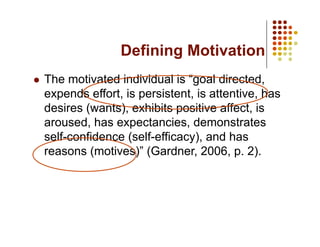
Defining Motivation
  The motivated individual is “goal directed,
  expends effort, is persistent, is attentive, has
  desires (wants), exhibits positive affect, is
  aroused, has expectancies, demonstrates
  self-confidence (self-efficacy), and has
  reasons (motives)” (Gardner, 2006, p. 2).
Motivation for Learning
           Japanese: Participants
  129 university students registered in Japanese
   language courses
  Age 18 to 35 years (M = 20.44, SD = 2.73)

  Gender: 55.9% female

  Mother tongue: 55% English; 39.6% Chinese

  Language used most frequently: 77% English

  According to the Statistics Canada (2007),
   Japanese represents 0.4% of the province’s
   population.
Self-Determination Theory
                                    Deci & Ryan (1985, 2001)


                                  INTRINSIC!
                                MOTIVATION!


The more I find out about Japanese language/culture, the more interested
 in it I become; it is very interesting and fun for me to discover each new
           kernel of knowledge. … Once again, because it is fun.
                                                          -- Canadian, English

… over time I’ve fallen in love with the language itself and its sound and
        structure. I love writing Japanese, especially the kanji.
                                                      -- Canadian, English
Self-Determination Theory
           Deci & Ryan (1985, 2001)


         INTRINSIC!
        MOTIVATION!
Self-Determination Theory
                                      Deci & Ryan (1985, 2001)


AMOTIVATION!                                                          INTRINSIC!
                                                                     MOTIVATION!


         Sigh… 6 credits of LOE [language other than English] in order to
    complete a BA. I really don’t understand what is with the Faculty of Arts.
  Silly requirements, i.e., LOE make linguistically-challenged people like me…
    pretty upset to find out that the university values linguistic capability over
               academic achievements. After all, the ability to pick a
           language up is innate and not something that can be taught.
                   Anyway                                          .

                                                          -- Canadian, Mandarin
Self-Determination Theory
                                     Deci & Ryan (1985, 2001)


                            EXTRINSIC MOTIVATION!
AMOTIVATION!                                                          INTRINSIC!
                                                                      MOTIVATION!
                EXTERNAL! INTROJECTED!    IDENTIFIED!   INTEGRATED!
               REGULATION! REGULATION!   REGULATION!    REGULATION!
Self-Determination Theory
                                      Deci & Ryan (1985, 2001)


                             EXTRINSIC MOTIVATION!
AMOTIVATION!                                                       INTRINSIC!
                                                               MOTIVATION!
                EXTERNAL!
               REGULATION!


                             LOE requirement
                      -- Canadian, English

            I am learning Japanese because I would like to get
        a job with a Japanese car company as an accountant.
                There is a lot of money in Japan, and I want it.
                                           -- Canadian, English
Self-Determination Theory
                                     Deci & Ryan (1985, 2001)


                            EXTRINSIC MOTIVATION!
AMOTIVATION!                                                   INTRINSIC!
                                                              MOTIVATION!
                EXTERNAL! INTROJECTED!
               REGULATION! REGULATION!


             I spent 3 years in Japan… I studied the martial
          art of naginata and my teacher and fellow students
           knew little English. We communicated pretty well,
       but I truly wish I could have known them better. Learning
      Japanese would have helped that. I have some shame over
         not learning more of the language while I was there.
                           I didn’t apply myself…
                                                  -- Canadian, English
Self-Determination Theory
                                     Deci & Ryan (1985, 2001)


                            EXTRINSIC MOTIVATION!
AMOTIVATION!                                                   INTRINSIC!
                                                              MOTIVATION!
                EXTERNAL! INTROJECTED!
               REGULATION! REGULATION!


          To culture myself, to prove to myself and others that
          it is something I can do, and provide me with status
                       and a sense of intelligence.
                                                  -- Canadian, English
Self-Determination Theory
                                     Deci & Ryan (1985, 2001)


                            EXTRINSIC MOTIVATION!
AMOTIVATION!                                                    INTRINSIC!
                                                               MOTIVATION!
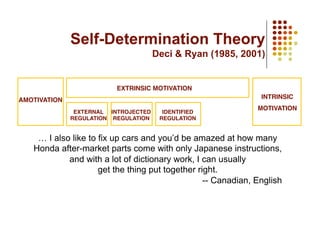
                EXTERNAL! INTROJECTED!    IDENTIFIED!
               REGULATION! REGULATION!   REGULATION!


    … I also like to fix up cars and you’d be amazed at how many
   Honda after-market parts come with only Japanese instructions,
            and with a lot of dictionary work, I can usually
                     get the thing put together right.
                                                  -- Canadian, English
Self-Determination Theory
                                     Deci & Ryan (1985, 2001)


                            EXTRINSIC MOTIVATION!
AMOTIVATION!                                                  INTRINSIC!
                                                             MOTIVATION!
                EXTERNAL! INTROJECTED!    IDENTIFIED!
               REGULATION! REGULATION!   REGULATION!


      As part of my research in cultural anthropology, learning the
     language would help me understand Japanese culture better
                       (to some extent at least)
                                             -- Singaporean, English
Self-Determination Theory
                                     Deci & Ryan (1985, 2001)


                            EXTRINSIC MOTIVATION!
AMOTIVATION!                                                          INTRINSIC!
                                                                      MOTIVATION!
                EXTERNAL! INTROJECTED!    IDENTIFIED!   INTEGRATED!
               REGULATION! REGULATION!   REGULATION!    REGULATION!


       When I was younger I was really interested in Japanese
      culture. So when I won a scholarship to do an exchange in
      Japan, I was really excited. It was there where I decided to
    become an English teacher. So I’m going to get my degree in
        Education with my major as Japanese and my minor as
    International/Intercultural Education. After I convocate in a few
        years I plan on teaching in [X High School] in Sendai….
                                                  -- Canadian, English
Self-Determination Theory
                                     Deci & Ryan (1985, 2001)


                            EXTRINSIC MOTIVATION!
AMOTIVATION!                                                          INTRINSIC!
                                                                      MOTIVATION!
                EXTERNAL! INTROJECTED!    IDENTIFIED!   INTEGRATED!
               REGULATION! REGULATION!   REGULATION!    REGULATION!


                 I’m learning it because in my heart,
                I know that is what I was meant to do.
                                    -- Canadian, English
Motivation for Learning Japanese:
                    Motivational Orientations

                                                         Students often have
                                                          multiple reasons for
                                                          learning a language.
                                                          This group of
                                                          students expressed
                                                          high levels of
                                                          identified regulation,
                                                          followed by intrinsic
Adapted from Noels, Sugita, Saumure & Sharma, 2011
                                                          motivation, followed
                                                          by external regulation.
Context and Language
                 Learning Motivation
  Foreign   Language Students (n = 20)
      Age: M=24.90 years (SD=6.27)
      Sex: 55% female
  Heritage   Language Students (n = 12)
      Age: M=21.33 years (SD=2.27)
      Sex: 91.7% female
  English
         as a Second Language (ESL)
  Students (n = 30)
      Age: M=24.86 years (SD=5.40)
      Sex: 46.7% female
Focussed Essay Technique:
                                       What are your reasons for learning
                                                 your second language?
Proportion of responses (main theme)


                                                       Adapted from Noels, Marchak, Saumure & Adrian-Taylor, 2011
BASIC PSYCHOLOGICAL NEEDS
        AND SELF-DETERMINATION
    Autonomy
         sense of making a conscious and voluntary
          decision to engage in a personally relevant
          activity
    Competence
         sense of being effective in performing the
          activity; capacity to rise to “optimal challenges”
    Relatedness
         sense of secure and satisfying connections with
          others in one’s social surroundings
Hypothetical Model

Autonomy      +            Intrinsic
                          Motivation
              +                           +
               +
                                              Motivational
Relatedness
                                          +    Intensity
                      +
                  +
                           Extrinsic
Competence     +      (Self-Determined)
                         Motivation
Motivation and Culture
    Motivational models developed in North America
     are often transported elsewhere, a practice that
     can be problematic.
    Autonomy is a central value in many “Western”
     societies, especially in (North) America, and is
     associated with an “individualistic” cultural
     orientation.
    Cross-cultural researchers suggest that other
     countries (often exemplified by East Asian
     nations) might be more “collectivistic”.
Motivation and Culture

    Is Self-Determination Theory valid cross-
     culturally?
         Do more self-determined extrinsic orientations
          and intrinsic motivation predict positive learning
          “outcomes”?
         Is autonomy an important predictor of self-
          determined orientations in more collectivistic
          societies? Or are other needs more important
          (e.g. relatedness)?
    We need a comparative perspective to
     examine cultural differences in patterns of
     relations between motivational variables.
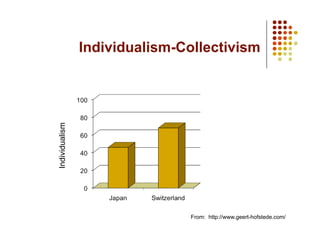
Individualism-Collectivism
Individualism


                                From: http://www.geert-hofstede.com/
Method
  Participants
      101 students enrolled in EFL courses at the Aichi
       Shukutoku University in Japan
         All native Japanese speakers
         Mean age = 20.57 years; 68.3% females
         Years studied English = 8.83 years
      217 students enrolled in the EFL program at the
       Zurich University of Applied Sciences Winterthur
       in Switzerland
         All native (Swiss) German speakers
         Mean age = 23.79 years; 41.7% females
         Years studied English = 6.57 years
Materials
•    Cultural Differences
        •    Interdependent and Independent Self-Construals
             (Cross, 1995)
•    Intrinsic and Extrinsic Orientations
        •     Language Learning Orientations Scale (Noels et
             al., 2000)
                 External: To gain the benefits (eg., job, money, course
                  credit) which English will provide.
                 Introjected: Because I would feel guilty if I didn’t know
                  English.
                 Identified: Because English helps me to achieve goals
                  that are important to me.
                 Intrinsic: For the enjoyment I feel when learning English.
•    RAI = (-2 * External Regulation) + (-1 * Introjected
     Regulation) + (+1 * Identified Regulation) + (+2 *
     Intrinsic Motivation)
Materials
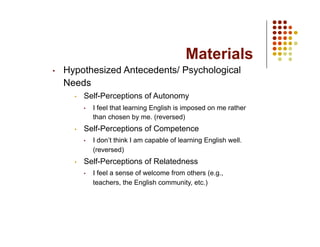
•    Hypothesized Antecedents/ Psychological
     Needs
       •    Self-Perceptions of Autonomy
            •    I feel that learning English is imposed on me rather
                 than chosen by me. (reversed)
       •    Self-Perceptions of Competence
            •    I don’t think I am capable of learning English well.
                 (reversed)
       •    Self-Perceptions of Relatedness
            •    I feel a sense of welcome from others (e.g.,
                 teachers, the English community, etc.)
Materials
•    Hypothesized Consequences
       •    Motivational Intensity (Effort)
            •    I really work hard to learn English.
       •    Intention to Continue (Persistence)
            •    I want to continue to learn English after I finish this
                 class.
       •    Self-Evaluation of English Competence
            •    Read, write, speak, understand
       •    Use of English outside the Class
Self-Construal (Mean)
                        Self-Construals
Correlations between Orientations and
                Hypothesized Consequences

                        Japan                         Switzerland
              Mot.   Self-   Persist   Engl.   Mot.   Self-   Persist   English
              Int.   Eval.             Use     Int.   Eval.              Use

Amotivation   -.47   -.58    -.66      -.20    -.14   -.15    -.31      -.07
 External     -.03   .01      .15      -.01    .00    .00      .13      -.09
Regulation
Introjected   .09    .02      .07      -.01    .12    .08      .05      -.05
Regulation
 Identified   .43    .41      .66      .27     .36    .42      .46       .26
Regulation
 Intrinsic    .39    .43      .63      .31     .55    .44      .46       .26
Motivation
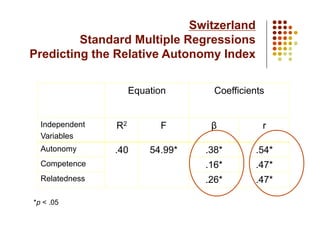
Switzerland
         Standard Multiple Regressions
Predicting the Relative Autonomy Index

                     Equation       Coefficients


  Independent   R2         F       β           r
  Variables
  Autonomy      .40      54.99*   .38*       .54*
  Competence                      .16*       .47*
  Relatedness                     .26*       .47*

*p < .05
Japan
Standard Multiple Regressions Predicting
           the Relative Autonomy Index


                    Equation       Coefficients


 Independent   R2          F       β          r
 Variables
 Autonomy      .49       30.76*   .55*      .67*
 Competence                       .02       .43*
 Relatedness                      .20*      .53*
 *p < .05
Implications and
                         Future Directions
  Implications
      This evidence supports the cross-cultural validity
       of SDT across these countries that have been
       shown to differ in individualism.
  Methodological      directions
      Multiple comparison groups
      Matched samples
  Conceptual     directions
      Proactive and Reactive Autonomy (Littlewood,
       1999)
Hypothetical Model

Autonomy      +            Intrinsic
                          Motivation
              +                           +
               +
                                              Motivational
Relatedness
                                          +    Intensity
                      +
                  +
                           Extrinsic
Competence     +      (Self-Determined)
                         Motivation
A Dynamic Perspective on
                      Motivation
  Do Autonomy, Competence and Relatedness
   “cause” Intrinsic and Self-Determined
   Extrinsic Orientations?
  Do Intrinsic and Self-Determined Extrinsic
   Orientations “cause” Motivational Intensity?
Participants
  146 university students registered in French
   language courses
  Age 17 to 43 years (M = 21.19, SD = 4.55)

  Gender: 79.2% female

  Mother tongue: 81.5% English (no French)

  English used most frequently: 92.4%
Materials
  Web-based               questionnaire
     Language Learning Orientations Scale (LLOS)
        Intrinsic Motivation
        Extrinsic motivation
               Adapted RAI = (-2 * External Regulation) + (-1 * Introjected
                Regulation) + (+1 * Identified Regulation) + (+2 * Integrated
                Regulation)
     Psychological Needs
        Self-Perceptions of Autonomy
        Self-Perceptions of Competence
        Self-Perceptions of Relatedness

     Motivational Intensity
Procedure
  3   time points
      Early in the semester (Sept 16 to 25)
      Mid-semester (Oct 10 to 22)
      End of semester (Nov 30 to Dec 13)
  Nt1   = 146; Nt2 = 110; Nt3 = 79
Cross-lagged Panel Analysis

      Time 1 to Time 2

Compet.           Compet.
 (T1)              (T2)


Intrinsic          Intrinsic
  (T1)               (T2)
Cross-lagged Panel Analysis

      Time 1 to Time 2

Compet.           Compet.
 (T1)              (T2)


Intrinsic          Intrinsic
  (T1)               (T2)
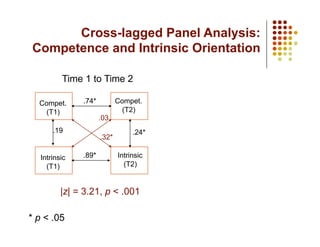
Cross-lagged Panel Analysis:
Competence and Intrinsic Orientation

         Time 1 to Time 2

  Compet.     .74*          Compet.
   (T1)                      (T2)
                     .03
      .19                        .24*
                     .32*

  Intrinsic   .89*          Intrinsic
    (T1)                      (T2)


         |z| = 3.21, p < .001

* p < .05
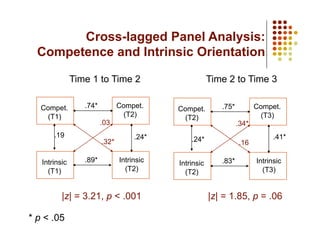
Cross-lagged Panel Analysis:
  Competence and Intrinsic Orientation

               Time 1 to Time 2                         Time 2 to Time 3

   Compet.        .74*          Compet.     Compet.        .75*          Compet.
    (T1)                         (T2)        (T2)                         (T3)
                         .03                                      .34*
       .19                           .24*                                      .41*
                         .32*                   .24*              .16

   Intrinsic      .89*          Intrinsic   Intrinsic      .83*          Intrinsic
     (T1)                         (T2)        (T2)                         (T3)


          |z| = 3.21, p < .001                          |z| = 1.85, p = .06

* p < .05
The Progressive Cycle
                     of Motivation


Competence                      Competence
   (T1)                            (T3)


        .32                   .34
                  Intrinsic
                 Motivation
                    (T2)
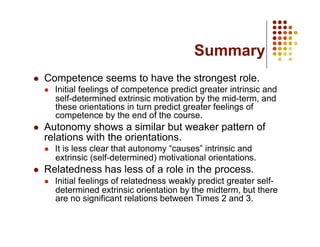
Summary
    Competence seems to have the strongest role.
         Initial feelings of competence predict greater intrinsic and
          self-determined extrinsic motivation by the mid-term, and
          these orientations in turn predict greater feelings of
          competence by the end of the course.
    Autonomy shows a similar but weaker pattern of
     relations with the orientations.
         It is less clear that autonomy “causes” intrinsic and
          extrinsic (self-determined) motivational orientations.
    Relatedness has less of a role in the process.
         Initial feelings of relatedness weakly predict greater self-
          determined extrinsic orientation by the midterm, but there
          are no significant relations between Times 2 and 3.
The Progressive Cycle
                       of Motivation


Motivational                            Motivational
 Intensity                               Intensity
   (T1)                                     (T3)


          .53/.40     Intrinsic/   .50/.32
                    SD Extrinsic
                     Motivation
                        (T2)
A Dynamic Perspective on
                           Motivation
    Motivation is a complex process.
         Promoting feelings of autonomy, relatedness and especially
          competence can foster intrinsic and self-determined
          extrinsic motivation… and vice versa.
         Self-determined extrinsic and intrinsic motivation are
          relevant for understanding why people put in the extra
          effort to engage in language learning … and vice versa.
    From a dynamic systems theory, this complexity and
     reciprocity of relations shouldn’t be surprising.
Fostering Autonomy
  Autonomy-enhancing         behaviours
     Foster relevance
     Provide choice
  Autonomy-suppressing          behaviours
     Suppress criticism
     Intrude/interfere with the learner’s natural pace


                         based on Assor, Kaplan & Roth (2002). British
                                Journal of Educational Psychology, 72.
Fostering Competence
    Informational Feedback/Structure
         Articulate clear, explicit and well-organized directions
         Provide leadership and a program of action to guide
          students’ ongoing activity
         Offer constructive feedback on how to gain control
          over valued outcomes.
    Chaos
         Ambiguous, confusing directions of “what to do”
         Little guidance, no goals
         Off-task or little feedback, competence-irrelevant info.
                                  Based on Jang, H., Reeve, J., & Deci, E.L. (2010). Journal
                                                  Of Educational Psychology, 102, 588-600.
Fostering Relatedness
  Acceptance,     warmth, security
      Express interest, empathy
      Assurance of security, positive regard
      Use inclusive language and display nonverbal
       “immediacy”
  Isolation,   unvalued, cold, uncaring
      Tease, ridicule, use disparaging comments
      Show resentfulness or disinterest

                                 Ryan & Powelson (1991). Journal of
                                  Experimental Education, 60, 49-66.
Noels Plenary CUE2011

Noels Plenary CUE2011

  • 1.
    The Contexts and Dynamicsof Language Learning Motivation Kimberly A. Noels CUE JALT July 2-3, 2011
  • 2.
    Acknowledgements   Colleagues and students involved in these projects include Maureen Ehrensberger-Dow, Hiroshi Ota, Megan Lau, Kristie Saumure, and Maya Sugita.   Many thanks go out to the professors and students who participated in this study.   This project was supported financially by the Social Sciences and Humanities Research Council of Canada.
  • 3.
    Overview   Defining Motivation: Self-Determination Theory   Motivation across Learning Contexts   Motivation and the Cultural Context   The Dynamics of Motivation   Fostering Motivation in Language Learners
  • 4.
    Defining Motivation   Themotivated individual is “goal directed, expends effort, is persistent, is attentive, has desires (wants), exhibits positive affect, is aroused, has expectancies, demonstrates self-confidence (self-efficacy), and has reasons (motives)” (Gardner, 2006, p. 2).
  • 5.
    Motivation for Learning Japanese: Participants   129 university students registered in Japanese language courses   Age 18 to 35 years (M = 20.44, SD = 2.73)   Gender: 55.9% female   Mother tongue: 55% English; 39.6% Chinese   Language used most frequently: 77% English   According to the Statistics Canada (2007), Japanese represents 0.4% of the province’s population.
  • 6.
    Self-Determination Theory Deci & Ryan (1985, 2001) INTRINSIC! MOTIVATION! The more I find out about Japanese language/culture, the more interested in it I become; it is very interesting and fun for me to discover each new kernel of knowledge. … Once again, because it is fun. -- Canadian, English … over time I’ve fallen in love with the language itself and its sound and structure. I love writing Japanese, especially the kanji. -- Canadian, English
  • 7.
    Self-Determination Theory Deci & Ryan (1985, 2001) INTRINSIC! MOTIVATION!
  • 8.
    Self-Determination Theory Deci & Ryan (1985, 2001) AMOTIVATION! INTRINSIC! MOTIVATION! Sigh… 6 credits of LOE [language other than English] in order to complete a BA. I really don’t understand what is with the Faculty of Arts. Silly requirements, i.e., LOE make linguistically-challenged people like me… pretty upset to find out that the university values linguistic capability over academic achievements. After all, the ability to pick a language up is innate and not something that can be taught. Anyway . -- Canadian, Mandarin
  • 9.
    Self-Determination Theory Deci & Ryan (1985, 2001) EXTRINSIC MOTIVATION! AMOTIVATION! INTRINSIC! MOTIVATION! EXTERNAL! INTROJECTED! IDENTIFIED! INTEGRATED! REGULATION! REGULATION! REGULATION! REGULATION!
  • 10.
    Self-Determination Theory Deci & Ryan (1985, 2001) EXTRINSIC MOTIVATION! AMOTIVATION! INTRINSIC! MOTIVATION! EXTERNAL! REGULATION! LOE requirement -- Canadian, English I am learning Japanese because I would like to get a job with a Japanese car company as an accountant. There is a lot of money in Japan, and I want it. -- Canadian, English
  • 11.
    Self-Determination Theory Deci & Ryan (1985, 2001) EXTRINSIC MOTIVATION! AMOTIVATION! INTRINSIC! MOTIVATION! EXTERNAL! INTROJECTED! REGULATION! REGULATION! I spent 3 years in Japan… I studied the martial art of naginata and my teacher and fellow students knew little English. We communicated pretty well, but I truly wish I could have known them better. Learning Japanese would have helped that. I have some shame over not learning more of the language while I was there. I didn’t apply myself… -- Canadian, English
  • 12.
    Self-Determination Theory Deci & Ryan (1985, 2001) EXTRINSIC MOTIVATION! AMOTIVATION! INTRINSIC! MOTIVATION! EXTERNAL! INTROJECTED! REGULATION! REGULATION! To culture myself, to prove to myself and others that it is something I can do, and provide me with status and a sense of intelligence. -- Canadian, English
  • 13.
    Self-Determination Theory Deci & Ryan (1985, 2001) EXTRINSIC MOTIVATION! AMOTIVATION! INTRINSIC! MOTIVATION! EXTERNAL! INTROJECTED! IDENTIFIED! REGULATION! REGULATION! REGULATION! … I also like to fix up cars and you’d be amazed at how many Honda after-market parts come with only Japanese instructions, and with a lot of dictionary work, I can usually get the thing put together right. -- Canadian, English
  • 14.
    Self-Determination Theory Deci & Ryan (1985, 2001) EXTRINSIC MOTIVATION! AMOTIVATION! INTRINSIC! MOTIVATION! EXTERNAL! INTROJECTED! IDENTIFIED! REGULATION! REGULATION! REGULATION! As part of my research in cultural anthropology, learning the language would help me understand Japanese culture better (to some extent at least) -- Singaporean, English
  • 15.
    Self-Determination Theory Deci & Ryan (1985, 2001) EXTRINSIC MOTIVATION! AMOTIVATION! INTRINSIC! MOTIVATION! EXTERNAL! INTROJECTED! IDENTIFIED! INTEGRATED! REGULATION! REGULATION! REGULATION! REGULATION! When I was younger I was really interested in Japanese culture. So when I won a scholarship to do an exchange in Japan, I was really excited. It was there where I decided to become an English teacher. So I’m going to get my degree in Education with my major as Japanese and my minor as International/Intercultural Education. After I convocate in a few years I plan on teaching in [X High School] in Sendai…. -- Canadian, English
  • 16.
    Self-Determination Theory Deci & Ryan (1985, 2001) EXTRINSIC MOTIVATION! AMOTIVATION! INTRINSIC! MOTIVATION! EXTERNAL! INTROJECTED! IDENTIFIED! INTEGRATED! REGULATION! REGULATION! REGULATION! REGULATION! I’m learning it because in my heart, I know that is what I was meant to do. -- Canadian, English
  • 17.
    Motivation for LearningJapanese: Motivational Orientations   Students often have multiple reasons for learning a language. This group of students expressed high levels of identified regulation, followed by intrinsic Adapted from Noels, Sugita, Saumure & Sharma, 2011 motivation, followed by external regulation.
  • 18.
    Context and Language Learning Motivation   Foreign Language Students (n = 20)   Age: M=24.90 years (SD=6.27)   Sex: 55% female   Heritage Language Students (n = 12)   Age: M=21.33 years (SD=2.27)   Sex: 91.7% female   English as a Second Language (ESL) Students (n = 30)   Age: M=24.86 years (SD=5.40)   Sex: 46.7% female
  • 19.
    Focussed Essay Technique: What are your reasons for learning your second language? Proportion of responses (main theme) Adapted from Noels, Marchak, Saumure & Adrian-Taylor, 2011
  • 20.
    BASIC PSYCHOLOGICAL NEEDS AND SELF-DETERMINATION   Autonomy   sense of making a conscious and voluntary decision to engage in a personally relevant activity   Competence   sense of being effective in performing the activity; capacity to rise to “optimal challenges”   Relatedness   sense of secure and satisfying connections with others in one’s social surroundings
  • 21.
    Hypothetical Model Autonomy + Intrinsic Motivation + + + Motivational Relatedness + Intensity + + Extrinsic Competence + (Self-Determined) Motivation
  • 22.
    Motivation and Culture   Motivational models developed in North America are often transported elsewhere, a practice that can be problematic.   Autonomy is a central value in many “Western” societies, especially in (North) America, and is associated with an “individualistic” cultural orientation.   Cross-cultural researchers suggest that other countries (often exemplified by East Asian nations) might be more “collectivistic”.
  • 23.
    Motivation and Culture   Is Self-Determination Theory valid cross- culturally?   Do more self-determined extrinsic orientations and intrinsic motivation predict positive learning “outcomes”?   Is autonomy an important predictor of self- determined orientations in more collectivistic societies? Or are other needs more important (e.g. relatedness)?   We need a comparative perspective to examine cultural differences in patterns of relations between motivational variables.
  • 24.
    Individualism-Collectivism Individualism From: http://www.geert-hofstede.com/
  • 25.
    Method   Participants   101 students enrolled in EFL courses at the Aichi Shukutoku University in Japan   All native Japanese speakers   Mean age = 20.57 years; 68.3% females   Years studied English = 8.83 years   217 students enrolled in the EFL program at the Zurich University of Applied Sciences Winterthur in Switzerland   All native (Swiss) German speakers   Mean age = 23.79 years; 41.7% females   Years studied English = 6.57 years
  • 26.
    Materials •  Cultural Differences •  Interdependent and Independent Self-Construals (Cross, 1995) •  Intrinsic and Extrinsic Orientations •  Language Learning Orientations Scale (Noels et al., 2000)   External: To gain the benefits (eg., job, money, course credit) which English will provide.   Introjected: Because I would feel guilty if I didn’t know English.   Identified: Because English helps me to achieve goals that are important to me.   Intrinsic: For the enjoyment I feel when learning English. •  RAI = (-2 * External Regulation) + (-1 * Introjected Regulation) + (+1 * Identified Regulation) + (+2 * Intrinsic Motivation)
  • 27.
    Materials •  Hypothesized Antecedents/ Psychological Needs •  Self-Perceptions of Autonomy •  I feel that learning English is imposed on me rather than chosen by me. (reversed) •  Self-Perceptions of Competence •  I don’t think I am capable of learning English well. (reversed) •  Self-Perceptions of Relatedness •  I feel a sense of welcome from others (e.g., teachers, the English community, etc.)
  • 28.
    Materials •  Hypothesized Consequences •  Motivational Intensity (Effort) •  I really work hard to learn English. •  Intention to Continue (Persistence) •  I want to continue to learn English after I finish this class. •  Self-Evaluation of English Competence •  Read, write, speak, understand •  Use of English outside the Class
  • 29.
    Self-Construal (Mean) Self-Construals
  • 30.
    Correlations between Orientationsand Hypothesized Consequences Japan Switzerland Mot. Self- Persist Engl. Mot. Self- Persist English Int. Eval. Use Int. Eval. Use Amotivation -.47 -.58 -.66 -.20 -.14 -.15 -.31 -.07 External -.03 .01 .15 -.01 .00 .00 .13 -.09 Regulation Introjected .09 .02 .07 -.01 .12 .08 .05 -.05 Regulation Identified .43 .41 .66 .27 .36 .42 .46 .26 Regulation Intrinsic .39 .43 .63 .31 .55 .44 .46 .26 Motivation
  • 31.
    Switzerland Standard Multiple Regressions Predicting the Relative Autonomy Index Equation Coefficients Independent R2 F β r Variables Autonomy .40 54.99* .38* .54* Competence .16* .47* Relatedness .26* .47* *p < .05
  • 32.
    Japan Standard Multiple RegressionsPredicting the Relative Autonomy Index Equation Coefficients Independent R2 F β r Variables Autonomy .49 30.76* .55* .67* Competence .02 .43* Relatedness .20* .53* *p < .05
  • 33.
    Implications and Future Directions   Implications   This evidence supports the cross-cultural validity of SDT across these countries that have been shown to differ in individualism.   Methodological directions   Multiple comparison groups   Matched samples   Conceptual directions   Proactive and Reactive Autonomy (Littlewood, 1999)
  • 34.
    Hypothetical Model Autonomy + Intrinsic Motivation + + + Motivational Relatedness + Intensity + + Extrinsic Competence + (Self-Determined) Motivation
  • 35.
    A Dynamic Perspectiveon Motivation   Do Autonomy, Competence and Relatedness “cause” Intrinsic and Self-Determined Extrinsic Orientations?   Do Intrinsic and Self-Determined Extrinsic Orientations “cause” Motivational Intensity?
  • 36.
    Participants   146 universitystudents registered in French language courses   Age 17 to 43 years (M = 21.19, SD = 4.55)   Gender: 79.2% female   Mother tongue: 81.5% English (no French)   English used most frequently: 92.4%
  • 37.
    Materials   Web-based questionnaire   Language Learning Orientations Scale (LLOS)   Intrinsic Motivation   Extrinsic motivation   Adapted RAI = (-2 * External Regulation) + (-1 * Introjected Regulation) + (+1 * Identified Regulation) + (+2 * Integrated Regulation)   Psychological Needs   Self-Perceptions of Autonomy   Self-Perceptions of Competence   Self-Perceptions of Relatedness   Motivational Intensity
  • 38.
    Procedure   3 time points   Early in the semester (Sept 16 to 25)   Mid-semester (Oct 10 to 22)   End of semester (Nov 30 to Dec 13)   Nt1 = 146; Nt2 = 110; Nt3 = 79
  • 39.
    Cross-lagged Panel Analysis Time 1 to Time 2 Compet. Compet. (T1) (T2) Intrinsic Intrinsic (T1) (T2)
  • 40.
    Cross-lagged Panel Analysis Time 1 to Time 2 Compet. Compet. (T1) (T2) Intrinsic Intrinsic (T1) (T2)
  • 41.
    Cross-lagged Panel Analysis: Competenceand Intrinsic Orientation Time 1 to Time 2 Compet. .74* Compet. (T1) (T2) .03 .19 .24* .32* Intrinsic .89* Intrinsic (T1) (T2) |z| = 3.21, p < .001 * p < .05
  • 42.
    Cross-lagged Panel Analysis: Competence and Intrinsic Orientation Time 1 to Time 2 Time 2 to Time 3 Compet. .74* Compet. Compet. .75* Compet. (T1) (T2) (T2) (T3) .03 .34* .19 .24* .41* .32* .24* .16 Intrinsic .89* Intrinsic Intrinsic .83* Intrinsic (T1) (T2) (T2) (T3) |z| = 3.21, p < .001 |z| = 1.85, p = .06 * p < .05
  • 43.
    The Progressive Cycle of Motivation Competence Competence (T1) (T3) .32 .34 Intrinsic Motivation (T2)
  • 44.
    Summary   Competence seems to have the strongest role.   Initial feelings of competence predict greater intrinsic and self-determined extrinsic motivation by the mid-term, and these orientations in turn predict greater feelings of competence by the end of the course.   Autonomy shows a similar but weaker pattern of relations with the orientations.   It is less clear that autonomy “causes” intrinsic and extrinsic (self-determined) motivational orientations.   Relatedness has less of a role in the process.   Initial feelings of relatedness weakly predict greater self- determined extrinsic orientation by the midterm, but there are no significant relations between Times 2 and 3.
  • 45.
    The Progressive Cycle of Motivation Motivational Motivational Intensity Intensity (T1) (T3) .53/.40 Intrinsic/ .50/.32 SD Extrinsic Motivation (T2)
  • 46.
    A Dynamic Perspectiveon Motivation   Motivation is a complex process.   Promoting feelings of autonomy, relatedness and especially competence can foster intrinsic and self-determined extrinsic motivation… and vice versa.   Self-determined extrinsic and intrinsic motivation are relevant for understanding why people put in the extra effort to engage in language learning … and vice versa.   From a dynamic systems theory, this complexity and reciprocity of relations shouldn’t be surprising.
  • 47.
    Fostering Autonomy   Autonomy-enhancing behaviours   Foster relevance   Provide choice   Autonomy-suppressing behaviours   Suppress criticism   Intrude/interfere with the learner’s natural pace based on Assor, Kaplan & Roth (2002). British Journal of Educational Psychology, 72.
  • 48.
    Fostering Competence   Informational Feedback/Structure   Articulate clear, explicit and well-organized directions   Provide leadership and a program of action to guide students’ ongoing activity   Offer constructive feedback on how to gain control over valued outcomes.   Chaos   Ambiguous, confusing directions of “what to do”   Little guidance, no goals   Off-task or little feedback, competence-irrelevant info. Based on Jang, H., Reeve, J., & Deci, E.L. (2010). Journal Of Educational Psychology, 102, 588-600.
  • 49.
    Fostering Relatedness   Acceptance, warmth, security   Express interest, empathy   Assurance of security, positive regard   Use inclusive language and display nonverbal “immediacy”   Isolation, unvalued, cold, uncaring   Tease, ridicule, use disparaging comments   Show resentfulness or disinterest Ryan & Powelson (1991). Journal of Experimental Education, 60, 49-66.