M. Suguna Int. Journal of Engineering Research and Applications www.ijera.com
ISSN : 2248-9622, Vol. 5, Issue 3, ( Part -5) March 2015, pp.44-47
www.ijera.com 44 | P a g e
Dynamic Metadata Management in Semantic File Systems
M. Suguna1
, T. Anand2
1
P.G Student& A.V.C College of Engineering, Mayiladuthurai, Tamil Nadu.
2
Professor & A.V.C College of Engineering, Mayiladuthurai, Tamil Nadu.
ABSTRACT
The progression in data capacity and difficulty inflicts great challenges for file systems. To address these
contests, an inventive namespace management scheme is in distracted need to deliver both the ease and
competence of data access. For scalability, each server makes only local, autonomous decisions about relocation
for load balancing. Associative access is provided by a traditional extension to present tree-structured file
system conventions, and by protocols that are intended specifically for content based access.Rapid attribute-
based accesstofile system contents is fulfilled by instinctive extraction and indexing of key properties of file
system objects. The programmed indexing of files and calendars is called “semantic” because user
programmable transducers use data about the semantics of efficient file system objects to extract the properties
for indexing. Tentative results from a semantic file system execution support the thesis that semantic file
systems present a more active storage abstraction than do traditional tree planned file systems for data sharing
and command level programming. Semantic file system is executed as a middleware in predictable file systems
and works orthogonally with categorized directory trees. The semantic relationships and file groups recognized
in file systems can also be used to facilitate file prefetching among other system-level optimizations. All-
encompassing trace-driven experiments on our sample implementation validate the efficiency and competence.
Key Terms—File systems, mete data, namespace management , semantic awareness, storage systems
I. INTRODUCTION
Profligate and flexible metadata recovering is
critical in the next cohort data storage systems. As
the storage capacity is approaching Exabyte and the
number of files stored is getting billions, directory-
tree based metadata organization widely arranged in
conventional file systems can no longer meet the
requirements of scalability and functionality.Many
systems are required to achieve hundreds of
thousands of metadata actions per second and
theperformance is strictly controlled by the
categorized directory-tree based metadata
organization system used in nearly all file systems
today. File system namespace as an information-
organizing infrastructure is important to system’s
quality of service such as presentation, scalability,
and comfort of use. Almost all recent file systems are
based on categorized directory trees.
A semantic file system delivers both a user line
and an submission programming boundary to its
associative access services. User boundaries based
upon browsers have verified to be operative for query
founded access to data, and we expect browsers to be
presented by most semantic file system executions.
Presentation programming lines that license remote
access include dedicated protocols for information
recovery, and remote technique call based
boundaries.
It is also potential to spread the services of a
semantic file system without presenting any new
boundaries. This can be skilled by covering the
naming semantics of files and manuals to support
associative access. A profit of this approach is that all
present submissions, including user interfaces,
instantly get the benefits of associative access. A
semantic file system participates associative accees
into a tree controlled file system through the concept
of a simulated directory. Simulated directory names
are construed as queries and thus deliver flexible
associative access to files and directories in a custom
well-matched with present software.
II. RELATED WORK
It is worth noting that the vital difference from
current work is its even, rather than classified,
namespace for data-intensive file systems. Semantic
file system is one of the first file systems that spread
the traditional file system orders by permitting users
to search modified file attributes. SFS creates
simulated directories based on demand. quFiles
provides a simple and combined view of different
copies of files that are enhanced for different contact
settings, such as network bandwidth. It uses a new
method that achievements semantic relationships
among files to create a vigorous per-file namespace
to speed up file lookups when full pathnames are not
offered. This approach differs from SFS and quFiles
in that we take into attention the semantic context
obliquely and unambiguously signified in file
metadata when allocation complex queries.
RESEARCH ARTICLE OPEN ACCESS
M. Suguna Int. Journal of Engineering Research and Applications www.ijera.com
ISSN : 2248-9622, Vol. 5, Issue 3, ( Part -5) March 2015, pp.44-47
www.ijera.com 45 | P a g e
In order to holder the scalability difficult of file
system directories, GIGA+ proposed a POSIX-
compliant accessible directory scheme to efficiently
support hundreds of thousands of simultaneous
changes per second, in particular in terms of file
designs. An extendible hashing-based technique is
used to dynamically barrier each directory to support
metadata organisation for a trillion files. Moreover,
with a goal to scale metadata quantity with the
calculation of metadata servers, the Ursa Minor
distributed packing system switches metadata
operations on things stored in altered metadata
servers by commonly and atomically apprising these
items. Active subtree barrier offers adaptive
management for ordered metadata capacities that
evolve over time. Here focus is not on how to store a
large number of files. Instead, aim to plan a new
attitude that helps rapidly find target files in a file
system with possibly billions or trillions of files.
III. PROBLEM DEFINITION
In the next-generation file systems, metadata
contacts will very possible become a severe act
blockage as metadata-based communications not only
account for over 50 percent of all file system actions
but also outcome in billions of pieces of metadata in
directories. Real-world applications establish the
wide actuality of access locality that is helpful to
classify semantic relationship. For example, Filecules
examines a great set of real suggestions and arranges
that files can be confidential into interrelated groups
since 6.5 percent of files explanation for 45 percent
of I/O requests. Spyglass reports that the locality
ratios are below 1 percent in many drops, connotation
that interconnected files are contained in less than 1
percent of the manual space. A assignment study on a
large-scale file system determines that rarer than 1
percent clients issue 50 percent file wishes and over
60 percent re-open actions occur within one minute.
A recent study displays that resident write operations
essence on 22 percent files in a five-year dated. The
reality of access locality simplifies the performance
optimization in many computer organization
schemes.
IV. METHODOLOGY
4.1 EXISTING METHOD
Detecting a objective file by physically
directing the encyclopaedias through directory trees
in a great system totals to pointed a needle in a
haystack. As the manual tree converts gradually
“heavier”, it is similarly hard for users to instruct the
file systems where a file should be kept and to find
them rapidly. When one does not recognize the
complete pathnameof a file, measured complete
search over all calendars is often resorted to. Such
thorough search on a great organisation with billions
of files takes a unreasonable amount of time. It is
level more trying to trace interrelated files
subsequently users often cannot clearly outline fixed
search conditions in most file systems.
The metadata may be structured, semi
structured, or even unstructured, since they come
from different operational system platforms and
support various real-world applications. This is often
ignored by present database solutions.Existing file
systems only provide filename-based boundary and
allow users to request a given file, which strictly
limits the suppleness and comfort of use of file
establishments. It only brings a filename-based
edge.Provide the simultaneous access with high
latency.
4.2 PROPOSED METHOD
As the storage capacity is upcoming Exabyte’s
and the number of files stored is achieving billions,
directory-tree based metadataorganization commonly
deployed in predictable file systems can no longer
meet the needs of scalability and functionality. For
the next-generation large-scale packing systems, new
metadata organization schemes are preferred to meet
two critical goals:
1) to attend a large number of simultaneouscontacts
with low potential and
2) to deliversupple I/O boundaries to allow users to
achieve advanced metadata queries, such as
range and top-k queries, to further decrease
query latency.
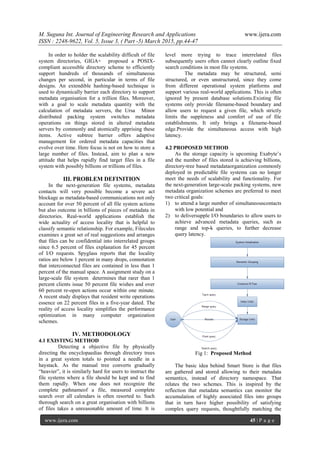
Fig 1: Proposed Method
The basic idea behind Smart Store is that files
are gathered and stored allowing to their metadata
semantics, instead of directory namespace. That
relates the two schemes. This is inspired by the
reflection that metadata semantics can monitor the
accumulation of highly associated files into groups
that in turn have higher possibility of satisfying
complex query requests, thoughtfully matching the
M. Suguna Int. Journal of Engineering Research and Applications www.ijera.com
ISSN : 2248-9622, Vol. 5, Issue 3, ( Part -5) March 2015, pp.44-47
www.ijera.com 46 | P a g e
access pattern of locality. Thus, query and other
relevant operations can be completed within one or a
small number of such groups, where one group may
include several storage nodes, other than linearly
searching via brute force on almost all storage nodes
in a directory namespace approach. On the other
hand, the semantic grouping can also improve system
scalability and avoid access bottlenecks and single-
point failures since it renders the metadata
association fully reorganized whereby most actions,
such as inclusion/omission and queries, can be
implemented within a given group.
4.3 MODULES DESCRIPTION
1. Node creation
2. Construction of r-tree
3. User query processing
4. Multi query service
4.3.1 NODE CREATION
Here the system contains the collection of
storage units and index units. In this module first
create the storage unit and index unit by giving the
detail information of node such as node name, node
ipaddress and node port no.
4.3.2 CONSTRUCTION OF R-TREE
A semantic R- involves of index units holding
location and planning data and storage units
containing file metadata, both of which are presented
on a collection of storage servers. One or more R-
trees may be used to represent the same set of
metadata to match query patterns effectively. Smart
Store supports complex queries, including range and
top-k queries, in addition to simple point query.
Smart Store that provides multiquery services for
users while organizes metadata to enhance system
performance by using decentralized semantic R-tree
structures.
Each metadata server is a leaf node in our
semantic R-tree and can also potentially hold
multiple nonleaf nodes of the R-tree. We refer to the
semantic R-tree leaf nodes as storage units and the
nonleaf nodes as index units.
4.3.3 USER QUERY PROCESSING
Smart Store supports flexible multi-query
services for users and these queries follow similar
query path. In general, users initially send a query
request to a casually chosen server that is also
signified as storage unit that is a leaf node of
semantic R-tree.
The selected storage unit, also called home unit
for the invitation, then recovers semantic R-tree
nodes by using an available multicast-based or off-
line pre-computation approach to locating a query
request to its correlated R-tree node. After obtaining
query results, the home unit returns them to users.
4.3.4 MULTI QUERY SERVICE
It supports complex queries, such as range and
top-k queries, within the context of ultra-large-scale
circulated file systems. More precisely, our Smart-
Store can care three query edges for point, range, and
top-k queries. Predictable query systems in small
scale file systems are regularly troubled with
filename-based queries that will soon be extracted
ineffective and hopeless in next-generation large-
scale circulated file systems.
The composite queries will attend as an vital
portal or browser, like the web or web browser for
Internet and city map for a tourist, for query services
in an ocean of records. First effort at providing
provision for complex queries right at the file
arrangement level.
V. CONCLUSION
The new namespace organization system, that
activities semantic connections among files to create
a flat, small, and correct semantic attentive
namespace for separate file. The file namespace is a
smooth construction without an inside hierarchy. For
a specified file, its namespace involve of a positive
number of the greatest closely associated files. Here
design an effective method to recognize semantic
connections among files by consuming a humble and
wild LSH-based lookup. For each lookup action,
SANE efficiently grants users’ files that power be of
benefits.Implementation of SANE as a middleware
that can path on highest of most present file
organizations, orthogonally to manual trees, to enable
file lookups. In addition, the semantic association
exactly recognized in SANE can be used to advance
some scheme functions, such as information
deduplication and file prefetching. SANE is a
respected tool for both system designers and
consumers.
REFERENCES
[1] D. Beaver, S. Kumar, H. Li, J. Sobel, and P.
Vajgel, “Finding a Needle in Haystack:
Facebooks Photo Storage,” Proc. Ninth
USENIX Conf. Operating Systems Design
andImplementation (OSDI), 2010.
[2] D.K. Gifford, P. Jouvelot, M.A. Sheldon,
and J.W.O. Jr, “Semantic File Systems,Proc.
Symp. Operating Systems Principle (SOSP),
1991.
[3] H. Huang, N. Zhang, W. Wang, G. Das, and
A. Szalay, “Just-In- Time Analytics on
Large File Systems,” Proc. Ninth USENIX
Conf. File and Storage
Technologies(FAST), 2011.
[4] I.D.C. (IDC), “2010 Digital Universe Study:
A Digital Universe Decade - Are You
Ready?”http://gigaom.files.wordpress.com/
2010/05/2010-digital-universe-iview.,2013.
M. Suguna Int. Journal of Engineering Research and Applications www.ijera.com
ISSN : 2248-9622, Vol. 5, Issue 3, ( Part -5) March 2015, pp.44-47
www.ijera.com 47 | P a g e
[5] I. Gorton, P. Greenfield, A. Szalay, and R.
Williams, “Data- Intensive Computing inthe
21st Century,” Computer, vol. 41, no. 4, pp.
30-32, 2008.
[6] K. Veeraraghavan, J. Flinn, E.B.
Nightingale, and B. Noble, “quFiles: The
Right Fileat the Right Time,” Proc. USENIX
Conf. File and Storage Technologies
(FAST), 2010.
[7] M. Seltzer and N. Murphy, “Hierarchical
File Systems are Dead,” Proc. 12th Conf.
HotTopics in Operating Systems (HotOS
’09), 2009.
[8] R. Daley and P. Neumann, “A General-
Purpose File System for Secondary
Storage,” Proc. Fall Joint Computer Conf.,
Part I, pp. 213- 229, 1965.
[9] S. Weil, S.A. Brandt, E.L. Miller, D.D.E.
Long, and C. Maltzahn, “Ceph: A Scalable,
High-Performance Distributed File System,”
Proc. Seventh Symp. Operating Systems
Design and Implementation (OSDI), 2006.
[10] Y. Hua, H. Jiang, Y. Zhu, D. Feng, and L.
Tian, “Smart Store: A New Metadata
Organization Paradigm with Semantic-
Awareness for Next-Generation File
Systems,” Proc. ACM/IEEE
Supercomputing Conf. (SC),

Dynamic Metadata Management in Semantic File Systems

  • 1.
    M. Suguna Int.Journal of Engineering Research and Applications www.ijera.com ISSN : 2248-9622, Vol. 5, Issue 3, ( Part -5) March 2015, pp.44-47 www.ijera.com 44 | P a g e Dynamic Metadata Management in Semantic File Systems M. Suguna1 , T. Anand2 1 P.G Student& A.V.C College of Engineering, Mayiladuthurai, Tamil Nadu. 2 Professor & A.V.C College of Engineering, Mayiladuthurai, Tamil Nadu. ABSTRACT The progression in data capacity and difficulty inflicts great challenges for file systems. To address these contests, an inventive namespace management scheme is in distracted need to deliver both the ease and competence of data access. For scalability, each server makes only local, autonomous decisions about relocation for load balancing. Associative access is provided by a traditional extension to present tree-structured file system conventions, and by protocols that are intended specifically for content based access.Rapid attribute- based accesstofile system contents is fulfilled by instinctive extraction and indexing of key properties of file system objects. The programmed indexing of files and calendars is called “semantic” because user programmable transducers use data about the semantics of efficient file system objects to extract the properties for indexing. Tentative results from a semantic file system execution support the thesis that semantic file systems present a more active storage abstraction than do traditional tree planned file systems for data sharing and command level programming. Semantic file system is executed as a middleware in predictable file systems and works orthogonally with categorized directory trees. The semantic relationships and file groups recognized in file systems can also be used to facilitate file prefetching among other system-level optimizations. All- encompassing trace-driven experiments on our sample implementation validate the efficiency and competence. Key Terms—File systems, mete data, namespace management , semantic awareness, storage systems I. INTRODUCTION Profligate and flexible metadata recovering is critical in the next cohort data storage systems. As the storage capacity is approaching Exabyte and the number of files stored is getting billions, directory- tree based metadata organization widely arranged in conventional file systems can no longer meet the requirements of scalability and functionality.Many systems are required to achieve hundreds of thousands of metadata actions per second and theperformance is strictly controlled by the categorized directory-tree based metadata organization system used in nearly all file systems today. File system namespace as an information- organizing infrastructure is important to system’s quality of service such as presentation, scalability, and comfort of use. Almost all recent file systems are based on categorized directory trees. A semantic file system delivers both a user line and an submission programming boundary to its associative access services. User boundaries based upon browsers have verified to be operative for query founded access to data, and we expect browsers to be presented by most semantic file system executions. Presentation programming lines that license remote access include dedicated protocols for information recovery, and remote technique call based boundaries. It is also potential to spread the services of a semantic file system without presenting any new boundaries. This can be skilled by covering the naming semantics of files and manuals to support associative access. A profit of this approach is that all present submissions, including user interfaces, instantly get the benefits of associative access. A semantic file system participates associative accees into a tree controlled file system through the concept of a simulated directory. Simulated directory names are construed as queries and thus deliver flexible associative access to files and directories in a custom well-matched with present software. II. RELATED WORK It is worth noting that the vital difference from current work is its even, rather than classified, namespace for data-intensive file systems. Semantic file system is one of the first file systems that spread the traditional file system orders by permitting users to search modified file attributes. SFS creates simulated directories based on demand. quFiles provides a simple and combined view of different copies of files that are enhanced for different contact settings, such as network bandwidth. It uses a new method that achievements semantic relationships among files to create a vigorous per-file namespace to speed up file lookups when full pathnames are not offered. This approach differs from SFS and quFiles in that we take into attention the semantic context obliquely and unambiguously signified in file metadata when allocation complex queries. RESEARCH ARTICLE OPEN ACCESS
  • 2.
    M. Suguna Int.Journal of Engineering Research and Applications www.ijera.com ISSN : 2248-9622, Vol. 5, Issue 3, ( Part -5) March 2015, pp.44-47 www.ijera.com 45 | P a g e In order to holder the scalability difficult of file system directories, GIGA+ proposed a POSIX- compliant accessible directory scheme to efficiently support hundreds of thousands of simultaneous changes per second, in particular in terms of file designs. An extendible hashing-based technique is used to dynamically barrier each directory to support metadata organisation for a trillion files. Moreover, with a goal to scale metadata quantity with the calculation of metadata servers, the Ursa Minor distributed packing system switches metadata operations on things stored in altered metadata servers by commonly and atomically apprising these items. Active subtree barrier offers adaptive management for ordered metadata capacities that evolve over time. Here focus is not on how to store a large number of files. Instead, aim to plan a new attitude that helps rapidly find target files in a file system with possibly billions or trillions of files. III. PROBLEM DEFINITION In the next-generation file systems, metadata contacts will very possible become a severe act blockage as metadata-based communications not only account for over 50 percent of all file system actions but also outcome in billions of pieces of metadata in directories. Real-world applications establish the wide actuality of access locality that is helpful to classify semantic relationship. For example, Filecules examines a great set of real suggestions and arranges that files can be confidential into interrelated groups since 6.5 percent of files explanation for 45 percent of I/O requests. Spyglass reports that the locality ratios are below 1 percent in many drops, connotation that interconnected files are contained in less than 1 percent of the manual space. A assignment study on a large-scale file system determines that rarer than 1 percent clients issue 50 percent file wishes and over 60 percent re-open actions occur within one minute. A recent study displays that resident write operations essence on 22 percent files in a five-year dated. The reality of access locality simplifies the performance optimization in many computer organization schemes. IV. METHODOLOGY 4.1 EXISTING METHOD Detecting a objective file by physically directing the encyclopaedias through directory trees in a great system totals to pointed a needle in a haystack. As the manual tree converts gradually “heavier”, it is similarly hard for users to instruct the file systems where a file should be kept and to find them rapidly. When one does not recognize the complete pathnameof a file, measured complete search over all calendars is often resorted to. Such thorough search on a great organisation with billions of files takes a unreasonable amount of time. It is level more trying to trace interrelated files subsequently users often cannot clearly outline fixed search conditions in most file systems. The metadata may be structured, semi structured, or even unstructured, since they come from different operational system platforms and support various real-world applications. This is often ignored by present database solutions.Existing file systems only provide filename-based boundary and allow users to request a given file, which strictly limits the suppleness and comfort of use of file establishments. It only brings a filename-based edge.Provide the simultaneous access with high latency. 4.2 PROPOSED METHOD As the storage capacity is upcoming Exabyte’s and the number of files stored is achieving billions, directory-tree based metadataorganization commonly deployed in predictable file systems can no longer meet the needs of scalability and functionality. For the next-generation large-scale packing systems, new metadata organization schemes are preferred to meet two critical goals: 1) to attend a large number of simultaneouscontacts with low potential and 2) to deliversupple I/O boundaries to allow users to achieve advanced metadata queries, such as range and top-k queries, to further decrease query latency. Fig 1: Proposed Method The basic idea behind Smart Store is that files are gathered and stored allowing to their metadata semantics, instead of directory namespace. That relates the two schemes. This is inspired by the reflection that metadata semantics can monitor the accumulation of highly associated files into groups that in turn have higher possibility of satisfying complex query requests, thoughtfully matching the
  • 3.
    M. Suguna Int.Journal of Engineering Research and Applications www.ijera.com ISSN : 2248-9622, Vol. 5, Issue 3, ( Part -5) March 2015, pp.44-47 www.ijera.com 46 | P a g e access pattern of locality. Thus, query and other relevant operations can be completed within one or a small number of such groups, where one group may include several storage nodes, other than linearly searching via brute force on almost all storage nodes in a directory namespace approach. On the other hand, the semantic grouping can also improve system scalability and avoid access bottlenecks and single- point failures since it renders the metadata association fully reorganized whereby most actions, such as inclusion/omission and queries, can be implemented within a given group. 4.3 MODULES DESCRIPTION 1. Node creation 2. Construction of r-tree 3. User query processing 4. Multi query service 4.3.1 NODE CREATION Here the system contains the collection of storage units and index units. In this module first create the storage unit and index unit by giving the detail information of node such as node name, node ipaddress and node port no. 4.3.2 CONSTRUCTION OF R-TREE A semantic R- involves of index units holding location and planning data and storage units containing file metadata, both of which are presented on a collection of storage servers. One or more R- trees may be used to represent the same set of metadata to match query patterns effectively. Smart Store supports complex queries, including range and top-k queries, in addition to simple point query. Smart Store that provides multiquery services for users while organizes metadata to enhance system performance by using decentralized semantic R-tree structures. Each metadata server is a leaf node in our semantic R-tree and can also potentially hold multiple nonleaf nodes of the R-tree. We refer to the semantic R-tree leaf nodes as storage units and the nonleaf nodes as index units. 4.3.3 USER QUERY PROCESSING Smart Store supports flexible multi-query services for users and these queries follow similar query path. In general, users initially send a query request to a casually chosen server that is also signified as storage unit that is a leaf node of semantic R-tree. The selected storage unit, also called home unit for the invitation, then recovers semantic R-tree nodes by using an available multicast-based or off- line pre-computation approach to locating a query request to its correlated R-tree node. After obtaining query results, the home unit returns them to users. 4.3.4 MULTI QUERY SERVICE It supports complex queries, such as range and top-k queries, within the context of ultra-large-scale circulated file systems. More precisely, our Smart- Store can care three query edges for point, range, and top-k queries. Predictable query systems in small scale file systems are regularly troubled with filename-based queries that will soon be extracted ineffective and hopeless in next-generation large- scale circulated file systems. The composite queries will attend as an vital portal or browser, like the web or web browser for Internet and city map for a tourist, for query services in an ocean of records. First effort at providing provision for complex queries right at the file arrangement level. V. CONCLUSION The new namespace organization system, that activities semantic connections among files to create a flat, small, and correct semantic attentive namespace for separate file. The file namespace is a smooth construction without an inside hierarchy. For a specified file, its namespace involve of a positive number of the greatest closely associated files. Here design an effective method to recognize semantic connections among files by consuming a humble and wild LSH-based lookup. For each lookup action, SANE efficiently grants users’ files that power be of benefits.Implementation of SANE as a middleware that can path on highest of most present file organizations, orthogonally to manual trees, to enable file lookups. In addition, the semantic association exactly recognized in SANE can be used to advance some scheme functions, such as information deduplication and file prefetching. SANE is a respected tool for both system designers and consumers. REFERENCES [1] D. Beaver, S. Kumar, H. Li, J. Sobel, and P. Vajgel, “Finding a Needle in Haystack: Facebooks Photo Storage,” Proc. Ninth USENIX Conf. Operating Systems Design andImplementation (OSDI), 2010. [2] D.K. Gifford, P. Jouvelot, M.A. Sheldon, and J.W.O. Jr, “Semantic File Systems,Proc. Symp. Operating Systems Principle (SOSP), 1991. [3] H. Huang, N. Zhang, W. Wang, G. Das, and A. Szalay, “Just-In- Time Analytics on Large File Systems,” Proc. Ninth USENIX Conf. File and Storage Technologies(FAST), 2011. [4] I.D.C. (IDC), “2010 Digital Universe Study: A Digital Universe Decade - Are You Ready?”http://gigaom.files.wordpress.com/ 2010/05/2010-digital-universe-iview.,2013.
  • 4.
    M. Suguna Int.Journal of Engineering Research and Applications www.ijera.com ISSN : 2248-9622, Vol. 5, Issue 3, ( Part -5) March 2015, pp.44-47 www.ijera.com 47 | P a g e [5] I. Gorton, P. Greenfield, A. Szalay, and R. Williams, “Data- Intensive Computing inthe 21st Century,” Computer, vol. 41, no. 4, pp. 30-32, 2008. [6] K. Veeraraghavan, J. Flinn, E.B. Nightingale, and B. Noble, “quFiles: The Right Fileat the Right Time,” Proc. USENIX Conf. File and Storage Technologies (FAST), 2010. [7] M. Seltzer and N. Murphy, “Hierarchical File Systems are Dead,” Proc. 12th Conf. HotTopics in Operating Systems (HotOS ’09), 2009. [8] R. Daley and P. Neumann, “A General- Purpose File System for Secondary Storage,” Proc. Fall Joint Computer Conf., Part I, pp. 213- 229, 1965. [9] S. Weil, S.A. Brandt, E.L. Miller, D.D.E. Long, and C. Maltzahn, “Ceph: A Scalable, High-Performance Distributed File System,” Proc. Seventh Symp. Operating Systems Design and Implementation (OSDI), 2006. [10] Y. Hua, H. Jiang, Y. Zhu, D. Feng, and L. Tian, “Smart Store: A New Metadata Organization Paradigm with Semantic- Awareness for Next-Generation File Systems,” Proc. ACM/IEEE Supercomputing Conf. (SC),