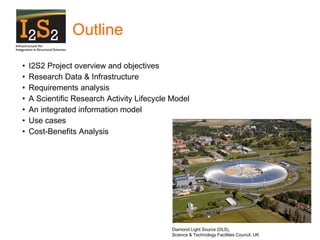
Outline I2S2 Project overview and objectives Research Data & Infrastructure Requirements analysis A Scientific Research Activity Lifecycle Model An integrated information model Use cases Cost-Benefits Analysis Diamond Light Source (DLS), Science & Technology Facilities Council, UK
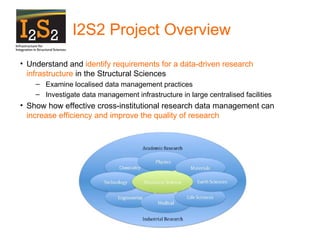
I2S2 Project Overview Understand and  identify requirements for a data-driven research infrastructure  in the Structural Sciences  Examine localised data management practices Investigate data management infrastructure in large centralised facilities Show how effective cross-institutional research data management can  increase efficiency and improve the quality of research
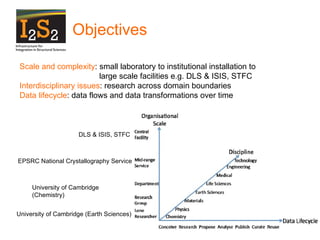
Objectives Scale and complexity : small laboratory to institutional installation to   large scale facilities e.g. DLS & ISIS, STFC Interdisciplinary issues : research across domain boundaries Data lifecycle : data flows and data transformations over time University of Cambridge (Earth Sciences) DLS & ISIS, STFC EPSRC National Crystallography Service University of Cambridge (Chemistry)
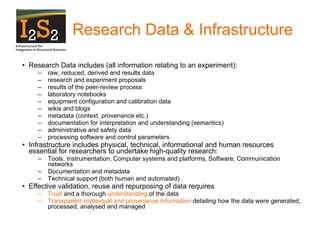
Research Data & Infrastructure Research Data includes (all information relating to an experiment): raw, reduced, derived and results data  research and experiment proposals results of the peer-review process laboratory notebooks equipment configuration and calibration data wikis and blogs  metadata (context, provenance etc.) documentation for interpretation and understanding (semantics) administrative and safety data  processing software and control parameters Infrastructure includes   physical, technical, informational and human resources essential for researchers to undertake high-quality research: Tools, Instrumentation, Computer systems and platforms, Software, Communication networks Documentation and metadata Technical support (both human and automated) Effective validation, reuse and repurposing of data requires  Trust  and a thorough  understanding  of the data  Transparent contextual and provenance information  detailing how the data were generated, processed, analysed and managed
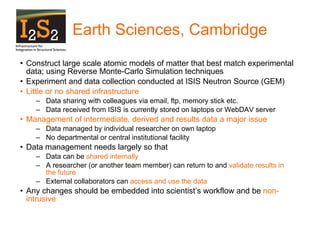
Earth Sciences, Cambridge Construct large scale atomic models of matter that best match experimental data; using Reverse Monte-Carlo Simulation techniques Experiment and data collection conducted at ISIS Neutron Source (GEM)  Little or   no shared infrastructure Data sharing with colleagues via email, ftp, memory stick etc. Data received from ISIS is currently stored on laptops or WebDAV server Management of intermediate, derived and results data a major issue Data managed by individual researcher on own laptop No departmental or central institutional facility  Data management needs largely so that Data can be  shared internally  A researcher (or another team member) can return to and  validate results in the future  External collaborators can  access and use the data Any changes should be embedded into scientist’s workflow and be  non-intrusive
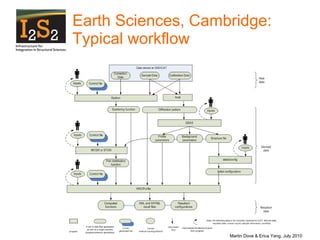
Earth Sciences, Cambridge: Typical workflow Martin Dove & Erica Yang, July 2010
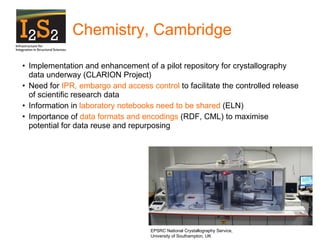
Chemistry, Cambridge Implementation and enhancement of a pilot repository for crystallography data underway (CLARION Project)  Need for  IPR, embargo and access control  to facilitate the controlled release of scientific research data  Information in  laboratory notebooks need to be shared  (ELN) Importance of  data formats and encodings  (RDF, CML) to maximise potential for data reuse and repurposing  EPSRC National Crystallography Service, University of Southampton, UK
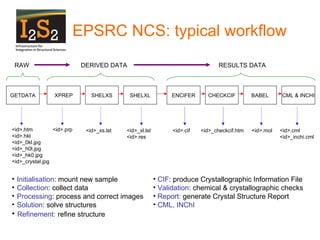
EPSRC NCS, Southampton Service provision function  (operates nationally across institutions) Local x-ray diffraction instruments + use of DLS (beamline I19) Retain experiment data Maintain administrative data Raw data generated in-house is stored at ATLAS Data Store (STFC) Local  institutional repository (eCrystals) for intermediate, derived and results data Metadata application profile Public and private parts (embargo system) Digital Object Identifier, InChi  Experiments conducted and data collected by NCS scientists either in-house or at DLS  Labour-intensive paper-based administration and records-keeping   Paper-based system for scheduling experiments Paper copies of Experiment Risk Assessment (ERA) get annotated by scientist and photocopied several times Several  identifiers  per sample  Administrative functions require streamlining between NCS and DLS e.g. standardisation of ERA forms, identifiers
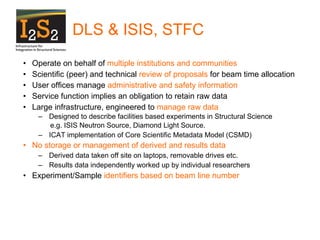
Initialisation : mount new sample Collection : collect data Processing : process and correct images Solution : solve structures Refinement:   refine structure CIF : produce Crystallographic Information File Validation : chemical & crystallographic checks Report:  generate Crystal Structure Report CML, INChI EPSRC NCS: typical workflow GETDATA XPREP SHELXS SHELXL ENCIFER CHECKCIF BABEL CML & INCHI RAW DERIVED DATA RESULTS DATA <id>.htm <id>.hkl <id>_0kl.jpg <id>_h0l.jpg <id>_hk0.jpg <id>_crystal.jpg <id>.prp <id>_xs.lst <id>_xl.lst <id>.res <id>.cif <id>_checkcif.htm <id>.mol <id>.cml <id>_inchi.cml
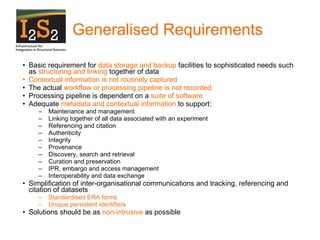
DLS & ISIS, STFC Operate on behalf of  multiple institutions and communities Scientific (peer) and technical  review of proposals  for beam time allocation User offices manage  administrative and safety information Service function implies an obligation to retain raw data  Large infrastructure, engineered to  manage raw data Designed to describe facilities based experiments in Structural Science  e.g. ISIS Neutron Source, Diamond Light Source. ICAT implementation of Core Scientific Metadata Model (CSMD) No storage or management of derived and results data   Derived data taken off site on laptops, removable drives etc. Results data independently worked up by individual researchers Experiment/Sample  identifiers based on beam line number
Generalised Requirements Basic requirement for  data storage and backup  facilities to sophisticated needs such as  structuring and linking  together of data Contextual information is not routinely captured   The actual  workflow or processing pipeline is not recorded Processing pipeline is dependent on a  suite of software Adequate  metadata and contextual information  to support: Maintenance and management Linking together of all data associated with an experiment  Referencing and citation Authenticity Integrity Provenance Discovery, search and retrieval Curation and preservation IPR, embargo and access management Interoperability and data exchange Simplification of inter-organisational communications and tracking, referencing and citation of datasets  Standardised ERA forms  Unique persistent identifiers   Solutions should be as  non-intrusive  as possible
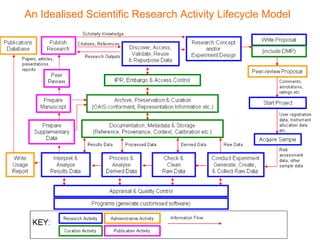
An Idealised Scientific Research Activity Lifecycle Model
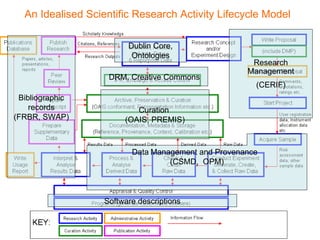
An Idealised Scientific Research Activity Lifecycle Model Research Management (CERIF) Data   Management and Provenance  (CSMD,  OPM) Software descriptions Bibliographic records (FRBR, SWAP) Curation  (OAIS, PREMIS) Dublin Core, Ontologies DRM, Creative Commons
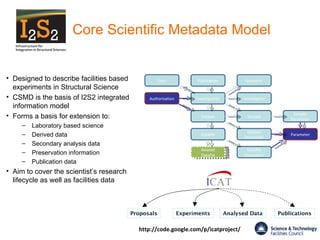
Core Scientific Metadata Model http://code.google.com/p/icatproject/ Proposals Experiments Analysed Data Publications Designed to describe facilities based experiments in Structural Science CSMD is the basis of I2S2 integrated information model Forms a basis for extension to: Laboratory based science Derived data Secondary analysis data Preservation information Publication data Aim to cover the scientist’s research lifecycle as well as facilities data Investigation Publication Keyword Topic Sample Sample Parameter Dataset Dataset Parameter Datafile Datafile Parameter Investigator Related Datafile Parameter Authorisation
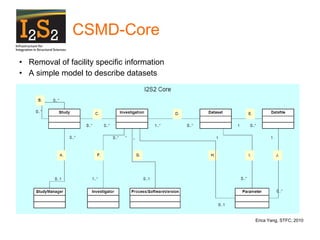
CSMD-Core Removal of facility specific information A simple model to describe datasets Erica Yang, STFC, 2010
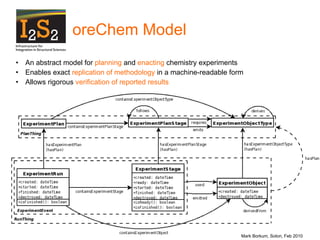
oreChem Model An abstract model for  planning  and  enacting  chemistry experiments Enables exact  replication of methodology  in a machine-readable form Allows rigorous  verification of reported results   Mark Borkum, Soton, Feb 2010
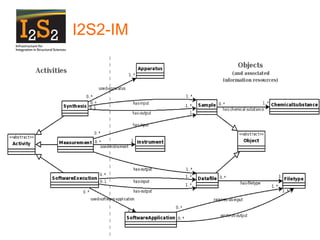
I2S2 Integrated Information Model I2S2-IM = CSMD-Core + oreChem Model Use oreChem to describe  planning and enactment  of scientific process Use CSMD to  describe the data-sets  from the experiment I2S2-IM being implemented at STFC in the form of  ICAT-Lite A personal workbench for managing data flows Allows the user to commit data  Enables capture of provenance information
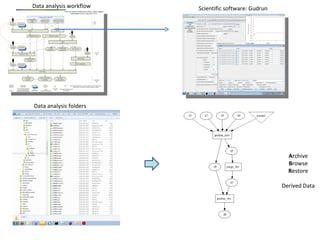
Data analysis workflow Data analysis folders A rchive B rowse R estore Derived Data Scientific software: Gudrun
I2S2-IM
Testing the I2S2-IM Case study 1: Scale and Complexity Data management issues  spanning organisational boundaries  in Chemistry Interactions between a lone worker or research group, the EPSRC NCS and DLS  Traversing  administrative boundaries  between institutions and experiment service facilities  Aim to probe both  cross-institutional and scale  issues Case Study 2: Inter-disciplinary issues Collaborative group of inter-disciplinary scientists (university and central facility researchers) from both Chemistry and Earth Sciences Use of ISIS neutron facility and subsequent modelling of structures based on raw data  Identification of  infrastructural components and workflow modelling Aim to explore the  role of XML for data representation  to support easier sharing of information content of derived data
Cost-Benefits Analysis A  before and after cost-benefit analysis  using the Keeping Research Data Safe model Extending the KRDS Model Focus has been on extensions and elaboration of activities in the research (KRDS “pre-Archive”) phase Metrics and assigning costs Identification of activities in research activity lifecycle model that will represent significant cost savings or benefits Work to identify non-cost benefits and possible metrics 2 use case studies Quantitative -cost-benefits in terms of service efficiencies (NCS) Qualitative -researcher benefits (improvement in tools; ease of making data accessible)
Conclusions Considerable variation in requirements between  differing scales of science At present individual researcher, group, department, institution, facilities all  working within their own frameworks Merit in adopting an  integrated approach  which caters for all scales of science: Aggregation and/or cross-searching of related datasets Efficient exchange, reuse and repurposing of data across disciplinary boundaries Data mining to identify patterns or trends I2S2 Integrated information model aims to: Support the scientific research activity lifecycle model Capture processes and provenance information Interoperate with and complement existing models and frameworks Before and after cost-benefits analysis to assess impact
Project Team Liz Lyon (UKOLN, University of Bath & Digital Curation Centre) Manjula Patel (UKOLN, University of Bath & Digital Curation Centre) Simon Coles (EPSRC National Crystallography Centre, University of Southampton)  Brian Matthews (Science & Technology Facilities Council) Erica Yang (Science & Technology Facilities Council) Martin Dove (Earth Sciences, University of Cambridge) Peter Murray-Rust (Chemistry, University of Cambridge) Neil Beagrie (Charles Beagrie Ltd.) [email_address] http://www.ukoln.ac.uk/projects/I2S2/

Integrated research data management in the Structural Sciences

  • 1.
  • 2.
    Outline I2S2 Projectoverview and objectives Research Data & Infrastructure Requirements analysis A Scientific Research Activity Lifecycle Model An integrated information model Use cases Cost-Benefits Analysis Diamond Light Source (DLS), Science & Technology Facilities Council, UK
  • 3.
    I2S2 Project OverviewUnderstand and identify requirements for a data-driven research infrastructure in the Structural Sciences Examine localised data management practices Investigate data management infrastructure in large centralised facilities Show how effective cross-institutional research data management can increase efficiency and improve the quality of research
  • 4.
    Objectives Scale andcomplexity : small laboratory to institutional installation to large scale facilities e.g. DLS & ISIS, STFC Interdisciplinary issues : research across domain boundaries Data lifecycle : data flows and data transformations over time University of Cambridge (Earth Sciences) DLS & ISIS, STFC EPSRC National Crystallography Service University of Cambridge (Chemistry)
  • 5.
    Research Data &Infrastructure Research Data includes (all information relating to an experiment): raw, reduced, derived and results data research and experiment proposals results of the peer-review process laboratory notebooks equipment configuration and calibration data wikis and blogs metadata (context, provenance etc.) documentation for interpretation and understanding (semantics) administrative and safety data processing software and control parameters Infrastructure includes physical, technical, informational and human resources essential for researchers to undertake high-quality research: Tools, Instrumentation, Computer systems and platforms, Software, Communication networks Documentation and metadata Technical support (both human and automated) Effective validation, reuse and repurposing of data requires Trust and a thorough understanding of the data Transparent contextual and provenance information detailing how the data were generated, processed, analysed and managed
  • 6.
    Earth Sciences, CambridgeConstruct large scale atomic models of matter that best match experimental data; using Reverse Monte-Carlo Simulation techniques Experiment and data collection conducted at ISIS Neutron Source (GEM) Little or no shared infrastructure Data sharing with colleagues via email, ftp, memory stick etc. Data received from ISIS is currently stored on laptops or WebDAV server Management of intermediate, derived and results data a major issue Data managed by individual researcher on own laptop No departmental or central institutional facility Data management needs largely so that Data can be shared internally A researcher (or another team member) can return to and validate results in the future External collaborators can access and use the data Any changes should be embedded into scientist’s workflow and be non-intrusive
  • 7.
    Earth Sciences, Cambridge:Typical workflow Martin Dove & Erica Yang, July 2010
  • 8.
    Chemistry, Cambridge Implementationand enhancement of a pilot repository for crystallography data underway (CLARION Project) Need for IPR, embargo and access control to facilitate the controlled release of scientific research data Information in laboratory notebooks need to be shared (ELN) Importance of data formats and encodings (RDF, CML) to maximise potential for data reuse and repurposing EPSRC National Crystallography Service, University of Southampton, UK
  • 9.
    EPSRC NCS, SouthamptonService provision function (operates nationally across institutions) Local x-ray diffraction instruments + use of DLS (beamline I19) Retain experiment data Maintain administrative data Raw data generated in-house is stored at ATLAS Data Store (STFC) Local institutional repository (eCrystals) for intermediate, derived and results data Metadata application profile Public and private parts (embargo system) Digital Object Identifier, InChi Experiments conducted and data collected by NCS scientists either in-house or at DLS Labour-intensive paper-based administration and records-keeping Paper-based system for scheduling experiments Paper copies of Experiment Risk Assessment (ERA) get annotated by scientist and photocopied several times Several identifiers per sample Administrative functions require streamlining between NCS and DLS e.g. standardisation of ERA forms, identifiers
  • 10.
    Initialisation : mountnew sample Collection : collect data Processing : process and correct images Solution : solve structures Refinement: refine structure CIF : produce Crystallographic Information File Validation : chemical & crystallographic checks Report: generate Crystal Structure Report CML, INChI EPSRC NCS: typical workflow GETDATA XPREP SHELXS SHELXL ENCIFER CHECKCIF BABEL CML & INCHI RAW DERIVED DATA RESULTS DATA <id>.htm <id>.hkl <id>_0kl.jpg <id>_h0l.jpg <id>_hk0.jpg <id>_crystal.jpg <id>.prp <id>_xs.lst <id>_xl.lst <id>.res <id>.cif <id>_checkcif.htm <id>.mol <id>.cml <id>_inchi.cml
  • 11.
    DLS & ISIS,STFC Operate on behalf of multiple institutions and communities Scientific (peer) and technical review of proposals for beam time allocation User offices manage administrative and safety information Service function implies an obligation to retain raw data Large infrastructure, engineered to manage raw data Designed to describe facilities based experiments in Structural Science e.g. ISIS Neutron Source, Diamond Light Source. ICAT implementation of Core Scientific Metadata Model (CSMD) No storage or management of derived and results data Derived data taken off site on laptops, removable drives etc. Results data independently worked up by individual researchers Experiment/Sample identifiers based on beam line number
  • 12.
    Generalised Requirements Basicrequirement for data storage and backup facilities to sophisticated needs such as structuring and linking together of data Contextual information is not routinely captured The actual workflow or processing pipeline is not recorded Processing pipeline is dependent on a suite of software Adequate metadata and contextual information to support: Maintenance and management Linking together of all data associated with an experiment Referencing and citation Authenticity Integrity Provenance Discovery, search and retrieval Curation and preservation IPR, embargo and access management Interoperability and data exchange Simplification of inter-organisational communications and tracking, referencing and citation of datasets Standardised ERA forms Unique persistent identifiers Solutions should be as non-intrusive as possible
  • 13.
    An Idealised ScientificResearch Activity Lifecycle Model
  • 14.
    An Idealised ScientificResearch Activity Lifecycle Model Research Management (CERIF) Data Management and Provenance (CSMD, OPM) Software descriptions Bibliographic records (FRBR, SWAP) Curation (OAIS, PREMIS) Dublin Core, Ontologies DRM, Creative Commons
  • 15.
    Core Scientific MetadataModel http://code.google.com/p/icatproject/ Proposals Experiments Analysed Data Publications Designed to describe facilities based experiments in Structural Science CSMD is the basis of I2S2 integrated information model Forms a basis for extension to: Laboratory based science Derived data Secondary analysis data Preservation information Publication data Aim to cover the scientist’s research lifecycle as well as facilities data Investigation Publication Keyword Topic Sample Sample Parameter Dataset Dataset Parameter Datafile Datafile Parameter Investigator Related Datafile Parameter Authorisation
  • 16.
    CSMD-Core Removal offacility specific information A simple model to describe datasets Erica Yang, STFC, 2010
  • 17.
    oreChem Model Anabstract model for planning and enacting chemistry experiments Enables exact replication of methodology in a machine-readable form Allows rigorous verification of reported results Mark Borkum, Soton, Feb 2010
  • 18.
    I2S2 Integrated InformationModel I2S2-IM = CSMD-Core + oreChem Model Use oreChem to describe planning and enactment of scientific process Use CSMD to describe the data-sets from the experiment I2S2-IM being implemented at STFC in the form of ICAT-Lite A personal workbench for managing data flows Allows the user to commit data Enables capture of provenance information
  • 19.
    Data analysis workflowData analysis folders A rchive B rowse R estore Derived Data Scientific software: Gudrun
  • 20.
  • 21.
    Testing the I2S2-IMCase study 1: Scale and Complexity Data management issues spanning organisational boundaries in Chemistry Interactions between a lone worker or research group, the EPSRC NCS and DLS Traversing administrative boundaries between institutions and experiment service facilities Aim to probe both cross-institutional and scale issues Case Study 2: Inter-disciplinary issues Collaborative group of inter-disciplinary scientists (university and central facility researchers) from both Chemistry and Earth Sciences Use of ISIS neutron facility and subsequent modelling of structures based on raw data Identification of infrastructural components and workflow modelling Aim to explore the role of XML for data representation to support easier sharing of information content of derived data
  • 22.
    Cost-Benefits Analysis A before and after cost-benefit analysis using the Keeping Research Data Safe model Extending the KRDS Model Focus has been on extensions and elaboration of activities in the research (KRDS “pre-Archive”) phase Metrics and assigning costs Identification of activities in research activity lifecycle model that will represent significant cost savings or benefits Work to identify non-cost benefits and possible metrics 2 use case studies Quantitative -cost-benefits in terms of service efficiencies (NCS) Qualitative -researcher benefits (improvement in tools; ease of making data accessible)
  • 23.
    Conclusions Considerable variationin requirements between differing scales of science At present individual researcher, group, department, institution, facilities all working within their own frameworks Merit in adopting an integrated approach which caters for all scales of science: Aggregation and/or cross-searching of related datasets Efficient exchange, reuse and repurposing of data across disciplinary boundaries Data mining to identify patterns or trends I2S2 Integrated information model aims to: Support the scientific research activity lifecycle model Capture processes and provenance information Interoperate with and complement existing models and frameworks Before and after cost-benefits analysis to assess impact
  • 24.
    Project Team LizLyon (UKOLN, University of Bath & Digital Curation Centre) Manjula Patel (UKOLN, University of Bath & Digital Curation Centre) Simon Coles (EPSRC National Crystallography Centre, University of Southampton) Brian Matthews (Science & Technology Facilities Council) Erica Yang (Science & Technology Facilities Council) Martin Dove (Earth Sciences, University of Cambridge) Peter Murray-Rust (Chemistry, University of Cambridge) Neil Beagrie (Charles Beagrie Ltd.) [email_address] http://www.ukoln.ac.uk/projects/I2S2/

Editor's Notes

  • #13 Non-intrusive soln, so researchers can concentrate on research Try not to Demand users to change their established practice Change their programs Change deployment platform Change their programs’ interface Change how their programs interact with their data Try to Adapt to their existing practice Allow them to use their favourites (program, language, platform, OS, format, file system, …) Make their life easier Ask them to do as little as possible
  • #16 Could drop this slide if too many.
  • #20 Software study: two fortran programs, one Java gui Understanding the data: correction data, sample data, calibration data Learn about the software from the scientists