How is ITV branded? By Li, Kayleigh and Emily
Branding: Manages relationship between consumers and producers.  Helps viewer choose. Promotes loyalty. http://www.itvmedia.co.uk/ This website allows us to see ITV’s programmes, the target audience and who would be interested on advertising on the channel at that time.
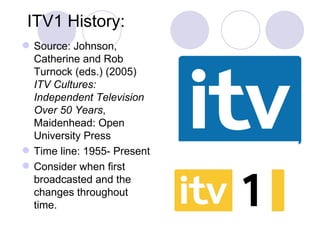
ITV1 History: Source: Johnson, Catherine and Rob Turnock (eds.) (2005)  ITV Cultures: Independent Television Over 50 Years , Maidenhead: Open University Press Time line: 1955- Present Consider when first broadcasted and the changes throughout time.
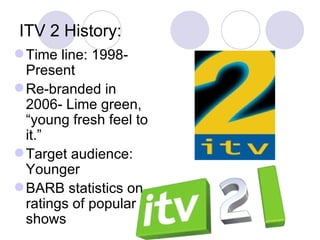
ITV 2 History: Time line: 1998- Present Re-branded in 2006- Lime green, “young fresh feel to it.” Target audience: Younger BARB statistics on ratings of popular shows
Public Service Broadcasting: How does ITV conform to PSB? The range of programmes they provide: From children’s television, news, documentaries, drama’s, soaps, reality and trash TV. Scannell, Paddy. (1989) ‘Public Service Broadcasting and Modern Public Life’ in  Media Culture and Society , Vol. 11 No. 2, pp 135- 166
Flow (Raymond Williams): A process that leads us from programme to programme. Depends upon scheduling and traditional times that certain programmes are expected to be on. Look into relationship with advertising and idents. Establish the relationship between institutions, technologies and cultural forms and practices.
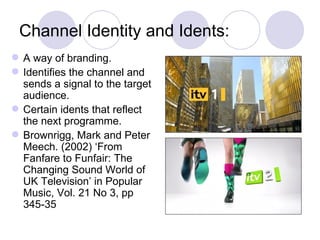
Channel Identity and Idents: A way of branding. Identifies the channel and sends a signal to the target audience. Certain idents that reflect the next programme. Brownrigg, Mark and Peter Meech. (2002) ‘From Fanfare to Funfair: The Changing Sound World of UK Television’ in Popular Music, Vol. 21 No 3, pp 345-35
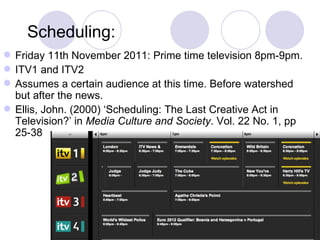
Scheduling: Friday 11th November 2011: Prime time television 8pm-9pm. ITV1 and ITV2 Assumes a certain audience at this time. Before watershed but after the news.  Ellis, John. (2000) ‘Scheduling: The Last Creative Act in Television?’ in  Media Culture and Society . Vol. 22 No. 1, pp 25-38
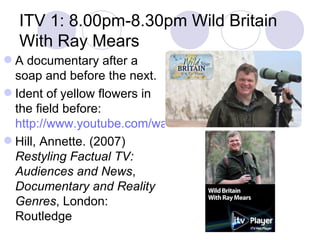
ITV 1: 8.00pm-8.30pm Wild Britain With Ray Mears A documentary after a soap and before the next. Ident of yellow flowers in the field before:  http://www.youtube.com/watch?v=eeSEwdnumQg Hill, Annette. (2007)  Restyling Factual TV: Audiences and News ,  Documentary and Reality Genres , London: Routledge
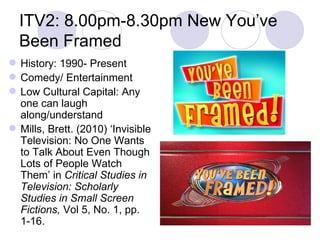
ITV2: 8.00pm-8.30pm New You’ve Been Framed History: 1990- Present Comedy/ Entertainment  Low Cultural Capital: Any one can laugh along/understand Mills, Brett. (2010) ‘Invisible Television: No One Wants to Talk About Even Though Lots of People Watch Them’ in  Critical Studies in Television: Scholarly Studies in Small Screen Fictions,  Vol 5, No. 1, pp. 1-16.
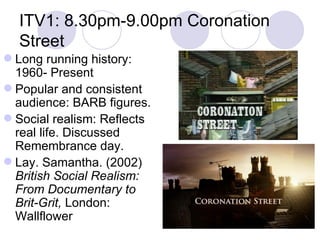
ITV1: 8.30pm-9.00pm Coronation Street Long running history: 1960- Present Popular and consistent audience: BARB figures. Social realism: Reflects real life. Discussed Remembrance day. Lay. Samantha. (2002)  British Social Realism: From Documentary to Brit-Grit,  London: Wallflower
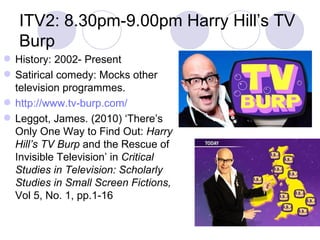
ITV2: 8.30pm-9.00pm Harry Hill’s TV Burp History: 2002- Present Satirical comedy: Mocks other television programmes. http://www. tv-burp . com/ Leggot, James. (2010) ‘There’s Only One Way to Find Out:  Harry Hill’s TV Burp  and the Rescue of Invisible Television’ in  Critical Studies in Television: Scholarly Studies in Small Screen Fictions,  Vol 5, No. 1, pp.1-16
OFCOM and Censorship Communications Act 2003: Ofcom should ‘further the interests of citizens and of consumers’. From a passive audience to an active audience. How much is censored to protect from obscenity? Watershed programmes. What has been complained about to Ofcom?
Further Questions How far is the ITV brand recognizable by its programming alone? How far is advertising associated with television brands? What would be the differences if we were to look at the two channels earlier/later in the day? What attracts audiences to a TV brand over another? How do specific television genres influence the idents used?
Bibliography Brownrigg, Mark and Peter Meech. (2002) ‘From Fanfare to Funfair: The Changing Sound World of UK Television’ in Popular Music, Vol. 21 No 3, pp 345-35 Ellis, John. (2000) ‘Scheduling: The Last Creative Act in Television?’ in  Media Culture and Society . Vol. 22 No. 1, pp 25-38 Hill, Annette. (2007)  Restyling Factual TV: Audiences and News ,  Documentary and Reality Genres , London: Routledge Johnson, Catherine and Rob Turnock (eds.) (2005)  ITV Cultures: Independent Television Over 50 Years , Maidenhead: Open University Press
Bibliography Continued… Lay. Samantha. (2002)  British Social Realism: From Documentary to Brit-Grit,  London: Wallflower  Leggot, James. (2010) ‘There’s Only One Way to Find Out:  Harry Hill’s TV Burp  and the Rescue of Invisible Television’ in  Critical Studies in Television: Scholarly Studies in Small Screen Fictions,  Vol 5, No. 1, pp.1-16 Mills, Brett. (2010) ‘Invisible Television: No One Wants to Talk About Even Though Lots of People Watch Them’ in  Critical Studies in Television: Scholarly Studies in Small Screen Fictions,  Vol 5, No. 1, pp. 1-16. Scannell, Paddy. (1989) ‘Public Service Broadcasting and Modern Public Life’ in  Media Culture and Society , Vol. 11 No. 2, pp 135- 166

Itv presentation

  • 1.
    How is ITVbranded? By Li, Kayleigh and Emily
  • 2.
    Branding: Manages relationshipbetween consumers and producers. Helps viewer choose. Promotes loyalty. http://www.itvmedia.co.uk/ This website allows us to see ITV’s programmes, the target audience and who would be interested on advertising on the channel at that time.
  • 3.
    ITV1 History: Source:Johnson, Catherine and Rob Turnock (eds.) (2005) ITV Cultures: Independent Television Over 50 Years , Maidenhead: Open University Press Time line: 1955- Present Consider when first broadcasted and the changes throughout time.
  • 4.
    ITV 2 History:Time line: 1998- Present Re-branded in 2006- Lime green, “young fresh feel to it.” Target audience: Younger BARB statistics on ratings of popular shows
  • 5.
    Public Service Broadcasting:How does ITV conform to PSB? The range of programmes they provide: From children’s television, news, documentaries, drama’s, soaps, reality and trash TV. Scannell, Paddy. (1989) ‘Public Service Broadcasting and Modern Public Life’ in Media Culture and Society , Vol. 11 No. 2, pp 135- 166
  • 6.
    Flow (Raymond Williams):A process that leads us from programme to programme. Depends upon scheduling and traditional times that certain programmes are expected to be on. Look into relationship with advertising and idents. Establish the relationship between institutions, technologies and cultural forms and practices.
  • 7.
    Channel Identity andIdents: A way of branding. Identifies the channel and sends a signal to the target audience. Certain idents that reflect the next programme. Brownrigg, Mark and Peter Meech. (2002) ‘From Fanfare to Funfair: The Changing Sound World of UK Television’ in Popular Music, Vol. 21 No 3, pp 345-35
  • 8.
    Scheduling: Friday 11thNovember 2011: Prime time television 8pm-9pm. ITV1 and ITV2 Assumes a certain audience at this time. Before watershed but after the news. Ellis, John. (2000) ‘Scheduling: The Last Creative Act in Television?’ in Media Culture and Society . Vol. 22 No. 1, pp 25-38
  • 9.
    ITV 1: 8.00pm-8.30pmWild Britain With Ray Mears A documentary after a soap and before the next. Ident of yellow flowers in the field before: http://www.youtube.com/watch?v=eeSEwdnumQg Hill, Annette. (2007) Restyling Factual TV: Audiences and News , Documentary and Reality Genres , London: Routledge
  • 10.
    ITV2: 8.00pm-8.30pm NewYou’ve Been Framed History: 1990- Present Comedy/ Entertainment Low Cultural Capital: Any one can laugh along/understand Mills, Brett. (2010) ‘Invisible Television: No One Wants to Talk About Even Though Lots of People Watch Them’ in Critical Studies in Television: Scholarly Studies in Small Screen Fictions, Vol 5, No. 1, pp. 1-16.
  • 11.
    ITV1: 8.30pm-9.00pm CoronationStreet Long running history: 1960- Present Popular and consistent audience: BARB figures. Social realism: Reflects real life. Discussed Remembrance day. Lay. Samantha. (2002) British Social Realism: From Documentary to Brit-Grit, London: Wallflower
  • 12.
    ITV2: 8.30pm-9.00pm HarryHill’s TV Burp History: 2002- Present Satirical comedy: Mocks other television programmes. http://www. tv-burp . com/ Leggot, James. (2010) ‘There’s Only One Way to Find Out: Harry Hill’s TV Burp and the Rescue of Invisible Television’ in Critical Studies in Television: Scholarly Studies in Small Screen Fictions, Vol 5, No. 1, pp.1-16
  • 13.
    OFCOM and CensorshipCommunications Act 2003: Ofcom should ‘further the interests of citizens and of consumers’. From a passive audience to an active audience. How much is censored to protect from obscenity? Watershed programmes. What has been complained about to Ofcom?
  • 14.
    Further Questions Howfar is the ITV brand recognizable by its programming alone? How far is advertising associated with television brands? What would be the differences if we were to look at the two channels earlier/later in the day? What attracts audiences to a TV brand over another? How do specific television genres influence the idents used?
  • 15.
    Bibliography Brownrigg, Markand Peter Meech. (2002) ‘From Fanfare to Funfair: The Changing Sound World of UK Television’ in Popular Music, Vol. 21 No 3, pp 345-35 Ellis, John. (2000) ‘Scheduling: The Last Creative Act in Television?’ in Media Culture and Society . Vol. 22 No. 1, pp 25-38 Hill, Annette. (2007) Restyling Factual TV: Audiences and News , Documentary and Reality Genres , London: Routledge Johnson, Catherine and Rob Turnock (eds.) (2005) ITV Cultures: Independent Television Over 50 Years , Maidenhead: Open University Press
  • 16.
    Bibliography Continued… Lay.Samantha. (2002) British Social Realism: From Documentary to Brit-Grit, London: Wallflower Leggot, James. (2010) ‘There’s Only One Way to Find Out: Harry Hill’s TV Burp and the Rescue of Invisible Television’ in Critical Studies in Television: Scholarly Studies in Small Screen Fictions, Vol 5, No. 1, pp.1-16 Mills, Brett. (2010) ‘Invisible Television: No One Wants to Talk About Even Though Lots of People Watch Them’ in Critical Studies in Television: Scholarly Studies in Small Screen Fictions, Vol 5, No. 1, pp. 1-16. Scannell, Paddy. (1989) ‘Public Service Broadcasting and Modern Public Life’ in Media Culture and Society , Vol. 11 No. 2, pp 135- 166