Investigating Media
          Platforms
Media Platforms
**Key Term**
 Media platform – the technology through
  which we receive media products/texts.
  (Broadcasting, print and e-media).
 Text – products or texts are TV/radio
  programmes, films, adverts, websites,
  newspapers, magazines etc produced for
  audiences.
Broadcasting
 The  institutionalised practice of sending
  television and radio content to large numbers
  of receivers.
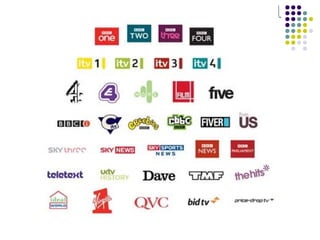
 A large selection of channels are carried on
  satellite, cable, digital and terrestrial
  television services.
 6 major British broadcasters – BBC, ITV,
  Channel 4, Five, BSkyB and Virgin Media.
Thinking about Media
   Name the BBC radio stations available to listeners. What sort of content
    does each carry? How, where and when can listeners access these
    stations?
   How many non-BBC radio stations can you receive? On which media
    platforms are these available? What sort of content is carried?
   Name TV channels aimed at the under 10s. What sort of content does
    each carry? On which media platforms are these available?
   How many TV channels are dedicated to popular music? What type of
    musical content does each carry? Where else in the media can you
    listen to popular music?
   Many broadcasters show films. How many dedicated film channels can
    you receive? Where would you see promotional material and trailers for
    upcoming films?
   On which media platforms might you find local news and events
    listings?
   On which media platforms could you buy or sell band memorabilia?
The BBC
 The    BBC (British Broadcasting Corporation)
  is the largest broadcasting organisation in the
  world.
 Its main responsibility is to provide public
  service broadcasting to the UK.
 This means broadcasting intended for the
  public benefit rather than for purely
  commercial concerns.
 It is funded by an annual licence fee (set by
  the government) £145.50 – colour £49 b+w
Ofcom and PSP
   It is the responsibility of Ofcom to regulate broadcast services.
   It deals with complaints, regulates competition, monitors standards
    and deals with licences.
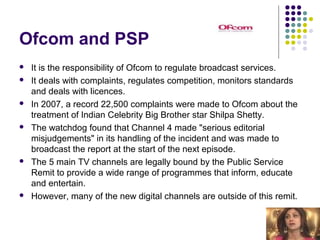
   In 2007, a record 22,500 complaints were made to Ofcom about the
    treatment of Indian Celebrity Big Brother star Shilpa Shetty.
   The watchdog found that Channel 4 made "serious editorial
    misjudgements" in its handling of the incident and was made to
    broadcast the report at the start of the next episode.
   The 5 main TV channels are legally bound by the Public Service
    Remit to provide a wide range of programmes that inform, educate
    and entertain.
   However, many of the new digital channels are outside of this remit.
Scheduling
 TV  and radio schedules must be filled with
  content that attracts audiences.
 Media broadcasters produce media content
  over a number of channels each with a
  particular brand image, aimed at specific
  audiences.
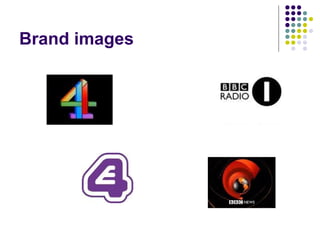
 Individual channels will have their own
  IDENT, a symbol or logo that appears on
  screen (on radio it may be a jingle).
Brand images
Cinema – then and now
   1896 – the first film screened by the Lumiere brothers.
   1898 – cinema advertising is introduced.
   1930s – British people visit the cinema twice a week
   1950s – invention of TV
   1960s – colour TV and decline of cinema audiences.
   1980s – cinema audiences at an all time low
   1990s – Multiplex cinemas see a rise in audiences

   Being able to exhibit a film in more than one place –
    cinema, television, DVD, internet – increases the
    opportunity for recovering money.
Films are marketed across a
range of media...
 Harry Potter and the Deathly Hallows: part 1
 Release date – 19th November 2010

 Official film website offers content, games and
  activities to further promote the film.
  harrypotter.warnerbros.com/
 Official trailer released on internet prior to
  cinema release.
 Further promotion through print (Empire
  magazine, newspaper articles).
 Computer game in production from Playstation.
**Key Terms**
 Target audience
 Schedules

 Brand Image

 Scheduling

 Ident

 Logo
Task:
What broadcast channels do we associate with
the music industry?

Research these different channels and their
target audiences. Type up your findings (either
in PowerPoint or Word).
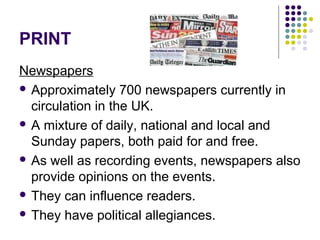
PRINT
Newspapers
 Approximately 700 newspapers currently in
  circulation in the UK.
 A mixture of daily, national and local and
  Sunday papers, both paid for and free.
 As well as recording events, newspapers also
  provide opinions on the events.
 They can influence readers.

 They have political allegiances.
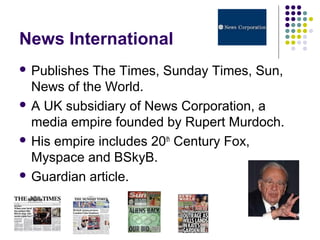
News International
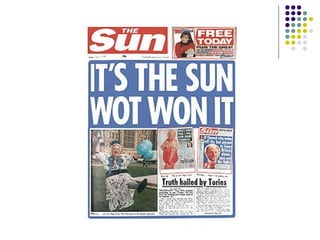
 Publishes The Times, Sunday Times, Sun,
  News of the World.
 A UK subsidiary of News Corporation, a
  media empire founded by Rupert Murdoch.
 His empire includes 20th Century Fox,
  Myspace and BSkyB.
 Guardian article.
Mastheads
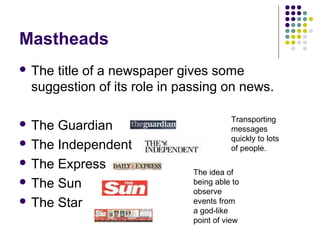
 Thetitle of a newspaper gives some
 suggestion of its role in passing on news.

                                       Transporting
 The Guardian                         messages
                                       quickly to lots
 The Independent                      of people.
 The Express
                             The idea of
 The Sun                    being able to
                             observe
 The Star                   events from
                             a god-like
                             point of view
Ethics
 We   live in a climate of liberal pluralism –
  individual choice and freedom is a human
  right and more than one opinion/political view
  is allowed.
 Journalists are free to investigate stories and
  not reveal their sources.
 The British press is free to express opinions
  and there is no censorship.
 Code of practice – the code by which all
  journalists abide – is enforced by the PCC.
Magazines
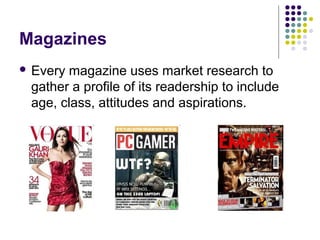
 Everymagazine uses market research to
 gather a profile of its readership to include
 age, class, attitudes and aspirations.
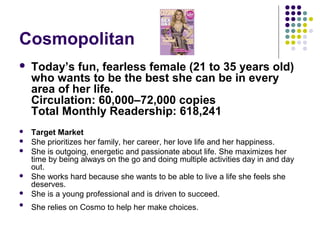
Cosmopolitan
   Today’s fun, fearless female (21 to 35 years old)
    who wants to be the best she can be in every
    area of her life.
    Circulation: 60,000–72,000 copies
    Total Monthly Readership: 618,241
   Target Market
   She prioritizes her family, her career, her love life and her happiness.
   She is outgoing, energetic and passionate about life. She maximizes her
    time by being always on the go and doing multiple activities day in and day
    out.
   She works hard because she wants to be able to live a life she feels she
    deserves.
   She is a young professional and is driven to succeed.

    She relies on Cosmo to help her make choices.
Task:
What music publications are available in the
current market (popular and niche)?

Choose three magazines and outline their target
audience. Include information on…

Target Market
Reader profile
Circulation
Total Monthly Readership
E-Media
Internet
 The term world wide web was coined by Tim
  Berners-Lee in 1990.
 Google's index now stands at over 8 billion
  pages.
 There are now over a billion Internet Users
  and that number is growing rapidly.
Web 2.0
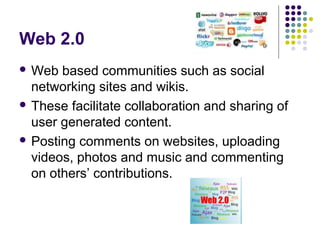
 Web  based communities such as social
  networking sites and wikis.
 These facilitate collaboration and sharing of
  user generated content.
 Posting comments on websites, uploading
  videos, photos and music and commenting
  on others’ contributions.
Regulation
 No  one owns or controls the internet.
 Legal actions have been taken against the
  use of the internet for criminal purposes.
 The downloading of music and film is an
  increasing problem.
 Issues surrounding on-line bullying remain
  unresolved.
**Key Terms**

 Public  Service Broadcasting
 Institutions

 Audience Share

 Convergence

 Web 2.0

 Media platforms

Investigating media platforms

  • 1.
  • 2.
    Media Platforms **Key Term** Media platform – the technology through which we receive media products/texts. (Broadcasting, print and e-media).  Text – products or texts are TV/radio programmes, films, adverts, websites, newspapers, magazines etc produced for audiences.
  • 3.
    Broadcasting  The institutionalised practice of sending television and radio content to large numbers of receivers.  A large selection of channels are carried on satellite, cable, digital and terrestrial television services.  6 major British broadcasters – BBC, ITV, Channel 4, Five, BSkyB and Virgin Media.
  • 5.
    Thinking about Media  Name the BBC radio stations available to listeners. What sort of content does each carry? How, where and when can listeners access these stations?  How many non-BBC radio stations can you receive? On which media platforms are these available? What sort of content is carried?  Name TV channels aimed at the under 10s. What sort of content does each carry? On which media platforms are these available?  How many TV channels are dedicated to popular music? What type of musical content does each carry? Where else in the media can you listen to popular music?  Many broadcasters show films. How many dedicated film channels can you receive? Where would you see promotional material and trailers for upcoming films?  On which media platforms might you find local news and events listings?  On which media platforms could you buy or sell band memorabilia?
  • 6.
    The BBC  The BBC (British Broadcasting Corporation) is the largest broadcasting organisation in the world.  Its main responsibility is to provide public service broadcasting to the UK.  This means broadcasting intended for the public benefit rather than for purely commercial concerns.  It is funded by an annual licence fee (set by the government) £145.50 – colour £49 b+w
  • 7.
    Ofcom and PSP  It is the responsibility of Ofcom to regulate broadcast services.  It deals with complaints, regulates competition, monitors standards and deals with licences.  In 2007, a record 22,500 complaints were made to Ofcom about the treatment of Indian Celebrity Big Brother star Shilpa Shetty.  The watchdog found that Channel 4 made "serious editorial misjudgements" in its handling of the incident and was made to broadcast the report at the start of the next episode.  The 5 main TV channels are legally bound by the Public Service Remit to provide a wide range of programmes that inform, educate and entertain.  However, many of the new digital channels are outside of this remit.
  • 8.
    Scheduling  TV and radio schedules must be filled with content that attracts audiences.  Media broadcasters produce media content over a number of channels each with a particular brand image, aimed at specific audiences.  Individual channels will have their own IDENT, a symbol or logo that appears on screen (on radio it may be a jingle).
  • 9.
  • 10.
    Cinema – thenand now  1896 – the first film screened by the Lumiere brothers.  1898 – cinema advertising is introduced.  1930s – British people visit the cinema twice a week  1950s – invention of TV  1960s – colour TV and decline of cinema audiences.  1980s – cinema audiences at an all time low  1990s – Multiplex cinemas see a rise in audiences  Being able to exhibit a film in more than one place – cinema, television, DVD, internet – increases the opportunity for recovering money.
  • 11.
    Films are marketedacross a range of media...  Harry Potter and the Deathly Hallows: part 1  Release date – 19th November 2010  Official film website offers content, games and activities to further promote the film. harrypotter.warnerbros.com/  Official trailer released on internet prior to cinema release.  Further promotion through print (Empire magazine, newspaper articles).  Computer game in production from Playstation.
  • 12.
    **Key Terms**  Targetaudience  Schedules  Brand Image  Scheduling  Ident  Logo
  • 13.
    Task: What broadcast channelsdo we associate with the music industry? Research these different channels and their target audiences. Type up your findings (either in PowerPoint or Word).
  • 14.
    PRINT Newspapers  Approximately 700newspapers currently in circulation in the UK.  A mixture of daily, national and local and Sunday papers, both paid for and free.  As well as recording events, newspapers also provide opinions on the events.  They can influence readers.  They have political allegiances.
  • 16.
    News International  PublishesThe Times, Sunday Times, Sun, News of the World.  A UK subsidiary of News Corporation, a media empire founded by Rupert Murdoch.  His empire includes 20th Century Fox, Myspace and BSkyB.  Guardian article.
  • 17.
    Mastheads  Thetitle ofa newspaper gives some suggestion of its role in passing on news. Transporting  The Guardian messages quickly to lots  The Independent of people.  The Express The idea of  The Sun being able to observe  The Star events from a god-like point of view
  • 18.
    Ethics  We live in a climate of liberal pluralism – individual choice and freedom is a human right and more than one opinion/political view is allowed.  Journalists are free to investigate stories and not reveal their sources.  The British press is free to express opinions and there is no censorship.  Code of practice – the code by which all journalists abide – is enforced by the PCC.
  • 19.
    Magazines  Everymagazine usesmarket research to gather a profile of its readership to include age, class, attitudes and aspirations.
  • 20.
    Cosmopolitan  Today’s fun, fearless female (21 to 35 years old) who wants to be the best she can be in every area of her life. Circulation: 60,000–72,000 copies Total Monthly Readership: 618,241  Target Market  She prioritizes her family, her career, her love life and her happiness.  She is outgoing, energetic and passionate about life. She maximizes her time by being always on the go and doing multiple activities day in and day out.  She works hard because she wants to be able to live a life she feels she deserves.  She is a young professional and is driven to succeed.  She relies on Cosmo to help her make choices.
  • 21.
    Task: What music publicationsare available in the current market (popular and niche)? Choose three magazines and outline their target audience. Include information on… Target Market Reader profile Circulation Total Monthly Readership
  • 22.
    E-Media Internet  The termworld wide web was coined by Tim Berners-Lee in 1990.  Google's index now stands at over 8 billion pages.  There are now over a billion Internet Users and that number is growing rapidly.
  • 23.
    Web 2.0  Web based communities such as social networking sites and wikis.  These facilitate collaboration and sharing of user generated content.  Posting comments on websites, uploading videos, photos and music and commenting on others’ contributions.
  • 24.
    Regulation  No one owns or controls the internet.  Legal actions have been taken against the use of the internet for criminal purposes.  The downloading of music and film is an increasing problem.  Issues surrounding on-line bullying remain unresolved.
  • 25.
    **Key Terms**  Public Service Broadcasting  Institutions  Audience Share  Convergence  Web 2.0  Media platforms