An Introduction to Television Studies Fourth Edition Jonathan Bignell
An Introduction to Television Studies Fourth Edition Jonathan Bignell
An Introduction to Television Studies Fourth Edition Jonathan Bignell
An Introduction to Television Studies Fourth Edition Jonathan Bignell
An Introduction to Television Studies Fourth Edition Jonathan Bignell
1.
An Introduction toTelevision Studies Fourth
Edition Jonathan Bignell install download
https://ebookmeta.com/product/an-introduction-to-television-
studies-fourth-edition-jonathan-bignell/
Download more ebook from https://ebookmeta.com
2.
We believe theseproducts will be a great fit for you. Click
the link to download now, or visit ebookmeta.com
to discover even more!
An Introduction to Clinical Trials Jonathan A. Cook
https://ebookmeta.com/product/an-introduction-to-clinical-trials-
jonathan-a-cook/
An Introduction to Moral Philosophy 2nd Edition
Jonathan Wolff
https://ebookmeta.com/product/an-introduction-to-moral-
philosophy-2nd-edition-jonathan-wolff/
An Introduction to Mechanical Engineering Enhanced SI
Edition Jonathan Wickert
https://ebookmeta.com/product/an-introduction-to-mechanical-
engineering-enhanced-si-edition-jonathan-wickert/
Membrane and Membrane-Based Processes for Wastewater
Treatment 1st Edition Maulin P. Shah
https://ebookmeta.com/product/membrane-and-membrane-based-
processes-for-wastewater-treatment-1st-edition-maulin-p-shah/
3.
Sabrina Holidays inDaisy Hills 3 1st Edition Kali Hart
https://ebookmeta.com/product/sabrina-holidays-in-daisy-
hills-3-1st-edition-kali-hart/
Marx’s Theory of Value in Chapter 1 of Capital. A
Critique of Heinrich’s Value-Form Interpretation Fred
Moseley
https://ebookmeta.com/product/marxs-theory-of-value-in-
chapter-1-of-capital-a-critique-of-heinrichs-value-form-
interpretation-fred-moseley/
Mele Kalikimaka Murder Aimee Gilchrist
https://ebookmeta.com/product/mele-kalikimaka-murder-aimee-
gilchrist/
Murder on Pleasant Avenue Gaslight Cozy Mystery 23
Victoria Thompson
https://ebookmeta.com/product/murder-on-pleasant-avenue-gaslight-
cozy-mystery-23-victoria-thompson/
A Union of Peoples Europe as a Community of Principle
1st Edition Pavlos Eleftheriadis
https://ebookmeta.com/product/a-union-of-peoples-europe-as-a-
community-of-principle-1st-edition-pavlos-eleftheriadis/
4.
Art History -Vol. 1, 6th Edition Marilyn Stokstad
https://ebookmeta.com/product/art-history-vol-1-6th-edition-
marilyn-stokstad/
An Introduction to
TelevisionStudies
This comprehensive textbook, now substantially updated for its fourth edition,
provides students with a framework for understanding the key concepts and main
approaches to Television Studies, including audiences, representation, industry
and global television, as well as the analytical study of individual programmes.
This new edition reflects the significant changes the television industry is
undergoing in the streaming era with an explosion of new content and providers,
whilst also identifying how many existing practices have endured. The book
includes a glossary of key terms, with each chapter suggesting further reading.
New and updated material includes:
■ Chapters on style and form, narrative, industry, and representation and
identity
■ Case studies on Bon Appétit’s YouTube channel, Insecure, British youth
television, ABC and Disney+, fixed-rig observational documentary, streaming
platforms’ use of data to shape audience experience, Chewing Gum, Korean
drama and The Marvelous Mrs Maisel
■ Sections on medical drama, YouTube creators, Skam and scripted format
sales, the global spread of streaming platforms, prestige TV and period drama
With individual chapters addressing television style and form, narrative, histories,
industries, genres and formats, realities, production, audiences, representation
and identity, and quality, this book is essential reading for both students and
scholars of Television Studies.
Jonathan Bignell is Professor of Television and Film at the University of Reading,
UK. He authored three previous editions of An Introduction to Television Studies and
was co-author of The Television Handbook, second edition. His many other publica-
tions include co-editing the book A European Television History.
Faye Woods is Associate Professor of Film and Television at the University
of Reading, UK. She is the author of the books Period Drama and British Youth
Television.
7.
Praise for theprevious editions:
‘At a time when the question of what constitutes “television” is being ever
more keenly debated and as the medium continues to be reimagined, I
can think of no other book to so adroitly meet the needs of students new
to Television Studies. Engaging, accessible, and with a diverse series of
activities and case studies that capture both the history and dynamism
of this subject, Bignell’s invaluable new edition provides a comprehensive
entry into the most significant debates in the field.’ Dr Deborah Jermyn,
Reader in Film and Television, Roehampton University, UK
‘IncoveringkeyareasofTelevisionStudies,rangingacrosshistory,aesthetics,
genre, production and reception, this book remains a key touchstone for
students entering and studying the field. Accessibly written and well-
illustrated with the addition of up-to-date examples, Bignell manages to
span the core concepts and concerns of the discipline in an engaging and
stimulating manner. At a time when the very idea of “television” as an object
of study is undergoing significant shifts, An Introduction to Television Studies
succeeds in taking us on a journey which maps out longstanding aspects of
television (and Television Studies), whilst embracing the “new” context of
television’s dispersed screens and digital culture.’ Su Holmes, Reader in
Television Studies, University of East Anglia, UK
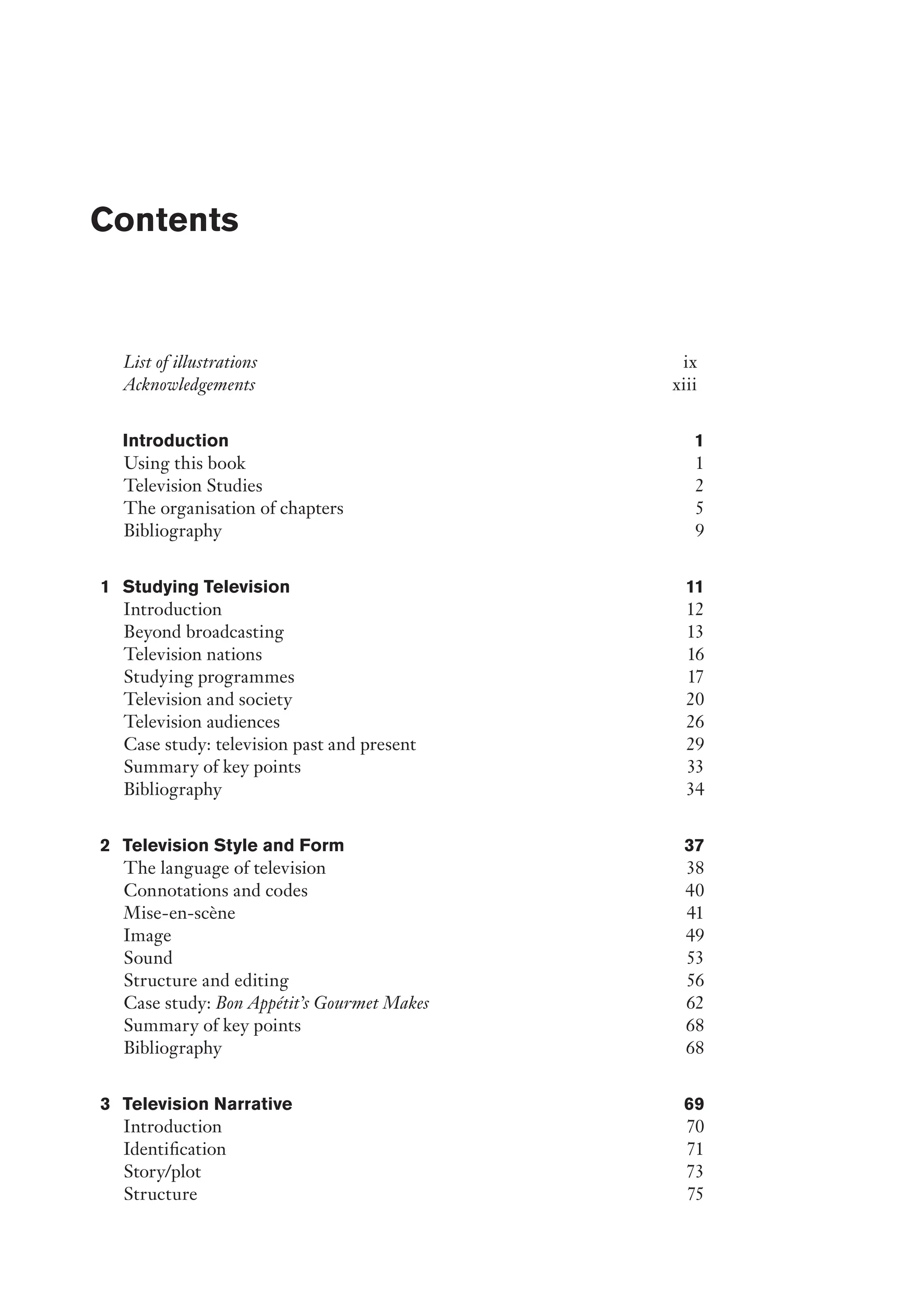
List of illustrationsix
Acknowledgements xiii
Introduction 1
Using this book 1
Television Studies 2
The organisation of chapters 5
Bibliography 9
1 Studying Television 11
Introduction 12
Beyond broadcasting 13
Television nations 16
Studying programmes 17
Television and society 20
Television audiences 26
Case study: television past and present 29
Summary of key points 33
Bibliography 34
2 Television Style and Form 37
The language of television 38
Connotations and codes 40
Mise-en-scène 41
Image 49
Sound 53
Structure and editing 56
Case study: Bon Appétit’s Gourmet Makes 62
Summary of key points 68
Bibliography 68
3 Television Narrative 69
Introduction 70
Identification 71
Story/plot 73
Structure 75
Contents
11.
v i Contents
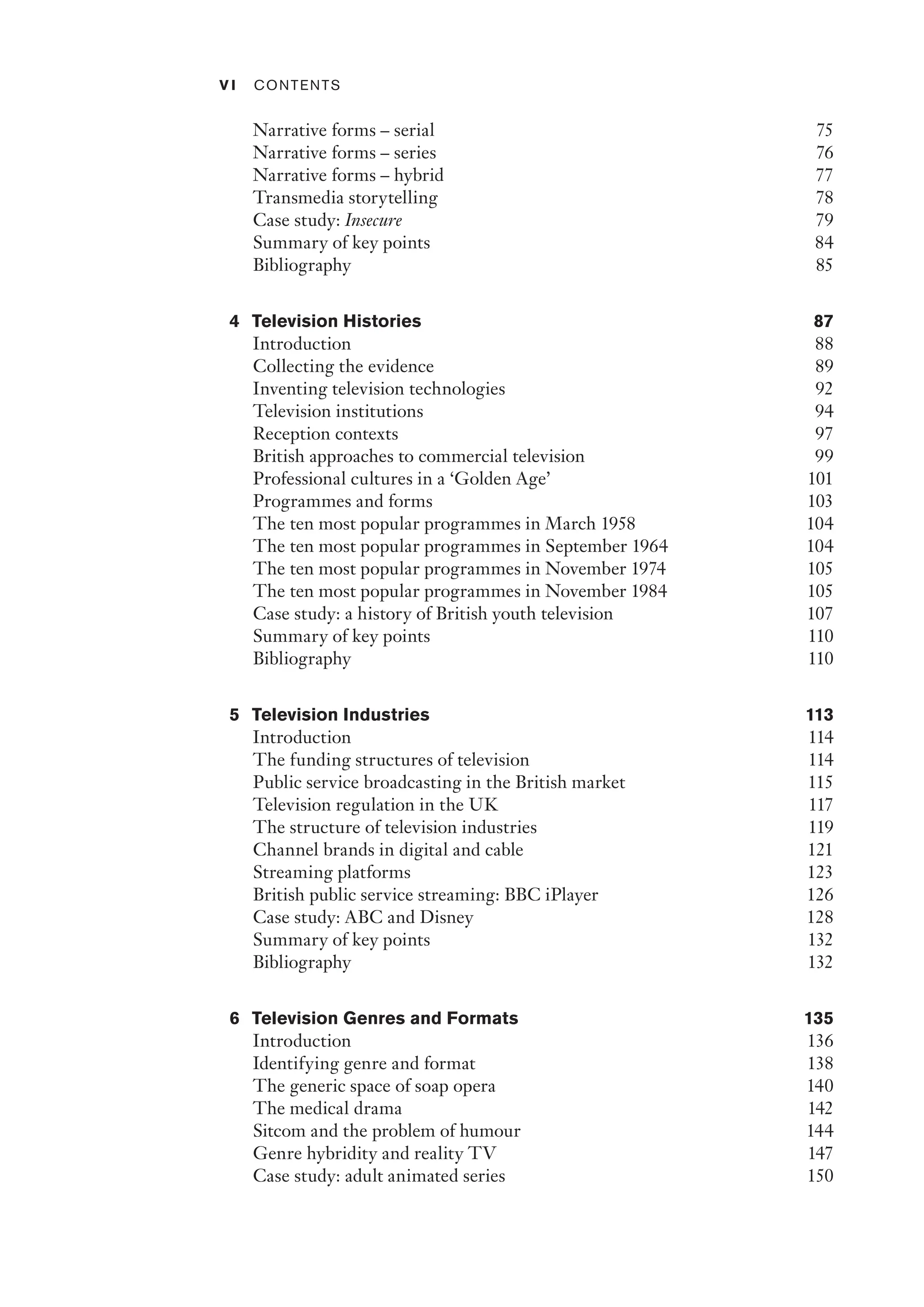
Narrative forms– serial 75
Narrative forms – series 76
Narrative forms – hybrid 77
Transmedia storytelling 78
Case study: Insecure 79
Summary of key points 84
Bibliography 85
4 Television Histories 87
Introduction 88
Collecting the evidence 89
Inventing television technologies 92
Television institutions 94
Reception contexts 97
British approaches to commercial television 99
Professional cultures in a ‘Golden Age’ 101
Programmes and forms 103
The ten most popular programmes in March 1958 104
The ten most popular programmes in September 1964 104
The ten most popular programmes in November 1974 105
The ten most popular programmes in November 1984 105
Case study: a history of British youth television 107
Summary of key points 110
Bibliography 110
5 Television Industries 113
Introduction 114
The funding structures of television 114
Public service broadcasting in the British market 115
Television regulation in the UK 117
The structure of television industries 119
Channel brands in digital and cable 121
Streaming platforms 123
British public service streaming: BBC iPlayer 126
Case study: ABC and Disney 128
Summary of key points 132
Bibliography 132
6 Television Genres and Formats 135
Introduction 136
Identifying genre and format 138
The generic space of soap opera 140
The medical drama 142
Sitcom and the problem of humour 144
Genre hybridity and reality TV 147
Case study: adult animated series 150
12.
Contents v ii
Summaryof key points 155
Bibliography 155
7 Television Realities 157
Introduction 158
Factual television 158
Realism and television technologies 160
British soap opera and realism 162
Realism and ideology 165
News and liveness 166
The documentary mode 169
Case study: docudrama 174
Summary of key points 177
Bibliography 177
8 Television Production 181
Introduction 182
Development 183
Pre-production 185
Production 191
Post-production 196
YouTube, user-generated content and the amateur-professional creator 198
Case study: ‘fixed rig’ observational documentary 201
Summary of key points 204
Bibliography 205
9 Television Audiences 207
Introduction 208
The economics of watching television 209
Ratings: measuring audiences 211
Targeting audiences 213
‘Protecting’ audiences 213
Active audiences 214
Attention and involvement 215
Qualitative audience research 217
Fan audiences 220
Case study: data, algorithms and interfaces – shaping streaming
audiences 224
Summary of key points 228
Bibliography 229
10 Television Representation and Identity 231
Introduction 232
Intersectionality and othering 233
Representation and stereotype 235
13.
v iii Contents
Meaningful diversityand plastic representation 237
Ideology 239
Television as cultural forum 241
Reality television and identity 242
Who makes TV? 244
Diversity as brand management 246
Case study: Chewing Gum 249
Summary of key points 251
Bibliography 252
11 Television Cultures and Globalisation 255
Introduction 256
Global television 257
National television in global contexts 260
International unscripted format sales 262
The scripted format trade and localisation 265
Global power and streaming platforms 267
The global and local interrelationship 269
Case study: Hallyu and Korean drama 272
Summary of key points 276
Bibliography 276
12 Television and Quality 279
Introduction 280
Identifying ‘quality’ 282
Channels and brands in American television drama 285
Television and authorship 288
The ‘cinematic’, legitimating television and complex serial drama 291
Visual style and the Doctor Who brand 293
Period drama as prestige genre 296
Case study: The Marvelous Mrs Maisel 298
Summary of key points 300
Bibliography 301
Glossary of key terms 303
Index 315
14.
Figures
1.1 The wedding ofPrince Harry to Meghan Markle, 19 May 2018 21
1.2 Famous, Rich and Homeless 22
1.3 A political debate during the 2019 General Election 22
1.4 Television rehearsals at Alexandra Palace, 1946. Photograph
courtesy of the Daily Herald Archive/Science Museum Group 31
2.1 Krishnan Guru-Murthy delivers the Channel 4 News 40
2.2 The brothers’ cramped apartment in It’s Okay to Not Be Okay 42
2.3 Moon-young’s large family mansion 43
2.4 ITV News reporting from outside the US Senate on 6 January 2021 44
2.5 Costume and colour signifying women’s social categories in
The Handmaid’s Tale 44
2.6 Conventional late night chat show presenting on Late Night
With Seth Myers 45
2.7 Laid back presenting style on Desus & Mero 46
2.8 Lighting in The Great British Bake Off allows contestants to be
evenly lit as they bake 47
2.9 Low-key lighting in Peaky Blinders provides high contrast
between light and dark 47
2.10 Unbalanced lighting of a Black actor in Stranger Things 48
2.11 Insecure’s use of reflected light in night scenes to accentuate
Black skin 48
2.12 Establishing shot in Happy Valley 49
2.13 Long shot framing and blocking express emotional distance in
Master of None 50
2.14 Close-up and shallow focus in Normal People 51
2.15 Low angle communicating Arabella’s emotional state in I May
Destroy You 51
2.16 High angle and unbalance framing communicated Issa’s
unsureness in Insecure 52
2.17 A point of view shot in Peep Show 52
2.18 A conversation between three characters in Starstruck 57
2.19 A conversation between three characters in Starstruck 57
2.20 A conversation between three characters in Starstruck 58
2.21 A conversation between three characters in Starstruck 58
2.22 Editing maintains the 180-degree rule in Ru Paul’s Drag Race 59
Illustrations
15.
x Illustrations
2.23 Editing maintainsthe 180-degree rule in Ru Paul’s Drag Race 59
2.24 Editing maintains the 180-degree rule in Ru Paul’s Drag Race 59
2.25 Editing maintains the 180-degree rule in Ru Paul’s Drag Race 60
2.26 Sharp Objects illustrates memory through fragmented flashbacks 61
2.27 Sharp Objects illustrates memory through fragmented flashbacks 61
2.28 Sharp Objects illustrates memory through fragmented flashbacks 61
2.29 Sharp Objects illustrates memory through fragmented flashbacks 62
2.30 The Bon Appétit Test Kitchen 63
2.31 Brad and Claire in the episode teaser 64
2.32 Claire holds a Snickers cross section to camera 65
2.33 Claire deconstructs the Snickers bar 66
2.34 Claire asks Andy for help, Rick Martinez can be seen in the
depth of the frame 66
2.35 The reading of the ingredients 67
3.1 Fleabag gives the audience intimate access to its unnamed
protagonist 72
3.2 Sex Education keeps its will-they-won’t-they romance maintained
in C plots 74
3.3 Skam’s website, featuring season 3 focused on Isak 79
3.4 Issa and her intern discuss the block party 82
3.5 Molly and Issa’s awkward greeting 83
3.6 Molly and Issa do ‘The Wobble’ 83
3.7 Issa is left alone at the episode’s close 84
4.1 In 2010, The Road to Coronation Street dramatised the creation
of the ITV soap opera at the beginning of the 1960s 92
4.2 John Logie Baird with his experimental television receiver, 1926.
Photograph courtesy of the Daily Herald Archive / Science
Museum Group 94
4.3 The first episode of Coronation Street in 1960 106
4.4 Margherita Taylor and June Sarpong present T4 109
4.5 An awkward teenage house party in The Inbetweeners 109
5.1 Ackley Bridge on Channel 4 118
5.2 ITV2’s reality dating show Love Island is made by ITV
Entertainment 120
5.3 Privileged Los Angeles lifestyles displayed in MTV reality show
The Hills 122
5.4 Jennifer Aniston is one of the big-name stars of The Morning
Show on Apple TV+ 125
5.5 Romantic drama Normal People was 2020’s most popular
programme on BBC iPlayer 128
5.6 The Mandalorian drew on the Star Wars franchise’s expansive
transmedia storytelling and featured ‘Baby Yoda’ as a character 131
6.1 A dance routine on Strictly Come Dancing 140
6.2 Surgeons operate on a patient in Grey’s Anatomy 144
6.3 The catholic schoolgirls of Derry Girls 145
6.4 The Simpsons’ launch on Disney+ is advertised through a
synergistic teaser promo 150
16.
Illustrations x i
6.5‘A couch gag’ ends the opening credits of The Simpsons 151
6.6 Jessie and Connie her hormone monster in Big Mouth 152
7.1 Images of the 9/11 attacks in New York, in 102 Minutes That
Changed America 159
7.2 Documentary Grenfell uses video from social media to tell the
story of the fire 160
7.3 The tower still smoking after the fire in a scene from Grenfell 170
7.4 Presenter Stephen Satterfield and food writer Dr Jessica B.
Harris discuss okra in a Benin food market in High on the Hog 171
7.5 Grenfell uses interviews with residents and officials to tell the
story of the fire and its aftermath 172
7.6 High on the Hog uses archive imagery to illustrate historian
Gabin Diamassè’s outlining of the history of the slave trade in Benin 173
7.7 Damilola: Our Loved Boy recreates a public speech by
Richard Taylor 175
7.8 Tensions in the Taylor family boil over in the private space of their
home 176
7.9 A firefighter gazes at the inferno caused by the explosion at the
Chernobyl nuclear plant 176
8.1 Example of a storyboard. Courtesy of Jeremy Orlebar 188
8.2 By its final season the episode budget for HBO’s Game of
Thrones had risen to $15 million 189
8.3 Visual effects in Disney+’s Loki 192
8.4 Steadicam operator Larry McConkey filming a long take in The
Marvelous Mrs Maisel 194
8.5 Vlogger Patricia Bright framed against her living room 200
8.6 A patient shot from an overhead camera in 24 Hours in A&E 203
8.7 A camera is relatively unobtrusive amongst the medical equipment 203
9.1 Sponsorship bumper from an episode of Love Island 211
9.2 Gogglebox cast members react to a programme 216
9.3 The Doctor confronts a mass of Daleks in Doctor Who 221
9.4 Ofcom chart of average minutes of viewing per day per device in
2020. Courtesy of Ofcom Media Nations Report 2021 225
9.5 New and popular programmes are given a prominent position on
the Netflix interface 227
10.1 Sisters Lyn and Emma gaze at their mother’s bar in Vida 234
10.2 We Are Lady Parts in their rehearsal room 235
10.3 Chabuddy G shows the camera around his office/living space in
People Just Do Nothing 236
10.4 The cast of season twelve of The Great British Bake Off 241
10.5 Parks and Recreation derives comedy from Ron and Leslie’s
opposing perspectives 242
10.6 Broad City’s ‘precarious girl’ comedy gives us intimate access
to its protagonists 246
10.7 Comedian Adam Hills features in Channel 4’s Altogether
Different branding campaign 248
10.8 Direct address in Chewing Gum 249
17.
x ii Illustrations
10.9 Tracey’s naïveapproach to sex is played for slapstick comedy 250
11.1 The blockbuster His Dark Materials adaptation is a BBC/HBO
co-production 261
11.2 An outlandish character disguise in the US version of The
Masked Singer 264
11.3 The UK version of The Circle 264
11.4 Skam Austin is produced for Facebook and uses the brand
identity of the Norwegian original 266
11.5 The crime caper Lupin is a French Netflix Original 271
11.6 An intense focus on romantic tension in My Love from the Star 273
11.7 Players compete to the death in Squid Game’s violent survival game 275
12.1 Making The Blue Planet natural history series 282
12.2 Visual style in Mad Men 286
12.3 Sally Wainwright’s crime drama Happy Valley 289
12.4 Made in Chelsea’s careful composition and soft champagne
colour grade 292
12.5 The doctor dangles from the TARDIS in ‘The Eleventh Hour’ 295
12.6 The Marvelous Mrs Maisel recreates 1950s New York on location 299
Table
5.1 Media conglomerates own the US major networks 120
5.2 Most popular programmes on BBC iPlayer 2020 (requests to
stream = view of individual episode) 128
9.1 Comparison of characteristics of linear and non-linear television 226
18.
Firstly, thank youto Jonathan Bignell for passing on the stewardship of this
book and all his work on the previous editions. This fourth edition combines our
voices. I would like to thank my colleagues past and present at the University of
Reading who have taught Television Studies with me over the years and continue
to inform my understanding of the discipline, as well as my non-TV colleagues
who teach with and support me on a daily basis. Thanks also go to the Department
of Film and Television at the University of Warwick and those I studied alongside
there, who opened my eyes to Television Studies and made me the academic I am
today, particularly Rachel Moseley, Helen Wheatley and Amy Holdsworth. The
Northern Television Research Group have provided stimulating discussion and
fun times, and the ladies of the Backchannel continue to support and inspire me
every day on matters television-related and beyond. This book is dedicated to all
of the students I have worked with across my academic career who continue to
make unpicking this ever-expanding world of television a pleasure and a privilege,
particularly Rhonda Cowell who now has students of her own.
Acknowledgements
20.
Using this book
Thisbook is an introduction to Television Studies, aimed especially at those who
are new to the study of the medium at college and university level. It describes
some of the critical approaches to television that have become widely accepted in
the subject. It also explains and makes use of key concepts in Television Studies
that every student needs to know about. The book reevaluates the terms and ideas
that have been significant in studying television, and tests out their limits, draw-
ing attention to the strengths and weaknesses in the ways that television has been
studied up to now. So the book draws together a collection of concepts and critical
languages that are sometimes quite diverse, or even contradictory, and suggests
how there are some ways of thinking about television that are more fruitful than
others. Television Studies is a dynamic and rapidly changing field of work, as the
next section explains. This makes the task of the student of television an open-
ended and exciting one.
This book outlines significant strands of critical work in the field and provides
worked-though case study examples of how critical approaches can be applied to
actual problems, programmes and issues. It is organised into chapters that are
suitable for use as preparatory reading for class study, or as follow-up reading to
support classroom debate. Significant terms are highlighted in bold in the text
when they are doing important work in the discussion. A definition of the high-
lighted term appears in the margin next to its first appearance in a chapter, and
these definitions can also be found in alphabetical order in the glossary of key
terms at the end of the book. The terms we have highlighted in this way are those
that seem to require a specific definition. Some of them are part of the critical
terminology of the academic discipline of Television Studies or one of the areas of
research that has fed into the field. Some of them are terms used in the television
industry in Britain or the US to describe an aspect of how television technology
works, or how programme-making, broadcasting and streaming are carried out.
Some terms are more widely known and are part of non-professional language,
but may need a precise definition so that they can be understood and used accu-
rately by readers and students of television. Readers of this book will already know
some terms, will have heard but not understood others and will be introduced to
some completely new vocabulary that we hope will enrich their capacity to talk
and write about television.
Each chapter ends with a bibliography that also includes suggested further
reading. The books, essays and articles chosen are often those we have quoted
Introduction
DOI: 10.4324/9781315619675-1
21.
2 Introduction
from, butthere are also some other books listed that deal with the topics covered in
the chapter. This section can be a useful tool for looking at the range of the subject,
and exploring sources for independent work. There is great insight to be gained
from further exploration of how other voices have expressed ideas that we have
written about here, and especially so if another writer has an alternative or even
opposing attitude to a subject. Like any academic subject, Television Studies is
diverse and evolving, and there are strongly held and articulately presented points
of view within it that differ greatly in aims, assumptions, emphases and conclu-
sions. Approaches to Television Studies are not a set of tools, but more like a group
of different languages. They do not translate neatly one into another, and each
defines its world in rather different ways. This book is concerned with the most
commonly studied theoretical issues in television courses. The major differences
between courses of study are in their focus on one or two of the following areas:
■ Analytical study of television programmes as texts
■ The television industry as an institution and its production practices and
organisation
■ Television in contemporary culture, its representations and the sociological
study of audiences
■ Television history and developments in broadcasting policy
This book provides introductory explanation, evaluation and routes for further
study in each of these areas. We aim to show why these approaches have a sig-
nificant role in Television Studies, to encourage students to participate in debates
within and between these approaches, and to gain an understanding of the
strengths and weaknesses of particular theoretical models for studying television.
In each chapter the reader will discover references to work by others who have
contributed to Television Studies. In a single volume it is impossible for us to note
all of the significant ideas in the sources we have used, and readers have many
opportunities to build on the brief discussions of existing research that we have
included here by reading the source texts that we have cited. Indeed, the many
directions that such further work can take indicate how Television Studies, like
the industry it analyses, is always evolving. We hope that readers of this book will
be encouraged to make their own contributions to the subject by identifying the
gaps, new directions and even contradictions opened up in these pages.
Television Studies
Television Studies has tried to define how the medium communicates, and this
has involved distinguishing between television communication and the media
of cinema or radio, for example. But it has used methodologies for describing
and analysing television texts that come from disciplines including Film Studies,
methods of discussing audiences and television institutions that come from soci-
ology and Cultural Studies, and ways of describing the development of television
that amount to different histories of the medium.
Because television includes so many different programmes, channels, plat-
forms and ways of addressing its audiences even at one point in time in a single
22.
Introduction 3
geographical region,it has proved very difficult for critics and commentators to
produce useful general insights into the medium. This is even more the case once
the history of the medium and its regional variations across countries and regions
of the world are considered.
Early predictions (in the 1930s, for instance) of what television would be
emphasised its liveness, its ability to present to a mass audience images of what
was happening in the real world. Commentators remarked on television’s inability
to compete with cinema as entertainment and therefore expected the medium to
focus on information and actuality. These early thoughts conditioned the ways in
which realism, connection to the contemporary and uneasiness about bringing
controversial visions into the home were played out. The connection of television
technology to immediacy and liveness distinguishes it from film. Television can
record or relay events occurring in real time (qualities which it now shares with
the internet). This has predisposed it to linear real-time progress, and the claim to
report the real world. Film has been theorised in terms of space (what can be seen
on the space of the screen), and this has led to theories about how individual film
spectators identify with the usually fictional characters and points of view offered
for spectators to see. Some of these ways of thinking from studying film have
been deployed in Television Studies to explain how viewers make sense of the
television medium. Analysing television’s formal qualities and narrative structure
has drawn from the study of film and literature, whilst also asserting television’s
difference from these forms. Time has also been an important frame for examin-
ing television. As a broadcast medium it is always ‘on’ – you switch on a television
set and a broadcast is always in process. As a result, broadcast television has long
been studied as a linear ‘flow’ of audio-visual material that, although divided up
into programmes, runs on across a period of time without empty gaps in between.
Discussing the linear ‘flow’ of broadcast television Charlotte Brunsdon has noted:
Television is, for the most part, made as programmes or runs of pro-
grammes: series, serials and mini-series. However this is not necessarily
how television is watched … It is precisely this possible ‘drifting’ through
an evening’s viewing that has come to seem … one of the unique features
of television watching.
(1998: 105–6)
Experiencing broadcast television as flow is different to the defined end point of
a film. The rise of streaming platforms has continued viewing practices that had
previously been enabled by VCRs, DVD and DVRs, shifting viewing towards a
non-linear experience, with programmes as discrete units. However, the experi-
ence of flow is in part maintained through these streaming platforms’ auto-play
features, which select viewing and encourage ‘binge watching’ of entire seasons
of television. Television Studies looks not only at individual programmes but also
at the ways they link together. These links might be in terms of the similarities
of one programme with another, where shared features of a genre tell us some-
thing about the persistence of some kinds of storytelling, sets of issues or ideas
being explored or the conventions to which the makers of programmes adhere.
The links might also be in the planning and organisation of a period of viewing
within linear broadcast television, for example an evening’s television schedule on
23.
4 Introduction
a certainchannel. These shared features and links can help shape the interfaces
and suggestions of streaming platforms, which use data-driven algorithms to pro-
mote certain programmes and shape a viewer’s personal schedule.
The viewing audience and its interests drives the organisation of television and
shapes assumptions about how television is used and enjoyed. Viewers today may
blend the scheduled flow of linear television with the personal selection enabled
by DVRs and streaming platforms; however, the schedule has been the primary
structuring device of viewers’ experience of television for much of the medium’s
history. Planning a schedule means including a variety of programming, yet also
creating a continuity of interest that can keep a viewer tuned to a single channel.
The connections between programmes in a linear schedule or on a streaming
platform’s interface are the responsibility of the institutions that broadcast and
stream them. Looking at how television institutions work has been important to
Television Studies’ understanding of the medium’s role as an industrial product,
made and organised in different ways in different parts of the world.
It’s important to think about television as both a global and local experience.
Even though television programmes and formats are distributed globally, its local
forms are different. This can be seen immediately in the difference between com-
mercial television in the US and the British tradition, which has a strong civic,
‘public service’ character. In Britain’s blend of public service and commercially
funded there has always been a tension between taking television’s responsibility
to society seriously and regarding television as entertainment for a consumer.
Globally, the impact of different commercial and governmental structures has
shaped television forms and industry in the past and present in a range of ways.
Television Studies has also explored how television moves around the world
through export and import flows, bringing cultural and political power with it.
Television can also be remade and reformatted in the image of local cultures. We
must remember that television does not have to take the form that it does in the
places with which we might be familiar.
The ways in which television holds or transmits cultural power highlight its
social significance. The questions of what and who is represented, in what ways
and with what possible effects have been considered in Television Studies with
particular attention to the representation of groups who are relatively lacking in
social power. This kind of study can show how television can contribute to the
ways that viewers understand and experience their own lives and those of the peo-
ple around them. As well as looking at what can be seen and heard in the medium
of television, how it is organised in different parts of the world and its relation-
ship with the ways of thinking and experiencing the world in social contexts,
Television Studies pays attention to the audiences of television and how they
interact with the medium. This involves noting which programmes and kinds of
programme are watched the most, using information that television institutions
themselves collect in statistical form – in the form of ratings and increasingly
data on audience choices and demographics. This also involves Television Studies
researchers undertaking independent audience studies, observing groups of view-
ers and talking to them about how, what and why they watch, exploring how
television fits into their everyday life. In recent years internet discussion forums
and social media have also been a focus of researchers looking to understand how
people think about and use television, how it shapes who they are and how they
24.
Introduction 5
understand theworld. Research that focuses on audiences attempts to engage
with how viewers make sense of television, and how it is important (or perhaps
unimportant) to them. In this way Television Studies aims to break down the
boundaries between the academic agendas that it has developed for specialised
work on the medium and the place of watching television in the lives of non-spe-
cialist viewers for whom television can function in a range of ways among other
routines and everyday experiences.
As Catherine Johnson notes, ‘television is a hybrid medium that has been sub-
ject to seemingly endless change … and whose definition has never been stable’
(2019: 30). Each previous edition of this book charted significant shifts in the tel-
evision industry and technology. The 2012 edition of this textbook was published
at a transitional point where the UK and many other countries had converted to
digital television and streaming platforms were on the rise. This new edition is
written in a world where viewing video on mobile devices is a norm and stream-
ing platforms are a dominant part of television life. A new wave of global stream-
ing platforms launched in the late 2010s. Combined with the global impact of the
coronavirus pandemic on television production and viewing behaviours, this has
helped accelerate long-term shifts in viewing behaviour away from linear broad-
cast television. A sporting event can now be watched live via a linear television
channel on digital, cable or satellite; on a subscription or advertising-supported
streaming platform; or even on a social media platform. Live television remains a
prominent part of many viewers’ experience of television, so we must take care not
to present streaming (which relies on high-speed internet via broadband or mobile
data) as a universal experience. Particularly as the technological and financial bar-
riers to access can be much more significant compared to a broadcast television
signal captured by a television aerial. As a result of these changes the new edition
of this book speaks of television channels and streaming platforms with the same
prominence
The organisation of chapters
Studying Television
The first chapter sketches out the topics of study and critical approaches which
can be found in academic Television Studies, noting its significant emphases and
exclusions. Television Studies in Britain and the US, for example, is dominated
by work on television in the English-speaking world. One dominant strand is
the detailed textual analysis of programmes, with a preference for popular pro-
grammes in serial and series form, concentrating on drama, documentary and
news programmes. This derives from the tradition in academic work of studying
content and form in detail. It also reflects the dominance of English-language
programmes in the world television market. There are other kinds of televi-
sion to mention, however, which stimulate thinking about what television can
include: trailers, commercials and channel idents, for instance. This chapter con-
siders different understandings of what television is, and how Television Studies
approaches are based on assumptions about the television text, the form of its
transmission and who is watching where and when. The chapter includes a case
25.
6 Introduction
study comparingand contrasting representations of television viewing in the
1950s and the 2020s, showing how the medium has been thought about in differ-
ent ways at different times.
Television Style and Form
Chapter 2 explores how television programmes can be studied in close detail as
‘texts’, to reveal how their meanings are made. The techniques for undertaking
this kind of close analysis, deriving from the methodologies of semiotics, are
explained. The chapter includes detailed discussion of the style and formal struc-
tures of television, focusing on image and sound. It gives students the tools to
produce detailed close textual analysis. The case study takes a segment of the
YouTube series Gourmet Makes and conducts a close analysis of its images and
sound, showing how textual approaches to television can be used in practice.
Television Narrative
Chapter 3 looks at the structure and organisation of television programmes’ narra-
tives. It considers the role of identification in narrative focus and outlines how televi-
sion is built as episodes and seasons. It pays attention to story structure, narrative
problematics and arcs. Different narrative forms are outlined, defining the serial
and series forms, as well as the blending of these aspects. The expansion of storytell-
ing beyond the episode is considered through transmedia narrative. The case study
breaks down the structure and storytelling of an episode of HBO comedy Insecure.
Television Histories
Chapter 4 describes and analyses the different approaches to the evolution of tel-
evision from the 1930s to the 1990s, primarily focused on Britain and the US.
This involves a discussion of state regulation of television, the increasing pro-
liferation of channels and the introduction of cable and satellite broadcasting
systems, competition and commerce. The chapter aims to introduce the subject
of television history through an understanding of the changing social place of
television in society, changes in television institutions and technologies, along
with changing conceptions of the television audience and the nature of television
viewing. The chapter explains a range of historical approaches to show differ-
ent ways of approaching television history. The case study explores the history
of British youth television, illustrating how we can analyse television history
through programming targeting a particular demographic, considering how it
has been impacted by social and industrial change.
Television Industries
Chapter 5 looks at the structure and organisation of the companies that make
television. It considers the funding structures of television and how the industries
26.
Introduction 7
in differentnations are organised. It looks at how British television is shaped by
public service broadcasting and television regulation. It lays out some of the own-
ership structures of US and global media companies, as well as highlighting the
role of brand identity in digital and cable channels. The chapter considers the
place of streaming platforms in global markets, and considers how public service
broadcasters developed streaming in the UK. Its case study focuses on the Walt
Disney Company, looking at the key moments in the history of the US network
ABC and the launch of the Disney+ streaming platform.
Television Genres
Chapter 6 focuses on the significance of genre in television, showing how genres
are relatively stable, but also how they can blend and change over time. The chap-
ter explains theories of genre, and talks in more detail about the genres of medical
drama, sitcom and reality TV, considering why some of these blur genre bounda-
ries. The chapter explains the concept of television formats, suggesting that these
display much less variability than genres. The case study looks at American adult
animated series, analysing how they draw from a range of television genres and
combine them in interesting ways to address different audiences.
Television Realities
Chapter 7 focuses on the ways that questions of realism can be addressed in
Television Studies. This includes looking at what realism might mean in dif-
ferent programme genres, and the conventions used in various kinds of docu-
mentary and factual programmes. Television has a strong tradition of showing
its viewers images of reality, using live footage and actuality in such diverse
forms as news, documentary, docusoap and reality TV. The chapter debates
the different understandings of reality and realism in television. It ends with a
case study on dramatisations of real events in drama-documentary, also known
as docudrama.
Television Production
Chapter 8 discusses the production practices and technologies that are used in
bringing programmes to the screen, including the pitching, writing, production
planning, production scheduling, shooting and post-production of programmes.
It gives an account of the professional culture of television production in different
kinds of broadcasting environments and in different genres and forms of pro-
gramme. The chapter aims to provide a critical understanding of the television
industry as a profession. Attention is paid to developments in technology, includ-
ing the different kinds of equipment used in programme-making. The chapter
also includes a discussion of YouTube and how developments in technology have
opened up production to amateur creators. The chapter includes a case study of
observational documentary’s use of fixed-rig filming systems.
27.
8 Introduction
Television Audiences
Chapter9 analyses the methods of understanding audiences, and how television
institutions seek to control their viewing behaviours. It discusses methods used
by British and US broadcasters and streaming platforms to gather information
about television viewers and considers some of the changing industrial assump-
tions about viewers and television across its history. The chapter introduces dif-
ferent industry and academic approaches to audiences, and their implications.
It addresses issues connected with the activity or ‘agency’ of viewers, including
fandom, the role of academic television audience researchers and the ways that
audiences make and resist the meanings of television programmes. The chapter
concludes with a case study on streaming platforms’ use of data and algorithms to
shape viewers’ experience of television.
Television, Representation and Identity
Chapter 10 outlines Television Studies’ interest in how the medium shapes view-
ers’ understanding of the world and other people. This includes industry and
content analysis, as well as debates over fair and accurate representations of dif-
ferent groups of people. In this context television has participated in setting up,
maintaining and also changing the cultural norms that underlie how members
of society think about themselves and about people who seem different to them.
It considers industrial initiatives around ‘diversity’ as well as how this is used as
part of brand identities. The chapter’s case study looks at the sitcom Chewing
Gum, and its intersectional engagement with gender, race and class, along with
national specificity.
Television Cultures and Globalisation
Chapter 11 looks at the significance of national and international cultures of tel-
evision broadcasting. It considers how the complexity of globalisation and televi-
sion requires analysis of the structure of television industries, media regulation,
funding practices, distribution and reception, and how particular programme
types move around the world. It explores debates about television’s contribution
to media imperialism as well as the power involved in international flows of televi-
sion import and export. The chapter refers to inequalities in production funding
and the role of imported programming and global streaming platforms in national
television cultures. The chapter finishes with a case study of Korean drama and
the Korean Wave, looking at how the form gained popularity internationally and
the factors that influenced its global spread
Television and Quality
Chapter 12 discusses the social and cultural frameworks that confer value on
some kinds of television, exploring academic discussions of ‘quality TV’ and how
28.
Introduction 9
prestige TVis mobilised in the television industry. The ‘quality TV’ debate con-
siders how cultural importance has been assigned to certain programmes or kinds
of television, engaging in processes of legitimation. The chapter explains how
understandings of prestige TV are shaped by authorship, aesthetics, genre and
channel identity. The chapter’s case study addresses period comedy drama The
Marvelous Mrs Maisel, looking at how budget, authorship and genre worked to
present it as prestige TV, identifying the programme’s value for streaming plat-
form Amazon Prime Video.
Bibliography
Allen, R. (ed.) (1992) Channels of Discourse, Reassembled: Television and Contemporary
Criticism. London: Routledge.
Bennett, J. and Strange, N. (eds) (2011) Television as Digital Media. Durham, NC:
Duke University Press.
Brunsdon, C. (1998) ‘What is the television of television studies?’, in Geraghty,
C and D. Lusted (eds), The Television Studies Book. London: Arnold, 1998, pp.
95–113.
Corner, J. (1999) Critical Ideas in Television Studies. Oxford: Clarendon.
Fiske, J. (1992) Television Culture. London: Routledge.
Geraghty, C. and Lusted, D. (eds) (1998) The Television Studies Book. London:
Arnold.
Gillan, J. (2011) Television and New Media. London: Routledge.
Jenkins, H. (2006) Convergence Culture: Where Old and New Media Collide.
Cambridge, MA: MIT Press.
Johnson, C. (2019) Online TV. Abingdon: Routledge.
Lotz, A.D. (2018) ‘Evolution or revolution? Television in transformation’, Critical
Studies in Television, 13(4), pp. 491–494.
Lury, K. (2005) Interpreting Television. London: Hodder Arnold.
Newcomb, H. (2005) ‘The development of television studies’, in Wasko, J. (ed.),
A Companion to Television. Malden, Mass. and Oxford: Blackwell, pp. 15–28.
Thompson E. and Mittell J. (eds) (2020) How to Watch Television, second edition.
New York: New York University Press.
Wasko, J. (2005) ‘Introduction’, in Wasko J. (ed.), A Companion to Television.
Malden, MA and Oxford: Blackwell, pp. 1–8.
30.
Studying Television
■ Introduction12
■ Beyond broadcasting 13
■ Television nations 16
■ Studying programmes 17
■ Television and society 20
■ Television audiences 26
■ Case study: television past and present 29
■ Summary of key points 33
■ Bibliography 34
DOI: 10.4324/9781315619675-2
1
31.
Studying Television
Introduction
This chapterbriefly maps out the topics of study and introduces some of the
critical approaches that are central to academic Television Studies today, with
emphasis on the approaches used in Britain and the United States. By doing this
the chapter aims to provide an overview of the kinds of questions which students
of television should carry with them as they use this book. Each of the chapters in
the remainder of this book focuses on a particular aspect of the study of television,
picking up the concerns and ways of thinking about television that are introduced
here. The discipline of Television Studies is a relatively young academic subject,
and in its short history the questions that have been asked about television, and
the answers which researchers have discovered, have changed in interesting ways.
Television Studies, like all academic subjects, is in a continual process of develop-
ment. This is partly because researchers discover new information and respond
to changes in what is happening in television in the present. Television Studies
also changes because, as ways of thinking about television are discussed and their
strengths and weaknesses discovered, new questions and problems in understand-
ing television are found. One of the aims of this book is to involve readers in the
debates and disagreements about television that animate Television Studies.
The study of television emerged out of the larger field of media education.
Media education began in the 1930s on the assumption that mass media had nega-
tive effects on society, and that educating citizens about how media products are
made would help to protect them from their impact. Television, beginning its
history as a medium at about the same time, has long been regarded as a medium
that has a special relationship with its viewers’ everyday lives. Television is very
familiar to most people and often taken for granted, so the scholarly study of tel-
evision tries to examine familiar programmes in new ways, introduces unfamiliar
programmes and aims to attain critical distance from television as a medium. The
premise that underpins media education is that academic studies should engage
with everyday media experiences that are understood as an aspect of everyday
popular culture. Television and media studies encourage the questioning of media
by means of the analysis of media products, media institutions and media tech-
nologies. The work of the literary and cultural critic Raymond Williams (1974)
was crucial in establishing this breadth in the field, as a result of his interest in
evaluating television as an aspect of contemporary culture. In Europe, media edu-
cation is often referred to as media literacy and it was in Britain that the idea was
first put into practice in the context of school and university teaching. Key issues
that structure this curriculum include:
■ Institutions and ownership: the patterns of ownership of media organisa-
tions, where the national and global holdings of corporations such as Disney,
media literacy the
skills and competence
that viewers learn in
order to understand
easily the audio-visual
‘languages’ of media
texts.
32.
Studying Television13
Comcast or Warner Media are assessed in terms of the concentration of media
power in the hands of a few main players
■ The laws and regulation of media industries: in relation to content, censor-
ship, bias and assumptions about their influence
■ Texts and their conventions: in addressing specific media texts like television
programmes, films or magazine advertisements, media education asks what
audience the text is addressed to, and how the conventions of a certain genre
or form are used to target an audience
■ Audiences: the study of media audiences is interested in how different groups
of viewers or readers interpret media content in different ways according to
(for example) age, race, gender, sexuality or economic status. Scholars of tel-
evision have conducted studies of individual media users or audience groups,
to provide a more finely textured understanding of how and why television
and other media are used in the context of ordinary life.
Television Studies draws on each of these approaches, with different scholars
adopting them to differing extents. In this book, aspects of each way of studying
media are examined specifically in relation to television.
Beyond broadcasting
Clearly, an important place to start is to consider how wide or how narrow televi-
sion might be as an object of study. Television Studies has until recently focused
on linear broadcast television. Here programmes are watched at the time they
are transmitted, in the home on a television set or recorded by a VCR or DVR
to be viewed later. The transmission signals for broadcast television have been
received by rooftop aerials (terrestrial tv) or satellite dishes, or along cables
embedded in the ground. Many different broadcast signals may be available to be
received at any one time, but all the television receivers tuned into a specific chan-
nel would receive the same broadcast programme at the same time. Since 2012 all
British television has been broadcast digitally and the previous ‘analogue’ system
was switched off. This increased the number of channels available free to each
home, rather than those received through a satellite or cable which must be paid
for. Rooftop aerials still work after 2012 and receive digital signals that need to
be decoded by television sets with digital receivers built into them. Across the
late 2000s and the 2010s the availability of high-speed broadband and home wi-fi
enabled streaming platforms to rise to prominence, delivering television on-
demand via the internet and watched via websites and apps. Streaming platforms
were initially only available on computers, but ‘smart’ television sets and digital
media players (or streaming devices) attached to televisions now allow viewers
to access streaming platforms alongside broadcast television. Mobile technolo-
gies allow television to be streamed on tablets and mobile phones inside and out-
side the home. Technologies such as DVRs and streaming platforms have helped
to transition television from a ‘mass’ medium to an ‘individualized’ collection
of niche audiences and personalised content viewed on demand. Yet despite this
rapid pace of change many continuities remain, with traditional ways of watching
and modes of programming continuing. Television has always borrowed from
other media around it, and has been a hybrid medium – one that does some of
regulation the control of
television institutions by
laws, codes of practice or
guidelines.
genre a kind or type of
programme. Programmes
of the same genre have
shared characteristics.
linear television
broadcast from a central
source on a channel
in a continuous flow,
according to a prescribed
schedule.
broadcasting the
transmission of signals
from a central source
which can be received by
dispersed receivers over a
large geographical area.
VCR programmable
machine connected to
a television that played
and recorded onto video
cassettes.
DVR programmable
machine connected to a
television that records and
plays back television from
a hard drive.
terrestrial broadcasting
from a ground-based
transmission system, as
opposed to broadcasting
via satellite.
digital television
television pictures and
sound encoded into
the ones and zeros of
electronic data. Digital
signals can also be sent
back down cables by
viewers, making possible
interaction with television
programmes.
analogue broadcasting
signals in waves of varying
frequency. Analogue
signals require greater
space or ‘bandwidth’ than
digital signals, and do not
allow interactive response
from viewers.
streaming platform
company that provides
video on-demand via
the internet, can be
subscription-based or
supported by advertising
or a licence fee e.g.
Disney+, BBC iPlayer.
digital media player (or
streaming device) small
internet-connected device
attached to a television
that accesses a range of
streaming platforms in
app form.
33.
14 Studying Television
thesame things as newspapers, radio, magazines, advertisements or films while
adapting what they do into its own distinctive form.
Television is a hungry medium that borrows audio-visual content from a
range of other places. For instance, a news programme might broadcast extracts
from surveillance video in order to show a crime being committed and to iden-
tify the perpetrator so that television viewers can provide information to help
catch the offender. Mobile phone footage appears in news programmes, when
people witnessing an accident or a war provide footage of news events. ‘Viral’
videos regularly transition from social media platforms to provide content for a
range of television genres, including news, magazine shows and light entertain-
ment. Members of the public can also broadcast themselves live on the inter-
net through social media and ‘open’ (Johnson 2019) streaming platforms like
YouTube, removing the intermediary of the television programme altogether.
In the case of both surveillance video and mobile video, the footage changes
its meaning once it is put in a broadcast context. What was private becomes
public. The fascination of reality TV programmes such as Big Brother derived
partly from this contrast between the usually private behaviour – which would
previously only have been recorded by surveillance or amateur cameras – and
the very public broadcasting of the material on television. Since the 1960s visual
artists have incorporated live or recorded video into artworks, to be seen in a
gallery space, in a different location of viewing from conventional television and
designed for different ways of watching (standing up rather than sitting down,
in a gallery rather than in the home). Occasionally these art videos might be
screened in a late-night compilation of avant-garde works, or as part of a televi-
sion documentary, but like mobile videos these films change their meaning once
they are transmitted to a different kind of audience. At large public events, such
as football matches or music concerts, live video is shown on big screens. One
convention of music videos is to recreate the kinds of images that are projected
at concerts, by using lighting and editing effects to capture footage of singers,
musicians and dancers performing. For a long time, television has borrowed the
conventions of non-broadcast video to communicate the excitement of being at
a live performance or sports event as well as offering a closer, more intimate
experience than the ‘live’ audience can experience. Some of the distinguishing
features of music video, talent shows or reality TV, for example, come from the
ways in which they draw on non-broadcast television or video and make use of
the connotations which they carry, such as
■ Privacy (in reality TV, where private behaviour becomes public)
■ Performance (in music video or talent shows, where television borrows the
conventions of a live show)
■ Evidence (where surveillance video or mobile phone footage confirms that
something shocking or controversial has happened)
The hybridity of television becomes more visible when viewers do more than
just watch programmes as they are transmitted. Updating your social media
or making purchases on the same piece of technology that you use to watch
Friends makes it obvious that television has become one among several inter-
connected aspects of digital media culture. But television has always looked
reality TV programmes
where the unscripted
behaviour of ‘ordinary
people’ is the focus of
interest.
avant-garde work
aiming to challenge the
norms and conventions
of its medium, and the
group of people making
such work.
documentary a form
aiming to record actual
events, often with an
explanatory purpose or
to analyse and debate
an issue.
connotations the term
used in semiotic analysis
for the meanings that
are associated with
a particular sign or
combination of signs.
34.
Studying Television15
outwards beyond the domestic living room to borrow and adapt aspects of
social life. Popular entertainment programmes such as Strictly Come Dancing
or The Voice work by connecting the private sphere of television viewership
with the public world of celebrity performance. Television is a medium that
is predominantly experienced in the home, but it has both adopted and trans-
formed existing forms of popular entertainment that come from public, col-
lective experiences. Light entertainment television negotiates between a ‘here’
and ‘there’ of home and public spaces of entertainment, between ordinariness
and spectacle, between ordinary people (‘us’) and performers and stars (‘them’)
(Dyer 1973). Each of these terms can blur into the other. The Voice has star per-
formers acting as judges, but the television audience is also invited to judge by
voting for their favourite contestant. Amateur ‘ordinary’ contestants perform as
if they were stars, and seek to become one. So talent shows recognise how the
television medium sits between domestic familiarity and a spectacular world of
celebrity. The effect is to frame the programme as a mediating format. Light
entertainment’s presentation of the content of singing, comedy routines and
entertainment acts in light entertainment comes originally from earlier forms
of popular entertainment, such as vaudeville or music hall, which have been
adapted into television for domestic and private consumption. Like music hall
variety performances, talent shows are either really or apparently live, take place
in an auditorium setting with an audience and are made up of a mix of types of
content. But at the same time, on television their domesticity is signified by
the placement of the programme within the routines of a schedule designed to
match the rhythms of domestic life (mealtimes, work versus leisure time, etc.),
modes of address that assume a home audience, and the use of multi-camera
shooting techniques to edit the material into an event for television rather than
a relayed performance. Television’s hybridity is evident in how some genres of
programme borrow and adapt cultural forms.
Television Studies has developed theoretical approaches to the distribution of
programmes to different kinds of screen and to locations other than the home.
Users are now as familiar with watching television streamed over the internet
on a phone or tablet as watching programmes broadcast to a television set. This
has meant traditional broadcasters have had to decide how they want to engage
with the streaming platform YouTube, because users regularly upload clips of
programmes illegally onto the website. Broadcasters commission programmes
and show them as the basis of their business, so they have legal ownership of
the copyright on the programmes that they show. Uploading content from these
programmes to YouTube is viewed as threatening the revenue of television chan-
nels and programme makers. YouTube is owned by the technology company
Google and it has responded to these concerns in two ways. It created a series
of computer programmes that automatically search the internet to find illegally
uploaded content. Google then informs the owners of the uploaded material and
offers the choice of having Google delete the content or allow the placement of
advertising on the page where the content is displayed. Broadcasters are con-
stantly having to find ways of adapting to the new media landscape where control
over content is hard to police, and where the boundaries of television are expand-
ing to include these different ways of delivering and experiencing audio-visual
content.
private sphere the
domestic world of
the home, family and
personal life.
35.
16 Studying Television
Televisionnations
The majority of the examples of television that are discussed in this book were
made and shown in the English-speaking world, and most of the books which
are used in courses in Television Studies in Britain refer to British and American
television. One of the reasons for this is that English-language television pro-
grammes are exported around the world to many other countries whose national
language is not English, where they are shown either with subtitled dialogue
or with a dubbed soundtrack in another language, spoken by actors from the
country in which the programme is broadcast or streamed. This issue is discussed
further in Chapter 11, where television around the world is considered. Television
advertisements are also sometimes shown in several different countries, with
the same visual images but with a soundtrack made in another language. People
in England are notoriously resistant to watching television programmes in lan-
guages other than English and are unwilling to read subtitles translating foreign-
language dialogue (BBC Alba and S4C broadcast Gaelic and Welsh-language
content respectively). However, this is relatively unusual internationally and
dubbing of foreign-language programmes is standard in many European coun-
tries. Netflix’s global growth has in part been driven by the range of subtitle and
dubbing options it offers on many of its most prominent original and acquired
programmes.
The experience of watching television in Britain is relatively unusual, in
that almost all programmes are in English, originating either in Britain, the
United States or Australia, countries with which Britain has had an historical
‘special relationship’. However, recently, subtitled European drama (particularly
Scandinavian crime drama) has had success on BBC4 and Channel 4. The situa-
tion is different in other countries, where imported television from Britain or the
US is immediately marked as different because of its dubbed or subtitled dialogue.
There are also countries where there are several commonly spoken languages and
which broadcast television in each of these languages. For example, in Singapore
there are television channels in English, Chinese and Malay and in the United
States there are channels in English and Spanish. The sense of what a national
television culture might be is different in these countries, and the experience of
familiarity would be different from the experience in Britain.
Television has aimed to represent a relatively unified culture in the UK,
though its division into the nations of England, Scotland and Wales along with
Northern Ireland, means that television also has a regional character. The further
division of terrestrial television broadcasting into regional areas (the south-west
of England, the Midlands or East Anglia, for example) where there are news and
current affairs programmes aimed at local audiences, makes this situation more
marked. The issue of belonging to a region, nation or country complicates the
assumption that British television can be referred to as a national television cul-
ture. Furthermore, since Britain is a multi-cultural society, there are cable and
satellite channels aimed at people from international backgrounds and in lan-
guages other than English, such as channels in Chinese and the languages of the
Indian sub-continent. Much of this content is now available online through free
and subscription streaming apps. In 2017 Sky TV made a deal to incorporate
South Asian channels such as Zee TV and Star TV in its basic satellite package
subtitle written text
appearing on the
television screen,
normally to translate
speech in a foreign
language.
dubbing replacing
the original speech
in a programme,
advertisement, etc.
with speech added
later, often to translate
speech in a foreign
language.
culture the shared
attitudes, ways of life
and assumptions of a
group of people.
36.
Studying Television17
rather than as an add-on package. The unity and diversity of contemporary tel-
evision matches the co-existing forces of unification and diversification that are at
work in ‘our’ society, and raise questions about who this ‘we’ might be.
Television has regional, national and transnational aspects, and is thus impli-
cated in the concept of globalisation. As with other media at the present time,
television is transnational but takes nationally specific forms. British television
draws primarily on programmes by British programme-makers, but that con-
sciousness of national identity in and through television is also constituted against
imported programmes. However, the glocalisation involved in remaking format-
ted television – from gameshows to reality TV – means those originating from
other cultures can be presented as purely British. The better-funded production
cultures of Britain, the US, France and Germany produce programmes designed
partly for export as well as for their national domestic audiences, and frequently
work in co-production partnerships to fund high-end drama. Thus their national
specificity exists in tension with conceptions of transnational marketability. For
Britain in particular, the global spread of the English language offers opportu-
nities for British television to be internationally popular and to rival US pro-
grammes in international trading.
Studying programmes
An important component of many courses in Television Studies is the study of
television programmes. Particular programmes might be chosen for study in
each week of a course, and there are several reasons for this. Television Studies
emerged in the 1970s and 1980s out of three ways of writing about television:
■ The reviewing of programmes in newspapers and magazines (Caughie 1984,
Rixon 2011)
■ The criticism of programmes as works of art (like literature texts)
■ The sociology of culture
Journalists’ reviews and cultural criticism focus on television programmes as
texts, where the method of discussing them is to closely study their structure,
characters and themes, in ways similar to the study of literature and drama. The
advantage for the students and teachers who adopt this way of studying televi-
sion is that there is an example accessible to the class, who can watch and rewatch
the programme, and focus on selected moments in it. Close analysis of a pro-
gramme uncovers how the programme is structured and how it creates its mean-
ings by using images and sound in certain ways; critical arguments about the
programme can be tested out and proved by referring back to a concrete example.
Chapters 2 and 3 of this book explore this method of study in detail, and intro-
duce some of the methodologies that it uses.
Studying television by analysing programmes is useful for setting up catego-
ries and making distinctions between programmes. Making distinctions is a good
way of discovering the rules and conventions which the makers of programmes
use, and which television viewers learn to recognise, in order to make meaning
in the television medium. As well as complete programmes, linear television also
glocalisation when
a globally distributed
product, company or
programme is adjusted
to fit a local market.
sociology the
academic study of
society, aiming to
describe and explain
aspects of life in that
society.
text an object such as
a television programme,
film or poem,
considered as a network
of meaningful signs that
can be analysed and
interpreted.
conventions the
frameworks and
procedures used to
make or interpret texts.
37.
18 Studying Television
includestrailers, advertisements and channel idents. These elements are also pre-
sent on streaming services, such as the pre-roll adverts on YouTube, the auto-play
trailers on Netflix’s main homepage and the idents that open All4 programmes
and bumper their advert breaks. On commercial broadcast channels several min-
utes in each hour of broadcasting are taken up by these kinds of television, but
they are not programmes and are not often studied. Nevertheless, trailers for
forthcoming programmes have important functions:
■ They inform the audience about what will be available to watch in the future
■ They shape the viewer’s expectations about what a future programme will be
like
■ They offer suggestions why it might be interesting and enjoyable
Since television advertisements are the means of gaining income for many televi-
sion broadcasters and some streaming platforms, who charge fees to advertisers
to screen them, it could be argued that they are as significant to what television is
as the programmes that they interrupt. Television advertisements frequently cost
much more per minute of screentime to make than many programmes, and they
are often innovative, memorable and amusing. The density and speed of infor-
mation and meaning in television commercials make them rewarding objects of
study, and show the conventions by which images and sounds can be put together
in the television medium. Since our capitalist society is one where desiring, buy-
ing and owning products is important to our sense of identity and our place in
society, it is also illuminating to see how products are brought to our attention
in television advertisements, so studying them may also tell us much about how
our society works. Channel idents are also moments of television that are fre-
quently repeated and familiar, giving a brand identity to television broadcasters
and streaming platforms, and they too are worthy of study. So it is not only pro-
grammes that can be analysed in Television Studies, though programmes have
been the core of syllabuses in the subject for many years.
Studying programmes closely as single texts also has the disadvantage of sepa-
rating a programme from its place in the schedule of the day in which it was
broadcast. There are some television programmes which viewers might select and
view with special attention (‘must see’ programmes) or record via DVRs. This
kind of viewing is more common with streaming platforms where programmes
can be selected for watching and re-watching at any time. Nearly all linear televi-
sion channels have their own streaming platforms enabling on-demand viewing
of their programmes, along with channel livestreams. Linear television can be
experienced as a ‘live’ flow, a scheduled sequence of programmes, idents, adverts,
trailers. Of course, viewers also switch channels, sometimes part-way through
a programme, and their level of attention may vary considerably from moment
to moment and programme to programme. Within programmes, high points or
turning points are included by programme-makers where breaks for advertise-
ments are to be included. This is done to encourage viewers to stay on the same
channel to find out what the consequences or developments will be once the pro-
gramme returns after the break.
The two consequences of studying programmes as individual units relate to
the important Television Studies concept of ‘flow’ (Williams 1974). Selecting
ident a short sequence
containing a channel
or streaming platform’s
logo (or that of a
programming strand)
which appears before a
programme, reminding
the viewer where they
are watching it. A key
part of communicating
brand identity.
capitalism the
organisation of an
economy around the
private ownership of
accumulated wealth,
involving the exploitation
of labour to produce
profit that creates such
wealth.
brand recognition the
ability of audiences to
recognise the distinctive
identity of a product,
service or institution and
the values and meanings
associated with it.
flow the ways in
which programmes,
advertisements, etc.
follow one another in
an unbroken sequence
across the day or
part of the day, and
the experience of
watching the sequence
of programmes,
advertisements, trailers,
etc.
38.
Studying Television19
individual programmes for study means extracting them from the flow of mate-
rial of which they are a part, and which might have important effects on their
meaning. For example, a current affairs about childhood obesity might be fol-
lowed by a commercial break including adverts for fast food, and then a cook-
ing programme where time-saving, low-cost healthy recipes are targeted at busy
working parents. While each programme or ad might be interesting to analyse in
itself, more meanings relating to food cultures and household economics might
arise because of the connections between the programmes and ads in this televi-
sion flow.
Part of the textual study of television is an interest in authorship, considering
who the authors of television programmes are – a writer, director or producer
– and what the intended meanings of their work might be. ‘Authored’ dramatic
television work has often featured as the ground for debates about the ‘quality’
of television in Britain and whether a broadcaster’s public service commitment is
being fulfilled. In Britain television was established in the 1930s by the BBC, the
broadcaster that operated all the radio broadcasting. The BBC’s legal constitu-
tion requires it to fulfil a public service role through its radio and television. The
meaning of public service television has shifted across the BBC’s lifetime, with
slight adjustments each time the corporation agrees a new Royal Charter with the
government. The 2017 Royal Charter agreed that the BBC would ‘act in the pub-
lic interest’ by providing ‘impartial, high-quality and distinctive’ content, which
would ‘inform, educate and entertain’ all audiences. The BBC’s central aims are:
■ Provide programmes which are educative or improving
■ Offer a range of different kinds of programme at different levels of accessibility
■ Represent and serve the diverse communities of the nation
■ Engage audiences in the significant events and issues occurring in the present
Graham Murdoch (1980: 25) wrote, in an early theoretical essay on television
‘quality’, ‘The promotion of authorship and creativity lies at the heart of the
broadcasters’ presentation of themselves as guarantors of cultural diversity and
patrons of the contemporary arts, elements which are central to their claims to
responsibility and public service.’
Television drama has been regarded as the most culturally prestigious part of
broadcast output. It is expensive to make, and often prominently scheduled and
advertised. Its high profile has made it the subject of hype and controversy,
orchestrated by the broadcasters themselves, the press or social media. In the late
2010s and early 2020s era of ‘Peak TV’ high-budget prestige drama became cen-
tral to the increased international competition for viewers. Television companies
compete to land high-profile projects and to lock successful television creatives
into big money production deals (this is sometimes called the ‘TV arms race’ by
journalists). This has in part been driven by the huge programming budgets of
new global streaming platforms such as Netflix, Amazon Prime Video and Apple
TV+, with whom less well-funded national broadcasters must now compete.
Authored drama has also been one of the main forms of television exported
to other countries (for example the Masterpiece slot on US public television
service PBS). There were and still are debates about public service television,
seen either as:
authorship the
question of who an
author is, the role of the
author as creator and
the significance of the
author’s input into the
material being studied.
quality in television,
kinds of programmes
that are perceived
as more expensively
produced and more
culturally worthwhile
than other programmes.
The term can create
cultural and gendered
hierarchies that suggest
television is otherwise
‘low culture’.
public service in
television, the provision
of a mix of programmes
that inform, educate
and entertain in ways
that encourage the
betterment of audiences
and society in general.
Royal Charter sets
out the BBC’s Object,
Mission and Public
Purposes. Renewed
every ten years after a
process of negotiation
with the current
government.
‘Peak TV’ industry term
coined by US television
executive John Landgraf
to refer to the huge
amount of scripted
series produced by
network, cable and
streaming in the US in
the second half of the
2010s.
public television
television funded by
government or by private
supporters, rather than
solely by advertising.
39.
2 0 StudyingTelevision
■ An old-fashioned and monolithic system which prevents change, or as
■ A space in which television that challenges commercial values and aspires to
artistic quality might find an audience
In this context, the analysis of television programmes explores how a culture,
government or the creative establishment has valued certain programmes over
others, as more or less conducive of social change, or more or less worthy of
consideration as a creative statement. A focus on authored television drama high-
lights television’s historic connections to literary and theatre culture. In the
early years of television broadcasting in Britain, in the years before and after the
Second World War, many television plays were adaptations of theatre plays or
extracts from them, sometimes using the same cast as productions being staged in
London’s West End theatres. But a drawback of this valuing television drama and
its writers as if it were literature or written drama is a neglect of the importance of
performers and performances in television. Although Film Studies has for many
years had a critical interest in stardom and stars, Television Studies has not often
considered the significance of how actors and television personalities affect the
meanings that television programmes may have (Caughie 2000, Bennett 2010,
Cantrell and Hogg 2018).
The fact that a television single drama or serial can be considered a self-con-
tained text, written by a single author, made this television form especially sig-
nificant for researchers studying television from this perspective. Although there
were some early studies of television (Williams 1968, Newcomb 1974) that dis-
cussed popular programmes such as soap opera, writing about television focused
on the high-profile programmes regarded as ‘quality television’ (an idea discussed
in Chapter 12). But Television Studies has in the last 30 years problematised asser-
tions of ‘quality’ built on authorship (Newman and Levine 2012) as well as diver-
sifying its focus beyond the close study of fictional programmes (although this is
still an important part of the subject) to consider other aspects of analysis. Part of
the reason for this is that Television Studies has established itself by breaking away
from the study of literature and drama, so that the methods of analysis increas-
ingly appear to be drawn from subjects outside of Television Studies itself. Rather
than studying high-profile television fiction by authors whose names become
nationally known (such as Sally Wainwright or David Simon), Television Studies
academics have discussed programmes which fall solidly into factual genres, such
as reality or lifestyle television, as well as fiction genres less tied a single author
like soap opera, police drama and sitcom. These are also the programmes which
attract the largest audiences, and which can be described as ‘popular’ rather than
‘elite’ culture.
Television and society
Unlike cinema, television has always placed emphasis on the witnessing of events
in the real world. When television began, all of its programmes were broadcast
live, because the technology to record television signals had not been invented.
The thrill of watching television in its early days, and still occasionally now, is to
see and hear representations of events, people and places distant from the viewer.
personalities people
appearing on television
who are recognised by
audiences as celebrities
with a media image and
public status beyond
the role they play in a
particular programme.
serial a television form
where a developing
narrative unfolds across
a sequence of separate
episodes.
soap opera a
continuing drama
serial involving a
large number of
characters in a specific
location, focusing on
relationships, emotions
and reversals of fortune.
popular culture the
texts created by ordinary
people (as opposed
to an elite group) or
created for them, and
the ways these are used.
40.
Studying Television21
Indeed, the word ‘television’ literally means ‘seeing from afar’. Television gives
viewers access to the world with immediacy and credibility, because live television
technology appears to transcribe or reproduce faithfully what is seen and heard.
The ability of television to disseminate information widely, beyond the local and
personal experience of its viewers, can be argued to broaden the experience and
awareness of the television audience. The political effects of this might be for
television to assist national institutions in involving citizens in social and political
debate, so that television enhances public debate and participation in democratic
decision-making.
Television broadcasting might therefore contribute to the ‘public sphere’: to
discussion and thought about issues which concern the direction of society as a
whole, and have bearing on the lives of most people. Figure 1.1 is an image from
the television coverage of the wedding of Prince Harry to Meghan Markle, at
St George’s Chapel in May 2018. As this image shows, the main purpose of the
coverage was to give access to an event of public importance that only a small
number of selected guests had been invited to see in person (particularly as the
Chapel was much smaller than Westminster Abbey used for Prince William’s
wedding). The close-up in Figure 1.1 offers a privileged kind of view that guests
in the chapel could not share. This notion of access underpinned a different use
of television in BBC2’s 2016 two-part documentary Famous, Rich and Homeless, a
‘social experiment’ in aid of Sport Relief, in which four celebrities spent a week
living on the streets. The aim was to give the celebrities (snooker player Willi
Thorne, TV personalities Kim Woodburn and Julia Bradbury and comedian
Nick Hancock) and by extension the viewers, an insight into the lives of the long-
term unhoused population, and to let the television audience see how they reacted
to this experience.
The Royal Wedding gave access to an event centred on Britain’s social elite,
whereas Famous, Rich and Homeless placed members of Britain’s celebrity class in
an experience many viewers had little direct experience or understanding of. Like
many socially focused celebrity experiential ‘challenge’ programmes this sought
to raise awareness of steep rises in Britain’s unhoused population. It offered
entertainment for the television audience through the celebrities’ discomfort and
endurance, whilst also educating as they lived alongside and learned from people
public sphere the
world of politics,
economic affairs
and national and
international events, as
opposed to the ‘private
sphere’ of domestic life.
Figure 1.1
The wedding of Prince Harry to Meghan Markle, 19 May 2018
41.
2 2 Studying Television
wholacked their social and cultural privilege. The isolating and dangerous expe-
rience of being unhoused is seen in the long shot of Nick Hancock in Figure 1.2
settling into his sleeping bag on the cold concrete floor of an underpass.
Figure 1.3 is from a television debate broadcast on ITV during the November
2019 General Election between the leaders of two of Britain’s main political par-
ties. At times the broadcast used split screen to show viewers how one politi-
cian listened and prepared to respond to the other’s points, giving equal space in
the frame to each party leader, and positioning them as if they were addressing
the viewer. Since 2010 British General Elections have involved televised political
debates of the style more common in the US, at times including leaders and MPs
from up to seven parties. These were established due to concerns that British
people were sceptical about the value of parliamentary politics and might not
bother to vote in the election. The aim was to inform potential voters about the
parties’ policies and to encourage participation in the election and the political
process more generally. So again, television was being used to provide access for
Figure 1.2
Famous, Rich and Homeless
Figure 1.3
A political debate during the 2019 General Election
42.
Studying Television2 3
the audience to people, events and political issues that broadcasters considered
important to the citizens of the nation.
The role of television in Britain has been, and still is, to offer a public service
by informing and educating its audience, as well as entertaining viewers. But tel-
evision can present only selected images and sounds, chosen by someone else, and
present them according to the conventions of storytelling and reporting which
are established by television institutions and by legal regulations. In a sense, tel-
evision takes over the job of relating the viewer to the world around them and sep-
arates the viewer from their experience of reality. The political consequences of
television from this point of view are negative. If television experiences the world
on its audience’s behalf, and substitutes mediated and partial versions of informa-
tion and understanding for the authentic experience of people, then its effect is to
dissuade people from involvement in discussion and debate. The television viewer
might be disempowered and alone, with discussion and participation simulated by
television rather than enabled by it. Watching the political question-and-answer
programme Question Time or the commentaries by experts in current affairs and
news programmes might allow viewers to feel involved in debates when they are
not. This point of view positions television viewing as reproducing the apparent
passivity of consumers and spectators, turning its audience into ‘couch potatoes’,
and encourages it to continue. A key advantage of television’s convergence with
the internet is the possibility for viewers to respond to programmes via social
media, to criticise what they see on television, resist arguments and occasionally
to contribute ideas and audio-visual content that become part of the television
experience.
Social science research in Television Studies considers how television has a role
in reproducing the patterns of values and the divisions between different groups,
ethnicities and classes of people in society, in other words how television repre-
sents and affects the social order. Part of this research concerns how television
adopts the ‘public speech’ of institutions such as:
■ Parliament
■ Academia
■ The judicial system
Social science is concerned with how this contrasts with adoptions of ‘private
speech’ such as:
■ Gossip
■ Everyday talk
■ The language of subcultural groups such as football fans or youth subcultures
By investigating these aspects of television, it can be seen how television gives dif-
ferent kinds of value and legitimacy to different facets of social life, and separates
out or unifies people with each other. Since television is controlled by institutions,
and governed by laws, questions of the regulation and ownership of television are
also addressed by this strand of research. Social science research considers televi-
sion as a form of mass communication, in relation to sociological and political
issues rather than studies of textuality or the form of programmes. Because of
class a section of
society defined by their
relationship to economic
activity, whether as
workers (the working
class) or possessors
of economic power
(the bourgeoisie), for
example.
43.
2 4 StudyingTelevision
their interest in the relations of social groups to each other, and the place of tel-
evision in communicating social values and attitudes, researchers are frequently
interested in news programming, popular genres such as television sports pro-
grammes, or kinds of content (especially violence and social disorder) represented
in different kinds of programmes.
The ways in which broadcasting is organised in different nations are surpris-
ingly different, and it is important to study broadcasting cultures in comparison
and in contrast to each other. Although it might seem that American television
is the dominant norm because of the worldwide export of such programmes as
fantasy series Game of Thrones, the conventions, laws and assumptions about
television differ in different countries because of the different evolution of
television broadcasting and different conceptions of the nature and function
of television. In Britain, for instance, broadcasting (first on radio) began as a
monopoly business entrusted in 1922 to the British Broadcasting Company (a
commercial organisation), paralleling the monopoly control over the supply
of water or electricity in the Victorian period. Radio, and television when it
appeared in the 1930s, was considered as if it were drinking water, on tap, which
could be run by a national company as long as it was kept clean and available
to everyone equally (Caughie 2000). Only later did commercial television and
competition appear, and even now there is a strong body of opinion in Britain
that television must be taken seriously and must fulfil its moral responsibility
to an audience of citizens. In the United States, by contrast, television quickly
developed as a form of commercial business, where the requirements of adver-
tisers and the need for local relay stations to make profits from the programmes
supplied by programme-makers have driven the development of television. To
put this distinction crudely, there is a debate between two sets of assumptions
about television:
■ Television should provide resources to answer people’s needs and raise cul-
tural standards, or
■ Television should give people what the majority seem to want and what makes
the most profit
Television Studies has engaged frequently in this debate, most often by taking
the perhaps impossible compromise position that broadcasting should be a public
service but that it should not impose the cultural standards of the few upon a
majority whose ‘popular’ tastes should not be denigrated.
The background to this position in Television Studies is closely bound up
with the changes in how broadcasters have conceived of their audiences. The
BBC shifted its conception of its relationship with the British public. Its initial
aim sought to train its audience to understand and enjoy more and more ‘quality’
programmes, with ‘worthwhile’ levels of intellectual content and sophistication,
requiring sustained and attentive viewing (Ang 1991). When the arrival of ITV
introduced commercial television to Britain in 1955, the high ratings for the
new channel forced the BBC to produce programmes that could compete against
popular formats such as imported American drama series and quizzes. From the
1950s onwards, the conception of the audience as consumers able to exercise a
free choice has become increasingly dominant in British broadcasting, and this
commercial television
funded by the sale
of advertising time
or sponsorship of
programmes
ratings the number
of viewers estimated
to have watched
certain programmes,
as compared to the
numbers watching other
programmes
format the blueprint for
a programme, including
its setting, main
characters, genre, form
and main themes.
44.
Studying Television2 5
both reflects and supports the view of society which has come to be familiar and
natural today. Rather than thinking of British society as if it were a pyramid with
a small cultural elite at the top, with sophisticated tastes, and a broad base of
ordinary viewers underneath preferring undemanding entertainment, the image
of society has changed to one of overlapping and scattered sets of viewers, or
niche audiences, who have changing and diverse televisual preferences across
many genres, forms and levels of complexity. Broadcasters no longer attempt to
lead the nation to the top of the cultural pyramid, but instead reflect what they
believe to be the demands of contemporary society. The audience is conceived
as a collection of diverse and autonomous individuals whose viewing habits and
interests are hard to discover and predict, and who can be as fickle as any other
kind of consumer.
The role of the academic discipline of Television Studies in political debates
about the direction of television in Britain has always been rather peripheral.
When the subject focused on making distinctions between progressive or con-
servative texts in the 1960s and 1970s, and valuing the progressive ones, the
highly theoretical arguments about the form and meanings of programmes were
largely inaccessible to readerships outside the lecturers and students who engaged
in them. Despite the often-repeated claim that programmes could empower audi-
ences to think in challenging and radical ways about their own lives and cultures,
Television Studies had little engagement with programme-makers and policy-
makers. The discipline of Cultural Studies, pioneered in Britain in the 1970s at
the University of Birmingham, recognises the significance of popular television
and studies how television contributes to the assumptions and attitudes of sectors
of society, a set of ideas and emotions described as a ‘structure of feeling’. Key
work in this field includes the books by Raymond Williams (1974) and John Ellis
(1982), whose interest was in the flow of programmes in the television schedule,
exploring how viewers rarely watched programmes singly but instead as part of
flow of programmes and commercials over a period of hours. Viewers could also
switch from one programme or channel to another, composing their own ‘text’ of
television from these segments, which does not exhibit the bounded and unified
qualities which derive from thinking of television as a series of individual texts to
be analysed singly. In the 1980s the issue of the progressiveness of particular tel-
evision texts was overtaken by interest in audiences, and how real viewers gained
pleasure from their viewing (Morley 1980). This approach began to transfer to the
US in the 1980s, and is evident in the work of Lawrence Grossberg (Grossberg
et al. 1992). While still a political debate, because there could be progressive or
conservative kinds of pleasure, this phase in Television Studies refused to iden-
tify some programmes as good and some as bad, preferring to value the different
kinds of pleasure that different audience groups might gain from programmes.
The commissioners and producers of programmes, let alone actors, politicians
or journalists, have always made distinctions between good and bad programmes,
in terms of their popularity, cost as compared to profit or the social status of their
majority audience.
The sophisticated arguments which led to the refusal to judge ‘quality’ in
Television Studies meant that academic criticism has been largely unable to
engage in the debates about television that can be seen expressed in different
contexts, including:
niche audiences
particular groups of
viewers defined by
age group, gender or
economic status, for
example, who may be
the target audience for a
programme
Cultural Studies the
academic discipline
devoted to studying
culture, involving work
on texts, institutions,
audiences and
economic contexts.
structure of feeling
the assumptions,
attitudes and ideas
prevalent in a society,
arising from the
ideologies underpinning
that society.
Commissioning the
UK process through
which programmes are
pitched, developed and
selected for funding
and broadcast. The US
television industry’s
structure will see a
similar process of a
programme being
‘picked up’ or ‘greenlit’
by a network or
streaming service.
producer the person
working for a television
institution who is
responsible for the
budget, planning and
making of a television
programme or series of
programmes.
45.
2 6 StudyingTelevision
■ Newspapers
■ Parliamentary debates
■ Broadcasters’ policy documents
Therefore, the issues which still concern viewers and commentators, such as
whether violence in programmes affects the audience, whether there is more or
less ‘quality television’ than there was and the standards of taste and decency
in television, often remain absent from the books and articles written and read
by Television Studies academics and students. So although Television Studies is
crucially about the relationships between television and society, the topic can at
times seem to be debated in a vacuum.
Television audiences
Because of the variety of the different kinds of programmes and advertisements
on television, as a medium it appears to offer an almost unlimited range of infor-
mation and entertainment. The different genres of programme, and the range
of factual and fictional output on television channels and streaming platforms,
appear to offer vast choice and to address the needs and desires of different view-
ers. This became even more evident with the emergence of themed channels on
cable, satellite and digital television, which focus, for example, on:
■ Sport
■ Films
■ Science
■ Drama
■ Comedy
■ Shopping
■ Lifestyle
Television companies are especially interested in who is watching which kinds
of programme, when and why. Television broadcasters have always referred to
audiences in order to back up their claims to give the public what it seems to
want, to set the level of fees charged to advertisers and as an indication of which
forms and genres of programme seem to ‘work’. In the UK the BBC’s channels
are funded by a licence fee, needed to view live television and the iPlayer. ITV,
Channel 4 and Channel 5 gain their income from charges made to advertisers
to screen their advertisements. The various non-BBC digital, cable and satellite
channels are funded either by subscription charges or by advertising, and often a
combination of both. In the US networks and channels are funded by advertising,
subscription, or a combination, asides from the public broadcaster PBS. In both
the US and the UK streaming platforms are funded by subscription, advertising,
or a combination of both. In all cases, information about audience size and com-
position is highly significant to television institutions.
Channels funded by commercial advertising need to attract audiences for their
advertisers, subscription funded outlets need to attract and maintain subscrib-
ers, and BBC channels funded by the licence fee need to justify the payment
taste and decency
conformity to the
standards of good
taste and acceptable
language
and behaviour
represented on
television, as required
by regulations.
licence fee an annual
payment by all owners
of television sets, which
is the main source of
income for the BBC.
subscription
payment to a television
broadcaster or
streaming platform
in exchange for the
opportunity to view
programmes on certain
channels that are
otherwise blocked.
46.
Studying Television2 7
of the licence fee by attracting audiences. The competition between terrestrial
channels is measured by audience size (the ratings, calculated by multiplying the
audience sizes in a representative sample of viewers), and by the proportion of
the total available audience watching one channel rather than another (audience
share). The television industry’s methods of audience research derive from the
methods used to identify new markets for consumer products, to survey current
users of products and to measure the sales and reactions to products of all kinds,
from washing powder to brands of lager. Increasingly this audience research is
blended with data-based research processed by algorithms. Television Studies
researchers working with methods deriving from the academic disciplines of the
social sciences, such as sociology and anthropology, have a related interest in
television audiences. But rather than finding out about audiences in order to tar-
get or maximise audiences in the interests of increasing profits for broadcasters,
academic audience researchers seek to understand how television viewing fits into
people’s cultural life, and how pleasure, knowledge and opportunities for social
interaction (but also boredom, anger and dissatisfaction) in television arise. The
methods used to gain this information include:
■ Questionnaires
■ Interviews
■ Focus groups
The strand of work in Television Studies called ‘uses and gratifications’ research
describes the uses and pleasures which audiences derive from television, by focus-
ing on how and why people use television. This approach is in contrast to the
study of television’s effects on its viewers (questioning whether they are more
violent, or more informed about science, for example) in that studies of effects
regard audiences as passive vessels waiting to be filled up by television messages.
As Television Studies views audiences as active, effects-based research is not
part of the field, and is now largely carried out by the social sciences. Uses and
gratifications research shows how television is used as an information source, as
entertainment and as a resource for constructing the viewer’s sense of identity,
often by identifying himself or herself as a member of a group. The drawback of
this kind of work, however, is that it can neglect the specificity of the television
programmes which viewers actually watch.
Academic audience researchers have been especially interested in understand-
ing the ways television fits into the lives of people whose relatively unequal social
position has led the programmes they watch to be denigrated, and their reactions
to television belittled. When Television Studies researchers sought to analyse the
politics of programme texts, they tended to mean how programmes dealt with
‘national issues’ such as law and order, work and political viewpoints, associated
with the predominantly male spokespersons and leaders in party politics, trade
unions and business. The feminist movement started to focus on television in the
1980s, and argued that ‘the personal is political’, meaning that people’s private
concerns with family life, shopping or relationships also had political implica-
tions, and these areas of life were traditionally associated with women. Feminist
Television Studies took an interest both in programmes which represented the
‘private sphere’ of life, meaning the usually private goings on in the home, and in
audience share the
percentage of viewers
estimated to have
watched one channel
as opposed to another
channel broadcasting at
the same time.
algorithms calculations
made by computer
programmes using data
collected by channels
and streaming services.
Used to analyse viewer
behaviour and tastes
based on their viewing
practices.
anthropology the study
of humankind, including
the evolution of humans
and the different kinds
of human society
existing in different
times and places.
focus groups small
groups of selected
people representing
larger social groupings
such as people of a
certain age group,
gender or economic
status, who take part
in discussions about
a topic chosen for
investigation.
uses and
gratifications a
theoretical approach
that assumes people
engage in an activity
because it provides
them with a benefit of
some kind.
effects measurable
outcomes produced
by watching television,
such as becoming more
violent or adopting a
certain opinion.
feminism the political
and theoretical
investment in and
exploration of women’s
place in society and
culture, focused on a
goal of equality.
47.
2 8 StudyingTelevision
the place of television in the lives of ordinary people, especially women. In par-
ticular, feminist academics studying television audiences directed attention to the
often-disparaged genre of soap opera, and have explored in detail the ways that
women viewers watched television in the real circumstances of their own homes
(Brunsdon et al. 1997). Indeed the home is an important site of audience research
in Television Studies, since television is usually watched there and it has been
associated with domesticity.
One of the shifts that has taken place in television culture over the twentieth
and twenty-first centuries has been the massive expansion of television owner-
ship. Just a small proportion of homes in a few areas of the country had television
in the 1930–50 period, but the present situation is one in which households may
own several televisions, as well as computers, tablets, phones or games consoles
which can show television. From being a collective experience shared with family,
friends and neighbours, watching television can now take place simultaneously in
different rooms in the same household, individually by members of the same fam-
ily. The rise of mobile devices means that a family can sit together in the living
room whilst watching different programmes. How people of different age groups,
genders and daily routines use television in the home is a subject of interest to
audience researchers seeking to discover how television integrates into the fabric
of present-day life. Television Studies’ interest in audiences and the programmes
which most ordinary viewers watch attempts to understand the processes of how
television engages its audiences in ways that the audience finds satisfying and
valuable, rather than simply dismissing ordinary viewers’ apparently shallow
enthusiasms. When the pendulum of critical interest shifted in the direction of
audience studies, popular programmes and relatively inattentive viewing, how-
ever, Television Studies somewhat lost sight of the programmes that are watched
with concentration and intensity (such as prestige drama) until relatively recently.
A particular strand of audience research that places special emphasis on what
viewers have to say about their relationships with television is the approach called
television ethnography. Ethnographic studies draw on the methods developed in
the discipline of anthropology, in gathering information through close and often
lengthy interactions with and observations of small samples of viewers (Gillespie
1995, Skeggs and Wood 2012). Both mass communications research in Television
Studies and the television industry have thought of audiences as homogeneous
masses whose reactions and interests are broadly the same, and have investigated
them by quantitative methods such as counting audience sizes. However, ethno-
graphic audience research focuses on smaller-scale groupings, selected by factors
such as locality, gender, age group or social class. The problem which ethnogra-
phy faces is the challenge of selecting some information relevant to the research
question while leaving out most of the responses that viewers give to the research-
er’s questions, and rearranging or ‘translating’ research information into a wider
context that illuminates how television works as a medium (Geraghty 1998).
The political project of granting legitimacy to ordinary viewers, their interests
and pleasures, as well as involving them directly in Television Studies research
as respondents to ethnographic researchers’ questions, leads to the claim that
audiences are active makers of meaning and negotiators with the television they
watch. This celebration of the active audience is most associated with the work
of John Fiske (1992, 1994) and with a body of research on television fan culture.
ethnography the
detailed study of how
people live, conducted
by observing behaviour
and talking to selected
individuals about their
attitudes and activities.
fan culture the
activities of groups of
fans, as distinct from
‘ordinary’ viewers.
48.
Studying Television2 9
Television fans (such as Star Trek fans, or Doctor Who fans) use programmes as the
central resource for activities including:
■ Constructing social networks
■ Setting up social and commercial events (such as conventions)
■ Creating new texts (such as songs, videos, fanzines or websites)
Studies of fan audiences show how some television viewers take hold of television
and transform it into their own cultural text (Jenkins 1992, 2013). It is argued
that all television viewers, though to a lesser extent than fans, make their own
meanings and social relationships out of television. Fans and audiences in general
appear to resist swallowing whole the meanings which television programmes
may have, and instead they take and reshape the aspects of television programmes
that make sense to them and offer them opportunities. Fans, and indeed all view-
ers to some extent, are resistant and active audiences.
Case study: television past and present
2019 and 2020 saw the launch of several prominent streaming platforms in the US and
major global markets. These were backed by giant US-based media and technology compa-
nies and included Disney+, AppleTV+ and HBO Max (the streaming arm of Warner Media)
as well as the short-lived short-form platform Quibi. These new arrivals debuted to varied
success in markets where Netflix and Amazon Prime Video had significant global power.
The transition from linear television to streaming on-demand television is reaching a tip-
ping point, with viewers able to select when, where, and what to watch from a huge range
of channels and platforms. The UK media regulator Ofcom’s 2020 Media Nations report
highlighted accelerating growth in streaming viewing and changing viewer behaviours in
the UK. This was in part driven by the global lockdown and restrictions caused by the coro-
navirus pandemic. They also noted British broadcasters and traditions of linear television
faced significant challenges in competing for audiences. British broadcasters’ own stream-
ing platforms faced intensified competition from global subscription streaming platforms with
Disney+ seeing significant UK growth in its first year. In 2021 responding to the intensified
international competition of the ‘Peak TV’ era legacy broadcasters such as the BBC and
Channel 4 announced plans to reorientate their commissioning structures and executive
ranks. This was part of a move away from prioritising the linear schedule when greenlighting
new programming, instead positioning their streaming platforms iPlayer and All4 as a primary
destination for viewers’ interaction with their programming. Similar reorganisations were
happening with US broadcasters and studios, responding to changes in viewing behaviours
and attempting to compete with the global streaming giants for national audiences.
The BBC has said that part of its role as a public service broadcaster is to offer
‘public value’ by enabling everyone in Britain to receive its services without direct pay-
ment, reflecting the traditional public service broadcasting principles of offering a wide
range of different kinds of programmes to as many people as possible, to suit the needs
and desires of the whole nation. Conflicts over the BBC’s content and its role in the UK
entertainment market have been ongoing since the institution’s birth. The rise of streaming
platforms has seen ongoing political and press debates over how the licence fee should be
charged and whether the iPlayer should exist as a subscription service, with a fee charged
resistance the ways in
which audiences make
meaning from television
programmes that are
counter to the meanings
that are thought to be
intended, or that are
discovered by close
analysis.
active audience
television audiences
regarded not as passive
consumers of meanings
but as negotiating
meanings for themselves
that are often resistant
to those meanings that
are intended or that are
discovered by close
analysis.
Ofcom the Office
of Communications,
a government
body responsible
for regulating
television and other
communications
media in the UK.
49.
3 0 Studying Television
foraccess. This would fundamentally change the universal access requirements of public
service broadcasting, and these debates consistently neglect the BBC’s need to fund inde-
pendent news, online content, and particularly radio stations, which are freely available over
the air as well as through the BBC Sounds platform. It is important to the survival of the
concept of public service broadcasting that the BBC has appealing programme content
and a trusted brand as Britain moves from linear to on-demand streaming as a dominant
mode of receiving television. This case study contrasts the beginnings of television as a
mass medium with its development today. In order to see and evaluate the present, it is
necessary to understand the history of how television arrived at where it is now, tracking
continuity and change.
Early predictions in the 1930s of what television would be emphasised its liveness, and
its consequent ability to present images of what was happening in the real world to a mass
audience. There was little sense that the new medium would compete with cinema as an
entertainment medium, because of:
■ The small size of early television screens
■ Their poor definition of pictures and sound
■ The location of the television set in the home
It seemed that the role of television would be similar to radio. Television would bring informa-
tion to its audience, and relay images and sounds of events actually happening in distant
places. These early thoughts conditioned the makers of television to think of the medium in
terms of realism, since television would reflect society to itself. Television would focus on
the contemporary, and as a new technology, having a television set was associated with
being modern and engaged in the growing technological sophistication of Britain’s industrial
society. At the same time there were concerns about television’s intrusiveness, because of
the uneasiness or even shock which viewers might feel when the box in the corner invaded
their private domestic space.
The emphasis on liveness, on seeing things as they happen, made drama and performance
important to the first television schedules (Caughie 2000). Plays performed live were fixed
points in the BBC’s evening television schedules and were very popular, as was a television
version of the variety show, where singers, comedians, magicians and other performers from
the stage music hall and radio shows of the time did their acts (Figure 1.4). There were some
films on television, but very few because the film studios would not allow television broadcast-
ers to screen them, for fear of competition with the cinema as a dominant medium for enter-
tainment. Plays were performed live in the television studio, and could also be relayed live from
a London theatre. So the function of television seemed to be to relay the live occasion of a
performance (including one made for television) rather than to find programme forms which
were different from what audiences might experience in other media such as radio, music
hall or theatre. British television began broadcasting in 1936 to tiny audiences, but even in
1950 the television audience for the only broadcast channel in Britain, the BBC, was only
about 300,000. Television was available only in London and the Midlands, and viewers paid
a £2 licence fee which covered the reception of programming via television and radio sets.
Programmes were broadcast each weekday morning and every afternoon, but stopped in
the early evening so that children could be put to bed. Programmes began again at 8pm
(after the closedown period known as ‘the toddlers’ truce’ was over) and there was no set
closedown time, since outside broadcasts of sporting events, for instance, could extend
realism the aim for
representations to
reproduce reality
faithfully, and the
ways this is done.
outside broadcast
the television
transmission of
outdoor events
such as sport
or ceremonial
occasions, using
equipment set
up in advance
for the purpose.
Abbreviated as OB.
ancient date thanthose unearthed in the other caves, yet no worked
bone instruments have been discovered. In another cave, the
Langerie, bronze and polished stone objects have been found,
together with various kinds of pottery, below which, and under
masses of fallen rock, covered with Palæolithic flints and sculptured
bones and antlers of reindeer, a human skeleton was discovered
lying under a block of stone. In another cave, La Madeleine, was
found a mammoth tusk, on which was rudely carved a picture of the
animal itself, proving incontestably that cave-men lived here in
mammoth times. In the Mentone cave Dr. Rivière, in 1872, suddenly
came upon the bones of a human foot, which caused him to make a
very careful examination of the deposit, the result being that he
unearthed an entire human skeleton at a depth of 20 feet,
surrounded by a large number of unpolished flint flakes and
scrapers, and a fragment of a skewer, about six inches long. No
metal, pottery, or polished flint was found; but bones of extinct
mammals were scattered about, thus suggesting a remote
Palæolithic antiquity. The skeleton is 5 feet 9 inches high, the skull
dolichocephalic, forehead narrow, temple flattened, and facial angle
measuring 80 to 85 degrees; the teeth were worn flat by eating hard
food, and the long bones are strong and flattened.
No human bones have as yet been discovered in the deposit of
the Somme valley, where so many Palæolithic flints have been
found; but in the valley of the Seine, at Clichy, Messrs. Bertrand and
Reboux found, in 1868, portions of human skeletons in the same
beds where Palæolithic implements had been embedded. These
bones were found at a depth of seventeen feet, and included a
female skull of very inferior type, having enormously thick frontal
bone and a low, narrow roof, slanting from before backwards. A very
good specimen of human fossil is that known as the “Denise Fossil
Man,” comprising the remains of more than one skeleton found in a
volcanic breccia near Le Puy-en-Velay, in Central France. These
bones have been very carefully examined by the members of the
French Scientific Congress, as also the deposit in which they were
found, and the opinion arrived at is that the fossils are genuine and
52.
their age earlyPleistocene. Another most interesting specimen of
ancient human remains is the skeleton found buried under four
Cypress forests, superimposed one upon the other, in the delta of
the Mississippi, near New Orleans, at a depth of sixteen feet. Dr.
Dowler ascribes to this skeleton an antiquity of at least 50,000 years,
reckoning by the minimum length of time that must have elapsed
during the formation of the deposits found and the sinking of the
four successive forest beds. In another part of the same delta, near
Natchez, a human bone, os innominatum, accompanied by bones of
the mastodon and megalonyx, was washed out of what is believed
to be a still more ancient alluvial deposit. Dr. Dickeson, in whose
possession the said bone is now, states that it was buried at a depth
of thirty feet, and geologists agree that its date is very early, some
maintaining that it is probably of a higher antiquity than any yet
discovered.
From these discoveries it is abundantly evident that man existed
on the earth contemporaneously with the mastodon and other
extinct mammals belonging to the Pleiocene and early Pleistocene
eras. There are, however, people who stoutly deny that this can be
so—at any rate, as regards Northern and Central Europe—and who
rank the discoveries at Moulin Quignon, Engis, Kent’s Cavern, etc.,
with late Pleistocene remains. They maintain that the beds in which
these relics were found could not have been of Pleiocene or early
Pleistocene formation, inasmuch as they lie above the till and
boulder-clay which form the glacial deposits of the time when
Europe was an Arctic region—that is to say, of late Pleistocene times.
Therefore, they say, man’s earliest existence in Europe was post-
glacial or late Pleistocene. But while the fact of the human remains
having been discovered above the boulder-clay appears to point to a
post-glacial date, still there is confronting us the perplexing anomaly
of the contemporary existence of extinct mammals belonging to a
tropical fauna, which, if we accept this theory, involves the necessity
of admitting that a tropical climate followed the last glacial epoch—a
condition of things that we know never existed at all. The fact is
there have been more periods of glaciation than one, each being
53.
followed by thedeposition of boulder-clays; and between the
periods of intense Arctic cold there were intervals of tropical or sub-
tropical heat, when mammals belonging to and requiring a tropical
climate ventured as far north as the north of England, to become
extinct when the period of glaciation supervened. The last glacial
period, we know, extended its area of influence as far as the high
peaks of Switzerland and Northern Italy, completely overwhelming
the whole of Northern Europe as far south as the latitude of 45°,
and the whole of North America as far south as the latitude of 40°;
since when there has been a gradual diminution of cold until the
present temperate climate supervened. Now, if it can be positively
ascertained that all the boulder-clays found in England and Northern
Europe were deposited during and immediately after this last glacial
period, the date of man’s first appearance in those districts, as far as
we have as yet any evidence, must be post-glacial; but in such a
case it would have been impossible that a tropical fauna and flora
could have existed in the same localities, whereas their remains have
been abundantly found lying side by side with the remains of
Palæolithic man. The conclusion we must draw is that the boulder-
clays found below the remains of Palæolithic man could not have
been deposited after the last period of glaciation, but must have
followed some prior glacial condition, and that man existed in
England and Northern Europe contemporaneously with extinct
mammalia during inter-glacial or pre-glacial times, when the climate
of England was tropical or sub-tropical—that is to say, in middle
Pleistocene or late Pleiocene times. If man really existed in England
in Pleiocene times, in favour of which view there appears to be
strong evidence, he would have been in all probability the
companion of the extinct tropical mammalia found deposited in the
Cromer Forest beds, and some of which belonged to Meiocene
times. This forest was in existence at the close of the Pleiocene era,
and stretched from Cromer far away into what is now the German
Ocean, uniting Norfolk and Suffolk to Holland and Belgium; but soon
after the commencement of the Pleistocene period the North Sea
gradually swept over the old continent between Britain on the west
and Sweden, Denmark, and the Netherlands on the east, thus
54.
converting the oldforest at Cromer into the bed of the ocean, where
the stumps of the trees may now be seen embedded in deposit at
very low tide. Immediately after the disappearance of this forest the
first period of glaciation commenced, from which moment until the
close of the glacial periods the alternations in temperature and
surface level were frequent and of enormous magnitude, the correct
sequence of which changes we have as yet no proper conception.
If we go back to the commencement of the Tertiary great division
of the geological periods, we shall find that, at the beginning of the
Eocene deposits, the Secondary cretaceous rocks had been
upheaved from the bottom of the sea, and had become the dry
ground of a large continent, of which the British Islands formed a
part; so that Eocene fauna and flora in England had free
communication with continental life. The relative positions of land
and water during this first Tertiary period were as follows: The great
continent spread from North America to Europe, uniting Canada,
Greenland, Iceland, Faroes, Shetlands, Orkneys, Ireland, and Britain
(except south-east portion), with Scandinavia and Spitzbergen on
the north-east, and with France (Brittany) and Spain on the south.
There were three seas—the North Sea, which, like a wedge with its
point downwards, separated Greenland, Iceland, and Faroes from
Spitzbergen and Scandinavia; the South-Eastern Sea, which
stretched from the top of Denmark to Boston in Lincolnshire, thence
to Lyme Regis in Dorsetshire, and on to Cherbourg, covering the
whole of the east and south-east of England; and the Atlantic, which
was separated from the North Sea by Iceland, Faroes, and
intermediate lands, and from the South-Eastern Sea by the British
Islands, Western France, and intermediate lands. These Eocene seas
teemed with fish now only found in more Southern latitudes; while
the inland lakes and rivers abounded with reptilian life. On the land
tropical flora and fauna flourished, among the former being palms,
cypresses, and giant cacti, and among the latter, in Lower Eocene
times, large numbers of marsupial species, in the Middle Eocene also
lion-like carnivora, and in Upper Eocene tapir-like animals, herds of
Anchitheres (ancestors of the horse), Hyænodon (ancestors of
55.
hyæna), and Lemurs.The Miocene period opened with a lower
temperature than that of the Eocene, and with a considerable
difference of surface level in Denmark and on the South of England,
the land having been upheaved to such an extent as to leave no part
of the country under water, uniting Yorkshire with Denmark, and
dividing the South-Eastern Sea into two portions, the Northern one
stretching from Schleswig as far as a few miles from the present
Lincolnshire coast and then back to the present mouth of the
Scheldt; and the latter stretching from Boulogne-sur-Mer to Hastings
and Portland Bill, and back to Cherbourg. Otherwise the relationship
between land and water was much the same as in Eocene times.
The climate of the Meiocene period was sub-tropical, and in the
lower strata were found placental mammals, but few marsupials; in
the middle beds remains of the mastodon, rhinoceros,
anthropomorphous apes, sloths, and ant-eaters; and in the upper
layers antelopes and gazelles; but no mammalian species in any
Meiocene deposit has continued to present times, all having become
extinct. When we arrive at the Pleiocene age we have quite a
different state of things; the Atlantic and North Seas gradually united
together, thus separating Europe from Faroes, Iceland, Greenland,
and North America; and on the east of Britain the North Sea slowly
descended as far as the present mouth of the Thames, thus
separating Britain from Norway, Denmark, and the Netherlands;
while the two Southern seas disappeared altogether, leaving a huge
continent, the borders of which stretched from the present west
coast of Norway to Denmark, the Netherlands, across to Essex,
central Norfolk (east Norfolk and Suffolk being part of North Sea),
and up to the Shetlands, at which point a turn was made south to a
few miles west of present west coast of Ireland, and thence
southward to a few miles west of present coast of Brittany, in
France, thus leaving the British Isles, France, and the rest of Europe
as one large continent. To accomplish these enormous changes, a
very long time was required, during which the climate was gradually
becoming more temperate, being in older Pleiocene times sub-
tropical and in newer Pleiocene warm-temperate; while the fauna
and flora gradually became less tropical in kind. The older Pleiocene
56.
deposits are dividedinto coralline crag and reg crag, while the newer
Pleiocene consist of Norwich crags and Weybourne sands, on a level
with which latter was the Cromer forest, submerged by the North
Sea during the earlier Pleistocene period.
At this point commence those enormous alterations in the surface
level and climate of this part of the world which produced such
extraordinary results, and during which man made his first
appearance in Britain. At the very commencement of the Pleistocene
era the temperature in Britain was lowered to such an extent as to
produce a sudden disappearance of the semi-tropical fauna and
flora: the land had reached the high elevation of 500 feet above the
present level, joining Scotland and Scandinavia, and there had
appeared in the North Sea large blocks of ice, which rapidly
increased in size and quantity, and continually pushed farther south,
until at length, after a long lapse of time, the whole of Northern
Europe, Asia, and America as far as the latitude of about 45°
became like a huge ice-house, the Arctic cold driving all life before it
to a more southern latitude, those forms which had lived in Britain
during Meiocene and Pleiocene times being the first to disappear on
the earliest sign of the approaching cold, and the Arctic flora and
fauna which took their place being afterwards compelled also to
move southward, owing to the intense severity of the glaciation.
When this state of things had lasted a very considerable time the
climate became milder, the melting ice deposited its boulder-clay,
and the high continent commenced to sink again to its former level,
during which gradual submergence the climate became still warmer,
until it at length reached a more than temperate mildness, at one
time being almost tropical. Still the land continued to sink, and this
submergence lasted until the British part of the great continent had
become a large archipelago of small islands, the surface of the land
being upwards of one thousand feet below the present level. It has
been calculated that such a submergence would require at the least
88,000 years to be completed; so that a general idea may be formed
of the enormous periods of time occupied by these glacial and inter-
57.
glacial epochs. Whilethe British archipelago existed, another change
of climate took place, resulting in another glacial period, but
probably not of such intensity as the previous one. At this period the
upper boulder clay was deposited in the sea, to be afterwards
upheaved above the sea level in Yorkshire and other places. After a
long continuance of this glaciation the land commenced to rise again
and the climate to improve, until, after a period of about 136,000
years (according to careful computation), there was produced
another continental condition, the ground reaching about 600 feet
higher than now, and the climate becoming temperate once more.
England, Ireland, Scotland, Scandinavia, Denmark, the Netherlands,
France, and Spain once again formed a mighty continent, the climate
of which was cold-temperate, becoming milder year by year, and the
elevation of which was gradually declining, as it has continued to do
until the present time, the British islands slowly becoming once more
separated from the continent of Europe. During the last temperate
continental condition Palæolithic and Neolithic man lived in Britain,
as is clearly proved by the evidence brought forward by various
authors in support of the contention; but, as we have seen,
Palæolithic man’s remains discovered in the various deposits were
often in the company of the bones of extinct mammals belonging to
a tropical fauna, which species could not have existed in Britain with
such a climate as that which followed the last period of glaciation,
but must have lived either in pre-glacial times, or, in other words, at
the end of Pleiocene or very beginning of Pleistocene times, or else
in inter-glacial or mid-Pleistocene times; and whichever alternative
be adopted we are bound to fix the date of the Palæolithic remains
at the same period. To fix their date in the very earliest of
Pleistocene, or latest of Pleiocene times, would give them an
antiquity of nearly 300,000 years; to fix it in mid-Pleistocene times,
during the temperate or inter-glacial period of submergence, would
give them an antiquity of upwards of 170,000 years; and to fix it in
post-glacial times would give them an antiquity of probably 70,000
or 80,000 years at most. The inter-glacial theory would, on the
whole, appear most likely to be the correct one, were it not for the
fact that, during the inter-glacial period, this country was partially
58.
submerged, which wouldprobably have prevented any
communication in those times between the islands and the
mainland. We must, however, not forget that the great submergence
commenced during the first period of glaciation, and did not cease
until the second period had been reached, so that the inter-glacial
period of warmth would take place when England and Scotland were
but little different from now in their relationship to the continent,
and long before the archipelago was formed. Whether it would have
been possible under these conditions for Palæolithic man to cross
from the continent to the British islands we cannot say; but the
probability is that the distance to travel by water would have been
far too great in such early times; in which case we have no
alternative but to place the date of man’s earliest existence in
England at the latest Pleiocene age, as indeed we are compelled to
do by the fact that Palæolithic implements have been found in Kent’s
cavern side by side with teeth of the extinct bear of that period, as
well as by the discoveries made in the Engis and other caves.
In Southern Europe and the Southern States of North America the
glacial epoch had little effect, so that man’s age upon the earth in
those districts will be better calculated than it can ever be here or in
France and Belgium; and it will not be surprising if we learn before
long that man lived in the districts surrounding the Mediterranean
Sea in early Pleiocene times. This sea, it must be recollected, was
almost dried up during the early and middle Pleistocene periods, and
there was no communication between it and the Atlantic Ocean, so
that Europe was connected both on the east and west with Africa,
and was also one continuous continent with Asia, there being then
no Black Sea and no Caspian Sea. The probability, therefore, is that
man first became a rational being, parting with his ape-like
characteristics, somewhere in Southern Asia or Northern Africa, or,
more probably still, in the now submerged continent of Lemuria,
which once joined China, India, and Africa in one continental
system; after which he emigrated in different directions, finding his
way north-westwards over the European continent as far as the very
limit of the Franco-British continental system. At what period man
59.
first existed inthe districts around the Mexican Gulf it is at present
impossible to say; but the skull found in the Mississippi beds is
calculated to be at least 50,000 years old, and by some the date is
fixed at 100,000 years, which would carry us back to middle
Pleistocene times at least. Man, therefore, most probably existed in
Europe long before he had made his appearance in the new world,
although it is quite possible that further investigation may lead to
the discovery of a still more ancient stock than that to which the
Mississippi skull belonged. How long a time elapsed between the first
appearance of Palæolithic man in Northern Europe, and the
subsequent advent of Neolithic man, it is at present impossible to
say with any degree of certainty; but the interval must have been of
enormous length, for we find no traces of polished stone implements
until the very close of the Pleistocene era during the last Franco-
British continental system. At this period man had become much
more civilised than his ancestors of the Palæolithic age; his
implements were more ornamental and better fitted for the purposes
for which they were intended; his mode of life had become more
settled; and he had developed primitive industries. In the ancient
“hut circles” found at Standlake and at Fisherton, near Salisbury,
have been found instruments used for spinning and weaving, which
date back to Neolithic times, also fragments of pottery and stones
used for grinding corn, side by side with the remains of domestic
animals. From this we conclude that Neolithic man was at this time a
companion of domestic animals, a keeper of flocks and herds, and
an agriculturalist. He very soon became, in addition to this, a miner,
as is evident from the remains found at Cissbury, on the South
Downs, and at Grimes Graves, near Bandon, in Suffolk. Shafts had
been sunk and galleries dug out of the ground in order to unearth a
better kind of flint for manufacturing useful implements; and in some
of these galleries the tools of the workmen have been discovered,
consisting of picks made out of stags’ antlers, polished stone celts,
chisels of bone and antler, and small cups made of chalk. With these
and other primitive tools the flint had been worked out in several
places, forming deep hollows in and near which were the remains of
birds, sheep, goats, horses, pigs, and dogs, which evidently had
60.
served as companionsto and food for the miners. Canoes, hollowed
out of large trees by the use of fire and axes, have also been
discovered, together with huge paddles for propelling them; and
numerous have been the discoveries of heads of javelins, arrows,
and spears, which were probably used as weapons of warfare, the
population by this time having grown large and divided itself into
small communities more or less at enmity with each other.
Similar progress was made by Neolithic man on the continent of
Europe, as we know from the discoveries made in Switzerland. As
early as 1829 very ancient piles had been discovered in the lake of
Zürich, which have since been found to be the remains of primitive
lake-dwellings, dating from Neolithic times. These peculiar
habitations consisted of wooden houses built on platforms erected
on a number of wooden piles driven into the bottom of the lake, and
were, no doubt, so constructed with the view of protecting the small
colony from the raids of wild beasts and warlike people from other
parts of the country. Most of these lake-dwellings were burnt down,
their charred remains sinking to the bottom of the lake, where they
have been discovered together with heaps of corn, pieces of woven
and plaited cloth, mealing or grinding stones, earthenware
implements, nets and mats, and implements of stone, antler, and
bone. Numbers of domestic and other animals were kept in these
dwellings, such as the dog, horse, pig, sheep, and cow; and fish
appears to have been a regular article of consumption. Similar
discoveries have been made in Denmark by Professor Steenstrup
and others, which show an equal advance in civilisation and culture
during early Neolithic times. Vast accumulations of refuse matter, in
the form of oyster-shells, fish-bones, and animal remains, have been
found near the shores of the Baltic, the whole being heaped up into
mounds, evidently having formed public refuse-heaps for
communities of settlers. Scattered about were also found polished
stone axes, but no metal implements; while upon some of the
stones were well-drawn engravings, pointing to a considerable
advance in culture; and the fact that the remains of the domestic
animals prove them to be of southern and eastern origin suggests
61.
the probability thatthese settlers were immigrants from the south-
east of Europe, where we should expect considerable advance to
have been effected in civilisation.
It is extremely probable and generally admitted that man became
civilised in oriental countries, and made his way northwards and
westwards, gradually covering the whole of Europe; so that we
should expect the races of Egypt, Persia, and India to be far more
highly cultured than those who were establishing themselves in the
west at the same time. It would take a very long time indeed for
people to spread themselves from Egypt and Persia over the whole
of Europe, and during all this time they would naturally, owing to
their wandering habits, advance in civilisation far more slowly than
those who remained in their original homes. At the time, therefore,
that Neolithic man had become a settler in Europe and Britain we
may fairly suppose that Egypt, Persia, and India were great,
powerful, and prosperous states, well advanced in civilisation and
art, and, perhaps, even the tail-end of a mighty and prosperous
civilisation that had preceded them long ages before. It was
probably from these highly-civilised centres that the discovery of
bronze was carried into Europe, which marked the commencement
of what is called the Bronze or Prehistoric Age, during which period
the use of bronze implements almost entirely superseded that of
polished stone weapons.
Before the Bronze Age had fairly commenced the last of the
Pleistocene deposits had taken place, and the recent layers of earth
had begun to distribute themselves upon the older strata; but how
long a time has actually elapsed since the completion of the
Pleistocene stratification has not been accurately ascertained. A
rough approximation to the relative length of the Pleistocene and
Prehistoric periods may be obtained from the fact that the valleys
were cut down by streams flowing through them as much as a
hundred feet deep in the former period, while the work done by the
rivers during the latter period is measured by the insignificant
fluviatile deposits close to the adjacent streams. We may, therefore,
62.
conclude that thePleistocene era was, beyond all calculation, of
longer duration than the Prehistoric. It must not be imagined from
this that the Prehistoric period was a short one, for there have been
a series of changes in the fauna, and a series of invasions of
different races of men into Europe, which must have required a very
long time to have been brought about, judging from similar changes
recorded in history.
It is believed that, soon after the commencement of the Bronze
Age, an Aryan stream of life poured over Europe from Central Asia,
and finally invaded England, driving out the old inhabitants and re-
stocking the country with a host of Aryan Celts, who brought with
them the knowledge of bronze manufacture. The defeated natives
retreated to Ireland and the west of England and Scotland, and
finally gave themselves up to their conquerors, whom they in future
served as slaves. Thus were annihilated the Neolithic men of Britain,
and thus was the use of polished stone weapons superseded by that
of bronze implements. These Celtic invaders, like their conquered
predecessors, lived upon the flesh both of wild and domestic
animals, as is evident from the discovery made in 1867 at Barton
Mere, near Bury St. Edmunds, where bronze spear-heads were
found in and around large piles and blocks of stone, together with
vast quantities of the broken bones of the stag, roe, wild boar, hare,
urus, horse, ox, hog, and dog, as well as fragments of pottery. Fire
was produced by these men by striking a flint flake against a piece
of iron pyrites, as is evident from the discovery of these articles in
and around charred remains of fires; thus a great advance was
made in this direction upon the habits of the older inhabitants, who
had only been able to procure fire by rapidly turning a piece of wood
between their two hands, the point being fixed in a hollow on
another piece of wood, so that the great friction which resulted
produced heat sufficient to generate flame.
Following the Bronze Age was the Iron Age, during which period
the historic era commenced; and thus we have not only various
discoveries to prove that iron gradually supplanted bronze, but
63.
history bears witnessto the same truth. The Homeric legends
abound with feats performed by heroes who wielded bronze and iron
weapons; and from Hesiod, who wrote nearly five hundred years
before Herodotus, we learn that iron had already superseded bronze
among the Greeks, and that the archæologists of his day recognised
a distinct era of the past as the Age of Bronze. The probability is that
the discovery of the mode of separating iron from its ore and turning
it into useful articles was made in Asia, from whence it was
afterwards introduced into Europe; for we find that at the very first
appearance of iron in Britain and France there were iron coins and
iron ornaments in regular use among the people, which articles were
no doubt brought by invading tribes of oriental people. In the early
or prehistoric portion of the Iron Age the practice of burying the
dead at full length first became known in Britain, cremation having
always been practised previously.
Having now arrived at historic times, our inquiry into man’s
antiquity need not be further continued. For the searcher after truth
there only now remains the task of carefully considering the facts
here brought forward and comparing the conclusions arrived at with
the old orthodox story of the creation of the world and man as found
in the Bible. If the story read in the Book of Nature be a true one,
then man has lived upon the earth several hundred thousand years,
and has passed from a state of unconscious animal existence,
through innumerable stages of savage, semi-savage, and civilised
conditions, to his present commanding position. If the story read in
the so-called Book of God be a true one, then the world and man
were created less than six thousand years ago. The reader must
judge for himself which is the truth.
64.
PLAN OF EVOLUTIONOF
MIND IN MAN
INDIVIDUAL
ASCENT
INTELLECTUAL
PRODUCTS
EMOTIONAL
PRODUCTS
RACE ASCENT
15 Yrs. Science Rational Emotion Homo Sapiens
10 Yrs. Monotheism Melancholy Ecstasy Homo Cultus
5 Yrs. Polytheism
Reverence, Remorse
Courtesy
Homo Semi-
Cultus
3½ Yrs.
Fetishism
Awe and Appreciation
of Art
Homo Semi-Ferox
3 Yrs. Superstition
Avarice, Envy, Hate,
Hope, Vanity, Mirth,
Love of Beauty
2½ Yrs. Definite Morality Homo Ferox
26 Mos.
Judgment, Recollection
Self Consciousness
Alali
22 Mos. Speech
Semi-Human
Apes
20 Mos. Concerted Action
16 Mos.
Knowledge of the use
of Simple Instruments
14 Mos. Articulation
13 Mos. Indefinite Morality
Anthropoid
Apes
8 Mos. True Reason
Pride, Shame, Deceit,
Passion, Cruelty
Ludicrousness
Monkeys, Dogs
Elephants
6 Mos.
Understanding of
Words
Sympathy, Curiosity,
Revenge Gratitude
Horses, Pigs
Cats
5 Mos. Dreaming
Emulation, Jealousy,
Joy, Grief.
Birds
4 Mos. Recognition of Persons Anger Reptiles
15 Wks. Recognition of Places Play
Insects and
Fishes
14 Wks. Association of Ideas Pugnacity Crustaceans
13 Wks. Conscious Memory Fear Crustaceans
1 to 2 Mos. Pain and Pleasure Vermes
3 Wks. Consciousness Higher Molluscs
A creeping Amœba,or unicellular Protist that changes its form continually; with
cell-nucleus in the middle, within which is the nucleolus. After Haeckel.
Gastrula of a Gasteropoda (Gastrœada)
After Haeckel.
A. Ectoderm. B. Endoderm. C. Mouth. D. Gastric cavity.
68.
EVOLUTION OF MIND.
Itseems hardly credible that there should exist people who
profess to accept the Darwinian theory of development of species in
all its fulness, and yet reject the idea of the human mind having
been evolved by slow stages from the primitive sense-organ of our
lowliest ancestors, the Protista. Such inconsistency seems almost
puerile, and, were it not for the fact that the admission of this truth
would be the final blow at the various faiths of the world, we should
not be called upon to-day to defend a position so utterly
impregnable as that assumed by Haeckel and others in regard to the
evolution of the human mind. When education has advanced further
there will, we must hope, be less of this shutting of the eyes to
obvious truths for the mere sake of propping up for a little while
longer the belief in a batch of fairy tales and preposterous legends.
As we look around us upon the wonderful objects of nature we see
everywhere animation and law; the heavens above are full of life—
suns, planets, moons, and other celestial bodies incessantly moving
to and fro, all bound in their courses by the immutable laws of
nature; the vast ocean, teeming with myriads of living beings, is
incessantly rolling and roaring like some great monster, but never
exceeds the limits which nature has assigned to its action; and the
whole face of the earth presents a constant scene of activity of some
kind or other—volcanoes discharging their molten fluid, huge glaciers
grinding along the ground, monster rivers rushing forward with
incessant roar, and the vegetable and animal kingdoms increasing
and multiplying at a marvellous pace. All this is life—in fact,
everything we see around us, of whatever form or shape, is life of
some sort. The very ground upon which we stand is full of life, each
particle of dust being held to its fellow particles by mutual attraction;
and there is not a single atom of the earth’s substance or of the
whole universe that we can say is minus this property of life or
69.
activity; nothing inthe universe that we know of ever remains for
one moment in a state of rest; everything is constantly moving, and
every particle of the whole contributes its own share to the general
activity which we term motion or life. The whole universe is a huge
manifestation of phenomena, which make up the sum-total of life or
activity. The sun rotating on its axis is one form of life; the moon
silently wandering round our planet is another form of life; the trees
and animals growing and multiplying on the land are other forms;
and every lump of ore taken out of the ground and every paving
stone in our streets are other forms of life. Every particle of every
substance whatever is in a state of continual motion, and therefore
full of life. In fact, it is this very motion or life that sustains matter;
for matter could not exist—that is, its particles could not hold
together, and thus form substance—without the life, motion, activity,
or whatever we like to term the property which operates upon them
and produces mutual cohesion.
Life has always, therefore, been active in matter, and always will
be, for life or motion cannot be separated from matter; and, just as
matter has passed from a condition of homogeneity to one of
heterogeneity, so has life done likewise. Life possesses infinite
potentiality, and manifests itself in an infinite variety of ways by
means of different combinations, which it brings about in the
molecular atoms of universal matter. It acts, for instance, upon a
planet by causing its particles to hold together in one mass apart
from other bodies of a similar or dissimilar character; it also acts
upon what we unscientifically call inanimate nature by causing its
particles to hold together, forming in one case a stone, in another a
metal, etc.; and it acts upon what we term animated nature by
causing its molecules to combine and procreate. This power of
attraction and cohesion of particles of universal matter is life, and it
depends entirely upon what particular combination of the molecular
atoms of universal matter takes place whether a sun, a moon, a
planet, a stone, a crystal, a sponge, a tree, or a man be the result.
This much is certain, however, that not one of these bodies can ever
70.
be produced exceptby an evolutionary process subject to the
universal and unchangeable law which fixes the sequence.
Animal life, as distinct from all other life, is a comparatively late
development or manifestation in the sequence of universal
phenomena. This world on which we live had existed as a compact
body for millions of ages before life assumed the character of animal
life; and so gradual was the process of evolution from the primal
condition of homogeneity, through all the manifold stages of life,
until the condition of animal life was reached, that it is impossible to
fix a particular moment when such life became manifest. So it is with
every stage of the evolutionary process; there are no starting-places
for particular species, the whole being one continuous unfolding of
phenomena, without arrest of any kind.
It is equally impossible to fix a particular point or moment for the
manifestation of the crystal life as it is for that of the animal or the
vegetable life. All are but gradual unfoldings of the universal
potentiality. Crystal life is the highest development of what is
popularly but erroneously termed inanimate nature, and differs not
one iota from Moneron life, which is the lowest form of animal life, in
its constituent elements, the only difference between the two being
in the mode of combination of the elementary particles composing
each. The crystal elements combine in such proportions as to cause
the mass to hold together like other solid bodies, its bulk being
increased by the deposition of fresh particles upon its outer surface;
while the Moneron elements combine in such a manner as to render
the body soft and yielding, so that it can absorb nutriment from
without to within and multiply by fission. The elements of both are
identically the same: the manner of combination causes the
differences between them. Many learned men declare that, if this
were true, we ought to be able to take the five elements—viz.,
Oxygen, Hydrogen, Nitrogen, Carbon, and Sulphur—in the necessary
proportions, and, by uniting them, form animal life. This, they say,
has been attempted, and the result has been failure; therefore,
animal life could not have been generated in that manner, but must
71.
have been speciallycreated at some particular moment. This
argument is absurdly unsound. These persons might just as well say
that, to substantiate the assertion that crystals are formed of a
combination of elementary molecules, we ought to be able to take
the necessary quantity of these elements, and, by uniting them
together, form a crystal; and that, if this cannot be done, then
crystals also require a special creation. The same argument for a
special creation will apply to every species of the animal, vegetable,
and mineral kingdoms. Protoplasm is the lowest form of animal life,
differing from the highest form of mineral life only in the mode of
combination of its elementary particles; but this difference causes
the manifestation of fresh phenomena, in this case as in every other
modification of a previous state of nature, which gives it the
appearance of possessing a property that had not been possessed
by any substance previously, whereas, in truth, the apparently new
property is but a further development of that previously possessed
by inorganic bodies. In short, the power of absorption possessed by
the Moneron is simply one of the many manifestations of that
universal life or energy that is inherent in all matter, and has been so
from all time; but it is a comparatively late development, occurring
at a particular period in the world’s history, when the conditions
necessary for such a development were present. Before this period
no such combination of molecular atoms took place with the same
result, simply because the necessary conditions of development
were absent. In the same manner precisely there was a prior period
when no such substance as a crystal existed, the conditions requisite
for the peculiar combination of molecular atoms to result in the
formation of a crystal having been absent.
When the world had undergone sufficient evolutionary
development there came a time when such atmospheric and other
conditions were present as to permit of a modification of the then
existing substances and properties, which resulted in the formation
of the crystal; and, precisely in the same manner, and for the same
reason, a further and later modification resulted in the formation of
Protoplasm, which is the earliest form of animal life. This little