IT’S A BIG
WORLD
AFTER ALL
A GLOBAL LOOK AT THE WALT DISNEY COMPANY’S
ORGANIZATIONAL CULTURE
CAYCI BANKS & CRAIG D. RAMEY
QUEENS UNIVERSITY OF CHARLOTTE
Utilizing Edgar Schein’s (1990)
Organizational Culture Theory, this
study will examine how Disney Texts
(i.e. annual reports, TV shows, and
movies) can be used to identify the
artifacts, values, and underlying
assumptions of Disney’s corporate
culture.
THESIS
COMPANY
INFO &
HISTORYTHE WALT DISNEY COMPANY
The culture at Disney began with its founder, Walt
Disney. He used his enthusiastic personal style as
a model to create traditional values, nostalgia for
the past, and visions for the future that were
reflected in his creations.
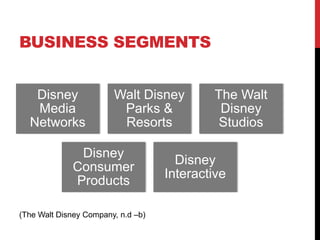
BUSINESS SEGMENTS
Disney
Media
Networks
Walt Disney
Parks &
Resorts
The Walt
Disney
Studios
Disney
Consumer
Products
Disney
Interactive
(The Walt Disney Company, n.d –b)
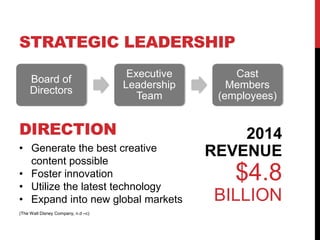
STRATEGIC LEADERSHIP
Board of
Directors
Executive
Leadership
Team
Cast
Members
(employees)
• Generate the best creative
content possible
• Foster innovation
• Utilize the latest technology
• Expand into new global markets
(The Walt Disney Company, n.d –c)
DIRECTION 2014
REVENUE
$4.8
BILLION
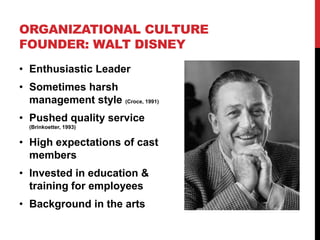
• Enthusiastic Leader
• Sometimes harsh
management style (Croce, 1991)
• Pushed quality service
(Brinkoetter, 1993)
• High expectations of cast
members
• Invested in education &
training for employees
• Background in the arts
ORGANIZATIONAL CULTURE
FOUNDER: WALT DISNEY
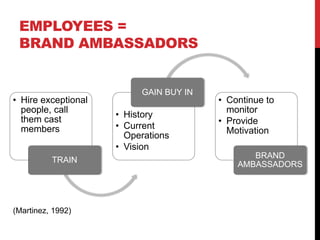
EMPLOYEES =
BRAND AMBASSADORS
• Hire exceptional
people, call
them cast
members
TRAIN
• History
• Current
Operations
• Vision
GAIN BUY IN
• Continue to
monitor
• Provide
Motivation
BRAND
AMBASSADORS
(Martinez, 1992)
THEORETICAL
FRAMEWORK
ORGANIZATIONAL CULTURE THEORY
Schein (1990) introduced organizational culture
theory as an analytical approach to the uncovering
and definition of specific organizational cultures.
Schein theorizes that all aspects of the
organizational culture can be categorized into three
primary areas of understanding, which are defined
as artifacts, values, and underlying assumptions.
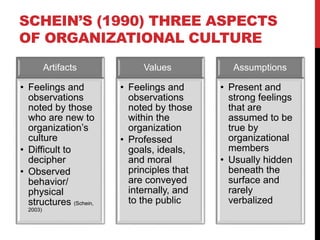
Artifacts
• Feelings and
observations
noted by those
who are new to
organization’s
culture
• Difficult to
decipher
• Observed
behavior/
physical
structures (Schein,
2003)
Values
• Feelings and
observations
noted by those
within the
organization
• Professed
goals, ideals,
and moral
principles that
are conveyed
internally, and
to the public
Assumptions
• Present and
strong feelings
that are
assumed to be
true by
organizational
members
• Usually hidden
beneath the
surface and
rarely
verbalized
SCHEIN’S (1990) THREE ASPECTS
OF ORGANIZATIONAL CULTURE
OTHER VIEWS
• Organizational culture has a fluctuating reality
determined by perception of external actors, particularly
within media companies that produce content for
external audiences (Deslandes, 2011)
• Cultural values provide a record of the behaviors that
have been “ingrained in the ways organizations develop
and structure themselves” (Gimenez, 2002, p. 325)
• Relevant for Disney who operates in
hundreds of markets, and whose
internal organizational beliefs do not
always align with the people and
governments in foreign markets
• Wakefield (2008) believes
organizational culture theory is a
two-way, symmetrical relationship,
fostered by the Internet and
media expansion
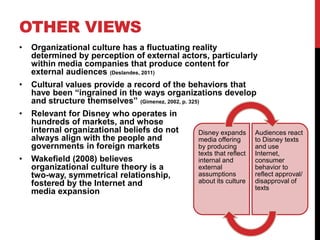
Disney expands
media offering
by producing
texts that reflect
internal and
external
assumptions
about its culture
Audiences react
to Disney texts
and use
Internet,
consumer
behavior to
reflect approval/
disapproval of
texts
LITERATURE
REVIEW
DISNEY’S ORGANIZATIONAL CULTURE
To better identify Disney’s organizational culture,
we will use organizational culture theorists and
texts produced by Disney to illuminate its
artifacts, values, and hidden assumptions that
exist internally, as well as assumptions that exist
externally in the form of global perceptions that
have been created as a response to Disney texts.
ARTIFACTS
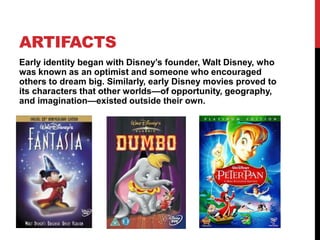
Early identity began with Disney’s founder, Walt Disney, who
was known as an optimist and someone who encouraged
others to dream big. Similarly, early Disney movies proved to
its characters that other worlds—of opportunity, geography,
and imagination—existed outside their own.
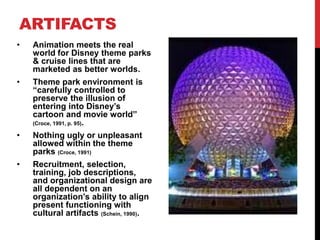
• Animation meets the real
world for Disney theme parks
& cruise lines that are
marketed as better worlds.
• Theme park environment is
“carefully controlled to
preserve the illusion of
entering into Disney’s
cartoon and movie world”
(Croce, 1991, p. 95).
• Nothing ugly or unpleasant
allowed within the theme
parks (Croce, 1991)
• Recruitment, selection,
training, job descriptions,
and organizational design are
all dependent on an
organization’s ability to align
present functioning with
cultural artifacts (Schein, 1990).
ARTIFACTS
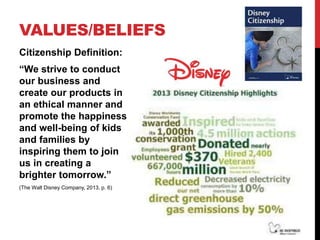
Citizenship Definition:
“We strive to conduct
our business and
create our products in
an ethical manner and
promote the happiness
and well-being of kids
and families by
inspiring them to join
us in creating a
brighter tomorrow.”
(The Walt Disney Company, 2013, p. 6)
VALUES/BELIEFS
VALUES/BELIEFS
• Deslandes (2011) theorizes that audiences are a critical component in the
definition of a mass media culture. By this rationale, the viewing audience is
the controlling force in determining Disney’s value system.
• Disney’s espoused values and ideals about “better worlds” are sometimes
compromised or at odds with the company’s intentions
• Ex. Aladdin – filled with Middle Eastern stereotypes, but also promised its
characters and audiences “A Whole New World”
• Everett’s (1990) functionalist perspective argues that Disney’s culture would
be rooted in capitalistic processes and “mechanisms to capture certain
goals” (p. 238), such as increased viewership and profitability.
“Everything we do is about trying to align
our organization, its resources, and its
efforts to cater to what the consumer
ultimately wants”
- Bob Chapek, president of Disney
Consumer Products (Lisanti, 2012, p. 50).
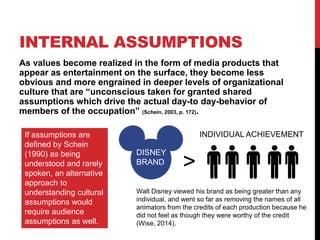
INTERNAL ASSUMPTIONS
As values become realized in the form of media products that
appear as entertainment on the surface, they become less
obvious and more engrained in deeper levels of organizational
culture that are “unconscious taken for granted shared
assumptions which drive the actual day-to day-behavior of
members of the occupation” (Schein, 2003, p. 172).
DISNEY
BRAND
>
INDIVIDUAL ACHIEVEMENT
Walt Disney viewed his brand as being greater than any
individual, and went so far as removing the names of all
animators from the credits of each production because he
did not feel as though they were worthy of the credit
(Wise, 2014).
If assumptions are
defined by Schein
(1990) as being
understood and rarely
spoken, an alternative
approach to
understanding cultural
assumptions would
require audience
assumptions as well.
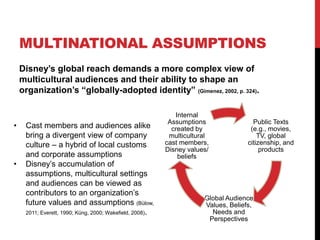
MULTINATIONAL ASSUMPTIONS
Disney’s global reach demands a more complex view of
multicultural audiences and their ability to shape an
organization’s “globally-adopted identity” (Gimenez, 2002, p. 324).
• Cast members and audiences alike
bring a divergent view of company
culture – a hybrid of local customs
and corporate assumptions
• Disney’s accumulation of
assumptions, multicultural settings
and audiences can be viewed as
contributors to an organization’s
future values and assumptions (Bülow,
2011; Everett, 1990; Küng, 2000; Wakefield, 2008).
Public Texts
(e.g., movies,
TV, global
citizenship, and
products
Global Audience
Values, Beliefs,
Needs and
Perspectives
Internal
Assumptions
created by
multicultural
cast members,
Disney values/
beliefs
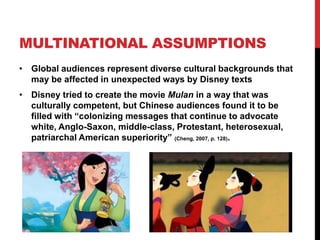
MULTINATIONAL ASSUMPTIONS
• Global audiences represent diverse cultural backgrounds that
may be affected in unexpected ways by Disney texts
• Disney tried to create the movie Mulan in a way that was
culturally competent, but Chinese audiences found it to be
filled with “colonizing messages that continue to advocate
white, Anglo-Saxon, middle-class, Protestant, heterosexual,
patriarchal American superiority” (Cheng, 2007, p. 128).
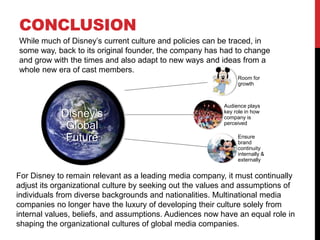
CONCLUSION
Disney’s
Global
Future
Room for
growth
Audience plays
key role in how
company is
perceived
Ensure
brand
continuity
internally &
externally
While much of Disney’s current culture and policies can be traced, in
some way, back to its original founder, the company has had to change
and grow with the times and also adapt to new ways and ideas from a
whole new era of cast members.
For Disney to remain relevant as a leading media company, it must continually
adjust its organizational culture by seeking out the values and assumptions of
individuals from diverse backgrounds and nationalities. Multinational media
companies no longer have the luxury of developing their culture solely from
internal values, beliefs, and assumptions. Audiences now have an equal role in
shaping the organizational cultures of global media companies.
REFERENCES
IT’S A BIG WORLD AFTER ALL
REFERENCES
Brinkoetter, T. (1993). Service, Disney style. Executive Excellence,
10(8), 3-5.
Bülow, A.M. (2011). Global corporate communication and the notion
of legitimacy. Journal of Intercultural Communication, (25), 4-29.
Cheng, S. (2007). A rhetorical analysis of cultural representation of
Disney's film Mulan. Kentucky Journal of Communication, 26(2),
123-141.
Croce, P.J. (1991). A clean and separate space: Walt Disney in
person and production. Journal of Popular Culture, 25(3), 91-104.
Deslandes, G. (2011). Corporate culture versus organizational
identity: Implications for media management. Journal of Media
Business Studies, 8(4), 23-36.
REFERENCES
Everett, J.L. (1990). Organizational culture and ethnoecology in
public relations theory and practice. Public Relations
Research Annual, 2, 235.
Gimenez, J. (2002). New media and conflicting realities in
multinational corporate communication: A case study.
International Review of Applied Linguistics in Language
Teaching, 40(4), 323-344.
Küng, L. (2000). Exploring the link between culture and strategy
in media organisations: The cases of the BBC and CNN. The
International Journal on Media Management, (2)2, 100-109.
Lisanti, T. (2012). Disney's new character. License! Global, 15(3),
48-50, 52, 54.
Martinez, M.N. (1992). Disney training works magic. HR
Magazine, 37(5), 53-56.
REFERENCES
Schein, E.H. (1990). Organizational culture. American
Psychologist, 45(2), 109-119.
Schein, E.H. (2003). The culture of media as viewed from an
organizational culture perspective. The International
Journal on Media Management, 5(3), 171-172.
Wakefield, R.I. (2008). Theory of international public relations,
the internet, and activism: A personal reflection. Journal
of Public Relations Research, 20(1), 138-157.
The Walt Disney Company. (2013). Disney citizenship: 2013
performance summary. Retrieved from
http://thewaltdisneycompany.com/sites/default/files/
reports/FY13PerfSummary.pdf
REFERENCES
The Walt Disney Company. (n.d.-b). Company overview.
Retrieved from http://thewaltdisneycompany.com/about-
disney/company-overview
The Walt Disney Company. (n.d.-c). Leadership. Retrieved
from http://thewaltdisneycompany.com/about-disney/
leadership
Wise, T.D. (2014). Creativity and culture at Pixar and Disney:
A comparison. Journal of the International Academy for
Case Studies, 20(1), 149-168.

It's a Big World After All

  • 1.
    IT’S A BIG WORLD AFTERALL A GLOBAL LOOK AT THE WALT DISNEY COMPANY’S ORGANIZATIONAL CULTURE CAYCI BANKS & CRAIG D. RAMEY QUEENS UNIVERSITY OF CHARLOTTE
  • 2.
    Utilizing Edgar Schein’s(1990) Organizational Culture Theory, this study will examine how Disney Texts (i.e. annual reports, TV shows, and movies) can be used to identify the artifacts, values, and underlying assumptions of Disney’s corporate culture. THESIS
  • 3.
    COMPANY INFO & HISTORYTHE WALTDISNEY COMPANY The culture at Disney began with its founder, Walt Disney. He used his enthusiastic personal style as a model to create traditional values, nostalgia for the past, and visions for the future that were reflected in his creations.
  • 4.
    BUSINESS SEGMENTS Disney Media Networks Walt Disney Parks& Resorts The Walt Disney Studios Disney Consumer Products Disney Interactive (The Walt Disney Company, n.d –b)
  • 5.
    STRATEGIC LEADERSHIP Board of Directors Executive Leadership Team Cast Members (employees) •Generate the best creative content possible • Foster innovation • Utilize the latest technology • Expand into new global markets (The Walt Disney Company, n.d –c) DIRECTION 2014 REVENUE $4.8 BILLION
  • 6.
    • Enthusiastic Leader •Sometimes harsh management style (Croce, 1991) • Pushed quality service (Brinkoetter, 1993) • High expectations of cast members • Invested in education & training for employees • Background in the arts ORGANIZATIONAL CULTURE FOUNDER: WALT DISNEY
  • 7.
    EMPLOYEES = BRAND AMBASSADORS •Hire exceptional people, call them cast members TRAIN • History • Current Operations • Vision GAIN BUY IN • Continue to monitor • Provide Motivation BRAND AMBASSADORS (Martinez, 1992)
  • 8.
    THEORETICAL FRAMEWORK ORGANIZATIONAL CULTURE THEORY Schein(1990) introduced organizational culture theory as an analytical approach to the uncovering and definition of specific organizational cultures. Schein theorizes that all aspects of the organizational culture can be categorized into three primary areas of understanding, which are defined as artifacts, values, and underlying assumptions.
  • 9.
    Artifacts • Feelings and observations notedby those who are new to organization’s culture • Difficult to decipher • Observed behavior/ physical structures (Schein, 2003) Values • Feelings and observations noted by those within the organization • Professed goals, ideals, and moral principles that are conveyed internally, and to the public Assumptions • Present and strong feelings that are assumed to be true by organizational members • Usually hidden beneath the surface and rarely verbalized SCHEIN’S (1990) THREE ASPECTS OF ORGANIZATIONAL CULTURE
  • 10.
    OTHER VIEWS • Organizationalculture has a fluctuating reality determined by perception of external actors, particularly within media companies that produce content for external audiences (Deslandes, 2011) • Cultural values provide a record of the behaviors that have been “ingrained in the ways organizations develop and structure themselves” (Gimenez, 2002, p. 325) • Relevant for Disney who operates in hundreds of markets, and whose internal organizational beliefs do not always align with the people and governments in foreign markets • Wakefield (2008) believes organizational culture theory is a two-way, symmetrical relationship, fostered by the Internet and media expansion Disney expands media offering by producing texts that reflect internal and external assumptions about its culture Audiences react to Disney texts and use Internet, consumer behavior to reflect approval/ disapproval of texts
  • 11.
    LITERATURE REVIEW DISNEY’S ORGANIZATIONAL CULTURE Tobetter identify Disney’s organizational culture, we will use organizational culture theorists and texts produced by Disney to illuminate its artifacts, values, and hidden assumptions that exist internally, as well as assumptions that exist externally in the form of global perceptions that have been created as a response to Disney texts.
  • 12.
    ARTIFACTS Early identity beganwith Disney’s founder, Walt Disney, who was known as an optimist and someone who encouraged others to dream big. Similarly, early Disney movies proved to its characters that other worlds—of opportunity, geography, and imagination—existed outside their own.
  • 13.
    • Animation meetsthe real world for Disney theme parks & cruise lines that are marketed as better worlds. • Theme park environment is “carefully controlled to preserve the illusion of entering into Disney’s cartoon and movie world” (Croce, 1991, p. 95). • Nothing ugly or unpleasant allowed within the theme parks (Croce, 1991) • Recruitment, selection, training, job descriptions, and organizational design are all dependent on an organization’s ability to align present functioning with cultural artifacts (Schein, 1990). ARTIFACTS
  • 14.
    Citizenship Definition: “We striveto conduct our business and create our products in an ethical manner and promote the happiness and well-being of kids and families by inspiring them to join us in creating a brighter tomorrow.” (The Walt Disney Company, 2013, p. 6) VALUES/BELIEFS
  • 15.
    VALUES/BELIEFS • Deslandes (2011)theorizes that audiences are a critical component in the definition of a mass media culture. By this rationale, the viewing audience is the controlling force in determining Disney’s value system. • Disney’s espoused values and ideals about “better worlds” are sometimes compromised or at odds with the company’s intentions • Ex. Aladdin – filled with Middle Eastern stereotypes, but also promised its characters and audiences “A Whole New World” • Everett’s (1990) functionalist perspective argues that Disney’s culture would be rooted in capitalistic processes and “mechanisms to capture certain goals” (p. 238), such as increased viewership and profitability. “Everything we do is about trying to align our organization, its resources, and its efforts to cater to what the consumer ultimately wants” - Bob Chapek, president of Disney Consumer Products (Lisanti, 2012, p. 50).
  • 16.
    INTERNAL ASSUMPTIONS As valuesbecome realized in the form of media products that appear as entertainment on the surface, they become less obvious and more engrained in deeper levels of organizational culture that are “unconscious taken for granted shared assumptions which drive the actual day-to day-behavior of members of the occupation” (Schein, 2003, p. 172). DISNEY BRAND > INDIVIDUAL ACHIEVEMENT Walt Disney viewed his brand as being greater than any individual, and went so far as removing the names of all animators from the credits of each production because he did not feel as though they were worthy of the credit (Wise, 2014). If assumptions are defined by Schein (1990) as being understood and rarely spoken, an alternative approach to understanding cultural assumptions would require audience assumptions as well.
  • 17.
    MULTINATIONAL ASSUMPTIONS Disney’s globalreach demands a more complex view of multicultural audiences and their ability to shape an organization’s “globally-adopted identity” (Gimenez, 2002, p. 324). • Cast members and audiences alike bring a divergent view of company culture – a hybrid of local customs and corporate assumptions • Disney’s accumulation of assumptions, multicultural settings and audiences can be viewed as contributors to an organization’s future values and assumptions (Bülow, 2011; Everett, 1990; Küng, 2000; Wakefield, 2008). Public Texts (e.g., movies, TV, global citizenship, and products Global Audience Values, Beliefs, Needs and Perspectives Internal Assumptions created by multicultural cast members, Disney values/ beliefs
  • 18.
    MULTINATIONAL ASSUMPTIONS • Globalaudiences represent diverse cultural backgrounds that may be affected in unexpected ways by Disney texts • Disney tried to create the movie Mulan in a way that was culturally competent, but Chinese audiences found it to be filled with “colonizing messages that continue to advocate white, Anglo-Saxon, middle-class, Protestant, heterosexual, patriarchal American superiority” (Cheng, 2007, p. 128).
  • 19.
    CONCLUSION Disney’s Global Future Room for growth Audience plays keyrole in how company is perceived Ensure brand continuity internally & externally While much of Disney’s current culture and policies can be traced, in some way, back to its original founder, the company has had to change and grow with the times and also adapt to new ways and ideas from a whole new era of cast members. For Disney to remain relevant as a leading media company, it must continually adjust its organizational culture by seeking out the values and assumptions of individuals from diverse backgrounds and nationalities. Multinational media companies no longer have the luxury of developing their culture solely from internal values, beliefs, and assumptions. Audiences now have an equal role in shaping the organizational cultures of global media companies.
  • 20.
    REFERENCES IT’S A BIGWORLD AFTER ALL
  • 21.
    REFERENCES Brinkoetter, T. (1993).Service, Disney style. Executive Excellence, 10(8), 3-5. Bülow, A.M. (2011). Global corporate communication and the notion of legitimacy. Journal of Intercultural Communication, (25), 4-29. Cheng, S. (2007). A rhetorical analysis of cultural representation of Disney's film Mulan. Kentucky Journal of Communication, 26(2), 123-141. Croce, P.J. (1991). A clean and separate space: Walt Disney in person and production. Journal of Popular Culture, 25(3), 91-104. Deslandes, G. (2011). Corporate culture versus organizational identity: Implications for media management. Journal of Media Business Studies, 8(4), 23-36.
  • 22.
    REFERENCES Everett, J.L. (1990).Organizational culture and ethnoecology in public relations theory and practice. Public Relations Research Annual, 2, 235. Gimenez, J. (2002). New media and conflicting realities in multinational corporate communication: A case study. International Review of Applied Linguistics in Language Teaching, 40(4), 323-344. Küng, L. (2000). Exploring the link between culture and strategy in media organisations: The cases of the BBC and CNN. The International Journal on Media Management, (2)2, 100-109. Lisanti, T. (2012). Disney's new character. License! Global, 15(3), 48-50, 52, 54. Martinez, M.N. (1992). Disney training works magic. HR Magazine, 37(5), 53-56.
  • 23.
    REFERENCES Schein, E.H. (1990).Organizational culture. American Psychologist, 45(2), 109-119. Schein, E.H. (2003). The culture of media as viewed from an organizational culture perspective. The International Journal on Media Management, 5(3), 171-172. Wakefield, R.I. (2008). Theory of international public relations, the internet, and activism: A personal reflection. Journal of Public Relations Research, 20(1), 138-157. The Walt Disney Company. (2013). Disney citizenship: 2013 performance summary. Retrieved from http://thewaltdisneycompany.com/sites/default/files/ reports/FY13PerfSummary.pdf
  • 24.
    REFERENCES The Walt DisneyCompany. (n.d.-b). Company overview. Retrieved from http://thewaltdisneycompany.com/about- disney/company-overview The Walt Disney Company. (n.d.-c). Leadership. Retrieved from http://thewaltdisneycompany.com/about-disney/ leadership Wise, T.D. (2014). Creativity and culture at Pixar and Disney: A comparison. Journal of the International Academy for Case Studies, 20(1), 149-168.