Proposal For My Animation
Project
By Sabrina Gardiner
Brief outline of my idea
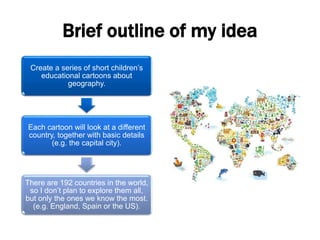
Create a series of short children’s
educational cartoons about
geography.
Each cartoon will look at a different
country, together with basic details
(e.g. the capital city).
There are 192 countries in the world,
so I don’t plan to explore them all,
but only the ones we know the most.
(e.g. England, Spain or the US).
What I hope to achieve from this
project
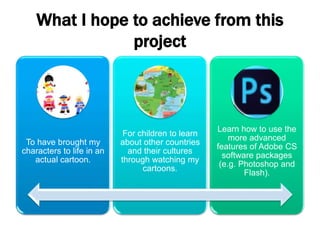
To have brought my
characters to life in an
actual cartoon.
For children to learn
about other countries
and their cultures
through watching my
cartoons.
Learn how to use the
more advanced
features of Adobe CS
software packages
(e.g. Photoshop and
Flash).
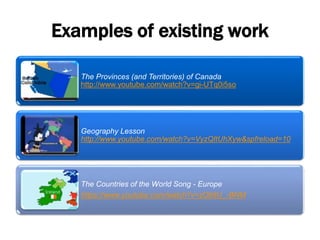
Examples of existing work
The Provinces (and Territories) of Canada
http://www.youtube.com/watch?v=gi-UTq0i5so
Geography Lesson
http://www.youtube.com/watch?v=VyzQItUhXyw&spfreload=10
The Countries of the World Song - Europe
https://www.youtube.com/watch?v=zOti8U_-BNM
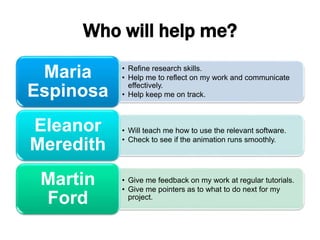
Who will help me?
• Refine research skills.
• Help me to reflect on my work and communicate
effectively.
• Help keep me on track.
Maria
Espinosa
• Will teach me how to use the relevant software.
• Check to see if the animation runs smoothly.
Eleanor
Meredith
• Give me feedback on my work at regular tutorials.
• Give me pointers as to what to do next for my
project.
Martin
Ford
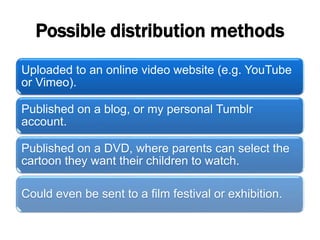
Possible distribution methods
Uploaded to an online video website (e.g. YouTube
or Vimeo).
Published on a blog, or my personal Tumblr
account.
Published on a DVD, where parents can select the
cartoon they want their children to watch.
Could even be sent to a film festival or exhibition.
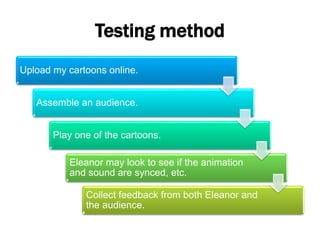
Testing method
Upload my cartoons online.
Assemble an audience.
Play one of the cartoons.
Eleanor may look to see if the animation
and sound are synced, etc.
Collect feedback from both Eleanor and
the audience.
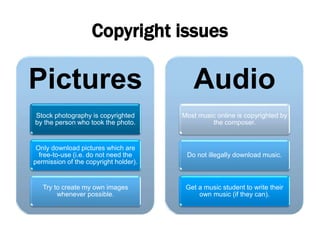
Copyright issues
Pictures
Stock photography is copyrighted
by the person who took the photo.
Only download pictures which are
free-to-use (i.e. do not need the
permission of the copyright holder).
Try to create my own images
whenever possible.
Audio
Most music online is copyrighted by
the composer.
Do not illegally download music.
Get a music student to write their
own music (if they can).
Bibliography
1. How many countries in the world. (c. 2014) Available at:
http://www.worldatlas.com/nations.htm (Accessed: 23 October 2014)
2. Oxford University Press. (2015) Animation: definition of animation in Oxford dictionary
(British & World English). Available at:
http://www.oxforddictionaries.com/definition/english/animation (Accessed: 23 January
2015).
3. Williams, R. and Sutton, I. (2001) The Animator’s Survival Kit. London, UK/New York, NY,
USA. Faber and Faber.
4. Laybourne, K. (1998) The Animation Book. New York, NY, USA. Three Rivers
Press/Random House.
5. Taylor, R. (1996) The Encyclopedia of Animation Techniques. Oxford, UK. Focal Press,
Butterworth-Heinemann, Quarto Publishing.
6. Wells, P. (2009) Drawing for Animation. Lausanne, Switzerland/London, UK. AVA
Publishing, Thames & Hudson.
7. Lasseter, J. (1987), ‘Principles of traditional animation applied to 3D computer animation’.
Computer Graphics, vol. 21, no. 4, pp. 35-44.
8. Mayer, R.E. and Moreno, R. (2002), ‘Animation as an aid to multimedia learning’.
Educational Psychology Review, vol. 14, no. 1, pp. 87-99.
9. British Film Institute (BFI). (2007) BFI Screenonline: Quinn, Joanna (1962-) Biography.
Available at: http://www.screenonline.org.uk/people/id/534141/ (Accessed: 23 January
2015).
10. National Media Museum. (2009) Joanna Quinn: How I Animate. [Web video] YouTube,
Available at: www.youtube.com/watch?v=rWfVEdbvdoE (Accessed: 23 January 2015).
Bibliography (continued)
1. Oxford University Press. (2015). Anthropomorphism: definition of anthropomorphism in Oxford
dictionary (British & World English). Available at:
http://www.oxforddictionaries.com/definition/english/anthropomorphism (Accessed: 28 January
2015).
2. Psych Central News. (2010) Why Do We Anthromorphize? Available at:
http://psychcentral.com/news/2010/03/01/why-do-we-anthropomorphize/11766.html (Accessed: 28
January 2015).
3. Blanchard, J.S. (1982), ‘Anthropomorphism in beginning readers’. The Reading Teacher, vol. 35,
no. 5, p. 536. Available at:
http://www.jstor.org/discover/10.2307/20198047?sid=21105722183443&uid=4&uid=2&uid=373803
2 (Accessed: 28 January 2015).
4. Markowsky, J.K. (1975), ‘Why Anthropomorphism in Children’s Literature?’ Elementary English,
vol. 52, no. 4, pp. 460-466. Available at:
http://www.jstor.org/discover/10.2307/41592646?sid=21105722692063&uid=2&uid=3738032&uid=
4 (Accessed: 28 January 2015).
5. Opotow, S. (2003) Identity and the Natural Environment: The Psychological Significance of
Nature. Cambridge, MA, USA. MIT Press.
6. kidslove2learn. (2012) The Provinces (and Territories) of Canada. [Web video] YouTube, Available
at: http://www.youtube.com/watch?v=gi-UTq0i5so (Accessed: 24 October 2014).
7. pscotton. (2005) Geography Lesson. [Web video] YouTube, Available at:
http://www.youtube.com/watch?v=VyzQItUhXyw&spfreload=10 (Accessed: 24 October 2014).
8. Alysson Luca. (2009) If The World Were A Village. [Web video] YouTube, Available at:
http://www.youtube.com/watch?v=FtYjUv2x65g (Accessed: 24 October 2014)
9. KidsTV123. (2011) The Countries of the World Song – Europe. [Web video] YouTube, Available at:
https://www.youtube.com/watch?v=zOti8U_-BNM (Accessed: 22 October 2014).

Proposal for my animation project

  • 1.
    Proposal For MyAnimation Project By Sabrina Gardiner
  • 2.
    Brief outline ofmy idea Create a series of short children’s educational cartoons about geography. Each cartoon will look at a different country, together with basic details (e.g. the capital city). There are 192 countries in the world, so I don’t plan to explore them all, but only the ones we know the most. (e.g. England, Spain or the US).
  • 3.
    What I hopeto achieve from this project To have brought my characters to life in an actual cartoon. For children to learn about other countries and their cultures through watching my cartoons. Learn how to use the more advanced features of Adobe CS software packages (e.g. Photoshop and Flash).
  • 4.
    Examples of existingwork The Provinces (and Territories) of Canada http://www.youtube.com/watch?v=gi-UTq0i5so Geography Lesson http://www.youtube.com/watch?v=VyzQItUhXyw&spfreload=10 The Countries of the World Song - Europe https://www.youtube.com/watch?v=zOti8U_-BNM
  • 5.
    Who will helpme? • Refine research skills. • Help me to reflect on my work and communicate effectively. • Help keep me on track. Maria Espinosa • Will teach me how to use the relevant software. • Check to see if the animation runs smoothly. Eleanor Meredith • Give me feedback on my work at regular tutorials. • Give me pointers as to what to do next for my project. Martin Ford
  • 6.
    Possible distribution methods Uploadedto an online video website (e.g. YouTube or Vimeo). Published on a blog, or my personal Tumblr account. Published on a DVD, where parents can select the cartoon they want their children to watch. Could even be sent to a film festival or exhibition.
  • 7.
    Testing method Upload mycartoons online. Assemble an audience. Play one of the cartoons. Eleanor may look to see if the animation and sound are synced, etc. Collect feedback from both Eleanor and the audience.
  • 8.
    Copyright issues Pictures Stock photographyis copyrighted by the person who took the photo. Only download pictures which are free-to-use (i.e. do not need the permission of the copyright holder). Try to create my own images whenever possible. Audio Most music online is copyrighted by the composer. Do not illegally download music. Get a music student to write their own music (if they can).
  • 9.
    Bibliography 1. How manycountries in the world. (c. 2014) Available at: http://www.worldatlas.com/nations.htm (Accessed: 23 October 2014) 2. Oxford University Press. (2015) Animation: definition of animation in Oxford dictionary (British & World English). Available at: http://www.oxforddictionaries.com/definition/english/animation (Accessed: 23 January 2015). 3. Williams, R. and Sutton, I. (2001) The Animator’s Survival Kit. London, UK/New York, NY, USA. Faber and Faber. 4. Laybourne, K. (1998) The Animation Book. New York, NY, USA. Three Rivers Press/Random House. 5. Taylor, R. (1996) The Encyclopedia of Animation Techniques. Oxford, UK. Focal Press, Butterworth-Heinemann, Quarto Publishing. 6. Wells, P. (2009) Drawing for Animation. Lausanne, Switzerland/London, UK. AVA Publishing, Thames & Hudson. 7. Lasseter, J. (1987), ‘Principles of traditional animation applied to 3D computer animation’. Computer Graphics, vol. 21, no. 4, pp. 35-44. 8. Mayer, R.E. and Moreno, R. (2002), ‘Animation as an aid to multimedia learning’. Educational Psychology Review, vol. 14, no. 1, pp. 87-99. 9. British Film Institute (BFI). (2007) BFI Screenonline: Quinn, Joanna (1962-) Biography. Available at: http://www.screenonline.org.uk/people/id/534141/ (Accessed: 23 January 2015). 10. National Media Museum. (2009) Joanna Quinn: How I Animate. [Web video] YouTube, Available at: www.youtube.com/watch?v=rWfVEdbvdoE (Accessed: 23 January 2015).
  • 10.
    Bibliography (continued) 1. OxfordUniversity Press. (2015). Anthropomorphism: definition of anthropomorphism in Oxford dictionary (British & World English). Available at: http://www.oxforddictionaries.com/definition/english/anthropomorphism (Accessed: 28 January 2015). 2. Psych Central News. (2010) Why Do We Anthromorphize? Available at: http://psychcentral.com/news/2010/03/01/why-do-we-anthropomorphize/11766.html (Accessed: 28 January 2015). 3. Blanchard, J.S. (1982), ‘Anthropomorphism in beginning readers’. The Reading Teacher, vol. 35, no. 5, p. 536. Available at: http://www.jstor.org/discover/10.2307/20198047?sid=21105722183443&uid=4&uid=2&uid=373803 2 (Accessed: 28 January 2015). 4. Markowsky, J.K. (1975), ‘Why Anthropomorphism in Children’s Literature?’ Elementary English, vol. 52, no. 4, pp. 460-466. Available at: http://www.jstor.org/discover/10.2307/41592646?sid=21105722692063&uid=2&uid=3738032&uid= 4 (Accessed: 28 January 2015). 5. Opotow, S. (2003) Identity and the Natural Environment: The Psychological Significance of Nature. Cambridge, MA, USA. MIT Press. 6. kidslove2learn. (2012) The Provinces (and Territories) of Canada. [Web video] YouTube, Available at: http://www.youtube.com/watch?v=gi-UTq0i5so (Accessed: 24 October 2014). 7. pscotton. (2005) Geography Lesson. [Web video] YouTube, Available at: http://www.youtube.com/watch?v=VyzQItUhXyw&spfreload=10 (Accessed: 24 October 2014). 8. Alysson Luca. (2009) If The World Were A Village. [Web video] YouTube, Available at: http://www.youtube.com/watch?v=FtYjUv2x65g (Accessed: 24 October 2014) 9. KidsTV123. (2011) The Countries of the World Song – Europe. [Web video] YouTube, Available at: https://www.youtube.com/watch?v=zOti8U_-BNM (Accessed: 22 October 2014).

Editor's Notes

  • #3 I’m planning to create a series of short cartoons for children aged 8-10 on the subject of geography. Each episode will focus on a different country, along with basic facts about that country, such as the capital city, and what it is known for. It wouldn’t be practical to create an episode for all 192 countries, so I will only focus on countries that we all know, e.g. England, Spain, or the US). (The UN estimates that there are currently 192 independent countries in the world: http://www.worldatlas.com/nations.htm)