ITIL® 2011 Foundation Certification
Module 1: ITIL Introduction
For more information:
Visit our website
www.makemewise.org
Email us at
support@makemewise.org
©2015 MakeMeWise. All Rights Reserved.
Based on AXELOS ITIL® material. Material is reproduced under license from AXELOS. All rights reserved.
ITIL® is a registered trade mark of AXELOS Limited, used under permission of AXELOS Limited. All rights reserved.
The Swirl logo™ is a trade mark of AXELOS Limited, used under permission of AXELOS Limited. All rights reserved.
MakeMeWise™ Education Services Pvt Ltd is the Accredited Training Organization (ATO) of PEOPLECERT®
PEOPLECERT® is the accredited Examination Institute (EI) of AXELOS Limited
Why ITIL
1
MakeMeWise. All Rights Reserved
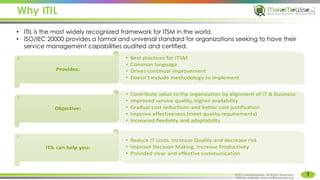
• ITIL is the most widely recognized framework for ITSM in the world.
• ISO/IEC 20000 provides a formal and universal standard for organizations seeking to have their
service management capabilities audited and certified.
©2015 MakeMeWise. All Rights Reserved.
Visit our website: www.makemewise.org
ITIL Qualification Scheme
2
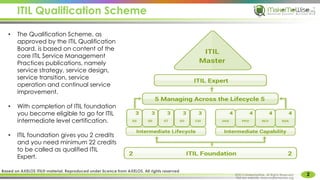
• The Qualification Scheme, as
approved by the ITIL Qualification
Board, is based on content of the
core ITIL Service Management
Practices publications, namely
service strategy, service design,
service transition, service
operation and continual service
improvement.
• With completion of ITIL foundation
you become eligible to go for ITIL
intermediate level certification.
• ITIL foundation gives you 2 credits
and you need minimum 22 credits
to be called as qualified ITIL
Expert.
©2015 MakeMeWise. All Rights Reserved.
Visit our website: www.makemewise.org
Based on AXELOS ITIL® material. Reproduced under licence from AXELOS. All rights reserved
ITIL Foundation Exam Details
3
MakeMeWise. All Rights Reserved
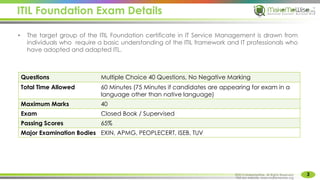
• The target group of the ITIL Foundation certificate in IT Service Management is drawn from
individuals who require a basic understanding of the ITIL framework and IT professionals who
have adopted and adapted ITL.
Questions Multiple Choice 40 Questions, No Negative Marking
Total Time Allowed 60 Minutes (75 Minutes if candidates are appearing for exam in a
language other than native language)
Maximum Marks 40
Exam Closed Book / Supervised
Passing Scores 65%
Major Examination Bodies EXIN, APMG, PEOPLECERT, ISEB, TUV
©2015 MakeMeWise. All Rights Reserved.
Visit our website: www.makemewise.org
ITIL Core and Complementary Publications
4
MakeMeWise. All Rights Reserved
•The ITIL core consists of five lifecycle publications. Each provides part of the
guidance necessary for an integrated approach as required by the ISO/IEC
20000 standard specification:
•ITIL Service Strategy
•ITIL Service Design
•ITIL Service Transition
•ITIL Service Operation
•ITIL Continual Service Improvement
Core Publications
•Complementary ITIL publications provide flexibility to implement the core in
a diverse range of environments
•Complementary set of ITIL publications providing guidance specific to
industry sectors, organization types, operating models and technology
architectures.
Complementary Publications
©2015 MakeMeWise. All Rights Reserved.
Visit our website: www.makemewise.org
Why ITIL is so successful
5
MakeMeWise. All Rights Reserved
•ITIL service management practices are applicable in any IT organization because
they are not based on any particular technology platform or industry type.
Vendor Neutral
•ITIL offers robust, mature and time-tested practices that have applicability to all
types of service organization. It continues to be useful and relevant in public and
private sectors, internal and external service providers, small, medium and large
enterprises, and within any technical environment.
Non-Prescriptive
•ITIL represents the learning experiences and thought leadership of the world’s
best-in-class service providers.
Best Practice
•ITIL is owned by the UK government and is not tied to any commercial proprietary
practice or solution.
Public Framework
©2015 MakeMeWise. All Rights Reserved.
Visit our website: www.makemewise.org
IT Service Management
6
MakeMeWise. All Rights Reserved
•The result of carrying out an activity, following a process, or delivering an IT
service
Outcome
•A means of delivering value to customers by facilitating outcomes customers
want to achieve without the ownership of specific costs and risks.
Service
•A set of specialized organizational capabilities for providing value to customers
in the form of services.
Service Management
•The implementation and management of quality IT services that meet the needs
of the business.
IT Service Management
©2015 MakeMeWise. All Rights Reserved.
Visit our website: www.makemewise.org
Types of Services
7
MakeMeWise. All Rights Reserved
•Core Services deliver the basic outcomes desired by one or more customers. They
represent the value that the customer wants and for which they are willing to pay.
•Core services anchor the value proposition for the customer and provide the basis
for their continued utilization and satisfaction
Core
•These are services that are needed in order for a core service to be delivered.
•These may or may not be visible to the customer, but the customer does not
perceive them as services in their own right. They are ‘basic factors’ which enable
the customer to receive the ‘real’ (core) service.
Enabling
•Enhancing services are services that are added to a core service to make it more
exciting or enticing to the customer.
•These are not essential to the delivery of a core service, and are added to a core
service as ‘excitement’ factors, which will encourage customers to use the core
service more (or to choose core service of one company over its competitors).
Enhancing
©2015 MakeMeWise. All Rights Reserved.
Visit our website: www.makemewise.org
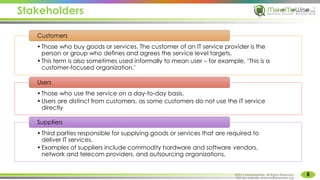
Stakeholders
8
MakeMeWise. All Rights Reserved
•Those who buy goods or services. The customer of an IT service provider is the
person or group who defines and agrees the service level targets.
•This term is also sometimes used informally to mean user – for example, ‘This is a
customer-focused organization.’
Customers
•Those who use the service on a day-to-day basis.
•Users are distinct from customers, as some customers do not use the IT service
directly
Users
•Third parties responsible for supplying goods or services that are required to
deliver IT services.
•Examples of suppliers include commodity hardware and software vendors,
network and telecom providers, and outsourcing organizations.
Suppliers
©2015 MakeMeWise. All Rights Reserved.
Visit our website: www.makemewise.org
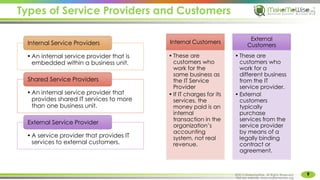
Types of Service Providers and Customers
9
MakeMeWise. All Rights Reserved
•An internal service provider that is
embedded within a business unit.
Internal Service Providers
•An internal service provider that
provides shared IT services to more
than one business unit.
Shared Service Providers
•A service provider that provides IT
services to external customers.
External Service Provider
Internal Customers
• These are
customers who
work for the
same business as
the IT Service
Provider
• If IT charges for its
services, the
money paid is an
internal
transaction in the
organization’s
accounting
system, not real
revenue.
External
Customers
• These are
customers who
work for a
different business
from the IT
service provider.
• External
customers
typically
purchase
services from the
service provider
by means of a
legally binding
contract or
agreement.
©2015 MakeMeWise. All Rights Reserved.
Visit our website: www.makemewise.org
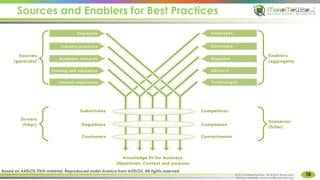
Sources and Enablers for Best Practices
10
MakeMeWise. All Rights Reserved
©2015 MakeMeWise. All Rights Reserved.
Visit our website: www.makemewise.org
Based on AXELOS ITIL® material. Reproduced under licence from AXELOS. All rights reserved
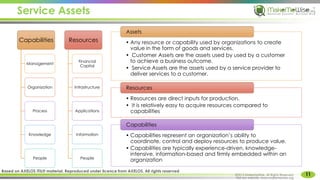
Service Assets
11
MakeMeWise. All Rights Reserved
Capabilities
Management
Organization
Process
Knowledge
People
Resources
Financial
Capital
Infrastructure
Applications
Information
People
• Any resource or capability used by organizations to create
value in the form of goods and services.
• Customer Assets are the assets used by used by a customer
to achieve a business outcome.
• Service Assets are the assets used by a service provider to
deliver services to a customer.
Assets
• Resources are direct inputs for production.
• It is relatively easy to acquire resources compared to
capabilities
Resources
• Capabilities represent an organization’s ability to
coordinate, control and deploy resources to produce value.
• Capabilities are typically experience-driven, knowledge-
intensive, information-based and firmly embedded within an
organization
Capabilities
©2015 MakeMeWise. All Rights Reserved.
Visit our website: www.makemewise.org
Based on AXELOS ITIL® material. Reproduced under licence from AXELOS. All rights reserved
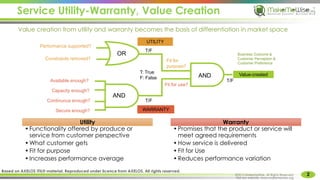
Service Utility-Warranty, Value Creation
2
Value creation from utility and warranty becomes the basis of differentiation in market space
UTILITY
WARRANTY
T/F
T/F
T/F
Fit for
purpose?
Fit for use?
OR
AND
Performance supported?
Constraints removed?
Available enough?
Capacity enough?
Continuous enough?
Secure enough?
T: True
F: False
Value-createdAND
Business Outcome &
Customer Perception &
Customer Preference
Utility
•Functionality offered by produce or
service from customer perspective
•What customer gets
•Fit for purpose
•Increases performance average
Warranty
•Promises that the product or service will
meet agreed requirements
•How service is delivered
•Fit for Use
•Reduces performance variation
©2015 MakeMeWise. All Rights Reserved.
Visit our website: www.makemewise.org
Based on AXELOS ITIL® material. Reproduced under licence from AXELOS. All rights reserved.
Service Value Creation
13
MakeMeWise. All Rights Reserved
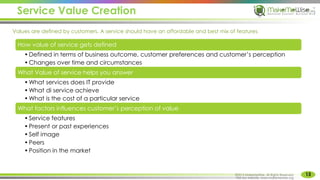
Values are defined by customers. A service should have an affordable and best mix of features
How value of service gets defined
•Defined in terms of business outcome, customer preferences and customer’s perception
•Changes over time and circumstances
What Value of service helps you answer
•What services does IT provide
•What di service achieve
•What is the cost of a particular service
What factors influences customer’s perception of value
•Service features
•Present or past experiences
•Self image
•Peers
•Position in the market
©2015 MakeMeWise. All Rights Reserved.
Visit our website: www.makemewise.org
Service Management Technology Automation
14
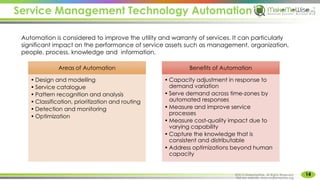
Automation is considered to improve the utility and warranty of services. It can particularly
significant impact on the performance of service assets such as management, organization,
people, process, knowledge and information.
Areas of Automation
• Design and modelling
• Service catalogue
• Pattern recognition and analysis
• Classification, prioritization and routing
• Detection and monitoring
• Optimization
Benefits of Automation
• Capacity adjustment in response to
demand variation
• Serve demand across time-zones by
automated responses
• Measure and improve service
processes
• Measure cost-quality impact due to
varying capability
• Capture the knowledge that is
consistent and distributable
• Address optimizations beyond human
capacity
©2015 MakeMeWise. All Rights Reserved.
Visit our website: www.makemewise.org
Process
15
MakeMeWise. All Rights Reserved
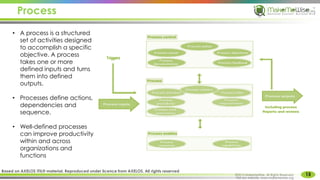
• A process is a structured
set of activities designed
to accomplish a specific
objective. A process
takes one or more
defined inputs and turns
them into defined
outputs.
• Processes define actions,
dependencies and
sequence.
• Well-defined processes
can improve productivity
within and across
organizations and
functions
©2015 MakeMeWise. All Rights Reserved.
Visit our website: www.makemewise.org
Based on AXELOS ITIL® material. Reproduced under licence from AXELOS. All rights reserved
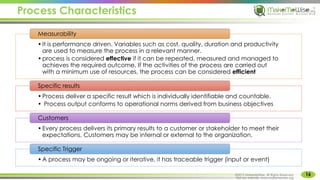
Process Characteristics
16
MakeMeWise. All Rights Reserved
•It is performance driven. Variables such as cost, quality, duration and productivity
are used to measure the process in a relevant manner.
•process is considered effective if it can be repeated, measured and managed to
achieves the required outcome. If the activities of the process are carried out
with a minimum use of resources, the process can be considered efficient
Measurability
•Process deliver a specific result which is individually identifiable and countable.
• Process output conforms to operational norms derived from business objectives
Specific results
•Every process delivers its primary results to a customer or stakeholder to meet their
expectations. Customers may be internal or external to the organization.
Customers
•A process may be ongoing or iterative, it has traceable trigger (input or event)
Specific Trigger
©2015 MakeMeWise. All Rights Reserved.
Visit our website: www.makemewise.org
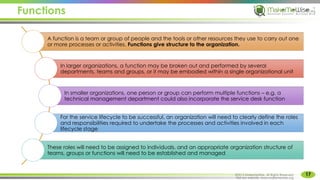
Functions
17
MakeMeWise. All Rights Reserved
A function is a team or group of people and the tools or other resources they use to carry out one
or more processes or activities. Functions give structure to the organization.
In larger organizations, a function may be broken out and performed by several
departments, teams and groups, or it may be embodied within a single organizational unit
In smaller organizations, one person or group can perform multiple functions – e.g. a
technical management department could also incorporate the service desk function
For the service lifecycle to be successful, an organization will need to clearly define the roles
and responsibilities required to undertake the processes and activities involved in each
lifecycle stage
These roles will need to be assigned to individuals, and an appropriate organization structure of
teams, groups or functions will need to be established and managed
©2015 MakeMeWise. All Rights Reserved.
Visit our website: www.makemewise.org
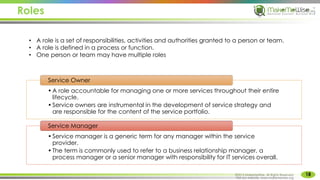
Roles
18
MakeMeWise. All Rights Reserved
• A role is a set of responsibilities, activities and authorities granted to a person or team.
• A role is defined in a process or function.
• One person or team may have multiple roles
•A role accountable for managing one or more services throughout their entire
lifecycle.
•Service owners are instrumental in the development of service strategy and
are responsible for the content of the service portfolio.
Service Owner
•Service manager is a generic term for any manager within the service
provider.
•The term is commonly used to refer to a business relationship manager, a
process manager or a senior manager with responsibility for IT services overall.
Service Manager
©2015 MakeMeWise. All Rights Reserved.
Visit our website: www.makemewise.org
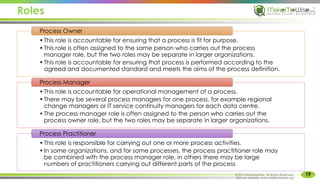
Roles
19
•This role is accountable for ensuring that a process is fit for purpose.
•This role is often assigned to the same person who carries out the process
manager role, but the two roles may be separate in larger organizations.
•This role is accountable for ensuring that process is performed according to the
agreed and documented standard and meets the aims of the process definition.
Process Owner
•This role is accountable for operational management of a process.
•There may be several process managers for one process, for example regional
change managers or IT service continuity managers for each data centre.
•The process manager role is often assigned to the person who carries out the
process owner role, but the two roles may be separate in larger organizations.
Process Manager
•This role is responsible for carrying out one or more process activities.
•In some organizations, and for some processes, the process practitioner role may
be combined with the process manager role, in others there may be large
numbers of practitioners carrying out different parts of the process
Process Practitioner
©2015 MakeMeWise. All Rights Reserved.
Visit our website: www.makemewise.org
RACI
20
MakeMeWise. All Rights Reserved
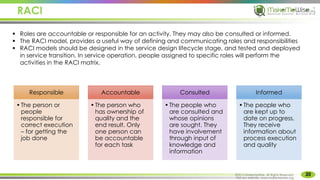
 Roles are accountable or responsible for an activity. They may also be consulted or informed.
 The RACI model, provides a useful way of defining and communicating roles and responsibilities
 RACI models should be designed in the service design lifecycle stage, and tested and deployed
in service transition. In service operation, people assigned to specific roles will perform the
activities in the RACI matrix.
Responsible
•The person or
people
responsible for
correct execution
– for getting the
job done
Accountable
•The person who
has ownership of
quality and the
end result. Only
one person can
be accountable
for each task
Consulted
•The people who
are consulted and
whose opinions
are sought. They
have involvement
through input of
knowledge and
information
Informed
•The people who
are kept up to
date on progress.
They receive
information about
process execution
and quality
©2015 MakeMeWise. All Rights Reserved.
Visit our website: www.makemewise.org
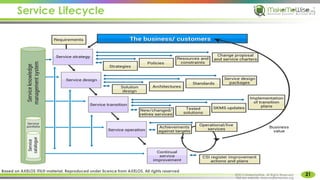
Service Lifecycle
21
MakeMeWise. All Rights Reserved
©2015 MakeMeWise. All Rights Reserved.
Visit our website: www.makemewise.org
Based on AXELOS ITIL® material. Reproduced under licence from AXELOS. All rights reserved
End of Module 1:
ITIL Introduction
No part of this document may be reproduced in any form
without the written permission of MakeMeWise Education
Services Pvt Ltd. and AXELOS Limited
Permission can be requested at www.makemewise.org and
licensing@AXELOS.com.
For more information:
Visit our website
www.makemewise.org
Email us at
support@makemewise.org
©2015 MakeMeWise. All Rights Reserved.

Itil certification course

  • 1.
    ITIL® 2011 FoundationCertification Module 1: ITIL Introduction For more information: Visit our website www.makemewise.org Email us at support@makemewise.org ©2015 MakeMeWise. All Rights Reserved. Based on AXELOS ITIL® material. Material is reproduced under license from AXELOS. All rights reserved. ITIL® is a registered trade mark of AXELOS Limited, used under permission of AXELOS Limited. All rights reserved. The Swirl logo™ is a trade mark of AXELOS Limited, used under permission of AXELOS Limited. All rights reserved. MakeMeWise™ Education Services Pvt Ltd is the Accredited Training Organization (ATO) of PEOPLECERT® PEOPLECERT® is the accredited Examination Institute (EI) of AXELOS Limited
  • 2.
    Why ITIL 1 MakeMeWise. AllRights Reserved • ITIL is the most widely recognized framework for ITSM in the world. • ISO/IEC 20000 provides a formal and universal standard for organizations seeking to have their service management capabilities audited and certified. ©2015 MakeMeWise. All Rights Reserved. Visit our website: www.makemewise.org
  • 3.
    ITIL Qualification Scheme 2 •The Qualification Scheme, as approved by the ITIL Qualification Board, is based on content of the core ITIL Service Management Practices publications, namely service strategy, service design, service transition, service operation and continual service improvement. • With completion of ITIL foundation you become eligible to go for ITIL intermediate level certification. • ITIL foundation gives you 2 credits and you need minimum 22 credits to be called as qualified ITIL Expert. ©2015 MakeMeWise. All Rights Reserved. Visit our website: www.makemewise.org Based on AXELOS ITIL® material. Reproduced under licence from AXELOS. All rights reserved
  • 4.
    ITIL Foundation ExamDetails 3 MakeMeWise. All Rights Reserved • The target group of the ITIL Foundation certificate in IT Service Management is drawn from individuals who require a basic understanding of the ITIL framework and IT professionals who have adopted and adapted ITL. Questions Multiple Choice 40 Questions, No Negative Marking Total Time Allowed 60 Minutes (75 Minutes if candidates are appearing for exam in a language other than native language) Maximum Marks 40 Exam Closed Book / Supervised Passing Scores 65% Major Examination Bodies EXIN, APMG, PEOPLECERT, ISEB, TUV ©2015 MakeMeWise. All Rights Reserved. Visit our website: www.makemewise.org
  • 5.
    ITIL Core andComplementary Publications 4 MakeMeWise. All Rights Reserved •The ITIL core consists of five lifecycle publications. Each provides part of the guidance necessary for an integrated approach as required by the ISO/IEC 20000 standard specification: •ITIL Service Strategy •ITIL Service Design •ITIL Service Transition •ITIL Service Operation •ITIL Continual Service Improvement Core Publications •Complementary ITIL publications provide flexibility to implement the core in a diverse range of environments •Complementary set of ITIL publications providing guidance specific to industry sectors, organization types, operating models and technology architectures. Complementary Publications ©2015 MakeMeWise. All Rights Reserved. Visit our website: www.makemewise.org
  • 6.
    Why ITIL isso successful 5 MakeMeWise. All Rights Reserved •ITIL service management practices are applicable in any IT organization because they are not based on any particular technology platform or industry type. Vendor Neutral •ITIL offers robust, mature and time-tested practices that have applicability to all types of service organization. It continues to be useful and relevant in public and private sectors, internal and external service providers, small, medium and large enterprises, and within any technical environment. Non-Prescriptive •ITIL represents the learning experiences and thought leadership of the world’s best-in-class service providers. Best Practice •ITIL is owned by the UK government and is not tied to any commercial proprietary practice or solution. Public Framework ©2015 MakeMeWise. All Rights Reserved. Visit our website: www.makemewise.org
  • 7.
    IT Service Management 6 MakeMeWise.All Rights Reserved •The result of carrying out an activity, following a process, or delivering an IT service Outcome •A means of delivering value to customers by facilitating outcomes customers want to achieve without the ownership of specific costs and risks. Service •A set of specialized organizational capabilities for providing value to customers in the form of services. Service Management •The implementation and management of quality IT services that meet the needs of the business. IT Service Management ©2015 MakeMeWise. All Rights Reserved. Visit our website: www.makemewise.org
  • 8.
    Types of Services 7 MakeMeWise.All Rights Reserved •Core Services deliver the basic outcomes desired by one or more customers. They represent the value that the customer wants and for which they are willing to pay. •Core services anchor the value proposition for the customer and provide the basis for their continued utilization and satisfaction Core •These are services that are needed in order for a core service to be delivered. •These may or may not be visible to the customer, but the customer does not perceive them as services in their own right. They are ‘basic factors’ which enable the customer to receive the ‘real’ (core) service. Enabling •Enhancing services are services that are added to a core service to make it more exciting or enticing to the customer. •These are not essential to the delivery of a core service, and are added to a core service as ‘excitement’ factors, which will encourage customers to use the core service more (or to choose core service of one company over its competitors). Enhancing ©2015 MakeMeWise. All Rights Reserved. Visit our website: www.makemewise.org
  • 9.
    Stakeholders 8 MakeMeWise. All RightsReserved •Those who buy goods or services. The customer of an IT service provider is the person or group who defines and agrees the service level targets. •This term is also sometimes used informally to mean user – for example, ‘This is a customer-focused organization.’ Customers •Those who use the service on a day-to-day basis. •Users are distinct from customers, as some customers do not use the IT service directly Users •Third parties responsible for supplying goods or services that are required to deliver IT services. •Examples of suppliers include commodity hardware and software vendors, network and telecom providers, and outsourcing organizations. Suppliers ©2015 MakeMeWise. All Rights Reserved. Visit our website: www.makemewise.org
  • 10.
    Types of ServiceProviders and Customers 9 MakeMeWise. All Rights Reserved •An internal service provider that is embedded within a business unit. Internal Service Providers •An internal service provider that provides shared IT services to more than one business unit. Shared Service Providers •A service provider that provides IT services to external customers. External Service Provider Internal Customers • These are customers who work for the same business as the IT Service Provider • If IT charges for its services, the money paid is an internal transaction in the organization’s accounting system, not real revenue. External Customers • These are customers who work for a different business from the IT service provider. • External customers typically purchase services from the service provider by means of a legally binding contract or agreement. ©2015 MakeMeWise. All Rights Reserved. Visit our website: www.makemewise.org
  • 11.
    Sources and Enablersfor Best Practices 10 MakeMeWise. All Rights Reserved ©2015 MakeMeWise. All Rights Reserved. Visit our website: www.makemewise.org Based on AXELOS ITIL® material. Reproduced under licence from AXELOS. All rights reserved
  • 12.
    Service Assets 11 MakeMeWise. AllRights Reserved Capabilities Management Organization Process Knowledge People Resources Financial Capital Infrastructure Applications Information People • Any resource or capability used by organizations to create value in the form of goods and services. • Customer Assets are the assets used by used by a customer to achieve a business outcome. • Service Assets are the assets used by a service provider to deliver services to a customer. Assets • Resources are direct inputs for production. • It is relatively easy to acquire resources compared to capabilities Resources • Capabilities represent an organization’s ability to coordinate, control and deploy resources to produce value. • Capabilities are typically experience-driven, knowledge- intensive, information-based and firmly embedded within an organization Capabilities ©2015 MakeMeWise. All Rights Reserved. Visit our website: www.makemewise.org Based on AXELOS ITIL® material. Reproduced under licence from AXELOS. All rights reserved
  • 13.
    Service Utility-Warranty, ValueCreation 2 Value creation from utility and warranty becomes the basis of differentiation in market space UTILITY WARRANTY T/F T/F T/F Fit for purpose? Fit for use? OR AND Performance supported? Constraints removed? Available enough? Capacity enough? Continuous enough? Secure enough? T: True F: False Value-createdAND Business Outcome & Customer Perception & Customer Preference Utility •Functionality offered by produce or service from customer perspective •What customer gets •Fit for purpose •Increases performance average Warranty •Promises that the product or service will meet agreed requirements •How service is delivered •Fit for Use •Reduces performance variation ©2015 MakeMeWise. All Rights Reserved. Visit our website: www.makemewise.org Based on AXELOS ITIL® material. Reproduced under licence from AXELOS. All rights reserved.
  • 14.
    Service Value Creation 13 MakeMeWise.All Rights Reserved Values are defined by customers. A service should have an affordable and best mix of features How value of service gets defined •Defined in terms of business outcome, customer preferences and customer’s perception •Changes over time and circumstances What Value of service helps you answer •What services does IT provide •What di service achieve •What is the cost of a particular service What factors influences customer’s perception of value •Service features •Present or past experiences •Self image •Peers •Position in the market ©2015 MakeMeWise. All Rights Reserved. Visit our website: www.makemewise.org
  • 15.
    Service Management TechnologyAutomation 14 Automation is considered to improve the utility and warranty of services. It can particularly significant impact on the performance of service assets such as management, organization, people, process, knowledge and information. Areas of Automation • Design and modelling • Service catalogue • Pattern recognition and analysis • Classification, prioritization and routing • Detection and monitoring • Optimization Benefits of Automation • Capacity adjustment in response to demand variation • Serve demand across time-zones by automated responses • Measure and improve service processes • Measure cost-quality impact due to varying capability • Capture the knowledge that is consistent and distributable • Address optimizations beyond human capacity ©2015 MakeMeWise. All Rights Reserved. Visit our website: www.makemewise.org
  • 16.
    Process 15 MakeMeWise. All RightsReserved • A process is a structured set of activities designed to accomplish a specific objective. A process takes one or more defined inputs and turns them into defined outputs. • Processes define actions, dependencies and sequence. • Well-defined processes can improve productivity within and across organizations and functions ©2015 MakeMeWise. All Rights Reserved. Visit our website: www.makemewise.org Based on AXELOS ITIL® material. Reproduced under licence from AXELOS. All rights reserved
  • 17.
    Process Characteristics 16 MakeMeWise. AllRights Reserved •It is performance driven. Variables such as cost, quality, duration and productivity are used to measure the process in a relevant manner. •process is considered effective if it can be repeated, measured and managed to achieves the required outcome. If the activities of the process are carried out with a minimum use of resources, the process can be considered efficient Measurability •Process deliver a specific result which is individually identifiable and countable. • Process output conforms to operational norms derived from business objectives Specific results •Every process delivers its primary results to a customer or stakeholder to meet their expectations. Customers may be internal or external to the organization. Customers •A process may be ongoing or iterative, it has traceable trigger (input or event) Specific Trigger ©2015 MakeMeWise. All Rights Reserved. Visit our website: www.makemewise.org
  • 18.
    Functions 17 MakeMeWise. All RightsReserved A function is a team or group of people and the tools or other resources they use to carry out one or more processes or activities. Functions give structure to the organization. In larger organizations, a function may be broken out and performed by several departments, teams and groups, or it may be embodied within a single organizational unit In smaller organizations, one person or group can perform multiple functions – e.g. a technical management department could also incorporate the service desk function For the service lifecycle to be successful, an organization will need to clearly define the roles and responsibilities required to undertake the processes and activities involved in each lifecycle stage These roles will need to be assigned to individuals, and an appropriate organization structure of teams, groups or functions will need to be established and managed ©2015 MakeMeWise. All Rights Reserved. Visit our website: www.makemewise.org
  • 19.
    Roles 18 MakeMeWise. All RightsReserved • A role is a set of responsibilities, activities and authorities granted to a person or team. • A role is defined in a process or function. • One person or team may have multiple roles •A role accountable for managing one or more services throughout their entire lifecycle. •Service owners are instrumental in the development of service strategy and are responsible for the content of the service portfolio. Service Owner •Service manager is a generic term for any manager within the service provider. •The term is commonly used to refer to a business relationship manager, a process manager or a senior manager with responsibility for IT services overall. Service Manager ©2015 MakeMeWise. All Rights Reserved. Visit our website: www.makemewise.org
  • 20.
    Roles 19 •This role isaccountable for ensuring that a process is fit for purpose. •This role is often assigned to the same person who carries out the process manager role, but the two roles may be separate in larger organizations. •This role is accountable for ensuring that process is performed according to the agreed and documented standard and meets the aims of the process definition. Process Owner •This role is accountable for operational management of a process. •There may be several process managers for one process, for example regional change managers or IT service continuity managers for each data centre. •The process manager role is often assigned to the person who carries out the process owner role, but the two roles may be separate in larger organizations. Process Manager •This role is responsible for carrying out one or more process activities. •In some organizations, and for some processes, the process practitioner role may be combined with the process manager role, in others there may be large numbers of practitioners carrying out different parts of the process Process Practitioner ©2015 MakeMeWise. All Rights Reserved. Visit our website: www.makemewise.org
  • 21.
    RACI 20 MakeMeWise. All RightsReserved  Roles are accountable or responsible for an activity. They may also be consulted or informed.  The RACI model, provides a useful way of defining and communicating roles and responsibilities  RACI models should be designed in the service design lifecycle stage, and tested and deployed in service transition. In service operation, people assigned to specific roles will perform the activities in the RACI matrix. Responsible •The person or people responsible for correct execution – for getting the job done Accountable •The person who has ownership of quality and the end result. Only one person can be accountable for each task Consulted •The people who are consulted and whose opinions are sought. They have involvement through input of knowledge and information Informed •The people who are kept up to date on progress. They receive information about process execution and quality ©2015 MakeMeWise. All Rights Reserved. Visit our website: www.makemewise.org
  • 22.
    Service Lifecycle 21 MakeMeWise. AllRights Reserved ©2015 MakeMeWise. All Rights Reserved. Visit our website: www.makemewise.org Based on AXELOS ITIL® material. Reproduced under licence from AXELOS. All rights reserved
  • 23.
    End of Module1: ITIL Introduction No part of this document may be reproduced in any form without the written permission of MakeMeWise Education Services Pvt Ltd. and AXELOS Limited Permission can be requested at www.makemewise.org and licensing@AXELOS.com. For more information: Visit our website www.makemewise.org Email us at support@makemewise.org ©2015 MakeMeWise. All Rights Reserved.