1
ITIL® is a (registered) Trade Mark of AXELOS Limited. All rights reserved.
IT Infrastructure Library® is a (registered) Trade Mark of AXELOS Limited. All rights reserved.
Service Design
2
ITIL® is a (registered) Trade Mark of AXELOS Limited. All rights reserved.
IT Infrastructure Library® is a (registered) Trade Mark of AXELOS Limited. All rights reserved.
Agenda
Service design principles
Service design processes
Service design technology-related activities
Organizing for service design
Technology considerations
Implementing service design
3
ITIL® is a (registered) Trade Mark of AXELOS Limited. All rights reserved.
IT Infrastructure Library® is a (registered) Trade Mark of AXELOS Limited. All rights reserved.
Service design principles
Service design basics
Service design goals
Balanced design
Identifying service requirements
Identifying & documenting business requirements & drivers
Design activities
Design aspects
The subsequent design activities
Design constraints
Service-oriented architecture
Service design models
Service design inputs & outputs
4
ITIL® is a (registered) Trade Mark of AXELOS Limited. All rights reserved.
IT Infrastructure Library® is a (registered) Trade Mark of AXELOS Limited. All rights reserved.
Service design basics
“The common mistake that people make when trying to design something
completely fool proof is to underestimate the ingenuity of complete fools.”
Douglas Adams (1952–2001)
The main purpose of the service design stage of the lifecycle is the design of
new or changed services for introduction into the live environment
5
ITIL® is a (registered) Trade Mark of AXELOS Limited. All rights reserved.
IT Infrastructure Library® is a (registered) Trade Mark of AXELOS Limited. All rights reserved.
Service design basics
If services or processes are not designed they will evolve organically. If they
evolve without proper controls, the tendency is simply to react to
environmental conditions that have occurred rather than to understand
clearly the overall vision & needs of the business. Designing to match the
anticipated environment is much more effective & efficient, but often
impossible – hence the need to consider iterative & incremental approaches
to service design.
6
ITIL® is a (registered) Trade Mark of AXELOS Limited. All rights reserved.
IT Infrastructure Library® is a (registered) Trade Mark of AXELOS Limited. All rights reserved.
Service design basics
Adopting & implementing standardized & consistent approaches for service
design will:
Enable projects to estimate the cost, timing, resource requirement & risks.
Result in higher volumes of successful change
Make design methods easier for people to adopt & follow
Enable service design assets to be shared & reused across projects &
services
Reduce delays from the need to redesign prior to completion of service
transition
7
ITIL® is a (registered) Trade Mark of AXELOS Limited. All rights reserved.
IT Infrastructure Library® is a (registered) Trade Mark of AXELOS Limited. All rights reserved.
Service design basics
Holistic approach
A holistic approach should be adopted for all service design aspects & areas
to ensure consistency & integration within all activities & processes across
the entire IT technology, providing end-to-end business-related functionality
& quality.
Five individual aspects of service design
Service solutions for new or changed services
Management information systems & tools, (especially the service portfolio,
including the service catalogue)
Technology architectures & management architectures
The processes required
Measurement methods & metrics.
8
ITIL® is a (registered) Trade Mark of AXELOS Limited. All rights reserved.
IT Infrastructure Library® is a (registered) Trade Mark of AXELOS Limited. All rights reserved.
Service design basics
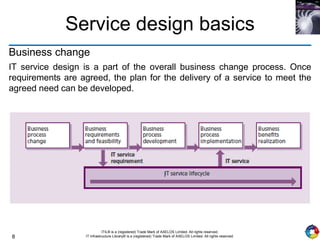
Business change
IT service design is a part of the overall business change process. Once
requirements are agreed, the plan for the delivery of a service to meet the
agreed need can be developed.
9
ITIL® is a (registered) Trade Mark of AXELOS Limited. All rights reserved.
IT Infrastructure Library® is a (registered) Trade Mark of AXELOS Limited. All rights reserved.
Service design basics
Scope & flow
Starts with a set of new or changed business requirements & ends with the
development of a service solution. Five aspects of service design to be
considered
Service solutions for new or changed services. The requirements for new or
changed services are extracted from the service portfolio.
The management information systems & tools. Reviewed to ensure they are
capable of supporting the new or changed service
The technology architectures & management architectures. Reviewed to
ensure that all they are consistent with the new or changed service
The processes required. Reviewed to ensure that they have the capability to
operate, support & maintain the new or changed service
The measurement methods & metrics. Reviewed to ensure that they can
provide the required metrics on the new or changed service
10
ITIL® is a (registered) Trade Mark of AXELOS Limited. All rights reserved.
IT Infrastructure Library® is a (registered) Trade Mark of AXELOS Limited. All rights reserved.
Service design basics
Value to the business
All aspects of service design are vital elements in supporting & enhancing
the capability of the IT service provider, particularly the design of the service
portfolio, the service catalogue & the individual IT services.
The ability to measure & demonstrate value to the business requires the
capability to link business outcomes, objectives & their underpinning
processes & functions to the IT services & their underpinning assets,
processes & functions.
11
ITIL® is a (registered) Trade Mark of AXELOS Limited. All rights reserved.
IT Infrastructure Library® is a (registered) Trade Mark of AXELOS Limited. All rights reserved.
Service design basics
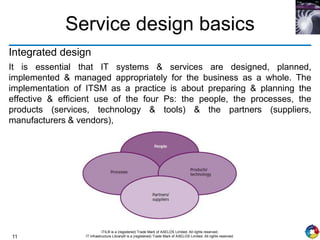
Integrated design
It is essential that IT systems & services are designed, planned,
implemented & managed appropriately for the business as a whole. The
implementation of ITSM as a practice is about preparing & planning the
effective & efficient use of the four Ps: the people, the processes, the
products (services, technology & tools) & the partners (suppliers,
manufacturers & vendors),
12
ITIL® is a (registered) Trade Mark of AXELOS Limited. All rights reserved.
IT Infrastructure Library® is a (registered) Trade Mark of AXELOS Limited. All rights reserved.
Service design basics
Integrated design
Are business- & customer-oriented, focused & driven
Are cost-effective
Meet the customer’s security requirements
Are flexible & adaptable, yet fit for purpose at the point of delivery
Can absorb an ever-increasing demand in the volume & speed of change
Meet increasing business demands for continuous operation
Are managed & operated to an acceptable level of risk
Are responsive, with appropriate availability & capacity matched to business
needs
13
ITIL® is a (registered) Trade Mark of AXELOS Limited. All rights reserved.
IT Infrastructure Library® is a (registered) Trade Mark of AXELOS Limited. All rights reserved.
Service design basics
In order to ensure that business & IT services remain synchronized, many
companies have a IT strategy or steering group (ISG) consisting of senior
management roles from the business & IT organizations. Overall
accountability for setting governance, direction, policy & strategy for IT
services. Act as a partnership between IT & the business. Meeting regularly
to review the business & IT strategies, designs, plans, service portfolio,
architectures & policies to ensure that they are closely aligned with each
other. Provide the vision, set direction & determine priorities of individual
programmes & projects to ensure that IT is aligned & focused on business
targets & drivers
14
ITIL® is a (registered) Trade Mark of AXELOS Limited. All rights reserved.
IT Infrastructure Library® is a (registered) Trade Mark of AXELOS Limited. All rights reserved.
Service design goals
Design services to satisfy business objectives & align with business needs
Design services that can be easily & efficiently developed & enhanced
Design an efficient & effective service management system
Design secure & resilient IT infrastructures & environments
Design measurement methods & metrics for assessing the effectiveness &
efficiency of the design processes
Produce & maintain IT plans, processes, policies, architectures, frameworks
15
ITIL® is a (registered) Trade Mark of AXELOS Limited. All rights reserved.
IT Infrastructure Library® is a (registered) Trade Mark of AXELOS Limited. All rights reserved.
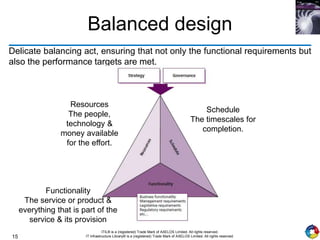
Delicate balancing act, ensuring that not only the functional requirements but
also the performance targets are met.
Balanced design
Resources
The people,
technology &
money available
for the effort.
Schedule
The timescales for
completion.
Functionality
The service or product &
everything that is part of the
service & its provision
16
ITIL® is a (registered) Trade Mark of AXELOS Limited. All rights reserved.
IT Infrastructure Library® is a (registered) Trade Mark of AXELOS Limited. All rights reserved.
Identifying service requirements
Service design must consider all elements of the service by taking a holistic
approach to the design of a new service. This approach should consider the
service & its constituent components & their inter-relationships, ensuring that
the services delivered meet the requirements of the business.
Four separate technology domains that will need to be addressed
Infrastructure
Environmental
Data
Applications
17
ITIL® is a (registered) Trade Mark of AXELOS Limited. All rights reserved.
IT Infrastructure Library® is a (registered) Trade Mark of AXELOS Limited. All rights reserved.
Identifying business requirements
IT must retain accurate information on business requirements & drivers .
Different types of information required when creating a new service,
amending an existing one or retiring a service.
To design & deliver IT services that meet the needs of the customers & the
business, clear, concise, unambiguous specifications of the requirements
must be documented & agreed.
18
ITIL® is a (registered) Trade Mark of AXELOS Limited. All rights reserved.
IT Infrastructure Library® is a (registered) Trade Mark of AXELOS Limited. All rights reserved.
Design activities
Are triggered by changes in business needs or service improvements, which
take a structured & holistic approach & just focused on functional
requirements.
Architectures & designs should be kept clear, concise, simple & relevant &
not complex or & theoretical with no relation to the ‘real world’.
19
ITIL® is a (registered) Trade Mark of AXELOS Limited. All rights reserved.
IT Infrastructure Library® is a (registered) Trade Mark of AXELOS Limited. All rights reserved.
Design aspects
The five aspects of service design are
Designing service solutions
Designing management information systems
Designing technology & management activities
Designing processes
Designing measurement methods & metrics
Each deliver quality, repeatable consistency & continual improvement. The
key aspect is the design of new or changed service solutions to meet
changing business needs
20
ITIL® is a (registered) Trade Mark of AXELOS Limited. All rights reserved.
IT Infrastructure Library® is a (registered) Trade Mark of AXELOS Limited. All rights reserved.
Designing service solutions
A formal & structured approach is required to produce the new service at the
right cost, utility (functionality) & warranty & within the right timeframe & right
resources & capabilities
It needs to be iterative/incremental to ensure that the service delivered
meets the evolving & changing needs of the business during the business
process development & the IT service lifecycle.
It is important to assemble a Service Design Package(SDP) with all aspects
of the service & its requirements though each stage of the lifecycle.
.
21
ITIL® is a (registered) Trade Mark of AXELOS Limited. All rights reserved.
IT Infrastructure Library® is a (registered) Trade Mark of AXELOS Limited. All rights reserved.
Designing mgmt. info systems
Most effective way of managing all aspects of services through their lifecycle
is by using appropriate management information systems & tools to support
& automate efficient processes
The service portfolio is the most critical management information system, it
articulates business needs & the provider’s response to those needs in
terms of value & includes all of the service information & status. It makes
clear in which phase the service current lies
22
ITIL® is a (registered) Trade Mark of AXELOS Limited. All rights reserved.
IT Infrastructure Library® is a (registered) Trade Mark of AXELOS Limited. All rights reserved.
Designing technology & mgmt.
This concerned with providing the overall strategic blueprints for the
development & deployment of an IT infrastructure that will satisfy the current
& future needs of the business.
The real benefit & ROI of the enterprise architecture comes from the ability of
an organization to design & successfully implement projects & solutions in a
rapid & consistent manner.
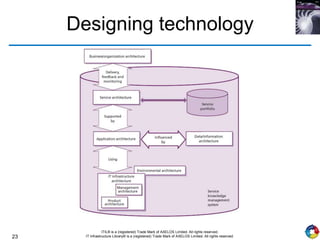
Differing layers of Technology architecture viz Service, Application,
Data/info, Infrastructure & Environmental.
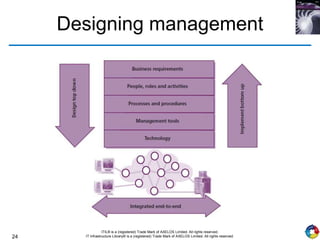
Differing management layers business, people, processes tools technology
23
ITIL® is a (registered) Trade Mark of AXELOS Limited. All rights reserved.
IT Infrastructure Library® is a (registered) Trade Mark of AXELOS Limited. All rights reserved.
Designing technology
24
ITIL® is a (registered) Trade Mark of AXELOS Limited. All rights reserved.
IT Infrastructure Library® is a (registered) Trade Mark of AXELOS Limited. All rights reserved.
Designing management
25
ITIL® is a (registered) Trade Mark of AXELOS Limited. All rights reserved.
IT Infrastructure Library® is a (registered) Trade Mark of AXELOS Limited. All rights reserved.
Designing processes
A process is a structured set of activities designed to accomplish a specific
objective. It process takes one or more inputs & turns them into defined
outputs & includes all of the roles, responsibilities, tools & management
controls required to reliably deliver the outputs. It may also define or revise
policies, st&ards, guidelines, activities, processes, procedures & work
instructions if they are needed. They owned by a process owner,
accountable for the process & its improvement. RACI is used to assign
Responsible, Accountable, Consultable & Informed roles
26
ITIL® is a (registered) Trade Mark of AXELOS Limited. All rights reserved.
IT Infrastructure Library® is a (registered) Trade Mark of AXELOS Limited. All rights reserved.
Designing measurement
‘If you can’t measure it then you can’t manage it.’ Peter Drucker.
In order to manage & control processes & services, they have to be
monitored & measured. Only use measurements that encourage progression
towards meeting business object
Progress Milestones & deliverables in the capability of the process
Compliance - Compliance of the process to governance requirements,
regulatory requirements & compliance of people to the use of the process
Effectiveness - The accuracy & correctness of the process & its ability to
deliver the ‘right result’
Efficiency - The productivity of the process, its speed, throughput & resource
utilization verses or desired behavioural change.
27
ITIL® is a (registered) Trade Mark of AXELOS Limited. All rights reserved.
IT Infrastructure Library® is a (registered) Trade Mark of AXELOS Limited. All rights reserved.
Subsequent design activates
Evaluation of alternative solutions from the available suppliers both internal
& external.
Procurement of the preferred solution involving the checks on suppliers,
finalising terms & conditions
Development of the procured solution or in house development ensuring a
focus is kept on the business needs taking into consideration the timescales
& resources & capabilities required.
28
ITIL® is a (registered) Trade Mark of AXELOS Limited. All rights reserved.
IT Infrastructure Library® is a (registered) Trade Mark of AXELOS Limited. All rights reserved.
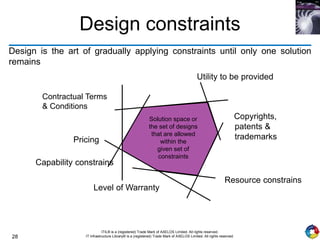
Design constraints
Design is the art of gradually applying constraints until only one solution
remains
Solution space or
the set of designs
that are allowed
within the
given set of
constraints
Contractual Terms
& Conditions
Pricing
Level of Warranty
Utility to be provided
Resource constrains
Capability constrains
Copyrights,
patents &
trademarks
29
ITIL® is a (registered) Trade Mark of AXELOS Limited. All rights reserved.
IT Infrastructure Library® is a (registered) Trade Mark of AXELOS Limited. All rights reserved.
Service oriented architecture
Business processes & solutions should be designed & developed using a
service-oriented architecture (SOA) approach. This SOA approach is
considered best practice & is used by many organizations to improve their
effectiveness & efficiency in the provision of IT services. SOA is defined by
OASIS (Organization for the Advancement of Structured Information
St&ards;) as:
‘A paradigm for organizing & utilizing distributed capabilities that may be
under the control of different ownership domains. It provides a uniform
means to offer, discover, interact with & use capabilities to produce desired
effects consistent with measurable preconditions & expectations.’
30
ITIL® is a (registered) Trade Mark of AXELOS Limited. All rights reserved.
IT Infrastructure Library® is a (registered) Trade Mark of AXELOS Limited. All rights reserved.
Service design models
The model selected for the design of IT services will depend mainly on the
model selected for the delivery of IT services. Review of current capabilities
to consider the provision of the new service. Many models are possible i.e.
Insourcing, outsourcing, co sourcing, partnerships. The delivery strategies
are relevant to the design, transition & operation stages of the service
lifecycle & may different for each.
31
ITIL® is a (registered) Trade Mark of AXELOS Limited. All rights reserved.
IT Infrastructure Library® is a (registered) Trade Mark of AXELOS Limited. All rights reserved.
Service design inputs
The main inputs to service design are requirements for new or changed
services. The main output of service design is the service design package,
which includes all of the information needed to manage the entire lifecycle of
a new or changed service
32
ITIL® is a (registered) Trade Mark of AXELOS Limited. All rights reserved.
IT Infrastructure Library® is a (registered) Trade Mark of AXELOS Limited. All rights reserved.
Agenda
Service design principles
Service design processes
Service design technology-related activities
Organizing for service design
Technology considerations
Implementing service design
33
ITIL® is a (registered) Trade Mark of AXELOS Limited. All rights reserved.
IT Infrastructure Library® is a (registered) Trade Mark of AXELOS Limited. All rights reserved.
Service design processes
Design Coordination
Service Catalogue Management
Service Level Management
Availability Management
Capacity Management
IT Service Continuity Management
Information Security Management
Supplier Management
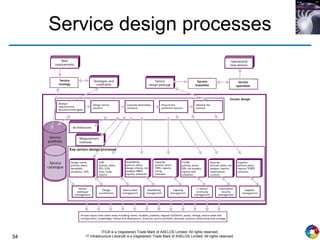
34
ITIL® is a (registered) Trade Mark of AXELOS Limited. All rights reserved.
IT Infrastructure Library® is a (registered) Trade Mark of AXELOS Limited. All rights reserved.
Service design processes
35
ITIL® is a (registered) Trade Mark of AXELOS Limited. All rights reserved.
IT Infrastructure Library® is a (registered) Trade Mark of AXELOS Limited. All rights reserved.
Design Coordination
Purpose
The purpose of the design coordination process is to ensure the goals &
objectives of the service design stage are met by providing & maintaining a
single point of coordination & control for all activities & processes within this
stage of the service lifecycle.
36
ITIL® is a (registered) Trade Mark of AXELOS Limited. All rights reserved.
IT Infrastructure Library® is a (registered) Trade Mark of AXELOS Limited. All rights reserved.
Design Coordination
Objectives
Ensure the consistent design of appropriate services, service management
information systems, architectures, technology, processes, information &
metrics to meet current & evolving business outcomes & requirements
Coordinate all design activities across projects, changes, suppliers & support
teams, & manage schedules, resources & conflicts where required
Plan & coordinate the resources & capabilities required to design new or
changed Services
Produce service design packages (SDPs) based on service charters &
change requests
Ensure that appropriate service designs &/or SDPs are produced & that they
are handed over to service transition as agreed
37
ITIL® is a (registered) Trade Mark of AXELOS Limited. All rights reserved.
IT Infrastructure Library® is a (registered) Trade Mark of AXELOS Limited. All rights reserved.
Design Coordination
Value to the business
Production of a set of consistent quality solution designs & SDPs that will
provide the desired business outcomes.
Achieve the intended business value of services through design at
acceptable risk & cost levels
Minimize rework & unplanned labour costs associated with reworking design
issues during later service lifecycle stages
Support the achievement of higher customer & user satisfaction & improved
confidence in IT & in the services received
Ensure that all services conform to a consistent architecture, allowing
integration & data exchange between services & systems
Provide improved focus on service value as well as business & customer
outcomes
38
ITIL® is a (registered) Trade Mark of AXELOS Limited. All rights reserved.
IT Infrastructure Library® is a (registered) Trade Mark of AXELOS Limited. All rights reserved.
Design Coordination
Concepts
A structured & holistic approach to design activities should be adopted, so
that all available information is considered & to ensure that consistency &
integration are achieved throughout the IT organization, within all design
activities.
The service provider should define policies for which service design efforts
require which type of attention from design coordination. E.g. design &
documentation st&ards.
A design that addresses all aspects of utility & warranty, as well as the
needs of the service throughout its lifecycle, is certainly the goal. Care must
be taken, however, not to set up st&ards or documentation requirements that
create excessive bureaucracy without consistently returning better services
to the business &/or customer.
39
ITIL® is a (registered) Trade Mark of AXELOS Limited. All rights reserved.
IT Infrastructure Library® is a (registered) Trade Mark of AXELOS Limited. All rights reserved.
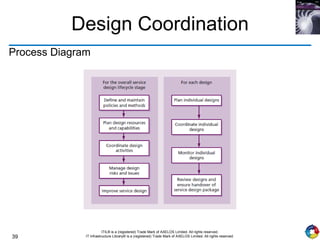
Design Coordination
Process Diagram
40
ITIL® is a (registered) Trade Mark of AXELOS Limited. All rights reserved.
IT Infrastructure Library® is a (registered) Trade Mark of AXELOS Limited. All rights reserved.
Design Coordination
Process Description for overall service design lifecycle stage
Define & maintain policies & methods
Ensure that a holistic approach to service design delivers consistent &
accurate designs are produced to ultimately provide services in the
operational environment which deliver & continue to deliver their required
business outcomes.
Plan design resources & capabilities
Responsible for planning & coordinate both resources & capabilities, by
analysis of information regarding activity in the service portfolio
Coordinate design activities
Oversight of all design activity & coordination between all resources &
capabilities
41
ITIL® is a (registered) Trade Mark of AXELOS Limited. All rights reserved.
IT Infrastructure Library® is a (registered) Trade Mark of AXELOS Limited. All rights reserved.
Design Coordination
Process Description for overall service design lifecycle stage
Manage design risks & issues
Use formal risk assessment & management techniques to manage risks
associated with design activities & reduce the number of issues that can
subsequently be traced to poor design
Improve service design
Design coordination must monitor & measure the performance of the service
design stage of the lifecycle. This will allow the identification of improvement
opportunities based on objective data & information
42
ITIL® is a (registered) Trade Mark of AXELOS Limited. All rights reserved.
IT Infrastructure Library® is a (registered) Trade Mark of AXELOS Limited. All rights reserved.
Design Coordination
Process Description for each design
Plan individual designs
The design activity for each individual project or change needs to be
carefully planned. Consider functionality (utility), warranty, requirements to
establish the service in effective use in the organization, & requirements to
operate, maintain & support the service on an ongoing basis – in other
words, the full SDP
Coordinate individual designs
Attention must be paid to scheduling of both the service provider & customer
resources to ensure involvement of the right people at the right time to create
an accurate & complete design.
Monitor individual designs
Review designs & ensure handover of SDPs.
43
ITIL® is a (registered) Trade Mark of AXELOS Limited. All rights reserved.
IT Infrastructure Library® is a (registered) Trade Mark of AXELOS Limited. All rights reserved.
Design Coordination
Process Description for each design
Monitor individual designs
Design coordination process should monitor each ongoing design effort to
ensure that there is adherence to agreed methods; that there are no conflicts
with other ongoing design efforts; that design milestones are being met; &
that the development of a comprehensive design that will support the
achievement of the required business outcomes is taking place.
Review designs & ensure handover of SDPs.
Final review of the designs for compliance with st&ards & conventions, & to
ensure that all agreed requirements for the SDP have been completed
correctly Once all required criteria for an SDP have been met, the SDP can
be officially handed over for service transition.
44
ITIL® is a (registered) Trade Mark of AXELOS Limited. All rights reserved.
IT Infrastructure Library® is a (registered) Trade Mark of AXELOS Limited. All rights reserved.
Design Coordination
Inputs
Service charters for new or significantly changed services. Business
information from the organization’s business & IT strategy, plans & financial
plans, & information on their current & future requirements. Business impact
analysis, providing information on the impact, priority & risk associated with
each service or changes to service requirements
Outputs
A comprehensive & consistent set of service designs & SDPs. A revised
enterprise architecture, management systems, measurement & metrics
methods & processes, Service portfolio updates
45
ITIL® is a (registered) Trade Mark of AXELOS Limited. All rights reserved.
IT Infrastructure Library® is a (registered) Trade Mark of AXELOS Limited. All rights reserved.
Design Coordination
CSFs & KPIs
CSF Accurate & consistent SDPs
KPI Reduction in the number of subsequent revisions of the content of SDPs
CSF Managing conflicting demands for shared resources
KPI Increased satisfaction with the service design activities, within project &
change staff
CSF New & changed services meet customer expectations
KPI Customer satisfaction score for each new or changed service meets or
exceeds a designated rating
46
ITIL® is a (registered) Trade Mark of AXELOS Limited. All rights reserved.
IT Infrastructure Library® is a (registered) Trade Mark of AXELOS Limited. All rights reserved.
Design Coordination
Challenges
Maintaining high-quality designs & SDPs consistently across all areas of the
business, services & infrastructure
Ensuring time & resources are devoted to design coordination activities &
that the roles & responsibilities of the process are assigned to the
appropriate individuals &/or groups to ensure completion
Risks
Potential lack of skills & knowledge
Reluctance of the business to be involved
Poor direction & strategy
Lack of information on business priorities & impacts
47
ITIL® is a (registered) Trade Mark of AXELOS Limited. All rights reserved.
IT Infrastructure Library® is a (registered) Trade Mark of AXELOS Limited. All rights reserved.
Service Catalogue Mgmt.
Purpose
The purpose of the service catalogue management process is to provide &
maintain a single source of consistent information on all operational services
& those being prepared to be run operationally, & to ensure that it is widely
available to those who are authorized to access it.
48
ITIL® is a (registered) Trade Mark of AXELOS Limited. All rights reserved.
IT Infrastructure Library® is a (registered) Trade Mark of AXELOS Limited. All rights reserved.
Service Catalogue Mgmt.
Objectives
Ensure that the service catalogue is accurate & reflects the current details,
status, interfaces & dependencies of all services that are being run, or being
prepared to run, in the live environment, according to the defined policies
Ensure that the service catalogue is made available to those approved to
access it in a manner that supports their effective & efficient use of service
catalogue information
Ensure that the service catalogue supports the evolving needs of all other
service management processes for service catalogue information, including
all interface & dependency information.
49
ITIL® is a (registered) Trade Mark of AXELOS Limited. All rights reserved.
IT Infrastructure Library® is a (registered) Trade Mark of AXELOS Limited. All rights reserved.
Value to the business
The Service Catalogue provides a central source of information on the
services delivered by the service provider organization. This ensures that all
areas of the business can view an accurate, consistent picture of the
services, their details & their status. It contains a customer-facing view of the
services in use, how they are intended to be used, the business processes
they enable, & the levels & quality of service the customer can expect for
each service.
Service Catalogue Mgmt.
50
ITIL® is a (registered) Trade Mark of AXELOS Limited. All rights reserved.
IT Infrastructure Library® is a (registered) Trade Mark of AXELOS Limited. All rights reserved.
Service Catalogue Mgmt.
Concepts
A service portfolio containing a service catalogue is produced & maintained
to provide a central, accurate set of information on all services & to develop
a service-focused culture. The service catalogue should contain details of all
services currently being provided as well as those being prepared for
transition to the live environment, a summary of their characteristics, &
details of the customers & maintainers of each.
Each organization should develop & maintain a policy with regard to both the
overall service portfolio & the constituent service catalogue, relating to the
services recorded within them & what details are recorded
Each organization needs to develop a policy of what a service is & how it is
to be defined & agreed as well as defining a hierarchy of services within the
service catalogue. E.g. Customer facing services vs supporting services
51
ITIL® is a (registered) Trade Mark of AXELOS Limited. All rights reserved.
IT Infrastructure Library® is a (registered) Trade Mark of AXELOS Limited. All rights reserved.
Service Catalogue Mgmt.
Concepts
The structure & presentation of the service catalogue should support the
uses to which it will be put, taking into consideration the different, Sometimes
conflicting needs of different audiences. E.g. A business/customer service
catalogue view, technical/supporting service catalogue view
52
ITIL® is a (registered) Trade Mark of AXELOS Limited. All rights reserved.
IT Infrastructure Library® is a (registered) Trade Mark of AXELOS Limited. All rights reserved.
Service Catalogue Mgmt.
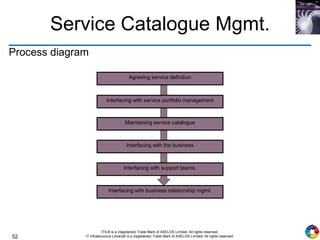
Process diagram
Agreeing service definition
Interfacing with service portfolio management
Maintaining service catalogue
Interfacing with the business
Interfacing with support teams,
Interfacing with business relationship mgmt.
53
ITIL® is a (registered) Trade Mark of AXELOS Limited. All rights reserved.
IT Infrastructure Library® is a (registered) Trade Mark of AXELOS Limited. All rights reserved.
Service Catalogue Mgmt.
Agreeing & documenting a service definition & description for each service
with all relevant parties
Interfacing with service portfolio management to agree the contents of the
service portfolio & service catalogue
Producing & maintaining an accurate service catalogue & its contents, in
conjunction with the overall service portfolio
Interfacing with the business & ITSCM on the dependencies of business
units & their business processes with the customer-facing IT services
contained within the service catalogue.
Interfacing with support teams, suppliers & service asset & configuration
management on interfaces & dependencies between IT services & the
supporting services.
Interfacing with business relationship management & SLM to ensure that the
information is aligned to the business & business process.
54
ITIL® is a (registered) Trade Mark of AXELOS Limited. All rights reserved.
IT Infrastructure Library® is a (registered) Trade Mark of AXELOS Limited. All rights reserved.
Service Catalogue Mgmt.
Inputs
Business information from the organization’s business & IT strategy, plans &
financial plans, & information on their current & future requirements from the
Service Portfolio.
Feedback from all other processes.
Outputs
The documentation & agreement of a ‘definition of the service’.
The updates current status of all services & requirements to the Service
Portfolio.
The updates current status of all services & requirements to the CMS.
55
ITIL® is a (registered) Trade Mark of AXELOS Limited. All rights reserved.
IT Infrastructure Library® is a (registered) Trade Mark of AXELOS Limited. All rights reserved.
Service Catalogue Mgmt.
CSFs & KPIs
CSF An accurate service catalogue
KPI Increase in the number of services recorded & managed within the
service catalogue as a percentage of those being delivered & transitioned in
the live environment
CSF Business users’ awareness of the services being provided
KPI Percentage increase in completeness of the customer-facing views of the
service catalogue against operational services
CSF IT staff awareness of the technology supporting the services
KPI Percentage increase in completeness of supporting services against the
IT components that make up those services
56
ITIL® is a (registered) Trade Mark of AXELOS Limited. All rights reserved.
IT Infrastructure Library® is a (registered) Trade Mark of AXELOS Limited. All rights reserved.
Service Catalogue Mgmt.
Challenges
Maintaining an accurate service catalogue as part of a service portfolio,
incorporating all catalogue views as part of an overall CMS & SKMS
Risks
Inaccuracy of the data in the catalogue & it not being under rigorous change
control
Poor acceptance of the service catalogue & its usage in all operational
processes. The more active the catalogue is, the more likely it is to be
accurate in its content
Inaccuracy of information received from the business, IT & the service
portfolio, with regard to service information
57
ITIL® is a (registered) Trade Mark of AXELOS Limited. All rights reserved.
IT Infrastructure Library® is a (registered) Trade Mark of AXELOS Limited. All rights reserved.
Service Level Mgmt.
Purpose
The purpose of the SLM process is to ensure that all current & planned IT
services are delivered to agreed achievable targets. This is accomplished
through a constant cycle of negotiating, agreeing, monitoring, reporting on &
reviewing IT service targets & achievements, & through instigation of actions
to correct or improve the level of service delivered.
58
ITIL® is a (registered) Trade Mark of AXELOS Limited. All rights reserved.
IT Infrastructure Library® is a (registered) Trade Mark of AXELOS Limited. All rights reserved.
Service Level Mgmt.
Objectives
Define, document, agree, monitor, measure, report & review the level of IT
services provided & instigate corrective measures whenever appropriate
Provide & improve the relationship & communication with the business &
customers in conjunction with business relationship management
Ensure that specific & measurable targets are developed for all IT services
Monitor & improve customer satisfaction with the quality of service delivered
Ensure that IT & the customers have a clear & unambiguous expectation of
the level of service to be delivered
Ensure that even when all agreed targets are met, the levels of service
delivered are subject to proactive, cost-effective continual improvement.
59
ITIL® is a (registered) Trade Mark of AXELOS Limited. All rights reserved.
IT Infrastructure Library® is a (registered) Trade Mark of AXELOS Limited. All rights reserved.
Service Level Mgmt.
Value to the business
SLM provides a consistent interface to the business for all service-related
issues. It provides the business with the agreed service targets & the
required management information to ensure that those targets have been
met.
Where targets are breached, SLM should provide feedback on the cause of
the breach & details of the actions taken to prevent the breach from
recurring. Thus SLM provides a reliable communication channel & a trusted
relationship with the appropriate customers & business representatives.
60
ITIL® is a (registered) Trade Mark of AXELOS Limited. All rights reserved.
IT Infrastructure Library® is a (registered) Trade Mark of AXELOS Limited. All rights reserved.
Service Level Mgmt.
Concepts – Contracts & agreements
SLM entail the planning, coordinating, supplying, agreeing, monitoring &
reporting of Service Level Agreements (SLAs) including an ongoing review
of the service ensuring the quality satisfies agreed requirements (SLRs) &
can be improved.
Service Level Agreements
An agreement between the service provider & customer as to the level of
service to be provided for a specific cost.
Operational Level Agreements
An agreement between departments of a service provider to determine
responsibilities on both sides.
Underpinning contracts
A contract with a third party, in support of the delivery of a service to a
customer which defines the targets & responsibilities of the third party.
61
ITIL® is a (registered) Trade Mark of AXELOS Limited. All rights reserved.
IT Infrastructure Library® is a (registered) Trade Mark of AXELOS Limited. All rights reserved.
Service Level Mgmt.
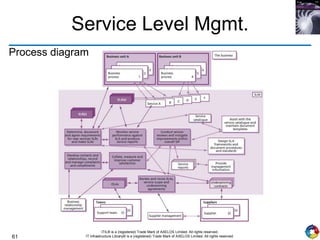
Process diagram
62
ITIL® is a (registered) Trade Mark of AXELOS Limited. All rights reserved.
IT Infrastructure Library® is a (registered) Trade Mark of AXELOS Limited. All rights reserved.
Service Level Mgmt.
Design of SLM Framework
SLM has to design the best possible SLA, so that all services can be
provided & clients can be serviced in a manner meeting mutual needs.
Determine, document & agree SLRs
When the Service Catalogue is made & SLA structure determined the SLR
needs to be determined.
Negotiating, documenting & agreeing SLAs for services
An SLA should be agreed, detailing the service level targets to be achieved
& specifying the responsibilities of both the IT service provider & the
customer. A new services targets are likely to originate from SLRs
Monitor & report on performance vs. SLAs
Everything incorporated into the SLA must be measurable. There is no point
in identifying a target that can not be measured
63
ITIL® is a (registered) Trade Mark of AXELOS Limited. All rights reserved.
IT Infrastructure Library® is a (registered) Trade Mark of AXELOS Limited. All rights reserved.
Service Level Mgmt.
Producing service reports
Immediately after the SLA is agreed & accepted, monitoring must be
instigated, & service achievement reports must be produced.
Conducting service reviews & instigating improvements
Review meetings must be held on a regular basis with customers (or their
representatives) to review the service achievement in the last period & to
preview any issues for the coming period.
Collating, measuring & improving customer satisfaction
There are a number of important ‘soft’ issues that cannot be monitored by
mechanistic or procedural means, such as customers’ overall feelings
64
ITIL® is a (registered) Trade Mark of AXELOS Limited. All rights reserved.
IT Infrastructure Library® is a (registered) Trade Mark of AXELOS Limited. All rights reserved.
Service Level Mgmt.
Reviewing & revising SLAs, service scope & underpinning
agreements
All SLAs & the agreements that underpin them, including OLAs, &
underpinning contracts, must be kept up to date. They should be brought
under the control of change mgmt. & service asset & configuration mgmt.
Reviewing & revising OLAs, underpinning agreements &
service scope
IT service providers are dependent on their own internal support teams as
well as on external partners or suppliers. The service provider cannot
commit to meeting SLA targets unless their own support teams’ & suppliers’
performances underpin these targets.
65
ITIL® is a (registered) Trade Mark of AXELOS Limited. All rights reserved.
IT Infrastructure Library® is a (registered) Trade Mark of AXELOS Limited. All rights reserved.
Service Level Mgmt.
Developing contacts & relationships
It is very important that the service provider develops trust & respect with the
business, especially with the key business contacts.
Handling complaints & compliments
The SLM process should also include activities & procedures for the logging
& management of complaints & compliments that relate to service levels.
66
ITIL® is a (registered) Trade Mark of AXELOS Limited. All rights reserved.
IT Infrastructure Library® is a (registered) Trade Mark of AXELOS Limited. All rights reserved.
Service Level Mgmt.
Inputs
Business requirements: details of any agreed, new or changed business
requirements
The service portfolio & service catalogue.
Customer & user feedback, complaints & compliments
Outputs
Service reports Performance vs SLA targets.
Service Improvement Plan & Service Quality Plan.
Service Level Agreements (SLAs) Service Level Requirements (SLRs),
Operational Level Agreements (OLAs) & Underpinning Contracts (UCs)
67
ITIL® is a (registered) Trade Mark of AXELOS Limited. All rights reserved.
IT Infrastructure Library® is a (registered) Trade Mark of AXELOS Limited. All rights reserved.
Service Level Mgmt.
CSFs & KPIs
CSF Managing the overall quality of IT services required both in the number
& level of services provided & managed.
KPI Percentage reduction in SLA targets threatened
CSF Deliver the service as previously agreed at affordable cost
KPI Total number & percentage increase in fully documented SLAs
CSF Manage the interface with the business & users
KPI Increased percentage of services covered by SLAs ace
68
ITIL® is a (registered) Trade Mark of AXELOS Limited. All rights reserved.
IT Infrastructure Library® is a (registered) Trade Mark of AXELOS Limited. All rights reserved.
Service Level Mgmt.
Challenges
Identifying suitable customer representatives with whom to negotiate. Who
‘owns’ the service on the customer side?
Risks
A lack of accurate input, involvement & commitment from the business &
customers
Lack of appropriate tools & resources required to agree, document, monitor,
report & review agreements & service levels
The process becomes a bureaucratic, administrative process, rather than an
active & proactive process delivering measurable benefit to the business
69
ITIL® is a (registered) Trade Mark of AXELOS Limited. All rights reserved.
IT Infrastructure Library® is a (registered) Trade Mark of AXELOS Limited. All rights reserved.
Availability Management
Purpose
The purpose of the availability management process is to ensure that the
level of availability delivered in all IT services meets the agreed availability
needs & /or service level targets in a cost-effective & timely manner.
Availability management is concerned with meeting both the current & future
availability needs of the business.
Availability management defines, analyses, plans, measures & improves all
aspects of the availability of IT services, ensuring that all IT infrastructure,
processes, tools, roles etc. are appropriate for the agreed availability service
level targets.
70
ITIL® is a (registered) Trade Mark of AXELOS Limited. All rights reserved.
IT Infrastructure Library® is a (registered) Trade Mark of AXELOS Limited. All rights reserved.
Availability Management
Objectives
Produce & maintain an appropriate & up-to-date availability plan that reflects
the current & future needs of the business
Provide advice & guidance to all other areas of the business & IT on all
availability-related issues
Ensure that service availability achievements meet all their agreed targets by
managing services & resources-related availability performance.
Assist with the diagnosis & resolution of availability-related incidents &
problems
Assess the impact of all changes on the availability plan & the availability of
all services & resources
Ensure that proactive measures to improve the availability of services are
implemented wherever it is cost-justifiable to do so
71
ITIL® is a (registered) Trade Mark of AXELOS Limited. All rights reserved.
IT Infrastructure Library® is a (registered) Trade Mark of AXELOS Limited. All rights reserved.
Availability Management
Value to the business
The availability management process ensures that the availability of systems
& services matches the evolving agreed needs of the business. The role of
IT within the business is now pivotal. The availability & reliability of IT
services can directly influence customer satisfaction & the reputation of the
business. This is why availability management is essential in ensuring IT
delivers the levels of service availability required by the business to satisfy
its business objectives & deliver the quality of service demanded by its
customers.
72
ITIL® is a (registered) Trade Mark of AXELOS Limited. All rights reserved.
IT Infrastructure Library® is a (registered) Trade Mark of AXELOS Limited. All rights reserved.
Availability Management
Concepts - Guiding principles:
There is a direct correlation in most organizations between service
availability & customer & user satisfaction,
The way a service provider reacts in a failure situation has a major influence
on customer & user perception & expectation.
Improving availability can only begin after understanding how the IT services
support the operation of the business.
Service availability is only as good as the weakest link in the chain
Availability is not just a reactive process. The more proactive the process,
the better service availability will be.
It is cheaper to design the right level of service availability into a service from
the start, rather than try & ‘bolt it on’ subsequently.
73
ITIL® is a (registered) Trade Mark of AXELOS Limited. All rights reserved.
IT Infrastructure Library® is a (registered) Trade Mark of AXELOS Limited. All rights reserved.
Availability Management
Concepts - Aspects of Availability (1)
1) Availability is the ability of a service, component or CI to perform its
agreed function when required
Availability (%) = Agreed service time (AST) - downtime*100
Agreed service time
2) Reliability is a measure of how long a service, component or CI can
perform its agreed function without interruption.
Mean Time Between Service Incidents = Available time in hours
Number of breaks
Mean Time Between Failures = Available time in hours – Total downtime in hours
Number of breaks
74
ITIL® is a (registered) Trade Mark of AXELOS Limited. All rights reserved.
IT Infrastructure Library® is a (registered) Trade Mark of AXELOS Limited. All rights reserved.
Availability Management
Concepts - Aspects of Availability (2)
3) Maintainability is a measure of how quickly & effectively a service,
component or CI can be restored to normal service after a failure.
Mean Time to restore Service= Total downtime in hours
Number of service breaks
4) Serviceability is the ability of a third-party supplier to meet the terms of its
contract. This contract will include agreed levels of availability, reliability & /or
maintainability for a supporting service or component.
5) Vital Business Function is used to reflect the part of a business process that is
critical to the success of the business. An IT service may support a number of
business functions that are less critical.
75
ITIL® is a (registered) Trade Mark of AXELOS Limited. All rights reserved.
IT Infrastructure Library® is a (registered) Trade Mark of AXELOS Limited. All rights reserved.
Availability Management
Concepts – Role of measurement
The availability management process depends heavily on the measurement
of service & component achievements with regard to availability.
‘If you don’t measure it, you can’t manage it.’
‘If you don’t measure it, you can’t improve it.’
‘If you don’t measure it, you probably don’t care.’
‘If you can’t influence or control it, then don’t measure it.’
76
ITIL® is a (registered) Trade Mark of AXELOS Limited. All rights reserved.
IT Infrastructure Library® is a (registered) Trade Mark of AXELOS Limited. All rights reserved.
Availability Management
Concepts – Role of measurement
77
ITIL® is a (registered) Trade Mark of AXELOS Limited. All rights reserved.
IT Infrastructure Library® is a (registered) Trade Mark of AXELOS Limited. All rights reserved.
Availability Management
Process diagram
78
ITIL® is a (registered) Trade Mark of AXELOS Limited. All rights reserved.
IT Infrastructure Library® is a (registered) Trade Mark of AXELOS Limited. All rights reserved.
Availability Management
Reactive activities
The reactive aspect of availability management involves work to ensure that
current operational services & components deliver the agreed levels of
availability & to respond appropriately when they do not.
Proactive activities
The proactive activities of availability management involve the work
necessary to ensure that new or changed services can & will deliver the
agreed levels of availability & that appropriate measurements are in place to
support this work.
79
ITIL® is a (registered) Trade Mark of AXELOS Limited. All rights reserved.
IT Infrastructure Library® is a (registered) Trade Mark of AXELOS Limited. All rights reserved.
Availability Management
Inputs
Business information from the organization’s business strategy
Business impact information from BIAs & assessment of VBFs underpinned
by IT services
Previous risk assessment reports & a risk register
Outputs
The availability MIS (AMIS)
The availability plan for the proactive improvement of IT services &
technology
Availability & recovery design criteria & proposed service targets for new or
changed services
80
ITIL® is a (registered) Trade Mark of AXELOS Limited. All rights reserved.
IT Infrastructure Library® is a (registered) Trade Mark of AXELOS Limited. All rights reserved.
Availability Management
CSFs & KPIs
CSF Manage availability & reliability of IT service
KPI Percentage reduction in the unavailability of services & components.
CSF Satisfy business needs for access to IT services
KPI Percentage reduction in the unavailability of services
CSF Availability of IT infrastructure & applications, as documented in SLAs,
provided at optimum costs:
KPI Percentage reduction in the cost of unavailability
81
ITIL® is a (registered) Trade Mark of AXELOS Limited. All rights reserved.
IT Infrastructure Library® is a (registered) Trade Mark of AXELOS Limited. All rights reserved.
Availability Management
Challenges
The main challenge is to actually meet & manage the expectations of the
customers, the business & senior management. These expectations are
frequently that services will always be available not just during their agreed
service hours, but that all services will be available on a 24-hour, 365-day
basis.
Risks
A lack of commitment from the business to the availability management
process
A lack of commitment from the business & a lack of appropriate information
on future plans & strategies
A lack of senior management commitment or a lack of resources & /or
budget to the availability management process
82
ITIL® is a (registered) Trade Mark of AXELOS Limited. All rights reserved.
IT Infrastructure Library® is a (registered) Trade Mark of AXELOS Limited. All rights reserved.
Capacity Management
Purpose
The purpose of the capacity management process is to ensure that the
capacity of IT services & the IT infrastructure meets the agreed capacity &
performance-related requirements in a cost-effective & timely manner.
Capacity management is concerned with meeting both the current & future
capacity & performance needs of the business
83
ITIL® is a (registered) Trade Mark of AXELOS Limited. All rights reserved.
IT Infrastructure Library® is a (registered) Trade Mark of AXELOS Limited. All rights reserved.
Capacity Management
Objectives
Produce & maintain an appropriate & up-to-date capacity plan, which reflects
the current & future needs of the business.
Provide advice & guidance to all other areas of the business & IT on all
capacity- & performance-related issues.
Ensure that service performance achievements meet their agreed targets by
managing the performance & capacity of both services & resources.
Assist with the diagnosis & resolution of performance- & capacity-related
incidents & problems.
Assess the impact of all changes on the capacity plan, & the performance &
capacity of all services & resources.
Ensure that proactive measures to improve the performance of services are
implemented wherever it is cost-justifiable to do so.
84
ITIL® is a (registered) Trade Mark of AXELOS Limited. All rights reserved.
IT Infrastructure Library® is a (registered) Trade Mark of AXELOS Limited. All rights reserved.
Capacity Management
Value to the business
A well-executed capacity management process will benefit the business by:
Improving the performance & availability of IT services the business needs
by helping to reduce capacity- & performance-related incidents & problems.
Ensuring required capacity & performance are provided in the most cost-
effective manner
Contributing to improved customer satisfaction & user productivity by
ensuring that all capacity- & performance- related service levels are met
Supporting the efficient & effective design & transition of new or changed
services through proactive capacity management activities
Improving the reliability of capacity-related budgeting through the use of a
forward-looking capacity plan based on a sound understanding of business
needs & plans
85
ITIL® is a (registered) Trade Mark of AXELOS Limited. All rights reserved.
IT Infrastructure Library® is a (registered) Trade Mark of AXELOS Limited. All rights reserved.
Capacity Management
Concepts
Capacity management is essentially a balancing act:
Balancing costs against resources needed - The need to ensure that
processing capacity that is purchased is cost-justifiable in terms of business
need, & the need to make the most efficient use of those resources.
Balancing supply against demand - The need to ensure that the available
supply of IT processing power matches the demands made on it by the
business, both now & in the future. It may also be necessary to manage or
influence the demand for a particular resource.
86
ITIL® is a (registered) Trade Mark of AXELOS Limited. All rights reserved.
IT Infrastructure Library® is a (registered) Trade Mark of AXELOS Limited. All rights reserved.
Capacity Management
Concepts - Policies
Policies should be established defining the required points of interface
between the capacity management & SLM processes to ensure this
connection to business requirements is appropriately established &
maintained. Capacity management needs to understand the total IT &
business environments.
87
ITIL® is a (registered) Trade Mark of AXELOS Limited. All rights reserved.
IT Infrastructure Library® is a (registered) Trade Mark of AXELOS Limited. All rights reserved.
Capacity Management
Concepts - Planning & managing complexity
Managing the capacity of large distributed IT infrastructures is a complex &
demanding task, especially when the IT capacity & the financial investment
required is ever-increasing. Therefore it makes even more sense to plan for
growth.
Capacity management provides the necessary information on current &
planned resource utilization of individual components to enable
organizations to decide: What, when & how to upgrade
88
ITIL® is a (registered) Trade Mark of AXELOS Limited. All rights reserved.
IT Infrastructure Library® is a (registered) Trade Mark of AXELOS Limited. All rights reserved.
Capacity Management
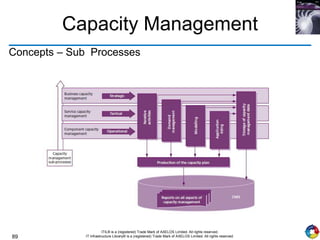
Concepts – Sub Processes
Business capacity management translates business needs & plans into
requirements for service & IT infrastructure, ensuring that the future business
requirements for IT services are quantified, designed, planned.
Service capacity management focuses on the management, control &
prediction of the end-to-end performance & capacity of the live, operational
IT services usage & workloads.
Component capacity management focuses on the management, control &
prediction of the performance, utilization & capacity of individual IT
technology components.
89
ITIL® is a (registered) Trade Mark of AXELOS Limited. All rights reserved.
IT Infrastructure Library® is a (registered) Trade Mark of AXELOS Limited. All rights reserved.
Capacity Management
Concepts – Sub Processes
90
ITIL® is a (registered) Trade Mark of AXELOS Limited. All rights reserved.
IT Infrastructure Library® is a (registered) Trade Mark of AXELOS Limited. All rights reserved.
Capacity Management
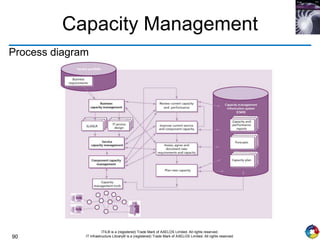
Process diagram
91
ITIL® is a (registered) Trade Mark of AXELOS Limited. All rights reserved.
IT Infrastructure Library® is a (registered) Trade Mark of AXELOS Limited. All rights reserved.
Capacity Management
Process description - Proactive activities
Pre-empting performance issues by taking the necessary actions before they
occur
Producing trends of the current component utilization & estimating the future
requirements, using trends & thresholds for planning upgrades &
enhancements
Modelling & trending the predicted changes in IT services (including service
retirements), & identifying the changes that need to be made to services &
components of the IT infrastructure & applications to ensure that appropriate
resource is available
Ensuring that upgrades are budgeted, planned & implemented before SLAs
& service targets are breached or performance issues occur
Actively seeking to improve service performance wherever it is cost-
justifiable
92
ITIL® is a (registered) Trade Mark of AXELOS Limited. All rights reserved.
IT Infrastructure Library® is a (registered) Trade Mark of AXELOS Limited. All rights reserved.
Capacity Management
Process description - Reactive activities
Monitoring, measuring, reporting & reviewing the current performance of
both services & components
Responding to all capacity-related ‘threshold’ events & instigating corrective
action
Reacting to & assisting with specific performance issues. For example, the
service desk may refer incidents of poor performance to technology
management, which will employ capacity management techniques to resolve
them.
These individual activities together allow an organization to
Review current capacity & performance
Improve current service & component capacity.
Assess, agree & document new requirements & capacity
Plan new capacity
93
ITIL® is a (registered) Trade Mark of AXELOS Limited. All rights reserved.
IT Infrastructure Library® is a (registered) Trade Mark of AXELOS Limited. All rights reserved.
Capacity Management
Inputs
Business information From the organization’s business strategy, plans &
financial plans, & information on their current & future requirements.
Service & IT information From service strategy, the IT strategy & plans &
current budgets, covering all areas of technology & technology plans.
Component performance & capacity information Of both existing & new
technology, from manufacturers & suppliers
Outputs
Capacity Management Information System (CMIS).
The Capacity Plan.
Service performance information & reports.
94
ITIL® is a (registered) Trade Mark of AXELOS Limited. All rights reserved.
IT Infrastructure Library® is a (registered) Trade Mark of AXELOS Limited. All rights reserved.
Capacity Management
CSFs & KPIs
CSF Accurate business forecasts
KPI Production of workload forecasts on time
CSF Knowledge of current & future technologies
KPI Increased ability to monitor performance & throughput of all services &
Components
CSF Ability to demonstrate cost effectiveness
KPI Reduction in last-minute buying to address urgent performance issues.
95
ITIL® is a (registered) Trade Mark of AXELOS Limited. All rights reserved.
IT Infrastructure Library® is a (registered) Trade Mark of AXELOS Limited. All rights reserved.
Capacity Management
Challenges
Persuading the business to provide information on its strategic business
plans, to enable the IT service provider organization to provide effective
business capacity management.
Risks
A lack of commitment from the business to the capacity management
process
A lack of appropriate information from the business on future plans &
strategies
A lack of senior management commitment or a lack of resources & /or
budget for the capacity management process
96
ITIL® is a (registered) Trade Mark of AXELOS Limited. All rights reserved.
IT Infrastructure Library® is a (registered) Trade Mark of AXELOS Limited. All rights reserved.
IT Service Continuity Mgmt.
Purpose
The purpose of the IT service continuity management process is to support
the overall business continuity management (BCM) process by ensuring
that, by managing the risks that could seriously affect IT services, the IT
service provider can always provide minimum agreed business continuity-
related service levels.
97
ITIL® is a (registered) Trade Mark of AXELOS Limited. All rights reserved.
IT Infrastructure Library® is a (registered) Trade Mark of AXELOS Limited. All rights reserved.
IT Service Continuity Mgmt.
Objectives
Produce & maintain a set of IT service continuity plans that support the
overall business continuity plans of the organization
Complete regular BIA exercises to ensure that all continuity plans are
maintained in line with changing business impacts & requirements
Conduct regular risk assessment & management exercises to manage IT
services within an agreed level of business risk in conjunction with the
business & the availability management & information security management
processes
Provide advice & guidance to all other areas of the business & IT on all
continuity-related issues
Ensure that appropriate continuity mechanisms are put in place to meet or
exceed the agreed business continuity targets
98
ITIL® is a (registered) Trade Mark of AXELOS Limited. All rights reserved.
IT Infrastructure Library® is a (registered) Trade Mark of AXELOS Limited. All rights reserved.
IT Service Continuity Mgmt.
Value to the business
ITSCM provides an invaluable role in supporting the BCM process. In many
organizations, ITSCM is used to raise awareness of continuity requirements
& is often used to justify & implement a BCM process & business continuity
plans. ITSCM should be driven by business risk as identified by BCM, &
ensure that the recovery arrangements for IT services are aligned to
identified business impacts, risks & needs.
99
ITIL® is a (registered) Trade Mark of AXELOS Limited. All rights reserved.
IT Infrastructure Library® is a (registered) Trade Mark of AXELOS Limited. All rights reserved.
IT Service Continuity Mgmt.
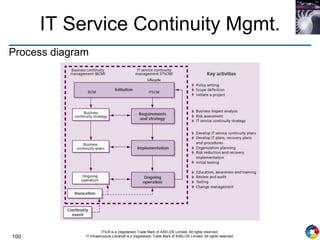
Concepts
A lifecycle approach should be adopted to the setting up & operation of an
ITSCM process. Initiation & , to a significant extent, the requirements stages
are principally BCM activities. ITSCM should only be involved in these
stages to support the BCM activities & to understand the relationship
between the business processes & the impacts caused on them by loss of IT
service.
However, in many organizations BCM is absent or has very little focus, &
often ITSCM is required to fulfil many of the requirements & activities of
BCM.
100
ITIL® is a (registered) Trade Mark of AXELOS Limited. All rights reserved.
IT Infrastructure Library® is a (registered) Trade Mark of AXELOS Limited. All rights reserved.
IT Service Continuity Mgmt.
Process diagram
101
ITIL® is a (registered) Trade Mark of AXELOS Limited. All rights reserved.
IT Infrastructure Library® is a (registered) Trade Mark of AXELOS Limited. All rights reserved.
IT Service Continuity Mgmt.
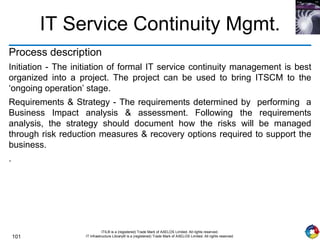
Process description
Initiation - The initiation of formal IT service continuity management is best
organized into a project. The project can be used to bring ITSCM to the
‘ongoing operation’ stage.
Requirements & Strategy - The requirements determined by performing a
Business Impact analysis & assessment. Following the requirements
analysis, the strategy should document how the risks will be managed
through risk reduction measures & recovery options required to support the
business.
.
102
ITIL® is a (registered) Trade Mark of AXELOS Limited. All rights reserved.
IT Infrastructure Library® is a (registered) Trade Mark of AXELOS Limited. All rights reserved.
IT Service Continuity Mgmt.
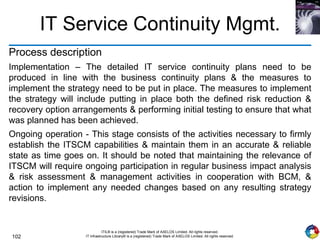
Process description
Implementation – The detailed IT service continuity plans need to be
produced in line with the business continuity plans & the measures to
implement the strategy need to be put in place. The measures to implement
the strategy will include putting in place both the defined risk reduction &
recovery option arrangements & performing initial testing to ensure that what
was planned has been achieved.
Ongoing operation - This stage consists of the activities necessary to firmly
establish the ITSCM capabilities & maintain them in an accurate & reliable
state as time goes on. It should be noted that maintaining the relevance of
ITSCM will require ongoing participation in regular business impact analysis
& risk assessment & management activities in cooperation with BCM, &
action to implement any needed changes based on any resulting strategy
revisions.
103
ITIL® is a (registered) Trade Mark of AXELOS Limited. All rights reserved.
IT Infrastructure Library® is a (registered) Trade Mark of AXELOS Limited. All rights reserved.
IT Service Continuity Mgmt.
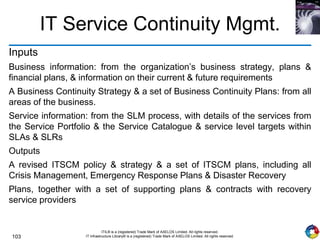
Inputs
Business information: from the organization’s business strategy, plans &
financial plans, & information on their current & future requirements
A Business Continuity Strategy & a set of Business Continuity Plans: from all
areas of the business.
Service information: from the SLM process, with details of the services from
the Service Portfolio & the Service Catalogue & service level targets within
SLAs & SLRs
Outputs
A revised ITSCM policy & strategy & a set of ITSCM plans, including all
Crisis Management, Emergency Response Plans & Disaster Recovery
Plans, together with a set of supporting plans & contracts with recovery
service providers
104
ITIL® is a (registered) Trade Mark of AXELOS Limited. All rights reserved.
IT Infrastructure Library® is a (registered) Trade Mark of AXELOS Limited. All rights reserved.
IT Service Continuity Mgmt.
CSFs & KPIs
CSF IT services are delivered & can be recovered to meet business
objectives
KPI Increase in success of regular audits of the ITSCM plans to ensure that,
at all times, the agreed recovery requirements of the business can be
achieved.
CSF Awareness throughout the organization of the business & IT service
continuity plans
KPI Increase in validated awareness of business impact, needs &
requirements throughout IT
105
ITIL® is a (registered) Trade Mark of AXELOS Limited. All rights reserved.
IT Infrastructure Library® is a (registered) Trade Mark of AXELOS Limited. All rights reserved.
IT Service Continuity Mgmt.
Challenges
One of the major challenges facing ITSCM is to provide appropriate plans
when there is no BCM process. If there is no BCM process, then IT is likely
to make incorrect assumptions about business criticality of business
processes & therefore adopt the wrong continuity strategies & options.
Risks
Lack of commitment from the business to the ITSCM processes &
procedures.
Lack of appropriate information on future business plans & strategies
Lack of senior management commitment or a lack of resources & /or budget
for the ITSCM process
The processes focus too much on the technology issues & not enough on
the IT services & the needs & priorities of the business
106
ITIL® is a (registered) Trade Mark of AXELOS Limited. All rights reserved.
IT Infrastructure Library® is a (registered) Trade Mark of AXELOS Limited. All rights reserved.
Information Security Mgmt.
Purpose
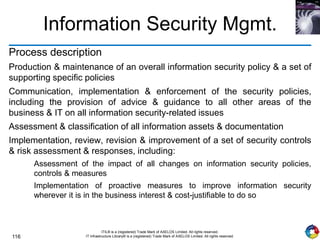
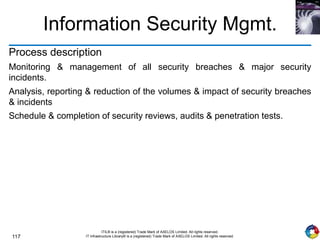
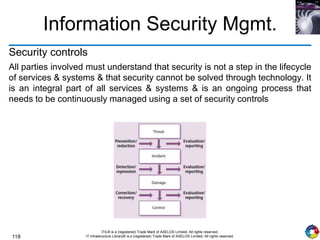
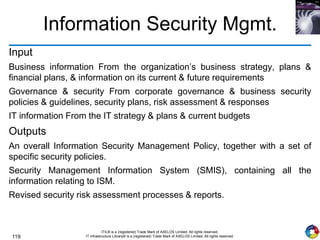
The purpose of the information security management process is to align IT
security with business security & ensure that the confidentiality, integrity &
availability of the organization’s assets, information, data & IT services
always matches the agreed needs of the business.
107
ITIL® is a (registered) Trade Mark of AXELOS Limited. All rights reserved.
IT Infrastructure Library® is a (registered) Trade Mark of AXELOS Limited. All rights reserved.
Information Security Mgmt.
Objectives
Information is observed by or disclosed to only those who have a right to
know (confidentiality)
Information is complete, accurate & protected against unauthorized
modification (integrity)
Information is available & usable when required, & the systems that provide
it can appropriately resist attacks & recover from or prevent failures
(availability)
Business transactions, as well as information exchanges between
enterprises, or with partners, can be trusted (authenticity & nonrepudiation).
108
ITIL® is a (registered) Trade Mark of AXELOS Limited. All rights reserved.
IT Infrastructure Library® is a (registered) Trade Mark of AXELOS Limited. All rights reserved.
Information Security Mgmt.
Value to the business
Information security management ensures that an information security policy
is maintained & enforced that fulfils the needs of the business security policy
& the requirements of corporate governance. It raises awareness of the need
for security within all IT services & assets throughout the organization,
ensuring that the policy is appropriate for the needs of the organization. It
manages all aspects of IT & information security within all areas of IT &
service management activity.
109
ITIL® is a (registered) Trade Mark of AXELOS Limited. All rights reserved.
IT Infrastructure Library® is a (registered) Trade Mark of AXELOS Limited. All rights reserved.
Information Security Mgmt.
Policies
Information security management activities should be focused on & driven by
an overall information security policy & a set of underpinning specific security
policies.
110
ITIL® is a (registered) Trade Mark of AXELOS Limited. All rights reserved.
IT Infrastructure Library® is a (registered) Trade Mark of AXELOS Limited. All rights reserved.
Information Security Mgmt.
Concepts - Risk assessment & management in information
security management
To achieve the objectives of information security management, formal risk
assessment & management relating to security of information. & information
processing is fundamental. Indeed, it is difficult to identify any part of this
process that does not relate to risk management in some way. The
information security management process frequently collaborates not only
with the business but also with the ITSCM & availability management
processes to conduct risk assessments at various levels.
111
ITIL® is a (registered) Trade Mark of AXELOS Limited. All rights reserved.
IT Infrastructure Library® is a (registered) Trade Mark of AXELOS Limited. All rights reserved.
Information Security Mgmt.
Concepts - Information security management system
The information security management process will have a formal system to
establish policy & objectives & to achieve those objectives. This system will
generally consist of:
An information security policy & specific security policies that address each
aspect of strategy, controls & regulation
A security management information system (SMIS), containing the
standards, management procedures & guidelines supporting the information
security policies
A comprehensive security strategy, closely linked to the business objectives,
strategies & plans
An effective security organizational structure
A set of security controls to support the policy
112
ITIL® is a (registered) Trade Mark of AXELOS Limited. All rights reserved.
IT Infrastructure Library® is a (registered) Trade Mark of AXELOS Limited. All rights reserved.
Information Security Mgmt.
Concepts - Elements of the information security management
system
The information security management system (ISMS) provides a basis for
the development of a cost-effective information security programme that
supports the business objectives.
ISO/IEC 27001 is the formal standard against which organizations may seek
independent certification of their ISMS (meaning their frameworks to design,
implement, manage, maintain & enforce information security processes &
controls systematically & consistently throughout the organizations).
113
ITIL® is a (registered) Trade Mark of AXELOS Limited. All rights reserved.
IT Infrastructure Library® is a (registered) Trade Mark of AXELOS Limited. All rights reserved.
Information Security Mgmt.
Concepts - Elements of the information security management
system
114
ITIL® is a (registered) Trade Mark of AXELOS Limited. All rights reserved.
IT Infrastructure Library® is a (registered) Trade Mark of AXELOS Limited. All rights reserved.
Information Security Mgmt.
Concepts – Security Governance
Information security governance, when properly implemented, should
provide six basic outcomes:
Strategic alignment
Value delivery
Risk management
Performance management
Resource management
Business Process assurance
115
ITIL® is a (registered) Trade Mark of AXELOS Limited. All rights reserved.
IT Infrastructure Library® is a (registered) Trade Mark of AXELOS Limited. All rights reserved.
Information Security Mgmt.
Process diagram
116
ITIL® is a (registered) Trade Mark of AXELOS Limited. All rights reserved.
IT Infrastructure Library® is a (registered) Trade Mark of AXELOS Limited. All rights reserved.
Information Security Mgmt.
Process description
Production & maintenance of an overall information security policy & a set of
supporting specific policies
Communication, implementation & enforcement of the security policies,
including the provision of advice & guidance to all other areas of the
business & IT on all information security-related issues
Assessment & classification of all information assets & documentation
Implementation, review, revision & improvement of a set of security controls
& risk assessment & responses, including:
Assessment of the impact of all changes on information security policies,
controls & measures
Implementation of proactive measures to improve information security
wherever it is in the business interest & cost-justifiable to do so
117
ITIL® is a (registered) Trade Mark of AXELOS Limited. All rights reserved.
IT Infrastructure Library® is a (registered) Trade Mark of AXELOS Limited. All rights reserved.
Information Security Mgmt.
Process description
Monitoring & management of all security breaches & major security
incidents.
Analysis, reporting & reduction of the volumes & impact of security breaches
& incidents
Schedule & completion of security reviews, audits & penetration tests.
118
ITIL® is a (registered) Trade Mark of AXELOS Limited. All rights reserved.
IT Infrastructure Library® is a (registered) Trade Mark of AXELOS Limited. All rights reserved.
Information Security Mgmt.
Security controls
All parties involved must understand that security is not a step in the lifecycle
of services & systems & that security cannot be solved through technology. It
is an integral part of all services & systems & is an ongoing process that
needs to be continuously managed using a set of security controls
119
ITIL® is a (registered) Trade Mark of AXELOS Limited. All rights reserved.
IT Infrastructure Library® is a (registered) Trade Mark of AXELOS Limited. All rights reserved.
Information Security Mgmt.
Input
Business information From the organization’s business strategy, plans &
financial plans, & information on its current & future requirements
Governance & security From corporate governance & business security
policies & guidelines, security plans, risk assessment & responses
IT information From the IT strategy & plans & current budgets
Outputs
An overall Information Security Management Policy, together with a set of
specific security policies.
Security Management Information System (SMIS), containing all the
information relating to ISM.
Revised security risk assessment processes & reports.
120
ITIL® is a (registered) Trade Mark of AXELOS Limited. All rights reserved.
IT Infrastructure Library® is a (registered) Trade Mark of AXELOS Limited. All rights reserved.
Information Security Mgmt.
CSFs & KPIs
CSF Business is protected against security violations
KPI Percentage decrease in security breaches reported to the service desk
CSF Security procedures that are justified, appropriate & supported by
senior management
KPI Increase in the acceptance & conformance of security procedures
CSF Effective marketing & education in security requirements, & IT staff
awareness of the technology supporting the services
KPI Increased awareness of the security policy & its contents, throughout the
organization
121
ITIL® is a (registered) Trade Mark of AXELOS Limited. All rights reserved.
IT Infrastructure Library® is a (registered) Trade Mark of AXELOS Limited. All rights reserved.
Information Security Mgmt.
Challenges
One of the biggest challenges is to ensure that there is adequate support
from the business, business security & senior management.
Risks
Information systems can generate many direct & indirect benefits, & as many
direct & indirect risks. These risks have led to a gap between the need to
protect systems & services & the degree of protection applied.
This means that there are new risk areas that could have a significant impact
on critical business operations, such as:
Increasing requirements for availability & robustness
Growing potential for misuse & abuse of information systems affecting privacy
& ethical values
External dangers from hackers, leading to denial-of-service
122
ITIL® is a (registered) Trade Mark of AXELOS Limited. All rights reserved.
IT Infrastructure Library® is a (registered) Trade Mark of AXELOS Limited. All rights reserved.
Supplier Management
Purpose
The purpose of the supplier management process is to obtain value for
money from suppliers & to provide seamless quality of IT service to the
business by ensuring that all contracts & agreements with suppliers support
the needs of the business & that all suppliers meet their contractual
commitments.
123
ITIL® is a (registered) Trade Mark of AXELOS Limited. All rights reserved.
IT Infrastructure Library® is a (registered) Trade Mark of AXELOS Limited. All rights reserved.
Supplier Management
Objectives
Obtain value for money from suppliers & contracts
Ensure that contracts with suppliers are aligned to business needs, &
support & align with agreed targets in SLRs & SLAs, in conjunction with SLM
Manage relationships with suppliers
Manage supplier performance
Negotiate & agree contracts with suppliers & manage them through their
lifecycle
Maintain a supplier policy & a supporting supplier & contract management
information system (SCMIS).
124
ITIL® is a (registered) Trade Mark of AXELOS Limited. All rights reserved.
IT Infrastructure Library® is a (registered) Trade Mark of AXELOS Limited. All rights reserved.
Supplier Management
Value to the business
The main objectives of the supplier management process are to provide
value for money from suppliers & contracts & to ensure that all targets in
underpinning supplier contracts & agreements are aligned to business needs
& agreed targets within SLAs.
This is to ensure the delivery to the business of end-to-end, seamless,
quality IT services that are aligned to the business’s expectation. The
supplier management process should align with all corporate requirements &
the requirements of all other IT & service management processes,
particularly ISM & ITSCM. This ensures that the business obtains value from
supporting supplier services & that they are aligned with business needs.
125
ITIL® is a (registered) Trade Mark of AXELOS Limited. All rights reserved.
IT Infrastructure Library® is a (registered) Trade Mark of AXELOS Limited. All rights reserved.
Supplier Management
Underpinning contracts & agreements
The nature & extent of an agreement between a service provider & supplier
depends on the relationship type & an assessment of the risks involved. A
comprehensive agreement minimizes the risk of disputes arising from a
difference of expectations. A flexible agreement, which adequately caters for
its adaptation across the term of the agreement, is maintainable & supports
change with a minimum amount of renegotiation.
The contents of a basic underpinning contract or service agreement are:
Basic terms & conditions
Service description & scope
Service standards
Workload ranges
Management information
Responsibilities & dependencies
126
ITIL® is a (registered) Trade Mark of AXELOS Limited. All rights reserved.
IT Infrastructure Library® is a (registered) Trade Mark of AXELOS Limited. All rights reserved.
Supplier Management
Supplier & contract management information system
In order to achieve consistency & effectiveness in the implementation of the
supplier policy, an SCMIS should be established, together with clearly
defined roles & responsibilities. Ideally the SCMIS should form an integrated
element of a comprehensive CMS or SKMS, recording all supplier & contract
details, together with details of the type of service(s) or product(s) provided
by each supplier, & all other information & relationships with other
associated CIs.
127
ITIL® is a (registered) Trade Mark of AXELOS Limited. All rights reserved.
IT Infrastructure Library® is a (registered) Trade Mark of AXELOS Limited. All rights reserved.
Supplier Management
Process diagram
128
ITIL® is a (registered) Trade Mark of AXELOS Limited. All rights reserved.
IT Infrastructure Library® is a (registered) Trade Mark of AXELOS Limited. All rights reserved.
Supplier Management
Process description
Definition of new supplier & contract requirements - The activities associated
with the identification of business needs & the subsequent evaluation of new
suppliers & contracts are part of the service design stage
Evaluation of new suppliers & contracts - selecting a new supplier or
contract, a number of factors need to be taken into consideration, including
track record, capability, references, credit rating & size relative to the
business being placed.
Supplier categorization & maintenance of the supplier & contract
management information system - Managers should spend more time &
effort managing key suppliers than less important suppliers. This means that
some form of categorization scheme should exist within the supplier
management process to categorize the supplier & their importance to the
service provider & the services provided to the business
129
ITIL® is a (registered) Trade Mark of AXELOS Limited. All rights reserved.
IT Infrastructure Library® is a (registered) Trade Mark of AXELOS Limited. All rights reserved.
Supplier Management
Process description( cont’d)
Establishment of new suppliers & contracts - The SCMIS provides a single,
central focal set of information for the management of all suppliers &
contracts. When establishing new suppliers & contracts, adding them to the
SCMIS needs to be handled via the change management process, to ensure
that any impact is assessed & understood
Supplier, contract & performance management - At an operational level,
integrated processes need to be in place between an organization & its
suppliers to ensure efficient day-to-day working practices.
Contract renewal or termination - Contract reviews must be undertaken on a
regular basis to ensure each contract is continuing to meet business needs.
Contract reviews assess the contract operation holistically & at a more
senior level than the service reviews that are undertaken at an operational
level.
130
ITIL® is a (registered) Trade Mark of AXELOS Limited. All rights reserved.
IT Infrastructure Library® is a (registered) Trade Mark of AXELOS Limited. All rights reserved.
Supplier Management
Inputs
Business information From the organization’s business strategy, plans &
financial plans, & information on its current & future requirements
Supplier & contracts strategy This covers the sourcing policy of the service
provider & the types of supplier & contract used. It is produced by the service
strategy processes
Supplier plans & strategies Details of the business plans & strategies of
suppliers, together with details of their technology developments.
Outputs
SCMIS This holds the information needed to execute the activities within
supplier management.
Supplier & contract performance information & reports
Supplier & contract review meeting minutes
131
ITIL® is a (registered) Trade Mark of AXELOS Limited. All rights reserved.
IT Infrastructure Library® is a (registered) Trade Mark of AXELOS Limited. All rights reserved.
Supplier Management
CSFs & KPIs
CSF Business protected from poor supplier performance or disruption
KPI Increase in the number of suppliers meeting the targets within the
contract
CSF Supporting services & their targets align with business needs & targets
KPI Increase in the number of service & contractual reviews held with
suppliers
CSF Availability of services is not compromised by supplier performance
KPI Reduction in the number of service breaches caused by suppliers
132
ITIL® is a (registered) Trade Mark of AXELOS Limited. All rights reserved.
IT Infrastructure Library® is a (registered) Trade Mark of AXELOS Limited. All rights reserved.
Supplier Management
Challenges
Continually changing business & IT needs & managing significant change in
parallel with delivering existing service
Working with an imposed non-ideal contract, a contract that has poor targets
or terms & conditions, or poor or non-existent definition of service or supplier
performance targets. Legacy issues, especially with services recently
outsourced
Risks
Lack of commitment from the business & senior management to the supplier
management process & procedures
Lack of appropriate information on future business & IT policies, plans &
strategies
Legacy of badly written & agreed contracts that do not underpin or support
business needs or SLA & SLR targets
133
ITIL® is a (registered) Trade Mark of AXELOS Limited. All rights reserved.
IT Infrastructure Library® is a (registered) Trade Mark of AXELOS Limited. All rights reserved.
Agenda
Service design principles
Service design processes
Service design technology-related activities
Organizing for service design
Technology considerations
Implementing service design
134
ITIL® is a (registered) Trade Mark of AXELOS Limited. All rights reserved.
IT Infrastructure Library® is a (registered) Trade Mark of AXELOS Limited. All rights reserved.
Technology-related activities
Requirements engineering
Management of data & information
Management of applications
135
ITIL® is a (registered) Trade Mark of AXELOS Limited. All rights reserved.
IT Infrastructure Library® is a (registered) Trade Mark of AXELOS Limited. All rights reserved.
Requirements engineering
Different requirement types
There are commonly said to be three major types of requirements for any
system.
Functional requirements - For a service these requirements are those
necessary to support a particular business function, business process or to
remove a customer or user constraint. These requirements describe the
utility aspects of a service.
Management & operational requirements - These define the requirements &
constraints on the service & address the need for a responsive, available &
secure service, & deal with such issues as ease of deployment, operability,
management needs & security. These requirements describe the warranty
aspects of a service.
Usability requirements - These requirements are those that relate to how
easy it is for the user to access & use the service to achieve the desired
outcomes, including addressing the ‘look & feel’ needs of the user.
136
ITIL® is a (registered) Trade Mark of AXELOS Limited. All rights reserved.
IT Infrastructure Library® is a (registered) Trade Mark of AXELOS Limited. All rights reserved.
Requirements engineering
Requirements for support – the user view
Users have formally defined roles & activities as user representatives in
requirements definition & acceptance testing. They should be actively
involved in identifying all aspects of service requirements, including the three
different requirements types & also in:
User training procedures & facilities
Support activities & service desk procedures.
137
ITIL® is a (registered) Trade Mark of AXELOS Limited. All rights reserved.
IT Infrastructure Library® is a (registered) Trade Mark of AXELOS Limited. All rights reserved.
Requirements engineering
Requirements investigation techniques
A range of techniques may be used to investigate business situations & elicit
service requirements. Sometimes the customers & the business are The two
most commonly used techniques are interviewing & workshops, but these
are usually supplemented by other techniques, such as observation &
scenarios.
138
ITIL® is a (registered) Trade Mark of AXELOS Limited. All rights reserved.
IT Infrastructure Library® is a (registered) Trade Mark of AXELOS Limited. All rights reserved.
Requirements engineering
Problems with requirements engineering
Studies carried out into IT project failure s tell a common story. Many of the
projects & unsatisfactory IT services suggest the following conclusions:
A large proportion of errors (over 80%) are introduced at the requirements
phase.
Very few faults (fewer than 10%) are introduced at design & development –
developers are developing things right, but frequently not developing the
right things.
Most of the project time is allocated to the development & testing phases of
the project.
Less than 12% of the project time is allocated to requirements.
139
ITIL® is a (registered) Trade Mark of AXELOS Limited. All rights reserved.
IT Infrastructure Library® is a (registered) Trade Mark of AXELOS Limited. All rights reserved.
Requirements engineering
Documenting requirements
The requirements document is at the heart of the process & can take a
number of forms. Typically the document will include a catalogue of
requirements, with each individual requirement documented using a
standard template.
140
ITIL® is a (registered) Trade Mark of AXELOS Limited. All rights reserved.
IT Infrastructure Library® is a (registered) Trade Mark of AXELOS Limited. All rights reserved.
Management of data &
information
Data is one of the critical asset types that need to be managed in order to
develop, deliver & support IT services effectively.
The role of data management is not just about managing raw data: it is about
managing all the contextual metadata – additional ‘data about the data’ –
that goes with it, & when added to the raw data gives ‘information’ or ‘data in
context’.
141
ITIL® is a (registered) Trade Mark of AXELOS Limited. All rights reserved.
IT Infrastructure Library® is a (registered) Trade Mark of AXELOS Limited. All rights reserved.
Management of data &
information
Managing data assets
If data is not managed effectively:
People maintain & collect data that is not needed.
The organization may have historic information that is no longer used.
The organization may hold a lot of data that is inaccessible to potential
users.
Information may be disseminated to more people than it should be, or not to
those people to whom it should.
The organization may use inefficient & out-of-date methods to collect,
analyse, store & retrieve the data
The organization may fail to adhere to regulatory requirements such as data
retention or security.
142
ITIL® is a (registered) Trade Mark of AXELOS Limited. All rights reserved.
IT Infrastructure Library® is a (registered) Trade Mark of AXELOS Limited. All rights reserved.
Management of data &
information
Scope of data management
There are four areas of management included within the scope of
data/information management:
Management of data resources
Management of data/information technology
Management of information processes
Management of data standards & policies
143
ITIL® is a (registered) Trade Mark of AXELOS Limited. All rights reserved.
IT Infrastructure Library® is a (registered) Trade Mark of AXELOS Limited. All rights reserved.
Management of data &
information
Data management & the service lifecycle
It is recommended that a lifecycle approach be adopted in understanding the
use of data in business processes. General issues include:
What data is currently held & how can it be classified?
What data needs to be collected or created by the business processes?
How will the data be stored & maintained?
How will the data be accessed, by whom & in what ways?
How will the data be disposed of, & under whose authority?
How will the quality of the data be maintained?
How can the data be made more accessible/available?
144
ITIL® is a (registered) Trade Mark of AXELOS Limited. All rights reserved.
IT Infrastructure Library® is a (registered) Trade Mark of AXELOS Limited. All rights reserved.
Management of data &
information
Supporting the service lifecycle
During requirements & initial design, data management can assist design &
development teams with service-specific data modelling & give advice on the
use of various techniques to model data.
Many new services have failed because poor data quality has not been
addressed during the development of the service, or because a particular
development created its own data & metadata, without consultation with
other service owners, or with data management.
145
ITIL® is a (registered) Trade Mark of AXELOS Limited. All rights reserved.
IT Infrastructure Library® is a (registered) Trade Mark of AXELOS Limited. All rights reserved.
Management of data &
information
Valuing data
Data is an asset & has value. Clearly in some organizations this is more
obvious than in others. Organizations that are providers of data to others –
for example, Yell, Dun & Bradstreet, & Reuters – can value data as an
‘output’ in terms of the price that they are charging external organizations to
receive it. It is also possible to think of value in terms of what the internal
data would be worth to another organization.
It is more common to value data in terms of what it is worth to the owner
organization. A number of ways of doing this have been suggested:
Valuing data by availability
Valuing lost data
Valuing data by considering the data lifecycle
146
ITIL® is a (registered) Trade Mark of AXELOS Limited. All rights reserved.
IT Infrastructure Library® is a (registered) Trade Mark of AXELOS Limited. All rights reserved.
Management of data &
information
Classifying data
Data can be initially classified as operational, tactical or strategic:
Operational data This data is necessary for the ongoing functioning of an
organization & can be regarded as the lowest, most specific, level.
Tactical data This data is usually needed by second-line management – or
higher – & is typically concerned with summarized data & historical data,
typically year-to-year data or quarterly data.
Strategic data This data is often concerned with longer-term trends &
comparison with the outside world. Therefore providing the necessary data
for a strategic support system involves bringing together the operational &
tactical data from many different areas with relevant external data.
An alternative method is to use a security classification of data & documents
147
ITIL® is a (registered) Trade Mark of AXELOS Limited. All rights reserved.
IT Infrastructure Library® is a (registered) Trade Mark of AXELOS Limited. All rights reserved.
Management of data &
information
Setting data standards
One of the critical aspects of data administration is to ensure that standards
for metadata are in place – for example, what metadata is to be kept for
different underlying ‘data types’. Different details are kept about structured
tabular data than for other areas. ‘Ownership’ is a critical item of this
metadata, some sort of unique identifier is another, a description in business
meaningful terms another, & a format might be another.
Standards for naming must be in place, so, for example, if a new type of data
is requested in a new service, then there is a need to use names that meet
these standards. An example standard might be ‘all capitals, no underlining
& no abbreviations’.
148
ITIL® is a (registered) Trade Mark of AXELOS Limited. All rights reserved.
IT Infrastructure Library® is a (registered) Trade Mark of AXELOS Limited. All rights reserved.
Management of data &
information
Data ownership
Data administration can assist the service developer by making sure
responsibilities for data ownership are taken seriously by the business & by
the IT department. One of the most successful ways of doing this is to get
the business & the IT organization to sign up to a data charter – a set of
procedural standards & guidance for the careful management of data in the
organization, by adherence to corporately defined standards.
149
ITIL® is a (registered) Trade Mark of AXELOS Limited. All rights reserved.
IT Infrastructure Library® is a (registered) Trade Mark of AXELOS Limited. All rights reserved.
Management of data &
information
Data migration
Data migration is an issue where a new service is replacing one or more
existing services, & it is necessary to carry across, into the new service,
good-quality data from the existing systems & services. There are two types
of data migration of interest to projects here: one is the data migration into
data warehouses etc., for business intelligence/analytics purposes; the other
is data migration to a new transactional, operational service.
150
ITIL® is a (registered) Trade Mark of AXELOS Limited. All rights reserved.
IT Infrastructure Library® is a (registered) Trade Mark of AXELOS Limited. All rights reserved.
Management of data &
information
Data capture
It is also very important to work with data management on effective
measures for data capture. The aim here is to capture data as quickly &
accurately as possible. There is a need to ensure that the data capture
processes require the minimum amount of keying, & exploit the advantages
that graphical user interfaces provide in terms of minimizing the number of
keystrokes needed, also decreasing the opportunity for errors during data
capture.
151
ITIL® is a (registered) Trade Mark of AXELOS Limited. All rights reserved.
IT Infrastructure Library® is a (registered) Trade Mark of AXELOS Limited. All rights reserved.
Management of data &
information
Data storage
One area where technology has moved on very rapidly is in the area of
storage of data. There is a need to consider different storage media & to be
aware of the size & cost implications associated with this.
The main reason for understanding the developments in this area is that they
make possible many types of data management that were considered too
expensive before.
152
ITIL® is a (registered) Trade Mark of AXELOS Limited. All rights reserved.
IT Infrastructure Library® is a (registered) Trade Mark of AXELOS Limited. All rights reserved.
Management of data &
information
Data retrieval & usage
Once the data has been captured & stored, the next aspect to consider is the
retrieval of information from the data. Services to allow easy access to
structured data via query tools of various levels of sophistication are needed
by all organizations, & generate their own specific architectural demands
153
ITIL® is a (registered) Trade Mark of AXELOS Limited. All rights reserved.
IT Infrastructure Library® is a (registered) Trade Mark of AXELOS Limited. All rights reserved.
Management of applications
Applications, along with data & infrastructure components such as hardware,
the operating system & middleware, make up the technology components
that are part of a service. The application itself is only one component, albeit
an important one of the service. Therefore it is important that the application
delivered matches the agreed requirements of the business. However, too
many organizations spend too much time focusing on the functional
requirements of the new service & application, & insufficient time is spent
designing the management & operational requirements (non-functional
requirements) of the service.
154
ITIL® is a (registered) Trade Mark of AXELOS Limited. All rights reserved.
IT Infrastructure Library® is a (registered) Trade Mark of AXELOS Limited. All rights reserved.
Management of applications
The application portfolio
This is simply a full record of all applications within the organization & is
dynamic in its content.
Linking application & service portfolios
Some organizations maintain a separate application portfolio with separate
attributes, while in other organizations the application portfolio is stored
within the configuration management system (CMS), together with the
appropriate relationships. Other organizations combine the application
portfolio together with the service portfolio.
Application frameworks
The application framework covers all management & operational aspects &
actually provides solutions for all the management & operational
requirements that surround an application.
155
ITIL® is a (registered) Trade Mark of AXELOS Limited. All rights reserved.
IT Infrastructure Library® is a (registered) Trade Mark of AXELOS Limited. All rights reserved.
Management of applications
The need for CASE tools & repositories
Application development environments traditionally have their own CASE
tools that offer the means to specify requirements, draw design diagrams
(according to particular modelling standards), or even generate complete
applications, or nearly complete application skeletons, almost ready to be
deployed.
Design of specific applications
The design phase is one of the most important phases within the application
lifecycle. The goal for designs should be
Designing for management & operational requirements
Managing trade-offs
Using application-independent design guidelines; using application
frameworks
Employing a structured design process/ manageability
156
ITIL® is a (registered) Trade Mark of AXELOS Limited. All rights reserved.
IT Infrastructure Library® is a (registered) Trade Mark of AXELOS Limited. All rights reserved.
Management of applications
Managing trade-offs
Managing trade-off decisions focuses on balancing the relationship among
resources, the project schedule, & those features that need to be included in
the application for the sake of quality.
Typical design outputs
Input & output design, including forms & reports
A usable user interface (human/computer interaction) design
A suitable data/object model
A process flow or workflow model
Design patterns
A design pattern is a general, repeatable solution to a commonly occurring
problem in software design.
157
ITIL® is a (registered) Trade Mark of AXELOS Limited. All rights reserved.
IT Infrastructure Library® is a (registered) Trade Mark of AXELOS Limited. All rights reserved.
Management of applications
Developing individual applications
the development team needs to focus on ensuring that the developing phase
continues to correctly address the management & operational aspects of the
design.
Templates & code generation
A number of development tools provide a variety of templates for creating
common application components. Rather than creating all the pieces of an
application from scratch, developers can customize an existing template.
Embedded application instrumentation
The development phase deals with incorporating instrumentation into the
fabric of the application. Developers need a consistent way to provide
instrumentation for application drivers/middleware components (e.g.
database drivers) & applications that is efficient & easy to implement.
158
ITIL® is a (registered) Trade Mark of AXELOS Limited. All rights reserved.
IT Infrastructure Library® is a (registered) Trade Mark of AXELOS Limited. All rights reserved.
Agenda
Service design principles
Service design processes
Service design technology-related activities
Organizing for service design
Technology considerations
Implementing service design
159
ITIL® is a (registered) Trade Mark of AXELOS Limited. All rights reserved.
IT Infrastructure Library® is a (registered) Trade Mark of AXELOS Limited. All rights reserved.
Organizing for service design
Organizational development
Functions
Roles
160
ITIL® is a (registered) Trade Mark of AXELOS Limited. All rights reserved.
IT Infrastructure Library® is a (registered) Trade Mark of AXELOS Limited. All rights reserved.
Organizing for service design
Organizational Development
There is no single best way to organize, & the best practices described in
ITIL need to be tailored to suit individual organizations & situations. Any
changes made will need to take into account resource constraints & the size,
nature & needs of the business & customers. The starting point for
organizational design is strategy. Organization development for service
management is described in more detail in ITIL Service Strategy
161
ITIL® is a (registered) Trade Mark of AXELOS Limited. All rights reserved.
IT Infrastructure Library® is a (registered) Trade Mark of AXELOS Limited. All rights reserved.
Organizing for service design
Functions
A function is a team or group of people & the tools or other resources they
use to carry out one or more processes or activities. For service design to be
successful, an organization will need to clearly define the roles &
responsibilities required to undertake the processes. ITIL Service Design
does not define any functions of its own, but it does rely on the technical &
application functions of ITIL Service Operations,
An IT service provider may design, deploy, deliver & improve IT services
without developing any applications in house, many if not most organizations
perform some of their own software development If an application
development function exists, this team will focus on building functionality –
that is, the utility.
The IT service provider organization may provide a project management
office (PMO). The purpose of this team is to define & maintain the service
provider’s project management standards & to provide overall resources &
management of IT projects
162
ITIL® is a (registered) Trade Mark of AXELOS Limited. All rights reserved.
IT Infrastructure Library® is a (registered) Trade Mark of AXELOS Limited. All rights reserved.
Organizing for service design
Functions
Each organization should consider all of the roles that they require & how
these can be combined within their organizational constraints to create a
structure that meets their needs.
In the small organization there is a service design manager who is the
process owner, process manager & process practitioner for overall design
coordination, as well as serving as the process owner for the service level
management process.
In the larger organization there is a central headquarters (HQ) organization
which includes all process owners, as well as a service design team to plan,
coordinate & manage all service designs under the leadership of one or
more service design managers or design coordination process managers.
163
ITIL® is a (registered) Trade Mark of AXELOS Limited. All rights reserved.
IT Infrastructure Library® is a (registered) Trade Mark of AXELOS Limited. All rights reserved.
Organizing for service design
Roles
A number of roles need to be performed in support of servicedesign. A role
is a set of responsibilities, activities & authorities granted to a person or
team. A role is defined in a process or function. One person or team may
have multiple roles; for example, the roles of configuration manager &
change manager may be carried out by a single person.
Roles are often confused with job titles, but it is important to realize that they
are not the same. Each organization will define appropriate job titles & job
descriptions that suit its needs, & individuals holding these job titles can
perform one or more of the required roles.
Roles fall into two main categories – generic roles such as process manager
& process owner, & specific roles that are involved within a particular
lifecycle stage or process such as a change administrator or knowledge
management process owner
164
ITIL® is a (registered) Trade Mark of AXELOS Limited. All rights reserved.
IT Infrastructure Library® is a (registered) Trade Mark of AXELOS Limited. All rights reserved.
Organizing for service design
Design coordination roles
Design coordination process owner
Carrying out the generic process owner role for the design coordination
process
Setting the scope & policies for service design
Overseeing the overall design of all service design processes to ensure that
they will work together to meet the needs of the business.
Design coordination process manager
Carrying out the generic process manager role for the design coordination
process
Coordinating interfaces between design coordination & other processes
Ensuring that overall service strategies are reflected in the service design
practice
165
ITIL® is a (registered) Trade Mark of AXELOS Limited. All rights reserved.
IT Infrastructure Library® is a (registered) Trade Mark of AXELOS Limited. All rights reserved.
Organizing for service design
Service catalogue management roles
Service catalogue management process owner
Carrying out the generic process owner role for the service catalogue
management process
Working with other process owners to ensure there is an integrated approach
to the design & implementation of service catalogue management, service
portfolio management, service level management & business relationship
management.
Service catalogue management process manager
Carrying out the generic process manager role for the service catalogue
management process
Coordinating interfaces between service catalogue management & other
processes, especially service asset & configuration management, & release &
deployment management
166
ITIL® is a (registered) Trade Mark of AXELOS Limited. All rights reserved.
IT Infrastructure Library® is a (registered) Trade Mark of AXELOS Limited. All rights reserved.
Organizing for service design
Service level management roles
Service level management process owner
Carrying out the generic process owner role for the service level management
process
Liaising with the business relationship management process owner to ensure
proper coordination & communication between the two processes
Working with other process owners to ensure there is an integrated approach
to the design & implementation of service catalogue management, service
portfolio management, service level management & business relationship
management.
Service level management process manager
Carrying out the generic process manager role for the service level
management process.
Coordinating interfaces between service level management & other
processes, especially service catalogue management, service portfolio
management, business relationship management & supplier management
167
ITIL® is a (registered) Trade Mark of AXELOS Limited. All rights reserved.
IT Infrastructure Library® is a (registered) Trade Mark of AXELOS Limited. All rights reserved.
Organizing for service design
Service level management roles
Service owner role in service level management
Ensuring that the service delivery& support meet customer requirements
Ensuring consistent & appropriate communication with customer(s) for service
related enquiries & issues
Providing input in service attributes such as performance & availability
Participating in external service review meetings
Soliciting required data, statistics & reports for analysis & to facilitate effective
service monitoring & performance
Participating in negotiating SLAs & OLAs relating to the service.
168
ITIL® is a (registered) Trade Mark of AXELOS Limited. All rights reserved.
IT Infrastructure Library® is a (registered) Trade Mark of AXELOS Limited. All rights reserved.
Organizing for service design
Service level management roles
Business relationship manager role in service level management
Ensuring high levels of customer satisfaction
Establishing & maintaining a constructive relationship between the service
provider & the customer at a strategic level
Confirming customer high-level requirements
Facilitating service level agreement negotiations by ensuring that the correct
customer representatives participate
Identifying opportunities for improvement.
169
ITIL® is a (registered) Trade Mark of AXELOS Limited. All rights reserved.
IT Infrastructure Library® is a (registered) Trade Mark of AXELOS Limited. All rights reserved.
Organizing for service design
Availability management roles
Availability management process owner
Carrying out the generic process owner role for the availability management
process
Working with managers of all functions to ensure acceptance of the availability
management process as the single point of coordination for all availability-
related issues, regardless of the specific technology involved
Working with other process owners to ensure there is an integrated approach
to the design & implementation of availability management, service level
management, capacity management, IT service continuity management &
information security management.
170
ITIL® is a (registered) Trade Mark of AXELOS Limited. All rights reserved.
IT Infrastructure Library® is a (registered) Trade Mark of AXELOS Limited. All rights reserved.
Organizing for service design
Availability management roles
Availability management process manager
Carrying out the generic process manager role for the availability
management process
Coordinating interfaces between availability management & other processes,
especially service level management, capacity management, IT service
continuity management & information security management
Ensuring that all existing services deliver the levels of availability agreed with
the business in SLAs
Ensuring that all new services are designed to deliver the levels of availability
required by the business, & validation of the final design to meet the minimum
levels of availability as agreed by the business for IT services.
Assisting with the investigation & diagnosis of all incidents & problems that
cause availability issues or unavailability of services or components
171
ITIL® is a (registered) Trade Mark of AXELOS Limited. All rights reserved.
IT Infrastructure Library® is a (registered) Trade Mark of AXELOS Limited. All rights reserved.
Organizing for service design
Capacity management roles
Capacity management process owner
Carrying out the generic process owner role for the capacity management
process
Working with managers of all functions to ensure acceptance of the capacity
management process as the single point of coordination for all capacity &
performance-related issues, regardless of the specific technology involved
Working with other process owners to ensure there is an integrated approach
to the design & implementation of capacity management, availability
management, IT service continuity management & information security
management.
172
ITIL® is a (registered) Trade Mark of AXELOS Limited. All rights reserved.
IT Infrastructure Library® is a (registered) Trade Mark of AXELOS Limited. All rights reserved.
Organizing for service design
Capacity management roles
Capacity management process manager
Carrying out the generic process manager role for the capacity management
process
Coordinating interfaces between capacity management & other processes,
especially service level management, availability management, IT service
continuity management & information security management
Ensuring that there is adequate IT capacity to meet required levels of service,
& that senior IT management is correctly advised on how to match capacity &
demand & to ensure that use of existing capacity is optimized
Identifying, with the service level manager, capacity requirements through
discussions with the business users
Understanding the current usage of the infrastructure & IT services, & the
maximum capacity of each component
Performing sizing on all proposed new services & systems, possibly using
modelling techniques, to ascertain capacity requirements
173
ITIL® is a (registered) Trade Mark of AXELOS Limited. All rights reserved.
IT Infrastructure Library® is a (registered) Trade Mark of AXELOS Limited. All rights reserved.
Organizing for service design
IT service continuity management roles
IT service continuity management process owner
Carrying out the generic process owner role for the IT service continuity
management process
Working with the business to ensure proper coordination & communication
between business continuity management & IT service continuity
management
Working with managers of all functions to ensure acceptance of the IT service
continuity management process as the single point of coordination for all IT
service continuity-related issues, regardless of the specific technology
involved
Working with other process owners to ensure there is an integrated approach
to the design & implementation of IT service continuity management,
information security management, availability management & business
continuity management
174
ITIL® is a (registered) Trade Mark of AXELOS Limited. All rights reserved.
IT Infrastructure Library® is a (registered) Trade Mark of AXELOS Limited. All rights reserved.
Organizing for service design
IT service continuity management roles
IT service continuity management process manager
Carrying out the generic process manager role for the IT service continuity
management process
Coordinating interfaces between IT service continuity management & other
processes, especially service level management, information security
management, availability management, capacity management & business
continuity management
Performing business impact analyses for all existing & new services
Implementing & maintaining the IT service continuity management process, in
accordance with the overall requirements of the organization’s business
continuity management process, & representing the IT services function within
the business continuity management process
175
ITIL® is a (registered) Trade Mark of AXELOS Limited. All rights reserved.
IT Infrastructure Library® is a (registered) Trade Mark of AXELOS Limited. All rights reserved.
Organizing for service design
Information security management roles
Information security management process owner
Carrying out the generic process owner role for the information security
management process
Working with the business to ensure proper coordination & communication
between organizational (business) security management & information
security management
Working with managers of all functions to ensure acceptance of the
information security management process as the single point of coordination
for all information security-related issues, regardless of the specific technology
involved
Working with other process owners to ensure there is an integrated approach
to the design & implementation of information security management,
availability management, IT service continuity management & organizational
security management.
176
ITIL® is a (registered) Trade Mark of AXELOS Limited. All rights reserved.
IT Infrastructure Library® is a (registered) Trade Mark of AXELOS Limited. All rights reserved.
Organizing for service design
Information security management roles
Information security management process manager
Carrying out the generic process manager role for the information security
management process
Coordinating interfaces between information security management & other
processes, especially service level management, availability management, IT
service continuity management & organizational security management
Developing & maintaining the information security policy & a supporting set of
specific policies, ensuring appropriate authorization, commitment &
endorsement from senior IT & business management
Communicating & publicizing the information security policy to all appropriate
parties
Ensuring that the information security policy is enforced & adhered to
Identifying & classifying IT & information assets (configuration items) & the
level of control & protection required
177
ITIL® is a (registered) Trade Mark of AXELOS Limited. All rights reserved.
IT Infrastructure Library® is a (registered) Trade Mark of AXELOS Limited. All rights reserved.
Organizing for service design
Supplier management roles
Supplier management process owner
Carrying out the generic process owner role for the supplier management
process
Working with the business to ensure proper coordination & communication
between corporate vendor management & /or procurement & supplier
management
Working with other process owners to ensure there is an integrated approach
to the design & implementation of supplier management, service level
management & corporate vendor management & /or procurement processes
178
ITIL® is a (registered) Trade Mark of AXELOS Limited. All rights reserved.
IT Infrastructure Library® is a (registered) Trade Mark of AXELOS Limited. All rights reserved.
Organizing for service design
Supplier management roles
Supplier management process manager
Carrying out the generic process manager role for the supplier management
process
Coordinating interfaces between supplier management & other processes,
especially service level management & corporate vendor management & /or
procurement processes
Providing assistance in the development & review of SLAs, contracts,
agreements or any other documents for third-party suppliers
Ensuring that value for money is obtained from all IT suppliers & contracts
Ensuring that all IT supplier processes are consistent & interface with all
corporate supplier strategies, processes & standard terms & conditions
Maintaining & reviewing a supplier & contract management information
system & reviewing & making risk assessments of all suppliers & contracts on
a regular basis
Ensuring that any underpinning contracts,are aligned with the business
179
ITIL® is a (registered) Trade Mark of AXELOS Limited. All rights reserved.
IT Infrastructure Library® is a (registered) Trade Mark of AXELOS Limited. All rights reserved.
Agenda
Service design principles
Service design processes
Service design technology-related activities
Organizing for service design
Technology considerations
Implementing service design
180
ITIL® is a (registered) Trade Mark of AXELOS Limited. All rights reserved.
IT Infrastructure Library® is a (registered) Trade Mark of AXELOS Limited. All rights reserved.
Technology considerations
Service design tools
Service management tools
181
ITIL® is a (registered) Trade Mark of AXELOS Limited. All rights reserved.
IT Infrastructure Library® is a (registered) Trade Mark of AXELOS Limited. All rights reserved.
Technology considerations
It is generally recognized that the use of service management tools is
essential for the success of all but the very smallest process
implementations. However, it is important that the tool being used supports
the processes – not the other way around.
As a general rule, do not modify processes to fit the tool. However, while
striving to adhere to this principle, organizations need to be pragmatic &
recognize that there may not be a tool that supports the designed process
exactly – some degree of process re-design may be necessary
182
ITIL® is a (registered) Trade Mark of AXELOS Limited. All rights reserved.
IT Infrastructure Library® is a (registered) Trade Mark of AXELOS Limited. All rights reserved.
Technology considerations
Service design tools
There are many tools & techniques that can be used to assist with the
design of services & their associated components.
Developing service designs can be simplified by the use of tools that provide
graphical views of the service & its constituent components, from the
business processes, through the service & service level agreement (SLA) to
the infrastructure, environment, data & applications, processes, operational
level agreements (OLAs), teams, contracts & suppliers.
These types of tool not only facilitate the design processes, but also greatly
support & assist all ITSM methods & lifecycle stages
183
ITIL® is a (registered) Trade Mark of AXELOS Limited. All rights reserved.
IT Infrastructure Library® is a (registered) Trade Mark of AXELOS Limited. All rights reserved.
Technology considerations
Service management tools
Tools will increase efficiency & effectiveness, & provide a wealth of
management information, leading to the identification of weaknesses &
opportunities for improvement.
It is essential to have a statement of requirements (SoR) for use during the
selection process – this statement can be used as a checklist. The tool
requirements should be categorized using the MoSCoW analysis:
M – Must have this
S – Should have this if at all possible
C – Could have this if it does not affect anything else
W – Won’t have this time but would like in the future.
184
ITIL® is a (registered) Trade Mark of AXELOS Limited. All rights reserved.
IT Infrastructure Library® is a (registered) Trade Mark of AXELOS Limited. All rights reserved.
Technology considerations
Service management tools
.
185
ITIL® is a (registered) Trade Mark of AXELOS Limited. All rights reserved.
IT Infrastructure Library® is a (registered) Trade Mark of AXELOS Limited. All rights reserved.
Agenda
Service design principles
Service design processes
Service design technology-related activities
Organizing for service design
Technology considerations
Implementing service design
186
ITIL® is a (registered) Trade Mark of AXELOS Limited. All rights reserved.
IT Infrastructure Library® is a (registered) Trade Mark of AXELOS Limited. All rights reserved.
Implementing service design
Business impact analysis
Service level requirements
Risks to the services & processes
Implementing service design
Measurement of service design
187
ITIL® is a (registered) Trade Mark of AXELOS Limited. All rights reserved.
IT Infrastructure Library® is a (registered) Trade Mark of AXELOS Limited. All rights reserved.
Implementing service design
The task of implementing the service design processes should tackle such
issues as
Where do we start?
How do we improve?
How do we know we are making progress?
The activities of implementing & improving service design need to be
focused on the needs & desires of the customer & the business. Therefore
these activities should be driven & prioritized by:
Business needs & business impacts
Risks to the services & processes.
The activities will be influenced significantly by the requirements outlined in
the SLRs & by the agreements made in the SLAs.
188
ITIL® is a (registered) Trade Mark of AXELOS Limited. All rights reserved.
IT Infrastructure Library® is a (registered) Trade Mark of AXELOS Limited. All rights reserved.
Implementing service design
Business impact analysis
A valuable source of input when trying to ascertain the business needs,
impacts & risks is the business impact analysis (BIA).
The BIA could be divided into two areas:
One by business management, which has to investigate the impact of the
loss (or partial loss) of a business process or a business function. This
includes the knowledge of manual workarounds & their costs.
A second role located in service management is essential to break down the
effects of service loss to the business. This element of the BIA shows the
impact of service disruption to the business. The services can be managed &
influenced by service management. Other aspects also covered in ‘business
BIA’ cannot be influenced by service management.
189
ITIL® is a (registered) Trade Mark of AXELOS Limited. All rights reserved.
IT Infrastructure Library® is a (registered) Trade Mark of AXELOS Limited. All rights reserved.
Implementing service design
Service level requirements
The service level requirements for all services will be ascertained & the
ability to deliver against these requirements will be assessed & finally agreed
in a formal service level agreement (SLA).
Building the service with service level requirements uppermost in mind is
essential from a service design perspective.
190
ITIL® is a (registered) Trade Mark of AXELOS Limited. All rights reserved.
IT Infrastructure Library® is a (registered) Trade Mark of AXELOS Limited. All rights reserved.
Implementing service design
Risks to the services & processes
When implementing the service design & IT service management processes,
business-as-usual practices must not be adversely affected. This aspect
must be considered during the production & selection of the preferred
solution to ensure that disruption to operational services is minimized. This
assessment of risk should then be considered in detail in the service
transition activities as part of the implementation process
191
ITIL® is a (registered) Trade Mark of AXELOS Limited. All rights reserved.
IT Infrastructure Library® is a (registered) Trade Mark of AXELOS Limited. All rights reserved.
Implementing service design
The process, policy & architecture for the design of IT services will need to
be documented & utilized to ensure the appropriate innovative IT services
can be designed & implemented to meet current & future agreed business
requirements.
We need to answer the following questions
Where do we start?
How do we improve?
What is the vision?
Where are we now?
Where do we want to be?
How do we get there?
Did we get there?
How do we keep the momentum going?
192
ITIL® is a (registered) Trade Mark of AXELOS Limited. All rights reserved.
IT Infrastructure Library® is a (registered) Trade Mark of AXELOS Limited. All rights reserved.
Implementing service design
Where do we start?
The question often asked is ‘Which process shall I implement first?’ The real
answer is all of them, as the true value of implementing all of the service
management processes is far greater than the sum of the individual
processes. All the processes are interrelated, & in some cases are totally
dependent on others. What is ultimately required is a single, integrated set of
processes, providing management & control of a set of IT services
throughout their entire lifecycle.
While recognizing that, to get the complete benefit of implementing IT
service management, all of the processes need to be addressed, it is also
recognized that organizations cannot do everything at once. It is therefore
recommended that the areas of greatest need be addressed first. A detailed
assessment needs to be undertaken to ascertain the strengths &
weaknesses of IT service provision.
193
ITIL® is a (registered) Trade Mark of AXELOS Limited. All rights reserved.
IT Infrastructure Library® is a (registered) Trade Mark of AXELOS Limited. All rights reserved.
Implementing service design
How do we improve?
The first thing to do is to establish a formal process & method of
implementation & improvement of service design, with the appropriate
governance in place as per the diagram on the following slide
194
ITIL® is a (registered) Trade Mark of AXELOS Limited. All rights reserved.
IT Infrastructure Library® is a (registered) Trade Mark of AXELOS Limited. All rights reserved.
Implementing service design
195
ITIL® is a (registered) Trade Mark of AXELOS Limited. All rights reserved.
IT Infrastructure Library® is a (registered) Trade Mark of AXELOS Limited. All rights reserved.
Implementing service design
1. Understanding the vision by ascertaining the high-level business
objectives. The ‘visionsetting’ should set & align business & IT
strategies.
2. Assessing the current situation to identify strengths that can be built on &
weaknesses that need to be addressed. So ‘Where are we now?’ is an
analysis of the current position in terms of the business, organization,
people & process.
3. ‘Where do we want to be?’ is a development of the principles defined in
the vision-setting, agreeing the priorities for improvement.
4. Detailing the SIP to achieve higher quality service provision.
5. Measurements & metrics need to be put in place to show that the
milestones have been achieved & that the business objectives &
business priorities have been met.
6. The process should ensure that the momentum for quality improvement
is maintained.
196
ITIL® is a (registered) Trade Mark of AXELOS Limited. All rights reserved.
IT Infrastructure Library® is a (registered) Trade Mark of AXELOS Limited. All rights reserved.
Implementing service design
The assessment should also include a review of the capability & maturity of
the service design processes
197
ITIL® is a (registered) Trade Mark of AXELOS Limited. All rights reserved.
IT Infrastructure Library® is a (registered) Trade Mark of AXELOS Limited. All rights reserved.
Implementing service design
Measurement of service design
The success of the service design & the success of the improvement to the
processes around the service design must be measured, & the data must be
analysed & reported on.
Six Sigma is often used to measure improvement in IT process execution.
Six Sigma (DMADV) is an improvement system used to develop new
processes at Six Sigma quality levels & is defined as:
Define the goals of the design activity that are consistent with customer
demands & organization strategy
Measure Identify critical success factors, capabilities, process capability & risk
assessment
Analyse the design alternatives, create high-level design & evaluate design
capability to select the best design
Design detailed design, optimize design & plan for design verification
Verify Set up pilot runs, implement production process & hand over

ITIL service design

  • 1.
    1 ITIL® is a(registered) Trade Mark of AXELOS Limited. All rights reserved. IT Infrastructure Library® is a (registered) Trade Mark of AXELOS Limited. All rights reserved. Service Design
  • 2.
    2 ITIL® is a(registered) Trade Mark of AXELOS Limited. All rights reserved. IT Infrastructure Library® is a (registered) Trade Mark of AXELOS Limited. All rights reserved. Agenda Service design principles Service design processes Service design technology-related activities Organizing for service design Technology considerations Implementing service design
  • 3.
    3 ITIL® is a(registered) Trade Mark of AXELOS Limited. All rights reserved. IT Infrastructure Library® is a (registered) Trade Mark of AXELOS Limited. All rights reserved. Service design principles Service design basics Service design goals Balanced design Identifying service requirements Identifying & documenting business requirements & drivers Design activities Design aspects The subsequent design activities Design constraints Service-oriented architecture Service design models Service design inputs & outputs
  • 4.
    4 ITIL® is a(registered) Trade Mark of AXELOS Limited. All rights reserved. IT Infrastructure Library® is a (registered) Trade Mark of AXELOS Limited. All rights reserved. Service design basics “The common mistake that people make when trying to design something completely fool proof is to underestimate the ingenuity of complete fools.” Douglas Adams (1952–2001) The main purpose of the service design stage of the lifecycle is the design of new or changed services for introduction into the live environment
  • 5.
    5 ITIL® is a(registered) Trade Mark of AXELOS Limited. All rights reserved. IT Infrastructure Library® is a (registered) Trade Mark of AXELOS Limited. All rights reserved. Service design basics If services or processes are not designed they will evolve organically. If they evolve without proper controls, the tendency is simply to react to environmental conditions that have occurred rather than to understand clearly the overall vision & needs of the business. Designing to match the anticipated environment is much more effective & efficient, but often impossible – hence the need to consider iterative & incremental approaches to service design.
  • 6.
    6 ITIL® is a(registered) Trade Mark of AXELOS Limited. All rights reserved. IT Infrastructure Library® is a (registered) Trade Mark of AXELOS Limited. All rights reserved. Service design basics Adopting & implementing standardized & consistent approaches for service design will: Enable projects to estimate the cost, timing, resource requirement & risks. Result in higher volumes of successful change Make design methods easier for people to adopt & follow Enable service design assets to be shared & reused across projects & services Reduce delays from the need to redesign prior to completion of service transition
  • 7.
    7 ITIL® is a(registered) Trade Mark of AXELOS Limited. All rights reserved. IT Infrastructure Library® is a (registered) Trade Mark of AXELOS Limited. All rights reserved. Service design basics Holistic approach A holistic approach should be adopted for all service design aspects & areas to ensure consistency & integration within all activities & processes across the entire IT technology, providing end-to-end business-related functionality & quality. Five individual aspects of service design Service solutions for new or changed services Management information systems & tools, (especially the service portfolio, including the service catalogue) Technology architectures & management architectures The processes required Measurement methods & metrics.
  • 8.
    8 ITIL® is a(registered) Trade Mark of AXELOS Limited. All rights reserved. IT Infrastructure Library® is a (registered) Trade Mark of AXELOS Limited. All rights reserved. Service design basics Business change IT service design is a part of the overall business change process. Once requirements are agreed, the plan for the delivery of a service to meet the agreed need can be developed.
  • 9.
    9 ITIL® is a(registered) Trade Mark of AXELOS Limited. All rights reserved. IT Infrastructure Library® is a (registered) Trade Mark of AXELOS Limited. All rights reserved. Service design basics Scope & flow Starts with a set of new or changed business requirements & ends with the development of a service solution. Five aspects of service design to be considered Service solutions for new or changed services. The requirements for new or changed services are extracted from the service portfolio. The management information systems & tools. Reviewed to ensure they are capable of supporting the new or changed service The technology architectures & management architectures. Reviewed to ensure that all they are consistent with the new or changed service The processes required. Reviewed to ensure that they have the capability to operate, support & maintain the new or changed service The measurement methods & metrics. Reviewed to ensure that they can provide the required metrics on the new or changed service
  • 10.
    10 ITIL® is a(registered) Trade Mark of AXELOS Limited. All rights reserved. IT Infrastructure Library® is a (registered) Trade Mark of AXELOS Limited. All rights reserved. Service design basics Value to the business All aspects of service design are vital elements in supporting & enhancing the capability of the IT service provider, particularly the design of the service portfolio, the service catalogue & the individual IT services. The ability to measure & demonstrate value to the business requires the capability to link business outcomes, objectives & their underpinning processes & functions to the IT services & their underpinning assets, processes & functions.
  • 11.
    11 ITIL® is a(registered) Trade Mark of AXELOS Limited. All rights reserved. IT Infrastructure Library® is a (registered) Trade Mark of AXELOS Limited. All rights reserved. Service design basics Integrated design It is essential that IT systems & services are designed, planned, implemented & managed appropriately for the business as a whole. The implementation of ITSM as a practice is about preparing & planning the effective & efficient use of the four Ps: the people, the processes, the products (services, technology & tools) & the partners (suppliers, manufacturers & vendors),
  • 12.
    12 ITIL® is a(registered) Trade Mark of AXELOS Limited. All rights reserved. IT Infrastructure Library® is a (registered) Trade Mark of AXELOS Limited. All rights reserved. Service design basics Integrated design Are business- & customer-oriented, focused & driven Are cost-effective Meet the customer’s security requirements Are flexible & adaptable, yet fit for purpose at the point of delivery Can absorb an ever-increasing demand in the volume & speed of change Meet increasing business demands for continuous operation Are managed & operated to an acceptable level of risk Are responsive, with appropriate availability & capacity matched to business needs
  • 13.
    13 ITIL® is a(registered) Trade Mark of AXELOS Limited. All rights reserved. IT Infrastructure Library® is a (registered) Trade Mark of AXELOS Limited. All rights reserved. Service design basics In order to ensure that business & IT services remain synchronized, many companies have a IT strategy or steering group (ISG) consisting of senior management roles from the business & IT organizations. Overall accountability for setting governance, direction, policy & strategy for IT services. Act as a partnership between IT & the business. Meeting regularly to review the business & IT strategies, designs, plans, service portfolio, architectures & policies to ensure that they are closely aligned with each other. Provide the vision, set direction & determine priorities of individual programmes & projects to ensure that IT is aligned & focused on business targets & drivers
  • 14.
    14 ITIL® is a(registered) Trade Mark of AXELOS Limited. All rights reserved. IT Infrastructure Library® is a (registered) Trade Mark of AXELOS Limited. All rights reserved. Service design goals Design services to satisfy business objectives & align with business needs Design services that can be easily & efficiently developed & enhanced Design an efficient & effective service management system Design secure & resilient IT infrastructures & environments Design measurement methods & metrics for assessing the effectiveness & efficiency of the design processes Produce & maintain IT plans, processes, policies, architectures, frameworks
  • 15.
    15 ITIL® is a(registered) Trade Mark of AXELOS Limited. All rights reserved. IT Infrastructure Library® is a (registered) Trade Mark of AXELOS Limited. All rights reserved. Delicate balancing act, ensuring that not only the functional requirements but also the performance targets are met. Balanced design Resources The people, technology & money available for the effort. Schedule The timescales for completion. Functionality The service or product & everything that is part of the service & its provision
  • 16.
    16 ITIL® is a(registered) Trade Mark of AXELOS Limited. All rights reserved. IT Infrastructure Library® is a (registered) Trade Mark of AXELOS Limited. All rights reserved. Identifying service requirements Service design must consider all elements of the service by taking a holistic approach to the design of a new service. This approach should consider the service & its constituent components & their inter-relationships, ensuring that the services delivered meet the requirements of the business. Four separate technology domains that will need to be addressed Infrastructure Environmental Data Applications
  • 17.
    17 ITIL® is a(registered) Trade Mark of AXELOS Limited. All rights reserved. IT Infrastructure Library® is a (registered) Trade Mark of AXELOS Limited. All rights reserved. Identifying business requirements IT must retain accurate information on business requirements & drivers . Different types of information required when creating a new service, amending an existing one or retiring a service. To design & deliver IT services that meet the needs of the customers & the business, clear, concise, unambiguous specifications of the requirements must be documented & agreed.
  • 18.
    18 ITIL® is a(registered) Trade Mark of AXELOS Limited. All rights reserved. IT Infrastructure Library® is a (registered) Trade Mark of AXELOS Limited. All rights reserved. Design activities Are triggered by changes in business needs or service improvements, which take a structured & holistic approach & just focused on functional requirements. Architectures & designs should be kept clear, concise, simple & relevant & not complex or & theoretical with no relation to the ‘real world’.
  • 19.
    19 ITIL® is a(registered) Trade Mark of AXELOS Limited. All rights reserved. IT Infrastructure Library® is a (registered) Trade Mark of AXELOS Limited. All rights reserved. Design aspects The five aspects of service design are Designing service solutions Designing management information systems Designing technology & management activities Designing processes Designing measurement methods & metrics Each deliver quality, repeatable consistency & continual improvement. The key aspect is the design of new or changed service solutions to meet changing business needs
  • 20.
    20 ITIL® is a(registered) Trade Mark of AXELOS Limited. All rights reserved. IT Infrastructure Library® is a (registered) Trade Mark of AXELOS Limited. All rights reserved. Designing service solutions A formal & structured approach is required to produce the new service at the right cost, utility (functionality) & warranty & within the right timeframe & right resources & capabilities It needs to be iterative/incremental to ensure that the service delivered meets the evolving & changing needs of the business during the business process development & the IT service lifecycle. It is important to assemble a Service Design Package(SDP) with all aspects of the service & its requirements though each stage of the lifecycle. .
  • 21.
    21 ITIL® is a(registered) Trade Mark of AXELOS Limited. All rights reserved. IT Infrastructure Library® is a (registered) Trade Mark of AXELOS Limited. All rights reserved. Designing mgmt. info systems Most effective way of managing all aspects of services through their lifecycle is by using appropriate management information systems & tools to support & automate efficient processes The service portfolio is the most critical management information system, it articulates business needs & the provider’s response to those needs in terms of value & includes all of the service information & status. It makes clear in which phase the service current lies
  • 22.
    22 ITIL® is a(registered) Trade Mark of AXELOS Limited. All rights reserved. IT Infrastructure Library® is a (registered) Trade Mark of AXELOS Limited. All rights reserved. Designing technology & mgmt. This concerned with providing the overall strategic blueprints for the development & deployment of an IT infrastructure that will satisfy the current & future needs of the business. The real benefit & ROI of the enterprise architecture comes from the ability of an organization to design & successfully implement projects & solutions in a rapid & consistent manner. Differing layers of Technology architecture viz Service, Application, Data/info, Infrastructure & Environmental. Differing management layers business, people, processes tools technology
  • 23.
    23 ITIL® is a(registered) Trade Mark of AXELOS Limited. All rights reserved. IT Infrastructure Library® is a (registered) Trade Mark of AXELOS Limited. All rights reserved. Designing technology
  • 24.
    24 ITIL® is a(registered) Trade Mark of AXELOS Limited. All rights reserved. IT Infrastructure Library® is a (registered) Trade Mark of AXELOS Limited. All rights reserved. Designing management
  • 25.
    25 ITIL® is a(registered) Trade Mark of AXELOS Limited. All rights reserved. IT Infrastructure Library® is a (registered) Trade Mark of AXELOS Limited. All rights reserved. Designing processes A process is a structured set of activities designed to accomplish a specific objective. It process takes one or more inputs & turns them into defined outputs & includes all of the roles, responsibilities, tools & management controls required to reliably deliver the outputs. It may also define or revise policies, st&ards, guidelines, activities, processes, procedures & work instructions if they are needed. They owned by a process owner, accountable for the process & its improvement. RACI is used to assign Responsible, Accountable, Consultable & Informed roles
  • 26.
    26 ITIL® is a(registered) Trade Mark of AXELOS Limited. All rights reserved. IT Infrastructure Library® is a (registered) Trade Mark of AXELOS Limited. All rights reserved. Designing measurement ‘If you can’t measure it then you can’t manage it.’ Peter Drucker. In order to manage & control processes & services, they have to be monitored & measured. Only use measurements that encourage progression towards meeting business object Progress Milestones & deliverables in the capability of the process Compliance - Compliance of the process to governance requirements, regulatory requirements & compliance of people to the use of the process Effectiveness - The accuracy & correctness of the process & its ability to deliver the ‘right result’ Efficiency - The productivity of the process, its speed, throughput & resource utilization verses or desired behavioural change.
  • 27.
    27 ITIL® is a(registered) Trade Mark of AXELOS Limited. All rights reserved. IT Infrastructure Library® is a (registered) Trade Mark of AXELOS Limited. All rights reserved. Subsequent design activates Evaluation of alternative solutions from the available suppliers both internal & external. Procurement of the preferred solution involving the checks on suppliers, finalising terms & conditions Development of the procured solution or in house development ensuring a focus is kept on the business needs taking into consideration the timescales & resources & capabilities required.
  • 28.
    28 ITIL® is a(registered) Trade Mark of AXELOS Limited. All rights reserved. IT Infrastructure Library® is a (registered) Trade Mark of AXELOS Limited. All rights reserved. Design constraints Design is the art of gradually applying constraints until only one solution remains Solution space or the set of designs that are allowed within the given set of constraints Contractual Terms & Conditions Pricing Level of Warranty Utility to be provided Resource constrains Capability constrains Copyrights, patents & trademarks
  • 29.
    29 ITIL® is a(registered) Trade Mark of AXELOS Limited. All rights reserved. IT Infrastructure Library® is a (registered) Trade Mark of AXELOS Limited. All rights reserved. Service oriented architecture Business processes & solutions should be designed & developed using a service-oriented architecture (SOA) approach. This SOA approach is considered best practice & is used by many organizations to improve their effectiveness & efficiency in the provision of IT services. SOA is defined by OASIS (Organization for the Advancement of Structured Information St&ards;) as: ‘A paradigm for organizing & utilizing distributed capabilities that may be under the control of different ownership domains. It provides a uniform means to offer, discover, interact with & use capabilities to produce desired effects consistent with measurable preconditions & expectations.’
  • 30.
    30 ITIL® is a(registered) Trade Mark of AXELOS Limited. All rights reserved. IT Infrastructure Library® is a (registered) Trade Mark of AXELOS Limited. All rights reserved. Service design models The model selected for the design of IT services will depend mainly on the model selected for the delivery of IT services. Review of current capabilities to consider the provision of the new service. Many models are possible i.e. Insourcing, outsourcing, co sourcing, partnerships. The delivery strategies are relevant to the design, transition & operation stages of the service lifecycle & may different for each.
  • 31.
    31 ITIL® is a(registered) Trade Mark of AXELOS Limited. All rights reserved. IT Infrastructure Library® is a (registered) Trade Mark of AXELOS Limited. All rights reserved. Service design inputs The main inputs to service design are requirements for new or changed services. The main output of service design is the service design package, which includes all of the information needed to manage the entire lifecycle of a new or changed service
  • 32.
    32 ITIL® is a(registered) Trade Mark of AXELOS Limited. All rights reserved. IT Infrastructure Library® is a (registered) Trade Mark of AXELOS Limited. All rights reserved. Agenda Service design principles Service design processes Service design technology-related activities Organizing for service design Technology considerations Implementing service design
  • 33.
    33 ITIL® is a(registered) Trade Mark of AXELOS Limited. All rights reserved. IT Infrastructure Library® is a (registered) Trade Mark of AXELOS Limited. All rights reserved. Service design processes Design Coordination Service Catalogue Management Service Level Management Availability Management Capacity Management IT Service Continuity Management Information Security Management Supplier Management
  • 34.
    34 ITIL® is a(registered) Trade Mark of AXELOS Limited. All rights reserved. IT Infrastructure Library® is a (registered) Trade Mark of AXELOS Limited. All rights reserved. Service design processes
  • 35.
    35 ITIL® is a(registered) Trade Mark of AXELOS Limited. All rights reserved. IT Infrastructure Library® is a (registered) Trade Mark of AXELOS Limited. All rights reserved. Design Coordination Purpose The purpose of the design coordination process is to ensure the goals & objectives of the service design stage are met by providing & maintaining a single point of coordination & control for all activities & processes within this stage of the service lifecycle.
  • 36.
    36 ITIL® is a(registered) Trade Mark of AXELOS Limited. All rights reserved. IT Infrastructure Library® is a (registered) Trade Mark of AXELOS Limited. All rights reserved. Design Coordination Objectives Ensure the consistent design of appropriate services, service management information systems, architectures, technology, processes, information & metrics to meet current & evolving business outcomes & requirements Coordinate all design activities across projects, changes, suppliers & support teams, & manage schedules, resources & conflicts where required Plan & coordinate the resources & capabilities required to design new or changed Services Produce service design packages (SDPs) based on service charters & change requests Ensure that appropriate service designs &/or SDPs are produced & that they are handed over to service transition as agreed
  • 37.
    37 ITIL® is a(registered) Trade Mark of AXELOS Limited. All rights reserved. IT Infrastructure Library® is a (registered) Trade Mark of AXELOS Limited. All rights reserved. Design Coordination Value to the business Production of a set of consistent quality solution designs & SDPs that will provide the desired business outcomes. Achieve the intended business value of services through design at acceptable risk & cost levels Minimize rework & unplanned labour costs associated with reworking design issues during later service lifecycle stages Support the achievement of higher customer & user satisfaction & improved confidence in IT & in the services received Ensure that all services conform to a consistent architecture, allowing integration & data exchange between services & systems Provide improved focus on service value as well as business & customer outcomes
  • 38.
    38 ITIL® is a(registered) Trade Mark of AXELOS Limited. All rights reserved. IT Infrastructure Library® is a (registered) Trade Mark of AXELOS Limited. All rights reserved. Design Coordination Concepts A structured & holistic approach to design activities should be adopted, so that all available information is considered & to ensure that consistency & integration are achieved throughout the IT organization, within all design activities. The service provider should define policies for which service design efforts require which type of attention from design coordination. E.g. design & documentation st&ards. A design that addresses all aspects of utility & warranty, as well as the needs of the service throughout its lifecycle, is certainly the goal. Care must be taken, however, not to set up st&ards or documentation requirements that create excessive bureaucracy without consistently returning better services to the business &/or customer.
  • 39.
    39 ITIL® is a(registered) Trade Mark of AXELOS Limited. All rights reserved. IT Infrastructure Library® is a (registered) Trade Mark of AXELOS Limited. All rights reserved. Design Coordination Process Diagram
  • 40.
    40 ITIL® is a(registered) Trade Mark of AXELOS Limited. All rights reserved. IT Infrastructure Library® is a (registered) Trade Mark of AXELOS Limited. All rights reserved. Design Coordination Process Description for overall service design lifecycle stage Define & maintain policies & methods Ensure that a holistic approach to service design delivers consistent & accurate designs are produced to ultimately provide services in the operational environment which deliver & continue to deliver their required business outcomes. Plan design resources & capabilities Responsible for planning & coordinate both resources & capabilities, by analysis of information regarding activity in the service portfolio Coordinate design activities Oversight of all design activity & coordination between all resources & capabilities
  • 41.
    41 ITIL® is a(registered) Trade Mark of AXELOS Limited. All rights reserved. IT Infrastructure Library® is a (registered) Trade Mark of AXELOS Limited. All rights reserved. Design Coordination Process Description for overall service design lifecycle stage Manage design risks & issues Use formal risk assessment & management techniques to manage risks associated with design activities & reduce the number of issues that can subsequently be traced to poor design Improve service design Design coordination must monitor & measure the performance of the service design stage of the lifecycle. This will allow the identification of improvement opportunities based on objective data & information
  • 42.
    42 ITIL® is a(registered) Trade Mark of AXELOS Limited. All rights reserved. IT Infrastructure Library® is a (registered) Trade Mark of AXELOS Limited. All rights reserved. Design Coordination Process Description for each design Plan individual designs The design activity for each individual project or change needs to be carefully planned. Consider functionality (utility), warranty, requirements to establish the service in effective use in the organization, & requirements to operate, maintain & support the service on an ongoing basis – in other words, the full SDP Coordinate individual designs Attention must be paid to scheduling of both the service provider & customer resources to ensure involvement of the right people at the right time to create an accurate & complete design. Monitor individual designs Review designs & ensure handover of SDPs.
  • 43.
    43 ITIL® is a(registered) Trade Mark of AXELOS Limited. All rights reserved. IT Infrastructure Library® is a (registered) Trade Mark of AXELOS Limited. All rights reserved. Design Coordination Process Description for each design Monitor individual designs Design coordination process should monitor each ongoing design effort to ensure that there is adherence to agreed methods; that there are no conflicts with other ongoing design efforts; that design milestones are being met; & that the development of a comprehensive design that will support the achievement of the required business outcomes is taking place. Review designs & ensure handover of SDPs. Final review of the designs for compliance with st&ards & conventions, & to ensure that all agreed requirements for the SDP have been completed correctly Once all required criteria for an SDP have been met, the SDP can be officially handed over for service transition.
  • 44.
    44 ITIL® is a(registered) Trade Mark of AXELOS Limited. All rights reserved. IT Infrastructure Library® is a (registered) Trade Mark of AXELOS Limited. All rights reserved. Design Coordination Inputs Service charters for new or significantly changed services. Business information from the organization’s business & IT strategy, plans & financial plans, & information on their current & future requirements. Business impact analysis, providing information on the impact, priority & risk associated with each service or changes to service requirements Outputs A comprehensive & consistent set of service designs & SDPs. A revised enterprise architecture, management systems, measurement & metrics methods & processes, Service portfolio updates
  • 45.
    45 ITIL® is a(registered) Trade Mark of AXELOS Limited. All rights reserved. IT Infrastructure Library® is a (registered) Trade Mark of AXELOS Limited. All rights reserved. Design Coordination CSFs & KPIs CSF Accurate & consistent SDPs KPI Reduction in the number of subsequent revisions of the content of SDPs CSF Managing conflicting demands for shared resources KPI Increased satisfaction with the service design activities, within project & change staff CSF New & changed services meet customer expectations KPI Customer satisfaction score for each new or changed service meets or exceeds a designated rating
  • 46.
    46 ITIL® is a(registered) Trade Mark of AXELOS Limited. All rights reserved. IT Infrastructure Library® is a (registered) Trade Mark of AXELOS Limited. All rights reserved. Design Coordination Challenges Maintaining high-quality designs & SDPs consistently across all areas of the business, services & infrastructure Ensuring time & resources are devoted to design coordination activities & that the roles & responsibilities of the process are assigned to the appropriate individuals &/or groups to ensure completion Risks Potential lack of skills & knowledge Reluctance of the business to be involved Poor direction & strategy Lack of information on business priorities & impacts
  • 47.
    47 ITIL® is a(registered) Trade Mark of AXELOS Limited. All rights reserved. IT Infrastructure Library® is a (registered) Trade Mark of AXELOS Limited. All rights reserved. Service Catalogue Mgmt. Purpose The purpose of the service catalogue management process is to provide & maintain a single source of consistent information on all operational services & those being prepared to be run operationally, & to ensure that it is widely available to those who are authorized to access it.
  • 48.
    48 ITIL® is a(registered) Trade Mark of AXELOS Limited. All rights reserved. IT Infrastructure Library® is a (registered) Trade Mark of AXELOS Limited. All rights reserved. Service Catalogue Mgmt. Objectives Ensure that the service catalogue is accurate & reflects the current details, status, interfaces & dependencies of all services that are being run, or being prepared to run, in the live environment, according to the defined policies Ensure that the service catalogue is made available to those approved to access it in a manner that supports their effective & efficient use of service catalogue information Ensure that the service catalogue supports the evolving needs of all other service management processes for service catalogue information, including all interface & dependency information.
  • 49.
    49 ITIL® is a(registered) Trade Mark of AXELOS Limited. All rights reserved. IT Infrastructure Library® is a (registered) Trade Mark of AXELOS Limited. All rights reserved. Value to the business The Service Catalogue provides a central source of information on the services delivered by the service provider organization. This ensures that all areas of the business can view an accurate, consistent picture of the services, their details & their status. It contains a customer-facing view of the services in use, how they are intended to be used, the business processes they enable, & the levels & quality of service the customer can expect for each service. Service Catalogue Mgmt.
  • 50.
    50 ITIL® is a(registered) Trade Mark of AXELOS Limited. All rights reserved. IT Infrastructure Library® is a (registered) Trade Mark of AXELOS Limited. All rights reserved. Service Catalogue Mgmt. Concepts A service portfolio containing a service catalogue is produced & maintained to provide a central, accurate set of information on all services & to develop a service-focused culture. The service catalogue should contain details of all services currently being provided as well as those being prepared for transition to the live environment, a summary of their characteristics, & details of the customers & maintainers of each. Each organization should develop & maintain a policy with regard to both the overall service portfolio & the constituent service catalogue, relating to the services recorded within them & what details are recorded Each organization needs to develop a policy of what a service is & how it is to be defined & agreed as well as defining a hierarchy of services within the service catalogue. E.g. Customer facing services vs supporting services
  • 51.
    51 ITIL® is a(registered) Trade Mark of AXELOS Limited. All rights reserved. IT Infrastructure Library® is a (registered) Trade Mark of AXELOS Limited. All rights reserved. Service Catalogue Mgmt. Concepts The structure & presentation of the service catalogue should support the uses to which it will be put, taking into consideration the different, Sometimes conflicting needs of different audiences. E.g. A business/customer service catalogue view, technical/supporting service catalogue view
  • 52.
    52 ITIL® is a(registered) Trade Mark of AXELOS Limited. All rights reserved. IT Infrastructure Library® is a (registered) Trade Mark of AXELOS Limited. All rights reserved. Service Catalogue Mgmt. Process diagram Agreeing service definition Interfacing with service portfolio management Maintaining service catalogue Interfacing with the business Interfacing with support teams, Interfacing with business relationship mgmt.
  • 53.
    53 ITIL® is a(registered) Trade Mark of AXELOS Limited. All rights reserved. IT Infrastructure Library® is a (registered) Trade Mark of AXELOS Limited. All rights reserved. Service Catalogue Mgmt. Agreeing & documenting a service definition & description for each service with all relevant parties Interfacing with service portfolio management to agree the contents of the service portfolio & service catalogue Producing & maintaining an accurate service catalogue & its contents, in conjunction with the overall service portfolio Interfacing with the business & ITSCM on the dependencies of business units & their business processes with the customer-facing IT services contained within the service catalogue. Interfacing with support teams, suppliers & service asset & configuration management on interfaces & dependencies between IT services & the supporting services. Interfacing with business relationship management & SLM to ensure that the information is aligned to the business & business process.
  • 54.
    54 ITIL® is a(registered) Trade Mark of AXELOS Limited. All rights reserved. IT Infrastructure Library® is a (registered) Trade Mark of AXELOS Limited. All rights reserved. Service Catalogue Mgmt. Inputs Business information from the organization’s business & IT strategy, plans & financial plans, & information on their current & future requirements from the Service Portfolio. Feedback from all other processes. Outputs The documentation & agreement of a ‘definition of the service’. The updates current status of all services & requirements to the Service Portfolio. The updates current status of all services & requirements to the CMS.
  • 55.
    55 ITIL® is a(registered) Trade Mark of AXELOS Limited. All rights reserved. IT Infrastructure Library® is a (registered) Trade Mark of AXELOS Limited. All rights reserved. Service Catalogue Mgmt. CSFs & KPIs CSF An accurate service catalogue KPI Increase in the number of services recorded & managed within the service catalogue as a percentage of those being delivered & transitioned in the live environment CSF Business users’ awareness of the services being provided KPI Percentage increase in completeness of the customer-facing views of the service catalogue against operational services CSF IT staff awareness of the technology supporting the services KPI Percentage increase in completeness of supporting services against the IT components that make up those services
  • 56.
    56 ITIL® is a(registered) Trade Mark of AXELOS Limited. All rights reserved. IT Infrastructure Library® is a (registered) Trade Mark of AXELOS Limited. All rights reserved. Service Catalogue Mgmt. Challenges Maintaining an accurate service catalogue as part of a service portfolio, incorporating all catalogue views as part of an overall CMS & SKMS Risks Inaccuracy of the data in the catalogue & it not being under rigorous change control Poor acceptance of the service catalogue & its usage in all operational processes. The more active the catalogue is, the more likely it is to be accurate in its content Inaccuracy of information received from the business, IT & the service portfolio, with regard to service information
  • 57.
    57 ITIL® is a(registered) Trade Mark of AXELOS Limited. All rights reserved. IT Infrastructure Library® is a (registered) Trade Mark of AXELOS Limited. All rights reserved. Service Level Mgmt. Purpose The purpose of the SLM process is to ensure that all current & planned IT services are delivered to agreed achievable targets. This is accomplished through a constant cycle of negotiating, agreeing, monitoring, reporting on & reviewing IT service targets & achievements, & through instigation of actions to correct or improve the level of service delivered.
  • 58.
    58 ITIL® is a(registered) Trade Mark of AXELOS Limited. All rights reserved. IT Infrastructure Library® is a (registered) Trade Mark of AXELOS Limited. All rights reserved. Service Level Mgmt. Objectives Define, document, agree, monitor, measure, report & review the level of IT services provided & instigate corrective measures whenever appropriate Provide & improve the relationship & communication with the business & customers in conjunction with business relationship management Ensure that specific & measurable targets are developed for all IT services Monitor & improve customer satisfaction with the quality of service delivered Ensure that IT & the customers have a clear & unambiguous expectation of the level of service to be delivered Ensure that even when all agreed targets are met, the levels of service delivered are subject to proactive, cost-effective continual improvement.
  • 59.
    59 ITIL® is a(registered) Trade Mark of AXELOS Limited. All rights reserved. IT Infrastructure Library® is a (registered) Trade Mark of AXELOS Limited. All rights reserved. Service Level Mgmt. Value to the business SLM provides a consistent interface to the business for all service-related issues. It provides the business with the agreed service targets & the required management information to ensure that those targets have been met. Where targets are breached, SLM should provide feedback on the cause of the breach & details of the actions taken to prevent the breach from recurring. Thus SLM provides a reliable communication channel & a trusted relationship with the appropriate customers & business representatives.
  • 60.
    60 ITIL® is a(registered) Trade Mark of AXELOS Limited. All rights reserved. IT Infrastructure Library® is a (registered) Trade Mark of AXELOS Limited. All rights reserved. Service Level Mgmt. Concepts – Contracts & agreements SLM entail the planning, coordinating, supplying, agreeing, monitoring & reporting of Service Level Agreements (SLAs) including an ongoing review of the service ensuring the quality satisfies agreed requirements (SLRs) & can be improved. Service Level Agreements An agreement between the service provider & customer as to the level of service to be provided for a specific cost. Operational Level Agreements An agreement between departments of a service provider to determine responsibilities on both sides. Underpinning contracts A contract with a third party, in support of the delivery of a service to a customer which defines the targets & responsibilities of the third party.
  • 61.
    61 ITIL® is a(registered) Trade Mark of AXELOS Limited. All rights reserved. IT Infrastructure Library® is a (registered) Trade Mark of AXELOS Limited. All rights reserved. Service Level Mgmt. Process diagram
  • 62.
    62 ITIL® is a(registered) Trade Mark of AXELOS Limited. All rights reserved. IT Infrastructure Library® is a (registered) Trade Mark of AXELOS Limited. All rights reserved. Service Level Mgmt. Design of SLM Framework SLM has to design the best possible SLA, so that all services can be provided & clients can be serviced in a manner meeting mutual needs. Determine, document & agree SLRs When the Service Catalogue is made & SLA structure determined the SLR needs to be determined. Negotiating, documenting & agreeing SLAs for services An SLA should be agreed, detailing the service level targets to be achieved & specifying the responsibilities of both the IT service provider & the customer. A new services targets are likely to originate from SLRs Monitor & report on performance vs. SLAs Everything incorporated into the SLA must be measurable. There is no point in identifying a target that can not be measured
  • 63.
    63 ITIL® is a(registered) Trade Mark of AXELOS Limited. All rights reserved. IT Infrastructure Library® is a (registered) Trade Mark of AXELOS Limited. All rights reserved. Service Level Mgmt. Producing service reports Immediately after the SLA is agreed & accepted, monitoring must be instigated, & service achievement reports must be produced. Conducting service reviews & instigating improvements Review meetings must be held on a regular basis with customers (or their representatives) to review the service achievement in the last period & to preview any issues for the coming period. Collating, measuring & improving customer satisfaction There are a number of important ‘soft’ issues that cannot be monitored by mechanistic or procedural means, such as customers’ overall feelings
  • 64.
    64 ITIL® is a(registered) Trade Mark of AXELOS Limited. All rights reserved. IT Infrastructure Library® is a (registered) Trade Mark of AXELOS Limited. All rights reserved. Service Level Mgmt. Reviewing & revising SLAs, service scope & underpinning agreements All SLAs & the agreements that underpin them, including OLAs, & underpinning contracts, must be kept up to date. They should be brought under the control of change mgmt. & service asset & configuration mgmt. Reviewing & revising OLAs, underpinning agreements & service scope IT service providers are dependent on their own internal support teams as well as on external partners or suppliers. The service provider cannot commit to meeting SLA targets unless their own support teams’ & suppliers’ performances underpin these targets.
  • 65.
    65 ITIL® is a(registered) Trade Mark of AXELOS Limited. All rights reserved. IT Infrastructure Library® is a (registered) Trade Mark of AXELOS Limited. All rights reserved. Service Level Mgmt. Developing contacts & relationships It is very important that the service provider develops trust & respect with the business, especially with the key business contacts. Handling complaints & compliments The SLM process should also include activities & procedures for the logging & management of complaints & compliments that relate to service levels.
  • 66.
    66 ITIL® is a(registered) Trade Mark of AXELOS Limited. All rights reserved. IT Infrastructure Library® is a (registered) Trade Mark of AXELOS Limited. All rights reserved. Service Level Mgmt. Inputs Business requirements: details of any agreed, new or changed business requirements The service portfolio & service catalogue. Customer & user feedback, complaints & compliments Outputs Service reports Performance vs SLA targets. Service Improvement Plan & Service Quality Plan. Service Level Agreements (SLAs) Service Level Requirements (SLRs), Operational Level Agreements (OLAs) & Underpinning Contracts (UCs)
  • 67.
    67 ITIL® is a(registered) Trade Mark of AXELOS Limited. All rights reserved. IT Infrastructure Library® is a (registered) Trade Mark of AXELOS Limited. All rights reserved. Service Level Mgmt. CSFs & KPIs CSF Managing the overall quality of IT services required both in the number & level of services provided & managed. KPI Percentage reduction in SLA targets threatened CSF Deliver the service as previously agreed at affordable cost KPI Total number & percentage increase in fully documented SLAs CSF Manage the interface with the business & users KPI Increased percentage of services covered by SLAs ace
  • 68.
    68 ITIL® is a(registered) Trade Mark of AXELOS Limited. All rights reserved. IT Infrastructure Library® is a (registered) Trade Mark of AXELOS Limited. All rights reserved. Service Level Mgmt. Challenges Identifying suitable customer representatives with whom to negotiate. Who ‘owns’ the service on the customer side? Risks A lack of accurate input, involvement & commitment from the business & customers Lack of appropriate tools & resources required to agree, document, monitor, report & review agreements & service levels The process becomes a bureaucratic, administrative process, rather than an active & proactive process delivering measurable benefit to the business
  • 69.
    69 ITIL® is a(registered) Trade Mark of AXELOS Limited. All rights reserved. IT Infrastructure Library® is a (registered) Trade Mark of AXELOS Limited. All rights reserved. Availability Management Purpose The purpose of the availability management process is to ensure that the level of availability delivered in all IT services meets the agreed availability needs & /or service level targets in a cost-effective & timely manner. Availability management is concerned with meeting both the current & future availability needs of the business. Availability management defines, analyses, plans, measures & improves all aspects of the availability of IT services, ensuring that all IT infrastructure, processes, tools, roles etc. are appropriate for the agreed availability service level targets.
  • 70.
    70 ITIL® is a(registered) Trade Mark of AXELOS Limited. All rights reserved. IT Infrastructure Library® is a (registered) Trade Mark of AXELOS Limited. All rights reserved. Availability Management Objectives Produce & maintain an appropriate & up-to-date availability plan that reflects the current & future needs of the business Provide advice & guidance to all other areas of the business & IT on all availability-related issues Ensure that service availability achievements meet all their agreed targets by managing services & resources-related availability performance. Assist with the diagnosis & resolution of availability-related incidents & problems Assess the impact of all changes on the availability plan & the availability of all services & resources Ensure that proactive measures to improve the availability of services are implemented wherever it is cost-justifiable to do so
  • 71.
    71 ITIL® is a(registered) Trade Mark of AXELOS Limited. All rights reserved. IT Infrastructure Library® is a (registered) Trade Mark of AXELOS Limited. All rights reserved. Availability Management Value to the business The availability management process ensures that the availability of systems & services matches the evolving agreed needs of the business. The role of IT within the business is now pivotal. The availability & reliability of IT services can directly influence customer satisfaction & the reputation of the business. This is why availability management is essential in ensuring IT delivers the levels of service availability required by the business to satisfy its business objectives & deliver the quality of service demanded by its customers.
  • 72.
    72 ITIL® is a(registered) Trade Mark of AXELOS Limited. All rights reserved. IT Infrastructure Library® is a (registered) Trade Mark of AXELOS Limited. All rights reserved. Availability Management Concepts - Guiding principles: There is a direct correlation in most organizations between service availability & customer & user satisfaction, The way a service provider reacts in a failure situation has a major influence on customer & user perception & expectation. Improving availability can only begin after understanding how the IT services support the operation of the business. Service availability is only as good as the weakest link in the chain Availability is not just a reactive process. The more proactive the process, the better service availability will be. It is cheaper to design the right level of service availability into a service from the start, rather than try & ‘bolt it on’ subsequently.
  • 73.
    73 ITIL® is a(registered) Trade Mark of AXELOS Limited. All rights reserved. IT Infrastructure Library® is a (registered) Trade Mark of AXELOS Limited. All rights reserved. Availability Management Concepts - Aspects of Availability (1) 1) Availability is the ability of a service, component or CI to perform its agreed function when required Availability (%) = Agreed service time (AST) - downtime*100 Agreed service time 2) Reliability is a measure of how long a service, component or CI can perform its agreed function without interruption. Mean Time Between Service Incidents = Available time in hours Number of breaks Mean Time Between Failures = Available time in hours – Total downtime in hours Number of breaks
  • 74.
    74 ITIL® is a(registered) Trade Mark of AXELOS Limited. All rights reserved. IT Infrastructure Library® is a (registered) Trade Mark of AXELOS Limited. All rights reserved. Availability Management Concepts - Aspects of Availability (2) 3) Maintainability is a measure of how quickly & effectively a service, component or CI can be restored to normal service after a failure. Mean Time to restore Service= Total downtime in hours Number of service breaks 4) Serviceability is the ability of a third-party supplier to meet the terms of its contract. This contract will include agreed levels of availability, reliability & /or maintainability for a supporting service or component. 5) Vital Business Function is used to reflect the part of a business process that is critical to the success of the business. An IT service may support a number of business functions that are less critical.
  • 75.
    75 ITIL® is a(registered) Trade Mark of AXELOS Limited. All rights reserved. IT Infrastructure Library® is a (registered) Trade Mark of AXELOS Limited. All rights reserved. Availability Management Concepts – Role of measurement The availability management process depends heavily on the measurement of service & component achievements with regard to availability. ‘If you don’t measure it, you can’t manage it.’ ‘If you don’t measure it, you can’t improve it.’ ‘If you don’t measure it, you probably don’t care.’ ‘If you can’t influence or control it, then don’t measure it.’
  • 76.
    76 ITIL® is a(registered) Trade Mark of AXELOS Limited. All rights reserved. IT Infrastructure Library® is a (registered) Trade Mark of AXELOS Limited. All rights reserved. Availability Management Concepts – Role of measurement
  • 77.
    77 ITIL® is a(registered) Trade Mark of AXELOS Limited. All rights reserved. IT Infrastructure Library® is a (registered) Trade Mark of AXELOS Limited. All rights reserved. Availability Management Process diagram
  • 78.
    78 ITIL® is a(registered) Trade Mark of AXELOS Limited. All rights reserved. IT Infrastructure Library® is a (registered) Trade Mark of AXELOS Limited. All rights reserved. Availability Management Reactive activities The reactive aspect of availability management involves work to ensure that current operational services & components deliver the agreed levels of availability & to respond appropriately when they do not. Proactive activities The proactive activities of availability management involve the work necessary to ensure that new or changed services can & will deliver the agreed levels of availability & that appropriate measurements are in place to support this work.
  • 79.
    79 ITIL® is a(registered) Trade Mark of AXELOS Limited. All rights reserved. IT Infrastructure Library® is a (registered) Trade Mark of AXELOS Limited. All rights reserved. Availability Management Inputs Business information from the organization’s business strategy Business impact information from BIAs & assessment of VBFs underpinned by IT services Previous risk assessment reports & a risk register Outputs The availability MIS (AMIS) The availability plan for the proactive improvement of IT services & technology Availability & recovery design criteria & proposed service targets for new or changed services
  • 80.
    80 ITIL® is a(registered) Trade Mark of AXELOS Limited. All rights reserved. IT Infrastructure Library® is a (registered) Trade Mark of AXELOS Limited. All rights reserved. Availability Management CSFs & KPIs CSF Manage availability & reliability of IT service KPI Percentage reduction in the unavailability of services & components. CSF Satisfy business needs for access to IT services KPI Percentage reduction in the unavailability of services CSF Availability of IT infrastructure & applications, as documented in SLAs, provided at optimum costs: KPI Percentage reduction in the cost of unavailability
  • 81.
    81 ITIL® is a(registered) Trade Mark of AXELOS Limited. All rights reserved. IT Infrastructure Library® is a (registered) Trade Mark of AXELOS Limited. All rights reserved. Availability Management Challenges The main challenge is to actually meet & manage the expectations of the customers, the business & senior management. These expectations are frequently that services will always be available not just during their agreed service hours, but that all services will be available on a 24-hour, 365-day basis. Risks A lack of commitment from the business to the availability management process A lack of commitment from the business & a lack of appropriate information on future plans & strategies A lack of senior management commitment or a lack of resources & /or budget to the availability management process
  • 82.
    82 ITIL® is a(registered) Trade Mark of AXELOS Limited. All rights reserved. IT Infrastructure Library® is a (registered) Trade Mark of AXELOS Limited. All rights reserved. Capacity Management Purpose The purpose of the capacity management process is to ensure that the capacity of IT services & the IT infrastructure meets the agreed capacity & performance-related requirements in a cost-effective & timely manner. Capacity management is concerned with meeting both the current & future capacity & performance needs of the business
  • 83.
    83 ITIL® is a(registered) Trade Mark of AXELOS Limited. All rights reserved. IT Infrastructure Library® is a (registered) Trade Mark of AXELOS Limited. All rights reserved. Capacity Management Objectives Produce & maintain an appropriate & up-to-date capacity plan, which reflects the current & future needs of the business. Provide advice & guidance to all other areas of the business & IT on all capacity- & performance-related issues. Ensure that service performance achievements meet their agreed targets by managing the performance & capacity of both services & resources. Assist with the diagnosis & resolution of performance- & capacity-related incidents & problems. Assess the impact of all changes on the capacity plan, & the performance & capacity of all services & resources. Ensure that proactive measures to improve the performance of services are implemented wherever it is cost-justifiable to do so.
  • 84.
    84 ITIL® is a(registered) Trade Mark of AXELOS Limited. All rights reserved. IT Infrastructure Library® is a (registered) Trade Mark of AXELOS Limited. All rights reserved. Capacity Management Value to the business A well-executed capacity management process will benefit the business by: Improving the performance & availability of IT services the business needs by helping to reduce capacity- & performance-related incidents & problems. Ensuring required capacity & performance are provided in the most cost- effective manner Contributing to improved customer satisfaction & user productivity by ensuring that all capacity- & performance- related service levels are met Supporting the efficient & effective design & transition of new or changed services through proactive capacity management activities Improving the reliability of capacity-related budgeting through the use of a forward-looking capacity plan based on a sound understanding of business needs & plans
  • 85.
    85 ITIL® is a(registered) Trade Mark of AXELOS Limited. All rights reserved. IT Infrastructure Library® is a (registered) Trade Mark of AXELOS Limited. All rights reserved. Capacity Management Concepts Capacity management is essentially a balancing act: Balancing costs against resources needed - The need to ensure that processing capacity that is purchased is cost-justifiable in terms of business need, & the need to make the most efficient use of those resources. Balancing supply against demand - The need to ensure that the available supply of IT processing power matches the demands made on it by the business, both now & in the future. It may also be necessary to manage or influence the demand for a particular resource.
  • 86.
    86 ITIL® is a(registered) Trade Mark of AXELOS Limited. All rights reserved. IT Infrastructure Library® is a (registered) Trade Mark of AXELOS Limited. All rights reserved. Capacity Management Concepts - Policies Policies should be established defining the required points of interface between the capacity management & SLM processes to ensure this connection to business requirements is appropriately established & maintained. Capacity management needs to understand the total IT & business environments.
  • 87.
    87 ITIL® is a(registered) Trade Mark of AXELOS Limited. All rights reserved. IT Infrastructure Library® is a (registered) Trade Mark of AXELOS Limited. All rights reserved. Capacity Management Concepts - Planning & managing complexity Managing the capacity of large distributed IT infrastructures is a complex & demanding task, especially when the IT capacity & the financial investment required is ever-increasing. Therefore it makes even more sense to plan for growth. Capacity management provides the necessary information on current & planned resource utilization of individual components to enable organizations to decide: What, when & how to upgrade
  • 88.
    88 ITIL® is a(registered) Trade Mark of AXELOS Limited. All rights reserved. IT Infrastructure Library® is a (registered) Trade Mark of AXELOS Limited. All rights reserved. Capacity Management Concepts – Sub Processes Business capacity management translates business needs & plans into requirements for service & IT infrastructure, ensuring that the future business requirements for IT services are quantified, designed, planned. Service capacity management focuses on the management, control & prediction of the end-to-end performance & capacity of the live, operational IT services usage & workloads. Component capacity management focuses on the management, control & prediction of the performance, utilization & capacity of individual IT technology components.
  • 89.
    89 ITIL® is a(registered) Trade Mark of AXELOS Limited. All rights reserved. IT Infrastructure Library® is a (registered) Trade Mark of AXELOS Limited. All rights reserved. Capacity Management Concepts – Sub Processes
  • 90.
    90 ITIL® is a(registered) Trade Mark of AXELOS Limited. All rights reserved. IT Infrastructure Library® is a (registered) Trade Mark of AXELOS Limited. All rights reserved. Capacity Management Process diagram
  • 91.
    91 ITIL® is a(registered) Trade Mark of AXELOS Limited. All rights reserved. IT Infrastructure Library® is a (registered) Trade Mark of AXELOS Limited. All rights reserved. Capacity Management Process description - Proactive activities Pre-empting performance issues by taking the necessary actions before they occur Producing trends of the current component utilization & estimating the future requirements, using trends & thresholds for planning upgrades & enhancements Modelling & trending the predicted changes in IT services (including service retirements), & identifying the changes that need to be made to services & components of the IT infrastructure & applications to ensure that appropriate resource is available Ensuring that upgrades are budgeted, planned & implemented before SLAs & service targets are breached or performance issues occur Actively seeking to improve service performance wherever it is cost- justifiable
  • 92.
    92 ITIL® is a(registered) Trade Mark of AXELOS Limited. All rights reserved. IT Infrastructure Library® is a (registered) Trade Mark of AXELOS Limited. All rights reserved. Capacity Management Process description - Reactive activities Monitoring, measuring, reporting & reviewing the current performance of both services & components Responding to all capacity-related ‘threshold’ events & instigating corrective action Reacting to & assisting with specific performance issues. For example, the service desk may refer incidents of poor performance to technology management, which will employ capacity management techniques to resolve them. These individual activities together allow an organization to Review current capacity & performance Improve current service & component capacity. Assess, agree & document new requirements & capacity Plan new capacity
  • 93.
    93 ITIL® is a(registered) Trade Mark of AXELOS Limited. All rights reserved. IT Infrastructure Library® is a (registered) Trade Mark of AXELOS Limited. All rights reserved. Capacity Management Inputs Business information From the organization’s business strategy, plans & financial plans, & information on their current & future requirements. Service & IT information From service strategy, the IT strategy & plans & current budgets, covering all areas of technology & technology plans. Component performance & capacity information Of both existing & new technology, from manufacturers & suppliers Outputs Capacity Management Information System (CMIS). The Capacity Plan. Service performance information & reports.
  • 94.
    94 ITIL® is a(registered) Trade Mark of AXELOS Limited. All rights reserved. IT Infrastructure Library® is a (registered) Trade Mark of AXELOS Limited. All rights reserved. Capacity Management CSFs & KPIs CSF Accurate business forecasts KPI Production of workload forecasts on time CSF Knowledge of current & future technologies KPI Increased ability to monitor performance & throughput of all services & Components CSF Ability to demonstrate cost effectiveness KPI Reduction in last-minute buying to address urgent performance issues.
  • 95.
    95 ITIL® is a(registered) Trade Mark of AXELOS Limited. All rights reserved. IT Infrastructure Library® is a (registered) Trade Mark of AXELOS Limited. All rights reserved. Capacity Management Challenges Persuading the business to provide information on its strategic business plans, to enable the IT service provider organization to provide effective business capacity management. Risks A lack of commitment from the business to the capacity management process A lack of appropriate information from the business on future plans & strategies A lack of senior management commitment or a lack of resources & /or budget for the capacity management process
  • 96.
    96 ITIL® is a(registered) Trade Mark of AXELOS Limited. All rights reserved. IT Infrastructure Library® is a (registered) Trade Mark of AXELOS Limited. All rights reserved. IT Service Continuity Mgmt. Purpose The purpose of the IT service continuity management process is to support the overall business continuity management (BCM) process by ensuring that, by managing the risks that could seriously affect IT services, the IT service provider can always provide minimum agreed business continuity- related service levels.
  • 97.
    97 ITIL® is a(registered) Trade Mark of AXELOS Limited. All rights reserved. IT Infrastructure Library® is a (registered) Trade Mark of AXELOS Limited. All rights reserved. IT Service Continuity Mgmt. Objectives Produce & maintain a set of IT service continuity plans that support the overall business continuity plans of the organization Complete regular BIA exercises to ensure that all continuity plans are maintained in line with changing business impacts & requirements Conduct regular risk assessment & management exercises to manage IT services within an agreed level of business risk in conjunction with the business & the availability management & information security management processes Provide advice & guidance to all other areas of the business & IT on all continuity-related issues Ensure that appropriate continuity mechanisms are put in place to meet or exceed the agreed business continuity targets
  • 98.
    98 ITIL® is a(registered) Trade Mark of AXELOS Limited. All rights reserved. IT Infrastructure Library® is a (registered) Trade Mark of AXELOS Limited. All rights reserved. IT Service Continuity Mgmt. Value to the business ITSCM provides an invaluable role in supporting the BCM process. In many organizations, ITSCM is used to raise awareness of continuity requirements & is often used to justify & implement a BCM process & business continuity plans. ITSCM should be driven by business risk as identified by BCM, & ensure that the recovery arrangements for IT services are aligned to identified business impacts, risks & needs.
  • 99.
    99 ITIL® is a(registered) Trade Mark of AXELOS Limited. All rights reserved. IT Infrastructure Library® is a (registered) Trade Mark of AXELOS Limited. All rights reserved. IT Service Continuity Mgmt. Concepts A lifecycle approach should be adopted to the setting up & operation of an ITSCM process. Initiation & , to a significant extent, the requirements stages are principally BCM activities. ITSCM should only be involved in these stages to support the BCM activities & to understand the relationship between the business processes & the impacts caused on them by loss of IT service. However, in many organizations BCM is absent or has very little focus, & often ITSCM is required to fulfil many of the requirements & activities of BCM.
  • 100.
    100 ITIL® is a(registered) Trade Mark of AXELOS Limited. All rights reserved. IT Infrastructure Library® is a (registered) Trade Mark of AXELOS Limited. All rights reserved. IT Service Continuity Mgmt. Process diagram
  • 101.
    101 ITIL® is a(registered) Trade Mark of AXELOS Limited. All rights reserved. IT Infrastructure Library® is a (registered) Trade Mark of AXELOS Limited. All rights reserved. IT Service Continuity Mgmt. Process description Initiation - The initiation of formal IT service continuity management is best organized into a project. The project can be used to bring ITSCM to the ‘ongoing operation’ stage. Requirements & Strategy - The requirements determined by performing a Business Impact analysis & assessment. Following the requirements analysis, the strategy should document how the risks will be managed through risk reduction measures & recovery options required to support the business. .
  • 102.
    102 ITIL® is a(registered) Trade Mark of AXELOS Limited. All rights reserved. IT Infrastructure Library® is a (registered) Trade Mark of AXELOS Limited. All rights reserved. IT Service Continuity Mgmt. Process description Implementation – The detailed IT service continuity plans need to be produced in line with the business continuity plans & the measures to implement the strategy need to be put in place. The measures to implement the strategy will include putting in place both the defined risk reduction & recovery option arrangements & performing initial testing to ensure that what was planned has been achieved. Ongoing operation - This stage consists of the activities necessary to firmly establish the ITSCM capabilities & maintain them in an accurate & reliable state as time goes on. It should be noted that maintaining the relevance of ITSCM will require ongoing participation in regular business impact analysis & risk assessment & management activities in cooperation with BCM, & action to implement any needed changes based on any resulting strategy revisions.
  • 103.
    103 ITIL® is a(registered) Trade Mark of AXELOS Limited. All rights reserved. IT Infrastructure Library® is a (registered) Trade Mark of AXELOS Limited. All rights reserved. IT Service Continuity Mgmt. Inputs Business information: from the organization’s business strategy, plans & financial plans, & information on their current & future requirements A Business Continuity Strategy & a set of Business Continuity Plans: from all areas of the business. Service information: from the SLM process, with details of the services from the Service Portfolio & the Service Catalogue & service level targets within SLAs & SLRs Outputs A revised ITSCM policy & strategy & a set of ITSCM plans, including all Crisis Management, Emergency Response Plans & Disaster Recovery Plans, together with a set of supporting plans & contracts with recovery service providers
  • 104.
    104 ITIL® is a(registered) Trade Mark of AXELOS Limited. All rights reserved. IT Infrastructure Library® is a (registered) Trade Mark of AXELOS Limited. All rights reserved. IT Service Continuity Mgmt. CSFs & KPIs CSF IT services are delivered & can be recovered to meet business objectives KPI Increase in success of regular audits of the ITSCM plans to ensure that, at all times, the agreed recovery requirements of the business can be achieved. CSF Awareness throughout the organization of the business & IT service continuity plans KPI Increase in validated awareness of business impact, needs & requirements throughout IT
  • 105.
    105 ITIL® is a(registered) Trade Mark of AXELOS Limited. All rights reserved. IT Infrastructure Library® is a (registered) Trade Mark of AXELOS Limited. All rights reserved. IT Service Continuity Mgmt. Challenges One of the major challenges facing ITSCM is to provide appropriate plans when there is no BCM process. If there is no BCM process, then IT is likely to make incorrect assumptions about business criticality of business processes & therefore adopt the wrong continuity strategies & options. Risks Lack of commitment from the business to the ITSCM processes & procedures. Lack of appropriate information on future business plans & strategies Lack of senior management commitment or a lack of resources & /or budget for the ITSCM process The processes focus too much on the technology issues & not enough on the IT services & the needs & priorities of the business
  • 106.
    106 ITIL® is a(registered) Trade Mark of AXELOS Limited. All rights reserved. IT Infrastructure Library® is a (registered) Trade Mark of AXELOS Limited. All rights reserved. Information Security Mgmt. Purpose The purpose of the information security management process is to align IT security with business security & ensure that the confidentiality, integrity & availability of the organization’s assets, information, data & IT services always matches the agreed needs of the business.
  • 107.
    107 ITIL® is a(registered) Trade Mark of AXELOS Limited. All rights reserved. IT Infrastructure Library® is a (registered) Trade Mark of AXELOS Limited. All rights reserved. Information Security Mgmt. Objectives Information is observed by or disclosed to only those who have a right to know (confidentiality) Information is complete, accurate & protected against unauthorized modification (integrity) Information is available & usable when required, & the systems that provide it can appropriately resist attacks & recover from or prevent failures (availability) Business transactions, as well as information exchanges between enterprises, or with partners, can be trusted (authenticity & nonrepudiation).
  • 108.
    108 ITIL® is a(registered) Trade Mark of AXELOS Limited. All rights reserved. IT Infrastructure Library® is a (registered) Trade Mark of AXELOS Limited. All rights reserved. Information Security Mgmt. Value to the business Information security management ensures that an information security policy is maintained & enforced that fulfils the needs of the business security policy & the requirements of corporate governance. It raises awareness of the need for security within all IT services & assets throughout the organization, ensuring that the policy is appropriate for the needs of the organization. It manages all aspects of IT & information security within all areas of IT & service management activity.
  • 109.
    109 ITIL® is a(registered) Trade Mark of AXELOS Limited. All rights reserved. IT Infrastructure Library® is a (registered) Trade Mark of AXELOS Limited. All rights reserved. Information Security Mgmt. Policies Information security management activities should be focused on & driven by an overall information security policy & a set of underpinning specific security policies.
  • 110.
    110 ITIL® is a(registered) Trade Mark of AXELOS Limited. All rights reserved. IT Infrastructure Library® is a (registered) Trade Mark of AXELOS Limited. All rights reserved. Information Security Mgmt. Concepts - Risk assessment & management in information security management To achieve the objectives of information security management, formal risk assessment & management relating to security of information. & information processing is fundamental. Indeed, it is difficult to identify any part of this process that does not relate to risk management in some way. The information security management process frequently collaborates not only with the business but also with the ITSCM & availability management processes to conduct risk assessments at various levels.
  • 111.
    111 ITIL® is a(registered) Trade Mark of AXELOS Limited. All rights reserved. IT Infrastructure Library® is a (registered) Trade Mark of AXELOS Limited. All rights reserved. Information Security Mgmt. Concepts - Information security management system The information security management process will have a formal system to establish policy & objectives & to achieve those objectives. This system will generally consist of: An information security policy & specific security policies that address each aspect of strategy, controls & regulation A security management information system (SMIS), containing the standards, management procedures & guidelines supporting the information security policies A comprehensive security strategy, closely linked to the business objectives, strategies & plans An effective security organizational structure A set of security controls to support the policy
  • 112.
    112 ITIL® is a(registered) Trade Mark of AXELOS Limited. All rights reserved. IT Infrastructure Library® is a (registered) Trade Mark of AXELOS Limited. All rights reserved. Information Security Mgmt. Concepts - Elements of the information security management system The information security management system (ISMS) provides a basis for the development of a cost-effective information security programme that supports the business objectives. ISO/IEC 27001 is the formal standard against which organizations may seek independent certification of their ISMS (meaning their frameworks to design, implement, manage, maintain & enforce information security processes & controls systematically & consistently throughout the organizations).
  • 113.
    113 ITIL® is a(registered) Trade Mark of AXELOS Limited. All rights reserved. IT Infrastructure Library® is a (registered) Trade Mark of AXELOS Limited. All rights reserved. Information Security Mgmt. Concepts - Elements of the information security management system
  • 114.
    114 ITIL® is a(registered) Trade Mark of AXELOS Limited. All rights reserved. IT Infrastructure Library® is a (registered) Trade Mark of AXELOS Limited. All rights reserved. Information Security Mgmt. Concepts – Security Governance Information security governance, when properly implemented, should provide six basic outcomes: Strategic alignment Value delivery Risk management Performance management Resource management Business Process assurance
  • 115.
    115 ITIL® is a(registered) Trade Mark of AXELOS Limited. All rights reserved. IT Infrastructure Library® is a (registered) Trade Mark of AXELOS Limited. All rights reserved. Information Security Mgmt. Process diagram
  • 116.
    116 ITIL® is a(registered) Trade Mark of AXELOS Limited. All rights reserved. IT Infrastructure Library® is a (registered) Trade Mark of AXELOS Limited. All rights reserved. Information Security Mgmt. Process description Production & maintenance of an overall information security policy & a set of supporting specific policies Communication, implementation & enforcement of the security policies, including the provision of advice & guidance to all other areas of the business & IT on all information security-related issues Assessment & classification of all information assets & documentation Implementation, review, revision & improvement of a set of security controls & risk assessment & responses, including: Assessment of the impact of all changes on information security policies, controls & measures Implementation of proactive measures to improve information security wherever it is in the business interest & cost-justifiable to do so
  • 117.
    117 ITIL® is a(registered) Trade Mark of AXELOS Limited. All rights reserved. IT Infrastructure Library® is a (registered) Trade Mark of AXELOS Limited. All rights reserved. Information Security Mgmt. Process description Monitoring & management of all security breaches & major security incidents. Analysis, reporting & reduction of the volumes & impact of security breaches & incidents Schedule & completion of security reviews, audits & penetration tests.
  • 118.
    118 ITIL® is a(registered) Trade Mark of AXELOS Limited. All rights reserved. IT Infrastructure Library® is a (registered) Trade Mark of AXELOS Limited. All rights reserved. Information Security Mgmt. Security controls All parties involved must understand that security is not a step in the lifecycle of services & systems & that security cannot be solved through technology. It is an integral part of all services & systems & is an ongoing process that needs to be continuously managed using a set of security controls
  • 119.
    119 ITIL® is a(registered) Trade Mark of AXELOS Limited. All rights reserved. IT Infrastructure Library® is a (registered) Trade Mark of AXELOS Limited. All rights reserved. Information Security Mgmt. Input Business information From the organization’s business strategy, plans & financial plans, & information on its current & future requirements Governance & security From corporate governance & business security policies & guidelines, security plans, risk assessment & responses IT information From the IT strategy & plans & current budgets Outputs An overall Information Security Management Policy, together with a set of specific security policies. Security Management Information System (SMIS), containing all the information relating to ISM. Revised security risk assessment processes & reports.
  • 120.
    120 ITIL® is a(registered) Trade Mark of AXELOS Limited. All rights reserved. IT Infrastructure Library® is a (registered) Trade Mark of AXELOS Limited. All rights reserved. Information Security Mgmt. CSFs & KPIs CSF Business is protected against security violations KPI Percentage decrease in security breaches reported to the service desk CSF Security procedures that are justified, appropriate & supported by senior management KPI Increase in the acceptance & conformance of security procedures CSF Effective marketing & education in security requirements, & IT staff awareness of the technology supporting the services KPI Increased awareness of the security policy & its contents, throughout the organization
  • 121.
    121 ITIL® is a(registered) Trade Mark of AXELOS Limited. All rights reserved. IT Infrastructure Library® is a (registered) Trade Mark of AXELOS Limited. All rights reserved. Information Security Mgmt. Challenges One of the biggest challenges is to ensure that there is adequate support from the business, business security & senior management. Risks Information systems can generate many direct & indirect benefits, & as many direct & indirect risks. These risks have led to a gap between the need to protect systems & services & the degree of protection applied. This means that there are new risk areas that could have a significant impact on critical business operations, such as: Increasing requirements for availability & robustness Growing potential for misuse & abuse of information systems affecting privacy & ethical values External dangers from hackers, leading to denial-of-service
  • 122.
    122 ITIL® is a(registered) Trade Mark of AXELOS Limited. All rights reserved. IT Infrastructure Library® is a (registered) Trade Mark of AXELOS Limited. All rights reserved. Supplier Management Purpose The purpose of the supplier management process is to obtain value for money from suppliers & to provide seamless quality of IT service to the business by ensuring that all contracts & agreements with suppliers support the needs of the business & that all suppliers meet their contractual commitments.
  • 123.
    123 ITIL® is a(registered) Trade Mark of AXELOS Limited. All rights reserved. IT Infrastructure Library® is a (registered) Trade Mark of AXELOS Limited. All rights reserved. Supplier Management Objectives Obtain value for money from suppliers & contracts Ensure that contracts with suppliers are aligned to business needs, & support & align with agreed targets in SLRs & SLAs, in conjunction with SLM Manage relationships with suppliers Manage supplier performance Negotiate & agree contracts with suppliers & manage them through their lifecycle Maintain a supplier policy & a supporting supplier & contract management information system (SCMIS).
  • 124.
    124 ITIL® is a(registered) Trade Mark of AXELOS Limited. All rights reserved. IT Infrastructure Library® is a (registered) Trade Mark of AXELOS Limited. All rights reserved. Supplier Management Value to the business The main objectives of the supplier management process are to provide value for money from suppliers & contracts & to ensure that all targets in underpinning supplier contracts & agreements are aligned to business needs & agreed targets within SLAs. This is to ensure the delivery to the business of end-to-end, seamless, quality IT services that are aligned to the business’s expectation. The supplier management process should align with all corporate requirements & the requirements of all other IT & service management processes, particularly ISM & ITSCM. This ensures that the business obtains value from supporting supplier services & that they are aligned with business needs.
  • 125.
    125 ITIL® is a(registered) Trade Mark of AXELOS Limited. All rights reserved. IT Infrastructure Library® is a (registered) Trade Mark of AXELOS Limited. All rights reserved. Supplier Management Underpinning contracts & agreements The nature & extent of an agreement between a service provider & supplier depends on the relationship type & an assessment of the risks involved. A comprehensive agreement minimizes the risk of disputes arising from a difference of expectations. A flexible agreement, which adequately caters for its adaptation across the term of the agreement, is maintainable & supports change with a minimum amount of renegotiation. The contents of a basic underpinning contract or service agreement are: Basic terms & conditions Service description & scope Service standards Workload ranges Management information Responsibilities & dependencies
  • 126.
    126 ITIL® is a(registered) Trade Mark of AXELOS Limited. All rights reserved. IT Infrastructure Library® is a (registered) Trade Mark of AXELOS Limited. All rights reserved. Supplier Management Supplier & contract management information system In order to achieve consistency & effectiveness in the implementation of the supplier policy, an SCMIS should be established, together with clearly defined roles & responsibilities. Ideally the SCMIS should form an integrated element of a comprehensive CMS or SKMS, recording all supplier & contract details, together with details of the type of service(s) or product(s) provided by each supplier, & all other information & relationships with other associated CIs.
  • 127.
    127 ITIL® is a(registered) Trade Mark of AXELOS Limited. All rights reserved. IT Infrastructure Library® is a (registered) Trade Mark of AXELOS Limited. All rights reserved. Supplier Management Process diagram
  • 128.
    128 ITIL® is a(registered) Trade Mark of AXELOS Limited. All rights reserved. IT Infrastructure Library® is a (registered) Trade Mark of AXELOS Limited. All rights reserved. Supplier Management Process description Definition of new supplier & contract requirements - The activities associated with the identification of business needs & the subsequent evaluation of new suppliers & contracts are part of the service design stage Evaluation of new suppliers & contracts - selecting a new supplier or contract, a number of factors need to be taken into consideration, including track record, capability, references, credit rating & size relative to the business being placed. Supplier categorization & maintenance of the supplier & contract management information system - Managers should spend more time & effort managing key suppliers than less important suppliers. This means that some form of categorization scheme should exist within the supplier management process to categorize the supplier & their importance to the service provider & the services provided to the business
  • 129.
    129 ITIL® is a(registered) Trade Mark of AXELOS Limited. All rights reserved. IT Infrastructure Library® is a (registered) Trade Mark of AXELOS Limited. All rights reserved. Supplier Management Process description( cont’d) Establishment of new suppliers & contracts - The SCMIS provides a single, central focal set of information for the management of all suppliers & contracts. When establishing new suppliers & contracts, adding them to the SCMIS needs to be handled via the change management process, to ensure that any impact is assessed & understood Supplier, contract & performance management - At an operational level, integrated processes need to be in place between an organization & its suppliers to ensure efficient day-to-day working practices. Contract renewal or termination - Contract reviews must be undertaken on a regular basis to ensure each contract is continuing to meet business needs. Contract reviews assess the contract operation holistically & at a more senior level than the service reviews that are undertaken at an operational level.
  • 130.
    130 ITIL® is a(registered) Trade Mark of AXELOS Limited. All rights reserved. IT Infrastructure Library® is a (registered) Trade Mark of AXELOS Limited. All rights reserved. Supplier Management Inputs Business information From the organization’s business strategy, plans & financial plans, & information on its current & future requirements Supplier & contracts strategy This covers the sourcing policy of the service provider & the types of supplier & contract used. It is produced by the service strategy processes Supplier plans & strategies Details of the business plans & strategies of suppliers, together with details of their technology developments. Outputs SCMIS This holds the information needed to execute the activities within supplier management. Supplier & contract performance information & reports Supplier & contract review meeting minutes
  • 131.
    131 ITIL® is a(registered) Trade Mark of AXELOS Limited. All rights reserved. IT Infrastructure Library® is a (registered) Trade Mark of AXELOS Limited. All rights reserved. Supplier Management CSFs & KPIs CSF Business protected from poor supplier performance or disruption KPI Increase in the number of suppliers meeting the targets within the contract CSF Supporting services & their targets align with business needs & targets KPI Increase in the number of service & contractual reviews held with suppliers CSF Availability of services is not compromised by supplier performance KPI Reduction in the number of service breaches caused by suppliers
  • 132.
    132 ITIL® is a(registered) Trade Mark of AXELOS Limited. All rights reserved. IT Infrastructure Library® is a (registered) Trade Mark of AXELOS Limited. All rights reserved. Supplier Management Challenges Continually changing business & IT needs & managing significant change in parallel with delivering existing service Working with an imposed non-ideal contract, a contract that has poor targets or terms & conditions, or poor or non-existent definition of service or supplier performance targets. Legacy issues, especially with services recently outsourced Risks Lack of commitment from the business & senior management to the supplier management process & procedures Lack of appropriate information on future business & IT policies, plans & strategies Legacy of badly written & agreed contracts that do not underpin or support business needs or SLA & SLR targets
  • 133.
    133 ITIL® is a(registered) Trade Mark of AXELOS Limited. All rights reserved. IT Infrastructure Library® is a (registered) Trade Mark of AXELOS Limited. All rights reserved. Agenda Service design principles Service design processes Service design technology-related activities Organizing for service design Technology considerations Implementing service design
  • 134.
    134 ITIL® is a(registered) Trade Mark of AXELOS Limited. All rights reserved. IT Infrastructure Library® is a (registered) Trade Mark of AXELOS Limited. All rights reserved. Technology-related activities Requirements engineering Management of data & information Management of applications
  • 135.
    135 ITIL® is a(registered) Trade Mark of AXELOS Limited. All rights reserved. IT Infrastructure Library® is a (registered) Trade Mark of AXELOS Limited. All rights reserved. Requirements engineering Different requirement types There are commonly said to be three major types of requirements for any system. Functional requirements - For a service these requirements are those necessary to support a particular business function, business process or to remove a customer or user constraint. These requirements describe the utility aspects of a service. Management & operational requirements - These define the requirements & constraints on the service & address the need for a responsive, available & secure service, & deal with such issues as ease of deployment, operability, management needs & security. These requirements describe the warranty aspects of a service. Usability requirements - These requirements are those that relate to how easy it is for the user to access & use the service to achieve the desired outcomes, including addressing the ‘look & feel’ needs of the user.
  • 136.
    136 ITIL® is a(registered) Trade Mark of AXELOS Limited. All rights reserved. IT Infrastructure Library® is a (registered) Trade Mark of AXELOS Limited. All rights reserved. Requirements engineering Requirements for support – the user view Users have formally defined roles & activities as user representatives in requirements definition & acceptance testing. They should be actively involved in identifying all aspects of service requirements, including the three different requirements types & also in: User training procedures & facilities Support activities & service desk procedures.
  • 137.
    137 ITIL® is a(registered) Trade Mark of AXELOS Limited. All rights reserved. IT Infrastructure Library® is a (registered) Trade Mark of AXELOS Limited. All rights reserved. Requirements engineering Requirements investigation techniques A range of techniques may be used to investigate business situations & elicit service requirements. Sometimes the customers & the business are The two most commonly used techniques are interviewing & workshops, but these are usually supplemented by other techniques, such as observation & scenarios.
  • 138.
    138 ITIL® is a(registered) Trade Mark of AXELOS Limited. All rights reserved. IT Infrastructure Library® is a (registered) Trade Mark of AXELOS Limited. All rights reserved. Requirements engineering Problems with requirements engineering Studies carried out into IT project failure s tell a common story. Many of the projects & unsatisfactory IT services suggest the following conclusions: A large proportion of errors (over 80%) are introduced at the requirements phase. Very few faults (fewer than 10%) are introduced at design & development – developers are developing things right, but frequently not developing the right things. Most of the project time is allocated to the development & testing phases of the project. Less than 12% of the project time is allocated to requirements.
  • 139.
    139 ITIL® is a(registered) Trade Mark of AXELOS Limited. All rights reserved. IT Infrastructure Library® is a (registered) Trade Mark of AXELOS Limited. All rights reserved. Requirements engineering Documenting requirements The requirements document is at the heart of the process & can take a number of forms. Typically the document will include a catalogue of requirements, with each individual requirement documented using a standard template.
  • 140.
    140 ITIL® is a(registered) Trade Mark of AXELOS Limited. All rights reserved. IT Infrastructure Library® is a (registered) Trade Mark of AXELOS Limited. All rights reserved. Management of data & information Data is one of the critical asset types that need to be managed in order to develop, deliver & support IT services effectively. The role of data management is not just about managing raw data: it is about managing all the contextual metadata – additional ‘data about the data’ – that goes with it, & when added to the raw data gives ‘information’ or ‘data in context’.
  • 141.
    141 ITIL® is a(registered) Trade Mark of AXELOS Limited. All rights reserved. IT Infrastructure Library® is a (registered) Trade Mark of AXELOS Limited. All rights reserved. Management of data & information Managing data assets If data is not managed effectively: People maintain & collect data that is not needed. The organization may have historic information that is no longer used. The organization may hold a lot of data that is inaccessible to potential users. Information may be disseminated to more people than it should be, or not to those people to whom it should. The organization may use inefficient & out-of-date methods to collect, analyse, store & retrieve the data The organization may fail to adhere to regulatory requirements such as data retention or security.
  • 142.
    142 ITIL® is a(registered) Trade Mark of AXELOS Limited. All rights reserved. IT Infrastructure Library® is a (registered) Trade Mark of AXELOS Limited. All rights reserved. Management of data & information Scope of data management There are four areas of management included within the scope of data/information management: Management of data resources Management of data/information technology Management of information processes Management of data standards & policies
  • 143.
    143 ITIL® is a(registered) Trade Mark of AXELOS Limited. All rights reserved. IT Infrastructure Library® is a (registered) Trade Mark of AXELOS Limited. All rights reserved. Management of data & information Data management & the service lifecycle It is recommended that a lifecycle approach be adopted in understanding the use of data in business processes. General issues include: What data is currently held & how can it be classified? What data needs to be collected or created by the business processes? How will the data be stored & maintained? How will the data be accessed, by whom & in what ways? How will the data be disposed of, & under whose authority? How will the quality of the data be maintained? How can the data be made more accessible/available?
  • 144.
    144 ITIL® is a(registered) Trade Mark of AXELOS Limited. All rights reserved. IT Infrastructure Library® is a (registered) Trade Mark of AXELOS Limited. All rights reserved. Management of data & information Supporting the service lifecycle During requirements & initial design, data management can assist design & development teams with service-specific data modelling & give advice on the use of various techniques to model data. Many new services have failed because poor data quality has not been addressed during the development of the service, or because a particular development created its own data & metadata, without consultation with other service owners, or with data management.
  • 145.
    145 ITIL® is a(registered) Trade Mark of AXELOS Limited. All rights reserved. IT Infrastructure Library® is a (registered) Trade Mark of AXELOS Limited. All rights reserved. Management of data & information Valuing data Data is an asset & has value. Clearly in some organizations this is more obvious than in others. Organizations that are providers of data to others – for example, Yell, Dun & Bradstreet, & Reuters – can value data as an ‘output’ in terms of the price that they are charging external organizations to receive it. It is also possible to think of value in terms of what the internal data would be worth to another organization. It is more common to value data in terms of what it is worth to the owner organization. A number of ways of doing this have been suggested: Valuing data by availability Valuing lost data Valuing data by considering the data lifecycle
  • 146.
    146 ITIL® is a(registered) Trade Mark of AXELOS Limited. All rights reserved. IT Infrastructure Library® is a (registered) Trade Mark of AXELOS Limited. All rights reserved. Management of data & information Classifying data Data can be initially classified as operational, tactical or strategic: Operational data This data is necessary for the ongoing functioning of an organization & can be regarded as the lowest, most specific, level. Tactical data This data is usually needed by second-line management – or higher – & is typically concerned with summarized data & historical data, typically year-to-year data or quarterly data. Strategic data This data is often concerned with longer-term trends & comparison with the outside world. Therefore providing the necessary data for a strategic support system involves bringing together the operational & tactical data from many different areas with relevant external data. An alternative method is to use a security classification of data & documents
  • 147.
    147 ITIL® is a(registered) Trade Mark of AXELOS Limited. All rights reserved. IT Infrastructure Library® is a (registered) Trade Mark of AXELOS Limited. All rights reserved. Management of data & information Setting data standards One of the critical aspects of data administration is to ensure that standards for metadata are in place – for example, what metadata is to be kept for different underlying ‘data types’. Different details are kept about structured tabular data than for other areas. ‘Ownership’ is a critical item of this metadata, some sort of unique identifier is another, a description in business meaningful terms another, & a format might be another. Standards for naming must be in place, so, for example, if a new type of data is requested in a new service, then there is a need to use names that meet these standards. An example standard might be ‘all capitals, no underlining & no abbreviations’.
  • 148.
    148 ITIL® is a(registered) Trade Mark of AXELOS Limited. All rights reserved. IT Infrastructure Library® is a (registered) Trade Mark of AXELOS Limited. All rights reserved. Management of data & information Data ownership Data administration can assist the service developer by making sure responsibilities for data ownership are taken seriously by the business & by the IT department. One of the most successful ways of doing this is to get the business & the IT organization to sign up to a data charter – a set of procedural standards & guidance for the careful management of data in the organization, by adherence to corporately defined standards.
  • 149.
    149 ITIL® is a(registered) Trade Mark of AXELOS Limited. All rights reserved. IT Infrastructure Library® is a (registered) Trade Mark of AXELOS Limited. All rights reserved. Management of data & information Data migration Data migration is an issue where a new service is replacing one or more existing services, & it is necessary to carry across, into the new service, good-quality data from the existing systems & services. There are two types of data migration of interest to projects here: one is the data migration into data warehouses etc., for business intelligence/analytics purposes; the other is data migration to a new transactional, operational service.
  • 150.
    150 ITIL® is a(registered) Trade Mark of AXELOS Limited. All rights reserved. IT Infrastructure Library® is a (registered) Trade Mark of AXELOS Limited. All rights reserved. Management of data & information Data capture It is also very important to work with data management on effective measures for data capture. The aim here is to capture data as quickly & accurately as possible. There is a need to ensure that the data capture processes require the minimum amount of keying, & exploit the advantages that graphical user interfaces provide in terms of minimizing the number of keystrokes needed, also decreasing the opportunity for errors during data capture.
  • 151.
    151 ITIL® is a(registered) Trade Mark of AXELOS Limited. All rights reserved. IT Infrastructure Library® is a (registered) Trade Mark of AXELOS Limited. All rights reserved. Management of data & information Data storage One area where technology has moved on very rapidly is in the area of storage of data. There is a need to consider different storage media & to be aware of the size & cost implications associated with this. The main reason for understanding the developments in this area is that they make possible many types of data management that were considered too expensive before.
  • 152.
    152 ITIL® is a(registered) Trade Mark of AXELOS Limited. All rights reserved. IT Infrastructure Library® is a (registered) Trade Mark of AXELOS Limited. All rights reserved. Management of data & information Data retrieval & usage Once the data has been captured & stored, the next aspect to consider is the retrieval of information from the data. Services to allow easy access to structured data via query tools of various levels of sophistication are needed by all organizations, & generate their own specific architectural demands
  • 153.
    153 ITIL® is a(registered) Trade Mark of AXELOS Limited. All rights reserved. IT Infrastructure Library® is a (registered) Trade Mark of AXELOS Limited. All rights reserved. Management of applications Applications, along with data & infrastructure components such as hardware, the operating system & middleware, make up the technology components that are part of a service. The application itself is only one component, albeit an important one of the service. Therefore it is important that the application delivered matches the agreed requirements of the business. However, too many organizations spend too much time focusing on the functional requirements of the new service & application, & insufficient time is spent designing the management & operational requirements (non-functional requirements) of the service.
  • 154.
    154 ITIL® is a(registered) Trade Mark of AXELOS Limited. All rights reserved. IT Infrastructure Library® is a (registered) Trade Mark of AXELOS Limited. All rights reserved. Management of applications The application portfolio This is simply a full record of all applications within the organization & is dynamic in its content. Linking application & service portfolios Some organizations maintain a separate application portfolio with separate attributes, while in other organizations the application portfolio is stored within the configuration management system (CMS), together with the appropriate relationships. Other organizations combine the application portfolio together with the service portfolio. Application frameworks The application framework covers all management & operational aspects & actually provides solutions for all the management & operational requirements that surround an application.
  • 155.
    155 ITIL® is a(registered) Trade Mark of AXELOS Limited. All rights reserved. IT Infrastructure Library® is a (registered) Trade Mark of AXELOS Limited. All rights reserved. Management of applications The need for CASE tools & repositories Application development environments traditionally have their own CASE tools that offer the means to specify requirements, draw design diagrams (according to particular modelling standards), or even generate complete applications, or nearly complete application skeletons, almost ready to be deployed. Design of specific applications The design phase is one of the most important phases within the application lifecycle. The goal for designs should be Designing for management & operational requirements Managing trade-offs Using application-independent design guidelines; using application frameworks Employing a structured design process/ manageability
  • 156.
    156 ITIL® is a(registered) Trade Mark of AXELOS Limited. All rights reserved. IT Infrastructure Library® is a (registered) Trade Mark of AXELOS Limited. All rights reserved. Management of applications Managing trade-offs Managing trade-off decisions focuses on balancing the relationship among resources, the project schedule, & those features that need to be included in the application for the sake of quality. Typical design outputs Input & output design, including forms & reports A usable user interface (human/computer interaction) design A suitable data/object model A process flow or workflow model Design patterns A design pattern is a general, repeatable solution to a commonly occurring problem in software design.
  • 157.
    157 ITIL® is a(registered) Trade Mark of AXELOS Limited. All rights reserved. IT Infrastructure Library® is a (registered) Trade Mark of AXELOS Limited. All rights reserved. Management of applications Developing individual applications the development team needs to focus on ensuring that the developing phase continues to correctly address the management & operational aspects of the design. Templates & code generation A number of development tools provide a variety of templates for creating common application components. Rather than creating all the pieces of an application from scratch, developers can customize an existing template. Embedded application instrumentation The development phase deals with incorporating instrumentation into the fabric of the application. Developers need a consistent way to provide instrumentation for application drivers/middleware components (e.g. database drivers) & applications that is efficient & easy to implement.
  • 158.
    158 ITIL® is a(registered) Trade Mark of AXELOS Limited. All rights reserved. IT Infrastructure Library® is a (registered) Trade Mark of AXELOS Limited. All rights reserved. Agenda Service design principles Service design processes Service design technology-related activities Organizing for service design Technology considerations Implementing service design
  • 159.
    159 ITIL® is a(registered) Trade Mark of AXELOS Limited. All rights reserved. IT Infrastructure Library® is a (registered) Trade Mark of AXELOS Limited. All rights reserved. Organizing for service design Organizational development Functions Roles
  • 160.
    160 ITIL® is a(registered) Trade Mark of AXELOS Limited. All rights reserved. IT Infrastructure Library® is a (registered) Trade Mark of AXELOS Limited. All rights reserved. Organizing for service design Organizational Development There is no single best way to organize, & the best practices described in ITIL need to be tailored to suit individual organizations & situations. Any changes made will need to take into account resource constraints & the size, nature & needs of the business & customers. The starting point for organizational design is strategy. Organization development for service management is described in more detail in ITIL Service Strategy
  • 161.
    161 ITIL® is a(registered) Trade Mark of AXELOS Limited. All rights reserved. IT Infrastructure Library® is a (registered) Trade Mark of AXELOS Limited. All rights reserved. Organizing for service design Functions A function is a team or group of people & the tools or other resources they use to carry out one or more processes or activities. For service design to be successful, an organization will need to clearly define the roles & responsibilities required to undertake the processes. ITIL Service Design does not define any functions of its own, but it does rely on the technical & application functions of ITIL Service Operations, An IT service provider may design, deploy, deliver & improve IT services without developing any applications in house, many if not most organizations perform some of their own software development If an application development function exists, this team will focus on building functionality – that is, the utility. The IT service provider organization may provide a project management office (PMO). The purpose of this team is to define & maintain the service provider’s project management standards & to provide overall resources & management of IT projects
  • 162.
    162 ITIL® is a(registered) Trade Mark of AXELOS Limited. All rights reserved. IT Infrastructure Library® is a (registered) Trade Mark of AXELOS Limited. All rights reserved. Organizing for service design Functions Each organization should consider all of the roles that they require & how these can be combined within their organizational constraints to create a structure that meets their needs. In the small organization there is a service design manager who is the process owner, process manager & process practitioner for overall design coordination, as well as serving as the process owner for the service level management process. In the larger organization there is a central headquarters (HQ) organization which includes all process owners, as well as a service design team to plan, coordinate & manage all service designs under the leadership of one or more service design managers or design coordination process managers.
  • 163.
    163 ITIL® is a(registered) Trade Mark of AXELOS Limited. All rights reserved. IT Infrastructure Library® is a (registered) Trade Mark of AXELOS Limited. All rights reserved. Organizing for service design Roles A number of roles need to be performed in support of servicedesign. A role is a set of responsibilities, activities & authorities granted to a person or team. A role is defined in a process or function. One person or team may have multiple roles; for example, the roles of configuration manager & change manager may be carried out by a single person. Roles are often confused with job titles, but it is important to realize that they are not the same. Each organization will define appropriate job titles & job descriptions that suit its needs, & individuals holding these job titles can perform one or more of the required roles. Roles fall into two main categories – generic roles such as process manager & process owner, & specific roles that are involved within a particular lifecycle stage or process such as a change administrator or knowledge management process owner
  • 164.
    164 ITIL® is a(registered) Trade Mark of AXELOS Limited. All rights reserved. IT Infrastructure Library® is a (registered) Trade Mark of AXELOS Limited. All rights reserved. Organizing for service design Design coordination roles Design coordination process owner Carrying out the generic process owner role for the design coordination process Setting the scope & policies for service design Overseeing the overall design of all service design processes to ensure that they will work together to meet the needs of the business. Design coordination process manager Carrying out the generic process manager role for the design coordination process Coordinating interfaces between design coordination & other processes Ensuring that overall service strategies are reflected in the service design practice
  • 165.
    165 ITIL® is a(registered) Trade Mark of AXELOS Limited. All rights reserved. IT Infrastructure Library® is a (registered) Trade Mark of AXELOS Limited. All rights reserved. Organizing for service design Service catalogue management roles Service catalogue management process owner Carrying out the generic process owner role for the service catalogue management process Working with other process owners to ensure there is an integrated approach to the design & implementation of service catalogue management, service portfolio management, service level management & business relationship management. Service catalogue management process manager Carrying out the generic process manager role for the service catalogue management process Coordinating interfaces between service catalogue management & other processes, especially service asset & configuration management, & release & deployment management
  • 166.
    166 ITIL® is a(registered) Trade Mark of AXELOS Limited. All rights reserved. IT Infrastructure Library® is a (registered) Trade Mark of AXELOS Limited. All rights reserved. Organizing for service design Service level management roles Service level management process owner Carrying out the generic process owner role for the service level management process Liaising with the business relationship management process owner to ensure proper coordination & communication between the two processes Working with other process owners to ensure there is an integrated approach to the design & implementation of service catalogue management, service portfolio management, service level management & business relationship management. Service level management process manager Carrying out the generic process manager role for the service level management process. Coordinating interfaces between service level management & other processes, especially service catalogue management, service portfolio management, business relationship management & supplier management
  • 167.
    167 ITIL® is a(registered) Trade Mark of AXELOS Limited. All rights reserved. IT Infrastructure Library® is a (registered) Trade Mark of AXELOS Limited. All rights reserved. Organizing for service design Service level management roles Service owner role in service level management Ensuring that the service delivery& support meet customer requirements Ensuring consistent & appropriate communication with customer(s) for service related enquiries & issues Providing input in service attributes such as performance & availability Participating in external service review meetings Soliciting required data, statistics & reports for analysis & to facilitate effective service monitoring & performance Participating in negotiating SLAs & OLAs relating to the service.
  • 168.
    168 ITIL® is a(registered) Trade Mark of AXELOS Limited. All rights reserved. IT Infrastructure Library® is a (registered) Trade Mark of AXELOS Limited. All rights reserved. Organizing for service design Service level management roles Business relationship manager role in service level management Ensuring high levels of customer satisfaction Establishing & maintaining a constructive relationship between the service provider & the customer at a strategic level Confirming customer high-level requirements Facilitating service level agreement negotiations by ensuring that the correct customer representatives participate Identifying opportunities for improvement.
  • 169.
    169 ITIL® is a(registered) Trade Mark of AXELOS Limited. All rights reserved. IT Infrastructure Library® is a (registered) Trade Mark of AXELOS Limited. All rights reserved. Organizing for service design Availability management roles Availability management process owner Carrying out the generic process owner role for the availability management process Working with managers of all functions to ensure acceptance of the availability management process as the single point of coordination for all availability- related issues, regardless of the specific technology involved Working with other process owners to ensure there is an integrated approach to the design & implementation of availability management, service level management, capacity management, IT service continuity management & information security management.
  • 170.
    170 ITIL® is a(registered) Trade Mark of AXELOS Limited. All rights reserved. IT Infrastructure Library® is a (registered) Trade Mark of AXELOS Limited. All rights reserved. Organizing for service design Availability management roles Availability management process manager Carrying out the generic process manager role for the availability management process Coordinating interfaces between availability management & other processes, especially service level management, capacity management, IT service continuity management & information security management Ensuring that all existing services deliver the levels of availability agreed with the business in SLAs Ensuring that all new services are designed to deliver the levels of availability required by the business, & validation of the final design to meet the minimum levels of availability as agreed by the business for IT services. Assisting with the investigation & diagnosis of all incidents & problems that cause availability issues or unavailability of services or components
  • 171.
    171 ITIL® is a(registered) Trade Mark of AXELOS Limited. All rights reserved. IT Infrastructure Library® is a (registered) Trade Mark of AXELOS Limited. All rights reserved. Organizing for service design Capacity management roles Capacity management process owner Carrying out the generic process owner role for the capacity management process Working with managers of all functions to ensure acceptance of the capacity management process as the single point of coordination for all capacity & performance-related issues, regardless of the specific technology involved Working with other process owners to ensure there is an integrated approach to the design & implementation of capacity management, availability management, IT service continuity management & information security management.
  • 172.
    172 ITIL® is a(registered) Trade Mark of AXELOS Limited. All rights reserved. IT Infrastructure Library® is a (registered) Trade Mark of AXELOS Limited. All rights reserved. Organizing for service design Capacity management roles Capacity management process manager Carrying out the generic process manager role for the capacity management process Coordinating interfaces between capacity management & other processes, especially service level management, availability management, IT service continuity management & information security management Ensuring that there is adequate IT capacity to meet required levels of service, & that senior IT management is correctly advised on how to match capacity & demand & to ensure that use of existing capacity is optimized Identifying, with the service level manager, capacity requirements through discussions with the business users Understanding the current usage of the infrastructure & IT services, & the maximum capacity of each component Performing sizing on all proposed new services & systems, possibly using modelling techniques, to ascertain capacity requirements
  • 173.
    173 ITIL® is a(registered) Trade Mark of AXELOS Limited. All rights reserved. IT Infrastructure Library® is a (registered) Trade Mark of AXELOS Limited. All rights reserved. Organizing for service design IT service continuity management roles IT service continuity management process owner Carrying out the generic process owner role for the IT service continuity management process Working with the business to ensure proper coordination & communication between business continuity management & IT service continuity management Working with managers of all functions to ensure acceptance of the IT service continuity management process as the single point of coordination for all IT service continuity-related issues, regardless of the specific technology involved Working with other process owners to ensure there is an integrated approach to the design & implementation of IT service continuity management, information security management, availability management & business continuity management
  • 174.
    174 ITIL® is a(registered) Trade Mark of AXELOS Limited. All rights reserved. IT Infrastructure Library® is a (registered) Trade Mark of AXELOS Limited. All rights reserved. Organizing for service design IT service continuity management roles IT service continuity management process manager Carrying out the generic process manager role for the IT service continuity management process Coordinating interfaces between IT service continuity management & other processes, especially service level management, information security management, availability management, capacity management & business continuity management Performing business impact analyses for all existing & new services Implementing & maintaining the IT service continuity management process, in accordance with the overall requirements of the organization’s business continuity management process, & representing the IT services function within the business continuity management process
  • 175.
    175 ITIL® is a(registered) Trade Mark of AXELOS Limited. All rights reserved. IT Infrastructure Library® is a (registered) Trade Mark of AXELOS Limited. All rights reserved. Organizing for service design Information security management roles Information security management process owner Carrying out the generic process owner role for the information security management process Working with the business to ensure proper coordination & communication between organizational (business) security management & information security management Working with managers of all functions to ensure acceptance of the information security management process as the single point of coordination for all information security-related issues, regardless of the specific technology involved Working with other process owners to ensure there is an integrated approach to the design & implementation of information security management, availability management, IT service continuity management & organizational security management.
  • 176.
    176 ITIL® is a(registered) Trade Mark of AXELOS Limited. All rights reserved. IT Infrastructure Library® is a (registered) Trade Mark of AXELOS Limited. All rights reserved. Organizing for service design Information security management roles Information security management process manager Carrying out the generic process manager role for the information security management process Coordinating interfaces between information security management & other processes, especially service level management, availability management, IT service continuity management & organizational security management Developing & maintaining the information security policy & a supporting set of specific policies, ensuring appropriate authorization, commitment & endorsement from senior IT & business management Communicating & publicizing the information security policy to all appropriate parties Ensuring that the information security policy is enforced & adhered to Identifying & classifying IT & information assets (configuration items) & the level of control & protection required
  • 177.
    177 ITIL® is a(registered) Trade Mark of AXELOS Limited. All rights reserved. IT Infrastructure Library® is a (registered) Trade Mark of AXELOS Limited. All rights reserved. Organizing for service design Supplier management roles Supplier management process owner Carrying out the generic process owner role for the supplier management process Working with the business to ensure proper coordination & communication between corporate vendor management & /or procurement & supplier management Working with other process owners to ensure there is an integrated approach to the design & implementation of supplier management, service level management & corporate vendor management & /or procurement processes
  • 178.
    178 ITIL® is a(registered) Trade Mark of AXELOS Limited. All rights reserved. IT Infrastructure Library® is a (registered) Trade Mark of AXELOS Limited. All rights reserved. Organizing for service design Supplier management roles Supplier management process manager Carrying out the generic process manager role for the supplier management process Coordinating interfaces between supplier management & other processes, especially service level management & corporate vendor management & /or procurement processes Providing assistance in the development & review of SLAs, contracts, agreements or any other documents for third-party suppliers Ensuring that value for money is obtained from all IT suppliers & contracts Ensuring that all IT supplier processes are consistent & interface with all corporate supplier strategies, processes & standard terms & conditions Maintaining & reviewing a supplier & contract management information system & reviewing & making risk assessments of all suppliers & contracts on a regular basis Ensuring that any underpinning contracts,are aligned with the business
  • 179.
    179 ITIL® is a(registered) Trade Mark of AXELOS Limited. All rights reserved. IT Infrastructure Library® is a (registered) Trade Mark of AXELOS Limited. All rights reserved. Agenda Service design principles Service design processes Service design technology-related activities Organizing for service design Technology considerations Implementing service design
  • 180.
    180 ITIL® is a(registered) Trade Mark of AXELOS Limited. All rights reserved. IT Infrastructure Library® is a (registered) Trade Mark of AXELOS Limited. All rights reserved. Technology considerations Service design tools Service management tools
  • 181.
    181 ITIL® is a(registered) Trade Mark of AXELOS Limited. All rights reserved. IT Infrastructure Library® is a (registered) Trade Mark of AXELOS Limited. All rights reserved. Technology considerations It is generally recognized that the use of service management tools is essential for the success of all but the very smallest process implementations. However, it is important that the tool being used supports the processes – not the other way around. As a general rule, do not modify processes to fit the tool. However, while striving to adhere to this principle, organizations need to be pragmatic & recognize that there may not be a tool that supports the designed process exactly – some degree of process re-design may be necessary
  • 182.
    182 ITIL® is a(registered) Trade Mark of AXELOS Limited. All rights reserved. IT Infrastructure Library® is a (registered) Trade Mark of AXELOS Limited. All rights reserved. Technology considerations Service design tools There are many tools & techniques that can be used to assist with the design of services & their associated components. Developing service designs can be simplified by the use of tools that provide graphical views of the service & its constituent components, from the business processes, through the service & service level agreement (SLA) to the infrastructure, environment, data & applications, processes, operational level agreements (OLAs), teams, contracts & suppliers. These types of tool not only facilitate the design processes, but also greatly support & assist all ITSM methods & lifecycle stages
  • 183.
    183 ITIL® is a(registered) Trade Mark of AXELOS Limited. All rights reserved. IT Infrastructure Library® is a (registered) Trade Mark of AXELOS Limited. All rights reserved. Technology considerations Service management tools Tools will increase efficiency & effectiveness, & provide a wealth of management information, leading to the identification of weaknesses & opportunities for improvement. It is essential to have a statement of requirements (SoR) for use during the selection process – this statement can be used as a checklist. The tool requirements should be categorized using the MoSCoW analysis: M – Must have this S – Should have this if at all possible C – Could have this if it does not affect anything else W – Won’t have this time but would like in the future.
  • 184.
    184 ITIL® is a(registered) Trade Mark of AXELOS Limited. All rights reserved. IT Infrastructure Library® is a (registered) Trade Mark of AXELOS Limited. All rights reserved. Technology considerations Service management tools .
  • 185.
    185 ITIL® is a(registered) Trade Mark of AXELOS Limited. All rights reserved. IT Infrastructure Library® is a (registered) Trade Mark of AXELOS Limited. All rights reserved. Agenda Service design principles Service design processes Service design technology-related activities Organizing for service design Technology considerations Implementing service design
  • 186.
    186 ITIL® is a(registered) Trade Mark of AXELOS Limited. All rights reserved. IT Infrastructure Library® is a (registered) Trade Mark of AXELOS Limited. All rights reserved. Implementing service design Business impact analysis Service level requirements Risks to the services & processes Implementing service design Measurement of service design
  • 187.
    187 ITIL® is a(registered) Trade Mark of AXELOS Limited. All rights reserved. IT Infrastructure Library® is a (registered) Trade Mark of AXELOS Limited. All rights reserved. Implementing service design The task of implementing the service design processes should tackle such issues as Where do we start? How do we improve? How do we know we are making progress? The activities of implementing & improving service design need to be focused on the needs & desires of the customer & the business. Therefore these activities should be driven & prioritized by: Business needs & business impacts Risks to the services & processes. The activities will be influenced significantly by the requirements outlined in the SLRs & by the agreements made in the SLAs.
  • 188.
    188 ITIL® is a(registered) Trade Mark of AXELOS Limited. All rights reserved. IT Infrastructure Library® is a (registered) Trade Mark of AXELOS Limited. All rights reserved. Implementing service design Business impact analysis A valuable source of input when trying to ascertain the business needs, impacts & risks is the business impact analysis (BIA). The BIA could be divided into two areas: One by business management, which has to investigate the impact of the loss (or partial loss) of a business process or a business function. This includes the knowledge of manual workarounds & their costs. A second role located in service management is essential to break down the effects of service loss to the business. This element of the BIA shows the impact of service disruption to the business. The services can be managed & influenced by service management. Other aspects also covered in ‘business BIA’ cannot be influenced by service management.
  • 189.
    189 ITIL® is a(registered) Trade Mark of AXELOS Limited. All rights reserved. IT Infrastructure Library® is a (registered) Trade Mark of AXELOS Limited. All rights reserved. Implementing service design Service level requirements The service level requirements for all services will be ascertained & the ability to deliver against these requirements will be assessed & finally agreed in a formal service level agreement (SLA). Building the service with service level requirements uppermost in mind is essential from a service design perspective.
  • 190.
    190 ITIL® is a(registered) Trade Mark of AXELOS Limited. All rights reserved. IT Infrastructure Library® is a (registered) Trade Mark of AXELOS Limited. All rights reserved. Implementing service design Risks to the services & processes When implementing the service design & IT service management processes, business-as-usual practices must not be adversely affected. This aspect must be considered during the production & selection of the preferred solution to ensure that disruption to operational services is minimized. This assessment of risk should then be considered in detail in the service transition activities as part of the implementation process
  • 191.
    191 ITIL® is a(registered) Trade Mark of AXELOS Limited. All rights reserved. IT Infrastructure Library® is a (registered) Trade Mark of AXELOS Limited. All rights reserved. Implementing service design The process, policy & architecture for the design of IT services will need to be documented & utilized to ensure the appropriate innovative IT services can be designed & implemented to meet current & future agreed business requirements. We need to answer the following questions Where do we start? How do we improve? What is the vision? Where are we now? Where do we want to be? How do we get there? Did we get there? How do we keep the momentum going?
  • 192.
    192 ITIL® is a(registered) Trade Mark of AXELOS Limited. All rights reserved. IT Infrastructure Library® is a (registered) Trade Mark of AXELOS Limited. All rights reserved. Implementing service design Where do we start? The question often asked is ‘Which process shall I implement first?’ The real answer is all of them, as the true value of implementing all of the service management processes is far greater than the sum of the individual processes. All the processes are interrelated, & in some cases are totally dependent on others. What is ultimately required is a single, integrated set of processes, providing management & control of a set of IT services throughout their entire lifecycle. While recognizing that, to get the complete benefit of implementing IT service management, all of the processes need to be addressed, it is also recognized that organizations cannot do everything at once. It is therefore recommended that the areas of greatest need be addressed first. A detailed assessment needs to be undertaken to ascertain the strengths & weaknesses of IT service provision.
  • 193.
    193 ITIL® is a(registered) Trade Mark of AXELOS Limited. All rights reserved. IT Infrastructure Library® is a (registered) Trade Mark of AXELOS Limited. All rights reserved. Implementing service design How do we improve? The first thing to do is to establish a formal process & method of implementation & improvement of service design, with the appropriate governance in place as per the diagram on the following slide
  • 194.
    194 ITIL® is a(registered) Trade Mark of AXELOS Limited. All rights reserved. IT Infrastructure Library® is a (registered) Trade Mark of AXELOS Limited. All rights reserved. Implementing service design Implementing service design
  • 195.
    195 ITIL® is a(registered) Trade Mark of AXELOS Limited. All rights reserved. IT Infrastructure Library® is a (registered) Trade Mark of AXELOS Limited. All rights reserved. Implementing service design 1. Understanding the vision by ascertaining the high-level business objectives. The ‘visionsetting’ should set & align business & IT strategies. 2. Assessing the current situation to identify strengths that can be built on & weaknesses that need to be addressed. So ‘Where are we now?’ is an analysis of the current position in terms of the business, organization, people & process. 3. ‘Where do we want to be?’ is a development of the principles defined in the vision-setting, agreeing the priorities for improvement. 4. Detailing the SIP to achieve higher quality service provision. 5. Measurements & metrics need to be put in place to show that the milestones have been achieved & that the business objectives & business priorities have been met. 6. The process should ensure that the momentum for quality improvement is maintained.
  • 196.
    196 ITIL® is a(registered) Trade Mark of AXELOS Limited. All rights reserved. IT Infrastructure Library® is a (registered) Trade Mark of AXELOS Limited. All rights reserved. Implementing service design The assessment should also include a review of the capability & maturity of the service design processes
  • 197.
    197 ITIL® is a(registered) Trade Mark of AXELOS Limited. All rights reserved. IT Infrastructure Library® is a (registered) Trade Mark of AXELOS Limited. All rights reserved. Implementing service design Measurement of service design The success of the service design & the success of the improvement to the processes around the service design must be measured, & the data must be analysed & reported on. Six Sigma is often used to measure improvement in IT process execution. Six Sigma (DMADV) is an improvement system used to develop new processes at Six Sigma quality levels & is defined as: Define the goals of the design activity that are consistent with customer demands & organization strategy Measure Identify critical success factors, capabilities, process capability & risk assessment Analyse the design alternatives, create high-level design & evaluate design capability to select the best design Design detailed design, optimize design & plan for design verification Verify Set up pilot runs, implement production process & hand over