Adding Value With Change
Management
Vicki Rogers
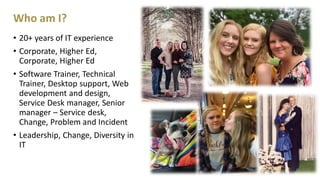
• 20+ years of IT experience
• Corporate, Higher Ed,
Corporate, Higher Ed
• Software Trainer, Technical
Trainer, Desktop support, Web
development and design,
Service Desk manager, Senior
manager – Service desk,
Change, Problem and Incident
• Leadership, Change, Diversity in
IT
Who am I?
• Public Research Institution in Georgia
• Current enrollment 33k
• Demographics
• 69% Male, 31% Female
• 24% International Students
• Confer about 7k degrees a year
• Part of the 26 Institution University
System of Georgia
• Total Employees 17k (62% male, 38
female)
• Not to be confused with the
University of Georgia, our biggest
sport rival (Clean old fashioned hate)
Georgia Tech
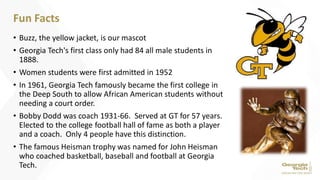
• Buzz, the yellow jacket, is our mascot
• Georgia Tech's first class only had 84 all male students in
1888.
• Women students were first admitted in 1952
• In 1961, Georgia Tech famously became the first college in
the Deep South to allow African American students without
needing a court order.
• Bobby Dodd was coach 1931-66. Served at GT for 57 years.
Elected to the college football hall of fame as both a player
and a coach. Only 4 people have this distinction.
• The famous Heisman trophy was named for John Heisman
who coached basketball, baseball and football at Georgia
Tech.
Fun Facts
• Distributed IT
• 350 Central IT Employees
• 600 IT Employees across the
Institute
• Lots of legacy systems and
institutional knowledge
Georgia Tech IT
• Why GT implemented change management
• How change management works at GT
• Lessons learned in our implementation
• Reporting
• Does it matter? Are we happy with the
results?
Today’s Plan
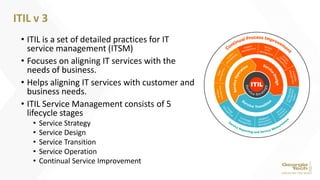
• ITIL is a set of detailed practices for IT
service management (ITSM)
• Focuses on aligning IT services with the
needs of business.
• Helps aligning IT services with customer and
business needs.
• ITIL Service Management consists of 5
lifecycle stages
• Service Strategy
• Service Design
• Service Transition
• Service Operation
• Continual Service Improvement
ITIL v 3
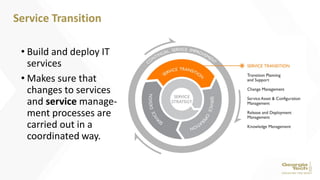
• Build and deploy IT
services
• Makes sure that
changes to services
and service manage-
ment processes are
carried out in a
coordinated way.
Service Transition
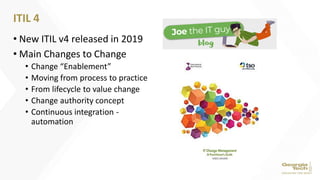
ITIL 4
• New ITIL v4 released in 2019
• Main Changes to Change
• Change “Enablement”
• Moving from process to practice
• From lifecycle to value change
• Change authority concept
• Continuous integration -
automation
• An event
• A champion
• Convincing leadership
• Selling everyone else
• Documentation
• Relationships
Why Change Management? AKA…Making A Case
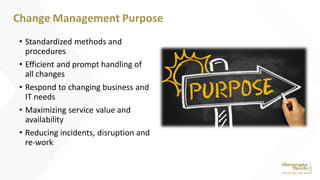
• Standardized methods and
procedures
• Efficient and prompt handling of
all changes
• Respond to changing business and
IT needs
• Maximizing service value and
availability
• Reducing incidents, disruption and
re-work
Change Management Purpose
ITIL says it is “the addition, modification or
removal of anything that could have an effect
on IT services.”
What is a Change?
•In Scope
• In Production
• Non-Production if used by
multiple teams or
workgroups, even if
categorized as test of
development.
•Out of Scope:
• Single end-user changes
• Service additions
Scope
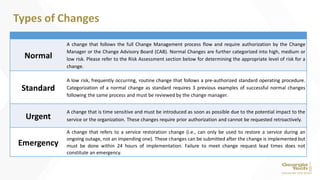
Normal
A change that follows the full Change Management process flow and require authorization by the Change
Manager or the Change Advisory Board (CAB). Normal Changes are further categorized into high, medium or
low risk. Please refer to the Risk Assessment section below for determining the appropriate level of risk for a
change.
Standard
A low risk, frequently occurring, routine change that follows a pre-authorized standard operating procedure.
Categorization of a normal change as standard requires 3 previous examples of successful normal changes
following the same process and must be reviewed by the change manager.
Urgent
A change that is time sensitive and must be introduced as soon as possible due to the potential impact to the
service or the organization. These changes require prior authorization and cannot be requested retroactively.
Emergency
A change that refers to a service restoration change (i.e., can only be used to restore a service during an
ongoing outage, not an impending one). These changes can be submitted after the change is implemented but
must be done within 24 hours of implementation. Failure to meet change request lead times does not
constitute an emergency.
Types of Changes
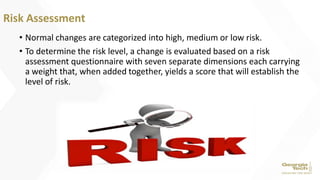
• Normal changes are categorized into high, medium or low risk.
• To determine the risk level, a change is evaluated based on a risk
assessment questionnaire with seven separate dimensions each carrying
a weight that, when added together, yields a score that will establish the
level of risk.
Risk Assessment
• Initially, flexible
• Realized risk mattered
• Presently we require normal requests be
submitted
• Low Risk – 7 days
• Medium Risk – 14 days
• High Risk – 45 days
• “We constantly seek to create an environment
that encourages early planning and the best
possible communication internally and
externally.”
Approval Cycles
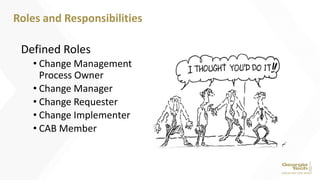
Defined Roles
• Change Management
Process Owner
• Change Manager
• Change Requester
• Change Implementer
• CAB Member
Roles and Responsibilities
•Keystone of the
Change
Management
process
•Primary purpose is
to mitigate risk
•Convenes weekly
Change Advisory Board (CAB)
The Change Advisory Board is comprised of the
Change Manager and one senior representative from
each of the following areas:
• Data Center Operations
• Networking
• Platform/Software as a Service
• Enterprise Applications & Middleware
• Academic Research Technologies
• Cyber Security
• Service Desk
• Partner IT Group
• Distributed IT Directors (2)
• Communications Director
• Library
CAB Makeup
•Business Justification
•Implementation Plan
•Risk and Potential Impact
•Testing Plan
•Back-out Plan
•Communication Plan
Required Documentation
• Weekly Forward Schedule of Changes
• Number of Changes requested and implemented by type,
risk and team – trend
• Number of deferred, canceled and denied Changes – trend
• Number of emergency and unplanned Changes
• Number of failed Changes (i.e., Changes that resulted in
incidents or outages)
• Post Implementation Reviews
• Number/Percentage of known unauthorized Changes *
• Number/Percentage of Changes that resulted in Incidents *
Reporting
LessonsLearned
• Top down adoption and support is a must.
• Transparency is critical.
• A champion is needed.
• Clear, concise communication is not
optional.
• Invest time and resources in proper
training.
• Focus on process, not the tool.
• Change is hard.
• Constant continuous improvement should
begin in the beginning.
• Reporting is critical.
Georgia Tech saw great benefit in the process in the first year
documented in the following areas:
• Improved alignment of IT services to the Institute
• Enhanced perception of IT, improved quality of service and
professional approach
• Increased visibility and communication of Changes
• Improved risk assessment
• Reduced adverse impact of Changes
• Increased productivity of Users as less disruption and higher-
quality services
• Reduced number of urgent/emergency Changes
Conclusions
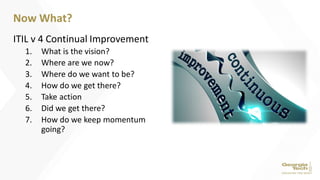
ITIL v 4 Continual Improvement
1. What is the vision?
2. Where are we now?
3. Where do we want to be?
4. How do we get there?
5. Take action
6. Did we get there?
7. How do we keep momentum
going?
Now What?
Vicki Rogers
vicki.rogers@oit.gatech.edu
Twitter - @vickirogers
www.linkedin.com/in/rogersvicki
vickinolesrogers.com
Stay in Touch!

Adding Value with Change Management

  • 1.
    Adding Value WithChange Management Vicki Rogers
  • 2.
    • 20+ yearsof IT experience • Corporate, Higher Ed, Corporate, Higher Ed • Software Trainer, Technical Trainer, Desktop support, Web development and design, Service Desk manager, Senior manager – Service desk, Change, Problem and Incident • Leadership, Change, Diversity in IT Who am I?
  • 3.
    • Public ResearchInstitution in Georgia • Current enrollment 33k • Demographics • 69% Male, 31% Female • 24% International Students • Confer about 7k degrees a year • Part of the 26 Institution University System of Georgia • Total Employees 17k (62% male, 38 female) • Not to be confused with the University of Georgia, our biggest sport rival (Clean old fashioned hate) Georgia Tech
  • 4.
    • Buzz, theyellow jacket, is our mascot • Georgia Tech's first class only had 84 all male students in 1888. • Women students were first admitted in 1952 • In 1961, Georgia Tech famously became the first college in the Deep South to allow African American students without needing a court order. • Bobby Dodd was coach 1931-66. Served at GT for 57 years. Elected to the college football hall of fame as both a player and a coach. Only 4 people have this distinction. • The famous Heisman trophy was named for John Heisman who coached basketball, baseball and football at Georgia Tech. Fun Facts
  • 5.
    • Distributed IT •350 Central IT Employees • 600 IT Employees across the Institute • Lots of legacy systems and institutional knowledge Georgia Tech IT
  • 6.
    • Why GTimplemented change management • How change management works at GT • Lessons learned in our implementation • Reporting • Does it matter? Are we happy with the results? Today’s Plan
  • 7.
    • ITIL isa set of detailed practices for IT service management (ITSM) • Focuses on aligning IT services with the needs of business. • Helps aligning IT services with customer and business needs. • ITIL Service Management consists of 5 lifecycle stages • Service Strategy • Service Design • Service Transition • Service Operation • Continual Service Improvement ITIL v 3
  • 8.
    • Build anddeploy IT services • Makes sure that changes to services and service manage- ment processes are carried out in a coordinated way. Service Transition
  • 9.
    ITIL 4 • NewITIL v4 released in 2019 • Main Changes to Change • Change “Enablement” • Moving from process to practice • From lifecycle to value change • Change authority concept • Continuous integration - automation
  • 10.
    • An event •A champion • Convincing leadership • Selling everyone else • Documentation • Relationships Why Change Management? AKA…Making A Case
  • 11.
    • Standardized methodsand procedures • Efficient and prompt handling of all changes • Respond to changing business and IT needs • Maximizing service value and availability • Reducing incidents, disruption and re-work Change Management Purpose
  • 12.
    ITIL says itis “the addition, modification or removal of anything that could have an effect on IT services.” What is a Change?
  • 13.
    •In Scope • InProduction • Non-Production if used by multiple teams or workgroups, even if categorized as test of development. •Out of Scope: • Single end-user changes • Service additions Scope
  • 14.
    Normal A change thatfollows the full Change Management process flow and require authorization by the Change Manager or the Change Advisory Board (CAB). Normal Changes are further categorized into high, medium or low risk. Please refer to the Risk Assessment section below for determining the appropriate level of risk for a change. Standard A low risk, frequently occurring, routine change that follows a pre-authorized standard operating procedure. Categorization of a normal change as standard requires 3 previous examples of successful normal changes following the same process and must be reviewed by the change manager. Urgent A change that is time sensitive and must be introduced as soon as possible due to the potential impact to the service or the organization. These changes require prior authorization and cannot be requested retroactively. Emergency A change that refers to a service restoration change (i.e., can only be used to restore a service during an ongoing outage, not an impending one). These changes can be submitted after the change is implemented but must be done within 24 hours of implementation. Failure to meet change request lead times does not constitute an emergency. Types of Changes
  • 15.
    • Normal changesare categorized into high, medium or low risk. • To determine the risk level, a change is evaluated based on a risk assessment questionnaire with seven separate dimensions each carrying a weight that, when added together, yields a score that will establish the level of risk. Risk Assessment
  • 16.
    • Initially, flexible •Realized risk mattered • Presently we require normal requests be submitted • Low Risk – 7 days • Medium Risk – 14 days • High Risk – 45 days • “We constantly seek to create an environment that encourages early planning and the best possible communication internally and externally.” Approval Cycles
  • 17.
    Defined Roles • ChangeManagement Process Owner • Change Manager • Change Requester • Change Implementer • CAB Member Roles and Responsibilities
  • 18.
    •Keystone of the Change Management process •Primarypurpose is to mitigate risk •Convenes weekly Change Advisory Board (CAB)
  • 19.
    The Change AdvisoryBoard is comprised of the Change Manager and one senior representative from each of the following areas: • Data Center Operations • Networking • Platform/Software as a Service • Enterprise Applications & Middleware • Academic Research Technologies • Cyber Security • Service Desk • Partner IT Group • Distributed IT Directors (2) • Communications Director • Library CAB Makeup
  • 20.
    •Business Justification •Implementation Plan •Riskand Potential Impact •Testing Plan •Back-out Plan •Communication Plan Required Documentation
  • 21.
    • Weekly ForwardSchedule of Changes • Number of Changes requested and implemented by type, risk and team – trend • Number of deferred, canceled and denied Changes – trend • Number of emergency and unplanned Changes • Number of failed Changes (i.e., Changes that resulted in incidents or outages) • Post Implementation Reviews • Number/Percentage of known unauthorized Changes * • Number/Percentage of Changes that resulted in Incidents * Reporting
  • 22.
    LessonsLearned • Top downadoption and support is a must. • Transparency is critical. • A champion is needed. • Clear, concise communication is not optional. • Invest time and resources in proper training. • Focus on process, not the tool. • Change is hard. • Constant continuous improvement should begin in the beginning. • Reporting is critical.
  • 23.
    Georgia Tech sawgreat benefit in the process in the first year documented in the following areas: • Improved alignment of IT services to the Institute • Enhanced perception of IT, improved quality of service and professional approach • Increased visibility and communication of Changes • Improved risk assessment • Reduced adverse impact of Changes • Increased productivity of Users as less disruption and higher- quality services • Reduced number of urgent/emergency Changes Conclusions
  • 24.
    ITIL v 4Continual Improvement 1. What is the vision? 2. Where are we now? 3. Where do we want to be? 4. How do we get there? 5. Take action 6. Did we get there? 7. How do we keep momentum going? Now What?
  • 25.
    Vicki Rogers vicki.rogers@oit.gatech.edu Twitter -@vickirogers www.linkedin.com/in/rogersvicki vickinolesrogers.com Stay in Touch!