Japan Objectives: To recognise location of Japan To learn the key physical features To understand and be able to explain the population distribution pattern
China Where is Japan?
HOKKAIDO HONSHU SHIKOKU KYUSHU
4 main islands Honshu Hokkaido Shikoku Kyushu All islands have mountainous interior and coastal lowlands
 
SEA OF JAPAN CENTRAL AREA OF HIGHLAND
Japan's area is comparable to that of Germany or California. Japan's northern most islands are located on a similar geographical latitude as Milan or Portland, while her southern most islands are on a similar latitude as the Bahamas. More than 50% of the country is mountainous and covered by forests
Japan has the world's  tenth largest population , with about 128 million people. The mountainous areas have low population densities ,70 people per square km because… Deep narrow forested valleys with steep sides and thin soils so ….. Winter temperatures are  < 0 o C  and summer temperatures are also low <10 o C so …… Rainfall is high, more than 2000mm per year
Rice is the main food in Japan Conditions which favour rice growth … Rice seeds have a growing season of 5 months with temperatures above 21 o C Annual rainfall of >2000mm with at least 120mm falling in each month of the growing season Dry sunny period for ripening and harvesting
Reasons for population distribution in Japan….
Mountainous interior areas have a low population (less than 70 people per km2) density because …. Conditions are unfavourable for rice growing Growing season is too short for arable farming below 0degrees in winter and less than 10 in summer. High rainfall > 2000mm pa. Narrow valley floors provide little flat land for building on.  Costs of constructing roads and railways are high Unfavourable to industry because… High costs of construction for roads and railways Remote from markets in cities No jobs for people No raw materials or natural resources
 
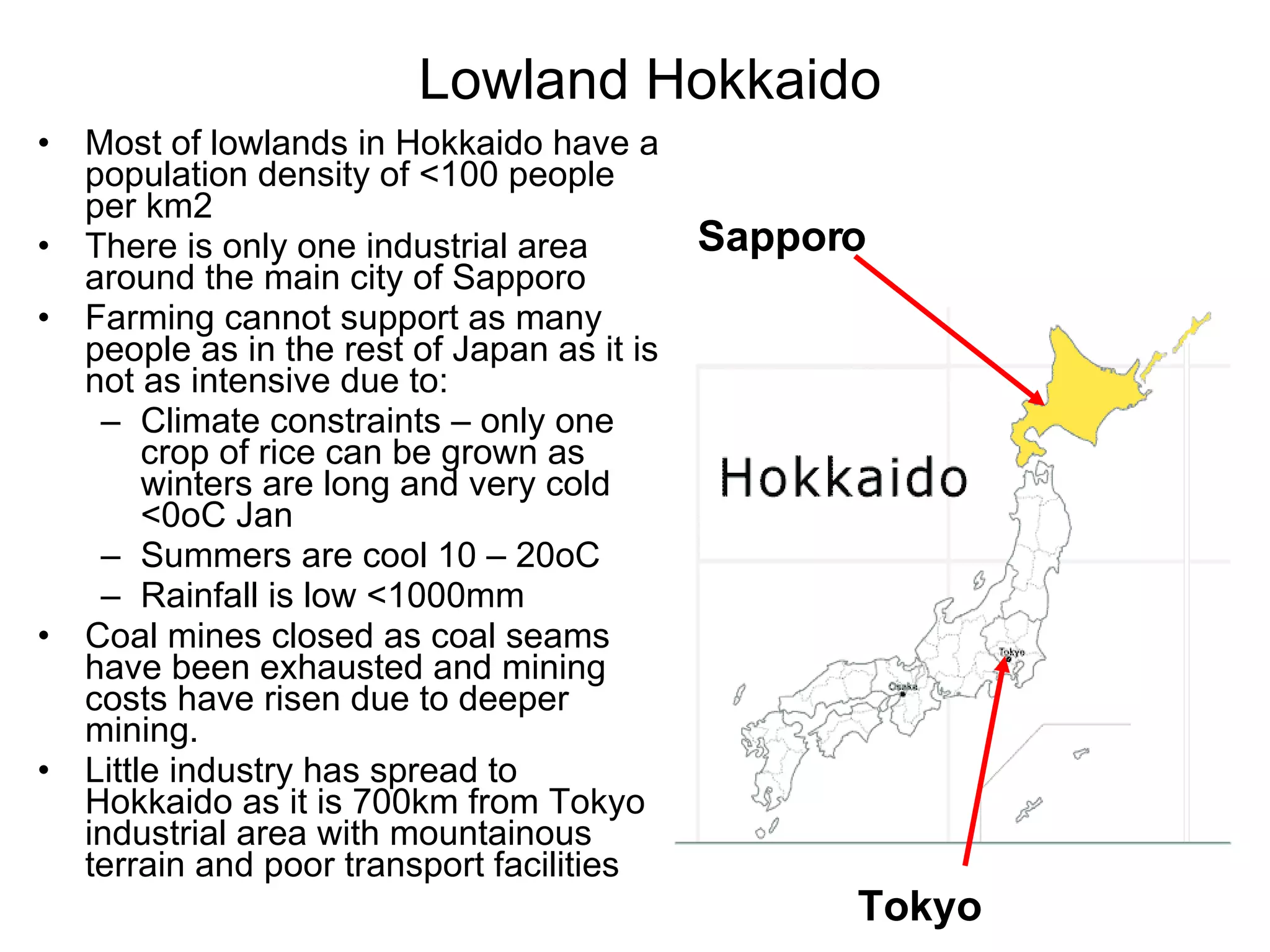
Lowland Hokkaido Most of lowlands in Hokkaido have a population density of <100 people per km2 There is only one industrial area around the main city of Sapporo Farming cannot support as many people as in the rest of Japan as it is not as intensive due to: Climate constraints – only one crop of rice can be grown as winters are long and very cold <0oC Jan  Summers are cool 10 – 20oC Rainfall is low <1000mm Coal mines closed as coal seams have been exhausted and mining costs have risen due to deeper mining. Little industry has spread to Hokkaido as it is 700km from Tokyo industrial area with mountainous terrain and poor transport facilities Sapporo Tokyo
Lowland Honshu, Shikoku and Kyushu All lowlands in Honshu, Shikoku and Kyushu have high population densities of over 100 per km 2 .  Population density is highest (>200 people per km 2 ) in the industrial zones where there are many jobs.  Farms are small and very intensive due to: Long growing season (up to 10 months) in the south so 2 crops per year can be grown.  Ideal growing season – High summer temps 20 – 30 o C in July and high rainfall (>1000mm) from the monsoon Land is flat in the lowlands, or it has been terraced.  Fields can be flooded for rice growing and farming is mechanised.  This results in large crop yields Fertile alluvium soils in lowland Rural areas also have high pop densities because many of the farmers are part time, working in cities during the week and on their farms at the weekend.
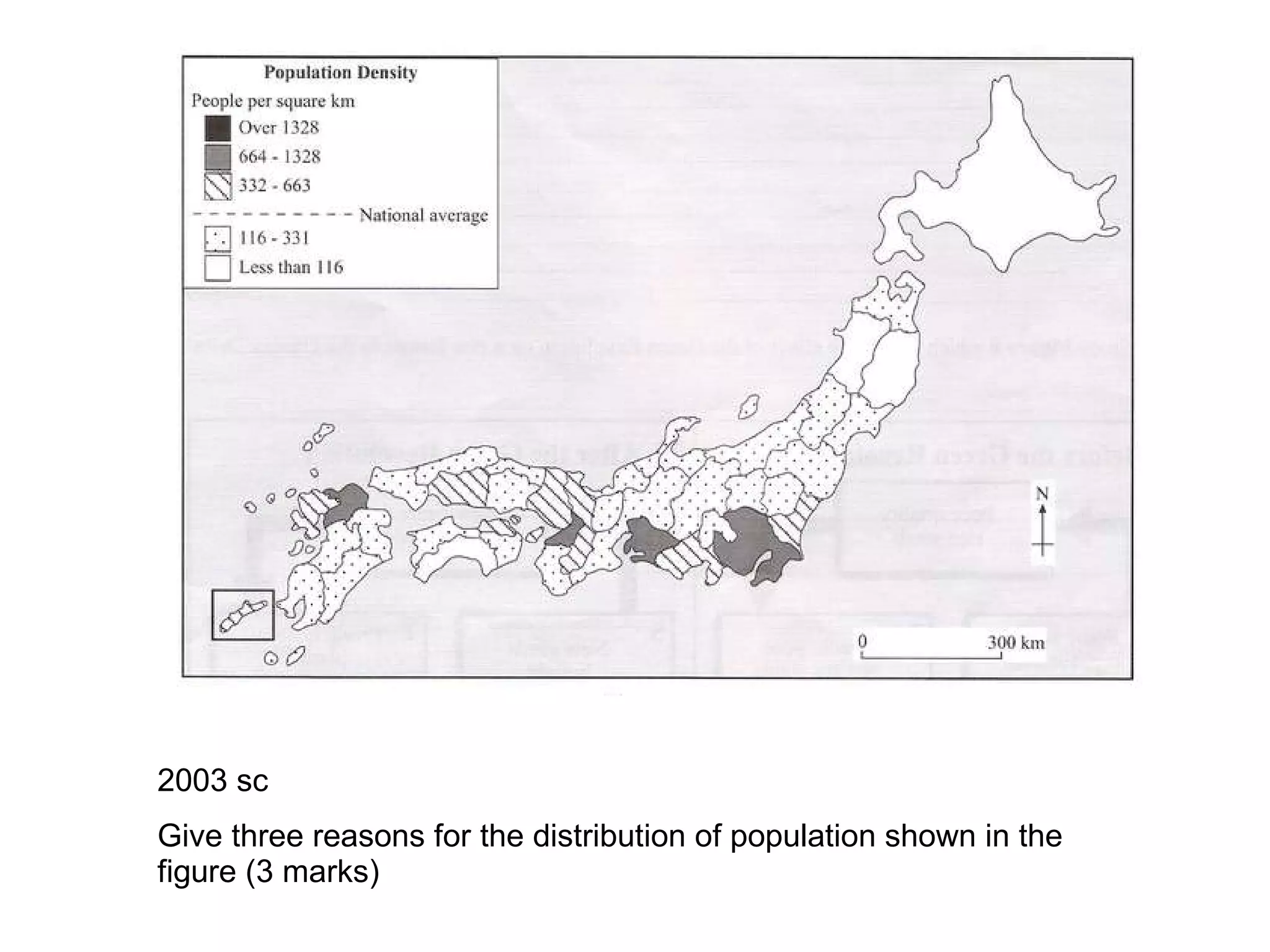
2003 sc Give three reasons for the distribution of population shown in the figure (3 marks)

Physical Geography And Population Distribution

  • 1.
    Japan Objectives: Torecognise location of Japan To learn the key physical features To understand and be able to explain the population distribution pattern
  • 2.
  • 3.
  • 4.
    4 main islandsHonshu Hokkaido Shikoku Kyushu All islands have mountainous interior and coastal lowlands
  • 5.
  • 6.
    SEA OF JAPANCENTRAL AREA OF HIGHLAND
  • 7.
    Japan's area iscomparable to that of Germany or California. Japan's northern most islands are located on a similar geographical latitude as Milan or Portland, while her southern most islands are on a similar latitude as the Bahamas. More than 50% of the country is mountainous and covered by forests
  • 8.
    Japan has theworld's tenth largest population , with about 128 million people. The mountainous areas have low population densities ,70 people per square km because… Deep narrow forested valleys with steep sides and thin soils so ….. Winter temperatures are < 0 o C and summer temperatures are also low <10 o C so …… Rainfall is high, more than 2000mm per year
  • 9.
    Rice is themain food in Japan Conditions which favour rice growth … Rice seeds have a growing season of 5 months with temperatures above 21 o C Annual rainfall of >2000mm with at least 120mm falling in each month of the growing season Dry sunny period for ripening and harvesting
  • 10.
    Reasons for populationdistribution in Japan….
  • 11.
    Mountainous interior areashave a low population (less than 70 people per km2) density because …. Conditions are unfavourable for rice growing Growing season is too short for arable farming below 0degrees in winter and less than 10 in summer. High rainfall > 2000mm pa. Narrow valley floors provide little flat land for building on. Costs of constructing roads and railways are high Unfavourable to industry because… High costs of construction for roads and railways Remote from markets in cities No jobs for people No raw materials or natural resources
  • 12.
  • 13.
    Lowland Hokkaido Mostof lowlands in Hokkaido have a population density of <100 people per km2 There is only one industrial area around the main city of Sapporo Farming cannot support as many people as in the rest of Japan as it is not as intensive due to: Climate constraints – only one crop of rice can be grown as winters are long and very cold <0oC Jan Summers are cool 10 – 20oC Rainfall is low <1000mm Coal mines closed as coal seams have been exhausted and mining costs have risen due to deeper mining. Little industry has spread to Hokkaido as it is 700km from Tokyo industrial area with mountainous terrain and poor transport facilities Sapporo Tokyo
  • 14.
    Lowland Honshu, Shikokuand Kyushu All lowlands in Honshu, Shikoku and Kyushu have high population densities of over 100 per km 2 . Population density is highest (>200 people per km 2 ) in the industrial zones where there are many jobs. Farms are small and very intensive due to: Long growing season (up to 10 months) in the south so 2 crops per year can be grown. Ideal growing season – High summer temps 20 – 30 o C in July and high rainfall (>1000mm) from the monsoon Land is flat in the lowlands, or it has been terraced. Fields can be flooded for rice growing and farming is mechanised. This results in large crop yields Fertile alluvium soils in lowland Rural areas also have high pop densities because many of the farmers are part time, working in cities during the week and on their farms at the weekend.
  • 15.
    2003 sc Givethree reasons for the distribution of population shown in the figure (3 marks)