Submitted by
Prince Aulakh
Bsc athm
1331930

Submitted to
Ms. gopika dutta
INTRODUCTION TO JAPAN
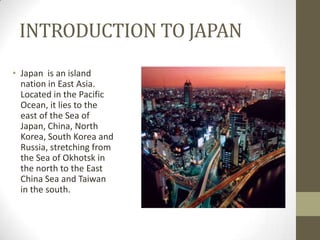
• Japan is an island
nation in East Asia.
Located in the Pacific
Ocean, it lies to the
east of the Sea of
Japan, China, North
Korea, South Korea and
Russia, stretching from
the Sea of Okhotsk in
the north to the East
China Sea and Taiwan
in the south.
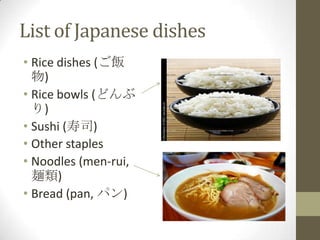
List of Japanese dishes
• Rice dishes (ご飯
物)
• Rice bowls (どんぶ
り)
• Sushi (寿司)
• Other staples
• Noodles (men-rui,
麺類)
• Bread (pan, パン)
CULTURE
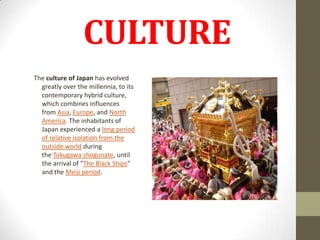
The culture of Japan has evolved
greatly over the millennia, to its
contemporary hybrid culture,
which combines influences
from Asia, Europe, and North
America. The inhabitants of
Japan experienced a long period
of relative isolation from the
outside world during
the Tokugawa shogunate, until
the arrival of "The Black Ships"
and the Meiji period.
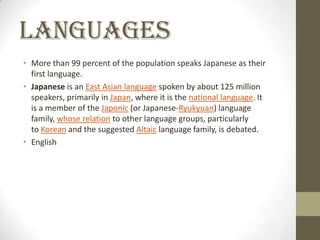
Languages
• More than 99 percent of the population speaks Japanese as their
first language.
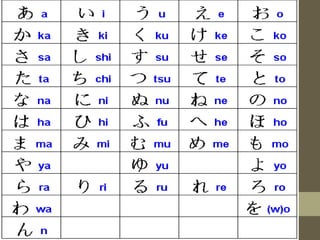
• Japanese is an East Asian language spoken by about 125 million
speakers, primarily in Japan, where it is the national language. It
is a member of the Japonic (or Japanese-Ryukyuan) language
family, whose relation to other language groups, particularly
to Korean and the suggested Altaic language family, is debated.
• English
Sumo
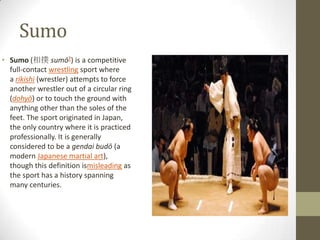
• Sumo (相撲 sumō?) is a competitive
full-contact wrestling sport where
a rikishi (wrestler) attempts to force
another wrestler out of a circular ring
(dohyō) or to touch the ground with
anything other than the soles of the
feet. The sport originated in Japan,
the only country where it is practiced
professionally. It is generally
considered to be a gendai budō (a
modern Japanese martial art),
though this definition ismisleading as
the sport has a history spanning
many centuries.
Tourist destination
•
•
•
•
•

Tokyo Disney land
Imperal palace
Great Buddha statue
Tokyo tower
Golden pavillion
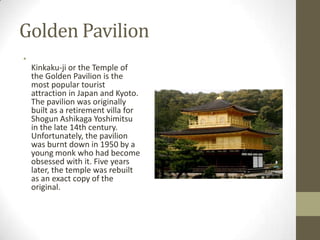
Golden Pavilion
•

Kinkaku-ji or the Temple of
the Golden Pavilion is the
most popular tourist
attraction in Japan and Kyoto.
The pavilion was originally
built as a retirement villa for
Shogun Ashikaga Yoshimitsu
in the late 14th century.
Unfortunately, the pavilion
was burnt down in 1950 by a
young monk who had become
obsessed with it. Five years
later, the temple was rebuilt
as an exact copy of the
original.
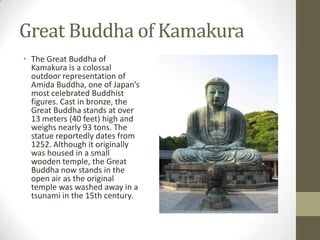
Great Buddha of Kamakura
• The Great Buddha of
Kamakura is a colossal
outdoor representation of
Amida Buddha, one of Japan’s
most celebrated Buddhist
figures. Cast in bronze, the
Great Buddha stands at over
13 meters (40 feet) high and
weighs nearly 93 tons. The
statue reportedly dates from
1252. Although it originally
was housed in a small
wooden temple, the Great
Buddha now stands in the
open air as the original
temple was washed away in a
tsunami in the 15th century.
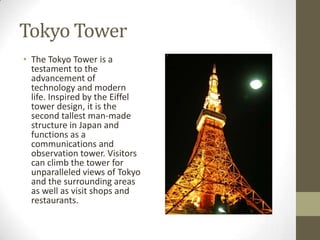
Tokyo Tower
• The Tokyo Tower is a
testament to the
advancement of
technology and modern
life. Inspired by the Eiffel
tower design, it is the
second tallest man-made
structure in Japan and
functions as a
communications and
observation tower. Visitors
can climb the tower for
unparalleled views of Tokyo
and the surrounding areas
as well as visit shops and
restaurants.
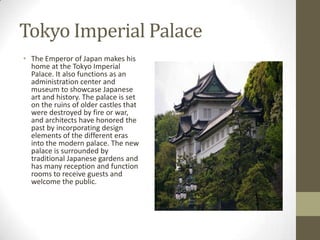
Tokyo Imperial Palace
• The Emperor of Japan makes his
home at the Tokyo Imperial
Palace. It also functions as an
administration center and
museum to showcase Japanese
art and history. The palace is set
on the ruins of older castles that
were destroyed by fire or war,
and architects have honored the
past by incorporating design
elements of the different eras
into the modern palace. The new
palace is surrounded by
traditional Japanese gardens and
has many reception and function
rooms to receive guests and
welcome the public.
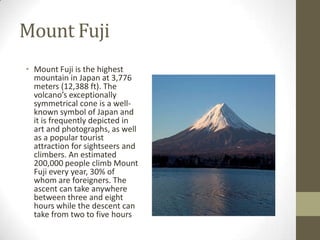
Mount Fuji
• Mount Fuji is the highest
mountain in Japan at 3,776
meters (12,388 ft). The
volcano’s exceptionally
symmetrical cone is a wellknown symbol of Japan and
it is frequently depicted in
art and photographs, as well
as a popular tourist
attraction for sightseers and
climbers. An estimated
200,000 people climb Mount
Fuji every year, 30% of
whom are foreigners. The
ascent can take anywhere
between three and eight
hours while the descent can
take from two to five hours
Tokyo Disneyland
• Tokyo Disneyland is a 115-acre (465,000
m2) theme park at the Tokyo Disney
Resort in Urayasu, Chiba, Japan, near
Tokyo.[1] Its main gate is directly
adjacent to both Maihama Station and
Tokyo Disneyland Station. It was the first
Disney park to be built outside the
United States, and it opened on April
15, 1983. The park was constructed by
Walt Disney Imagineering in the same
style as Disneyland in California and
Magic Kingdom in Florida.[2] It is owned
by The Oriental Land Company, which
licenses the theme from The Walt
Disney Company. Tokyo Disneyland and
its companion park, Tokyo DisneySea,
are the only Disney parks not wholly or
partially owned by the Walt Disney
Company.
Japan

Japan

  • 1.
    Submitted by Prince Aulakh Bscathm 1331930 Submitted to Ms. gopika dutta
  • 2.
    INTRODUCTION TO JAPAN •Japan is an island nation in East Asia. Located in the Pacific Ocean, it lies to the east of the Sea of Japan, China, North Korea, South Korea and Russia, stretching from the Sea of Okhotsk in the north to the East China Sea and Taiwan in the south.
  • 3.
    List of Japanesedishes • Rice dishes (ご飯 物) • Rice bowls (どんぶ り) • Sushi (寿司) • Other staples • Noodles (men-rui, 麺類) • Bread (pan, パン)
  • 4.
    CULTURE The culture ofJapan has evolved greatly over the millennia, to its contemporary hybrid culture, which combines influences from Asia, Europe, and North America. The inhabitants of Japan experienced a long period of relative isolation from the outside world during the Tokugawa shogunate, until the arrival of "The Black Ships" and the Meiji period.
  • 5.
    Languages • More than99 percent of the population speaks Japanese as their first language. • Japanese is an East Asian language spoken by about 125 million speakers, primarily in Japan, where it is the national language. It is a member of the Japonic (or Japanese-Ryukyuan) language family, whose relation to other language groups, particularly to Korean and the suggested Altaic language family, is debated. • English
  • 7.
    Sumo • Sumo (相撲sumō?) is a competitive full-contact wrestling sport where a rikishi (wrestler) attempts to force another wrestler out of a circular ring (dohyō) or to touch the ground with anything other than the soles of the feet. The sport originated in Japan, the only country where it is practiced professionally. It is generally considered to be a gendai budō (a modern Japanese martial art), though this definition ismisleading as the sport has a history spanning many centuries.
  • 8.
    Tourist destination • • • • • Tokyo Disneyland Imperal palace Great Buddha statue Tokyo tower Golden pavillion
  • 9.
    Golden Pavilion • Kinkaku-ji orthe Temple of the Golden Pavilion is the most popular tourist attraction in Japan and Kyoto. The pavilion was originally built as a retirement villa for Shogun Ashikaga Yoshimitsu in the late 14th century. Unfortunately, the pavilion was burnt down in 1950 by a young monk who had become obsessed with it. Five years later, the temple was rebuilt as an exact copy of the original.
  • 10.
    Great Buddha ofKamakura • The Great Buddha of Kamakura is a colossal outdoor representation of Amida Buddha, one of Japan’s most celebrated Buddhist figures. Cast in bronze, the Great Buddha stands at over 13 meters (40 feet) high and weighs nearly 93 tons. The statue reportedly dates from 1252. Although it originally was housed in a small wooden temple, the Great Buddha now stands in the open air as the original temple was washed away in a tsunami in the 15th century.
  • 11.
    Tokyo Tower • TheTokyo Tower is a testament to the advancement of technology and modern life. Inspired by the Eiffel tower design, it is the second tallest man-made structure in Japan and functions as a communications and observation tower. Visitors can climb the tower for unparalleled views of Tokyo and the surrounding areas as well as visit shops and restaurants.
  • 12.
    Tokyo Imperial Palace •The Emperor of Japan makes his home at the Tokyo Imperial Palace. It also functions as an administration center and museum to showcase Japanese art and history. The palace is set on the ruins of older castles that were destroyed by fire or war, and architects have honored the past by incorporating design elements of the different eras into the modern palace. The new palace is surrounded by traditional Japanese gardens and has many reception and function rooms to receive guests and welcome the public.
  • 13.
    Mount Fuji • MountFuji is the highest mountain in Japan at 3,776 meters (12,388 ft). The volcano’s exceptionally symmetrical cone is a wellknown symbol of Japan and it is frequently depicted in art and photographs, as well as a popular tourist attraction for sightseers and climbers. An estimated 200,000 people climb Mount Fuji every year, 30% of whom are foreigners. The ascent can take anywhere between three and eight hours while the descent can take from two to five hours
  • 14.
    Tokyo Disneyland • TokyoDisneyland is a 115-acre (465,000 m2) theme park at the Tokyo Disney Resort in Urayasu, Chiba, Japan, near Tokyo.[1] Its main gate is directly adjacent to both Maihama Station and Tokyo Disneyland Station. It was the first Disney park to be built outside the United States, and it opened on April 15, 1983. The park was constructed by Walt Disney Imagineering in the same style as Disneyland in California and Magic Kingdom in Florida.[2] It is owned by The Oriental Land Company, which licenses the theme from The Walt Disney Company. Tokyo Disneyland and its companion park, Tokyo DisneySea, are the only Disney parks not wholly or partially owned by the Walt Disney Company.