HISTORY AND EVOLUTION
ITC was incorporated on August 24, 1910 under the name Imperial Tobacco Company of
India Limited. As the Company's ownership progressively Indianised, the name of the
Company was changed from Imperial Tobacco Company of India Limited to India
Tobacco Company Limited in 1970 and then to I.T.C. Limited in 1974.. The
Company now stands rechristened 'ITC Limited'.
.
The ITC Profile
ITC is one of India's foremost private sector companies with a market capitalisation of
over US $ 33 billion and a turnover of US $ 7 billion. ITC is rated among the World's
Best Big Companies, Asia's 'Fab 50' and the World's Most Reputable Companies by
Forbes magazine, among India's Most Respected Companies by BusinessWorld and
among India's Most Valuable Companies by Business Today. ITC ranks among India's
`10 Most Valuable (Company) Brands', in a study conducted by Brand Finance and
published by the Economic Times. ITC also ranks among Asia's 50 best performing
companies compiled by Business Week.
ITC has a diversified presence in Cigarettes, Hotels, Paperboards & Specialty Papers,
Packaging, Agri-Business, Packaged Foods & Confectionery, Information Technology,
Branded Apparel, Personal Care, Stationery, Safety Matches and other FMCG products.
While ITC is an outstanding market leader in its traditional businesses of Cigarettes,
Hotels, Paperboards, Packaging and Agri-Exports, it is rapidly gaining market share even
in its nascent businesses of Packaged Foods & Confectionery, Branded Apparel, Personal
Care and Stationery.
As one of India's most valuable and respected corporations, ITC is widely perceived to be
dedicatedly nation-oriented. Chairman Y C Deveshwar calls this source of inspiration "a
commitment beyond the market". In his own words: "ITC believes that its aspiration to
create enduring value for the nation provides the motive force to sustain growing
shareholder value. ITC practices this philosophy by not only driving each of its
businesses towards international competitiveness but by also consciously contributing to
enhancing the competitiveness of the larger value chain of which it is a part."
ITC's diversified status originates from its corporate strategy aimed at creating multiple
drivers of growth anchored on its time-tested core competencies: unmatched distribution
reach, superior brand-building capabilities, effective supply chain management and
acknowledged service skills in hoteliering. Over time, the strategic forays into new
businesses are expected to garner a significant share of these emerging high-growth
markets in India.
ITC employs over 24,000 people at more than 60 locations across India. The Company
continuously endeavors to enhance its wealth generating capabilities in a globalising
environment to consistently reward more than 4,14,000 shareholders, fulfill the
aspirations of its stakeholders and meet societal expectations. This over-arching vision of
the company is expressively captured in its corporate positioning statement: "Enduring
Value. For the Nation. For the Shareholder."
ITC is involved in following businesses:
Cigarettes: ITC is the market leader in cigarettes in India and has a wide range of
popular brands such as Insignia, India Kings, Classic, Gold Flake, Silk Cut, Navy Cut,
Scissors, Capstan, Berkeley, Bristol and Flake in its portfolio.
Packaging: ITC's Packaging & Printing Business is the country's largest convertor of
paperboard into packaging. It was set up in 1925 as a strategic backward integration for
ITC's Cigarettes business. It offers a variety of value-added packaging solutions for the
food & beverage, personal products, cigarette, liquor, cellular phone and IT packaging
industries.
Hotels: ITC entered the hotels business in 1975 with the acquisition of a hotel in Chennai
which was rechristened Hotel Chola. Today ITC-Welcomgroup with over 70 hotels is one
of the foremost hotel chains in India.
Paperboards: In 1979, ITC entered the Paperboards business by promoting ITC
Bhadrachalam Paperboards. ITC's Paperboards business has a manufacturing capacity of
over 360,000 tonnes per year and is a market leader in India across all carton-consuming
segments.
Greeting, Gifting & Stationery: ITC's stationery brands "Paper Kraft" & "Classmate"
are widely distributed brands across India. The Paperkraft designer stationery range
consists of notepads & multi subject notebooks in hard, soft covers & multiple binding
formats including spirals, wiros etc. ITC's Greeting & Gifting products include
Expressions range of greeting cards and gifting products.
Safety Matches: ITC's brands of safety matches include iKno, Mangaldeep, VaxLit,
Delite and Aim. The Aim is the largest selling brand of Safety Matches in India. ITC also
exports premium brands to markets such as Europe, Africa and the USA.
Aggarbattis: ITC has launched Mangaldeep brand of Aggarbattis with a wide range of
fragrances like Rose, Jasmine, Bouquet, Sandalwood, Madhur, Durbar, Tarangini,
Anushri, Ananth and Mogra. Mangaldeep is also being exported to USA, UAE, Bahrain,
Nepal, Singapore, Malaysia, Oman and South Africa.
Lifestyle Retailing: ITC entered the Lifestyle Retailing business with the Wills Sport
range of international quality relaxed wear for men and women in 2000. The Wills
Lifestyle chain of exclusive stores later expanded its range to include Wills Classic
formal wear (2002) and Wills Clublife evening wear (2003). In 2002, ITC entered into
the popular segment with its men's wear brand, John Players. In 2005, ITC introduced
Essenza Di Wills, an exclusive line of prestige fragrance products.
Food: ITC made its entry into the branded & packaged Foods business in August 2001
with the launch of the "Kitchens of India" brand. In 2002 it expanded into Confectionery,
Staples and Snack Foods segments. ITC's brand in Food category include: Kitchens of
India, Aashirvaad, Sunfeast, Mint-O, Candyman, and Bingo!.
Agri Exports: ITC's International Business Division (IBD) is the country's second
largest exporter of agri-products. ITC exports Feed Ingredients (Soyameal), Foodgrains
(Rice, Wheat, Pulses), Coffee & Spices, Edible Nuts, Marine Products, and Processed
Fruits.
e-choupal: The e-Choupal model of ITC has been very effective in tackling the
challenges posed by the unique features of Indian agriculture, characterised by
fragmented farms, weak infrastructure and the involvement of numerous intermediaries,
among others. ITC's e-Choupal won the Stockholm Challenge 2006 award is for using
information technology for the economic development of rural communities.
Performance
ITC Ltd. completed yet another year of strong performance with Gross Turnover for the
year growing by 20.2% to ` 19505 crores. Net Turnover at ` 12369 crores grew by 26.3%
driven by the non-cigarette FMCG businesses, higher agri-business revenues and the
continuing strong performance by the Hotels business. The non- cigarette portfolio grew
by 37.6% during the year and now accounts for 52.3% of the Company's Net Turnover.
Pre-tax profit increased by 20.1% to ` 3927 crores, while Post-tax profit at ` 2700 crores
registered a growth of 20.8%. Earnings Per Share for the year stands at ` 7.19.
Organization
ITC 's Chairman is Mr. Y.C. Deveshwar.
SWOT Analysis ITC
ITC is one of India's biggest and best-known private sector companies. In fact it is one of
the World's most high profile consumer operations. This SWOT analysis is about ITC. Its
businesses and brands are focused almost entirely on the Indian markets, and despite
being most well-known for its tobacco brands such as Gold Flake, the business is now
diversifying into new FMCG (Fast Moving Consumer Goods) brands in a number of
market sectors
- including cigarettes, hotels, paper, agriculture, packaged foods and confectionary,
branded apparel, personal care, greetings cards, Information Technology, safety matches,
incense sticks and stationery. Examples of its successful new FMCG products include:
• Aashirvaad - India's most popular atta brand with over 50% market share. It is
also present in spices and instant mixes.
• Mint-o - Mint-0 Fresh is the largest cough lozenge brand in India.
• Bingo! - a new introduction of finger snacks.
• Kitchens of India - pre-prepared foods designed by ITC's master chefs.
• Sunfeast - is ITC's biscuit brand (and the sub-brand is also used on some pasta
products).
Strengths
ITC leveraged it traditional businesses to develop new brands for new segments. For
example, ITC used its experience of transporting and distributing tobacco products to
remote and distant parts of India to the advantage of its FMCG products. ITC master
chefs from its hotel chain are often asked to develop new food concepts for its FMCG
business.
ITC is a diversified company trading in a number of business sectors including cigarettes,
hotels, paper, agriculture, packaged foods and confectionary, branded apparel, personal
care, greetings cards, Information Technology, safety matches, incense sticks and
stationery.
Weaknesses
The company's original business was traded in tobacco. ITC stands for Imperial Tobacco
Company of India Limited. It is interesting that a business that is now so involved in
branding continues to use its original name, despite the negative connection of tobacco
with poor health and premature death.
To fund its cash guzzling FMCG start-up, the company is still dependant upon its
tobacco revenues. Cigarettes account for 47 per cent of the company's turnover, and
that in itself is responsible for 80% of its profits. So there is an argument that ITC's
move into FMCG (Fast Moving Consumer Goods) is being subsidised by its tobacco
operations. Its Gold Flake tobacco brand is the largest FMCG brand in India - and
this single brand alone hold 70% of the tobacco market. Opportunities
Core brands such as Aashirvaad, Mint-o, Bingo! And Sun Feast (and others) can be
developed using strategies of market development, product development and marketing
penetration.
ITC is moving into new and emerging sectors including Information Technology,
supporting business solutions.
e-Choupal is a community of practice that links rural Indian farmers using the Internet.
This is an original and well thought of initiative that could be used in other sectors in
many other parts of the world. It is also an ambitious project that has a goal of reaching
10 million farmers in 100,000 villages. Take a look at eChoupal here
http://www.itcportal.com/agri_exports/e-choupal_new.htm
ITC leverages e-Choupal in a novel way. The company researched the tastes of
consumers in the North, West and East of India of atta (a popular type of wheat flour),
then used the network to source and create the raw materials from farmers and then blend
them for consumers under purposeful brand names such as Aashirvaad Select in the
Northern market, Aashirvaad MP Chakki in the Western market and Aashirvaad in the
Eastern market. This concept is tremendously difficult for competitors to emulate.
Chairman Yogi Deveshwar's strategic vision is to turn his Indian conglomerate into the
country's premier FMCG business.
Per capita consumption of personal care products in India is the lowest in the world
offering an opportunity for ITC's soaps, shampoos and fragrances under their Wills brand.
Threats
The obvious threat is from competition, both domestic and international. The laws of
economics dictate that if competitors see that there is a solid profit to be made in an
emerging consumer society that ultimately new products and services will be made
available. Western companies will see India as an exciting opportunity for themselves to
find new market segments for their own offerings.
ITC's opportunities are likely to be opportunities for other companies as well. Therefore
the dynamic of competition will alter in the medium-term. Then ITC will need to decide
whether being a diversified conglomerate is the most competitive strategic formation for
a secure future.
Code of Conduct
Applicable to all directors, senior management and employees of the Company
Preamble
ITC’s Code of Conduct was circulated to the employees more than five years back and is
posted on the Company’s corporate website. This Code has now been re-drafted for better
presentation. This Code is derived from three interlinked fundamental principles, viz.
good corporate governance, good corporate citizenship and exemplary personal conduct.
Philosophy
ITC is a professionally managed organisation and the core value underlying our corporate
philosophy is "trusteeship". We believe this organisation has been handed to us by the
various stakeholders in "trust" and we as professionals are the "trustees" of these
stakeholders. It is therefore our responsibility to ensure that the organisation is managed
in a manner that protects and furthers the interests of our stakeholders. We recognise
society as an important stakeholder in this enterprise and therefore it is part of our
responsibility to practise good corporate citizenship.
It is also our belief that in order to serve the interests of our stakeholders in perpetuity, we
must build ITC into an institution whose dynamism and vitality are anchored in its core
values.
Corporate Governance Policy
The Corporate Governance Policy is the apex level instrument guiding conduct of the
affairs of the Company and clearly delineates the roles, responsibilities and authorities of
the key entities in the governance structure of the Company. This Code forms an integral
part of the Company’s Governance Policy. The directors, senior management and
employees must adhere to the Corporate Governance Policy of the Company.
Good Corporate Citizenship
In the conduct of the Company’s business, the practice of good corporate citizenship is a
prerequisite and embraces the following:
Dealing with People in the Organisation
In dealing with each other, directors, senior management and employees shall uphold the
values which are at the core of our HR Philosophy - trust, teamwork, mutuality and
collaboration, meritocracy, objectivity, self respect and human dignity. Indeed, these
values form the basis of our HR management systems and processes. In selection and
recruitment, while meritocracy will be a prime criterion, managers will scrupulously
consider all factors that go towards securing the interests of the Company. ITC will focus
on meritocracy, equity and upholding of Company values in all people processes
including performance management systems, appraisals, remuneration and rewards.
A Gender Friendly Workplace
As a good corporate citizen, ITC is committed to a gender friendly workplace. It seeks to
enhance equal opportunities for men and women, prevent/stop/redress sexual harassment
at the workplace and institute good employment practices.
ITC maintains an open door for reportees; encourages employees to report any
harassment concerns and is responsive to employee complaints about harassment or other
unwelcome and offensive conduct. A Grievance Committee on Gender Issues has been
constituted to enquire into complaints and to recommend appropriate action, wherever
required.
ITC demands, demonstrates and promotes professional behaviour and respectful
treatment of all employees.
Relationships with Suppliers and Customers
All directors, senior management and employees shall ensure that in their dealings with
suppliers and customers, the Company’s interests are never compromised. Accepting gifts
and presents of more than a nominal value, gratuity payments and other payments from
suppliers or customers will be viewed as serious breach of discipline as this could lead to
compromising the Company’s interests.
Legal Compliance
It is the Company’s policy to comply fully with all applicable laws and regulations.
Ensuring legal and regulatory compliance is the responsibility of the Chief Executives of
the Businesses and the Divisional Management Committees. The Company cannot accept
practices which are unlawful or may be damaging to its reputation. Divisional
Management Committees must satisfy themselves that sound and adequate arrangements
exist to ensure that they comply with the legal and regulatory requirements impacting
each business and identify and respond to developments in the regulatory environment in
which they operate. In the event the implication of any law is not clear, the Company’s
Legal Department shall be consulted for advice.
Health and Safety
The Company attaches great importance to a healthy and safe work environment. ITC is
committed to provide good physical working conditions and encourages high standards
of hygiene and housekeeping. Particular attention should be paid to training of employees
to increase safety awareness and adoption of safe working methods, particularly designed
to prevent serious or fatal accidents.
Environment Policies
The Company believes that commitment to sustainable development is a key component
of responsible corporate citizenship and therefore deserves to be accorded the highest
priority. Accordingly, the Company is committed to Best Practices in environmental
matters arising out of its business activities and expects each business to fully
demonstrate this commitment.
In addition to complying with applicable laws and regulations, Businesses must establish
procedures for assessing the environmental effects of their present and future activities.
They should adopt Best Practices in their environmental policies and procedures.
Personal Conduct
All directors, senior management and employees have the obligation to conduct
themselves in an honest and ethical manner and act in the best interest of the Company at
all times. They are expected to demonstrate exemplary personal conduct through
adherence to the following:
Avoidance of Conflict of Interest
All directors, senior management and employees must avoid situations in which their
personal interest could conflict with the interest of the Company. This is an area in which
it is impossible to provide comprehensive guidance but the guiding principle is that
conflict, if any, or potential conflict must be disclosed to higher management for
guidance and action as appropriate.
Transparency and Auditability
All directors, senior management and employees shall ensure that their actions in the
conduct of business are totally transparent except where the needs of business security
dictate otherwise. Such transparency shall be brought about through appropriate policies,
systems and processes, including as appropriate, segregation of duties, tiered approval
mechanism and involvement of more than one manager in key decisions and maintaining
supporting records. It shall be necessary to voluntarily ensure that areas of operation are
open to audit and the conduct of activities is totally auditable.
Protection of Confidential Information
No director, senior management and employee shall disclose or use any confidential
information gained in the course of employment/ association with the Company for
personal gain or for the advantage of any other person. No information either formally or
informally shall be provided to the press, other publicity media or any other external
agency except within approved policies.
Company Facilities
No director, senior management and employee shall misuse Company facilities. In the
use of Company facilities, care shall be exercised to ensure that costs are reasonable and
there is no wastage.
Leading by Example
The organisation’s directors and senior management set the professional tone for the
Company. Through both their words and their actions, the organisation’s leadership
conveys what is acceptable and unacceptable behaviour. ITC’s directors, senior
management and employees must constantly reinforce through their actions and
behaviour that ITC’s stated beliefs of responsible corporate citizenship are rooted in
individual conviction and personal integrity.
Waivers
Any waiver of any provision of this Code of Conduct for a director, senior management
or employee must be placed for approval before the Company’s Board of Directors/
Corporate Management Committee, as appropriate.
Non Adherence
Any instance of non-adherence to the Code of Conduct / any other observed unethical
behaviour on the part of those covered under this Code should be brought to the attention
of the immediate reporting authority, who shall in turn report the same to the Head of
Corporate Human Resources.
* Senior management for the purpose of this Code would mean the following:
- Managers at Grade ‘A’ & its equivalent, and above
- Divisional & SBU Chief Executives
- Corporate HODs
* This Code of Conduct, as adopted by the Board of Directors of the Company on 26th
March, 2005,
was amended on 29th March, 2006.
New Delhi: Two Indian companies ITC and Ruchi Soya were among the world's 50
fastest growing consumer firms during the June 2009-June 2010 period, according to the
latest annual report by market research firm Deloitte.
According to the 4th annual report "Global powers of the consumer products industry
2011," by the firm, India's ITC Ltd, which sells cigarettes, food and personal care
products besides presence in hospitality and paper segments, has been ranked 15th in the
list, while edible oil maker Ruchi Soya stood at the 20th position.
The Deloitte report identified 250 largest consumer products companies, based on data
available for the 12-month period between June 2009 and June 2010.
During the period, ITC's net sales stood at USD 4.04 billion at a growth rate rate of 17.2
per cent, while Ruchi Soya grew by 14.3 per cent with an annual sales of USD 3.01
billion.
Foods
ITC made its entry into the branded & packaged Foods business in August 2001 with the
launch of the Kitchens of India brand. A more broad-based entry has been made since
June 2002 with brand launches in the Confectionery, Staples and Snack Foods segments.
The packaged foods business is an ideal avenue to leverage ITC's proven strengths in the
areas of hospitality and branded cuisine, contemporary packaging and sourcing of
agricultural commodities. ITC's world famous restaurants like the Bukhara and the Dum
Pukht, nurtured by the Company's Hotels business, demonstrate that ITC has a deep
understanding of the Indian palate and the expertise required to translate this knowledge
into delightful dining experiences for the consumer. ITC has stood for quality products
for over 100 years to the Indian consumer and several of its brands are today
internationally benchmarked for quality.
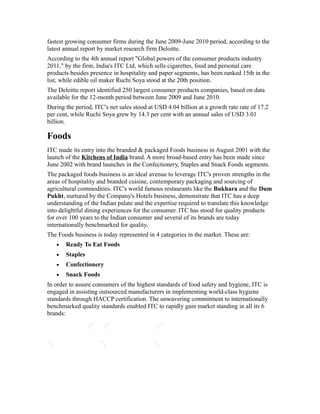
The Foods business is today represented in 4 categories in the market. These are:
• Ready To Eat Foods
• Staples
• Confectionery
• Snack Foods
In order to assure consumers of the highest standards of food safety and hygiene, ITC is
engaged in assisting outsourced manufacturers in implementing world-class hygiene
standards through HACCP certification. The unwavering commitment to internationally
benchmarked quality standards enabled ITC to rapidly gain market standing in all its 6
brands:
Personal Care
In line with ITC's aspiration to be India's premier FMCG company, recognised for its
world-class quality and enduring consumer trust, ITC forayed into the Personal Care
business in July 2005. In the short period since its entry, ITC has already launched an
array of brands, each of which offers a unique and superior value proposition to
discerning consumers. Anchored on extensive consumer research and product
development, ITC's personal care portfolio brings world-class products with clearly
differentiated benefits to quality-seeking consumers.
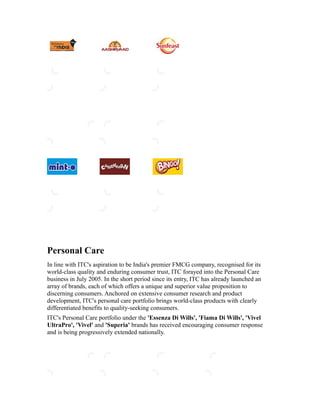
ITC's Personal Care portfolio under the 'Essenza Di Wills', 'Fiama Di Wills', 'Vivel
UltraPro', 'Vivel' and 'Superia' brands has received encouraging consumer response
and is being progressively extended nationally.
HARDWARE & NETWORKING FACILITIES
In present scenario network has become an asset for any organization. ITC is an
educational Institute and has a goal to produce Industry compatible product in order to
reduce the gap between Industry and Education. To fulfill this goal and to have a live
industrial working environment, ITC has adopted new,techniques like wireless
networking, fibre optics connectivity, structure ,cabling and much more since last few
years and has developed a rugged and high speed multi environment network. Now a
days corporate sectors need information at fingertips at higher speed with high security
and large storage. To fullfil the present need, new technologies in the field of networking
have evolved like video conferencing, VoIP with high speed band width is supported by
wireless technique, fibre optics connectivity and many more. ITC has added IBM-Blade
Server, VM Ware Virtualization & bunch of virtual servers into its hardware family
Recently we have improvised our Hardware and Networking Infrastructure with
following Our Network Infrastructure ,consists of :
• VLAN using Layer 2 Switch for better network management.
• IP SAN BOX of EMC2 with capacity of 3 TB having RAID 5 architecture for
Bulk Storage For Backup & Disaster Recovery ( Bare Metal System Recovery of
All Network Widows Computer ) for Multiple Servers and Unlimited Clients, we
have purchased Retrospect of EMC2.
• Generator of Cummings of 35 KVA with Auto start facility for uninterrupted
conduct of DOEACC Practical Examinations.
Cigarettes
Armenteros Handrolled
Cigars
ITC is the market leader in cigarettes in India. With its wide range of invaluable brands, it
has a leadership position in every segment of the market. It's highly popular portfolio of
brands includes Insignia, India Kings, Lucky Strike, Classic, Gold Flake, Navy Cut,
Players, Scissors, Capstan, Berkeley, Bristol and Flake, Silk Cut and Duke.
The Company has been able to build on its
leadership position because of its single minded focus on value creation for the consumer
through significant investments in product design, innovation, manufacturing technology,
quality, marketing and distribution.
All initiatives are therefore worked upon with the intent to fortify market standing in the
long term.
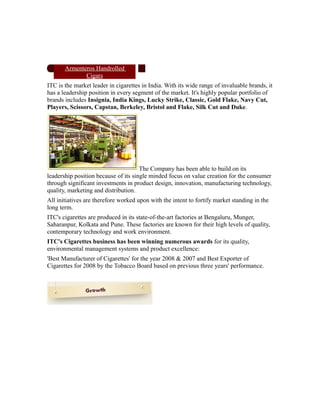
ITC's cigarettes are produced in its state-of-the-art factories at Bengaluru, Munger,
Saharanpur, Kolkata and Pune. These factories are known for their high levels of quality,
contemporary technology and work environment.
ITC's Cigarettes business has been winning numerous awards for its quality,
environmental management systems and product excellence:
'Best Manufacturer of Cigarettes' for the year 2008 & 2007 and Best Exporter of
Cigarettes for 2008 by the Tobacco Board based on previous three years' performance.
ITC vision to provide educational access to all
students from all areas has resulted in a surge of students enrolling with ITC. In order to
accommodate for such an increase, ITC has expanded its facilities, courses and
affiliations to ensure that the level of education provided remains at its highest. Such
expansion and growth has resulted in ITC receiving impressive audit ratings as well as
achieving a 100% growth rate in certified exams.
Technology obsolesce in information technology is prevailing at very high level and,
therefore, there is a prudential need to prepare all students/ teachers on latest state of art
technology. It would not be out of place to note that without going for any survey, ITC
needs to put in huge efforts to implement the technology to tune with industry
requirement. Efforts will be needed in terms of finance, R&D, Interpersonal
communication etc.
•
Future Plan for implementation:
• Cloud Computing
• Information Security
• Storage and Disaster Recovery
• Sun Academy Courses
• Quality Assurance and Testing
• Computer Graphics and Animation
• E-Business
• Enterprise Resource Planning (ERP)
• System Control & Audit
ITC has garnered international acclaim for its high standard of
IT courseware and teaching. It success relies on the incredible combination of various
affiliations, courses, and facilities that the ITC provides. The methodology by which ITC
executes all tasks concerning these three categories streamlines and optimizes the
workflow, providing a worthwhile experience for all those involved. This methodology
has led to a number of recognitions and awards from several IT organizations.
• 2007:
Ms.Divyesh K. Sangani of ITC Selected as one of Advisory Board Members
of Autodesk Inc., USA
ITC conferred for the Award of Instructor from Autodesk
• 2005:
Since 1995, Every Year, ITC is conferred with Commendation Certificate by
DOEACC Society
• 2004:
ITC Conferred with Award for Excellence in Electronics by MCIT (formerly
DoE), Govt.of India Recognizing ITC as the Best run Level In statute for the
year 2002-2003
• 2001:
ITC DOEACC Level Trainee of 1999-2000 batch Ms Hetal Panchmation
achieves the first position in the National Project Competition organized by
DOEACC Society at Pune
• 2001:
ITC Conferred with Award for Excellence in Electronics by MCIT (formerly
DoE), Govt. of India recognizing ITC as the Best run Level Institute for the
year 1999-2000
• 1998:
Rotary Club of Anand ,a member of Rotary Internationl has awarded
Certificate Appreciation to Ms Divyesh Sangani, in recognition of his
excellent vocational services to the society
• 1998:
ITC DOEACC Level Trainee of 1997-98 batch MS Gargi patel achieves the
first position in
the National Project Competition organized by DOEACC Society at Chennai
• 1998:
ITC conferred with Award for Excellence in Electronics by MCIT (formerly
DoE), Govt. of India recognizing ITC as the Best run Level Institute for the
year 1996
• 1997:
ITC DOEACC Level Trainee of 1995-96 batch Ms Preeti Chaudhary achieves
the first position in the National Project Cometition organized by DOEACC
Society at New Delhi
• 1992:
International Awards from Autodesk Inc. USA for Excellence in the Area of
Curriculum, Instruction, Facilities & Equipments

Itc project

  • 1.
    HISTORY AND EVOLUTION ITCwas incorporated on August 24, 1910 under the name Imperial Tobacco Company of India Limited. As the Company's ownership progressively Indianised, the name of the Company was changed from Imperial Tobacco Company of India Limited to India Tobacco Company Limited in 1970 and then to I.T.C. Limited in 1974.. The Company now stands rechristened 'ITC Limited'. . The ITC Profile ITC is one of India's foremost private sector companies with a market capitalisation of over US $ 33 billion and a turnover of US $ 7 billion. ITC is rated among the World's Best Big Companies, Asia's 'Fab 50' and the World's Most Reputable Companies by Forbes magazine, among India's Most Respected Companies by BusinessWorld and among India's Most Valuable Companies by Business Today. ITC ranks among India's `10 Most Valuable (Company) Brands', in a study conducted by Brand Finance and published by the Economic Times. ITC also ranks among Asia's 50 best performing companies compiled by Business Week.
  • 2.
    ITC has adiversified presence in Cigarettes, Hotels, Paperboards & Specialty Papers, Packaging, Agri-Business, Packaged Foods & Confectionery, Information Technology, Branded Apparel, Personal Care, Stationery, Safety Matches and other FMCG products. While ITC is an outstanding market leader in its traditional businesses of Cigarettes, Hotels, Paperboards, Packaging and Agri-Exports, it is rapidly gaining market share even in its nascent businesses of Packaged Foods & Confectionery, Branded Apparel, Personal Care and Stationery. As one of India's most valuable and respected corporations, ITC is widely perceived to be dedicatedly nation-oriented. Chairman Y C Deveshwar calls this source of inspiration "a commitment beyond the market". In his own words: "ITC believes that its aspiration to create enduring value for the nation provides the motive force to sustain growing shareholder value. ITC practices this philosophy by not only driving each of its businesses towards international competitiveness but by also consciously contributing to enhancing the competitiveness of the larger value chain of which it is a part." ITC's diversified status originates from its corporate strategy aimed at creating multiple drivers of growth anchored on its time-tested core competencies: unmatched distribution reach, superior brand-building capabilities, effective supply chain management and acknowledged service skills in hoteliering. Over time, the strategic forays into new businesses are expected to garner a significant share of these emerging high-growth markets in India. ITC employs over 24,000 people at more than 60 locations across India. The Company continuously endeavors to enhance its wealth generating capabilities in a globalising environment to consistently reward more than 4,14,000 shareholders, fulfill the aspirations of its stakeholders and meet societal expectations. This over-arching vision of the company is expressively captured in its corporate positioning statement: "Enduring Value. For the Nation. For the Shareholder." ITC is involved in following businesses: Cigarettes: ITC is the market leader in cigarettes in India and has a wide range of popular brands such as Insignia, India Kings, Classic, Gold Flake, Silk Cut, Navy Cut, Scissors, Capstan, Berkeley, Bristol and Flake in its portfolio. Packaging: ITC's Packaging & Printing Business is the country's largest convertor of paperboard into packaging. It was set up in 1925 as a strategic backward integration for ITC's Cigarettes business. It offers a variety of value-added packaging solutions for the food & beverage, personal products, cigarette, liquor, cellular phone and IT packaging industries. Hotels: ITC entered the hotels business in 1975 with the acquisition of a hotel in Chennai which was rechristened Hotel Chola. Today ITC-Welcomgroup with over 70 hotels is one of the foremost hotel chains in India. Paperboards: In 1979, ITC entered the Paperboards business by promoting ITC
  • 3.
    Bhadrachalam Paperboards. ITC'sPaperboards business has a manufacturing capacity of over 360,000 tonnes per year and is a market leader in India across all carton-consuming segments. Greeting, Gifting & Stationery: ITC's stationery brands "Paper Kraft" & "Classmate" are widely distributed brands across India. The Paperkraft designer stationery range consists of notepads & multi subject notebooks in hard, soft covers & multiple binding formats including spirals, wiros etc. ITC's Greeting & Gifting products include Expressions range of greeting cards and gifting products. Safety Matches: ITC's brands of safety matches include iKno, Mangaldeep, VaxLit, Delite and Aim. The Aim is the largest selling brand of Safety Matches in India. ITC also exports premium brands to markets such as Europe, Africa and the USA. Aggarbattis: ITC has launched Mangaldeep brand of Aggarbattis with a wide range of fragrances like Rose, Jasmine, Bouquet, Sandalwood, Madhur, Durbar, Tarangini, Anushri, Ananth and Mogra. Mangaldeep is also being exported to USA, UAE, Bahrain, Nepal, Singapore, Malaysia, Oman and South Africa. Lifestyle Retailing: ITC entered the Lifestyle Retailing business with the Wills Sport range of international quality relaxed wear for men and women in 2000. The Wills Lifestyle chain of exclusive stores later expanded its range to include Wills Classic formal wear (2002) and Wills Clublife evening wear (2003). In 2002, ITC entered into the popular segment with its men's wear brand, John Players. In 2005, ITC introduced Essenza Di Wills, an exclusive line of prestige fragrance products. Food: ITC made its entry into the branded & packaged Foods business in August 2001 with the launch of the "Kitchens of India" brand. In 2002 it expanded into Confectionery, Staples and Snack Foods segments. ITC's brand in Food category include: Kitchens of India, Aashirvaad, Sunfeast, Mint-O, Candyman, and Bingo!. Agri Exports: ITC's International Business Division (IBD) is the country's second largest exporter of agri-products. ITC exports Feed Ingredients (Soyameal), Foodgrains (Rice, Wheat, Pulses), Coffee & Spices, Edible Nuts, Marine Products, and Processed Fruits. e-choupal: The e-Choupal model of ITC has been very effective in tackling the challenges posed by the unique features of Indian agriculture, characterised by fragmented farms, weak infrastructure and the involvement of numerous intermediaries, among others. ITC's e-Choupal won the Stockholm Challenge 2006 award is for using information technology for the economic development of rural communities. Performance ITC Ltd. completed yet another year of strong performance with Gross Turnover for the
  • 4.
    year growing by20.2% to ` 19505 crores. Net Turnover at ` 12369 crores grew by 26.3% driven by the non-cigarette FMCG businesses, higher agri-business revenues and the continuing strong performance by the Hotels business. The non- cigarette portfolio grew by 37.6% during the year and now accounts for 52.3% of the Company's Net Turnover. Pre-tax profit increased by 20.1% to ` 3927 crores, while Post-tax profit at ` 2700 crores registered a growth of 20.8%. Earnings Per Share for the year stands at ` 7.19. Organization ITC 's Chairman is Mr. Y.C. Deveshwar. SWOT Analysis ITC ITC is one of India's biggest and best-known private sector companies. In fact it is one of the World's most high profile consumer operations. This SWOT analysis is about ITC. Its businesses and brands are focused almost entirely on the Indian markets, and despite being most well-known for its tobacco brands such as Gold Flake, the business is now diversifying into new FMCG (Fast Moving Consumer Goods) brands in a number of market sectors - including cigarettes, hotels, paper, agriculture, packaged foods and confectionary, branded apparel, personal care, greetings cards, Information Technology, safety matches, incense sticks and stationery. Examples of its successful new FMCG products include: • Aashirvaad - India's most popular atta brand with over 50% market share. It is also present in spices and instant mixes. • Mint-o - Mint-0 Fresh is the largest cough lozenge brand in India. • Bingo! - a new introduction of finger snacks. • Kitchens of India - pre-prepared foods designed by ITC's master chefs. • Sunfeast - is ITC's biscuit brand (and the sub-brand is also used on some pasta products). Strengths ITC leveraged it traditional businesses to develop new brands for new segments. For example, ITC used its experience of transporting and distributing tobacco products to remote and distant parts of India to the advantage of its FMCG products. ITC master chefs from its hotel chain are often asked to develop new food concepts for its FMCG business. ITC is a diversified company trading in a number of business sectors including cigarettes, hotels, paper, agriculture, packaged foods and confectionary, branded apparel, personal care, greetings cards, Information Technology, safety matches, incense sticks and stationery.
  • 5.
    Weaknesses The company's originalbusiness was traded in tobacco. ITC stands for Imperial Tobacco Company of India Limited. It is interesting that a business that is now so involved in branding continues to use its original name, despite the negative connection of tobacco with poor health and premature death. To fund its cash guzzling FMCG start-up, the company is still dependant upon its tobacco revenues. Cigarettes account for 47 per cent of the company's turnover, and that in itself is responsible for 80% of its profits. So there is an argument that ITC's move into FMCG (Fast Moving Consumer Goods) is being subsidised by its tobacco operations. Its Gold Flake tobacco brand is the largest FMCG brand in India - and this single brand alone hold 70% of the tobacco market. Opportunities Core brands such as Aashirvaad, Mint-o, Bingo! And Sun Feast (and others) can be developed using strategies of market development, product development and marketing penetration. ITC is moving into new and emerging sectors including Information Technology, supporting business solutions. e-Choupal is a community of practice that links rural Indian farmers using the Internet. This is an original and well thought of initiative that could be used in other sectors in many other parts of the world. It is also an ambitious project that has a goal of reaching 10 million farmers in 100,000 villages. Take a look at eChoupal here http://www.itcportal.com/agri_exports/e-choupal_new.htm ITC leverages e-Choupal in a novel way. The company researched the tastes of consumers in the North, West and East of India of atta (a popular type of wheat flour), then used the network to source and create the raw materials from farmers and then blend them for consumers under purposeful brand names such as Aashirvaad Select in the Northern market, Aashirvaad MP Chakki in the Western market and Aashirvaad in the Eastern market. This concept is tremendously difficult for competitors to emulate. Chairman Yogi Deveshwar's strategic vision is to turn his Indian conglomerate into the country's premier FMCG business. Per capita consumption of personal care products in India is the lowest in the world offering an opportunity for ITC's soaps, shampoos and fragrances under their Wills brand. Threats The obvious threat is from competition, both domestic and international. The laws of economics dictate that if competitors see that there is a solid profit to be made in an emerging consumer society that ultimately new products and services will be made available. Western companies will see India as an exciting opportunity for themselves to find new market segments for their own offerings. ITC's opportunities are likely to be opportunities for other companies as well. Therefore the dynamic of competition will alter in the medium-term. Then ITC will need to decide whether being a diversified conglomerate is the most competitive strategic formation for a secure future.
  • 6.
    Code of Conduct Applicableto all directors, senior management and employees of the Company Preamble ITC’s Code of Conduct was circulated to the employees more than five years back and is posted on the Company’s corporate website. This Code has now been re-drafted for better presentation. This Code is derived from three interlinked fundamental principles, viz. good corporate governance, good corporate citizenship and exemplary personal conduct. Philosophy ITC is a professionally managed organisation and the core value underlying our corporate philosophy is "trusteeship". We believe this organisation has been handed to us by the various stakeholders in "trust" and we as professionals are the "trustees" of these stakeholders. It is therefore our responsibility to ensure that the organisation is managed in a manner that protects and furthers the interests of our stakeholders. We recognise society as an important stakeholder in this enterprise and therefore it is part of our responsibility to practise good corporate citizenship.
  • 7.
    It is alsoour belief that in order to serve the interests of our stakeholders in perpetuity, we must build ITC into an institution whose dynamism and vitality are anchored in its core values. Corporate Governance Policy The Corporate Governance Policy is the apex level instrument guiding conduct of the affairs of the Company and clearly delineates the roles, responsibilities and authorities of the key entities in the governance structure of the Company. This Code forms an integral part of the Company’s Governance Policy. The directors, senior management and employees must adhere to the Corporate Governance Policy of the Company. Good Corporate Citizenship In the conduct of the Company’s business, the practice of good corporate citizenship is a prerequisite and embraces the following: Dealing with People in the Organisation In dealing with each other, directors, senior management and employees shall uphold the values which are at the core of our HR Philosophy - trust, teamwork, mutuality and collaboration, meritocracy, objectivity, self respect and human dignity. Indeed, these values form the basis of our HR management systems and processes. In selection and recruitment, while meritocracy will be a prime criterion, managers will scrupulously consider all factors that go towards securing the interests of the Company. ITC will focus on meritocracy, equity and upholding of Company values in all people processes including performance management systems, appraisals, remuneration and rewards. A Gender Friendly Workplace As a good corporate citizen, ITC is committed to a gender friendly workplace. It seeks to enhance equal opportunities for men and women, prevent/stop/redress sexual harassment at the workplace and institute good employment practices. ITC maintains an open door for reportees; encourages employees to report any harassment concerns and is responsive to employee complaints about harassment or other unwelcome and offensive conduct. A Grievance Committee on Gender Issues has been constituted to enquire into complaints and to recommend appropriate action, wherever required. ITC demands, demonstrates and promotes professional behaviour and respectful treatment of all employees. Relationships with Suppliers and Customers All directors, senior management and employees shall ensure that in their dealings with suppliers and customers, the Company’s interests are never compromised. Accepting gifts and presents of more than a nominal value, gratuity payments and other payments from suppliers or customers will be viewed as serious breach of discipline as this could lead to compromising the Company’s interests.
  • 8.
    Legal Compliance It isthe Company’s policy to comply fully with all applicable laws and regulations. Ensuring legal and regulatory compliance is the responsibility of the Chief Executives of the Businesses and the Divisional Management Committees. The Company cannot accept practices which are unlawful or may be damaging to its reputation. Divisional Management Committees must satisfy themselves that sound and adequate arrangements exist to ensure that they comply with the legal and regulatory requirements impacting each business and identify and respond to developments in the regulatory environment in which they operate. In the event the implication of any law is not clear, the Company’s Legal Department shall be consulted for advice. Health and Safety The Company attaches great importance to a healthy and safe work environment. ITC is committed to provide good physical working conditions and encourages high standards of hygiene and housekeeping. Particular attention should be paid to training of employees to increase safety awareness and adoption of safe working methods, particularly designed to prevent serious or fatal accidents. Environment Policies The Company believes that commitment to sustainable development is a key component of responsible corporate citizenship and therefore deserves to be accorded the highest priority. Accordingly, the Company is committed to Best Practices in environmental matters arising out of its business activities and expects each business to fully demonstrate this commitment. In addition to complying with applicable laws and regulations, Businesses must establish procedures for assessing the environmental effects of their present and future activities. They should adopt Best Practices in their environmental policies and procedures. Personal Conduct All directors, senior management and employees have the obligation to conduct themselves in an honest and ethical manner and act in the best interest of the Company at all times. They are expected to demonstrate exemplary personal conduct through adherence to the following: Avoidance of Conflict of Interest All directors, senior management and employees must avoid situations in which their personal interest could conflict with the interest of the Company. This is an area in which it is impossible to provide comprehensive guidance but the guiding principle is that conflict, if any, or potential conflict must be disclosed to higher management for guidance and action as appropriate. Transparency and Auditability All directors, senior management and employees shall ensure that their actions in the conduct of business are totally transparent except where the needs of business security dictate otherwise. Such transparency shall be brought about through appropriate policies,
  • 9.
    systems and processes,including as appropriate, segregation of duties, tiered approval mechanism and involvement of more than one manager in key decisions and maintaining supporting records. It shall be necessary to voluntarily ensure that areas of operation are open to audit and the conduct of activities is totally auditable. Protection of Confidential Information No director, senior management and employee shall disclose or use any confidential information gained in the course of employment/ association with the Company for personal gain or for the advantage of any other person. No information either formally or informally shall be provided to the press, other publicity media or any other external agency except within approved policies. Company Facilities No director, senior management and employee shall misuse Company facilities. In the use of Company facilities, care shall be exercised to ensure that costs are reasonable and there is no wastage. Leading by Example The organisation’s directors and senior management set the professional tone for the Company. Through both their words and their actions, the organisation’s leadership conveys what is acceptable and unacceptable behaviour. ITC’s directors, senior management and employees must constantly reinforce through their actions and behaviour that ITC’s stated beliefs of responsible corporate citizenship are rooted in individual conviction and personal integrity. Waivers Any waiver of any provision of this Code of Conduct for a director, senior management or employee must be placed for approval before the Company’s Board of Directors/ Corporate Management Committee, as appropriate. Non Adherence Any instance of non-adherence to the Code of Conduct / any other observed unethical behaviour on the part of those covered under this Code should be brought to the attention of the immediate reporting authority, who shall in turn report the same to the Head of Corporate Human Resources. * Senior management for the purpose of this Code would mean the following: - Managers at Grade ‘A’ & its equivalent, and above - Divisional & SBU Chief Executives - Corporate HODs * This Code of Conduct, as adopted by the Board of Directors of the Company on 26th March, 2005, was amended on 29th March, 2006. New Delhi: Two Indian companies ITC and Ruchi Soya were among the world's 50
  • 10.
    fastest growing consumerfirms during the June 2009-June 2010 period, according to the latest annual report by market research firm Deloitte. According to the 4th annual report "Global powers of the consumer products industry 2011," by the firm, India's ITC Ltd, which sells cigarettes, food and personal care products besides presence in hospitality and paper segments, has been ranked 15th in the list, while edible oil maker Ruchi Soya stood at the 20th position. The Deloitte report identified 250 largest consumer products companies, based on data available for the 12-month period between June 2009 and June 2010. During the period, ITC's net sales stood at USD 4.04 billion at a growth rate rate of 17.2 per cent, while Ruchi Soya grew by 14.3 per cent with an annual sales of USD 3.01 billion. Foods ITC made its entry into the branded & packaged Foods business in August 2001 with the launch of the Kitchens of India brand. A more broad-based entry has been made since June 2002 with brand launches in the Confectionery, Staples and Snack Foods segments. The packaged foods business is an ideal avenue to leverage ITC's proven strengths in the areas of hospitality and branded cuisine, contemporary packaging and sourcing of agricultural commodities. ITC's world famous restaurants like the Bukhara and the Dum Pukht, nurtured by the Company's Hotels business, demonstrate that ITC has a deep understanding of the Indian palate and the expertise required to translate this knowledge into delightful dining experiences for the consumer. ITC has stood for quality products for over 100 years to the Indian consumer and several of its brands are today internationally benchmarked for quality. The Foods business is today represented in 4 categories in the market. These are: • Ready To Eat Foods • Staples • Confectionery • Snack Foods In order to assure consumers of the highest standards of food safety and hygiene, ITC is engaged in assisting outsourced manufacturers in implementing world-class hygiene standards through HACCP certification. The unwavering commitment to internationally benchmarked quality standards enabled ITC to rapidly gain market standing in all its 6 brands:
  • 11.
    Personal Care In linewith ITC's aspiration to be India's premier FMCG company, recognised for its world-class quality and enduring consumer trust, ITC forayed into the Personal Care business in July 2005. In the short period since its entry, ITC has already launched an array of brands, each of which offers a unique and superior value proposition to discerning consumers. Anchored on extensive consumer research and product development, ITC's personal care portfolio brings world-class products with clearly differentiated benefits to quality-seeking consumers. ITC's Personal Care portfolio under the 'Essenza Di Wills', 'Fiama Di Wills', 'Vivel UltraPro', 'Vivel' and 'Superia' brands has received encouraging consumer response and is being progressively extended nationally.
  • 12.
    HARDWARE & NETWORKINGFACILITIES In present scenario network has become an asset for any organization. ITC is an educational Institute and has a goal to produce Industry compatible product in order to reduce the gap between Industry and Education. To fulfill this goal and to have a live industrial working environment, ITC has adopted new,techniques like wireless networking, fibre optics connectivity, structure ,cabling and much more since last few years and has developed a rugged and high speed multi environment network. Now a days corporate sectors need information at fingertips at higher speed with high security and large storage. To fullfil the present need, new technologies in the field of networking have evolved like video conferencing, VoIP with high speed band width is supported by wireless technique, fibre optics connectivity and many more. ITC has added IBM-Blade Server, VM Ware Virtualization & bunch of virtual servers into its hardware family Recently we have improvised our Hardware and Networking Infrastructure with following Our Network Infrastructure ,consists of : • VLAN using Layer 2 Switch for better network management. • IP SAN BOX of EMC2 with capacity of 3 TB having RAID 5 architecture for Bulk Storage For Backup & Disaster Recovery ( Bare Metal System Recovery of All Network Widows Computer ) for Multiple Servers and Unlimited Clients, we have purchased Retrospect of EMC2. • Generator of Cummings of 35 KVA with Auto start facility for uninterrupted conduct of DOEACC Practical Examinations. Cigarettes
  • 13.
    Armenteros Handrolled Cigars ITC isthe market leader in cigarettes in India. With its wide range of invaluable brands, it has a leadership position in every segment of the market. It's highly popular portfolio of brands includes Insignia, India Kings, Lucky Strike, Classic, Gold Flake, Navy Cut, Players, Scissors, Capstan, Berkeley, Bristol and Flake, Silk Cut and Duke. The Company has been able to build on its leadership position because of its single minded focus on value creation for the consumer through significant investments in product design, innovation, manufacturing technology, quality, marketing and distribution. All initiatives are therefore worked upon with the intent to fortify market standing in the long term. ITC's cigarettes are produced in its state-of-the-art factories at Bengaluru, Munger, Saharanpur, Kolkata and Pune. These factories are known for their high levels of quality, contemporary technology and work environment. ITC's Cigarettes business has been winning numerous awards for its quality, environmental management systems and product excellence: 'Best Manufacturer of Cigarettes' for the year 2008 & 2007 and Best Exporter of Cigarettes for 2008 by the Tobacco Board based on previous three years' performance.
  • 14.
    ITC vision toprovide educational access to all students from all areas has resulted in a surge of students enrolling with ITC. In order to accommodate for such an increase, ITC has expanded its facilities, courses and affiliations to ensure that the level of education provided remains at its highest. Such expansion and growth has resulted in ITC receiving impressive audit ratings as well as achieving a 100% growth rate in certified exams. Technology obsolesce in information technology is prevailing at very high level and, therefore, there is a prudential need to prepare all students/ teachers on latest state of art technology. It would not be out of place to note that without going for any survey, ITC needs to put in huge efforts to implement the technology to tune with industry requirement. Efforts will be needed in terms of finance, R&D, Interpersonal communication etc. • Future Plan for implementation: • Cloud Computing • Information Security • Storage and Disaster Recovery • Sun Academy Courses • Quality Assurance and Testing
  • 15.
    • Computer Graphicsand Animation • E-Business • Enterprise Resource Planning (ERP) • System Control & Audit ITC has garnered international acclaim for its high standard of IT courseware and teaching. It success relies on the incredible combination of various affiliations, courses, and facilities that the ITC provides. The methodology by which ITC executes all tasks concerning these three categories streamlines and optimizes the workflow, providing a worthwhile experience for all those involved. This methodology has led to a number of recognitions and awards from several IT organizations. • 2007: Ms.Divyesh K. Sangani of ITC Selected as one of Advisory Board Members of Autodesk Inc., USA ITC conferred for the Award of Instructor from Autodesk • 2005: Since 1995, Every Year, ITC is conferred with Commendation Certificate by DOEACC Society • 2004: ITC Conferred with Award for Excellence in Electronics by MCIT (formerly DoE), Govt.of India Recognizing ITC as the Best run Level In statute for the year 2002-2003 • 2001: ITC DOEACC Level Trainee of 1999-2000 batch Ms Hetal Panchmation achieves the first position in the National Project Competition organized by DOEACC Society at Pune • 2001: ITC Conferred with Award for Excellence in Electronics by MCIT (formerly
  • 16.
    DoE), Govt. ofIndia recognizing ITC as the Best run Level Institute for the year 1999-2000 • 1998: Rotary Club of Anand ,a member of Rotary Internationl has awarded Certificate Appreciation to Ms Divyesh Sangani, in recognition of his excellent vocational services to the society • 1998: ITC DOEACC Level Trainee of 1997-98 batch MS Gargi patel achieves the first position in the National Project Competition organized by DOEACC Society at Chennai • 1998: ITC conferred with Award for Excellence in Electronics by MCIT (formerly DoE), Govt. of India recognizing ITC as the Best run Level Institute for the year 1996 • 1997: ITC DOEACC Level Trainee of 1995-96 batch Ms Preeti Chaudhary achieves the first position in the National Project Cometition organized by DOEACC Society at New Delhi • 1992: International Awards from Autodesk Inc. USA for Excellence in the Area of Curriculum, Instruction, Facilities & Equipments