SKPIMCS Page 1
PROJECT REPORT
ON
CUSTOMER PREFERENCE WITH
RESPEPCT TO
(NESCAFE AND BRU COFFEE)
SKPIMCS Page 2
CERTIFICATE
This is to certify that GROUP NO-8, Div- B, MBA SEM 1 of Management and
have submitted their Project Report On CUSTOMER PREFERENCE WITH
RESPEPCT TO (NESCAFE AND BRU COFFEE) for the subject of “Managerial
Communication” in the year 2012-2013 in partial fulfillment requirements for
the award of the title of Master of Business Administration.
Date: /12/2012
SKPIMCS Page 3
ACKNOWLEDEMENT
It is indeed a great pleasure and privilege for us to present “CUSTOMER
PREFERENCE WITH RESPEPCT TO (neSCAFE AND BRU COFFEE).
We would also like to thanks to the potential customers of Nescafe and Bru
coffee who helped us giving needed information and their full co-operation
towards us to give time to us from his busy schedule for filling our
questionnaire.
SKPIMCS Page 4
PREFACE
“Learning categories you and practicing on that learning specializes you”
Practical aspect gives more knowledge and experience than the theory and no
learning can be completed without practical aspects.
Projects are one of the most important parts of our curriculum for management
students, its basic idea is to strengthen the students concept and make them
equipped with recent development.
In days when it was business as usual companies could succeed by there new
products with concept and supported by hard selling and good advertisement and
consider that customer exhibit varying diverse requirement for product/Services
combinations and price consider that they have high and rising expectations of
quality and services. In the face of their vast choices. Customers will gravitate to the
offering that best meet their individual needs and expectation value and all this will
come out as the positioning of the brand in the market.
SKPIMCS Page 5
TABLE OF CONTENT
SR NO. NAME PAGE NO.
1 History of the Company 6
1) Nescafe 6
2) Bru 9
2 Scope and Objectives of the study 12
3 Research Methodology 13
4 Sources of Data collection 14
5 Research Design 15
6 Data analysis 16
7 Research Findings 26
8 Limitations Of Report 27
9 Conclusion 28
10 Bibliography 29
11 Questionnaire 30
SKPIMCS Page 6
HISTORY OF COMPANY
NASCAFE
The beginnings of Nescafe can be traced all the way back to 1930, when the
Brazilian government, first approached Nestlé. The agency, Brazilian Coffee
Institute seeks Nestle to preserve the huge coffee surpluses, by develop coffee
that was soluble in hot water.
Coffee guru, Max Mergenthaler, and his team set out immediately to find a
way of producing a quality cup of coffee that could be made simply by adding
water, yet would retain the coffee’s natural flavor.
After seven long years of research in Nestle
Swiss laboratories, they found the answer.
The new product was named Nescafe – a
combination of Nestlé and café. Nestle
introduced Nescafe, the first commercially
successful soluble coffee, in Switzerland, on
April 1st, 1938. The company applied the
technology at its Hayes factory, west London.
Instant coffee processing was not a new
idea; it was invented by a Japanese chemist
in 1901 and had been marketed and sold by
other companies without success. Nestle
revolutionized the way instant coffee was
made. Nestle developed a new process for
SKPIMCS Page 7
dehydrating the concentrated coffee which vastly improved the quality. In
entailed spraying a fine mist of the solution into a heated tower where the
droplets turned to powder almost instantly.
For the first half of the next decade, however, World War II hindered its
success in Europe.
Nescafe was soon exported to France, Great Britain and the USA. Its popularity
grew rapidly through the rest of the decade. It was so popular that the entire
production of its US plant was reserved for military use.
By the 1950s, coffee had become the beverage of choice for teenagers, who
were flocking to coffeehouses to hear the new rock ’n’ roll music.
Over the years the company has kept the emphasis on innovation, introducing
pure soluble coffee (1952) solely using roast coffee beans, freeze dried soluble
coffee (1965) and coffee granules (1967). In 1994 Nestle invented the full
aroma process, which improved the quality of instant coffee. Such innovations
have made sure that Nescafe has remained the world’s leading coffee. It is also
the third most valuable brand in the entire drinks sector.
SKPIMCS Page 8
MISSION STATEMENT:
To bring Nescafe to people around the globe, providing a Nescafe to satisfy
every aspect of needs.
Nescafe provides good test, aromatic smells of coffee to people, providing “1
Nescafe with 1 unique moment” so that everyone can enjoy. Wherever you are,
you will be able to find Nescafe around, whether in shopping complexes,
supermarkets/hypermarkets or even grocery stalls.
GOALS/ ACHIEVEMENTS:
Giving people the unique moments (comfort, relaxations) through Nescafe. Stress,
pressures, working overtime has led the people to have at least a cup of Nescafe
coffee to relax them, having chit-chat with friends/colleagues as well, to prevent
from emotional influences.
SKPIMCS Page 9
BRU
Some moments in life are special and close to heart. Bru makes these
moments with loved ones even more magical… It is India’s largest coffee brand
that offers a range of coffee products. Its rich aroma and unique blend makes
every moment come alive.
Ever since its inception, Bru has been on a
constant Endeavour to bring better products and
formats to the consumer with every passing year.
With the launch of Cappuccino in 2007, Bru
pioneered the launch of instant coffee premixes
in India for the youth. Then in 2010, a premium
filter coffee with a blend of 85% coffee and 15%
chicory was introduced under the brand name BRU Select.
In 2011, BRU Lite, a light-tasting coffee with classic Mocha flavor, was launched
for people who avoid coffee because of its bitter taste. In the same year BRU
Exotica was launched which is premium freeze dried coffee sourced from some
of the world’s best coffee-producing regions like Colombia, Brazil and
Kilimanjaro. With BRU Exotica, Bru brought in ‘the world’s finest coffee
experience’ for the discerning Indian consumer. Later, in the same year, BRU
Gold - a 100% pure granulated coffee with an uplifting aroma and superior
taste - was launched.
Bru’s specially selected and freshly roasted coffee beans offer a great cup of
aromatic coffee to the consumers, which makes their moments of genuine
warmth and happiness even more special.
Bru also has opened cafes in Mumbai under the name BRU World Cafe with
world coffee experiences to be enjoyed out of home.
SKPIMCS Page 10
KEY FACTS
Number 1 Coffee brand in India
Unilever's only Coffee brand
Enjoys a rich heritage, came into existence in 1962 under the brand name
Deluxe Green Label
Consistently offering better and newer products to the consumer through
improved packaging solutions and innovative product formats
Enjoys a strong presence at various out of home locations
MISSION
To earn the loyalty of customers and grew the business by developing and
marketing coffee products that are leaders in quality and customer
enthusiasm.
VISION
We envision Bru to become the coffee supplier of excellence to its customers
throughout the region, by consistently delivering exciting products, sensation
and experiences to an increasing number of admirers
SKPIMCS Page 11
SCOPE AND OBJECTIVE OF THE
STUDY
SCOPE:
Generally scope can be considered among two parts:
1) Regional Scope
2) Functional Scope
Here our regional scope is limited up to Gandhinagar (Sector 23)
OBJECTIVES:
There are mainly two types of objectives:
1) Primary Objective :-
 To analyze the customers preference with respect to (Nescafe and
Bru coffee)
2) Secondary Objectives :-
 To know customers suggestions and recommendation about
(Nescafe and Bru coffee)
 To Study the Consumer Perception about the taste and availability of
product.
SKPIMCS Page 12
RESEARCH METHODOLOGY
INTRODUCTION OF RESEARCH:
Research is done to gain some knowledge so it may aid in understanding the
information gathered on specific topic. It is a scientific and systematic way of
understanding information on specific and particular subjects. It is a scientific
investigation to understand the cause and effect as well as the reasons through
investigation. It is an academic activity.
Research is a process in which the researcher wishes to find out the result for a
given problem and thus the solution helps in future course of action.
SKPIMCS Page 13
SOURCES OF DATA COLLECTION
 PRIMARY DATA SOURCE:
The primary data means the data gathering for first time for the problem
solution directly from the sample or population as per the requirement.
 Interviews
 Questionnaires
 Observation
 SECONDARY DATA SOURCE:
The secondary data consists of information that has been already exists
somewhere and has been collected for some specific purpose.
 Books
 Website
 Journal
 Annual Report
For this research, we used Primary data (Questionnaires) as well as
secondary data (Books, Website)
SKPIMCS Page 14
RESEARCH DESIGN
 RESEARCH INSTRUMENT:
Questionnaire-
 Face –to –face
 Close ended
 Open ended
 SAMPLE SIZE:
Sample Size is taken 50 out of which 8 questionnaires had been rejected
due to different choice of respondent as per our research.
SKPIMCS Page 15
DATA ANALYSIS
Q1. What do you prefer?
Particular Respondents
Coffee 18
Tea 8
Both 24
TOTAL 50
0
5
10
15
20
25
30
Coffee Tea Both
SKPIMCS Page 16
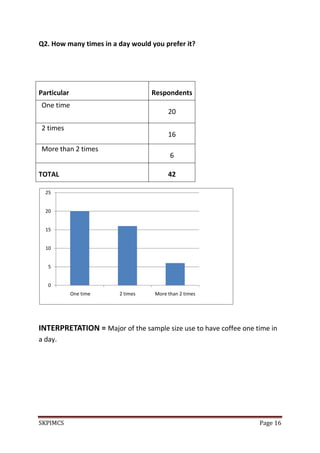
Q2. How many times in a day would you prefer it?
Particular Respondents
One time
20
2 times
16
More than 2 times
6
TOTAL 42
INTERPRETATION = Major of the sample size use to have coffee one time in
a day.
0
5
10
15
20
25
One time 2 times More than 2 times
SKPIMCS Page 17
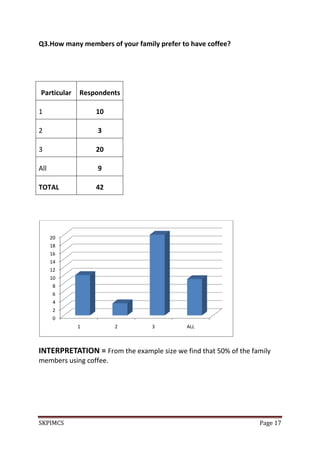
Q3.How many members of your family prefer to have coffee?
Particular Respondents
1 10
2 3
3 20
All 9
TOTAL 42
INTERPRETATION = From the example size we find that 50% of the family
members using coffee.
0
2
4
6
8
10
12
14
16
18
20
1 2 3 ALL
SKPIMCS Page 18
Q4. Which coffee brand do you prefer?
Particular Respondents
Nescafe 35
Bru 5
Other 2
TOTAL 42
INTERPRETATION = Majority of choice about coffee is given to Nescafe.
0
5
10
15
20
25
30
35
Nescafe Bru other
SKPIMCS Page 19
Q5. From where did u see our product?
INTERPRETATION = Majority of people are choice Nescafe from their own
experience.
0
5
10
15
20
25
Advertisement Own experience Reference
Particular Respondents
Advertisement 12
Own
experience
22
Reference 18
TOTAL 42
SKPIMCS Page 20
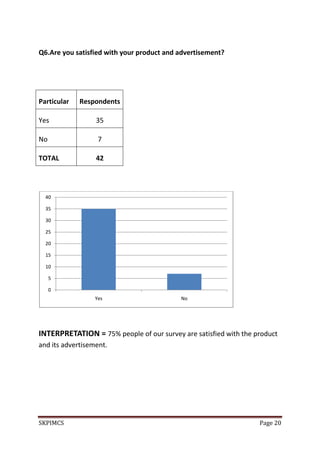
Q6.Are you satisfied with your product and advertisement?
Particular Respondents
Yes 35
No 7
TOTAL 42
INTERPRETATION = 75% people of our survey are satisfied with the product
and its advertisement.
0
5
10
15
20
25
30
35
40
Yes No
SKPIMCS Page 21
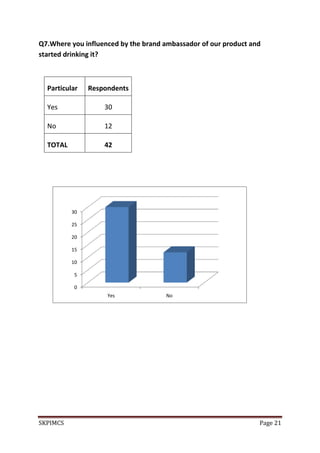
Q7.Where you influenced by the brand ambassador of our product and
started drinking it?
Particular Respondents
Yes 30
No 12
TOTAL 42
0
5
10
15
20
25
30
Yes No
SKPIMCS Page 22
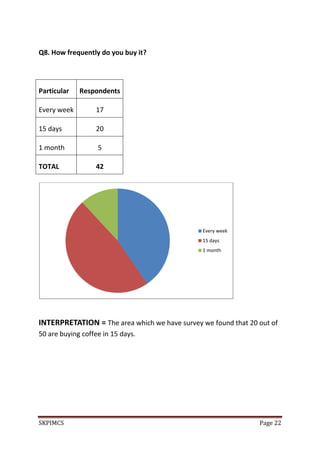
Q8. How frequently do you buy it?
INTERPRETATION = The area which we have survey we found that 20 out of
50 are buying coffee in 15 days.
Every week
15 days
1 month
Particular Respondents
Every week 17
15 days 20
1 month 5
TOTAL 42
SKPIMCS Page 23
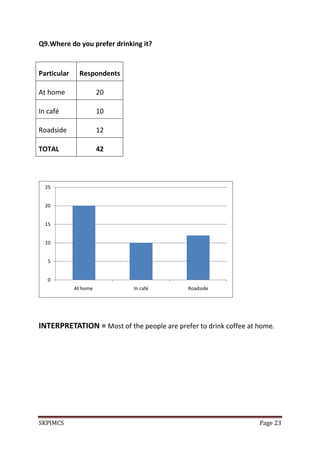
Q9.Where do you prefer drinking it?
INTERPRETATION = Most of the people are prefer to drink coffee at home.
Particular Respondents
At home 20
In café 10
Roadside 12
TOTAL 42
0
5
10
15
20
25
At home In café Roadside
SKPIMCS Page 24
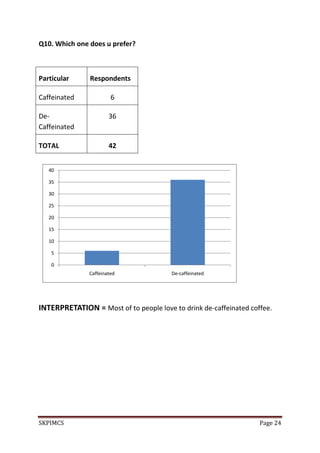
Q10. Which one does u prefer?
INTERPRETATION = Most of to people love to drink de-caffeinated coffee.
Particular Respondents
Caffeinated 6
De-
Caffeinated
36
TOTAL 42
0
5
10
15
20
25
30
35
40
Caffeinated De-caffeinated
SKPIMCS Page 25
Q11. Why do u prefer specific brand, rank it on the following basis:
INTERPRETATION = The reason to chose Nescafe is on following basis
Price – customers are satisfied with the price of product
Taste – Customers like much better test of Nescafe then Bru any other brand.
Qualities – Customers are satisfied with the quality of Nescafe and they are
neutral at quality.
Healthiness – Preference to healthiness is satisfying to the customer.
NESCAFEE BRU
HS S DS NEU HS S DS NEU
price 5 20 17 8 2 2 1 1
taste 5 10 7 3 1 2 1 1
quality 10 13 10 6 3 2 3 2
quantity 15 1 8 7 3 3 1 1
healthiness 10 1 10 9 1 1 2 2
0
5
10
15
20
25
HS S DS NEU HS S DS NEU
NESCAFEE BRU
price
taste
quality
quantity
healthness
SKPIMCS Page 26
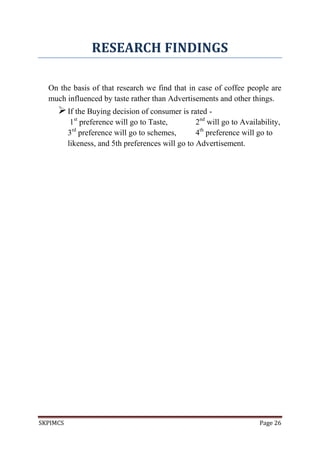
RESEARCH FINDINGS
On the basis of that research we find that in case of coffee people are
much influenced by taste rather than Advertisements and other things.
If the Buying decision of consumer is rated -
1st
preference will go to Taste, 2nd
will go to Availability,
3rd
preference will go to schemes, 4th
preference will go to
likeness, and 5th preferences will go to Advertisement.
SKPIMCS Page 27
LIMITATIONS OF REPORT
We put our whole heart on this project. But still are certain limitations while
doing the research work. Some of the limitations are as follows.
 As we did our project in limited area of our residents, so it becomes
difficult to conduct survey.
 We take only 50 respondents it is too small for find out the consumer
perception.
 There might have been tendencies among the respondents to amplifying
or filter their responses under the testing.
 In some cases, the respondent was not giving us the proper reply.
He/she might think that this is only wastage of time or this might create
some problem etc. And as a result he/she has given some fake answers
and fills the questionnaire very casually.
SKPIMCS Page 28
CONCLUSION
Coffee is a major export commodity in developing country like India
liberalization of coffee market has given rise to competition and to survive in
this competitive market newer and newer strategies are need to be formed to
take the advantage of opportunities arising in this market. In Indian market
there is a huge sector who using the Nescafe compare to Bru and other. On the
basis of price, taste, quality, quantity, healthiness.
SKPIMCS Page 29
BIBLIOGRAPHY
INTERNET:
www.nescafe.com
www.brucoffee.com
www.google.com
www.wikipidia.com
BOOKS:
Magazines
Research Methodology by C.R Kothari
SKPIMCS Page 30
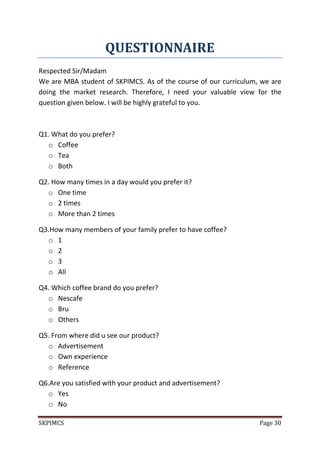
QUESTIONNAIRE
Respected Sir/Madam
We are MBA student of SKPIMCS. As of the course of our curriculum, we are
doing the market research. Therefore, I need your valuable view for the
question given below. I will be highly grateful to you.
Q1. What do you prefer?
o Coffee
o Tea
o Both
Q2. How many times in a day would you prefer it?
o One time
o 2 times
o More than 2 times
Q3.How many members of your family prefer to have coffee?
o 1
o 2
o 3
o All
Q4. Which coffee brand do you prefer?
o Nescafe
o Bru
o Others
Q5. From where did u see our product?
o Advertisement
o Own experience
o Reference
Q6.Are you satisfied with your product and advertisement?
o Yes
o No
SKPIMCS Page 31
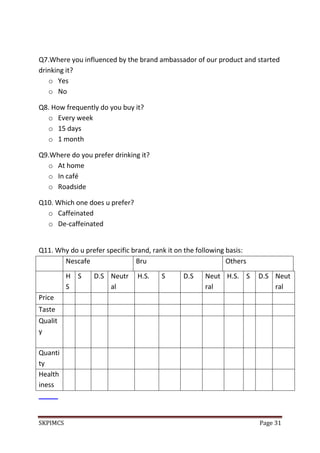
Q7.Where you influenced by the brand ambassador of our product and started
drinking it?
o Yes
o No
Q8. How frequently do you buy it?
o Every week
o 15 days
o 1 month
Q9.Where do you prefer drinking it?
o At home
o In café
o Roadside
Q10. Which one does u prefer?
o Caffeinated
o De-caffeinated
Q11. Why do u prefer specific brand, rank it on the following basis:
Nescafe Bru Others
H
S
S D.S Neutr
al
H.S. S D.S Neut
ral
H.S. S D.S Neut
ral
Price
Taste
Qualit
y
Quanti
ty
Health
iness

report on consumer preference w.r.t to coffee

  • 1.
    SKPIMCS Page 1 PROJECTREPORT ON CUSTOMER PREFERENCE WITH RESPEPCT TO (NESCAFE AND BRU COFFEE)
  • 2.
    SKPIMCS Page 2 CERTIFICATE Thisis to certify that GROUP NO-8, Div- B, MBA SEM 1 of Management and have submitted their Project Report On CUSTOMER PREFERENCE WITH RESPEPCT TO (NESCAFE AND BRU COFFEE) for the subject of “Managerial Communication” in the year 2012-2013 in partial fulfillment requirements for the award of the title of Master of Business Administration. Date: /12/2012
  • 3.
    SKPIMCS Page 3 ACKNOWLEDEMENT Itis indeed a great pleasure and privilege for us to present “CUSTOMER PREFERENCE WITH RESPEPCT TO (neSCAFE AND BRU COFFEE). We would also like to thanks to the potential customers of Nescafe and Bru coffee who helped us giving needed information and their full co-operation towards us to give time to us from his busy schedule for filling our questionnaire.
  • 4.
    SKPIMCS Page 4 PREFACE “Learningcategories you and practicing on that learning specializes you” Practical aspect gives more knowledge and experience than the theory and no learning can be completed without practical aspects. Projects are one of the most important parts of our curriculum for management students, its basic idea is to strengthen the students concept and make them equipped with recent development. In days when it was business as usual companies could succeed by there new products with concept and supported by hard selling and good advertisement and consider that customer exhibit varying diverse requirement for product/Services combinations and price consider that they have high and rising expectations of quality and services. In the face of their vast choices. Customers will gravitate to the offering that best meet their individual needs and expectation value and all this will come out as the positioning of the brand in the market.
  • 5.
    SKPIMCS Page 5 TABLEOF CONTENT SR NO. NAME PAGE NO. 1 History of the Company 6 1) Nescafe 6 2) Bru 9 2 Scope and Objectives of the study 12 3 Research Methodology 13 4 Sources of Data collection 14 5 Research Design 15 6 Data analysis 16 7 Research Findings 26 8 Limitations Of Report 27 9 Conclusion 28 10 Bibliography 29 11 Questionnaire 30
  • 6.
    SKPIMCS Page 6 HISTORYOF COMPANY NASCAFE The beginnings of Nescafe can be traced all the way back to 1930, when the Brazilian government, first approached Nestlé. The agency, Brazilian Coffee Institute seeks Nestle to preserve the huge coffee surpluses, by develop coffee that was soluble in hot water. Coffee guru, Max Mergenthaler, and his team set out immediately to find a way of producing a quality cup of coffee that could be made simply by adding water, yet would retain the coffee’s natural flavor. After seven long years of research in Nestle Swiss laboratories, they found the answer. The new product was named Nescafe – a combination of Nestlé and café. Nestle introduced Nescafe, the first commercially successful soluble coffee, in Switzerland, on April 1st, 1938. The company applied the technology at its Hayes factory, west London. Instant coffee processing was not a new idea; it was invented by a Japanese chemist in 1901 and had been marketed and sold by other companies without success. Nestle revolutionized the way instant coffee was made. Nestle developed a new process for
  • 7.
    SKPIMCS Page 7 dehydratingthe concentrated coffee which vastly improved the quality. In entailed spraying a fine mist of the solution into a heated tower where the droplets turned to powder almost instantly. For the first half of the next decade, however, World War II hindered its success in Europe. Nescafe was soon exported to France, Great Britain and the USA. Its popularity grew rapidly through the rest of the decade. It was so popular that the entire production of its US plant was reserved for military use. By the 1950s, coffee had become the beverage of choice for teenagers, who were flocking to coffeehouses to hear the new rock ’n’ roll music. Over the years the company has kept the emphasis on innovation, introducing pure soluble coffee (1952) solely using roast coffee beans, freeze dried soluble coffee (1965) and coffee granules (1967). In 1994 Nestle invented the full aroma process, which improved the quality of instant coffee. Such innovations have made sure that Nescafe has remained the world’s leading coffee. It is also the third most valuable brand in the entire drinks sector.
  • 8.
    SKPIMCS Page 8 MISSIONSTATEMENT: To bring Nescafe to people around the globe, providing a Nescafe to satisfy every aspect of needs. Nescafe provides good test, aromatic smells of coffee to people, providing “1 Nescafe with 1 unique moment” so that everyone can enjoy. Wherever you are, you will be able to find Nescafe around, whether in shopping complexes, supermarkets/hypermarkets or even grocery stalls. GOALS/ ACHIEVEMENTS: Giving people the unique moments (comfort, relaxations) through Nescafe. Stress, pressures, working overtime has led the people to have at least a cup of Nescafe coffee to relax them, having chit-chat with friends/colleagues as well, to prevent from emotional influences.
  • 9.
    SKPIMCS Page 9 BRU Somemoments in life are special and close to heart. Bru makes these moments with loved ones even more magical… It is India’s largest coffee brand that offers a range of coffee products. Its rich aroma and unique blend makes every moment come alive. Ever since its inception, Bru has been on a constant Endeavour to bring better products and formats to the consumer with every passing year. With the launch of Cappuccino in 2007, Bru pioneered the launch of instant coffee premixes in India for the youth. Then in 2010, a premium filter coffee with a blend of 85% coffee and 15% chicory was introduced under the brand name BRU Select. In 2011, BRU Lite, a light-tasting coffee with classic Mocha flavor, was launched for people who avoid coffee because of its bitter taste. In the same year BRU Exotica was launched which is premium freeze dried coffee sourced from some of the world’s best coffee-producing regions like Colombia, Brazil and Kilimanjaro. With BRU Exotica, Bru brought in ‘the world’s finest coffee experience’ for the discerning Indian consumer. Later, in the same year, BRU Gold - a 100% pure granulated coffee with an uplifting aroma and superior taste - was launched. Bru’s specially selected and freshly roasted coffee beans offer a great cup of aromatic coffee to the consumers, which makes their moments of genuine warmth and happiness even more special. Bru also has opened cafes in Mumbai under the name BRU World Cafe with world coffee experiences to be enjoyed out of home.
  • 10.
    SKPIMCS Page 10 KEYFACTS Number 1 Coffee brand in India Unilever's only Coffee brand Enjoys a rich heritage, came into existence in 1962 under the brand name Deluxe Green Label Consistently offering better and newer products to the consumer through improved packaging solutions and innovative product formats Enjoys a strong presence at various out of home locations MISSION To earn the loyalty of customers and grew the business by developing and marketing coffee products that are leaders in quality and customer enthusiasm. VISION We envision Bru to become the coffee supplier of excellence to its customers throughout the region, by consistently delivering exciting products, sensation and experiences to an increasing number of admirers
  • 11.
    SKPIMCS Page 11 SCOPEAND OBJECTIVE OF THE STUDY SCOPE: Generally scope can be considered among two parts: 1) Regional Scope 2) Functional Scope Here our regional scope is limited up to Gandhinagar (Sector 23) OBJECTIVES: There are mainly two types of objectives: 1) Primary Objective :-  To analyze the customers preference with respect to (Nescafe and Bru coffee) 2) Secondary Objectives :-  To know customers suggestions and recommendation about (Nescafe and Bru coffee)  To Study the Consumer Perception about the taste and availability of product.
  • 12.
    SKPIMCS Page 12 RESEARCHMETHODOLOGY INTRODUCTION OF RESEARCH: Research is done to gain some knowledge so it may aid in understanding the information gathered on specific topic. It is a scientific and systematic way of understanding information on specific and particular subjects. It is a scientific investigation to understand the cause and effect as well as the reasons through investigation. It is an academic activity. Research is a process in which the researcher wishes to find out the result for a given problem and thus the solution helps in future course of action.
  • 13.
    SKPIMCS Page 13 SOURCESOF DATA COLLECTION  PRIMARY DATA SOURCE: The primary data means the data gathering for first time for the problem solution directly from the sample or population as per the requirement.  Interviews  Questionnaires  Observation  SECONDARY DATA SOURCE: The secondary data consists of information that has been already exists somewhere and has been collected for some specific purpose.  Books  Website  Journal  Annual Report For this research, we used Primary data (Questionnaires) as well as secondary data (Books, Website)
  • 14.
    SKPIMCS Page 14 RESEARCHDESIGN  RESEARCH INSTRUMENT: Questionnaire-  Face –to –face  Close ended  Open ended  SAMPLE SIZE: Sample Size is taken 50 out of which 8 questionnaires had been rejected due to different choice of respondent as per our research.
  • 15.
    SKPIMCS Page 15 DATAANALYSIS Q1. What do you prefer? Particular Respondents Coffee 18 Tea 8 Both 24 TOTAL 50 0 5 10 15 20 25 30 Coffee Tea Both
  • 16.
    SKPIMCS Page 16 Q2.How many times in a day would you prefer it? Particular Respondents One time 20 2 times 16 More than 2 times 6 TOTAL 42 INTERPRETATION = Major of the sample size use to have coffee one time in a day. 0 5 10 15 20 25 One time 2 times More than 2 times
  • 17.
    SKPIMCS Page 17 Q3.Howmany members of your family prefer to have coffee? Particular Respondents 1 10 2 3 3 20 All 9 TOTAL 42 INTERPRETATION = From the example size we find that 50% of the family members using coffee. 0 2 4 6 8 10 12 14 16 18 20 1 2 3 ALL
  • 18.
    SKPIMCS Page 18 Q4.Which coffee brand do you prefer? Particular Respondents Nescafe 35 Bru 5 Other 2 TOTAL 42 INTERPRETATION = Majority of choice about coffee is given to Nescafe. 0 5 10 15 20 25 30 35 Nescafe Bru other
  • 19.
    SKPIMCS Page 19 Q5.From where did u see our product? INTERPRETATION = Majority of people are choice Nescafe from their own experience. 0 5 10 15 20 25 Advertisement Own experience Reference Particular Respondents Advertisement 12 Own experience 22 Reference 18 TOTAL 42
  • 20.
    SKPIMCS Page 20 Q6.Areyou satisfied with your product and advertisement? Particular Respondents Yes 35 No 7 TOTAL 42 INTERPRETATION = 75% people of our survey are satisfied with the product and its advertisement. 0 5 10 15 20 25 30 35 40 Yes No
  • 21.
    SKPIMCS Page 21 Q7.Whereyou influenced by the brand ambassador of our product and started drinking it? Particular Respondents Yes 30 No 12 TOTAL 42 0 5 10 15 20 25 30 Yes No
  • 22.
    SKPIMCS Page 22 Q8.How frequently do you buy it? INTERPRETATION = The area which we have survey we found that 20 out of 50 are buying coffee in 15 days. Every week 15 days 1 month Particular Respondents Every week 17 15 days 20 1 month 5 TOTAL 42
  • 23.
    SKPIMCS Page 23 Q9.Wheredo you prefer drinking it? INTERPRETATION = Most of the people are prefer to drink coffee at home. Particular Respondents At home 20 In café 10 Roadside 12 TOTAL 42 0 5 10 15 20 25 At home In café Roadside
  • 24.
    SKPIMCS Page 24 Q10.Which one does u prefer? INTERPRETATION = Most of to people love to drink de-caffeinated coffee. Particular Respondents Caffeinated 6 De- Caffeinated 36 TOTAL 42 0 5 10 15 20 25 30 35 40 Caffeinated De-caffeinated
  • 25.
    SKPIMCS Page 25 Q11.Why do u prefer specific brand, rank it on the following basis: INTERPRETATION = The reason to chose Nescafe is on following basis Price – customers are satisfied with the price of product Taste – Customers like much better test of Nescafe then Bru any other brand. Qualities – Customers are satisfied with the quality of Nescafe and they are neutral at quality. Healthiness – Preference to healthiness is satisfying to the customer. NESCAFEE BRU HS S DS NEU HS S DS NEU price 5 20 17 8 2 2 1 1 taste 5 10 7 3 1 2 1 1 quality 10 13 10 6 3 2 3 2 quantity 15 1 8 7 3 3 1 1 healthiness 10 1 10 9 1 1 2 2 0 5 10 15 20 25 HS S DS NEU HS S DS NEU NESCAFEE BRU price taste quality quantity healthness
  • 26.
    SKPIMCS Page 26 RESEARCHFINDINGS On the basis of that research we find that in case of coffee people are much influenced by taste rather than Advertisements and other things. If the Buying decision of consumer is rated - 1st preference will go to Taste, 2nd will go to Availability, 3rd preference will go to schemes, 4th preference will go to likeness, and 5th preferences will go to Advertisement.
  • 27.
    SKPIMCS Page 27 LIMITATIONSOF REPORT We put our whole heart on this project. But still are certain limitations while doing the research work. Some of the limitations are as follows.  As we did our project in limited area of our residents, so it becomes difficult to conduct survey.  We take only 50 respondents it is too small for find out the consumer perception.  There might have been tendencies among the respondents to amplifying or filter their responses under the testing.  In some cases, the respondent was not giving us the proper reply. He/she might think that this is only wastage of time or this might create some problem etc. And as a result he/she has given some fake answers and fills the questionnaire very casually.
  • 28.
    SKPIMCS Page 28 CONCLUSION Coffeeis a major export commodity in developing country like India liberalization of coffee market has given rise to competition and to survive in this competitive market newer and newer strategies are need to be formed to take the advantage of opportunities arising in this market. In Indian market there is a huge sector who using the Nescafe compare to Bru and other. On the basis of price, taste, quality, quantity, healthiness.
  • 29.
  • 30.
    SKPIMCS Page 30 QUESTIONNAIRE RespectedSir/Madam We are MBA student of SKPIMCS. As of the course of our curriculum, we are doing the market research. Therefore, I need your valuable view for the question given below. I will be highly grateful to you. Q1. What do you prefer? o Coffee o Tea o Both Q2. How many times in a day would you prefer it? o One time o 2 times o More than 2 times Q3.How many members of your family prefer to have coffee? o 1 o 2 o 3 o All Q4. Which coffee brand do you prefer? o Nescafe o Bru o Others Q5. From where did u see our product? o Advertisement o Own experience o Reference Q6.Are you satisfied with your product and advertisement? o Yes o No
  • 31.
    SKPIMCS Page 31 Q7.Whereyou influenced by the brand ambassador of our product and started drinking it? o Yes o No Q8. How frequently do you buy it? o Every week o 15 days o 1 month Q9.Where do you prefer drinking it? o At home o In café o Roadside Q10. Which one does u prefer? o Caffeinated o De-caffeinated Q11. Why do u prefer specific brand, rank it on the following basis: Nescafe Bru Others H S S D.S Neutr al H.S. S D.S Neut ral H.S. S D.S Neut ral Price Taste Qualit y Quanti ty Health iness