PURO WATER PLANT
SUBMITTED BY:
RADHIKA GUPTA
(32- MBA-14)
INTRODUCTION TO THE COMPANY
• The venture is a packaged drinking water plant
situated in food park, Bari Brahmna Jammu. the
plant would basically take into consideration
three process
• 1. Purification of water by reverse osmosis(RO).
• 2. JAR(20Ltr) FILLING AND SEALING
• 3. GLASS FILLING AND SEALING
The final products of our plant would be further
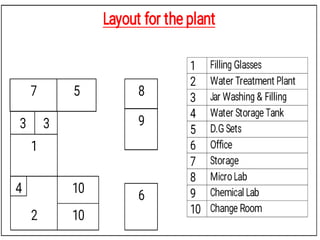
supplied in the market
Company :- Vision and Mission
• Vision:-To be the most trusted packaged
drinking water distributor of nation
• Mission:-To be a company which takes care of
both its internal and external customers and
become the largest drinking water distributor
of Jammu.
PLANT SETUP
• Over a projected timeframe of 12-months
(2016-17), a 3-phase process will be required
to fully plan out, construct, and launch this
venture.
• Whereas the project risk is highest during
phase I, the amount of required expenditure
only becomes large by phase III. These three
phases are described below.
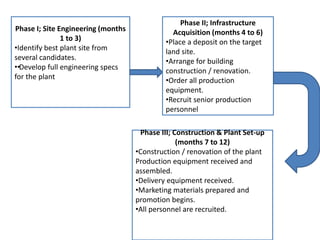
Phase I; Site Engineering (months
1 to 3)
•Identify best plant site from
several candidates.
••Develop full engineering specs
for the plant
Phase II; Infrastructure
Acquisition (months 4 to 6)
•Place a deposit on the target
land site.
•Arrange for building
construction / renovation.
•Order all production
equipment.
•Recruit senior production
personnel
Phase III; Construction & Plant Set-up
(months 7 to 12)
•Construction / renovation of the plant
Production equipment received and
assembled.
•Delivery equipment received.
•Marketing materials prepared and
promotion begins.
•All personnel are recruited.
KEY MANAGEMENT POSITIONS
• CHIEF EXECUTIVE OFFICER (CEO)
• CHIEF FINANACIAL OFFICER (CFO)
• MARKETING AND DISTRIBUTION MANAGER
• PRODUCTION & OPERATIONS MANAGER
• HR AND LEGAL ASPECTS
ABOUT PLANT
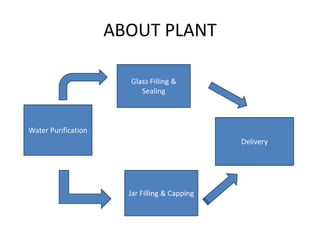
Water Purification
Glass Filling &
Sealing
Jar Filling & Capping
Delivery
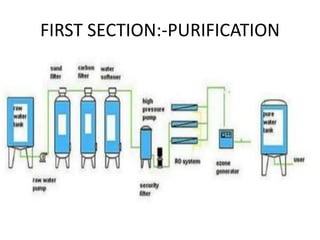
FIRST SECTION:-PURIFICATION
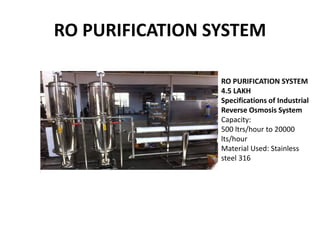
RO PURIFICATION SYSTEM
4.5 LAKH
Specifications of Industrial
Reverse Osmosis System
Capacity:
500 ltrs/hour to 20000
lts/hour
Material Used: Stainless
steel 316
Jar washing and filling machine
Four process are their in total in this, these are
as follows
1.Jar insertion
2.Jar washing
3.Jar filling
4.Jar capping
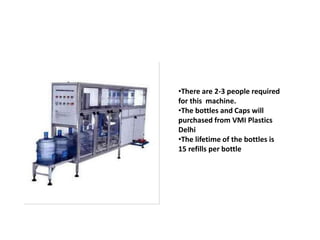
•There are 2-3 people required
for this machine.
•The bottles and Caps will
purchased from VMI Plastics
Delhi
•The lifetime of the bottles is
15 refills per bottle
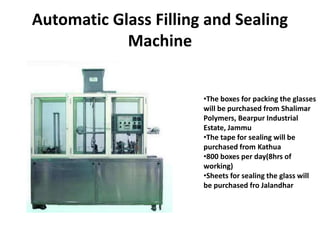
Automatic Glass Filling and Sealing
Machine
•The boxes for packing the glasses
will be purchased from Shalimar
Polymers, Bearpur Industrial
Estate, Jammu
•The tape for sealing will be
purchased from Kathua
•800 boxes per day(8hrs of
working)
•Sheets for sealing the glass will
be purchased fro Jalandhar
PURE WATER
Legal Documents Requirements
1. SSI REGISTRATION
The most basic Document needed for any small scale
industry in India. Once you have an SSI registration ,
you can avail many government facilities. Usually this is
available at the District Industries Centre , just check. It
is not very difficult to get this.
2. BIS Registration [ISI Mark Certificate]
This is mandatory for Packaged Drinking Water. The
Standard is – IS 14543
3. POLLUCTION CONTROL CERTIFACATE
This is available from the Local Pollution Board Office.
Simple Procedure.
4. ALL REQUIRED TEST REPORTS OF RAW AND PURE
WATER
Can be had from a local Test Laboratory , just locate a
Water Testing Lab ; Check at the Local Drinking Water
Testing Laboratory. Just Go with your sample Water of
1 Ltr. Take sample from 2-3 locations & get it tested for
Packaged Drinking Water.
5. PEST CONTROL CERTIFICATE
Approach a local pest Control guy, he will provide this.
6. CHEMIST-DEGREE AND MEDICAL CERTIFICATE.
7. MICROBIOLOGIST – DEGREE AND MEDICAL CERTIFICATE
8. MEDICAL CERTIFICATE FOR WORKERS
9. REGISTRATION OF TRADEMARK
This will be very important. Approach some of the trademark
consultants in your are. It is a lengthy procedure, start early.
10. DOCUMENT REGARDING OWNERSHIP/LEASE OF LAND
11. MEMORANDUM OF ASSOCIATION OF COMPANIES/
PARTNERSHIP DEED.
12. Electrical load sanction
13. Sanction layout plan
Quality Control
When developing a quality control program, we need to evaluate
many facets of their operation including sources, transportation,
supplies, ingredients, equipment, maintenance, product and
distribution. The three major areas to focus on for in-house quality
control testing are PROCESS, PACKAGING and PRODUCT.
The data accumulated is an invaluable tool, which can be attained
when customer complaint comes in, this data can be the first line
of defence. Accurate, organized and detailed records of daily
testing and process quality checks will give us a path to follow in
either ruling out a problem in the process, or pinpointing where a
product quality problem may have originated. Then any necessary
corrective action procedures can be developed and implemented.
Process
Hazard Analysis and Critical Control Points (HACCP)
plans helps determining what points in the process to
test.
•Hazard Analysis
It is a prevention-based program that identifies and
assesses hazards associated with the process,
determines the critical control points in the process for
the identified hazards, and establishes a monitoring
system for these points. There are many points in the
bottling process that could be monitored as a control
point or a point in the process where the product
quality could be at risk.
•Critical Control Points
A critical control point is slightly different in that it is the
last point in the process where a particular problem could
be avoided.
Eg. Transportation of source water to the plant has
potential risk for microbiological contamination, but it
would not be a critical control point for bacteria testing if
the water is disinfected at a later point in the process. The
last point of disinfection would be the critical control point
or most critical area of concern for monitoring in order to
prevent the possibility of microbiological contamination in
the final product water.
Checks should be performed at the beginning of each
shift and then at regular intervals throughout each
production run on all equipment used in the process
such as those discussed below:
Filtration processes—sand, carbon or particle
filtration, distillation, deionization call for tests on:
•Delta P (measures drop in water pressure);
•pH;
•Chlorine removal;
•Taste;
•Turbidity;
•Chloride;
•Resistivity; and
•THMs
Bottle washer monitoring should include testing
of:
•Cleanser concentration;
•Cleanser carryover in bottles;
•Pressure;
•Temperature;
•Rinse and wash volume; and
•Visual inspection of jets (direction and flow).
Packaging
Packaging equipment, such as cap and label
applicators and date coder operation efficiency,
should be inspected regularly for correct
application, legibility and accuracy. Contents of the
filled product bottles should be verified regularly
based on volume or weight.
Container and closure samples should be pulled
from the production line (just before filling) and
tested quarterly to be sure they are free of
bacterial contamination.
Product
Product quality monitoring should be set up on a
regular schedule throughout the production run,
dependent upon the parameter and the type of water
being produced. The following tests are typically
recommended for in-house product water testing
.Testing frequency for these parameters is usually at
production start-up and at regular intervals
throughout the specified production period.
•Taste(Perform periodic testing to determine that the
taste remains pleasant)
•pH(Natural waters should remain within a pH range
of 6.5–8.5
• Fluoride(Fluoridated product water is generally
tested at start-up and a couple of times per shift
to ensure consistent levels. If the fluoride is
naturally occurring, levels should be around 2
mg/L.
• Ozone residual(Recommended monitoring is
every 1/2 hour. A spike in ozone levels can lead
to product quality problems depending on the
chemical makeup of the water being ozonated.
Ozone residual should fall between 0.1 and 0.4
ppm.)
MARKETING PLAN
STRATEGIES FOR SUCCESS
• The mission of PWP is to become Jammu premier provider of
purified, safe, and affordable drinking water and associated
jars products.
• PWP is dedicated to building long-term relationships with
customers through quality products and customer support.
• The best way to achieve this, and the basis of the company’s
initial marketing focus, therefore, is to promote the benefits for
the home and office of buying PWP’s products.
• Secondarily, promotional messaging should also play up the
fact that PWP is an Jammu-based company. Other bottled
water product may appear from time-to-time, but why not take
advantage of nationalistic sentiment? A small Jammu flag logo
on the bottle would help achieve this.
• Finally, the company will adopt creative and aggressive tactics
to exclusively position its product into key target markets.
• For instance, by offering low pricing and / or promotional
supports to a particular high profile retailer will ensure that
only Puro Water appears on the shelf rather than some other
brands.
• Often, taking less revenue (or incurring a higher cost) when
dealing with a certain customer will incite that customer to
agree to some sort of preferential agreement. When that
customer just happens to be important (in terms of his location,
large market share, reputation, etc.), then the revenue sacrifice
or extra cost incurred may be very worthwhile in terms of the
big picture.
TARGET MARKETS
A number of prospective customer groups will comprise
PWP’s principal target markets. The type of marketing
required to effectively connect to the various groups will vary,
and these differences will be noted.
• Individuals; this group will be comprised of the population at
large, and can only be effectively approached through mass
media marketing.
• Retailers; a very important target market in so far as this
represents the best way to sell product to most members of the
general population. Potentially, this target market group could
represent the largest sales volumes. Establishing agreements with
retailers will require direct sales approaches, coupled to the
offering of sales commissions.
• Hospitals; this sector represents an excellent public relations
opportunity, since the placement of product into hospitals will
prove the assertion that the Puro Water brand represents
quality and safety. Establishing agreements with hospitals will
require direct sales approaches, coupled to the offering of
pricing discounts.
• Large Businesses, Commercial Complexes,
Government Offices; this will quickly become
the largest target market group in terms of sales
volumes. It is important to highlight the fact that
these are establishments with money, they have a
lot of workers, and they have a vested interest in
protecting / preserving the health of their
workforces. Establishing supply agreements with
these customers will require direct sales
approaches to key decision makers.
PROMOTIONAL STRATEGIES
As a general statement, the principal objective behind PWP’s
ongoing promotional activities will be to introduce and reinforce
the Puro Water brand name to the Jammu population.
Promotional activity builds familiarity, reduces inhibitions, and
often discourages the entry into the marketplace of new, would-
be competitors. Some of the promotional activity / tactics to be
employed is rather straightforward, including:
• Large signage along major roadways (e.g. billboards).
• Radio and newspaper ads.
• Create a “buzz” in the local press during the lead-up to the
establishment of the plant, and especially at the point of its
“Grand Opening”. - JAMMU LINK'S
• Maintaining a sizable marketing & sales budget over the long-
term. Promotion activity is an ongoing process, whose results
may not show in the very immediate term. After all, PWP not
only wishes to induce Jammu to try the product in the near-
term, the intent is for these people to become longstanding,
repeat customers on a continuous basis.
• Offer free trial offers, such as providing a water dispenser and
initial supply of purified water at no charge. This tactic is best
suited for large commercial buildings, government offices, or
other potentially large volume buyers. Such free trials can
entice certain prospective consumers to sign up for long-term
supply deals.
• Offer a discount on jars for those customers who agree to
commit to longer-term, minimum volume, supply contracts.
•Pay competitive commissions to retailers, wholesalers, and
brokers so that they remain motivated to sell PWP product lines.
PRICING STRATEGY
PWP will maintain pricing on its products that will always tend to be at, or
below the prices charged by other bottlers serving the Jammu marketplace.
Other elements of the company’s pricing strategy will include:
• Maintain pricing consistency over the year so as to tell customers that
PWP is a stable entity that is fully committed to its products.
• Offer pricing discounts for those customers willing to commit to taking
delivery of large volumes on a continuing, long-term basis. This will
translate into a major cost savings for large volume customers, and will
induce them to stay loyal.
• By maintaining an ultra-competitive pricing regimen, potential
newcomers to the Jammu marketplace will be dissuaded from selling
their bottled water products (if they are foreign-based bottlers, they will
likely pay more attention to some other nation where the pricing levels
and profit potential is higher).
Financial Appraisal
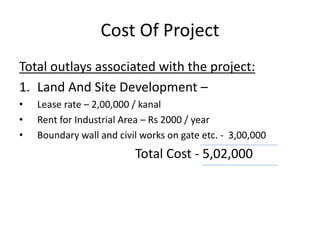
Cost Of Project
Total outlays associated with the project:
1. Land And Site Development –
• Lease rate – 2,00,000 / kanal
• Rent for Industrial Area – Rs 2000 / year
• Boundary wall and civil works on gate etc. - 3,00,000
Total Cost - 5,02,000
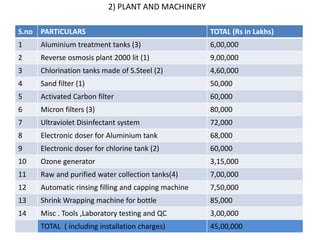
2) PLANT AND MACHINERY
S.no PARTICULARS TOTAL (Rs in Lakhs)
1 Aluminium treatment tanks (3) 6,00,000
2 Reverse osmosis plant 2000 lit (1) 9,00,000
3 Chlorination tanks made of S.Steel (2) 4,60,000
4 Sand filter (1) 50,000
5 Activated Carbon filter 60,000
6 Micron filters (3) 80,000
7 Ultraviolet Disinfectant system 72,000
8 Electronic doser for Aluminium tank 68,000
9 Electronic doser for chlorine tank (2) 60,000
10 Ozone generator 3,15,000
11 Raw and purified water collection tanks(4) 7,00,000
12 Automatic rinsing filling and capping machine 7,50,000
13 Shrink Wrapping machine for bottle 85,000
14 Misc . Tools ,Laboratory testing and QC 3,00,000
TOTAL ( including installation charges) 45,00,000
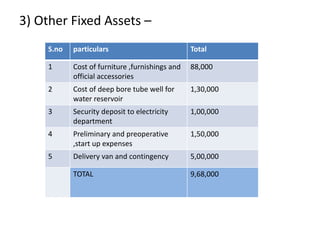
3) Other Fixed Assets –
S.no particulars Total
1 Cost of furniture ,furnishings and
official accessories
88,000
2 Cost of deep bore tube well for
water reservoir
1,30,000
3 Security deposit to electricity
department
1,00,000
4 Preliminary and preoperative
,start up expenses
1,50,000
5 Delivery van and contingency 5,00,000
TOTAL 9,68,000
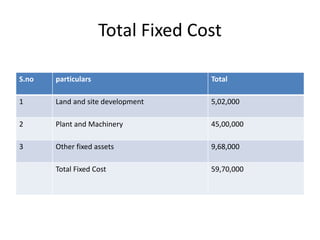
Total Fixed Cost
S.no particulars Total
1 Land and site development 5,02,000
2 Plant and Machinery 45,00,000
3 Other fixed assets 9,68,000
Total Fixed Cost 59,70,000
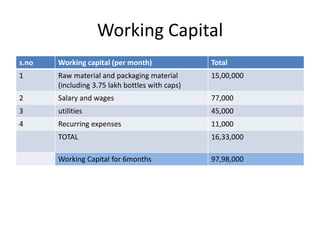
Working Capital
s.no Working capital (per month) Total
1 Raw material and packaging material
(including 3.75 lakh bottles with caps)
15,00,000
2 Salary and wages 77,000
3 utilities 45,000
4 Recurring expenses 11,000
TOTAL 16,33,000
Working Capital for 6months 97,98,000
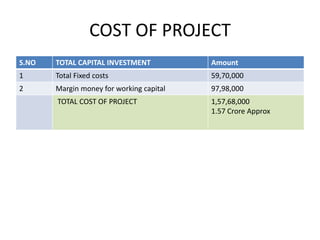
COST OF PROJECT
S.NO TOTAL CAPITAL INVESTMENT Amount
1 Total Fixed costs 59,70,000
2 Margin money for working capital 97,98,000
TOTAL COST OF PROJECT 1,57,68,000
1.57 Crore Approx
Financial Analysis
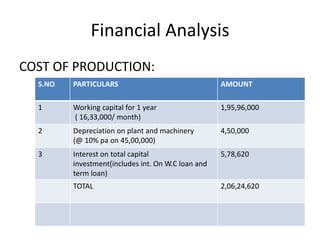
COST OF PRODUCTION:
S.NO PARTICULARS AMOUNT
1 Working capital for 1 year
( 16,33,000/ month)
1,95,96,000
2 Depreciation on plant and machinery
(@ 10% pa on 45,00,000)
4,50,000
3 Interest on total capital
investment(includes int. On W.C loan and
term loan)
5,78,620
TOTAL 2,06,24,620
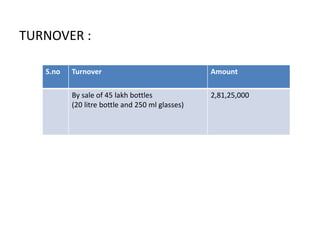
TURNOVER :
S.no Turnover Amount
By sale of 45 lakh bottles
(20 litre bottle and 250 ml glasses)
2,81,25,000
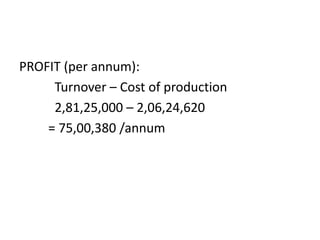
PROFIT (per annum):
Turnover – Cost of production
2,81,25,000 – 2,06,24,620
= 75,00,380 /annum
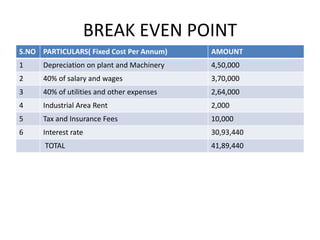
BREAK EVEN POINT
S.NO PARTICULARS( Fixed Cost Per Annum) AMOUNT
1 Depreciation on plant and Machinery 4,50,000
2 40% of salary and wages 3,70,000
3 40% of utilities and other expenses 2,64,000
4 Industrial Area Rent 2,000
5 Tax and Insurance Fees 10,000
6 Interest rate 30,93,440
TOTAL 41,89,440
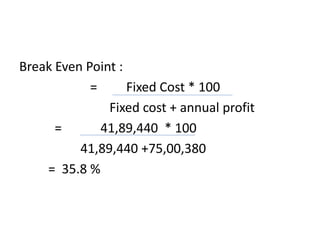
Break Even Point :
= Fixed Cost * 100
Fixed cost + annual profit
= 41,89,440 * 100
41,89,440 +75,00,380
= 35.8 %
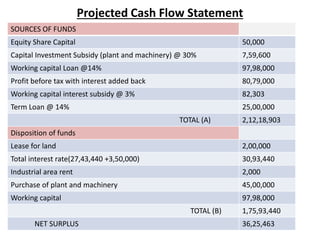
Projected Cash Flow Statement
SOURCES OF FUNDS
Equity Share Capital 50,000
Capital Investment Subsidy (plant and machinery) @ 30% 7,59,600
Working capital Loan @14% 97,98,000
Profit before tax with interest added back 80,79,000
Working capital interest subsidy @ 3% 82,303
Term Loan @ 14% 25,00,000
TOTAL (A) 2,12,18,903
Disposition of funds
Lease for land 2,00,000
Total interest rate(27,43,440 +3,50,000) 30,93,440
Industrial area rent 2,000
Purchase of plant and machinery 45,00,000
Working capital 97,98,000
TOTAL (B) 1,75,93,440
NET SURPLUS 36,25,463
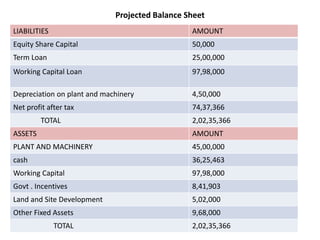
Projected Balance Sheet
LIABILITIES AMOUNT
Equity Share Capital 50,000
Term Loan 25,00,000
Working Capital Loan 97,98,000
Depreciation on plant and machinery 4,50,000
Net profit after tax 74,37,366
TOTAL 2,02,35,366
ASSETS AMOUNT
PLANT AND MACHINERY 45,00,000
cash 36,25,463
Working Capital 97,98,000
Govt . Incentives 8,41,903
Land and Site Development 5,02,000
Other Fixed Assets 9,68,000
TOTAL 2,02,35,366
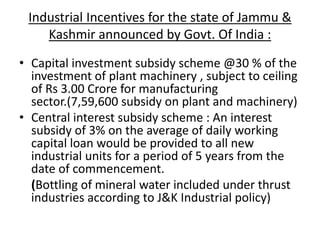
Industrial Incentives for the state of Jammu &
Kashmir announced by Govt. Of India :
• Capital investment subsidy scheme @30 % of the
investment of plant machinery , subject to ceiling
of Rs 3.00 Crore for manufacturing
sector.(7,59,600 subsidy on plant and machinery)
• Central interest subsidy scheme : An interest
subsidy of 3% on the average of daily working
capital loan would be provided to all new
industrial units for a period of 5 years from the
date of commencement.
(Bottling of mineral water included under thrust
industries according to J&K Industrial policy)

Puro water plant

  • 1.
    PURO WATER PLANT SUBMITTEDBY: RADHIKA GUPTA (32- MBA-14)
  • 2.
    INTRODUCTION TO THECOMPANY • The venture is a packaged drinking water plant situated in food park, Bari Brahmna Jammu. the plant would basically take into consideration three process • 1. Purification of water by reverse osmosis(RO). • 2. JAR(20Ltr) FILLING AND SEALING • 3. GLASS FILLING AND SEALING The final products of our plant would be further supplied in the market
  • 3.
    Company :- Visionand Mission • Vision:-To be the most trusted packaged drinking water distributor of nation • Mission:-To be a company which takes care of both its internal and external customers and become the largest drinking water distributor of Jammu.
  • 4.
    PLANT SETUP • Overa projected timeframe of 12-months (2016-17), a 3-phase process will be required to fully plan out, construct, and launch this venture. • Whereas the project risk is highest during phase I, the amount of required expenditure only becomes large by phase III. These three phases are described below.
  • 5.
    Phase I; SiteEngineering (months 1 to 3) •Identify best plant site from several candidates. ••Develop full engineering specs for the plant Phase II; Infrastructure Acquisition (months 4 to 6) •Place a deposit on the target land site. •Arrange for building construction / renovation. •Order all production equipment. •Recruit senior production personnel Phase III; Construction & Plant Set-up (months 7 to 12) •Construction / renovation of the plant Production equipment received and assembled. •Delivery equipment received. •Marketing materials prepared and promotion begins. •All personnel are recruited.
  • 6.
    KEY MANAGEMENT POSITIONS •CHIEF EXECUTIVE OFFICER (CEO) • CHIEF FINANACIAL OFFICER (CFO) • MARKETING AND DISTRIBUTION MANAGER • PRODUCTION & OPERATIONS MANAGER • HR AND LEGAL ASPECTS
  • 7.
    ABOUT PLANT Water Purification GlassFilling & Sealing Jar Filling & Capping Delivery
  • 8.
  • 9.
    RO PURIFICATION SYSTEM ROPURIFICATION SYSTEM 4.5 LAKH Specifications of Industrial Reverse Osmosis System Capacity: 500 ltrs/hour to 20000 lts/hour Material Used: Stainless steel 316
  • 10.
    Jar washing andfilling machine Four process are their in total in this, these are as follows 1.Jar insertion 2.Jar washing 3.Jar filling 4.Jar capping
  • 11.
    •There are 2-3people required for this machine. •The bottles and Caps will purchased from VMI Plastics Delhi •The lifetime of the bottles is 15 refills per bottle
  • 12.
    Automatic Glass Fillingand Sealing Machine •The boxes for packing the glasses will be purchased from Shalimar Polymers, Bearpur Industrial Estate, Jammu •The tape for sealing will be purchased from Kathua •800 boxes per day(8hrs of working) •Sheets for sealing the glass will be purchased fro Jalandhar
  • 13.
  • 15.
    Legal Documents Requirements 1.SSI REGISTRATION The most basic Document needed for any small scale industry in India. Once you have an SSI registration , you can avail many government facilities. Usually this is available at the District Industries Centre , just check. It is not very difficult to get this. 2. BIS Registration [ISI Mark Certificate] This is mandatory for Packaged Drinking Water. The Standard is – IS 14543
  • 16.
    3. POLLUCTION CONTROLCERTIFACATE This is available from the Local Pollution Board Office. Simple Procedure. 4. ALL REQUIRED TEST REPORTS OF RAW AND PURE WATER Can be had from a local Test Laboratory , just locate a Water Testing Lab ; Check at the Local Drinking Water Testing Laboratory. Just Go with your sample Water of 1 Ltr. Take sample from 2-3 locations & get it tested for Packaged Drinking Water. 5. PEST CONTROL CERTIFICATE Approach a local pest Control guy, he will provide this.
  • 17.
    6. CHEMIST-DEGREE ANDMEDICAL CERTIFICATE. 7. MICROBIOLOGIST – DEGREE AND MEDICAL CERTIFICATE 8. MEDICAL CERTIFICATE FOR WORKERS 9. REGISTRATION OF TRADEMARK This will be very important. Approach some of the trademark consultants in your are. It is a lengthy procedure, start early. 10. DOCUMENT REGARDING OWNERSHIP/LEASE OF LAND 11. MEMORANDUM OF ASSOCIATION OF COMPANIES/ PARTNERSHIP DEED.
  • 18.
    12. Electrical loadsanction 13. Sanction layout plan
  • 19.
    Quality Control When developinga quality control program, we need to evaluate many facets of their operation including sources, transportation, supplies, ingredients, equipment, maintenance, product and distribution. The three major areas to focus on for in-house quality control testing are PROCESS, PACKAGING and PRODUCT. The data accumulated is an invaluable tool, which can be attained when customer complaint comes in, this data can be the first line of defence. Accurate, organized and detailed records of daily testing and process quality checks will give us a path to follow in either ruling out a problem in the process, or pinpointing where a product quality problem may have originated. Then any necessary corrective action procedures can be developed and implemented.
  • 20.
    Process Hazard Analysis andCritical Control Points (HACCP) plans helps determining what points in the process to test. •Hazard Analysis It is a prevention-based program that identifies and assesses hazards associated with the process, determines the critical control points in the process for the identified hazards, and establishes a monitoring system for these points. There are many points in the bottling process that could be monitored as a control point or a point in the process where the product quality could be at risk.
  • 21.
    •Critical Control Points Acritical control point is slightly different in that it is the last point in the process where a particular problem could be avoided. Eg. Transportation of source water to the plant has potential risk for microbiological contamination, but it would not be a critical control point for bacteria testing if the water is disinfected at a later point in the process. The last point of disinfection would be the critical control point or most critical area of concern for monitoring in order to prevent the possibility of microbiological contamination in the final product water.
  • 22.
    Checks should beperformed at the beginning of each shift and then at regular intervals throughout each production run on all equipment used in the process such as those discussed below: Filtration processes—sand, carbon or particle filtration, distillation, deionization call for tests on: •Delta P (measures drop in water pressure); •pH; •Chlorine removal; •Taste; •Turbidity; •Chloride; •Resistivity; and •THMs
  • 23.
    Bottle washer monitoringshould include testing of: •Cleanser concentration; •Cleanser carryover in bottles; •Pressure; •Temperature; •Rinse and wash volume; and •Visual inspection of jets (direction and flow).
  • 24.
    Packaging Packaging equipment, suchas cap and label applicators and date coder operation efficiency, should be inspected regularly for correct application, legibility and accuracy. Contents of the filled product bottles should be verified regularly based on volume or weight. Container and closure samples should be pulled from the production line (just before filling) and tested quarterly to be sure they are free of bacterial contamination.
  • 25.
    Product Product quality monitoringshould be set up on a regular schedule throughout the production run, dependent upon the parameter and the type of water being produced. The following tests are typically recommended for in-house product water testing .Testing frequency for these parameters is usually at production start-up and at regular intervals throughout the specified production period. •Taste(Perform periodic testing to determine that the taste remains pleasant) •pH(Natural waters should remain within a pH range of 6.5–8.5
  • 26.
    • Fluoride(Fluoridated productwater is generally tested at start-up and a couple of times per shift to ensure consistent levels. If the fluoride is naturally occurring, levels should be around 2 mg/L. • Ozone residual(Recommended monitoring is every 1/2 hour. A spike in ozone levels can lead to product quality problems depending on the chemical makeup of the water being ozonated. Ozone residual should fall between 0.1 and 0.4 ppm.)
  • 27.
  • 28.
    STRATEGIES FOR SUCCESS •The mission of PWP is to become Jammu premier provider of purified, safe, and affordable drinking water and associated jars products. • PWP is dedicated to building long-term relationships with customers through quality products and customer support. • The best way to achieve this, and the basis of the company’s initial marketing focus, therefore, is to promote the benefits for the home and office of buying PWP’s products.
  • 29.
    • Secondarily, promotionalmessaging should also play up the fact that PWP is an Jammu-based company. Other bottled water product may appear from time-to-time, but why not take advantage of nationalistic sentiment? A small Jammu flag logo on the bottle would help achieve this.
  • 30.
    • Finally, thecompany will adopt creative and aggressive tactics to exclusively position its product into key target markets. • For instance, by offering low pricing and / or promotional supports to a particular high profile retailer will ensure that only Puro Water appears on the shelf rather than some other brands. • Often, taking less revenue (or incurring a higher cost) when dealing with a certain customer will incite that customer to agree to some sort of preferential agreement. When that customer just happens to be important (in terms of his location, large market share, reputation, etc.), then the revenue sacrifice or extra cost incurred may be very worthwhile in terms of the big picture.
  • 31.
    TARGET MARKETS A numberof prospective customer groups will comprise PWP’s principal target markets. The type of marketing required to effectively connect to the various groups will vary, and these differences will be noted. • Individuals; this group will be comprised of the population at large, and can only be effectively approached through mass media marketing.
  • 32.
    • Retailers; avery important target market in so far as this represents the best way to sell product to most members of the general population. Potentially, this target market group could represent the largest sales volumes. Establishing agreements with retailers will require direct sales approaches, coupled to the offering of sales commissions. • Hospitals; this sector represents an excellent public relations opportunity, since the placement of product into hospitals will prove the assertion that the Puro Water brand represents quality and safety. Establishing agreements with hospitals will require direct sales approaches, coupled to the offering of pricing discounts.
  • 33.
    • Large Businesses,Commercial Complexes, Government Offices; this will quickly become the largest target market group in terms of sales volumes. It is important to highlight the fact that these are establishments with money, they have a lot of workers, and they have a vested interest in protecting / preserving the health of their workforces. Establishing supply agreements with these customers will require direct sales approaches to key decision makers.
  • 34.
    PROMOTIONAL STRATEGIES As ageneral statement, the principal objective behind PWP’s ongoing promotional activities will be to introduce and reinforce the Puro Water brand name to the Jammu population. Promotional activity builds familiarity, reduces inhibitions, and often discourages the entry into the marketplace of new, would- be competitors. Some of the promotional activity / tactics to be employed is rather straightforward, including: • Large signage along major roadways (e.g. billboards). • Radio and newspaper ads.
  • 35.
    • Create a“buzz” in the local press during the lead-up to the establishment of the plant, and especially at the point of its “Grand Opening”. - JAMMU LINK'S • Maintaining a sizable marketing & sales budget over the long- term. Promotion activity is an ongoing process, whose results may not show in the very immediate term. After all, PWP not only wishes to induce Jammu to try the product in the near- term, the intent is for these people to become longstanding, repeat customers on a continuous basis.
  • 36.
    • Offer freetrial offers, such as providing a water dispenser and initial supply of purified water at no charge. This tactic is best suited for large commercial buildings, government offices, or other potentially large volume buyers. Such free trials can entice certain prospective consumers to sign up for long-term supply deals. • Offer a discount on jars for those customers who agree to commit to longer-term, minimum volume, supply contracts. •Pay competitive commissions to retailers, wholesalers, and brokers so that they remain motivated to sell PWP product lines.
  • 37.
    PRICING STRATEGY PWP willmaintain pricing on its products that will always tend to be at, or below the prices charged by other bottlers serving the Jammu marketplace. Other elements of the company’s pricing strategy will include: • Maintain pricing consistency over the year so as to tell customers that PWP is a stable entity that is fully committed to its products. • Offer pricing discounts for those customers willing to commit to taking delivery of large volumes on a continuing, long-term basis. This will translate into a major cost savings for large volume customers, and will induce them to stay loyal. • By maintaining an ultra-competitive pricing regimen, potential newcomers to the Jammu marketplace will be dissuaded from selling their bottled water products (if they are foreign-based bottlers, they will likely pay more attention to some other nation where the pricing levels and profit potential is higher).
  • 38.
  • 39.
    Cost Of Project Totaloutlays associated with the project: 1. Land And Site Development – • Lease rate – 2,00,000 / kanal • Rent for Industrial Area – Rs 2000 / year • Boundary wall and civil works on gate etc. - 3,00,000 Total Cost - 5,02,000
  • 40.
    2) PLANT ANDMACHINERY S.no PARTICULARS TOTAL (Rs in Lakhs) 1 Aluminium treatment tanks (3) 6,00,000 2 Reverse osmosis plant 2000 lit (1) 9,00,000 3 Chlorination tanks made of S.Steel (2) 4,60,000 4 Sand filter (1) 50,000 5 Activated Carbon filter 60,000 6 Micron filters (3) 80,000 7 Ultraviolet Disinfectant system 72,000 8 Electronic doser for Aluminium tank 68,000 9 Electronic doser for chlorine tank (2) 60,000 10 Ozone generator 3,15,000 11 Raw and purified water collection tanks(4) 7,00,000 12 Automatic rinsing filling and capping machine 7,50,000 13 Shrink Wrapping machine for bottle 85,000 14 Misc . Tools ,Laboratory testing and QC 3,00,000 TOTAL ( including installation charges) 45,00,000
  • 41.
    3) Other FixedAssets – S.no particulars Total 1 Cost of furniture ,furnishings and official accessories 88,000 2 Cost of deep bore tube well for water reservoir 1,30,000 3 Security deposit to electricity department 1,00,000 4 Preliminary and preoperative ,start up expenses 1,50,000 5 Delivery van and contingency 5,00,000 TOTAL 9,68,000
  • 42.
    Total Fixed Cost S.noparticulars Total 1 Land and site development 5,02,000 2 Plant and Machinery 45,00,000 3 Other fixed assets 9,68,000 Total Fixed Cost 59,70,000
  • 43.
    Working Capital s.no Workingcapital (per month) Total 1 Raw material and packaging material (including 3.75 lakh bottles with caps) 15,00,000 2 Salary and wages 77,000 3 utilities 45,000 4 Recurring expenses 11,000 TOTAL 16,33,000 Working Capital for 6months 97,98,000
  • 44.
    COST OF PROJECT S.NOTOTAL CAPITAL INVESTMENT Amount 1 Total Fixed costs 59,70,000 2 Margin money for working capital 97,98,000 TOTAL COST OF PROJECT 1,57,68,000 1.57 Crore Approx
  • 45.
    Financial Analysis COST OFPRODUCTION: S.NO PARTICULARS AMOUNT 1 Working capital for 1 year ( 16,33,000/ month) 1,95,96,000 2 Depreciation on plant and machinery (@ 10% pa on 45,00,000) 4,50,000 3 Interest on total capital investment(includes int. On W.C loan and term loan) 5,78,620 TOTAL 2,06,24,620
  • 46.
    TURNOVER : S.no TurnoverAmount By sale of 45 lakh bottles (20 litre bottle and 250 ml glasses) 2,81,25,000
  • 47.
    PROFIT (per annum): Turnover– Cost of production 2,81,25,000 – 2,06,24,620 = 75,00,380 /annum
  • 48.
    BREAK EVEN POINT S.NOPARTICULARS( Fixed Cost Per Annum) AMOUNT 1 Depreciation on plant and Machinery 4,50,000 2 40% of salary and wages 3,70,000 3 40% of utilities and other expenses 2,64,000 4 Industrial Area Rent 2,000 5 Tax and Insurance Fees 10,000 6 Interest rate 30,93,440 TOTAL 41,89,440
  • 49.
    Break Even Point: = Fixed Cost * 100 Fixed cost + annual profit = 41,89,440 * 100 41,89,440 +75,00,380 = 35.8 %
  • 50.
    Projected Cash FlowStatement SOURCES OF FUNDS Equity Share Capital 50,000 Capital Investment Subsidy (plant and machinery) @ 30% 7,59,600 Working capital Loan @14% 97,98,000 Profit before tax with interest added back 80,79,000 Working capital interest subsidy @ 3% 82,303 Term Loan @ 14% 25,00,000 TOTAL (A) 2,12,18,903 Disposition of funds Lease for land 2,00,000 Total interest rate(27,43,440 +3,50,000) 30,93,440 Industrial area rent 2,000 Purchase of plant and machinery 45,00,000 Working capital 97,98,000 TOTAL (B) 1,75,93,440 NET SURPLUS 36,25,463
  • 51.
    Projected Balance Sheet LIABILITIESAMOUNT Equity Share Capital 50,000 Term Loan 25,00,000 Working Capital Loan 97,98,000 Depreciation on plant and machinery 4,50,000 Net profit after tax 74,37,366 TOTAL 2,02,35,366 ASSETS AMOUNT PLANT AND MACHINERY 45,00,000 cash 36,25,463 Working Capital 97,98,000 Govt . Incentives 8,41,903 Land and Site Development 5,02,000 Other Fixed Assets 9,68,000 TOTAL 2,02,35,366
  • 52.
    Industrial Incentives forthe state of Jammu & Kashmir announced by Govt. Of India : • Capital investment subsidy scheme @30 % of the investment of plant machinery , subject to ceiling of Rs 3.00 Crore for manufacturing sector.(7,59,600 subsidy on plant and machinery) • Central interest subsidy scheme : An interest subsidy of 3% on the average of daily working capital loan would be provided to all new industrial units for a period of 5 years from the date of commencement. (Bottling of mineral water included under thrust industries according to J&K Industrial policy)