An Investigation of Gamification Typologies for Enhancing Learner Motivation 
Barryl Herbert, Darryl Charles, Adrian Moore 
School of Computing and Information Engineering 
University of Ulster 
Coleraine, Northern Ireland 
Therese Charles 
SilverFish Studios 
Coleraine, Northern Ireland
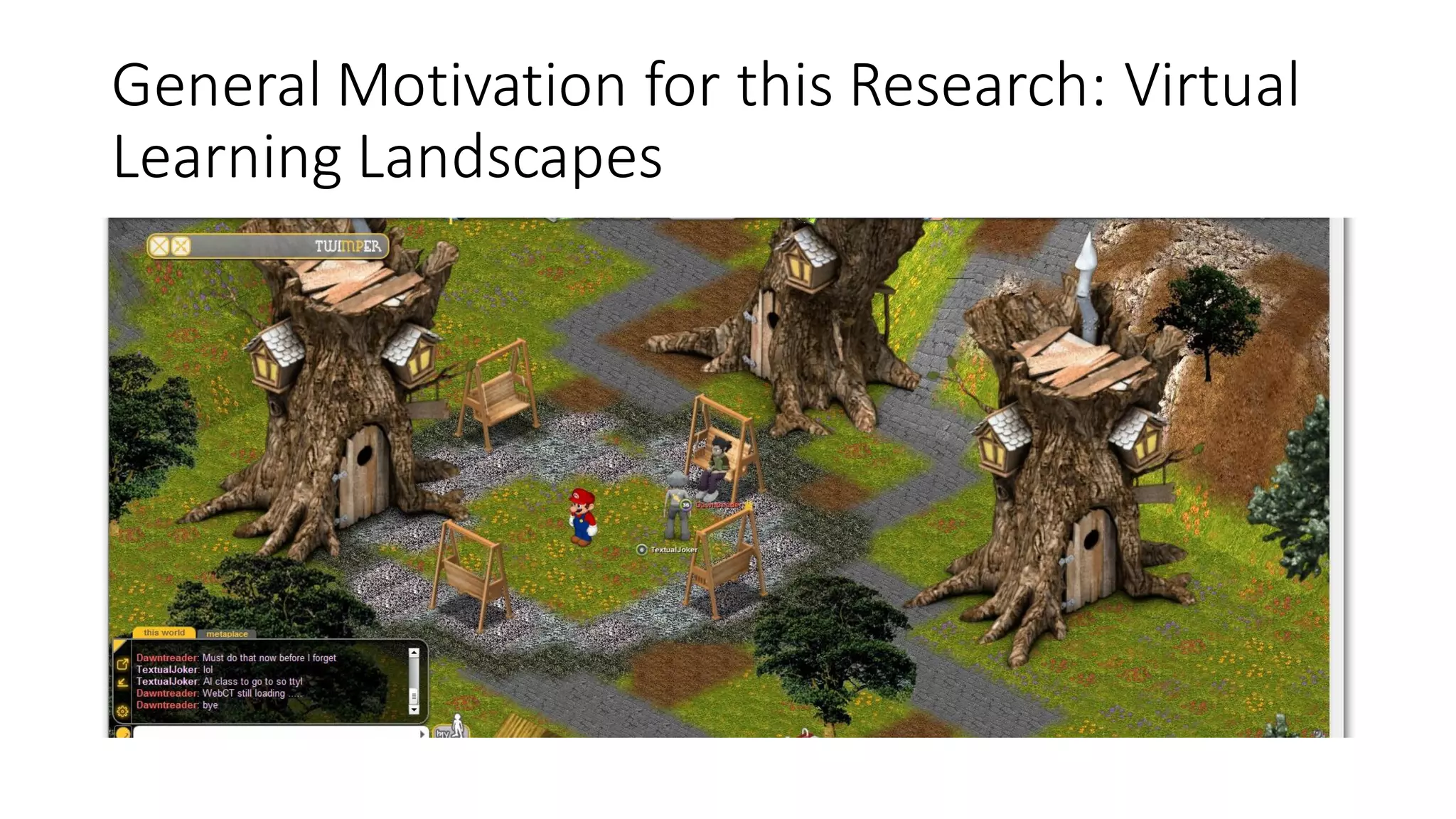
General Motivation for this Research: Virtual Learning Landscapes
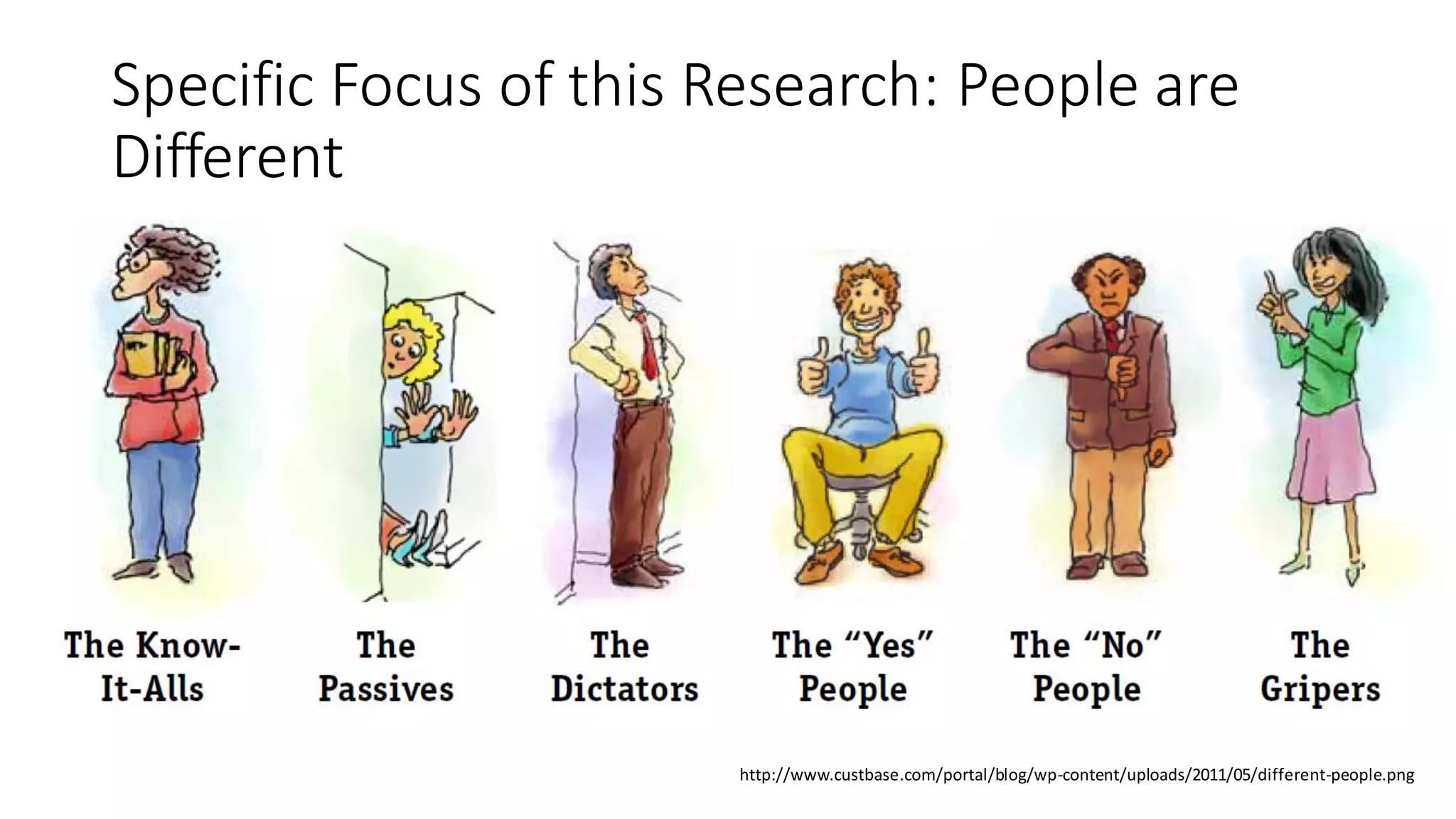
Specific Focus of this Research: People are Different 
http://www.custbase.com/portal/blog/wp-content/uploads/2011/05/different-people.png
People’s Temperament and Psychology Varies 
Keirsy Temperament 
Myers-Briggs Mapping 
Roles 
Typical Attributes 
Artisan 
ESTP, ISTP, ESFP, ISFP 
Promoter, Crafter, Performer, Composer 
Fun-loving, Excitable, optimistic, realistic, unconventional, bold, and spontaneous. 
Troubleshooting leaders. 
Guardian 
ESTJ, ISTJ, ESFJ, ISFJ 
Supervisor, Inspector, Provider, Protector 
Dependable, helpful, and hard-working, dutiful, cautious, humble. Stabilizing leaders. 
Rational 
INTJ, INTP, ENTP, ENTJ 
Field Marshall, Mastermind, Inventor, Architect 
Pragmatic, skeptical, self-contained, problem-solvers, ingenious, independent, and strong willed. Strategic leaders 
Idealist 
INFJ, INFP, ENFP, ENFJ 
Teacher, Councellor, Champion, Healer 
Enthusiastic, trust intuition, kindhearted, authentic, giving, trusting, and focused on personal journeys. Inspirational leaders. 
Keirsey.com, “Keirsey Temperament Website - Overview of the Four Temperaments.” [Online]. Available: http://www.keirsey.com. [Accessed: 03-Jun-2014].
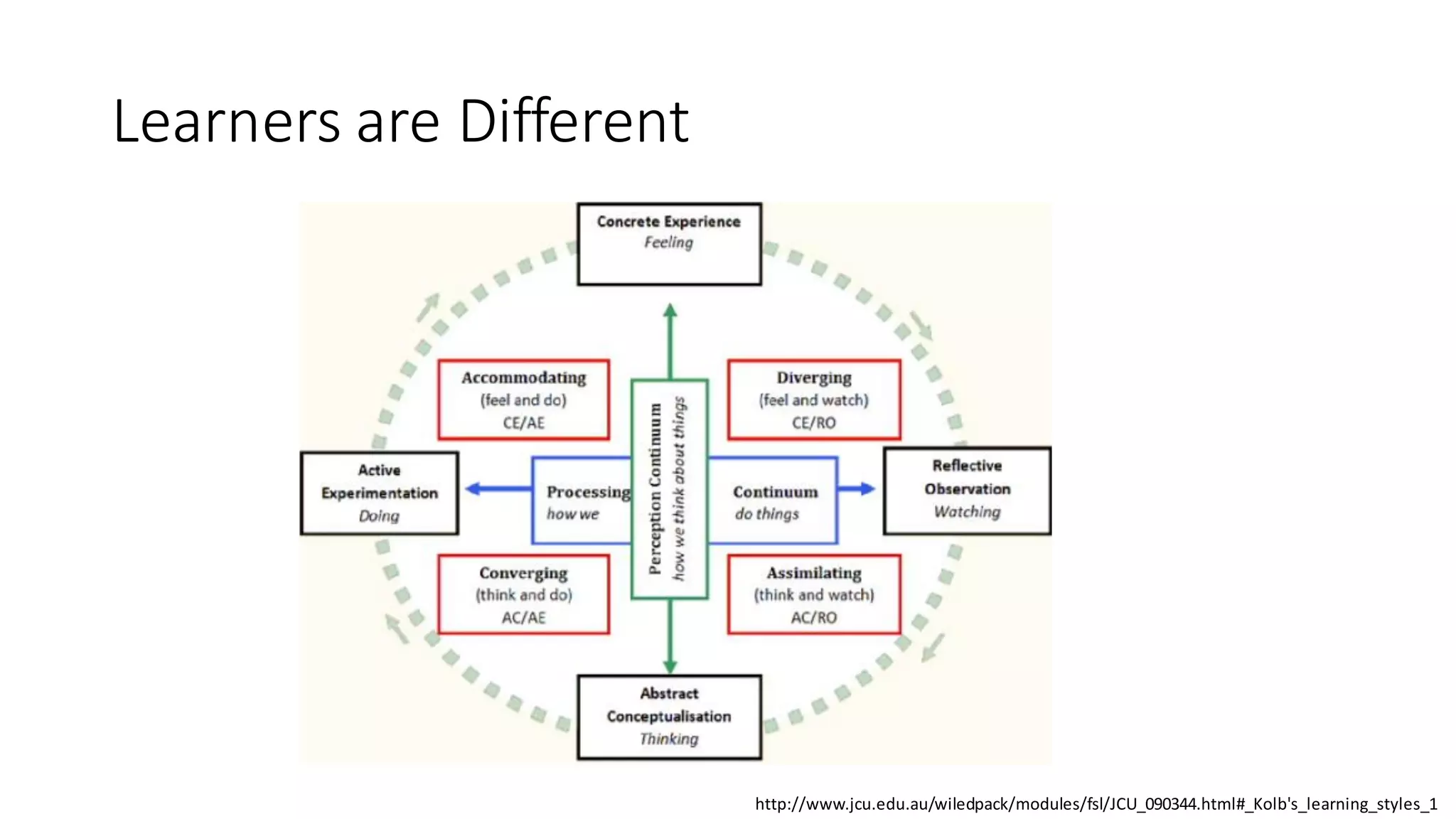
Learners are Different 
http://www.jcu.edu.au/wiledpack/modules/fsl/JCU_090344.html#_Kolb's_learning_styles_1
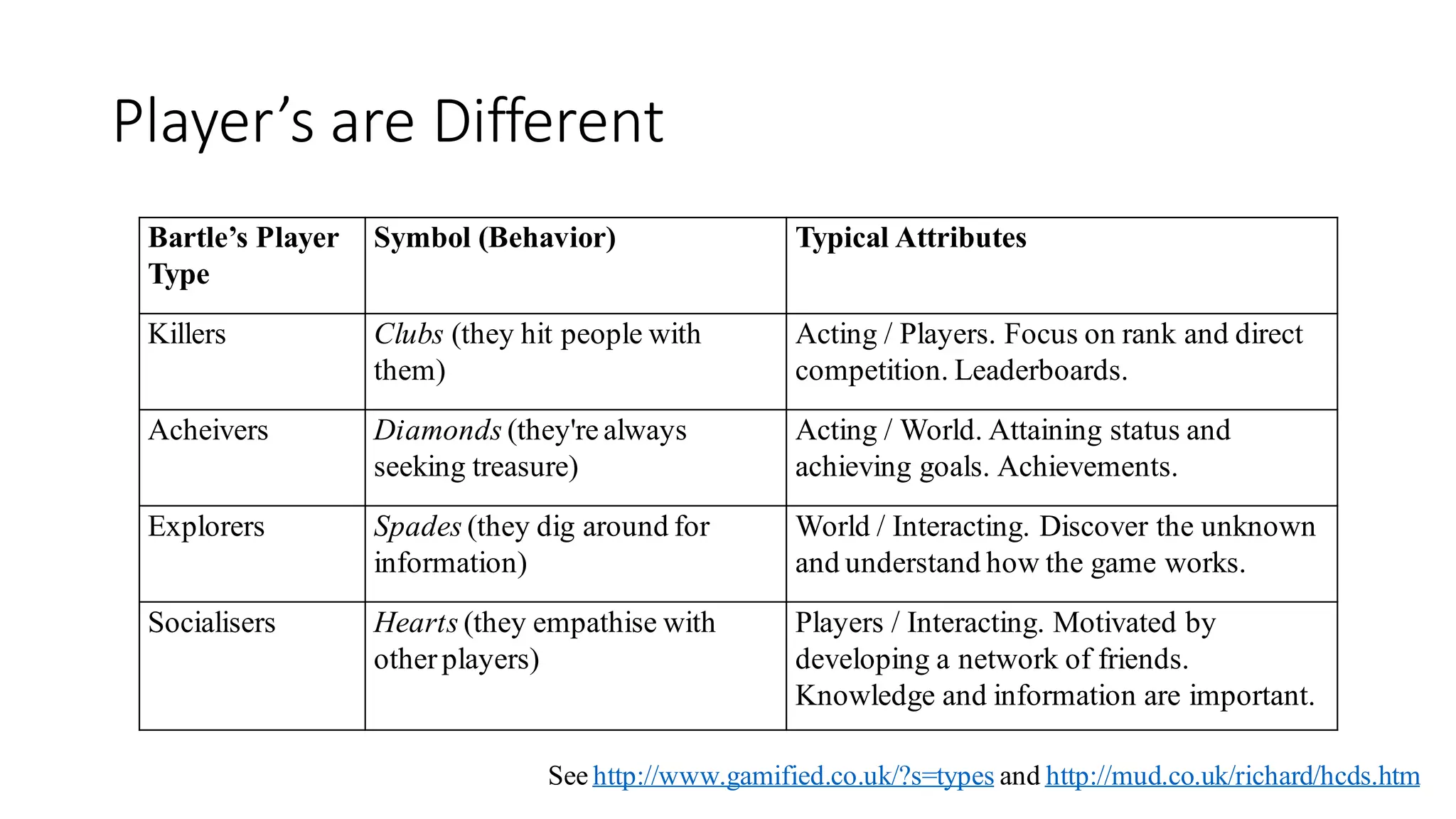
Player’s are Different 
Bartle’s Player Type 
Symbol (Behavior) 
Typical Attributes 
Killers 
Clubs (they hit people with them) 
Acting / Players. Focus on rank and direct competition. Leaderboards. 
Acheivers 
Diamonds (they're always seeking treasure) 
Acting / World. Attaining status and achieving goals. Achievements. 
Explorers 
Spades (they dig around for information) 
World / Interacting. Discover the unknown and understand how the game works. 
Socialisers 
Hearts (they empathise with other players) 
Players / Interacting. Motivated by developing a network of friends. Knowledge and information are important. 
See http://www.gamified.co.uk/?s=types and http://mud.co.uk/richard/hcds.htm
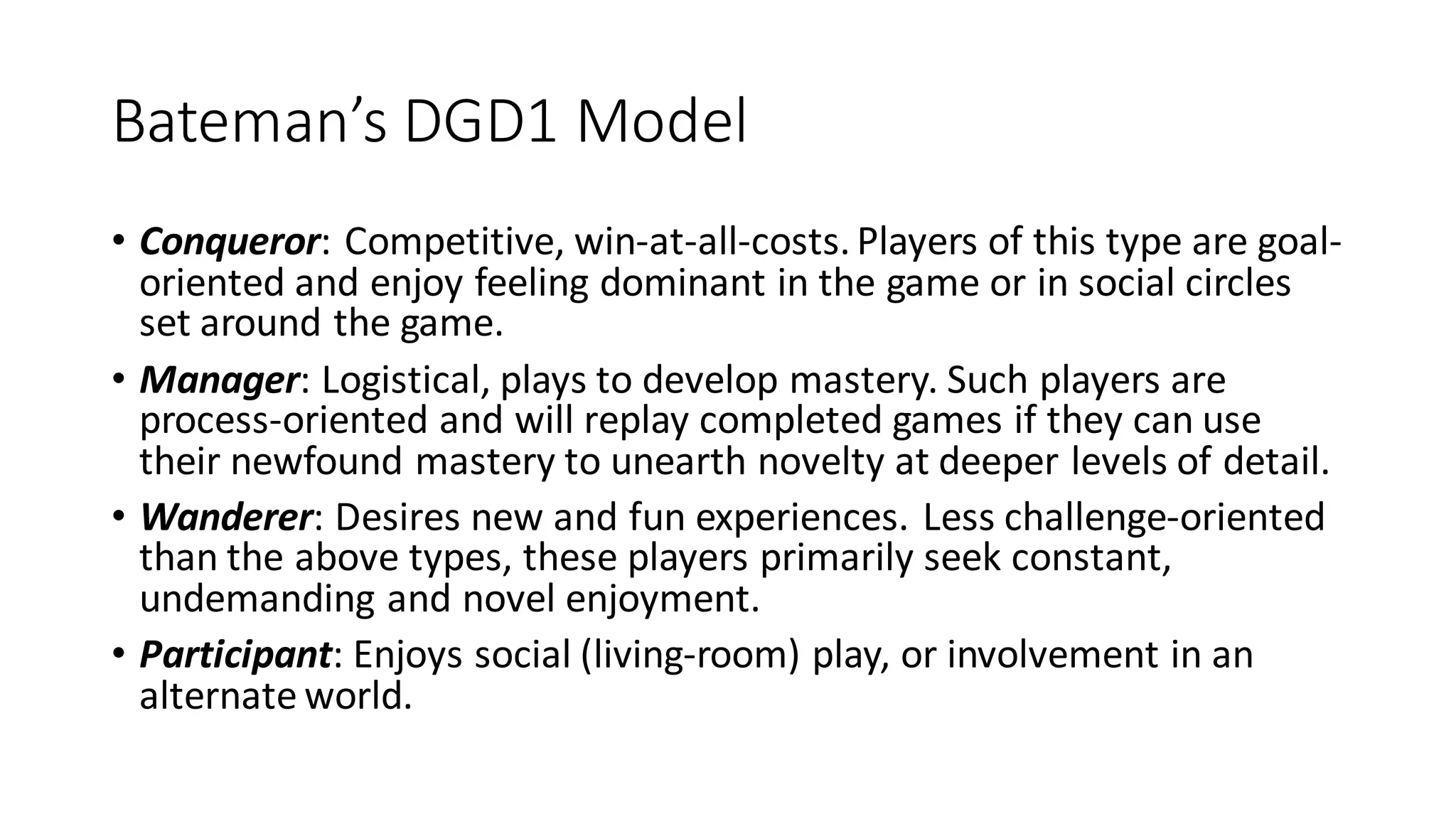
Bateman’s DGD1 Model 
•Conqueror: Competitive, win-at-all-costs. Players of this type are goal- oriented and enjoy feeling dominant in the game or in social circles set around the game. 
•Manager: Logistical, plays to develop mastery. Such players are process-oriented and will replay completed games if they can use their newfound mastery to unearth novelty at deeper levels of detail. 
•Wanderer: Desires new and fun experiences. Less challenge-oriented than the above types, these players primarily seek constant, undemanding and novel enjoyment. 
•Participant: Enjoys social (living-room) play, or involvement in an alternate world.
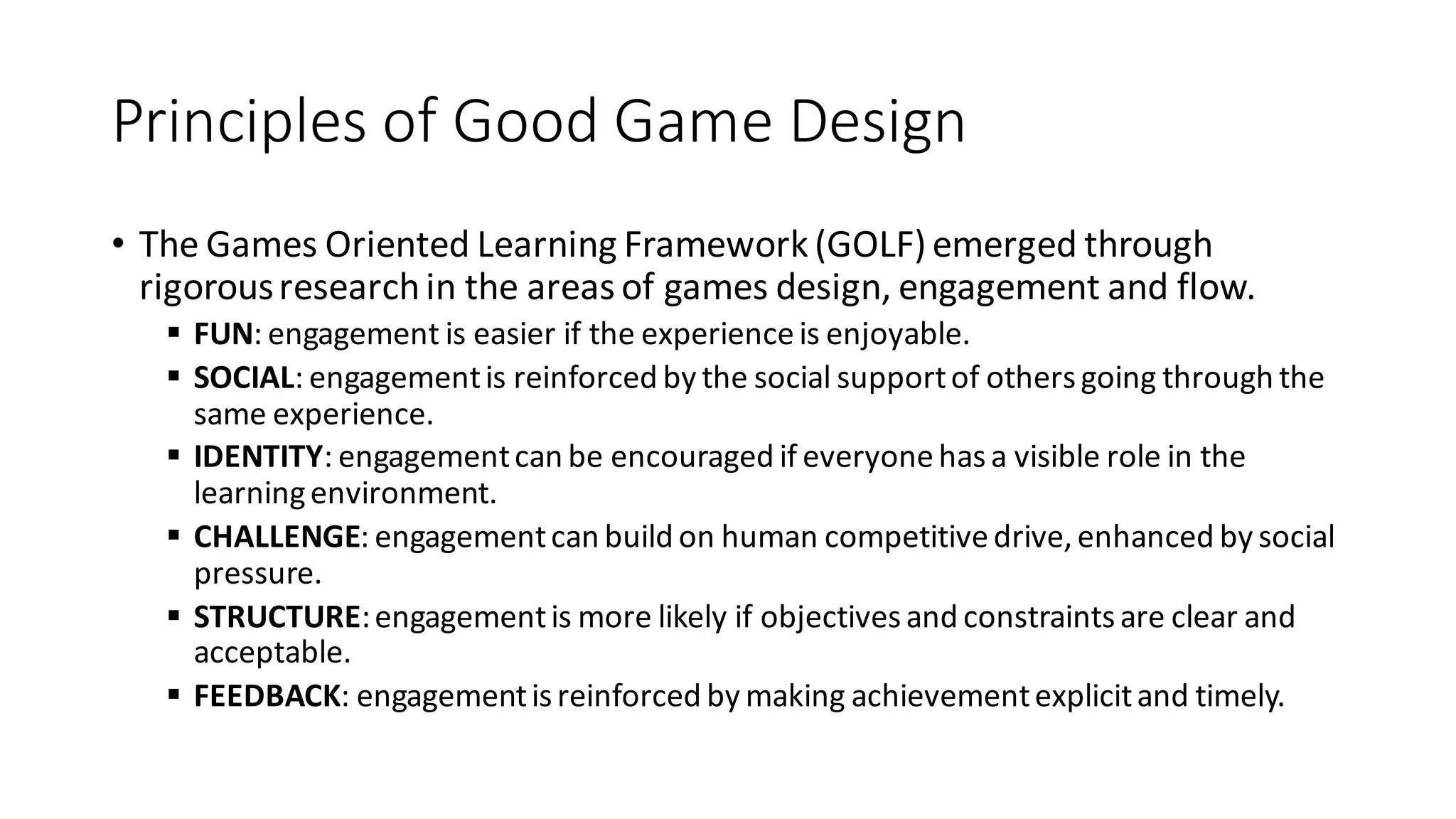
Principles of Good Game Design 
•The Games Oriented Learning Framework (GOLF) emerged through rigorous research in the areas of games design, engagement and flow. 
FUN: engagement is easier if the experience is enjoyable. 
SOCIAL: engagement is reinforced by the social support of others going through the same experience. 
IDENTITY: engagement can be encouraged if everyone has a visible role in the learning environment. 
CHALLENGE: engagement can build on human competitive drive, enhanced by social pressure. 
STRUCTURE: engagement is more likely if objectives and constraints are clear and acceptable. 
FEEDBACK: engagement is reinforced by making achievement explicit and timely.
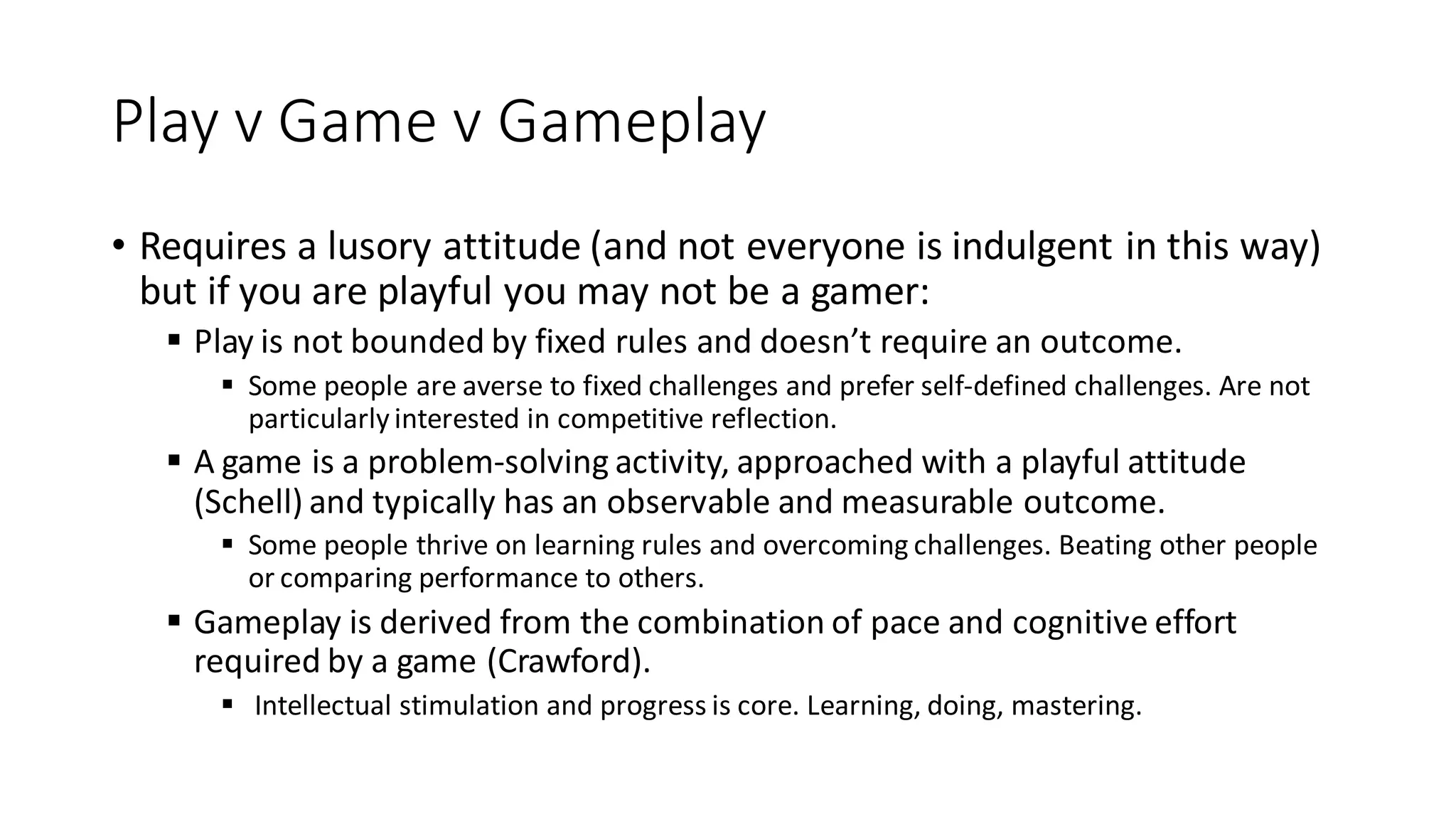
Play v Game v Gameplay 
•Requires a lusory attitude (and not everyone is indulgent in this way) but if you are playful you may not be a gamer: 
Play is not bounded by fixed rules and doesn’t require an outcome. 
Some people are averse to fixed challenges and prefer self-defined challenges. Are not particularly interested in competitive reflection. 
A game is a problem-solving activity, approached with a playful attitude (Schell) and typically has an observable and measurable outcome. 
Some people thrive on learning rules and overcoming challenges. Beating other people or comparing performance to others. 
Gameplay is derived from the combination of pace and cognitive effort required by a game (Crawford). 
 Intellectual stimulation and progress is core. Learning, doing, mastering.
What is Gamification? 
•“Gamification takes inspiration from commercial game elements, design patterns and metaphors in order to improve the design of non-game systems to positively influence behaviour, enhance engagement, and motivate people to achieve their goals. Facilitate experiences with positive emotions. 
•Much of the core gamification ideas are rooted in psychology and in the simplest form resembles customer reward schemes. 
•At its most effective gamification harnesses inherent, intrinsic motivation of users and is built on more complex processes than just reinforcement learning.
Tale of Two Gamifications 
•Influence – what we want people to do and be like 
Rewards and techniques focusing on extrinsic motivation. 
Tasks and processes that are deemed important but are not a particular internal desire for the user. 
Getting started, being consistent. E.g. Attendance for students. 
Can scaffold more important emergent behaviours. 
•Support – what people want to do and be like 
Rewards and techniques focusing on intrinsic motivation. 
Tasks and processes lending themselves directly to outcomes that the user inherently desires. 
Learning, learning how to learn. Knowing and capability of doing. 
Frequently more complex and process oriented. Related to learning theories.
What Really Engages? RAMP 
•Self-determinism and intrinsic motivation 
Relatedness (social factors), 
Autonomy (choice and freedom), 
Mastery (learning/achievement) and 
Purpose (meaning and knowing why)
Gamification Typology Experiment 
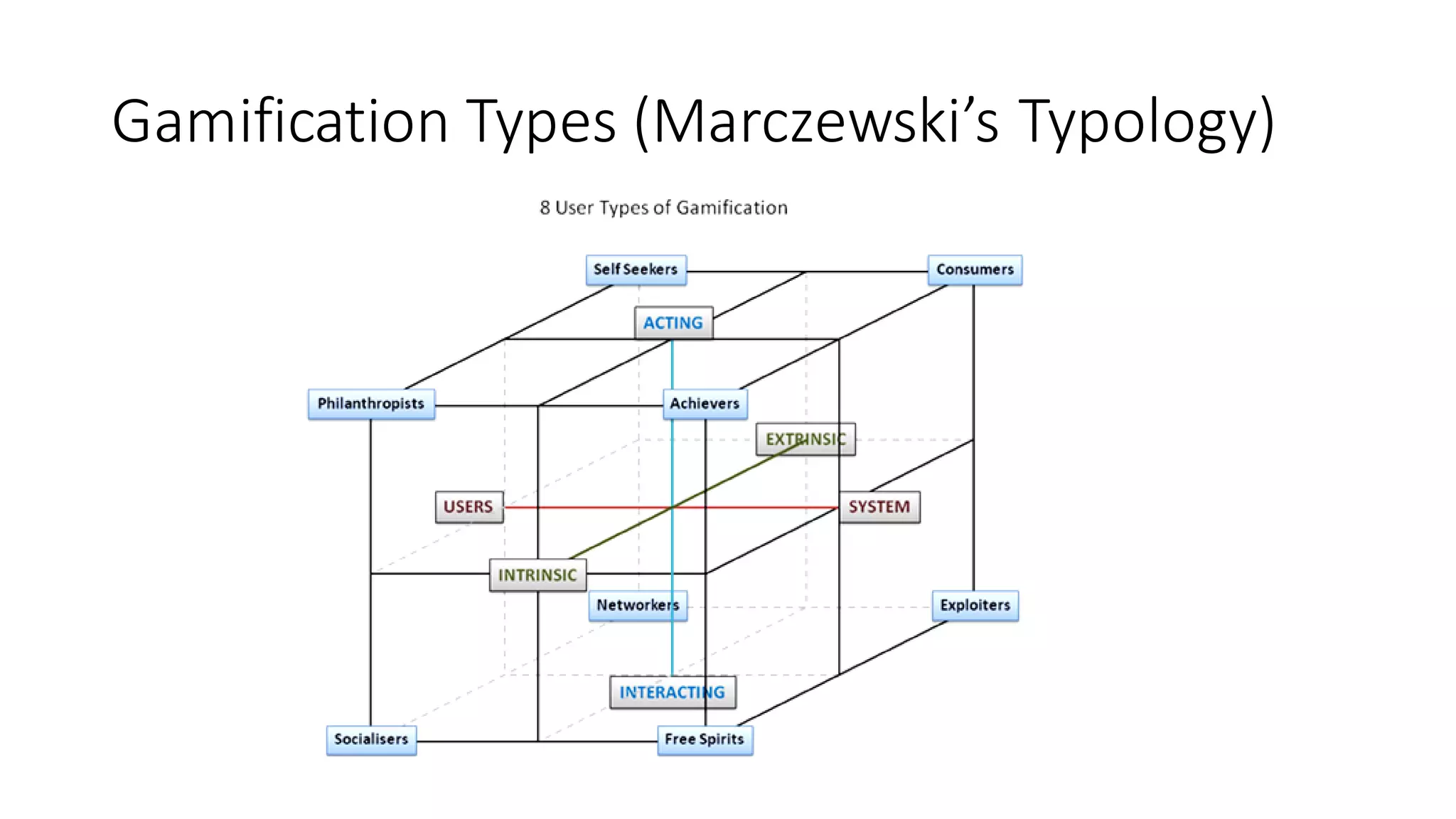
•Investigate variation in learner gamification profiles using Marczewski’s gamification typology as a model for motivation. 
•Context. 
•Two 2nd year computing degree modules (68 students co-enrolled). Web and games based topics. 
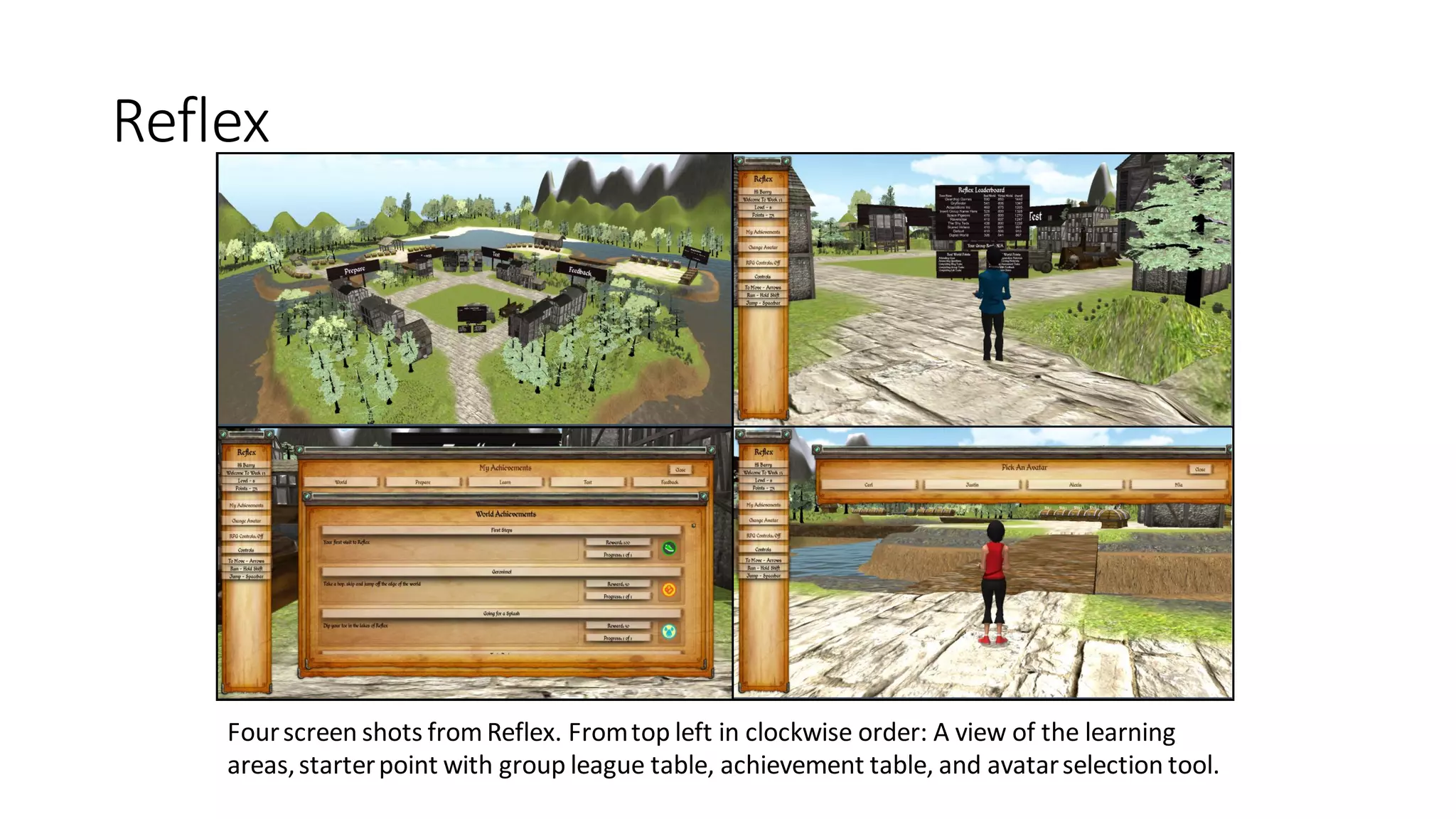
•We created a virtual world, Reflex, for the students to access content and receive feedback. The 3D world was important to the gamification process. 
•The teaching mode for the games module was chosen with gamification in mind, whereas the web module had a very traditional format.
Reflex 
Four screen shots from Reflex. From top left in clockwise order: A view of the learning 
areas, starter point with group league table, achievement table, and avatar selection tool.
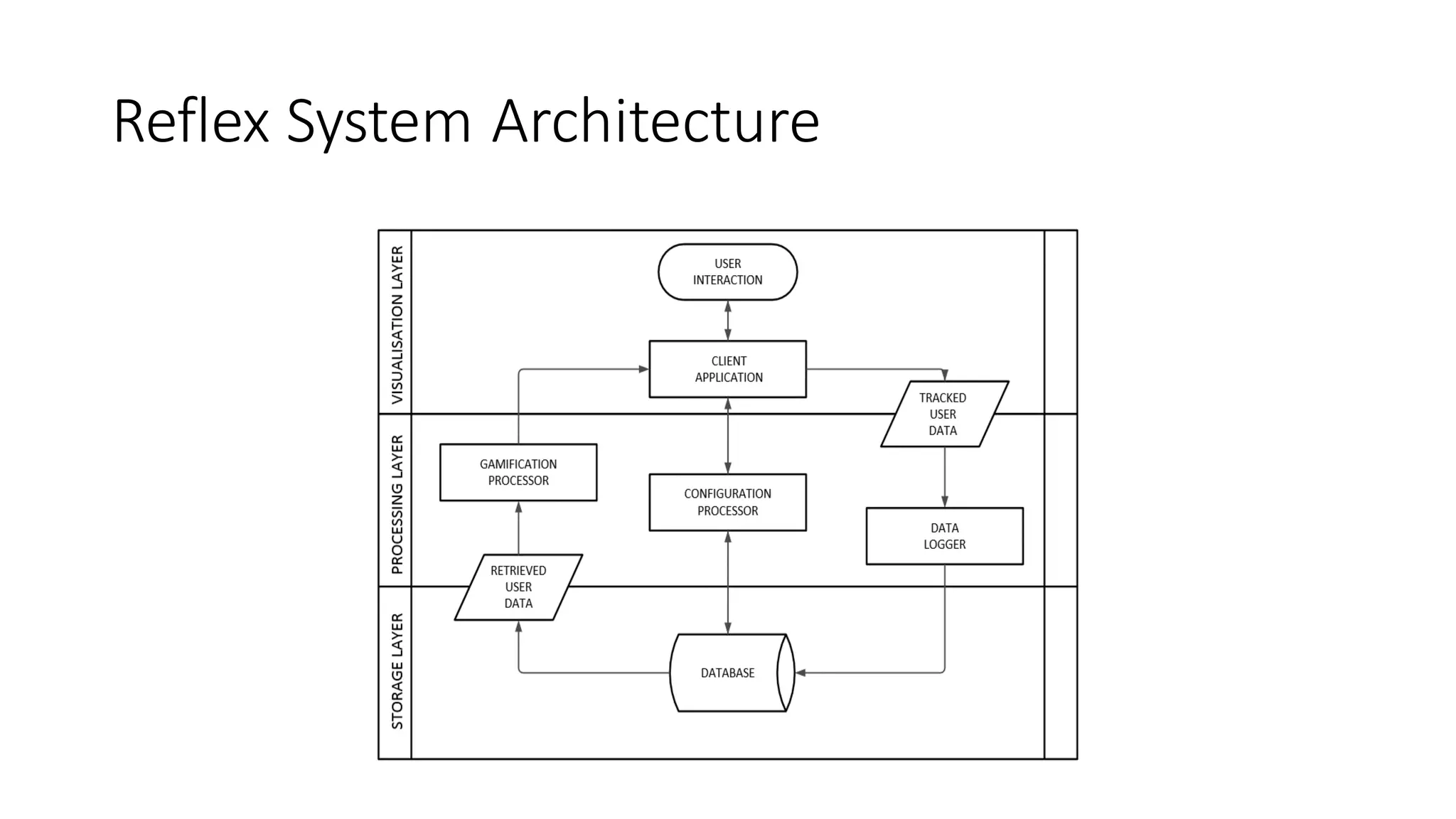
Reflex System Architecture
Motivation for a Virtual World 
•Offers richer opportunities for agency (embodiment) and situated learning. 
•A learners avatar and the world (over time) can become a representation of their learning state. 
•Gamification features utilising aspects such as exploration and socialising are more literal in a virtual world. 
•A 3D space can topographically represent the relationship between learning content (difficult, progression etc.) and visually (and physically) present a pedagogical learning process. 
•Landscape provides guidance 
•Landscape supplies feedback 
•Learners can be tracked through virtual learning landscape and heat and trajectory maps subsequently utilised for analysis
Mixed Methods Approach - Convergent Parallel Design 
Student preferences 
–Ask students to complete a questionnaire designed to gauge their gamification preference on the basis of how they say they are motivated. 
–Summarise and analyse student profiles. 
–Perform exploratory data analysis to attempt to uncover more complex typologies based on statistical relationships between the gamification attributes of the learner profiles. 
Student behaviour 
–Track actual student behaviour: actions and trajectories in the virtual world. 
–Summarise and analyse the effect of gamification on behaviour based on actions and trajectories. 
Preferences v Behaviour 
–Investigate how well student preferences map to actual behaviour. 
–Outcome from this analysis has the potential the recommendation (or at guidelines on) a gamification typology model based on behaviours alone (ideally eliminating the need for a questionnaire).
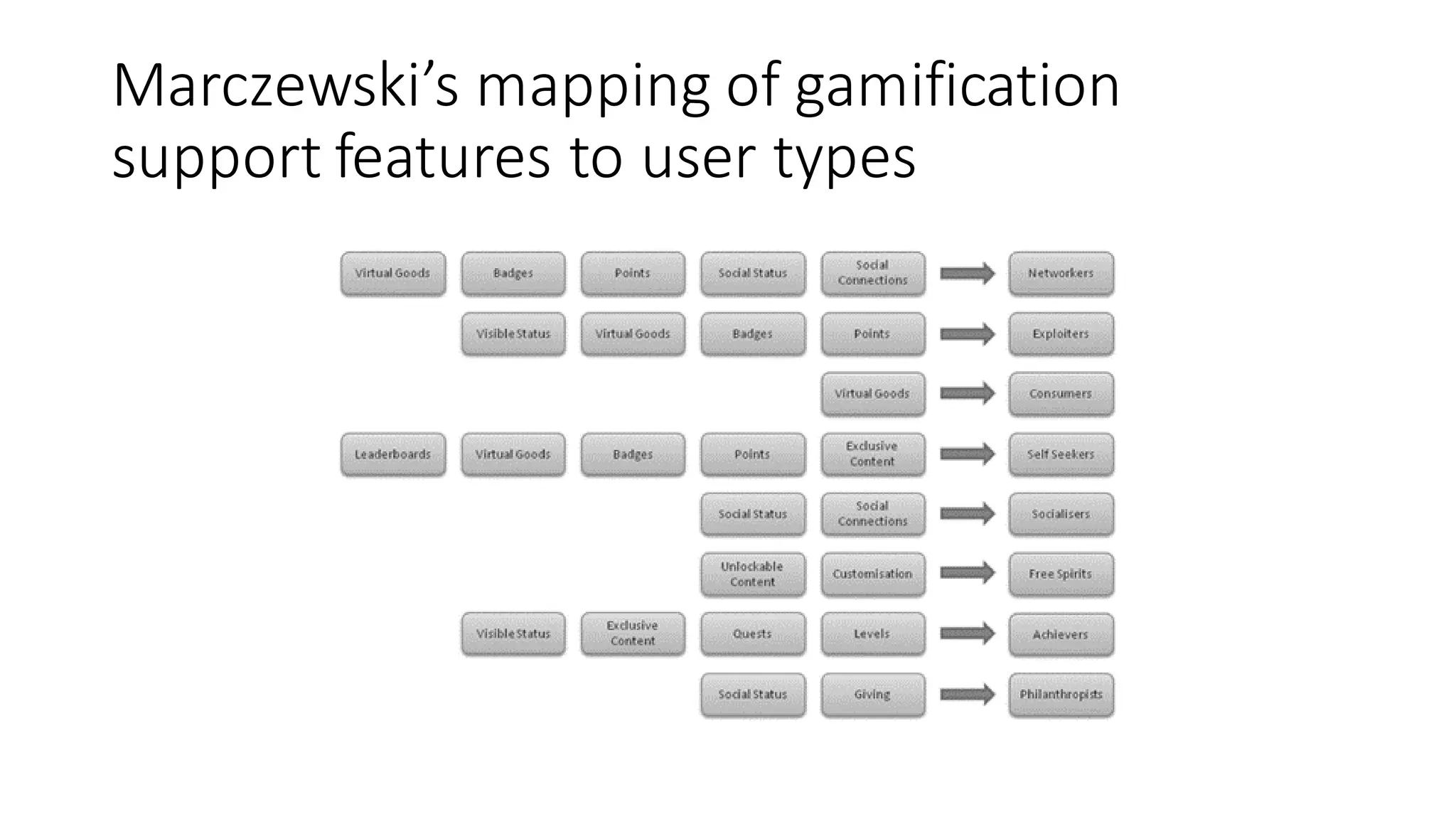
Gamification Types (Marczewski’s Typology)
Marczewski’s mapping of gamification support features to user types
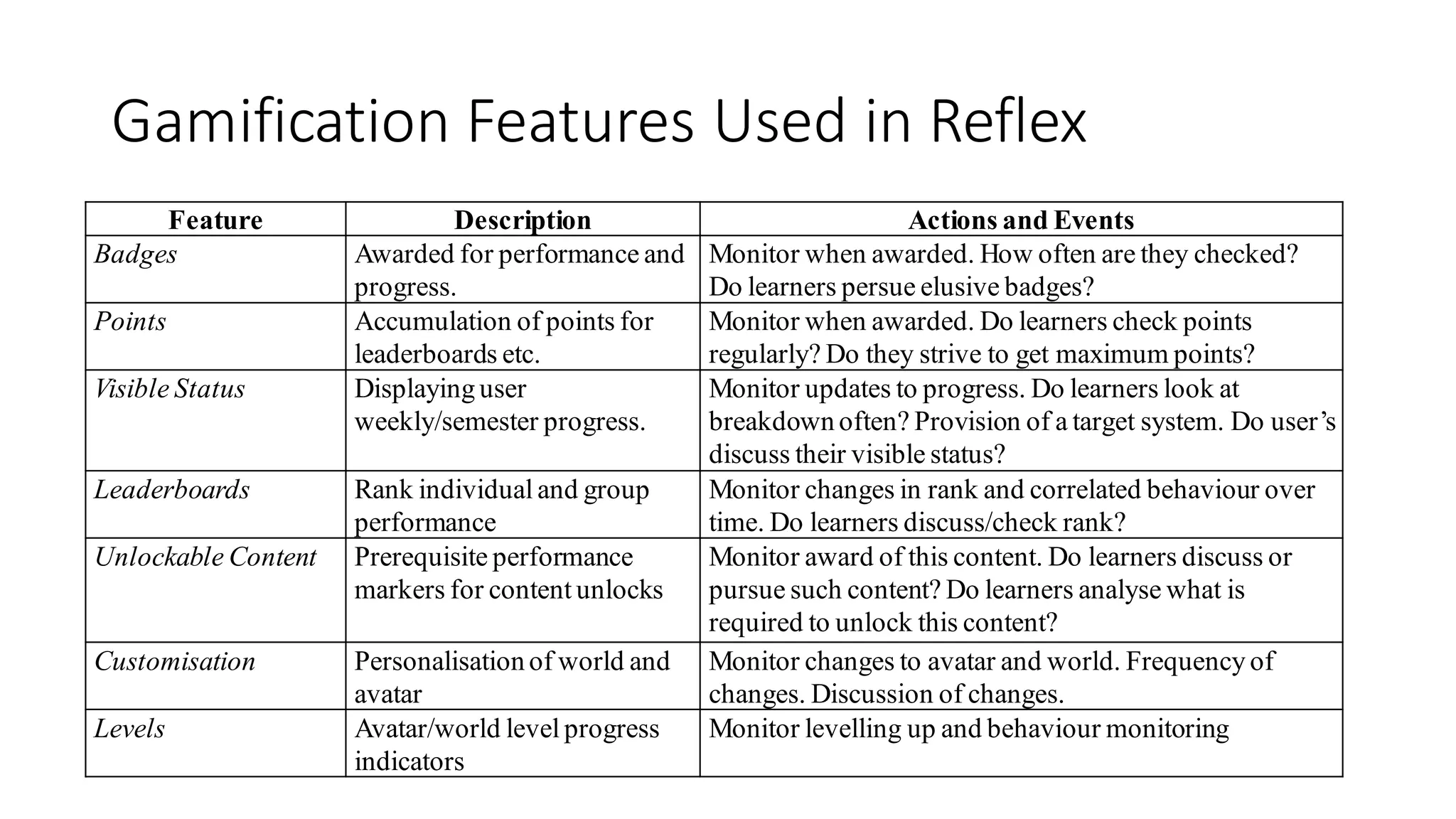
Gamification Features Used in Reflex 
Feature 
Description 
Actions and Events 
Badges 
Awarded for performance and progress. 
Monitor when awarded. How often are they checked? Do learners persue elusive badges? 
Points 
Accumulation of points for leaderboards etc. 
Monitor when awarded. Do learners check points regularly? Do they strive to get maximum points? 
Visible Status 
Displaying user weekly/semester progress. 
Monitor updates to progress. Do learners look at breakdown often? Provision of a target system. Do user’s discuss their visible status? 
Leaderboards 
Rank individual and group performance 
Monitor changes in rank and correlated behaviour over time. Do learners discuss/check rank? 
Unlockable Content 
Prerequisite performance markers for content unlocks 
Monitor award of this content. Do learners discuss or pursue such content? Do learners analyse what is required to unlock this content? 
Customisation 
Personalisation of world and avatar 
Monitor changes to avatar and world. Frequency of changes. Discussion of changes. 
Levels 
Avatar/world level progress indicators 
Monitor levelling up and behaviour monitoring
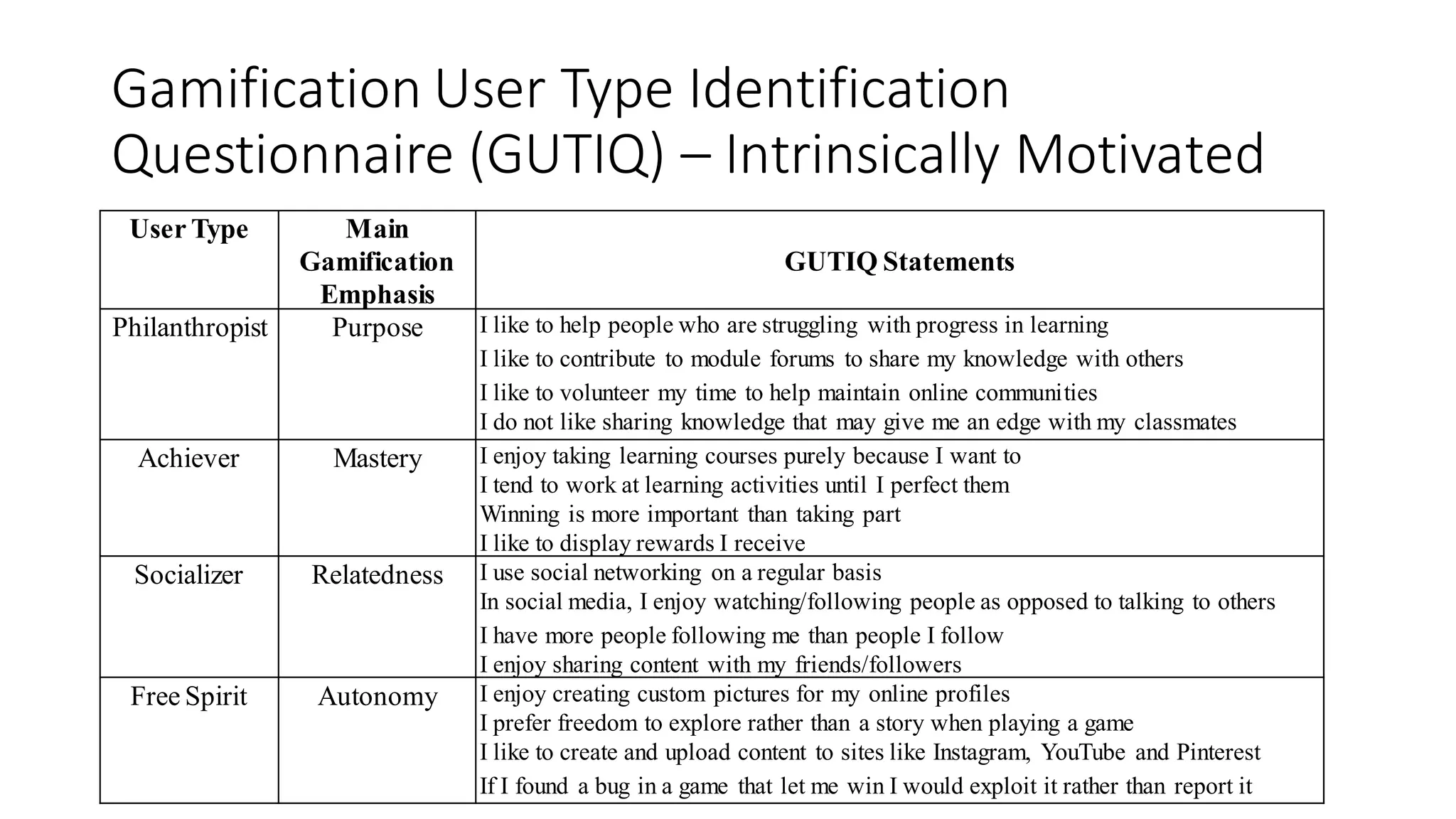
Gamification User Type Identification Questionnaire (GUTIQ) – Intrinsically Motivated 
User Type 
Main Gamification Emphasis 
GUTIQ Statements 
Philanthropist 
Purpose 
I like to help people who are struggling with progress in learning 
I like to contribute to module forums to share my knowledge with others 
I like to volunteer my time to help maintain online communities 
I do not like sharing knowledge that may give me an edge with my classmates 
Achiever 
Mastery 
I enjoy taking learning courses purely because I want to 
I tend to work at learning activities until I perfect them 
Winning is more important than taking part 
I like to display rewards I receive 
Socializer 
Relatedness 
I use social networking on a regular basis 
In social media, I enjoy watching/following people as opposed to talking to others 
I have more people following me than people I follow 
I enjoy sharing content with my friends/followers 
Free Spirit 
Autonomy 
I enjoy creating custom pictures for my online profiles 
I prefer freedom to explore rather than a story when playing a game 
I like to create and upload content to sites like Instagram, YouTube and Pinterest 
If I found a bug in a game that let me win I would exploit it rather than report it
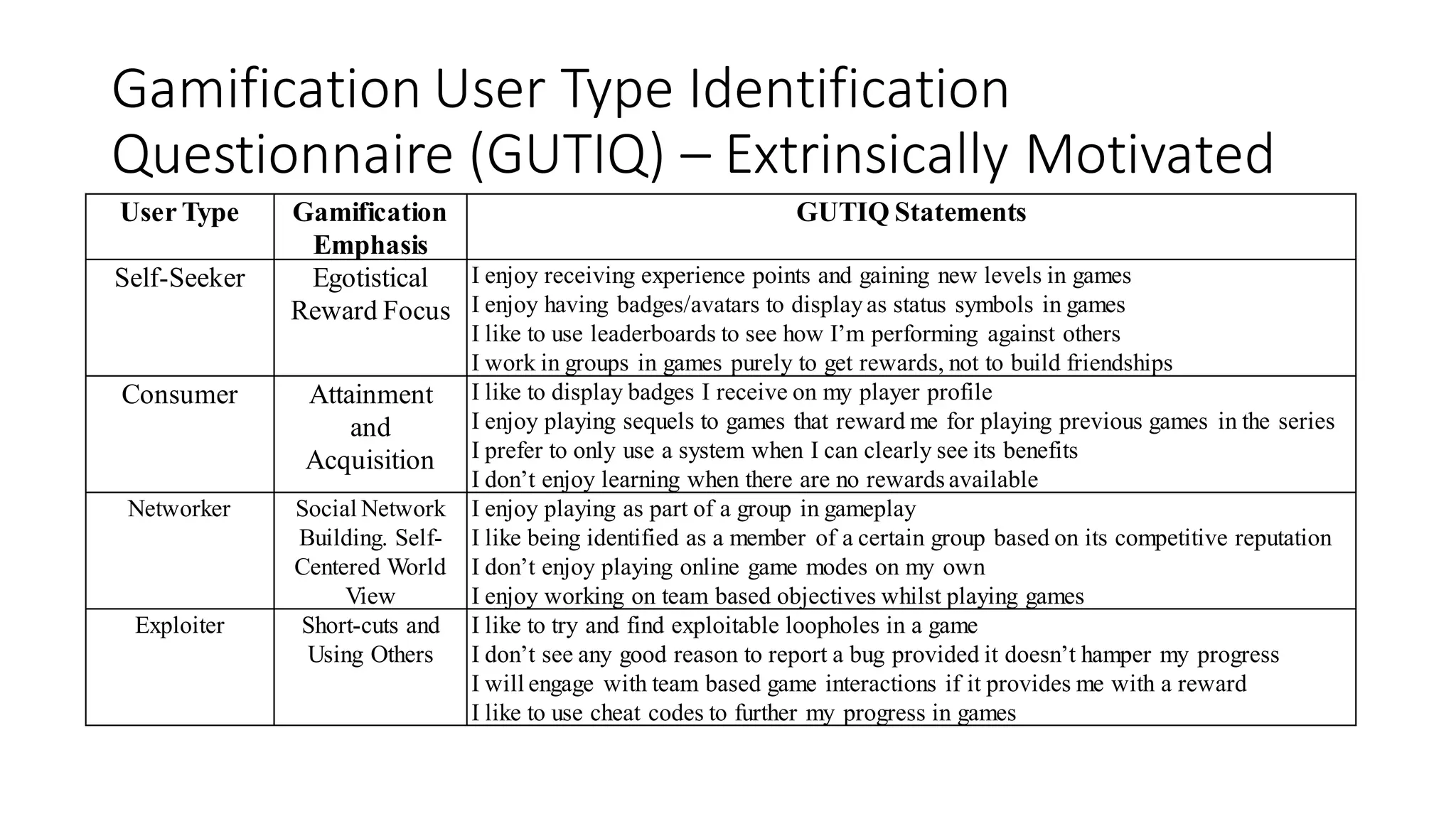
Gamification User Type Identification Questionnaire (GUTIQ) – Extrinsically Motivated 
User Type 
Gamification Emphasis 
GUTIQ Statements 
Self-Seeker 
Egotistical Reward Focus 
I enjoy receiving experience points and gaining new levels in games 
I enjoy having badges/avatars to display as status symbols in games 
I like to use leaderboards to see how I’m performing against others 
I work in groups in games purely to get rewards, not to build friendships 
Consumer 
Attainment and Acquisition 
I like to display badges I receive on my player profile 
I enjoy playing sequels to games that reward me for playing previous games in the series 
I prefer to only use a system when I can clearly see its benefits 
I don’t enjoy learning when there are no rewards available 
Networker 
Social Network Building. Self- Centered World View 
I enjoy playing as part of a group in gameplay 
I like being identified as a member of a certain group based on its competitive reputation 
I don’t enjoy playing online game modes on my own 
I enjoy working on team based objectives whilst playing games 
Exploiter 
Short-cuts and Using Others 
I like to try and find exploitable loopholes in a game 
I don’t see any good reason to report a bug provided it doesn’t hamper my progress 
I will engage with team based game interactions if it provides me with a reward 
I like to use cheat codes to further my progress in games
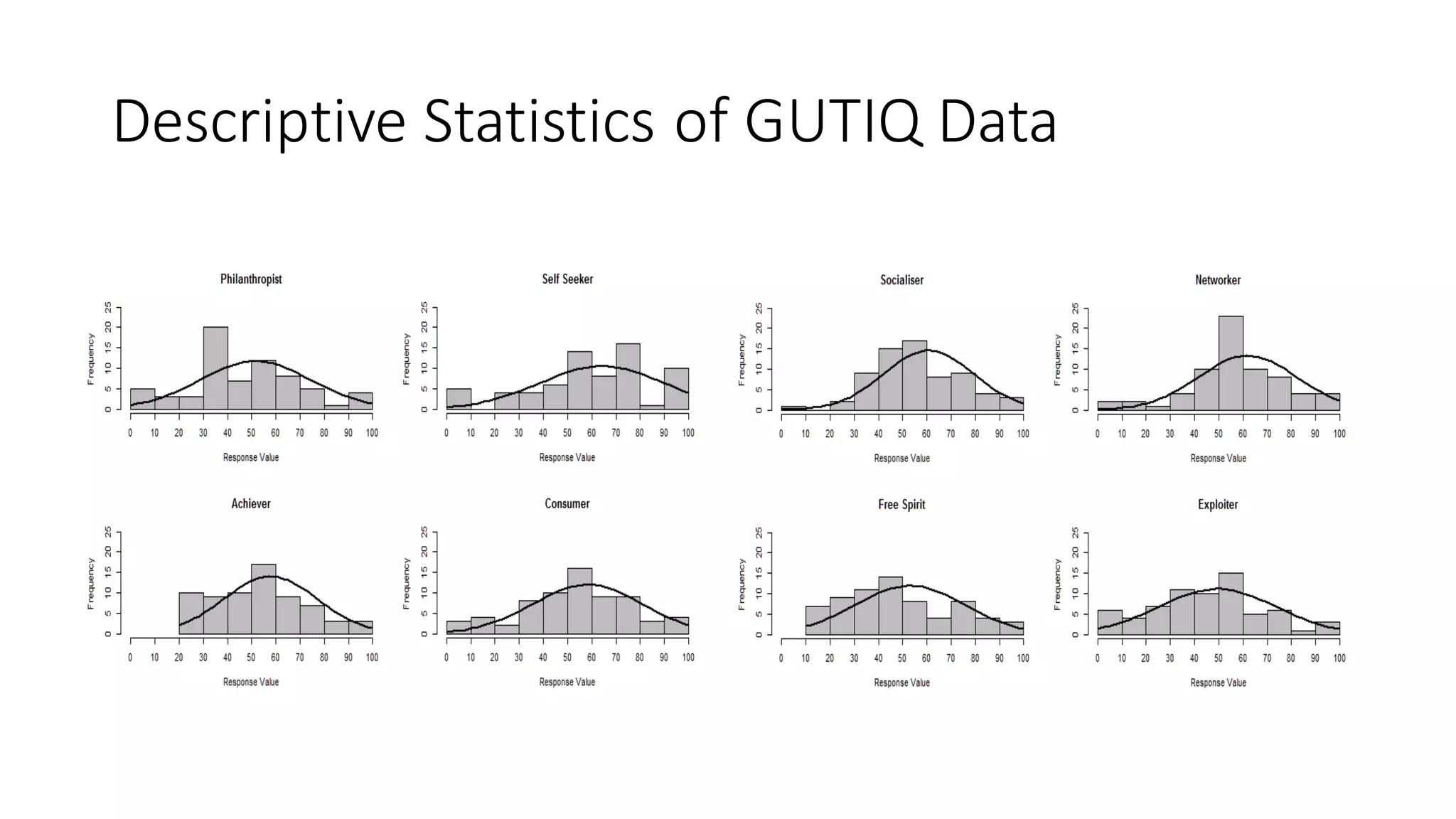
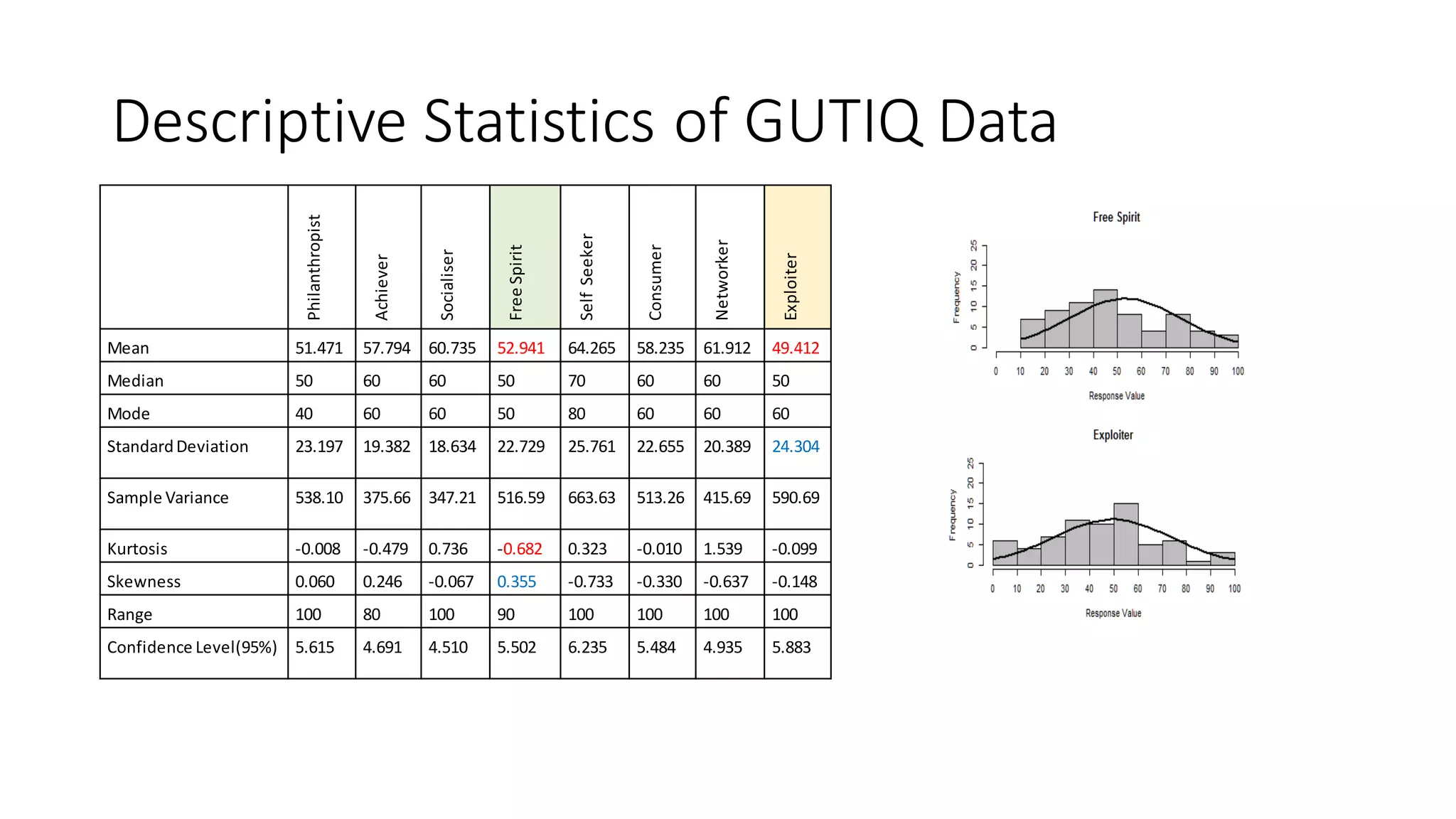
Descriptive Statistics of GUTIQ Data
Descriptive Statistics of GUTIQ Data 
Philanthropist 
Achiever 
Socialiser 
Free Spirit 
Self Seeker 
Consumer 
Networker 
Exploiter 
Mean 
51.471 
57.794 
60.735 
52.941 
64.265 
58.235 
61.912 
49.412 
Median 
50 
60 
60 
50 
70 
60 
60 
50 
Mode 
40 
60 
60 
50 
80 
60 
60 
60 
Standard Deviation 
23.197 
19.382 
18.634 
22.729 
25.761 
22.655 
20.389 
24.304 
Sample Variance 
538.10 
375.66 
347.21 
516.59 
663.63 
513.26 
415.69 
590.69 
Kurtosis 
-0.008 
-0.479 
0.736 
-0.682 
0.323 
-0.010 
1.539 
-0.099 
Skewness 
0.060 
0.246 
-0.067 
0.355 
-0.733 
-0.330 
-0.637 
-0.148 
Range 
100 
80 
100 
90 
100 
100 
100 
100 
Confidence Level(95%) 
5.615 
4.691 
4.510 
5.502 
6.235 
5.484 
4.935 
5.883
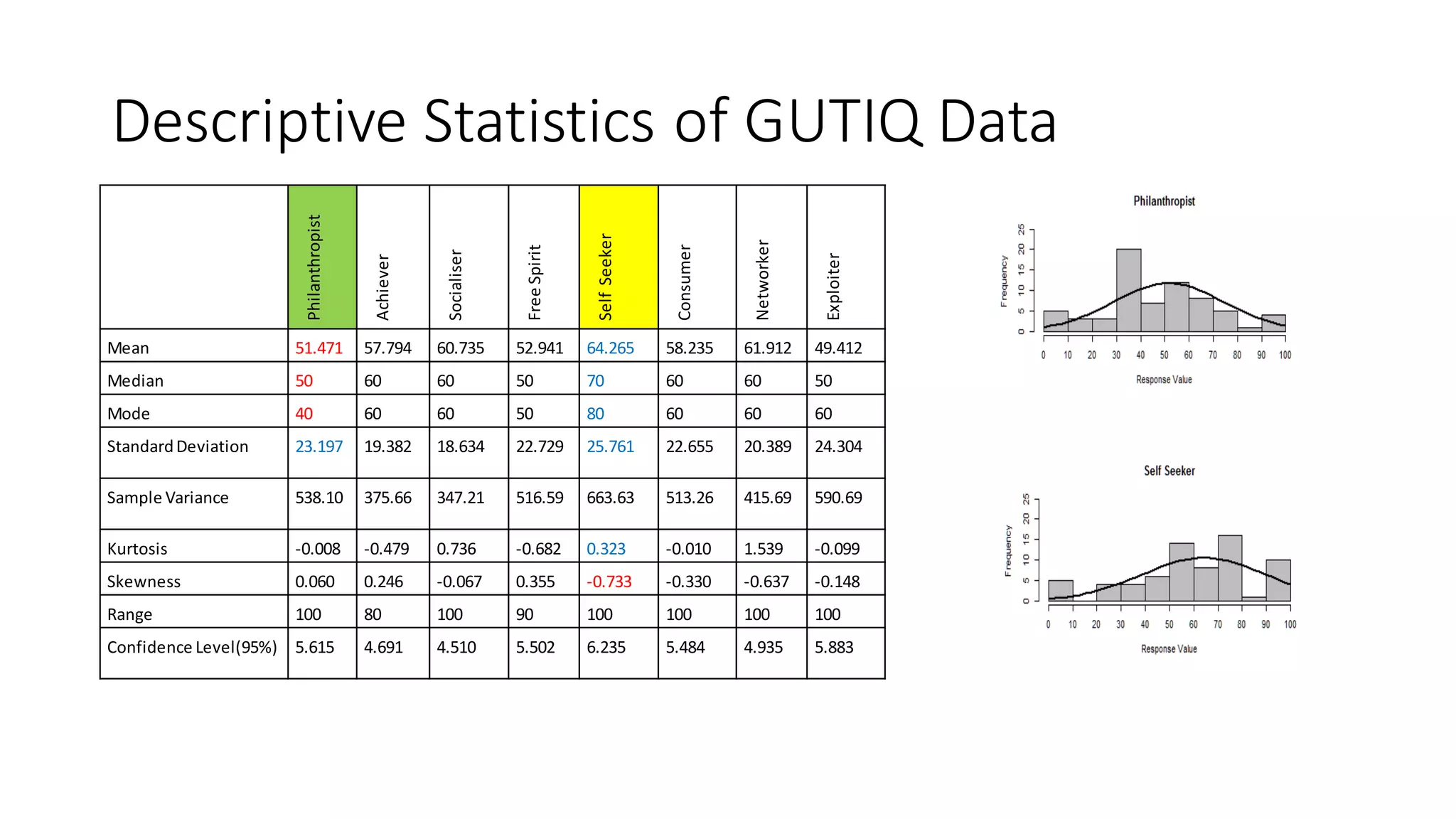
Descriptive Statistics of GUTIQ Data 
Philanthropist 
Achiever 
Socialiser 
Free Spirit 
Self Seeker 
Consumer 
Networker 
Exploiter 
Mean 
51.471 
57.794 
60.735 
52.941 
64.265 
58.235 
61.912 
49.412 
Median 
50 
60 
60 
50 
70 
60 
60 
50 
Mode 
40 
60 
60 
50 
80 
60 
60 
60 
Standard Deviation 
23.197 
19.382 
18.634 
22.729 
25.761 
22.655 
20.389 
24.304 
Sample Variance 
538.10 
375.66 
347.21 
516.59 
663.63 
513.26 
415.69 
590.69 
Kurtosis 
-0.008 
-0.479 
0.736 
-0.682 
0.323 
-0.010 
1.539 
-0.099 
Skewness 
0.060 
0.246 
-0.067 
0.355 
-0.733 
-0.330 
-0.637 
-0.148 
Range 
100 
80 
100 
90 
100 
100 
100 
100 
Confidence Level(95%) 
5.615 
4.691 
4.510 
5.502 
6.235 
5.484 
4.935 
5.883
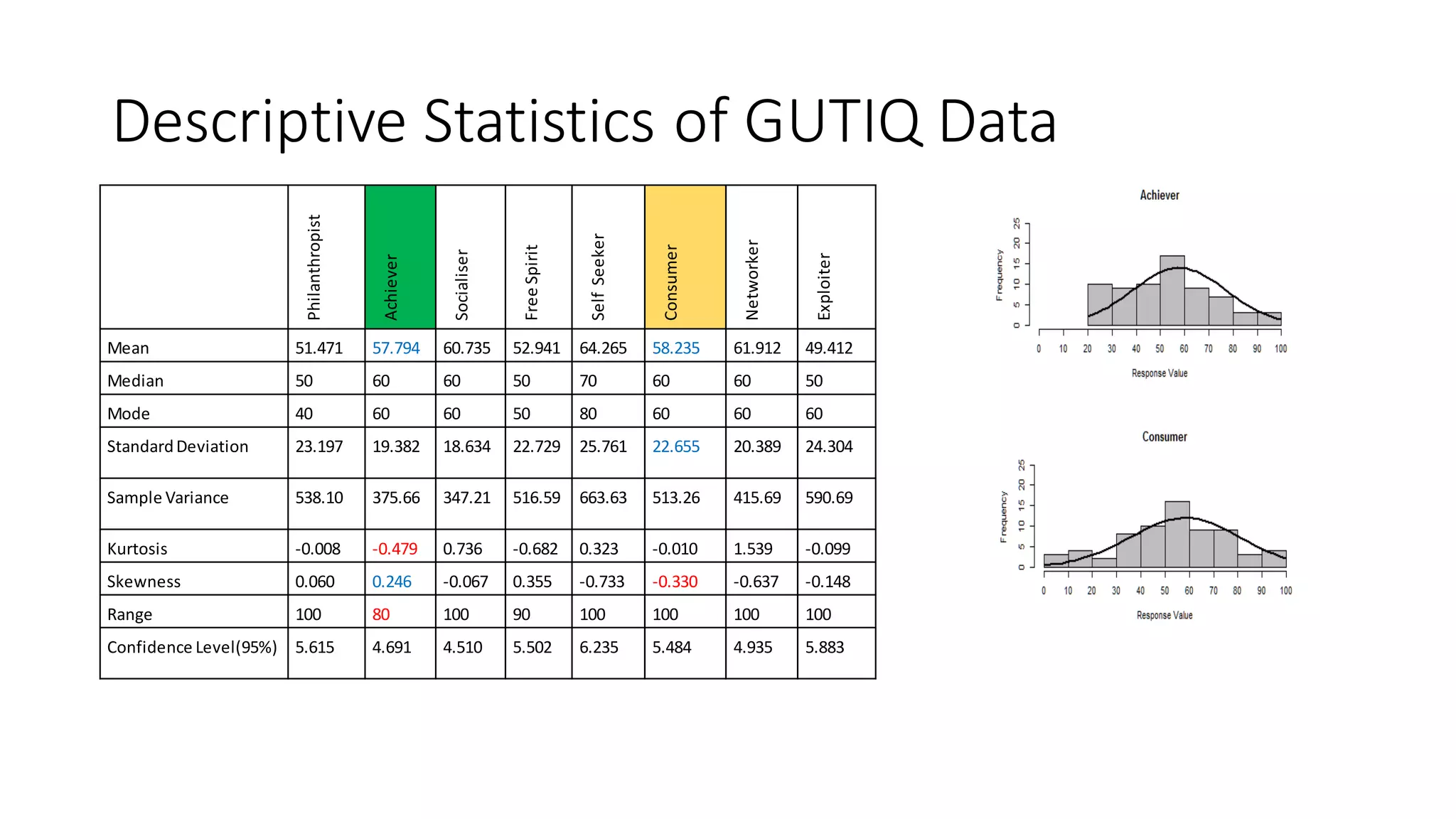
Descriptive Statistics of GUTIQ Data 
Philanthropist 
Achiever 
Socialiser 
Free Spirit 
Self Seeker 
Consumer 
Networker 
Exploiter 
Mean 
51.471 
57.794 
60.735 
52.941 
64.265 
58.235 
61.912 
49.412 
Median 
50 
60 
60 
50 
70 
60 
60 
50 
Mode 
40 
60 
60 
50 
80 
60 
60 
60 
Standard Deviation 
23.197 
19.382 
18.634 
22.729 
25.761 
22.655 
20.389 
24.304 
Sample Variance 
538.10 
375.66 
347.21 
516.59 
663.63 
513.26 
415.69 
590.69 
Kurtosis 
-0.008 
-0.479 
0.736 
-0.682 
0.323 
-0.010 
1.539 
-0.099 
Skewness 
0.060 
0.246 
-0.067 
0.355 
-0.733 
-0.330 
-0.637 
-0.148 
Range 
100 
80 
100 
90 
100 
100 
100 
100 
Confidence Level(95%) 
5.615 
4.691 
4.510 
5.502 
6.235 
5.484 
4.935 
5.883
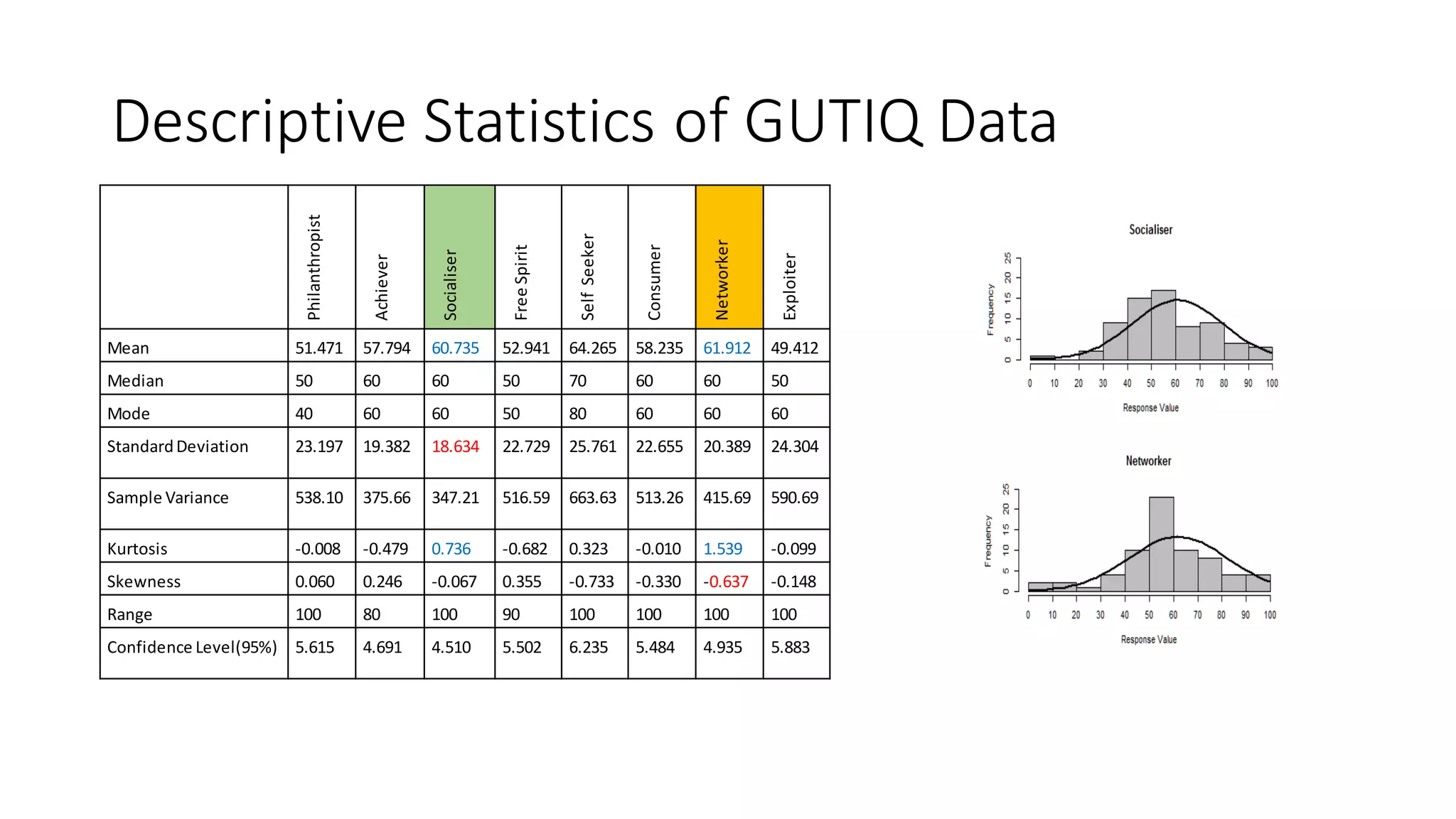
Descriptive Statistics of GUTIQ Data 
Philanthropist 
Achiever 
Socialiser 
Free Spirit 
Self Seeker 
Consumer 
Networker 
Exploiter 
Mean 
51.471 
57.794 
60.735 
52.941 
64.265 
58.235 
61.912 
49.412 
Median 
50 
60 
60 
50 
70 
60 
60 
50 
Mode 
40 
60 
60 
50 
80 
60 
60 
60 
Standard Deviation 
23.197 
19.382 
18.634 
22.729 
25.761 
22.655 
20.389 
24.304 
Sample Variance 
538.10 
375.66 
347.21 
516.59 
663.63 
513.26 
415.69 
590.69 
Kurtosis 
-0.008 
-0.479 
0.736 
-0.682 
0.323 
-0.010 
1.539 
-0.099 
Skewness 
0.060 
0.246 
-0.067 
0.355 
-0.733 
-0.330 
-0.637 
-0.148 
Range 
100 
80 
100 
90 
100 
100 
100 
100 
Confidence Level(95%) 
5.615 
4.691 
4.510 
5.502 
6.235 
5.484 
4.935 
5.883
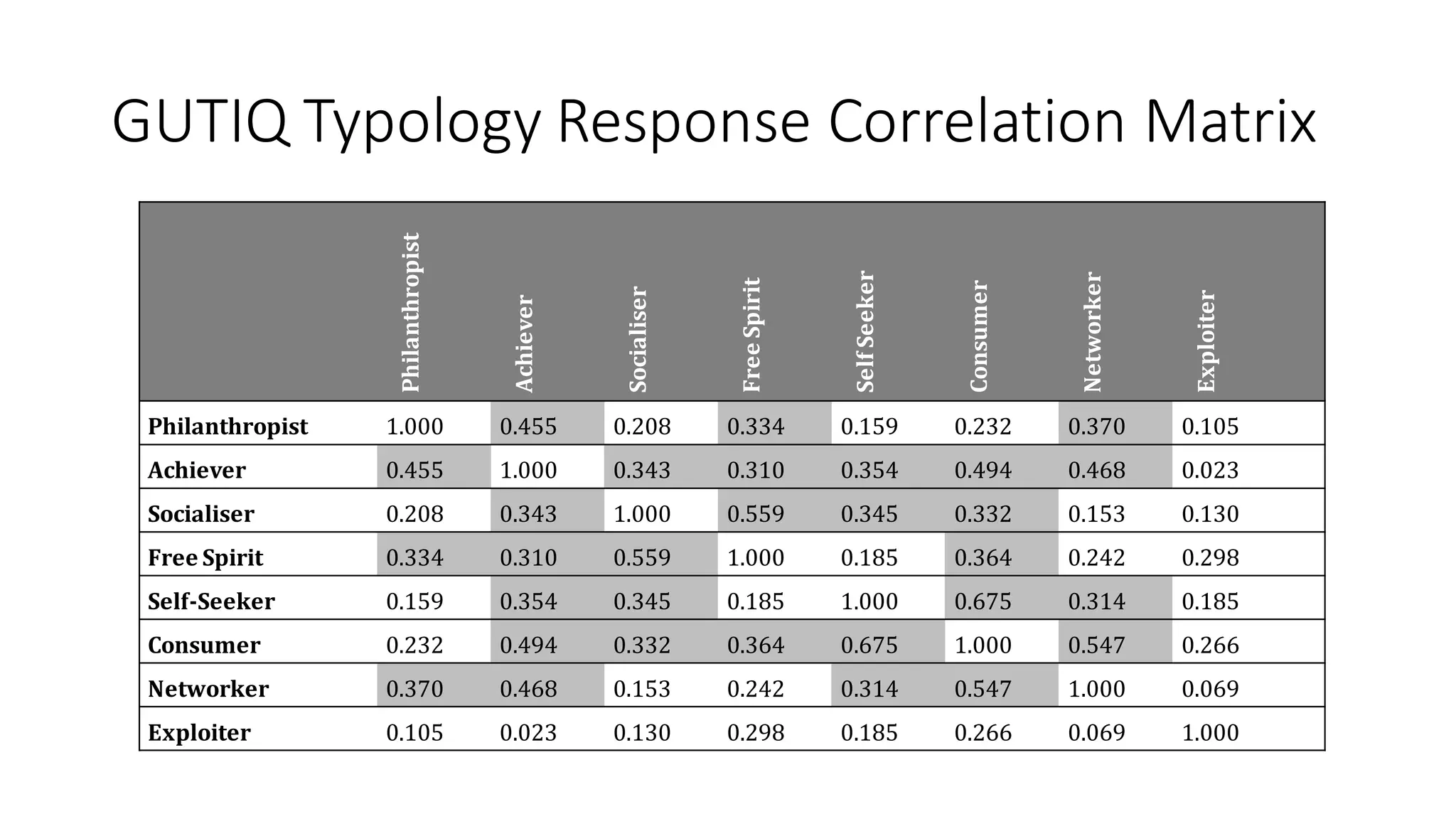
GUTIQ Typology Response Correlation Matrix 
Philanthropist 
Achiever 
Socialiser 
Free Spirit 
Self Seeker 
Consumer 
Networker 
Exploiter 
Philanthropist 
1.000 
0.455 
0.208 
0.334 
0.159 
0.232 
0.370 
0.105 
Achiever 
0.455 
1.000 
0.343 
0.310 
0.354 
0.494 
0.468 
0.023 
Socialiser 
0.208 
0.343 
1.000 
0.559 
0.345 
0.332 
0.153 
0.130 
Free Spirit 
0.334 
0.310 
0.559 
1.000 
0.185 
0.364 
0.242 
0.298 
Self-Seeker 
0.159 
0.354 
0.345 
0.185 
1.000 
0.675 
0.314 
0.185 
Consumer 
0.232 
0.494 
0.332 
0.364 
0.675 
1.000 
0.547 
0.266 
Networker 
0.370 
0.468 
0.153 
0.242 
0.314 
0.547 
1.000 
0.069 
Exploiter 
0.105 
0.023 
0.130 
0.298 
0.185 
0.266 
0.069 
1.000
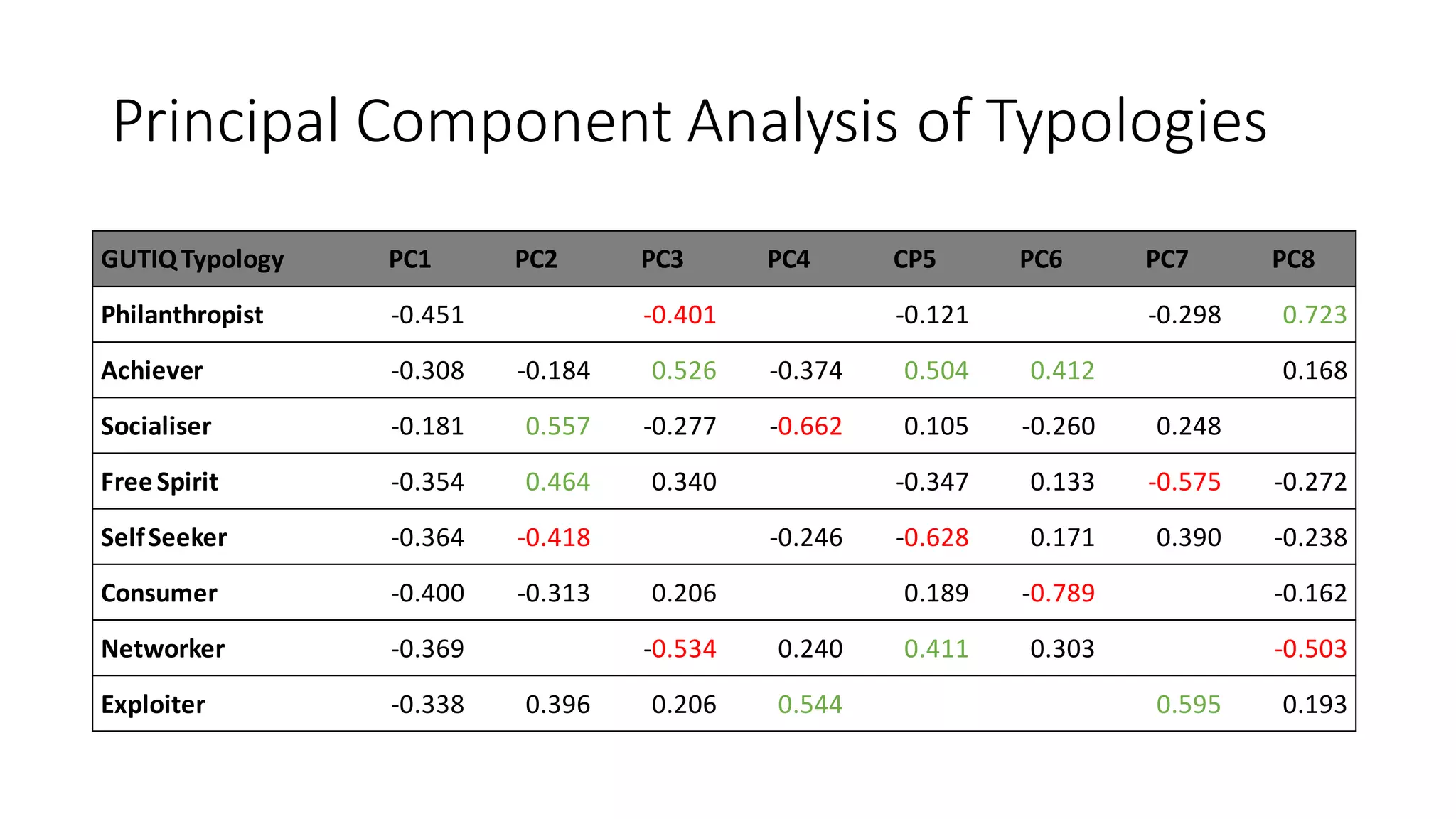
Principal Component Analysis of Typologies 
GUTIQ Typology 
PC1 
PC2 
PC3 
PC4 
CP5 
PC6 
PC7 
PC8 
Philanthropist 
-0.451 
-0.401 
-0.121 
-0.298 
0.723 
Achiever 
-0.308 
-0.184 
0.526 
-0.374 
0.504 
0.412 
0.168 
Socialiser 
-0.181 
0.557 
-0.277 
-0.662 
0.105 
-0.260 
0.248 
Free Spirit 
-0.354 
0.464 
0.340 
-0.347 
0.133 
-0.575 
-0.272 
Self Seeker 
-0.364 
-0.418 
-0.246 
-0.628 
0.171 
0.390 
-0.238 
Consumer 
-0.400 
-0.313 
0.206 
0.189 
-0.789 
-0.162 
Networker 
-0.369 
-0.534 
0.240 
0.411 
0.303 
-0.503 
Exploiter 
-0.338 
0.396 
0.206 
0.544 
0.595 
0.193
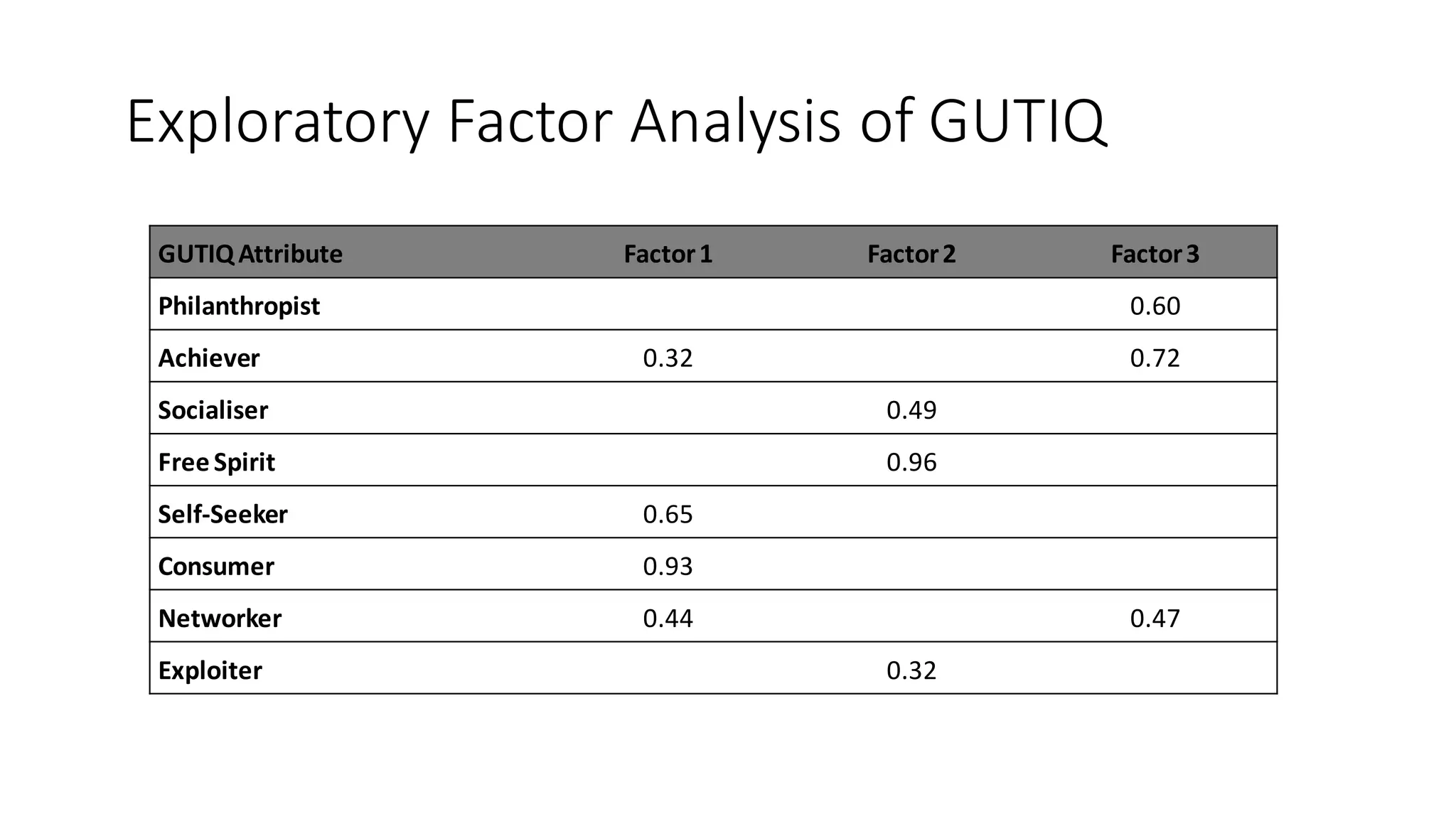
Exploratory Factor Analysis of GUTIQ 
GUTIQ Attribute 
Factor 1 
Factor 2 
Factor 3 
Philanthropist 
0.60 
Achiever 
0.32 
0.72 
Socialiser 
0.49 
Free Spirit 
0.96 
Self-Seeker 
0.65 
Consumer 
0.93 
Networker 
0.44 
0.47 
Exploiter 
0.32
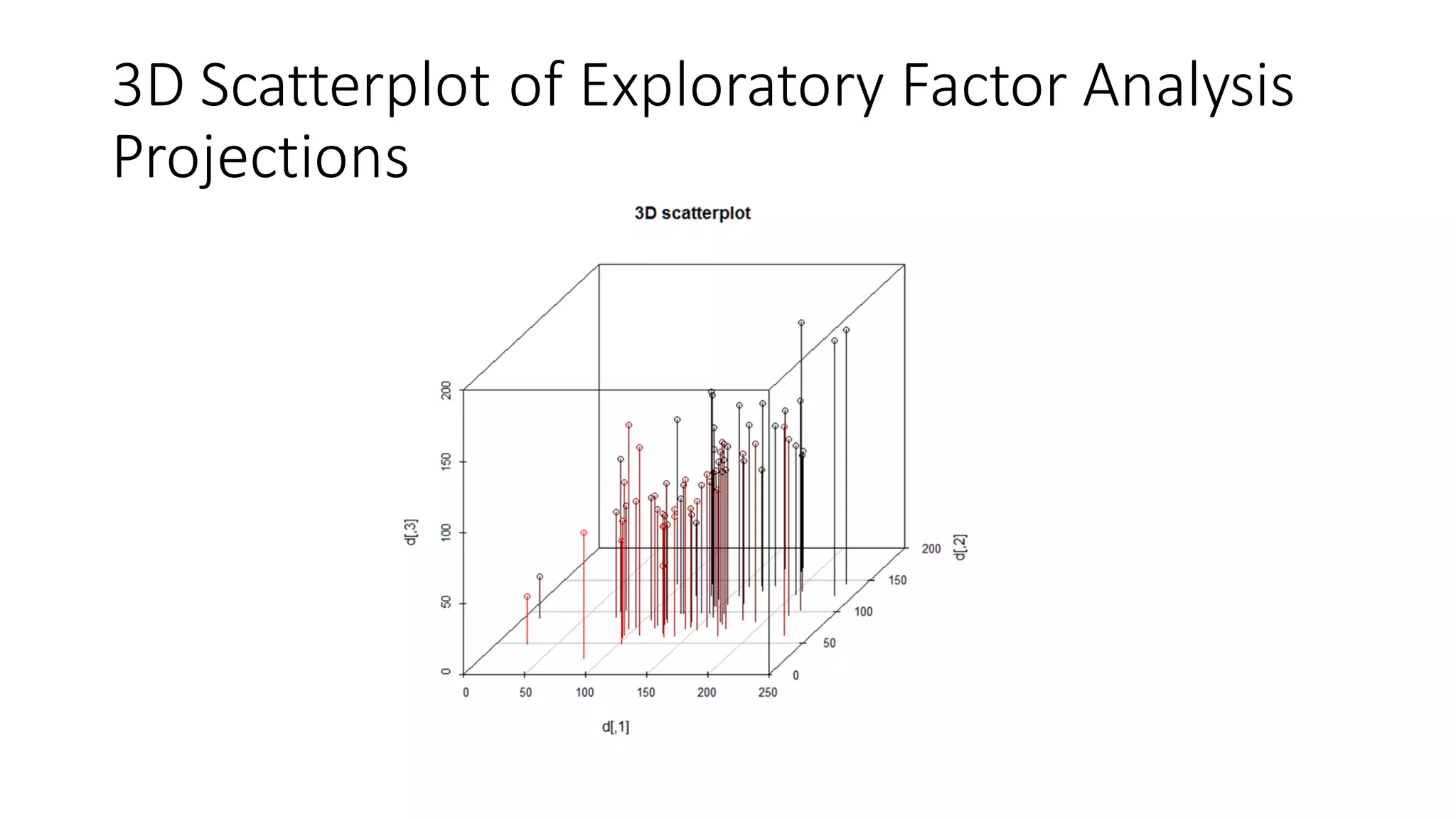
3D Scatterplot of Exploratory Factor Analysis Projections
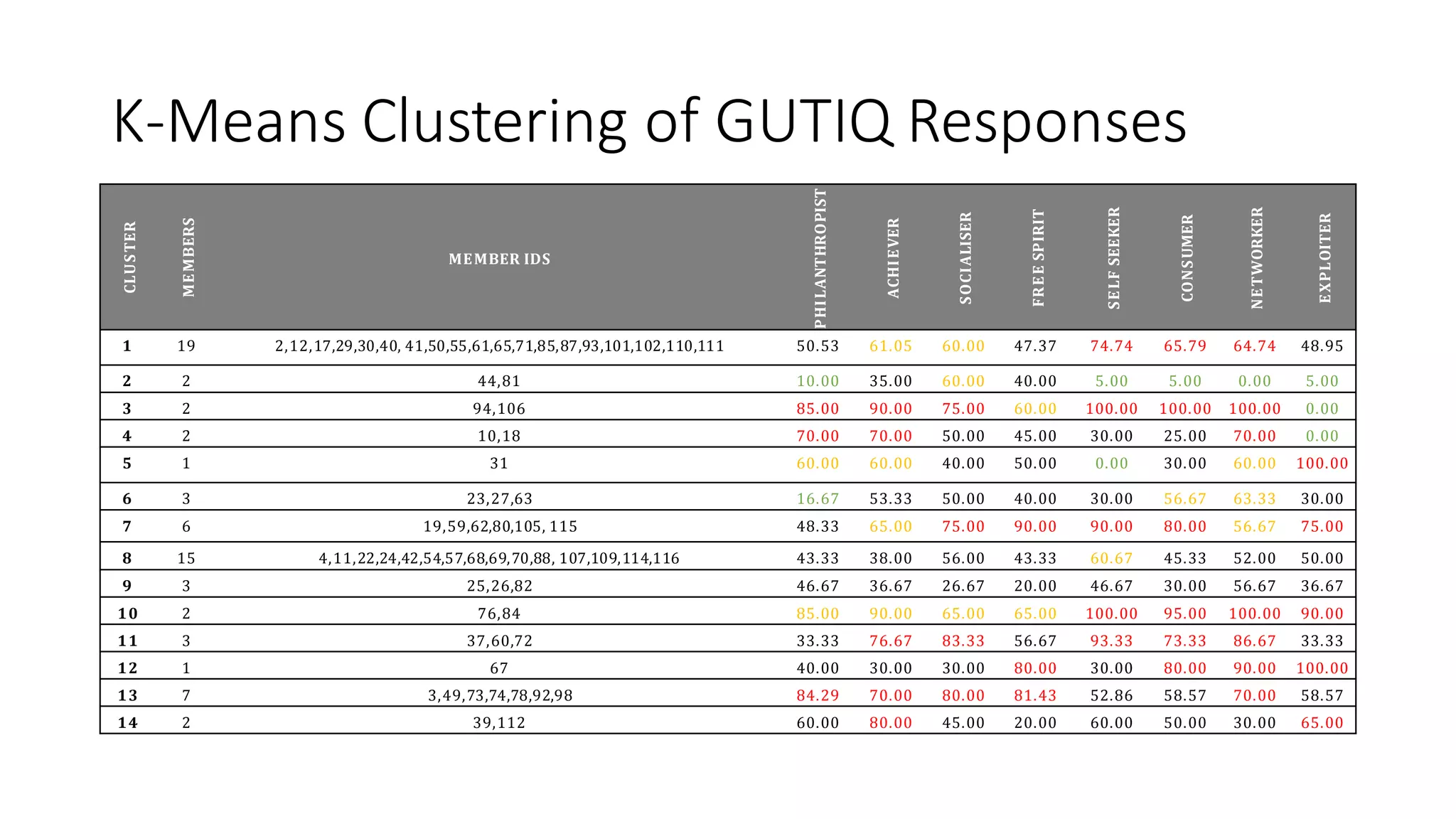
K-Means Clustering of GUTIQ Responses 
CLUSTER 
MEMBERS 
MEMBER IDS 
PHILANTHROPIST 
ACHIEVER 
SOCIALISER 
FREE SPIRIT 
SELF SEEKER 
CONSUMER 
NETWORKER 
EXPLOITER 
1 
19 
2,12,17,29,30,40, 41,50,55,61,65,71,85,87,93,101,102,110,111 
50.53 
61.05 
60.00 
47.37 
74.74 
65.79 
64.74 
48.95 
2 
2 
44,81 
10.00 
35.00 
60.00 
40.00 
5.00 
5.00 
0.00 
5.00 
3 
2 
94,106 
85.00 
90.00 
75.00 
60.00 
100.00 
100.00 
100.00 
0.00 
4 
2 
10,18 
70.00 
70.00 
50.00 
45.00 
30.00 
25.00 
70.00 
0.00 
5 
1 
31 
60.00 
60.00 
40.00 
50.00 
0.00 
30.00 
60.00 
100.00 
6 
3 
23,27,63 
16.67 
53.33 
50.00 
40.00 
30.00 
56.67 
63.33 
30.00 
7 
6 
19,59,62,80,105, 115 
48.33 
65.00 
75.00 
90.00 
90.00 
80.00 
56.67 
75.00 
8 
15 
4,11,22,24,42,54,57,68,69,70,88, 107,109,114,116 
43.33 
38.00 
56.00 
43.33 
60.67 
45.33 
52.00 
50.00 
9 
3 
25,26,82 
46.67 
36.67 
26.67 
20.00 
46.67 
30.00 
56.67 
36.67 
10 
2 
76,84 
85.00 
90.00 
65.00 
65.00 
100.00 
95.00 
100.00 
90.00 
11 
3 
37,60,72 
33.33 
76.67 
83.33 
56.67 
93.33 
73.33 
86.67 
33.33 
12 
1 
67 
40.00 
30.00 
30.00 
80.00 
30.00 
80.00 
90.00 
100.00 
13 
7 
3,49,73,74,78,92,98 
84.29 
70.00 
80.00 
81.43 
52.86 
58.57 
70.00 
58.57 
14 
2 
39,112 
60.00 
80.00 
45.00 
20.00 
60.00 
50.00 
30.00 
65.00
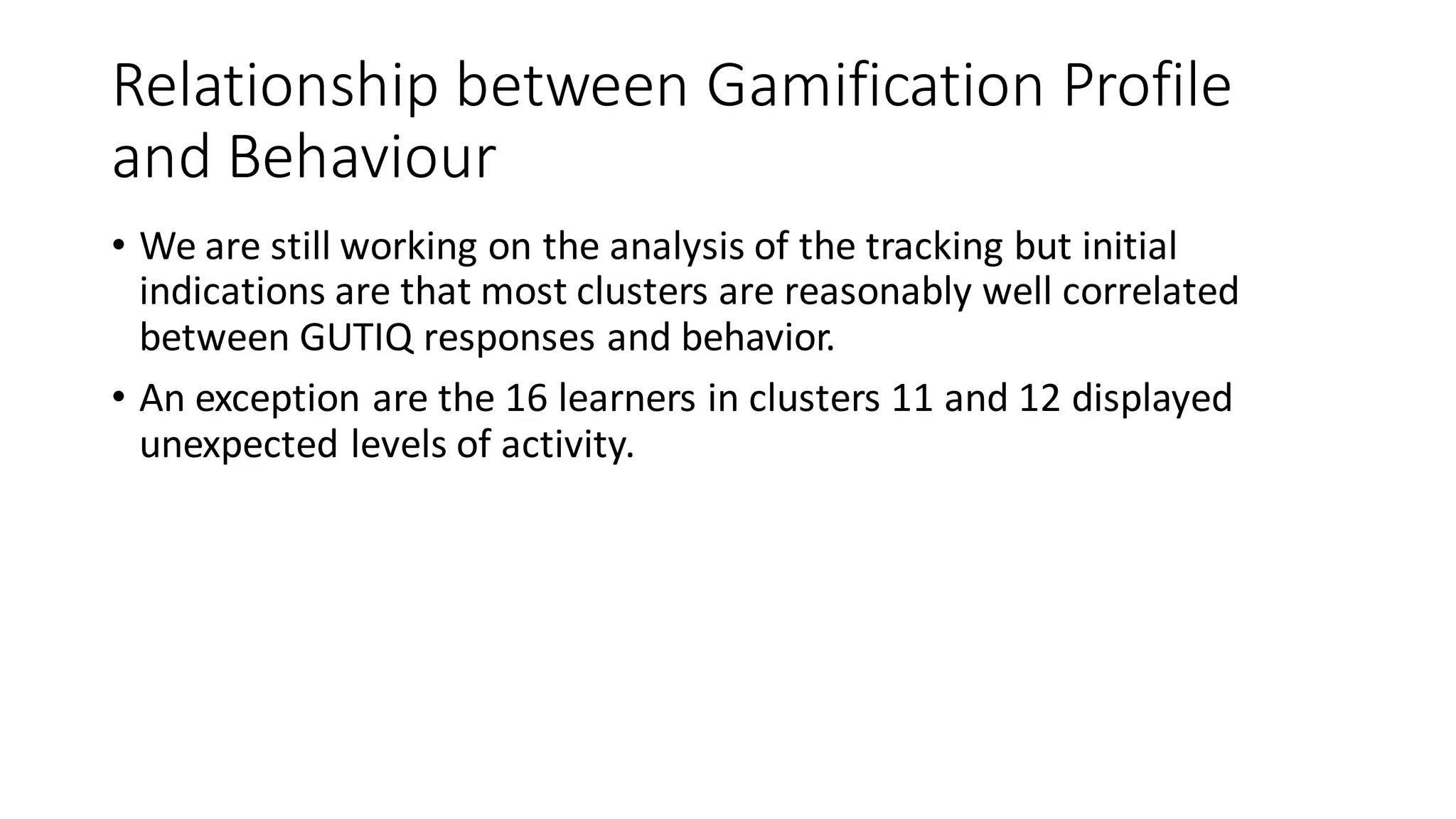
Relationship between Gamification Profile and Behaviour 
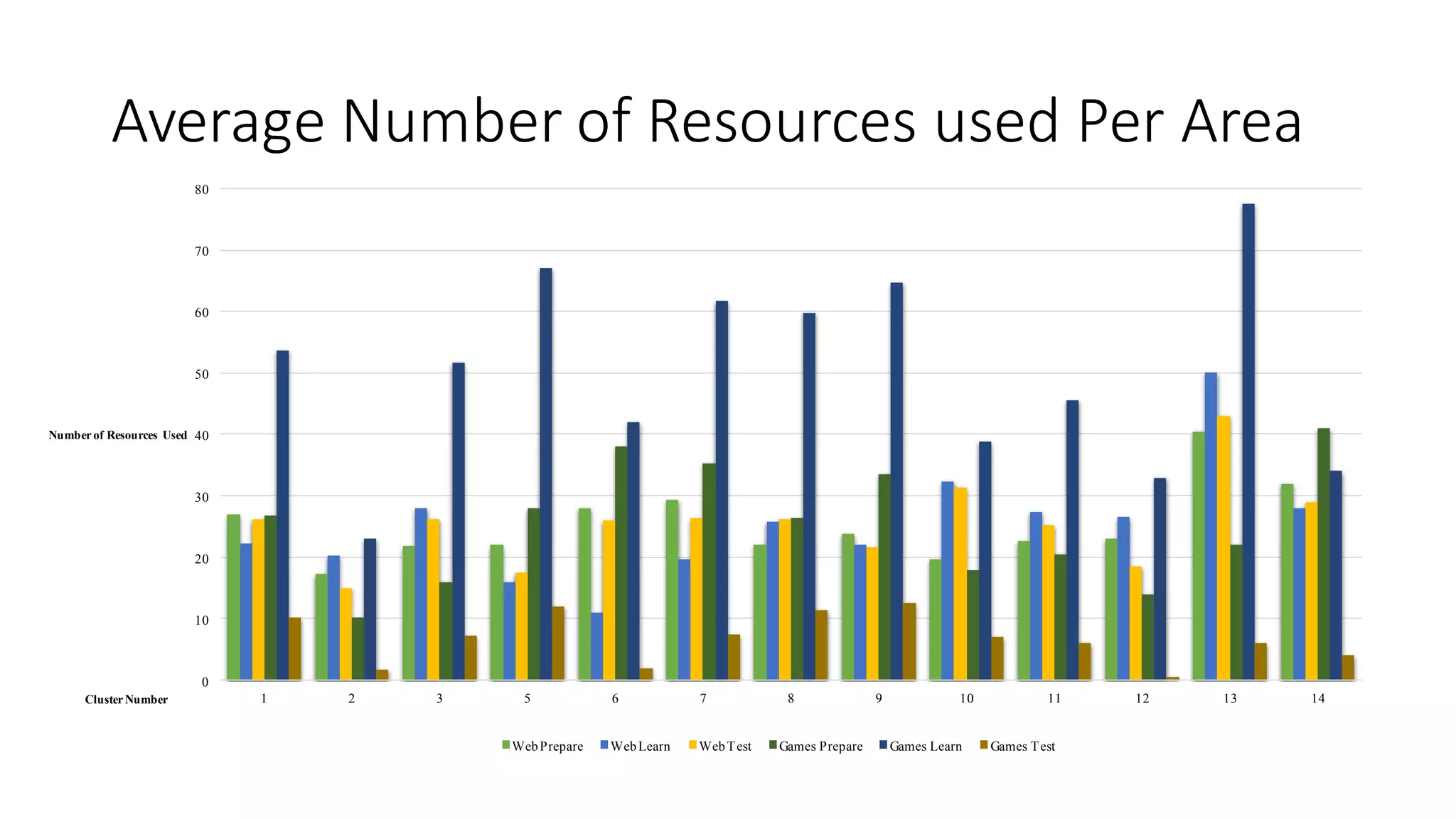
•We are still working on the analysis of the tracking but initial indications are that most clusters are reasonably well correlated between GUTIQ responses and behavior. 
•An exception are the 16 learners in clusters 11 and 12 displayed unexpected levels of activity.
Average Number of Resources used Per Area 
0 
10 
20 
30 
40 
50 
60 
70 
80 
1 
2 
3 
5 
6 
7 
8 
9 
10 
11 
12 
13 
14 
Number of Resources Used 
Web Prepare 
Web Learn 
Web Test 
Games Prepare 
Games Learn 
Games Test 
Cluster Number
Conclusion 
•We have used Marczewski’s Typology as the basis for investigating variation in motivating factors between learners with a virtual world. 
•We have proposed the use of a questionnaire, GUTIQ, to acquire the gamification type of learners 
•There is some evidence of interesting variation between learner gamification type and good correlation with behavior. 
•It was also found that behavior of each gamification type was consistent between two separate learning modules. 
•Further investigation is required to analyse tracked behaviour and to examine the relationship between gamification attributes, and to build a more robust typology.

An Investigation Of Gamification Typologies For Enhancing Learner Motivation

  • 1.
    An Investigation ofGamification Typologies for Enhancing Learner Motivation Barryl Herbert, Darryl Charles, Adrian Moore School of Computing and Information Engineering University of Ulster Coleraine, Northern Ireland Therese Charles SilverFish Studios Coleraine, Northern Ireland
  • 2.
    General Motivation forthis Research: Virtual Learning Landscapes
  • 3.
    Specific Focus ofthis Research: People are Different http://www.custbase.com/portal/blog/wp-content/uploads/2011/05/different-people.png
  • 4.
    People’s Temperament andPsychology Varies Keirsy Temperament Myers-Briggs Mapping Roles Typical Attributes Artisan ESTP, ISTP, ESFP, ISFP Promoter, Crafter, Performer, Composer Fun-loving, Excitable, optimistic, realistic, unconventional, bold, and spontaneous. Troubleshooting leaders. Guardian ESTJ, ISTJ, ESFJ, ISFJ Supervisor, Inspector, Provider, Protector Dependable, helpful, and hard-working, dutiful, cautious, humble. Stabilizing leaders. Rational INTJ, INTP, ENTP, ENTJ Field Marshall, Mastermind, Inventor, Architect Pragmatic, skeptical, self-contained, problem-solvers, ingenious, independent, and strong willed. Strategic leaders Idealist INFJ, INFP, ENFP, ENFJ Teacher, Councellor, Champion, Healer Enthusiastic, trust intuition, kindhearted, authentic, giving, trusting, and focused on personal journeys. Inspirational leaders. Keirsey.com, “Keirsey Temperament Website - Overview of the Four Temperaments.” [Online]. Available: http://www.keirsey.com. [Accessed: 03-Jun-2014].
  • 5.
    Learners are Different http://www.jcu.edu.au/wiledpack/modules/fsl/JCU_090344.html#_Kolb's_learning_styles_1
  • 6.
    Player’s are Different Bartle’s Player Type Symbol (Behavior) Typical Attributes Killers Clubs (they hit people with them) Acting / Players. Focus on rank and direct competition. Leaderboards. Acheivers Diamonds (they're always seeking treasure) Acting / World. Attaining status and achieving goals. Achievements. Explorers Spades (they dig around for information) World / Interacting. Discover the unknown and understand how the game works. Socialisers Hearts (they empathise with other players) Players / Interacting. Motivated by developing a network of friends. Knowledge and information are important. See http://www.gamified.co.uk/?s=types and http://mud.co.uk/richard/hcds.htm
  • 7.
    Bateman’s DGD1 Model •Conqueror: Competitive, win-at-all-costs. Players of this type are goal- oriented and enjoy feeling dominant in the game or in social circles set around the game. •Manager: Logistical, plays to develop mastery. Such players are process-oriented and will replay completed games if they can use their newfound mastery to unearth novelty at deeper levels of detail. •Wanderer: Desires new and fun experiences. Less challenge-oriented than the above types, these players primarily seek constant, undemanding and novel enjoyment. •Participant: Enjoys social (living-room) play, or involvement in an alternate world.
  • 8.
    Principles of GoodGame Design •The Games Oriented Learning Framework (GOLF) emerged through rigorous research in the areas of games design, engagement and flow. FUN: engagement is easier if the experience is enjoyable. SOCIAL: engagement is reinforced by the social support of others going through the same experience. IDENTITY: engagement can be encouraged if everyone has a visible role in the learning environment. CHALLENGE: engagement can build on human competitive drive, enhanced by social pressure. STRUCTURE: engagement is more likely if objectives and constraints are clear and acceptable. FEEDBACK: engagement is reinforced by making achievement explicit and timely.
  • 9.
    Play v Gamev Gameplay •Requires a lusory attitude (and not everyone is indulgent in this way) but if you are playful you may not be a gamer: Play is not bounded by fixed rules and doesn’t require an outcome. Some people are averse to fixed challenges and prefer self-defined challenges. Are not particularly interested in competitive reflection. A game is a problem-solving activity, approached with a playful attitude (Schell) and typically has an observable and measurable outcome. Some people thrive on learning rules and overcoming challenges. Beating other people or comparing performance to others. Gameplay is derived from the combination of pace and cognitive effort required by a game (Crawford).  Intellectual stimulation and progress is core. Learning, doing, mastering.
  • 10.
    What is Gamification? •“Gamification takes inspiration from commercial game elements, design patterns and metaphors in order to improve the design of non-game systems to positively influence behaviour, enhance engagement, and motivate people to achieve their goals. Facilitate experiences with positive emotions. •Much of the core gamification ideas are rooted in psychology and in the simplest form resembles customer reward schemes. •At its most effective gamification harnesses inherent, intrinsic motivation of users and is built on more complex processes than just reinforcement learning.
  • 11.
    Tale of TwoGamifications •Influence – what we want people to do and be like Rewards and techniques focusing on extrinsic motivation. Tasks and processes that are deemed important but are not a particular internal desire for the user. Getting started, being consistent. E.g. Attendance for students. Can scaffold more important emergent behaviours. •Support – what people want to do and be like Rewards and techniques focusing on intrinsic motivation. Tasks and processes lending themselves directly to outcomes that the user inherently desires. Learning, learning how to learn. Knowing and capability of doing. Frequently more complex and process oriented. Related to learning theories.
  • 12.
    What Really Engages?RAMP •Self-determinism and intrinsic motivation Relatedness (social factors), Autonomy (choice and freedom), Mastery (learning/achievement) and Purpose (meaning and knowing why)
  • 13.
    Gamification Typology Experiment •Investigate variation in learner gamification profiles using Marczewski’s gamification typology as a model for motivation. •Context. •Two 2nd year computing degree modules (68 students co-enrolled). Web and games based topics. •We created a virtual world, Reflex, for the students to access content and receive feedback. The 3D world was important to the gamification process. •The teaching mode for the games module was chosen with gamification in mind, whereas the web module had a very traditional format.
  • 14.
    Reflex Four screenshots from Reflex. From top left in clockwise order: A view of the learning areas, starter point with group league table, achievement table, and avatar selection tool.
  • 15.
  • 16.
    Motivation for aVirtual World •Offers richer opportunities for agency (embodiment) and situated learning. •A learners avatar and the world (over time) can become a representation of their learning state. •Gamification features utilising aspects such as exploration and socialising are more literal in a virtual world. •A 3D space can topographically represent the relationship between learning content (difficult, progression etc.) and visually (and physically) present a pedagogical learning process. •Landscape provides guidance •Landscape supplies feedback •Learners can be tracked through virtual learning landscape and heat and trajectory maps subsequently utilised for analysis
  • 17.
    Mixed Methods Approach- Convergent Parallel Design Student preferences –Ask students to complete a questionnaire designed to gauge their gamification preference on the basis of how they say they are motivated. –Summarise and analyse student profiles. –Perform exploratory data analysis to attempt to uncover more complex typologies based on statistical relationships between the gamification attributes of the learner profiles. Student behaviour –Track actual student behaviour: actions and trajectories in the virtual world. –Summarise and analyse the effect of gamification on behaviour based on actions and trajectories. Preferences v Behaviour –Investigate how well student preferences map to actual behaviour. –Outcome from this analysis has the potential the recommendation (or at guidelines on) a gamification typology model based on behaviours alone (ideally eliminating the need for a questionnaire).
  • 18.
  • 19.
    Marczewski’s mapping ofgamification support features to user types
  • 20.
    Gamification Features Usedin Reflex Feature Description Actions and Events Badges Awarded for performance and progress. Monitor when awarded. How often are they checked? Do learners persue elusive badges? Points Accumulation of points for leaderboards etc. Monitor when awarded. Do learners check points regularly? Do they strive to get maximum points? Visible Status Displaying user weekly/semester progress. Monitor updates to progress. Do learners look at breakdown often? Provision of a target system. Do user’s discuss their visible status? Leaderboards Rank individual and group performance Monitor changes in rank and correlated behaviour over time. Do learners discuss/check rank? Unlockable Content Prerequisite performance markers for content unlocks Monitor award of this content. Do learners discuss or pursue such content? Do learners analyse what is required to unlock this content? Customisation Personalisation of world and avatar Monitor changes to avatar and world. Frequency of changes. Discussion of changes. Levels Avatar/world level progress indicators Monitor levelling up and behaviour monitoring
  • 21.
    Gamification User TypeIdentification Questionnaire (GUTIQ) – Intrinsically Motivated User Type Main Gamification Emphasis GUTIQ Statements Philanthropist Purpose I like to help people who are struggling with progress in learning I like to contribute to module forums to share my knowledge with others I like to volunteer my time to help maintain online communities I do not like sharing knowledge that may give me an edge with my classmates Achiever Mastery I enjoy taking learning courses purely because I want to I tend to work at learning activities until I perfect them Winning is more important than taking part I like to display rewards I receive Socializer Relatedness I use social networking on a regular basis In social media, I enjoy watching/following people as opposed to talking to others I have more people following me than people I follow I enjoy sharing content with my friends/followers Free Spirit Autonomy I enjoy creating custom pictures for my online profiles I prefer freedom to explore rather than a story when playing a game I like to create and upload content to sites like Instagram, YouTube and Pinterest If I found a bug in a game that let me win I would exploit it rather than report it
  • 22.
    Gamification User TypeIdentification Questionnaire (GUTIQ) – Extrinsically Motivated User Type Gamification Emphasis GUTIQ Statements Self-Seeker Egotistical Reward Focus I enjoy receiving experience points and gaining new levels in games I enjoy having badges/avatars to display as status symbols in games I like to use leaderboards to see how I’m performing against others I work in groups in games purely to get rewards, not to build friendships Consumer Attainment and Acquisition I like to display badges I receive on my player profile I enjoy playing sequels to games that reward me for playing previous games in the series I prefer to only use a system when I can clearly see its benefits I don’t enjoy learning when there are no rewards available Networker Social Network Building. Self- Centered World View I enjoy playing as part of a group in gameplay I like being identified as a member of a certain group based on its competitive reputation I don’t enjoy playing online game modes on my own I enjoy working on team based objectives whilst playing games Exploiter Short-cuts and Using Others I like to try and find exploitable loopholes in a game I don’t see any good reason to report a bug provided it doesn’t hamper my progress I will engage with team based game interactions if it provides me with a reward I like to use cheat codes to further my progress in games
  • 23.
  • 24.
    Descriptive Statistics ofGUTIQ Data Philanthropist Achiever Socialiser Free Spirit Self Seeker Consumer Networker Exploiter Mean 51.471 57.794 60.735 52.941 64.265 58.235 61.912 49.412 Median 50 60 60 50 70 60 60 50 Mode 40 60 60 50 80 60 60 60 Standard Deviation 23.197 19.382 18.634 22.729 25.761 22.655 20.389 24.304 Sample Variance 538.10 375.66 347.21 516.59 663.63 513.26 415.69 590.69 Kurtosis -0.008 -0.479 0.736 -0.682 0.323 -0.010 1.539 -0.099 Skewness 0.060 0.246 -0.067 0.355 -0.733 -0.330 -0.637 -0.148 Range 100 80 100 90 100 100 100 100 Confidence Level(95%) 5.615 4.691 4.510 5.502 6.235 5.484 4.935 5.883
  • 25.
    Descriptive Statistics ofGUTIQ Data Philanthropist Achiever Socialiser Free Spirit Self Seeker Consumer Networker Exploiter Mean 51.471 57.794 60.735 52.941 64.265 58.235 61.912 49.412 Median 50 60 60 50 70 60 60 50 Mode 40 60 60 50 80 60 60 60 Standard Deviation 23.197 19.382 18.634 22.729 25.761 22.655 20.389 24.304 Sample Variance 538.10 375.66 347.21 516.59 663.63 513.26 415.69 590.69 Kurtosis -0.008 -0.479 0.736 -0.682 0.323 -0.010 1.539 -0.099 Skewness 0.060 0.246 -0.067 0.355 -0.733 -0.330 -0.637 -0.148 Range 100 80 100 90 100 100 100 100 Confidence Level(95%) 5.615 4.691 4.510 5.502 6.235 5.484 4.935 5.883
  • 26.
    Descriptive Statistics ofGUTIQ Data Philanthropist Achiever Socialiser Free Spirit Self Seeker Consumer Networker Exploiter Mean 51.471 57.794 60.735 52.941 64.265 58.235 61.912 49.412 Median 50 60 60 50 70 60 60 50 Mode 40 60 60 50 80 60 60 60 Standard Deviation 23.197 19.382 18.634 22.729 25.761 22.655 20.389 24.304 Sample Variance 538.10 375.66 347.21 516.59 663.63 513.26 415.69 590.69 Kurtosis -0.008 -0.479 0.736 -0.682 0.323 -0.010 1.539 -0.099 Skewness 0.060 0.246 -0.067 0.355 -0.733 -0.330 -0.637 -0.148 Range 100 80 100 90 100 100 100 100 Confidence Level(95%) 5.615 4.691 4.510 5.502 6.235 5.484 4.935 5.883
  • 27.
    Descriptive Statistics ofGUTIQ Data Philanthropist Achiever Socialiser Free Spirit Self Seeker Consumer Networker Exploiter Mean 51.471 57.794 60.735 52.941 64.265 58.235 61.912 49.412 Median 50 60 60 50 70 60 60 50 Mode 40 60 60 50 80 60 60 60 Standard Deviation 23.197 19.382 18.634 22.729 25.761 22.655 20.389 24.304 Sample Variance 538.10 375.66 347.21 516.59 663.63 513.26 415.69 590.69 Kurtosis -0.008 -0.479 0.736 -0.682 0.323 -0.010 1.539 -0.099 Skewness 0.060 0.246 -0.067 0.355 -0.733 -0.330 -0.637 -0.148 Range 100 80 100 90 100 100 100 100 Confidence Level(95%) 5.615 4.691 4.510 5.502 6.235 5.484 4.935 5.883
  • 28.
    GUTIQ Typology ResponseCorrelation Matrix Philanthropist Achiever Socialiser Free Spirit Self Seeker Consumer Networker Exploiter Philanthropist 1.000 0.455 0.208 0.334 0.159 0.232 0.370 0.105 Achiever 0.455 1.000 0.343 0.310 0.354 0.494 0.468 0.023 Socialiser 0.208 0.343 1.000 0.559 0.345 0.332 0.153 0.130 Free Spirit 0.334 0.310 0.559 1.000 0.185 0.364 0.242 0.298 Self-Seeker 0.159 0.354 0.345 0.185 1.000 0.675 0.314 0.185 Consumer 0.232 0.494 0.332 0.364 0.675 1.000 0.547 0.266 Networker 0.370 0.468 0.153 0.242 0.314 0.547 1.000 0.069 Exploiter 0.105 0.023 0.130 0.298 0.185 0.266 0.069 1.000
  • 29.
    Principal Component Analysisof Typologies GUTIQ Typology PC1 PC2 PC3 PC4 CP5 PC6 PC7 PC8 Philanthropist -0.451 -0.401 -0.121 -0.298 0.723 Achiever -0.308 -0.184 0.526 -0.374 0.504 0.412 0.168 Socialiser -0.181 0.557 -0.277 -0.662 0.105 -0.260 0.248 Free Spirit -0.354 0.464 0.340 -0.347 0.133 -0.575 -0.272 Self Seeker -0.364 -0.418 -0.246 -0.628 0.171 0.390 -0.238 Consumer -0.400 -0.313 0.206 0.189 -0.789 -0.162 Networker -0.369 -0.534 0.240 0.411 0.303 -0.503 Exploiter -0.338 0.396 0.206 0.544 0.595 0.193
  • 30.
    Exploratory Factor Analysisof GUTIQ GUTIQ Attribute Factor 1 Factor 2 Factor 3 Philanthropist 0.60 Achiever 0.32 0.72 Socialiser 0.49 Free Spirit 0.96 Self-Seeker 0.65 Consumer 0.93 Networker 0.44 0.47 Exploiter 0.32
  • 31.
    3D Scatterplot ofExploratory Factor Analysis Projections
  • 32.
    K-Means Clustering ofGUTIQ Responses CLUSTER MEMBERS MEMBER IDS PHILANTHROPIST ACHIEVER SOCIALISER FREE SPIRIT SELF SEEKER CONSUMER NETWORKER EXPLOITER 1 19 2,12,17,29,30,40, 41,50,55,61,65,71,85,87,93,101,102,110,111 50.53 61.05 60.00 47.37 74.74 65.79 64.74 48.95 2 2 44,81 10.00 35.00 60.00 40.00 5.00 5.00 0.00 5.00 3 2 94,106 85.00 90.00 75.00 60.00 100.00 100.00 100.00 0.00 4 2 10,18 70.00 70.00 50.00 45.00 30.00 25.00 70.00 0.00 5 1 31 60.00 60.00 40.00 50.00 0.00 30.00 60.00 100.00 6 3 23,27,63 16.67 53.33 50.00 40.00 30.00 56.67 63.33 30.00 7 6 19,59,62,80,105, 115 48.33 65.00 75.00 90.00 90.00 80.00 56.67 75.00 8 15 4,11,22,24,42,54,57,68,69,70,88, 107,109,114,116 43.33 38.00 56.00 43.33 60.67 45.33 52.00 50.00 9 3 25,26,82 46.67 36.67 26.67 20.00 46.67 30.00 56.67 36.67 10 2 76,84 85.00 90.00 65.00 65.00 100.00 95.00 100.00 90.00 11 3 37,60,72 33.33 76.67 83.33 56.67 93.33 73.33 86.67 33.33 12 1 67 40.00 30.00 30.00 80.00 30.00 80.00 90.00 100.00 13 7 3,49,73,74,78,92,98 84.29 70.00 80.00 81.43 52.86 58.57 70.00 58.57 14 2 39,112 60.00 80.00 45.00 20.00 60.00 50.00 30.00 65.00
  • 33.
    Relationship between GamificationProfile and Behaviour •We are still working on the analysis of the tracking but initial indications are that most clusters are reasonably well correlated between GUTIQ responses and behavior. •An exception are the 16 learners in clusters 11 and 12 displayed unexpected levels of activity.
  • 34.
    Average Number ofResources used Per Area 0 10 20 30 40 50 60 70 80 1 2 3 5 6 7 8 9 10 11 12 13 14 Number of Resources Used Web Prepare Web Learn Web Test Games Prepare Games Learn Games Test Cluster Number
  • 36.
    Conclusion •We haveused Marczewski’s Typology as the basis for investigating variation in motivating factors between learners with a virtual world. •We have proposed the use of a questionnaire, GUTIQ, to acquire the gamification type of learners •There is some evidence of interesting variation between learner gamification type and good correlation with behavior. •It was also found that behavior of each gamification type was consistent between two separate learning modules. •Further investigation is required to analyse tracked behaviour and to examine the relationship between gamification attributes, and to build a more robust typology.