Game features of Cognitive Training
Michael P. Craven
NIHR MindTech Healthcare Technology Cooperative
Institute of Mental Health, University of Nottingham
www.mindtech.org.uk @NIHR_MindTech
Carlo Fabricatore
Pro-Social Immersive Technologies (PSiT) incubator
School of Computing and Engineering, University of Huddersfield
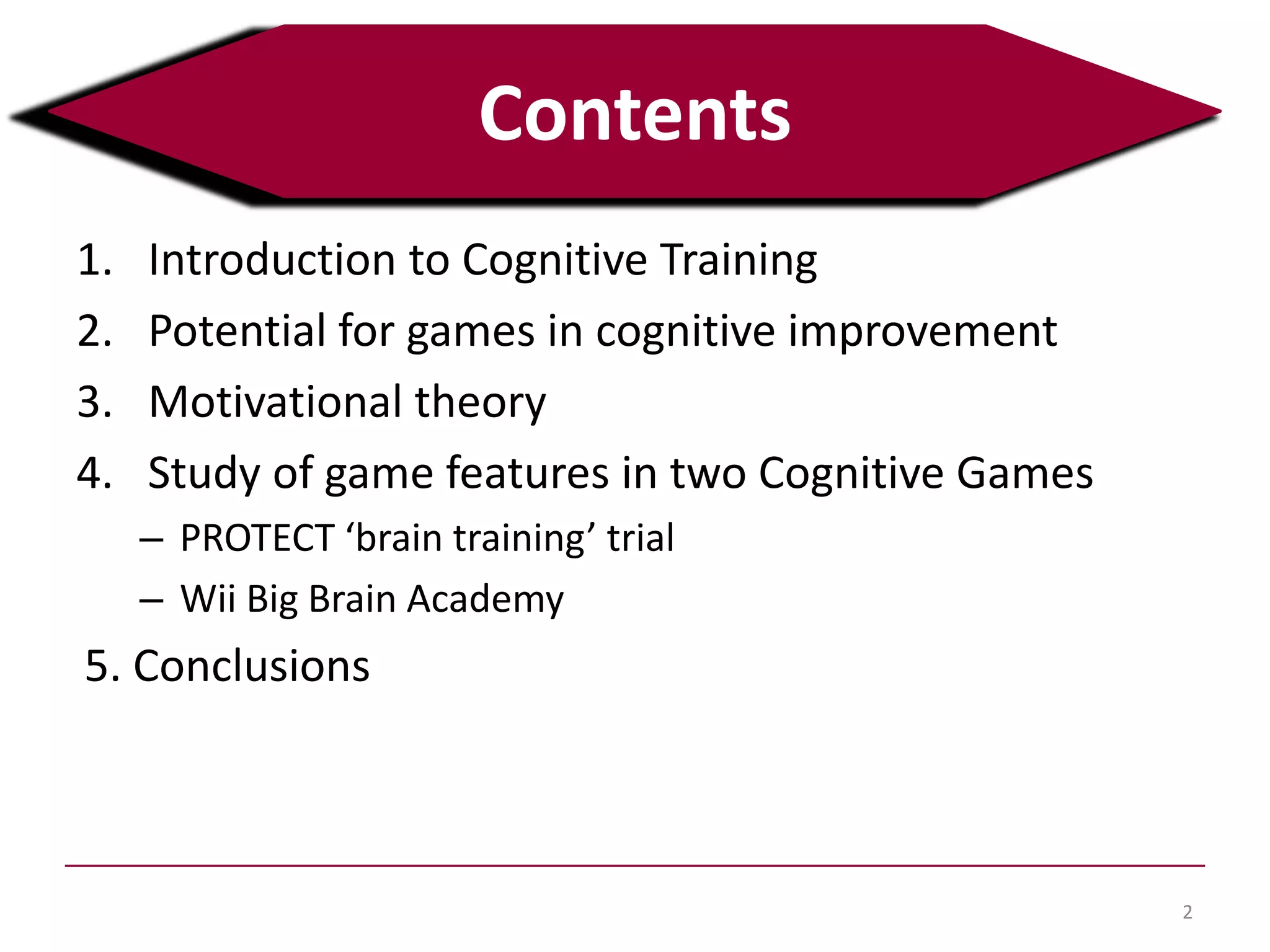
1. Introduction to Cognitive Training
2. Potential for games in cognitive improvement
3. Motivational theory
4. Study of game features in two Cognitive Games
– PROTECT ‘brain training’ trial
– Wii Big Brain Academy
5. Conclusions
2
Contents
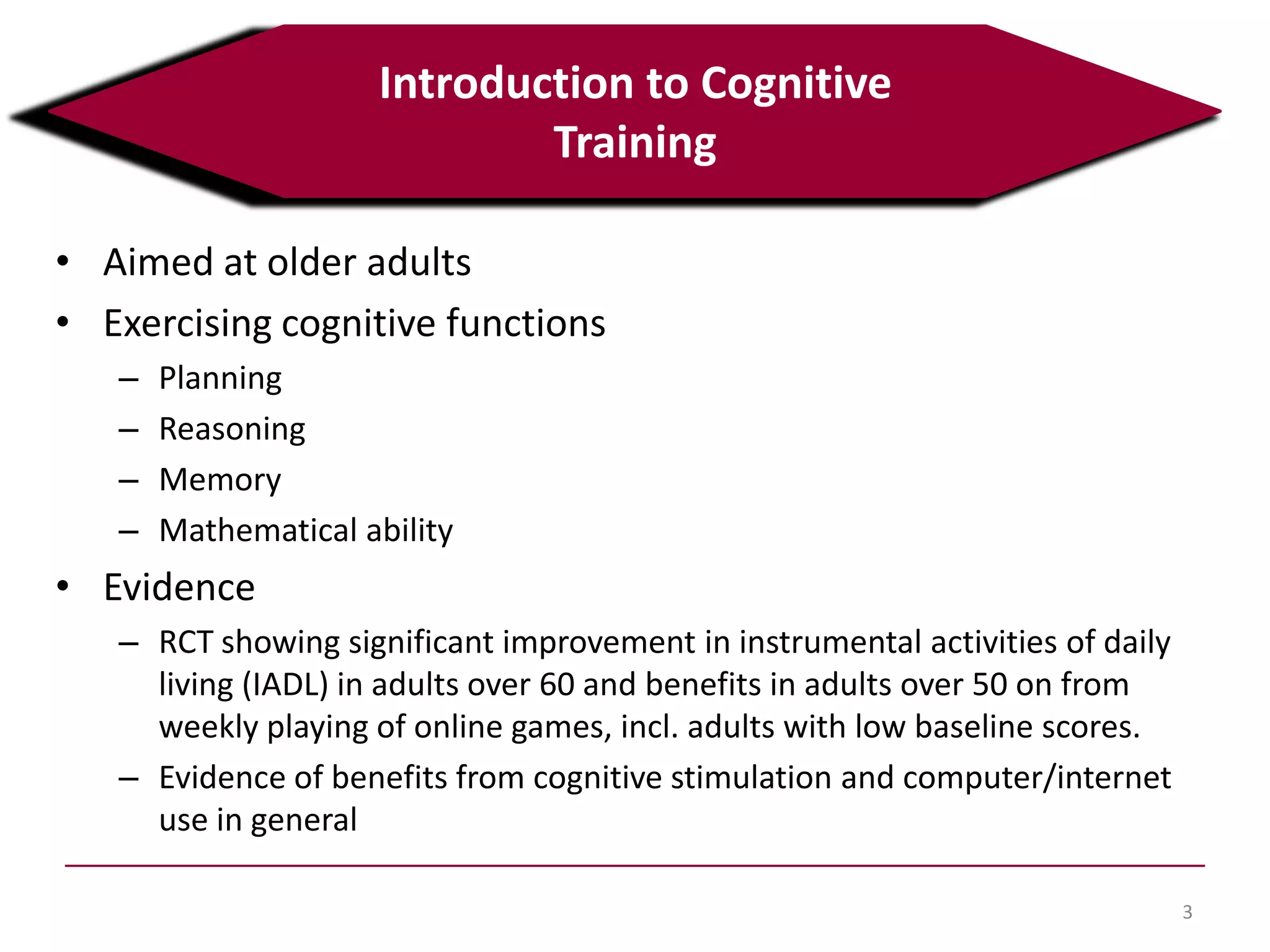
• Aimed at older adults
• Exercising cognitive functions
– Planning
– Reasoning
– Memory
– Mathematical ability
• Evidence
– RCT showing significant improvement in instrumental activities of daily
living (IADL) in adults over 60 and benefits in adults over 50 on from
weekly playing of online games, incl. adults with low baseline scores.
– Evidence of benefits from cognitive stimulation and computer/internet
use in general
3
Introduction to Cognitive
Training
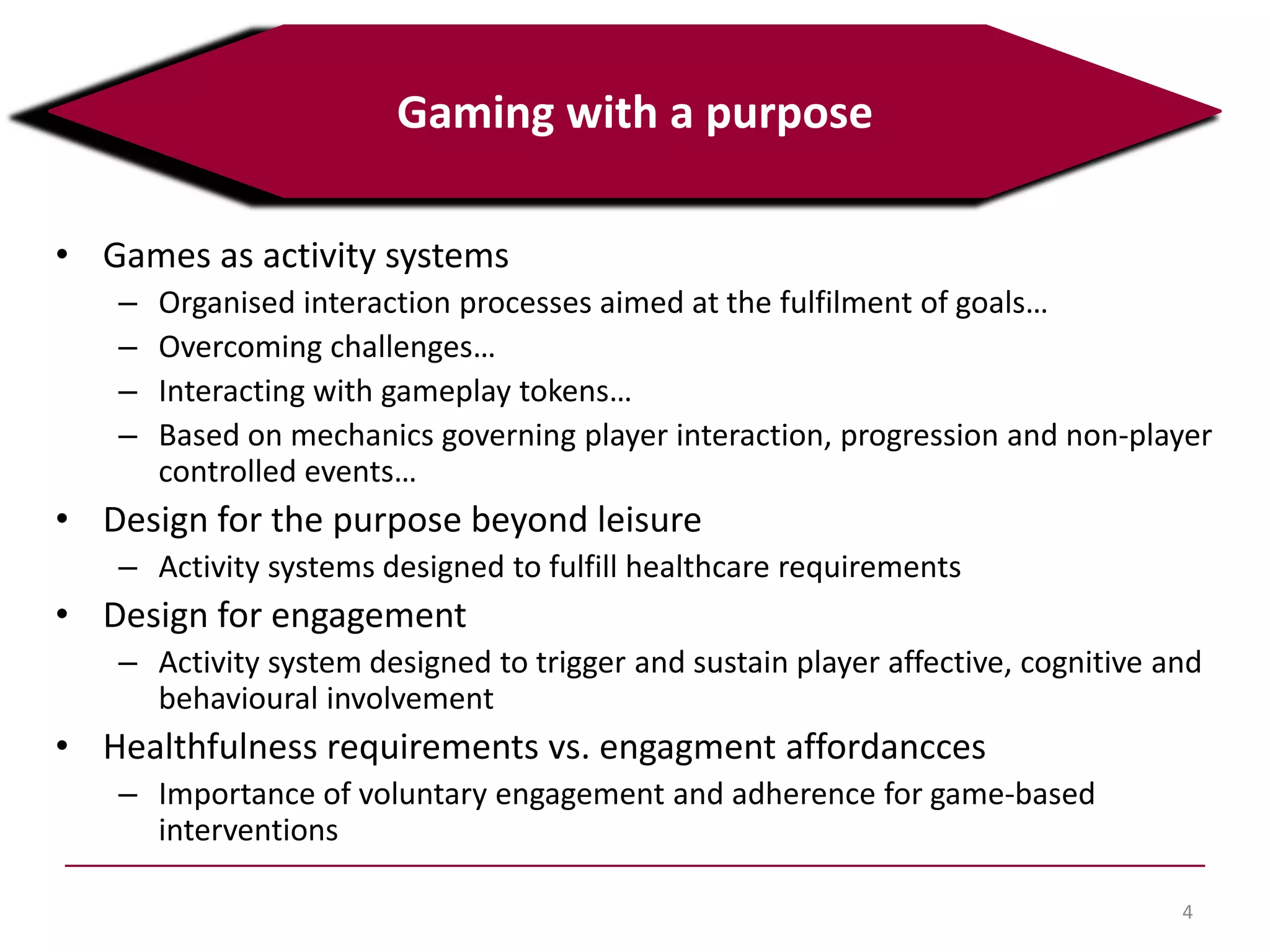
• Games as activity systems
– Organised interaction processes aimed at the fulfilment of goals…
– Overcoming challenges…
– Interacting with gameplay tokens…
– Based on mechanics governing player interaction, progression and non-player
controlled events…
• Design for the purpose beyond leisure
– Activity systems designed to fulfill healthcare requirements
• Design for engagement
– Activity system designed to trigger and sustain player affective, cognitive and
behavioural involvement
• Healthfulness requirements vs. engagment affordancces
– Importance of voluntary engagement and adherence for game-based
interventions
4
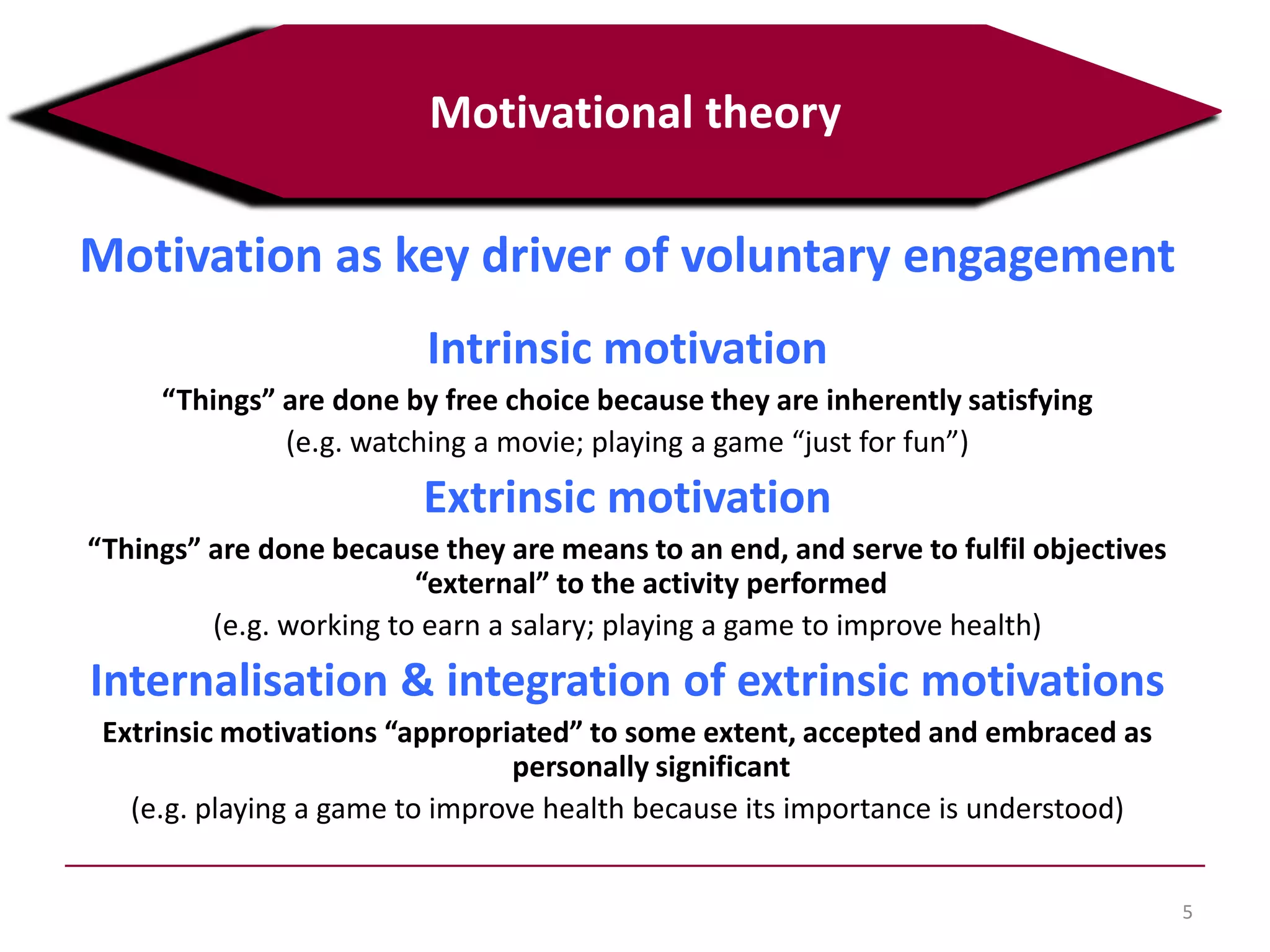
Gaming with a purpose
Motivation as key driver of voluntary engagement
Intrinsic motivation
“Things” are done by free choice because they are inherently satisfying
(e.g. watching a movie; playing a game “just for fun”)
Extrinsic motivation
“Things” are done because they are means to an end, and serve to fulfil objectives
“external” to the activity performed
(e.g. working to earn a salary; playing a game to improve health)
Internalisation & integration of extrinsic motivations
Extrinsic motivations “appropriated” to some extent, accepted and embraced as
personally significant
(e.g. playing a game to improve health because its importance is understood)
5
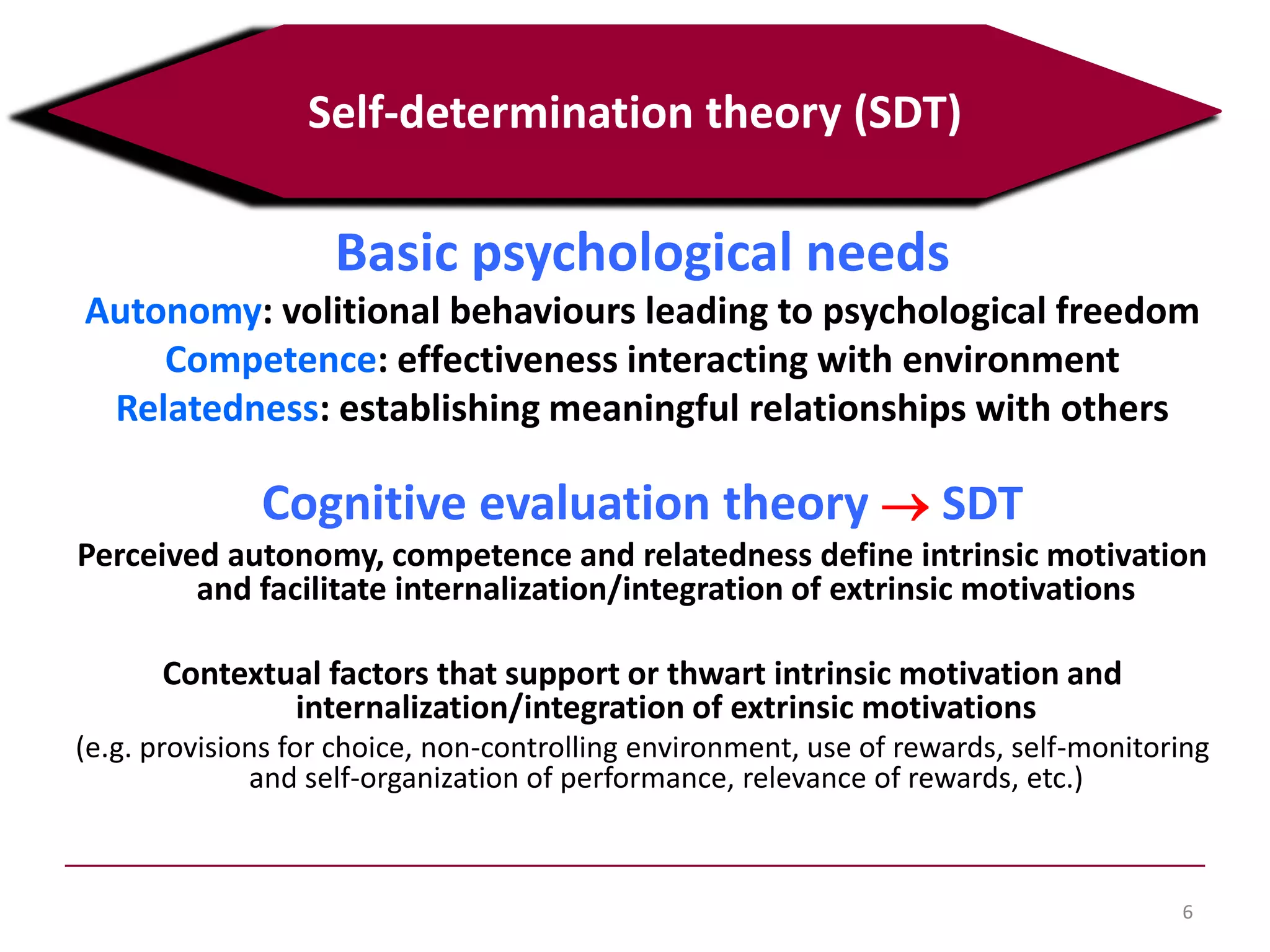
Motivational theory
Basic psychological needs
Autonomy: volitional behaviours leading to psychological freedom
Competence: effectiveness interacting with environment
Relatedness: establishing meaningful relationships with others
Cognitive evaluation theory SDT
Perceived autonomy, competence and relatedness define intrinsic motivation
and facilitate internalization/integration of extrinsic motivations
Contextual factors that support or thwart intrinsic motivation and
internalization/integration of extrinsic motivations
(e.g. provisions for choice, non-controlling environment, use of rewards, self-monitoring
and self-organization of performance, relevance of rewards, etc.)
6
Self-determination theory (SDT)
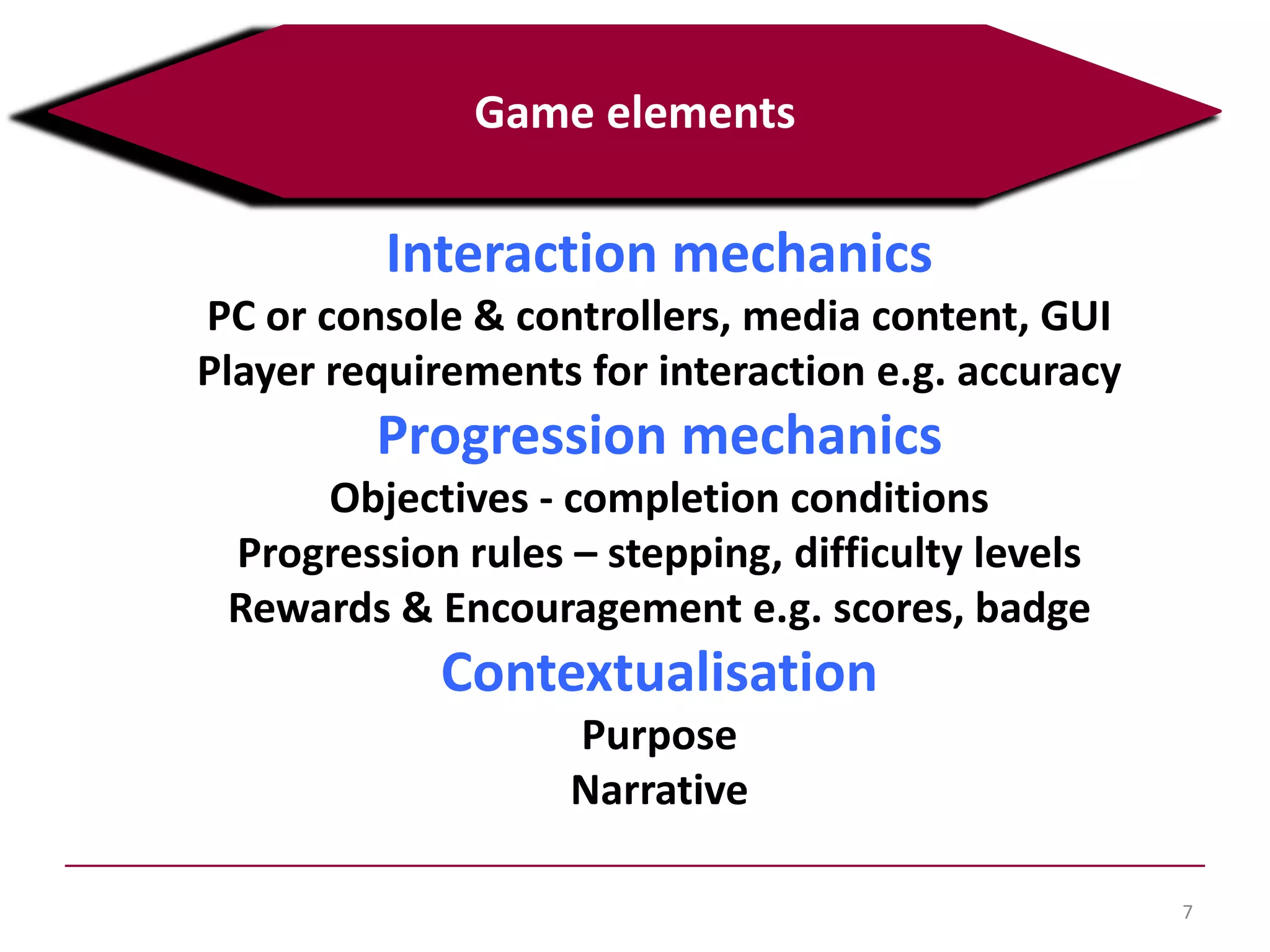
Interaction mechanics
PC or console & controllers, media content, GUI
Player requirements for interaction e.g. accuracy
Progression mechanics
Objectives - completion conditions
Progression rules – stepping, difficulty levels
Rewards & Encouragement e.g. scores, badge
Contextualisation
Purpose
Narrative
7
Game elements
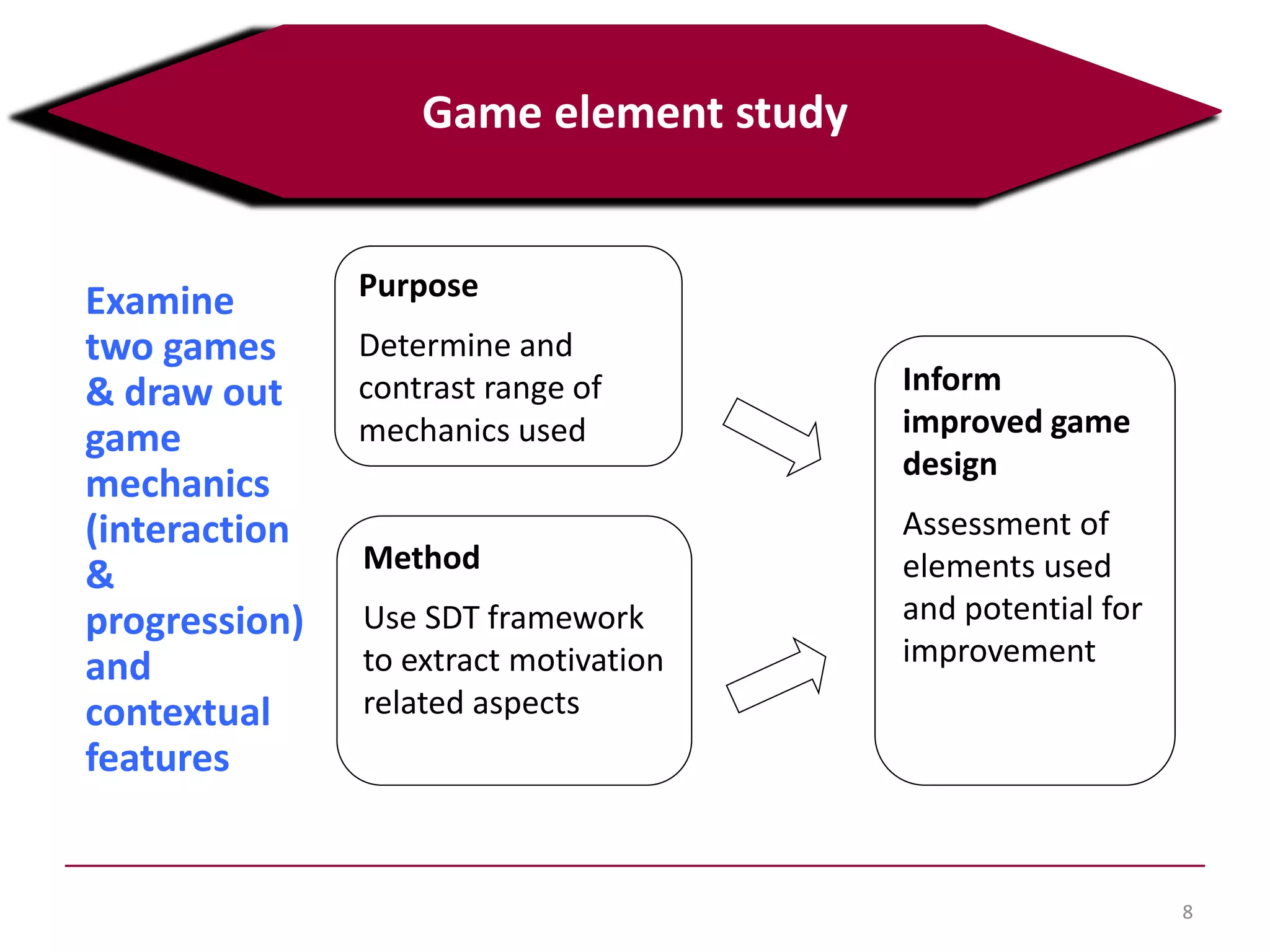
Examine
two games
& draw out
game
mechanics
(interaction
&
progression)
and
contextual
features
8
Game element study
Inform
improved game
design
Assessment of
elements used
and potential for
improvement
Purpose
Determine and
contrast range of
mechanics used
Method
Use SDT framework
to extract motivation
related aspects
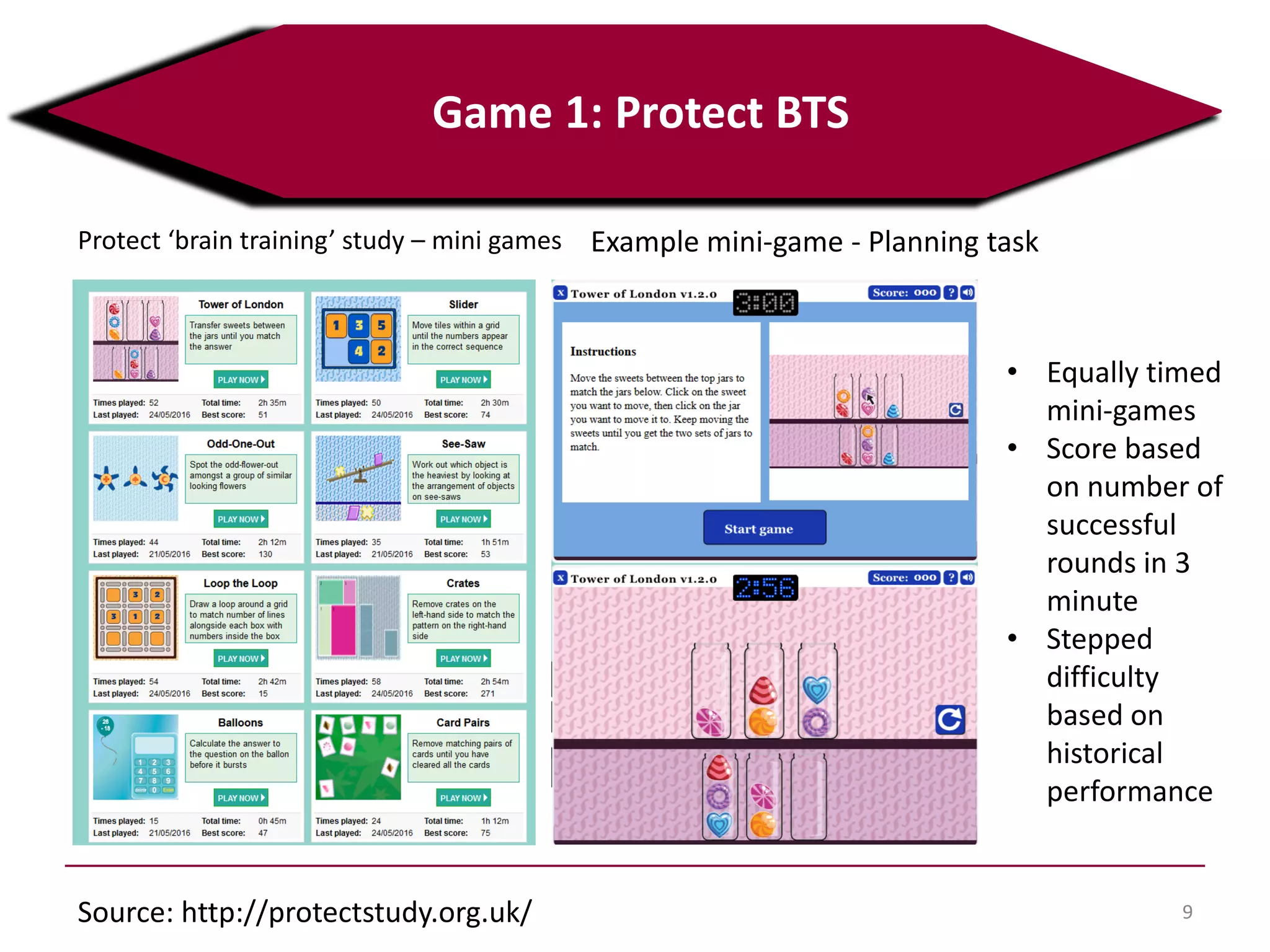
Protect ‘brain training’ study – mini games
9
Game 1: Protect BTS
Example mini-game - Planning task
Source: http://protectstudy.org.uk/
• Equally timed
mini-games
• Score based
on number of
successful
rounds in 3
minute
• Stepped
difficulty
based on
historical
performance
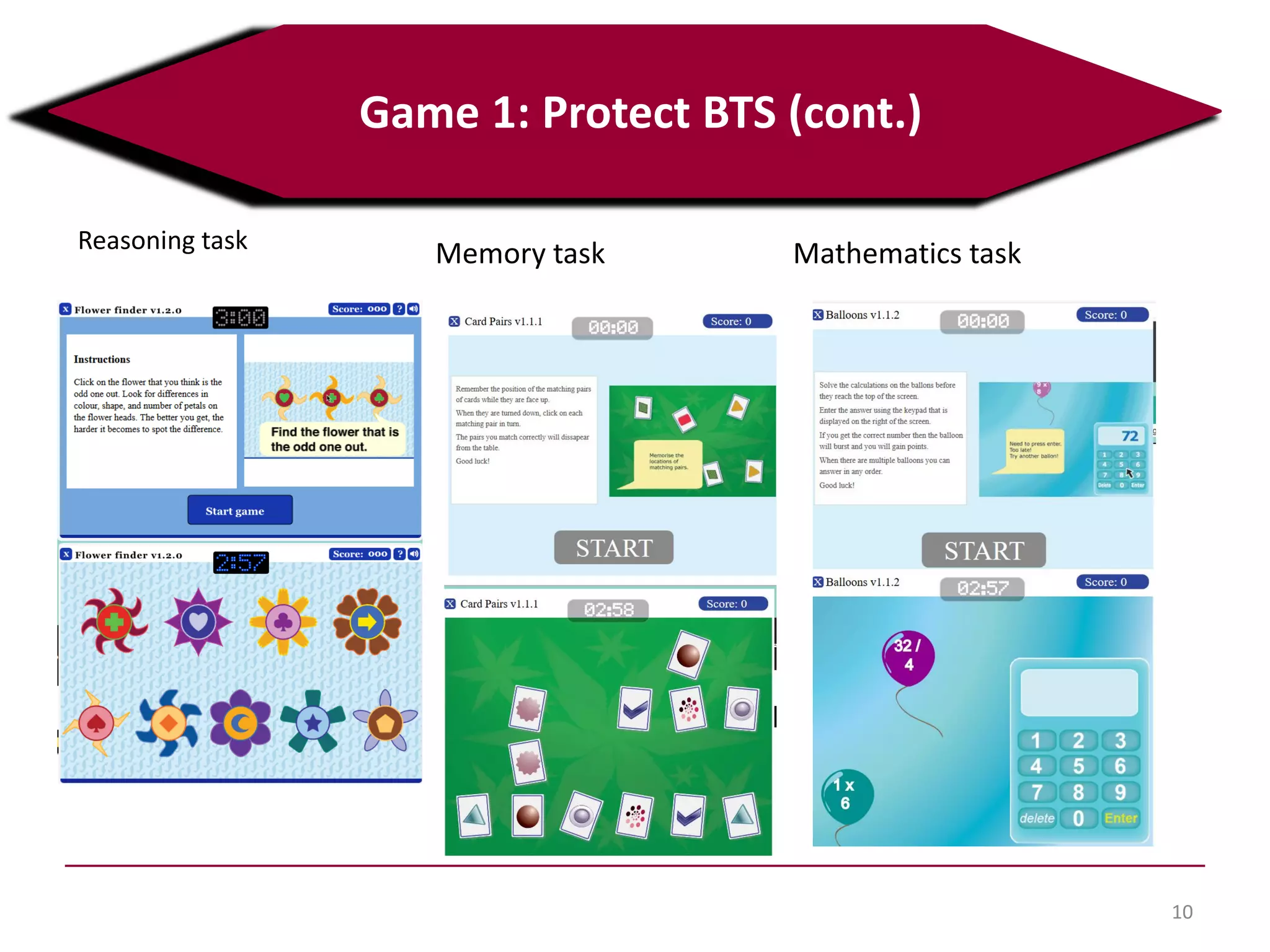
Reasoning task
10
Game 1: Protect BTS (cont.)
Memory task Mathematics task
11
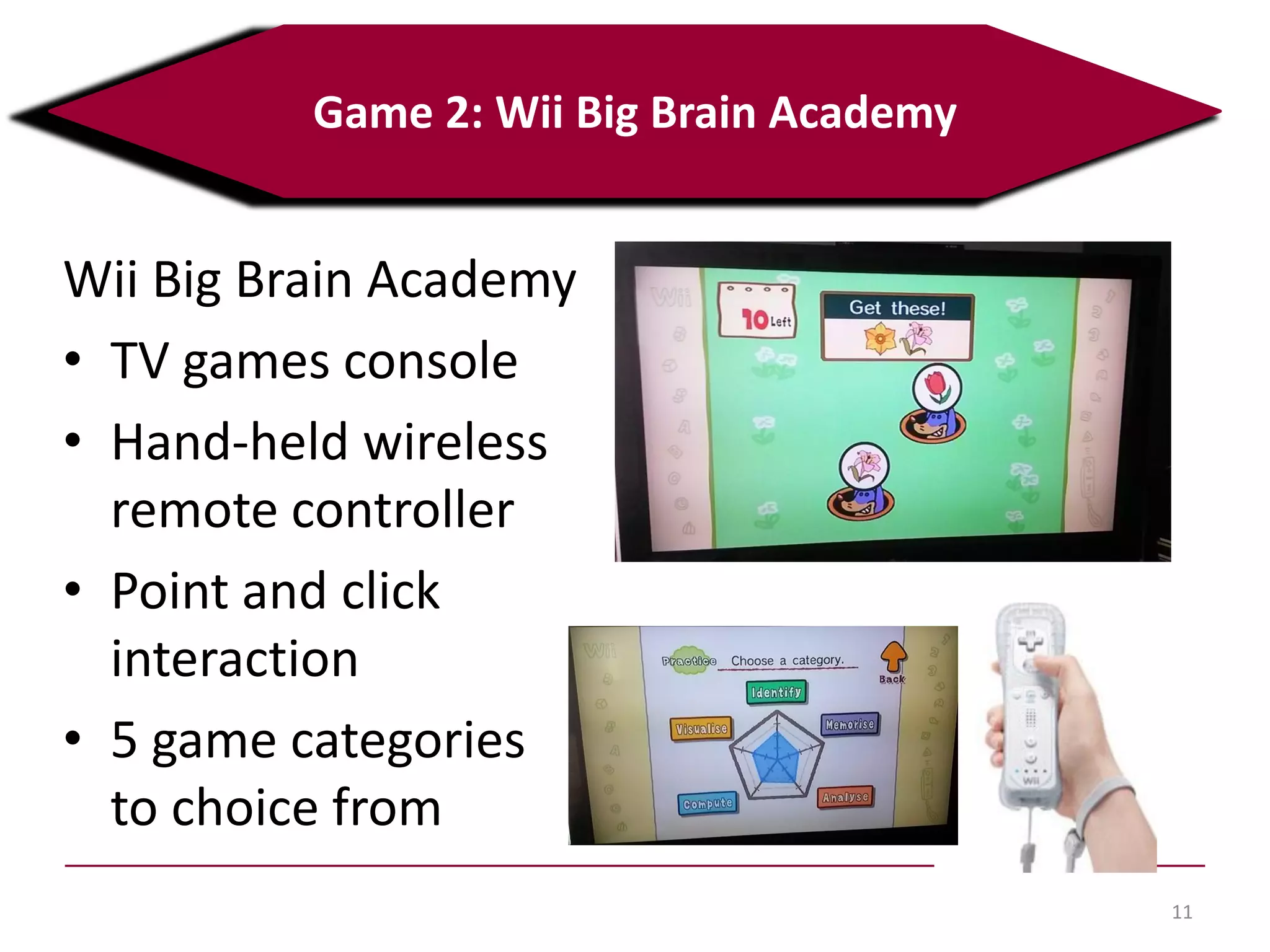
Game 2: Wii Big Brain Academy
Wii Big Brain Academy
• TV games console
• Hand-held wireless
remote controller
• Point and click
interaction
• 5 game categories
to choice from
12
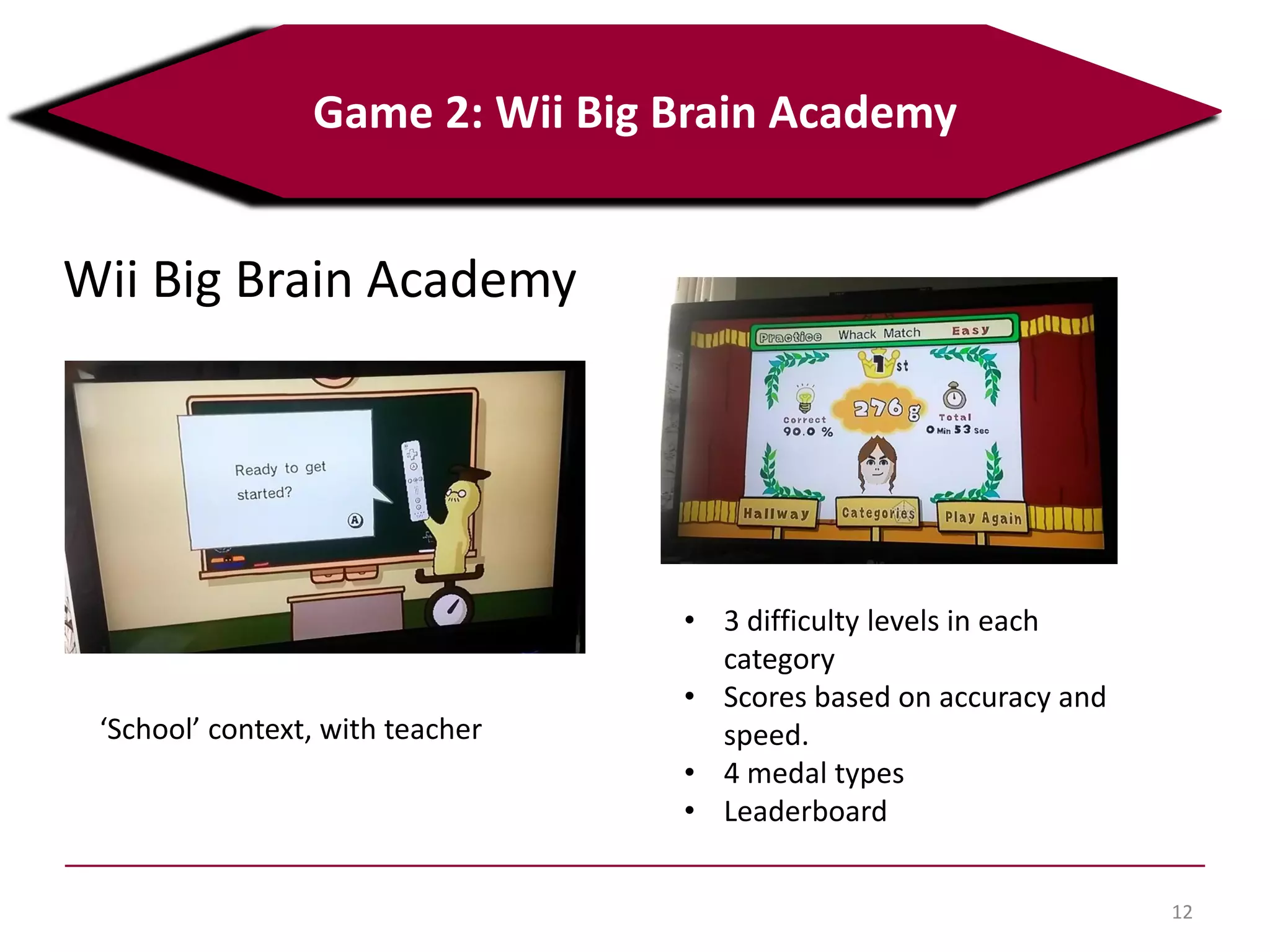
Game 2: Wii Big Brain Academy
Wii Big Brain Academy
‘School’ context, with teacher
• 3 difficulty levels in each
category
• Scores based on accuracy and
speed.
• 4 medal types
• Leaderboard
13
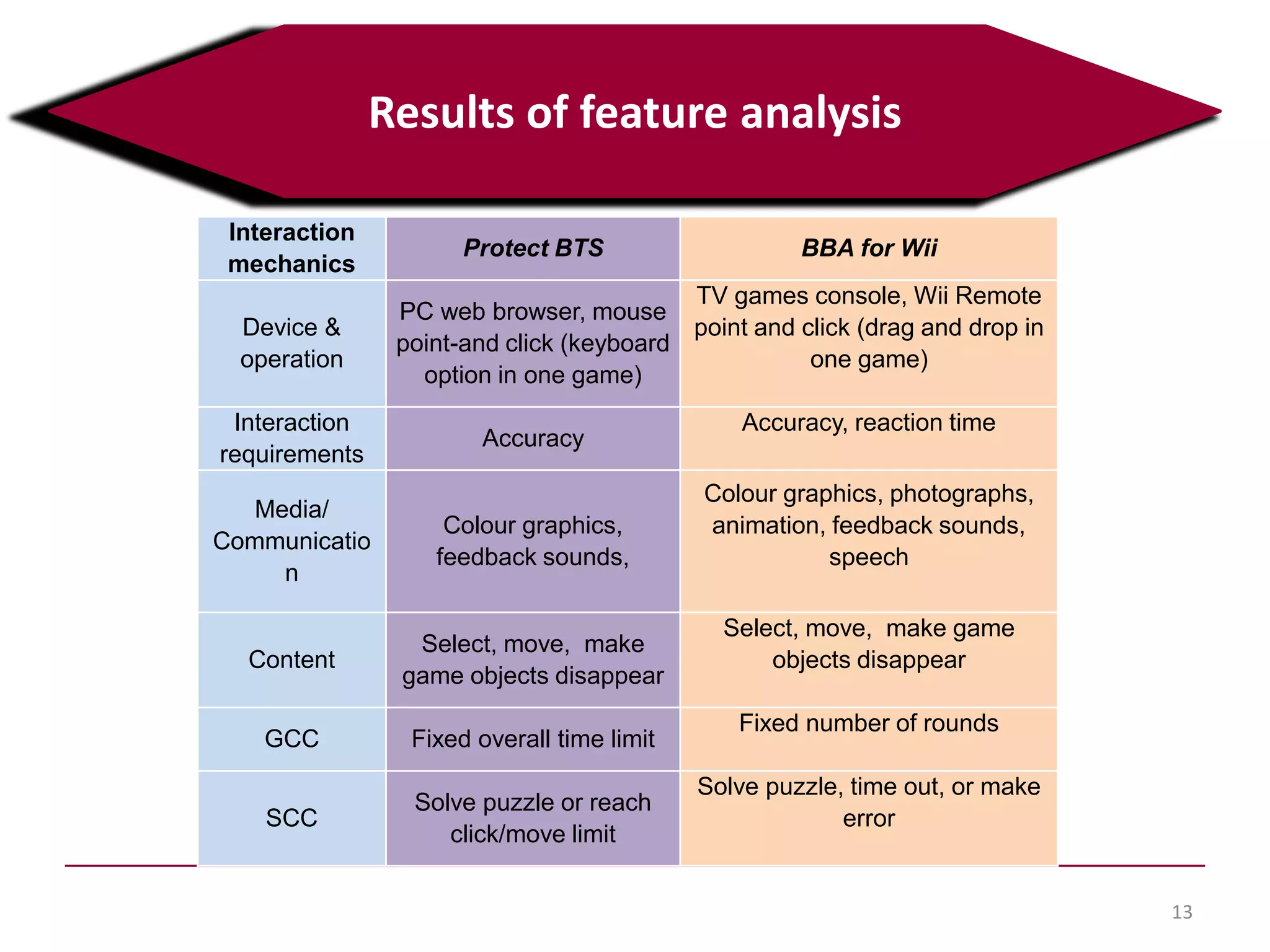
Results of feature analysis
Interaction
mechanics
Protect BTS BBA for Wii
Device &
operation
PC web browser, mouse
point-and click (keyboard
option in one game)
TV games console, Wii Remote
point and click (drag and drop in
one game)
Interaction
requirements
Accuracy
Accuracy, reaction time
Media/
Communicatio
n
Colour graphics,
feedback sounds,
Colour graphics, photographs,
animation, feedback sounds,
speech
Content
Select, move, make
game objects disappear
Select, move, make game
objects disappear
GCC Fixed overall time limit
Fixed number of rounds
SCC
Solve puzzle or reach
click/move limit
Solve puzzle, time out, or make
error
14
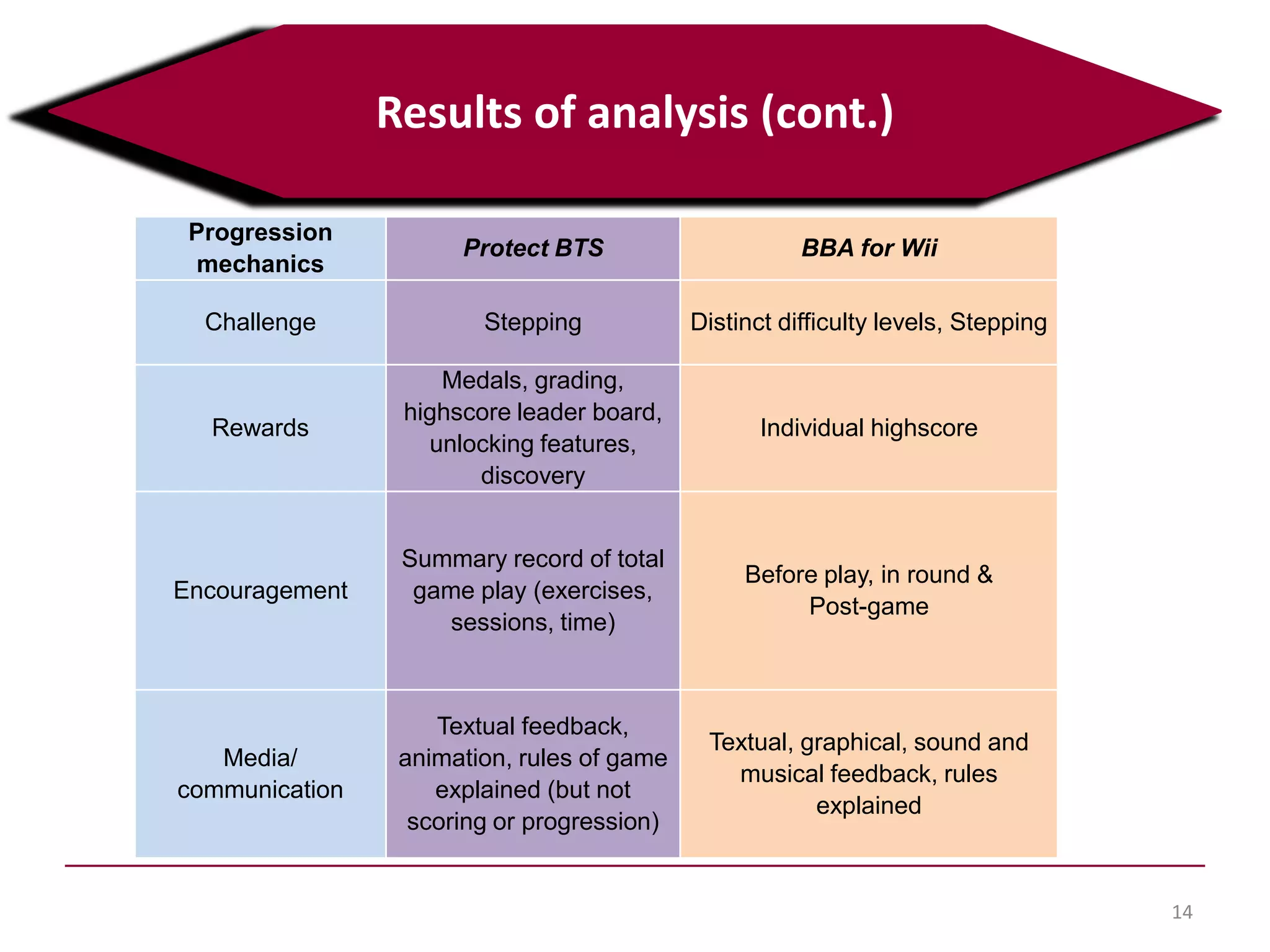
Results of analysis (cont.)
Progression
mechanics
Protect BTS BBA for Wii
Challenge Stepping Distinct difficulty levels, Stepping
Rewards
Medals, grading,
highscore leader board,
unlocking features,
discovery
Individual highscore
Encouragement
Summary record of total
game play (exercises,
sessions, time)
Before play, in round &
Post-game
Media/
communication
Textual feedback,
animation, rules of game
explained (but not
scoring or progression)
Textual, graphical, sound and
musical feedback, rules
explained
15
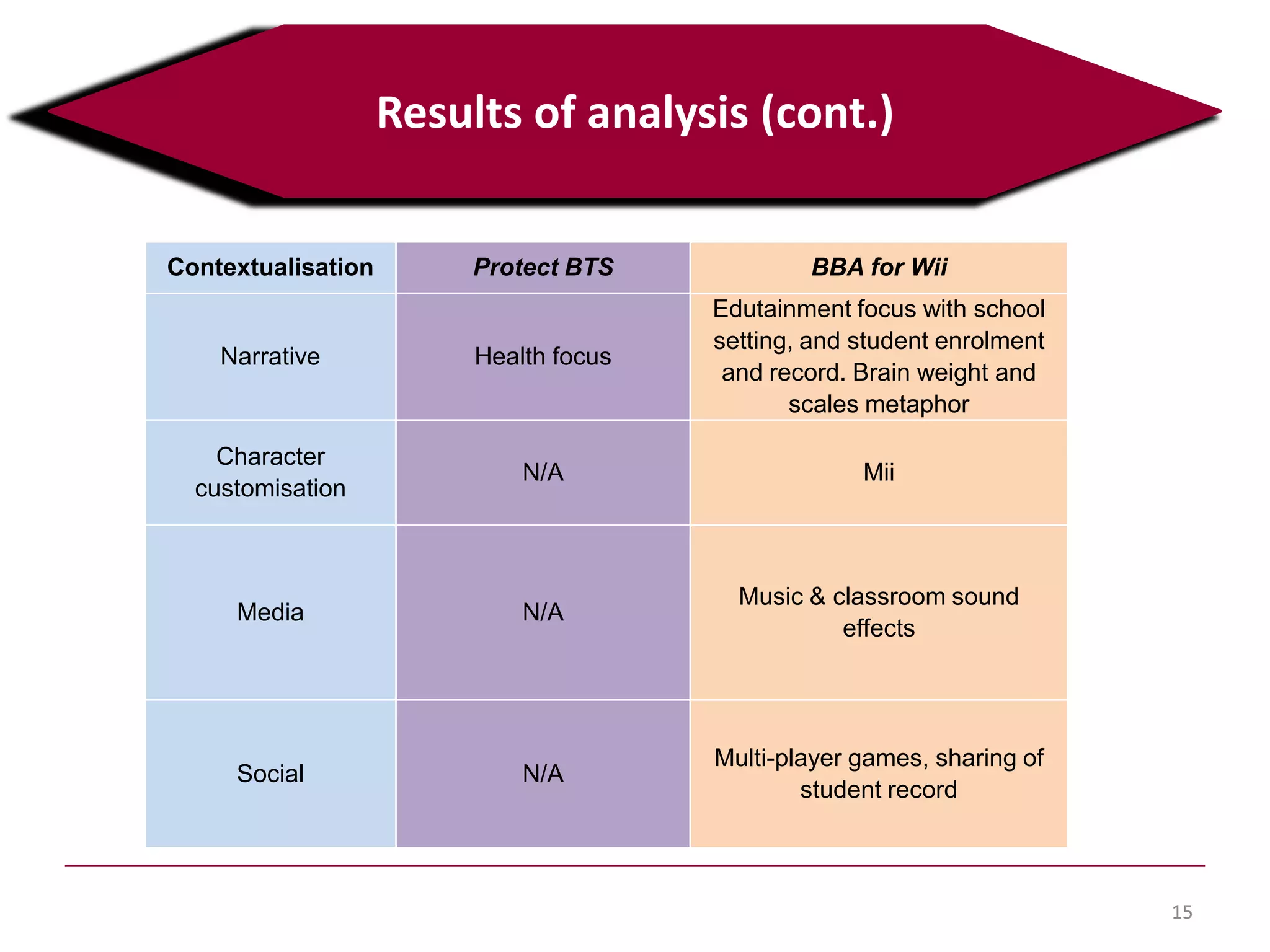
Results of analysis (cont.)
Contextualisation Protect BTS BBA for Wii
Narrative Health focus
Edutainment focus with school
setting, and student enrolment
and record. Brain weight and
scales metaphor
Character
customisation
N/A Mii
Media N/A
Music & classroom sound
effects
Social N/A
Multi-player games, sharing of
student record
16
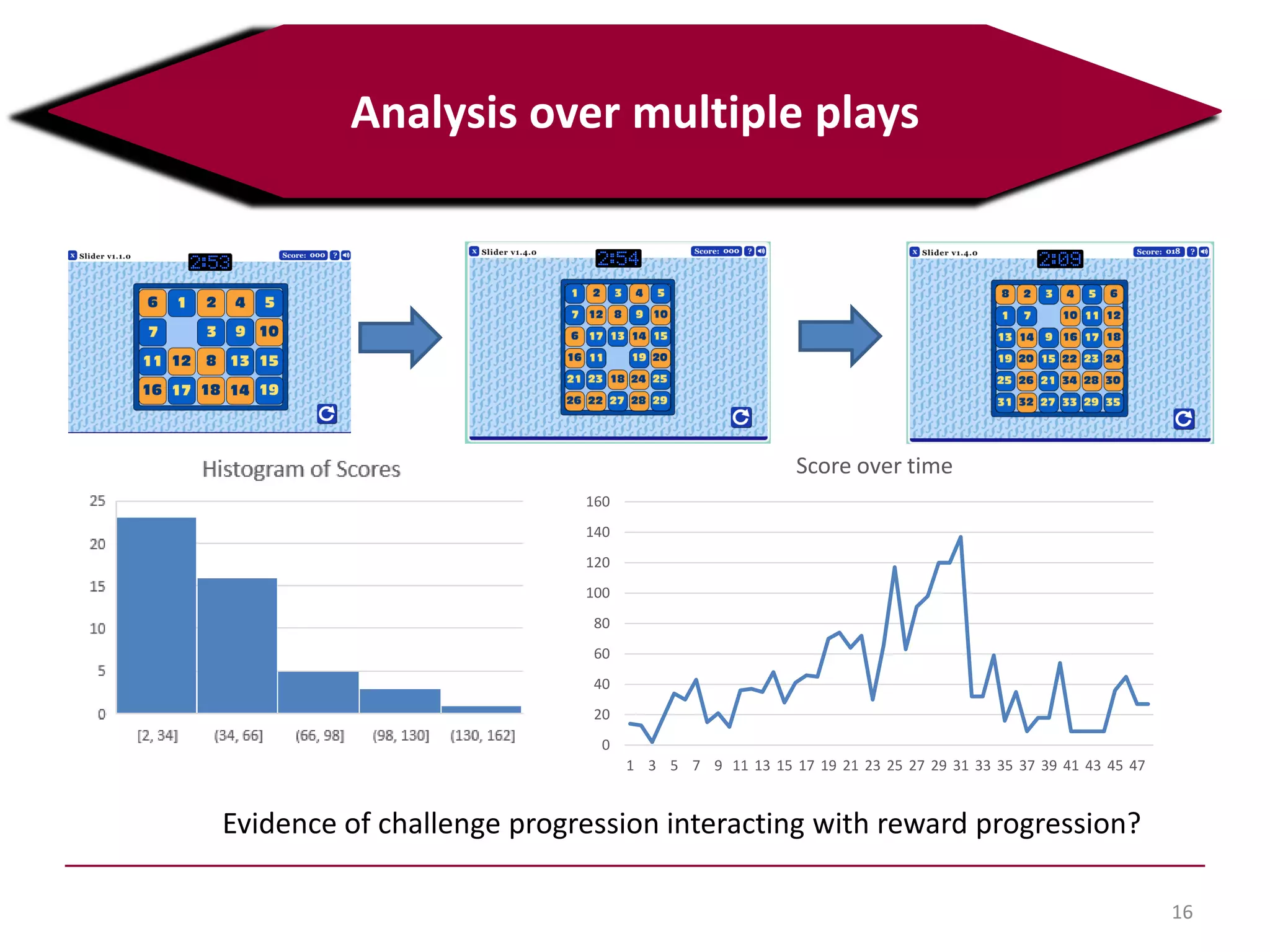
Analysis over multiple plays
0
20
40
60
80
100
120
140
160
1 3 5 7 9 11 13 15 17 19 21 23 25 27 29 31 33 35 37 39 41 43 45 47
Score over time
Evidence of challenge progression interacting with reward progression?
17
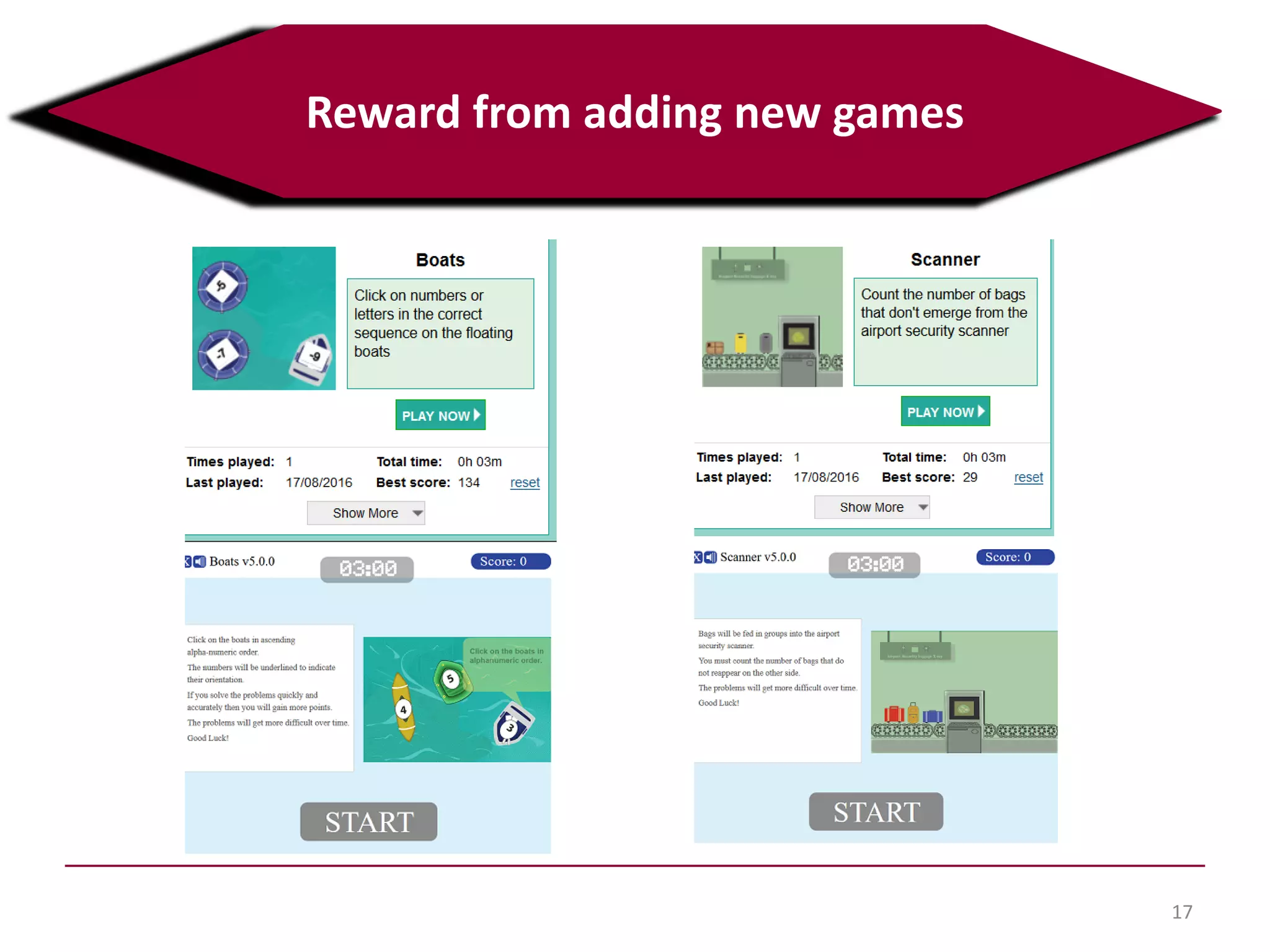
Reward from adding new games
18
Conclusions and next steps
Summary
• Leisure game: enhanced richness higher intrinsic motivation and facilitation
of internalisation/integration of extrinsic motivations
 Enhanced possibilities for autonomy, competence, relatedness
• Protect: positive extrinsic motivations likely to be internalised/integrated, and
facilitate integration/internalisation of further extrinsic motivations
 Health goal clearly associated with the study
 Altruistic motivation to contribute to research through engaging in a trial
• Similarities in gameplay systems:interaction affordances facilitating players’
control and support mastery development
 Affordances for competence
19
Conclusions and next steps
Future work
• Structured framework for game analysis to systematically define game
mechanics, identify elements promoting engagement, and interpret their
relative importance
– Which activities/mechanics afford or hamper engagement and intrinsic
motivations, and which facilitate integration and internalisation of extrinsic
motivations?
• Testing of mechanics through user studies and expert reviews
– Involvement of users, game designers and healthcare experts
• Deeper study of needs of health and cognitive psychology professionals in
relation to opportunities offered by assistive technologies such as games
• Investigation of effects and appropriateness of game activities and mechanics
for people with specific cognitive impairments
Thank you
Any questions?

Game features of cognitive training (Michael P. Craven and Carlo Fabricatore)

  • 1.
    Game features ofCognitive Training Michael P. Craven NIHR MindTech Healthcare Technology Cooperative Institute of Mental Health, University of Nottingham www.mindtech.org.uk @NIHR_MindTech Carlo Fabricatore Pro-Social Immersive Technologies (PSiT) incubator School of Computing and Engineering, University of Huddersfield
  • 2.
    1. Introduction toCognitive Training 2. Potential for games in cognitive improvement 3. Motivational theory 4. Study of game features in two Cognitive Games – PROTECT ‘brain training’ trial – Wii Big Brain Academy 5. Conclusions 2 Contents
  • 3.
    • Aimed atolder adults • Exercising cognitive functions – Planning – Reasoning – Memory – Mathematical ability • Evidence – RCT showing significant improvement in instrumental activities of daily living (IADL) in adults over 60 and benefits in adults over 50 on from weekly playing of online games, incl. adults with low baseline scores. – Evidence of benefits from cognitive stimulation and computer/internet use in general 3 Introduction to Cognitive Training
  • 4.
    • Games asactivity systems – Organised interaction processes aimed at the fulfilment of goals… – Overcoming challenges… – Interacting with gameplay tokens… – Based on mechanics governing player interaction, progression and non-player controlled events… • Design for the purpose beyond leisure – Activity systems designed to fulfill healthcare requirements • Design for engagement – Activity system designed to trigger and sustain player affective, cognitive and behavioural involvement • Healthfulness requirements vs. engagment affordancces – Importance of voluntary engagement and adherence for game-based interventions 4 Gaming with a purpose
  • 5.
    Motivation as keydriver of voluntary engagement Intrinsic motivation “Things” are done by free choice because they are inherently satisfying (e.g. watching a movie; playing a game “just for fun”) Extrinsic motivation “Things” are done because they are means to an end, and serve to fulfil objectives “external” to the activity performed (e.g. working to earn a salary; playing a game to improve health) Internalisation & integration of extrinsic motivations Extrinsic motivations “appropriated” to some extent, accepted and embraced as personally significant (e.g. playing a game to improve health because its importance is understood) 5 Motivational theory
  • 6.
    Basic psychological needs Autonomy:volitional behaviours leading to psychological freedom Competence: effectiveness interacting with environment Relatedness: establishing meaningful relationships with others Cognitive evaluation theory SDT Perceived autonomy, competence and relatedness define intrinsic motivation and facilitate internalization/integration of extrinsic motivations Contextual factors that support or thwart intrinsic motivation and internalization/integration of extrinsic motivations (e.g. provisions for choice, non-controlling environment, use of rewards, self-monitoring and self-organization of performance, relevance of rewards, etc.) 6 Self-determination theory (SDT)
  • 7.
    Interaction mechanics PC orconsole & controllers, media content, GUI Player requirements for interaction e.g. accuracy Progression mechanics Objectives - completion conditions Progression rules – stepping, difficulty levels Rewards & Encouragement e.g. scores, badge Contextualisation Purpose Narrative 7 Game elements
  • 8.
    Examine two games & drawout game mechanics (interaction & progression) and contextual features 8 Game element study Inform improved game design Assessment of elements used and potential for improvement Purpose Determine and contrast range of mechanics used Method Use SDT framework to extract motivation related aspects
  • 9.
    Protect ‘brain training’study – mini games 9 Game 1: Protect BTS Example mini-game - Planning task Source: http://protectstudy.org.uk/ • Equally timed mini-games • Score based on number of successful rounds in 3 minute • Stepped difficulty based on historical performance
  • 10.
    Reasoning task 10 Game 1:Protect BTS (cont.) Memory task Mathematics task
  • 11.
    11 Game 2: WiiBig Brain Academy Wii Big Brain Academy • TV games console • Hand-held wireless remote controller • Point and click interaction • 5 game categories to choice from
  • 12.
    12 Game 2: WiiBig Brain Academy Wii Big Brain Academy ‘School’ context, with teacher • 3 difficulty levels in each category • Scores based on accuracy and speed. • 4 medal types • Leaderboard
  • 13.
    13 Results of featureanalysis Interaction mechanics Protect BTS BBA for Wii Device & operation PC web browser, mouse point-and click (keyboard option in one game) TV games console, Wii Remote point and click (drag and drop in one game) Interaction requirements Accuracy Accuracy, reaction time Media/ Communicatio n Colour graphics, feedback sounds, Colour graphics, photographs, animation, feedback sounds, speech Content Select, move, make game objects disappear Select, move, make game objects disappear GCC Fixed overall time limit Fixed number of rounds SCC Solve puzzle or reach click/move limit Solve puzzle, time out, or make error
  • 14.
    14 Results of analysis(cont.) Progression mechanics Protect BTS BBA for Wii Challenge Stepping Distinct difficulty levels, Stepping Rewards Medals, grading, highscore leader board, unlocking features, discovery Individual highscore Encouragement Summary record of total game play (exercises, sessions, time) Before play, in round & Post-game Media/ communication Textual feedback, animation, rules of game explained (but not scoring or progression) Textual, graphical, sound and musical feedback, rules explained
  • 15.
    15 Results of analysis(cont.) Contextualisation Protect BTS BBA for Wii Narrative Health focus Edutainment focus with school setting, and student enrolment and record. Brain weight and scales metaphor Character customisation N/A Mii Media N/A Music & classroom sound effects Social N/A Multi-player games, sharing of student record
  • 16.
    16 Analysis over multipleplays 0 20 40 60 80 100 120 140 160 1 3 5 7 9 11 13 15 17 19 21 23 25 27 29 31 33 35 37 39 41 43 45 47 Score over time Evidence of challenge progression interacting with reward progression?
  • 17.
  • 18.
    18 Conclusions and nextsteps Summary • Leisure game: enhanced richness higher intrinsic motivation and facilitation of internalisation/integration of extrinsic motivations  Enhanced possibilities for autonomy, competence, relatedness • Protect: positive extrinsic motivations likely to be internalised/integrated, and facilitate integration/internalisation of further extrinsic motivations  Health goal clearly associated with the study  Altruistic motivation to contribute to research through engaging in a trial • Similarities in gameplay systems:interaction affordances facilitating players’ control and support mastery development  Affordances for competence
  • 19.
    19 Conclusions and nextsteps Future work • Structured framework for game analysis to systematically define game mechanics, identify elements promoting engagement, and interpret their relative importance – Which activities/mechanics afford or hamper engagement and intrinsic motivations, and which facilitate integration and internalisation of extrinsic motivations? • Testing of mechanics through user studies and expert reviews – Involvement of users, game designers and healthcare experts • Deeper study of needs of health and cognitive psychology professionals in relation to opportunities offered by assistive technologies such as games • Investigation of effects and appropriateness of game activities and mechanics for people with specific cognitive impairments
  • 20.