- The document discusses how ServiceNow's platform can help organizations realize a digital strategy by implementing IT4IT, an open standard for digital transformation.
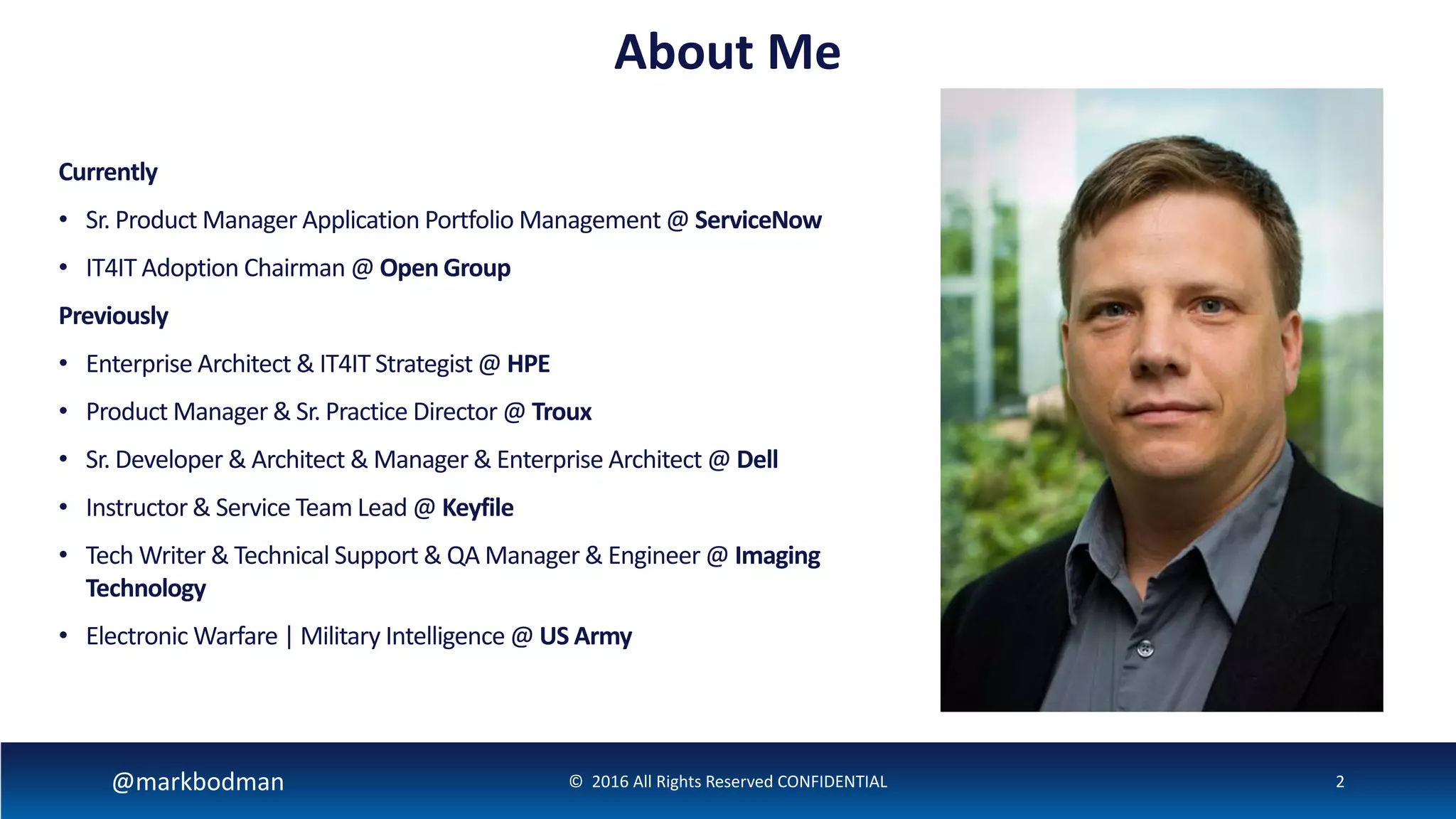
- It provides an overview of the speaker's background and experience in IT management.
- The presentation covers how ServiceNow supports all areas of IT4IT, including strategy to portfolio, requirement to deploy, request to fulfill, and detect to correct workflows. It also discusses ServiceNow's integration with Zenoss for IT monitoring.
Create Your LightspeedEnterprise™ With ServiceNow
Platform
Cloud Infrastructure
BUSINESS APPSIT SECURITY HRCUSTOMER SERVICE
HR
SECURITY
BUSINESS
APPS
CUSTOMER
SERVICE
IT
The Lightspeed Enterprise™
Change
Discovered CIs
Events andAlerts
Service-Oriented
Service Management
Infrastructure-Oriented
Operations Management
Service Catalog
Incident Problem
Servers Applications Storage
Virtualization Cloud NetworkCMDB
Service-aware
10.
IT Business ManagementProduct Overview
ServiceNow is the Only Company Able to Bring Together Strategic Planning for All the Technology Portfolios
Demand
Management
Resource
Management
Test
Management
Project
Portfolio
Agile
Development
Cost
Transparency
Project and Portfolio
Management
IT Financial
Management
Financial
Planning
Portfolio Delivery
Execution
Application
Portfolio
Application
Portfolio Management
New in Istanbul
Gain Financial and
Portfolio Visibility
Align Portfolio
Goals
Accelerate
Delivery
End-to-End IT Transformation
Consolidateonto a single cloud platform
Maximize availability via service-awareness
Provide a seamless user experience
Improve performance with analytics
Increase speed, lower costs, and align to business priorities
13.
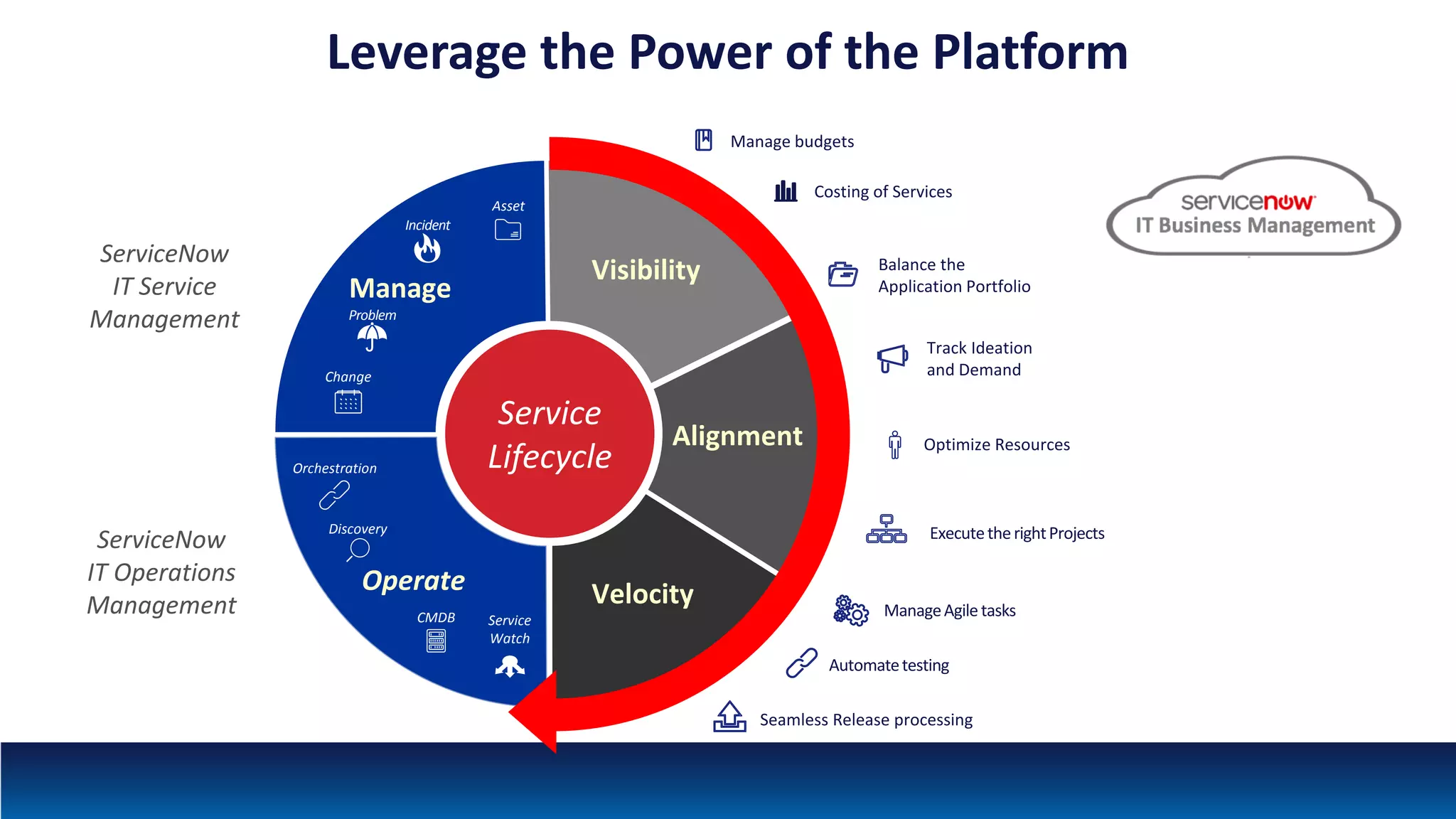
Leverage the Powerof the Platform
Service
Lifecycle
Manage
Change
Incident
Problem
Asset
ServiceNow
IT Service
Management
Operate
CMDB Service
Watch
Orchestration
Discovery
ServiceNow
IT Operations
Management
Visibility
Automatetesting
Velocity ManageAgile tasks
Balance the
Application Portfolio
Manage budgets
Track Ideation
and Demand
Optimize Resources
ExecutetherightProjects
Alignment
Seamless Release processing
Costing of Services
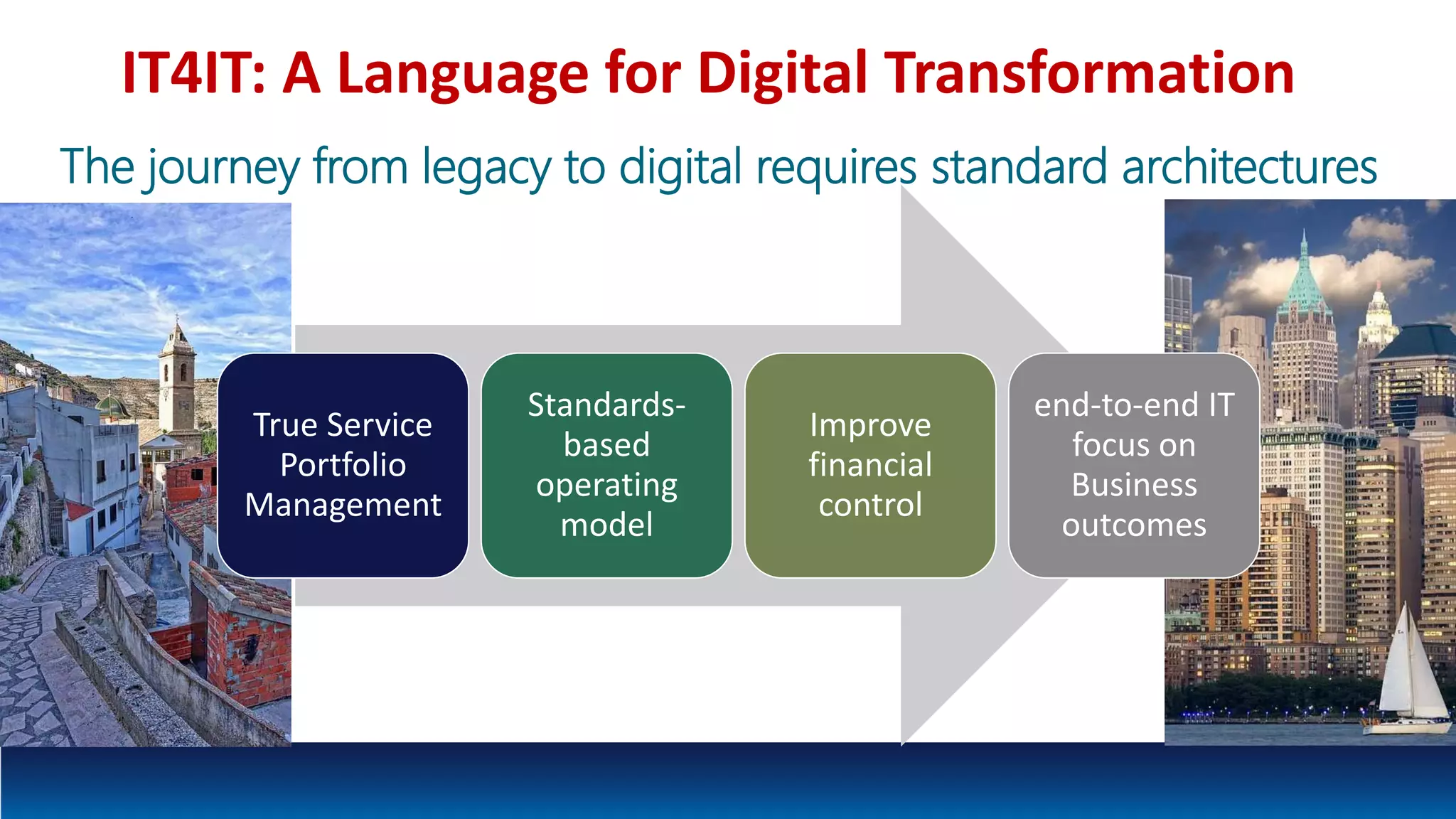
IT4IT: A Languagefor Digital Transformation
True Service
Portfolio
Management
Standards-
based
operating
model
Improve
financial
control
end-to-end IT
focus on
Business
outcomes
The journey from legacy to digital requires standard architectures
16.
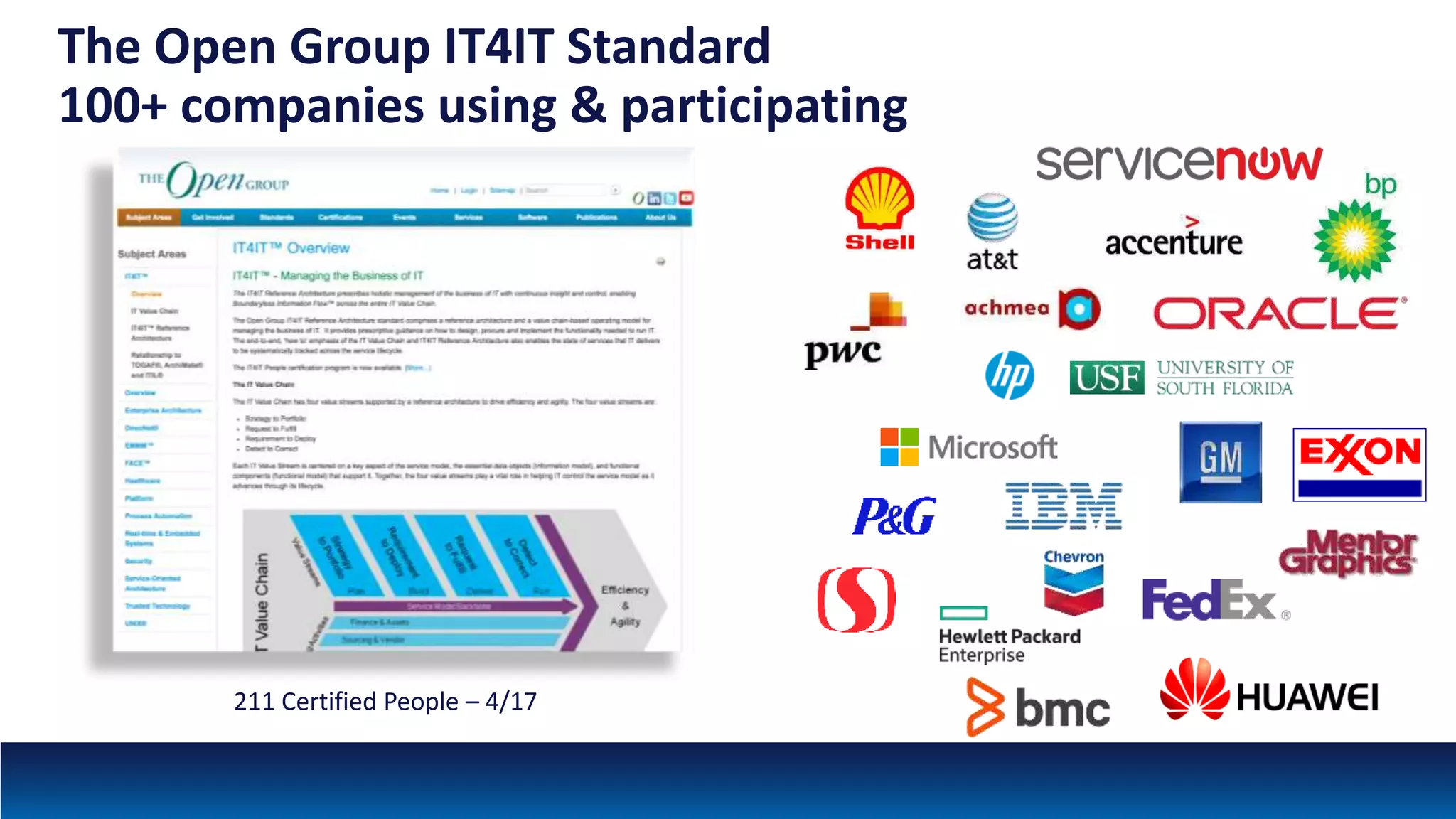
The Open GroupIT4IT Standard
100+ companies using & participating
211 Certified People – 4/17
17.
Efficient
Agile
IT4IT Reference Architecturefor IT organizations
•Improved strategic alignment
•Respond to changing markets
•Reduce risk
•Faster time to market
•Supports transparency
•Value based cost controls
•Fast issue resolution
•Feedback to strategy
•Improved services
•Pay as you go pricing model
•Catalog offerings
•Transparent pricing
18.
IT4ITTM Value Streams
ResolveDiagnoseDetectChange
Detect to Correct - Run
MeasureSubscribe
Design &
Publish
Fulfill
Request to Fulfill - Deliver
Selection
Service
Portfolio
Strategy Demand
Strategy to Portfolio - Plan
DeployDevelop
Plan &
Design
Test
Requirement to Deploy - Build
19.
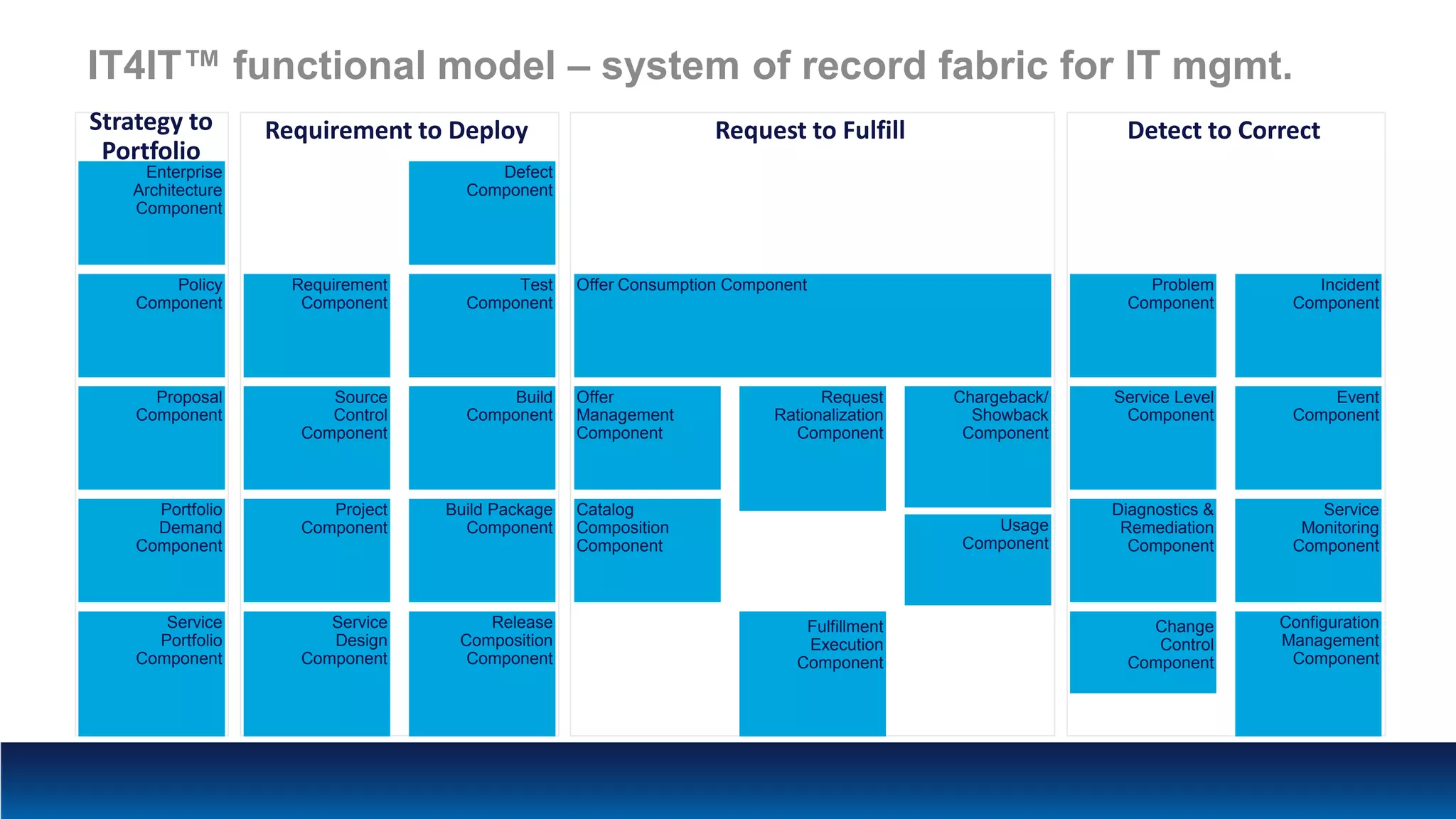
IT4IT™ functional model– system of record fabric for IT mgmt.
Policy
Component
Requirement
Component
Test
Component
Offer Consumption Component Problem
Component
Incident
Component
Proposal
Component
Source
Control
Component
Build
Component
Offer
Management
Component
Request
Rationalization
Component
Chargeback/
Showback
Component
Service Level
Component
Event
Component
Portfolio
Demand
Component
Project
Component
Build Package
Component
Catalog
Composition
Component
Change
Control
Component
Usage
Component
Diagnostics &
Remediation
Component
Service
Monitoring
Component
Enterprise
Architecture
Component
Defect
Component
Service
Portfolio
Component
Service
Design
Component
Release
Composition
Component
Configuration
Management
Component
Fulfillment
Execution
Component
Strategy to
Portfolio
Requirement to Deploy Request to Fulfill Detect to Correct
20.
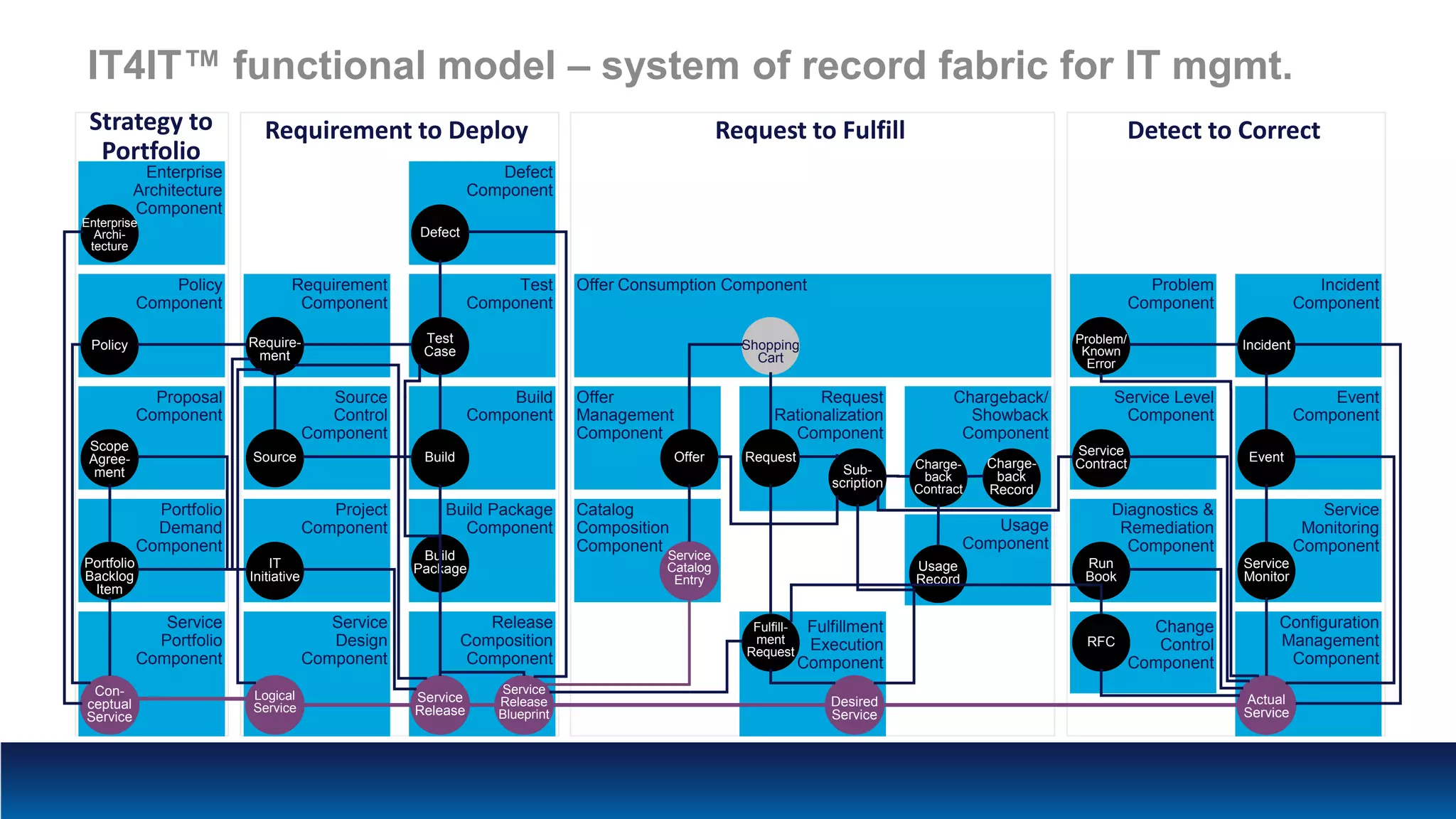
IT4IT™ functional model– system of record fabric for IT mgmt.
Policy
Component
Requirement
Component
Test
Component
Offer Consumption Component Problem
Component
Incident
Component
Proposal
Component
Source
Control
Component
Build
Component
Offer
Management
Component
Request
Rationalization
Component
Chargeback/
Showback
Component
Service Level
Component
Event
Component
Portfolio
Demand
Component
Project
Component
Build Package
Component
Catalog
Composition
Component
Change
Control
Component
Usage
Component
Diagnostics &
Remediation
Component
Service
Monitoring
Component
Enterprise
Architecture
Component
Defect
Component
Service
Portfolio
Component
Service
Design
Component
Release
Composition
Component
Configuration
Management
Component
Fulfillment
Execution
Component
Policy Require-
ment
Test
Case
Problem/
Known
Error
Incident
Scope
Agree-
ment
Source
Charge-
back
Contract
Build Offer
Sub-
scription
Service
Contract Event
Portfolio
Backlog
Item
IT
Initiative
Build
Package
Service
Catalog
Entry
RFC
Usage
Record
Run
Book
Service
Monitor
Enterprise
Archi-
tecture
Defect
Request
Fulfill-
ment
Request
Charge-
back
Record
Shopping
Cart
Con-
ceptual
Service
Logical
Service
Service
Release
Blueprint
Actual
Service
Desired
Service
Service
Release
Strategy to
Portfolio
Requirement to Deploy Request to Fulfill Detect to Correct
Comprehensive IT4ITTM Coverage– On One Platform
IT Business Management
IT Operations Management
IT Service Management
ResolveDiagnoseDetect Change
Detect to Correct - Run
MeasureSubscribe
Design &
Publish
Fulfill
Request to Fulfill - Deliver
Selection
Service
Portfolio
Strategy Demand
Strategy to Portfolio - Plan
DeployDevelop
Plan &
Design
Test
Requirement to Deploy - Build
Platform
23.
ServiceNow Supports Strategyto Portfolio
IT4IT™ is a trademark of The Open Group
Enterprise Architecture Service Portfolio
Policy
Portfolio Demand Proposal
Problem
Service Design
Requirement
IT Investment Portfolio
Project
IT Asset
Management
Cost Modeling
Business Process
Backlog
Portfolio
Item
Backlog Portfolio Item
Conceptual
Service
Portfolio Backlog
Item (rationalized/
prioritized)
Policy
Scope Agreement
Asset
(availability)
Competency
(availability)
Service Model
Business Strategy
(External to IT)
ChargeBack/ShowBack
Chargeback Record
Labor
Management
Finance
(External to IT)
Approved IT Budget
IT Budget Request
Estimated Asset & Labor Cost
Estimated Asset and Labor Configuration
Estimated
Budget
Scoping and investment Decision
Budget for run operations
Actual Spend
Development Spend
Development Scope & Budget
Portfolio
Backlog Item
Applied Models
Scoping &
Investment
Decisions
Proposed IT
Investments
Offer Management
APM APM SPM GRC
ITFMITFM
PPM ITFM
PPMPPMPPMBRM
ITSMAMHRITSM
●
●
◕
◕
◕
◑
◔
◑
◕
●
●
◕
●
◔
◑
◕
24.
ServiceNow Supports Requirementto Deploy
IT4IT™ is a trademark of The Open Group
Requirement
Component
Test Component Defect Component
Release
Composition
Service Design Component
Project Component Source Control
Component
Build Component
Build Package
Component
Proposal Component
Request
Rationalization
Component
Chargeback /
Showback
Component
Service Portfolio
Component
Policy Component
Portfolio Component Problem
Component
Catalog Component
Component
Fulfilment Execution
Component
Service Level
Component
Change Control
Component
Requirement
Service Catalog Entry (Unbound)
Defect
Defect
Defect
Release Package
RFC
RFC (normal)
Service Contract (Template)
Development
Spend
IT
Initiative
Development
Scope & Budget
Chargeback
Record
Request
Scope Agreement
Development Spend
PPM
PPM
ITSM
ITFM
ITSM
ITSM
ITSM ITOM
ITSM
GRC
SPM
ITSM
ITSM
25.
ServiceNow Supports Requestto Fulfill
IT4IT™ is a trademark of The Open Group
Catalog Composition
Component
Fulfillment Execution
Component
Request Rationalization
Component
Offer Mgmt.
Component
Offer Consumption Component
Chargeback/Showback
Component
Usage
Component
Proposal
Component
Service Level
Component
Project Component
Service Monitoring
Component
Engagement
Experience Portal
Knowledge &
Collaboration
Component
Incident
Component
Service
Portfolio
Component
IT Asset
Management
Fulfillment Engine &
Deploy/Provision
Systems
Configuration
Management
Component
Change Control
Component
Release Composition
Component
Sourcing &
Vendor
Management
(External to IT)
Finance
(External to IT)
Estimated
Labor &
Asset Cost
Estimated Labor
& Asset
Configuration
Service Catalog
Entry (Bound)
Composite Compound
Request
Service Level Status
Status
Chargeback
Record
Request
Service
Monitor
Usage
Chargeback
Record
Chargeback
Record
Chargeback
Record
Knowledge
Conversation
Incident
Request
Usage
Invoice
CostRequestRequest
Actual
Service
RFC
Service Catalog
Entry (Unbound)
Release
Package
Shopping Cart
Subscription
ITSM
ITSM
ITSMITSM ITSM ITFM
ITSMITSM
PPM
ITSM
ITFM
ITSM
ITSMITSM
PPM
ITAM
26.
ServiceNow Supports Detectto Correct
IT4IT™ is a trademark of The Open Group
Service Monitoring
Component
Event
Component
Incident
Component
Service Level
Component
Problem
Component
Change Control
Component
Diagnostics &
Remediation
Component
Configuration
Management
Component
Self-Service
Support
Defect Component
Request Rationalization
Component
Release Composition
Component
Usage
Component
Offer
Consumption
Component
Service Discovery
Fulfillment Execution
Component
Knowledge & Collaboration
Component
Service
Monitor
Actual Service
Actual
Service
Run Book
Run Book
Run Book
Incident ProblemEvent
Incident
RFC
RFC
Defect
RFC
Knowledge
RFC
Usage
Status
Business / IT
Measurement
Service
Contract
(Instance)
Service
Contract
(Template)
Service Level Status
ITOM ITSM ITSM
ITSM
ITOM ITOM ITSM
ITSM
ITOM
ITSM
PPM
ITOM
ITSM
ITSM
ITSM
ITSM
ServiceNow Supports Detectto Correct
IT4IT™ is a trademark of The Open Group
Service Monitoring
Component
Event
Component
Incident
Component
Service Level
Component
Problem
Component
Change Control
Component
Diagnostics &
Remediation
Component
Configuration
Management
Component
Self-Service
Support
Defect Component
Request Rationalization
Component
Release Composition
Component
Usage
Component
Offer
Consumption
Component
Service Discovery
Fulfillment Execution
Component
Knowledge & Collaboration
Component
Service
Monitor
Actual Service
Actual
Service
Run Book
Run Book
Run Book
Incident ProblemEvent
Incident
RFC
RFC
Defect
RFC
Knowledge
RFC
Usage
Status
Business / IT
Measurement
Service
Contract
(Instance)
Service
Contract
(Template)
Service Level Status
ITOM ITSM ITSM
ITSM
ITOM ITOM ITSM
ITSM
ITOM
ITSM
PPM
ITOM
ITSM
ITSM
ITSM
ITSM
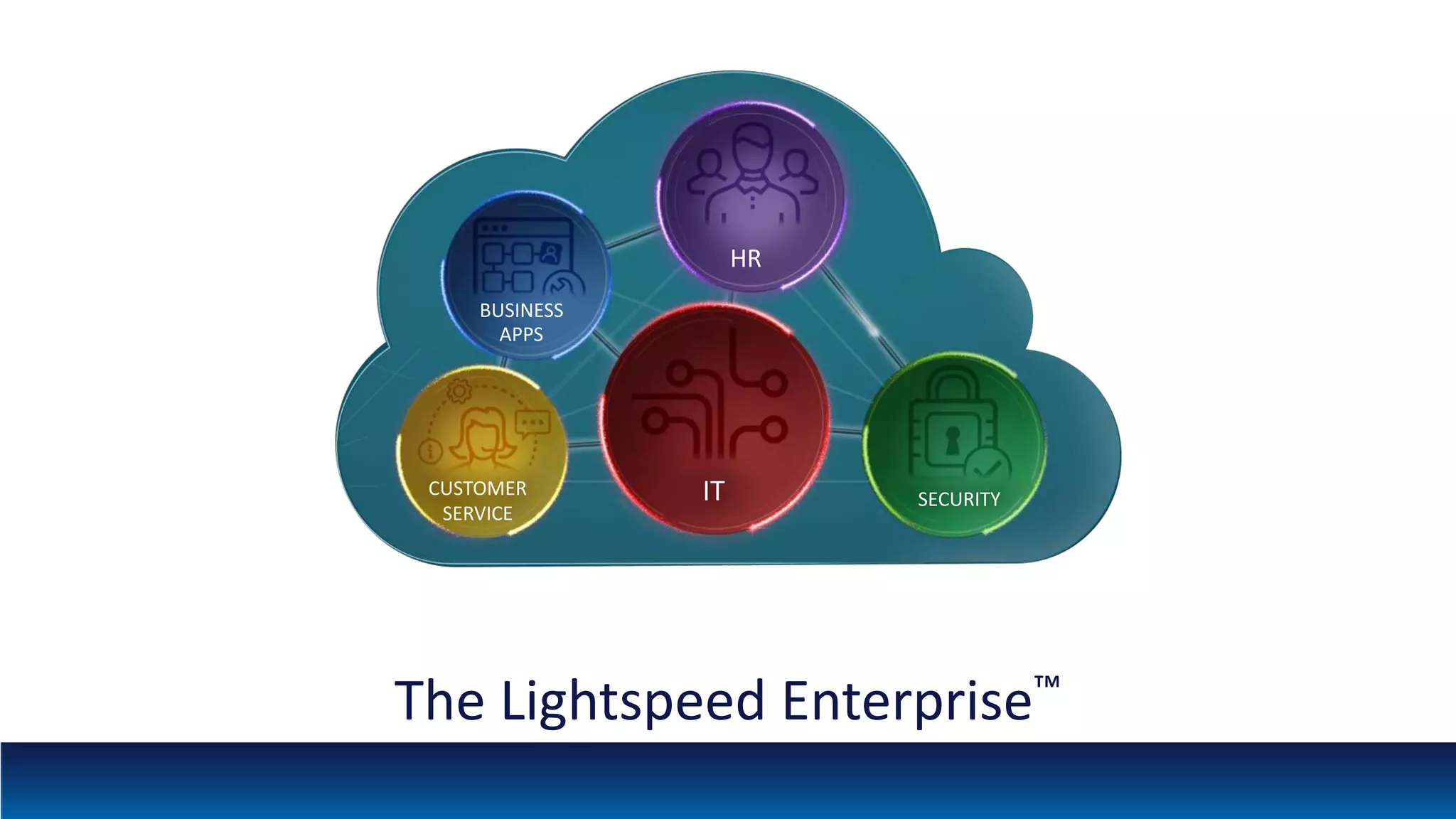
#7 This is what we call the Lightspeed Enterprise and ServiceNow can help you work at Lightspeed.
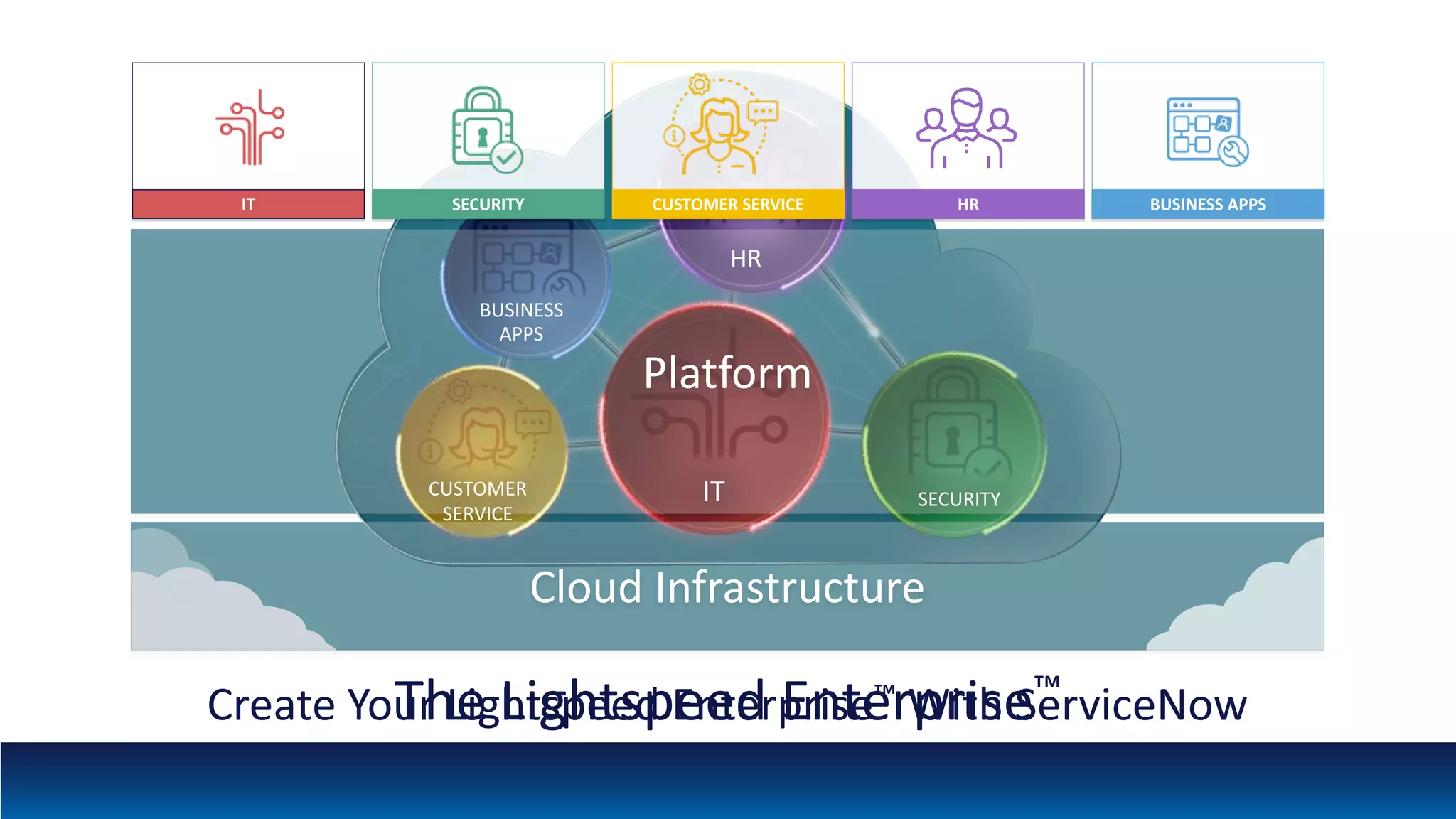
#8 ServiceNow provides IT services for 5 key areas of your business – IT, Security Operations, Customer Service, HR and building business applications.
IT can increase agility and lower costs by consolidating legacy tools into a modern, easy-to-use service management solution in the cloud.
Security can collaborate with IT to resolve real threats fast—using a structured response engine to prioritize and resolve incidents based on service impact.
Customer Service can drive case volume down, and customer loyalty up—by assessing product service health in real-time and working across departments to quickly remediate service issues.
HR can consumerize the employee service experience with self-service portals and get the insights they need to continually improve service delivery.
And any department can quickly build business applications to automate processes—with reusable components that help accelerate innovation.
All of these services help your organization make requests and fulfill those requests quickly. You can energize employees, increase service levels and get game changing economics with any of these services, but they are all built on a common platform and you can get unique value when you use them together.
For example, using security operations will help you resolve real security threats fast, but you can get better, business value-driven prioritization when you use Security with IT Operations Management. And, you can resolve security threats faster when you use Security Operations and IT Service Management.
Another great example is what happens when you use HR and and IT Service Management together so that you can automatically assign and fulfill IT tasks for employee onboarding and offboarding.
Finally, this is all on a cloud infrastructure. Let’s dig into the platform and infrastructure a bit more.
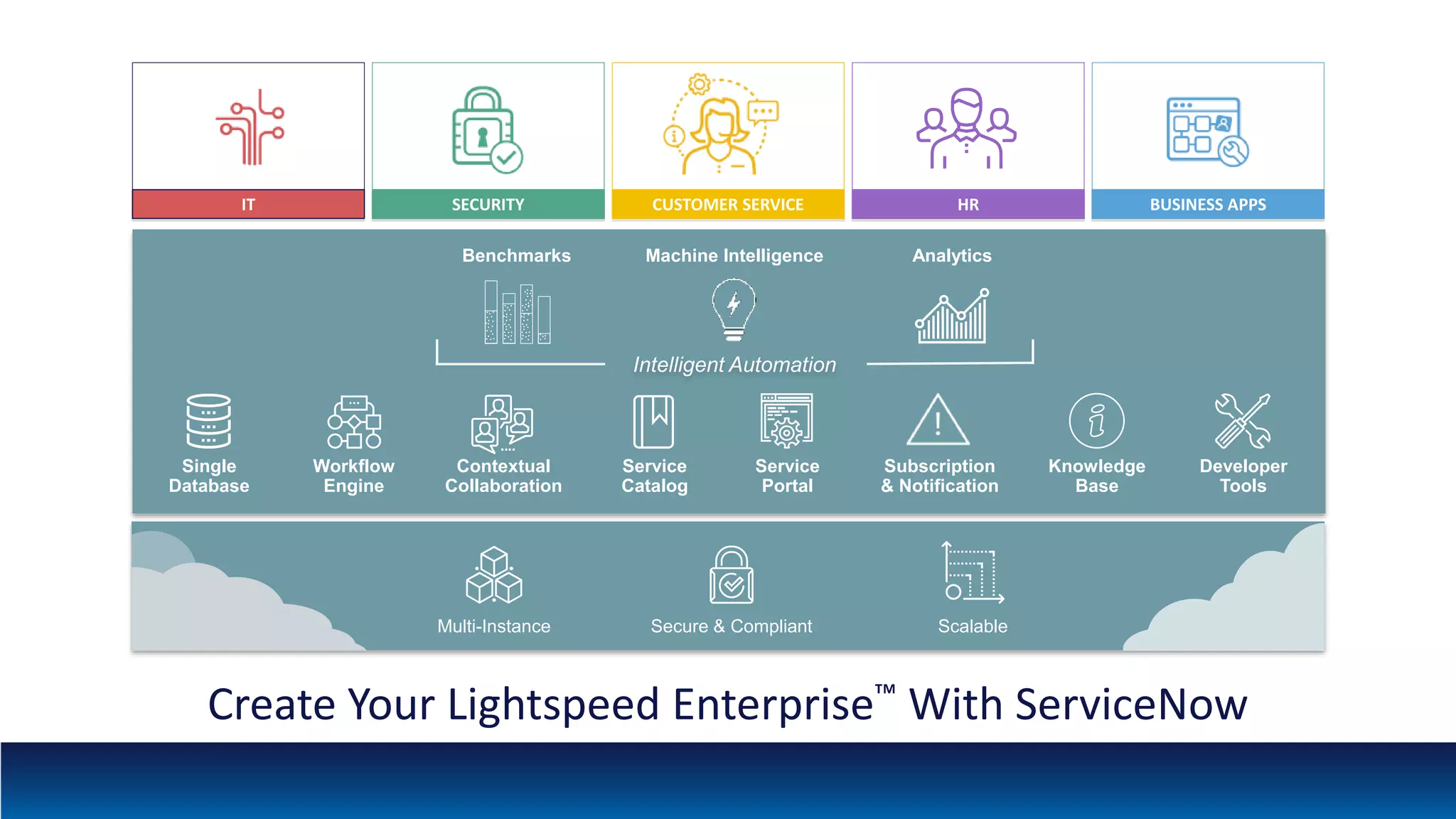
#9 The platform has a set of rich platform services that are common across all the applications.
ServiceNow Cloud infrastructure has a fundamentally different architecture. The other cloud providers operate in a multi-tenant architecture. What that means is that many customers share the same data base and application instance. This impacts the cloud provider's ability to trouble shoot or perform maintenance on the instance without severely impacting a wide range of customers. ServiceNow is a single-instance architecture. Meaning that each customer has their own data base and application set. We compliment this with 16 data centers across the globe that create 8 paired data centers. The paired data centers enable us to failover customers when issues arise or we are performing planned maintenance. This means that while we are working on your instance, you are able to still use it without seeing any change in performance.
In addition to the failover benefits, our 16 data centers are regional located across the globe to satisfy data sovereignty requirements. Having the compute source closer to the user also provides a faster connection speed to ensure your instance operates at light-speed.
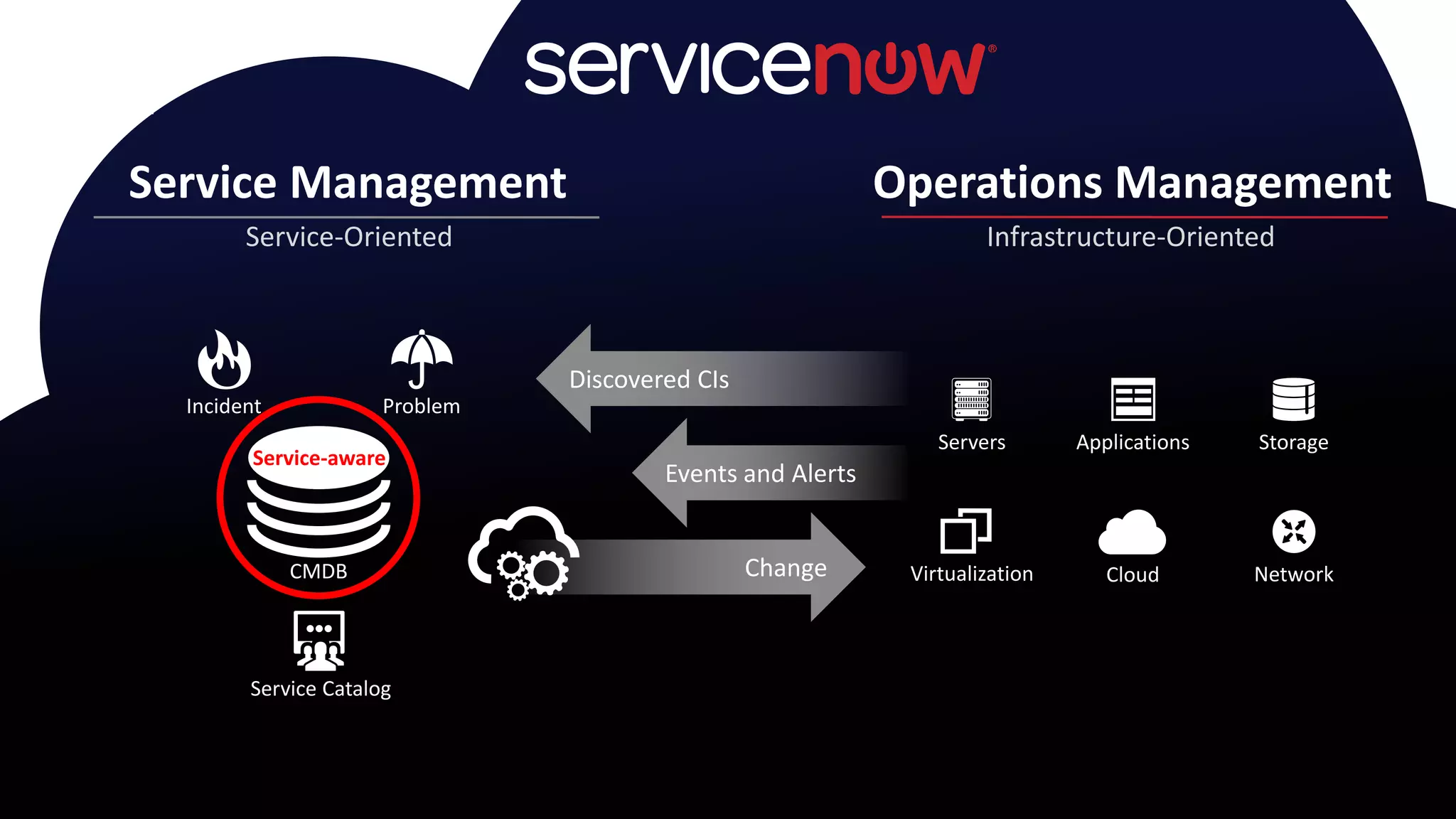
#10 The worlds of Service Management and Operations Management are separate today.
[CLICK]
ITOM connects ServiceNow ITSM to customers’ infrastructure and applications.
[CLICK]
But an ITOM solution, integrated with ITSM, with a service-aware CMDB at the center, can drive change back into that infrastructure – automated and more intelligently than ever.
We are setting out to change the ITOM game with a comprehensive, service-aware solution addressing IT Operations needs around visibility, availability, and agility.
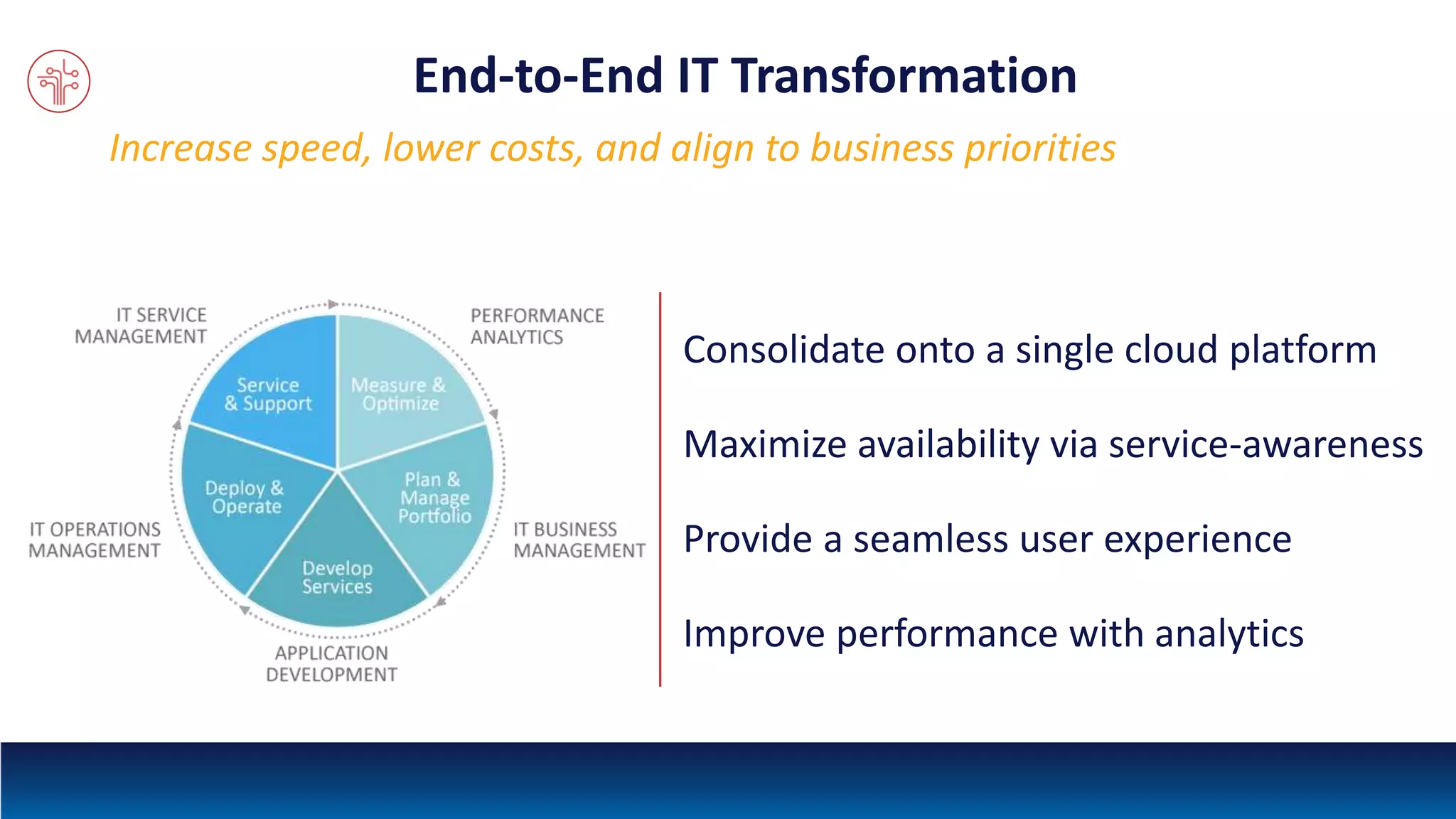
#13 ServiceNow provides applications for the complete set of IT functions, allowing you to realize End-to-End IT Transformation. We can help you…
Modernize IT Service Management with a single cloud-based platform. Your new service desk is up and running fast with built‑in ITIL best practices and guided setup. An easy‑to‑use service portal makes it painless for end users to submit and track requests without making a call. Prioritize and assign work with drag‑and‑drop Visual Task Boards. Gain control with complete IT service visibility, no infrastructure required.
Eliminate Service Outages by proactively identifying service issues, pinpointing disruptions, and automating remediation. Know the status of critical business services through a single dashboard. IT will be the first to know before problems arise. Quickly identify the business services experiencing problems. Review the infrastructure and operational data to determine root cause and the best approach to resolution. Reduce time to resolution by seamlessly connecting information, people, and processes. Automatically remediate problems and initiate the incident process, understand the impact of change, gain approvals as needed, and continually communicate with all stakeholders through resolution on a single platform.
Manage cloud sprawl by providing users with a self‑service catalog, automate provisioning across multiple cloud providers, consistently enforce corporate policies, and control costs.
Transform your business with actionable insights to increase efficiency and reduce costs. ServiceNow Performance Analytics enables you to work smarter by easily pinpointing areas of improvement and quickly remediating issues at the source—before they turn into problems.
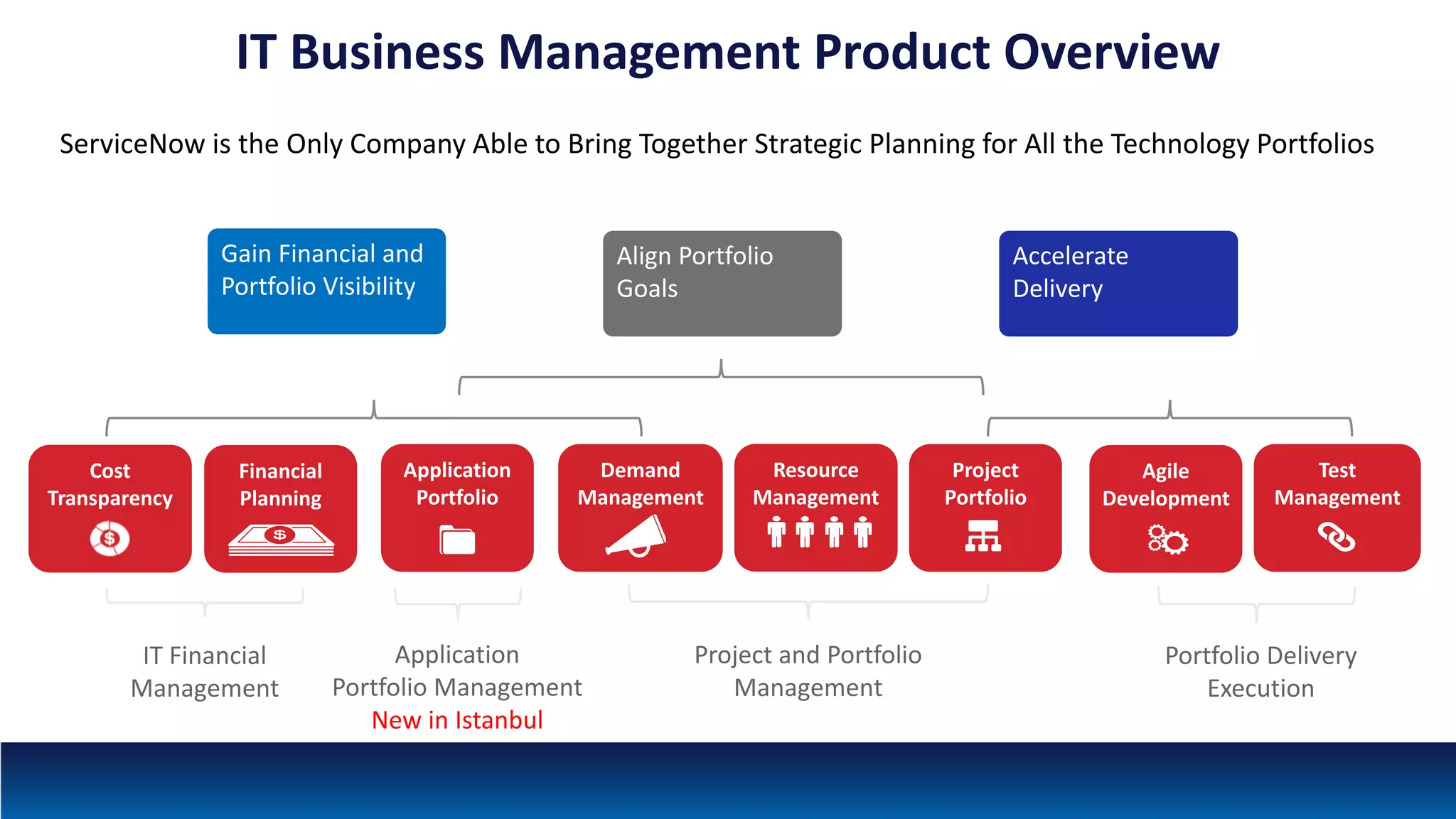
Gain Complete Portfolio and Financial Visibility, Align Better with the Business, and Accelerate Service Delivery. Take advantage of a command center that puts IT in the driver’s seat to manage change and speed innovation. With ServiceNow IT Business Management (ITBM), you can now get the visibility you need into financial, project, and application portfolios—all on a single platform.
#14 ServiceNow is changing the way people work.
IT Service Management
Increasing workflow efficiency across all service domains of the business
IT Operations Management
Prevent Service Outages and maximize operational agility
IT Business Management
Focus Resources on strategic business goals
#16 Most CIO’s struggle evolve legacy IT organization to run more like a business, leading the way for a digital transformation. CIO’s know that when you don’t think of IT as an extension of the business, business partners will bypass IT altogether and “going digital” is next to impossible.
To turn the corner starts with IT having the proper focus on what value IT provides, acutely focusing on maximizing value while minimizing cost and risk, just like any business would.
IT must also be laser focused on deploying or brokering the right strategic services to fuel digital business growth. IT must be able to embrace new roles and functions that know how to focus on delivering services automatically, removing bureaucracy and bottlenecks along the way and ensuring that interaction with IT is a meaningful experience for IT service consumers. Lets face it, most IT organizations haven’t focused on business outcomes and customer experience, forcing many to bypass IT altogether.
While IT4IT isn’t a silver bullet, it was created to address this very problem as an important tool for any CIO in any organziation.
#18
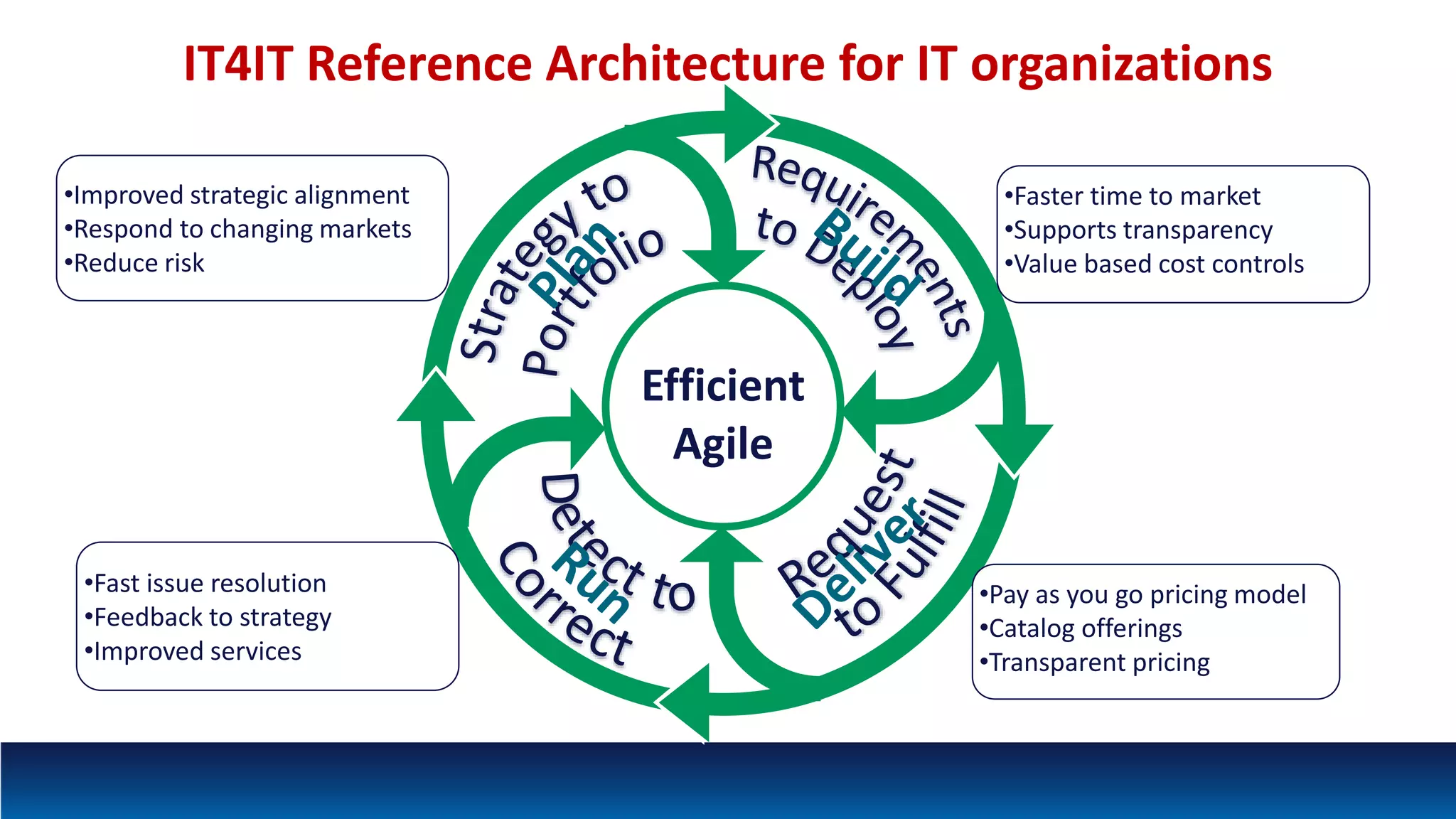
Introducing IT4IT, the next generation IT management approach focused on automation and all the contemporary CIO concerns for a digital transformation. The traditional plan, build, run IT organization has been re-defined into 4 valuestreams: Plan, Build, Deliver, and Run.
<<Build out strategy>>
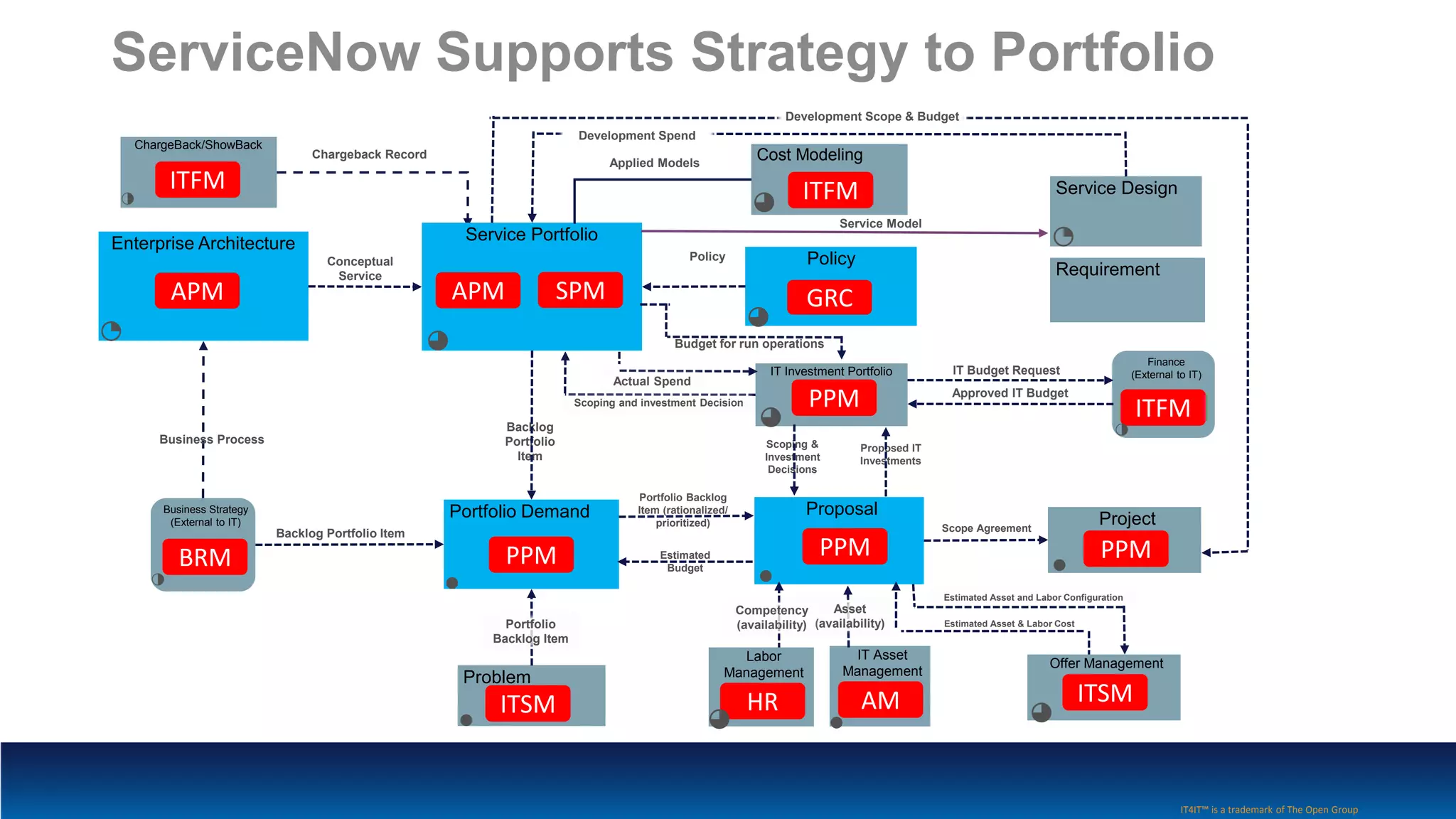
This comprehensive approach started with Plan, now defined as Strategy to Portfolio focused on aligning the IT strategy with the business, and investing in creating the the service portfolio the business needs to achieve business outcomes.
<<Build out Build>>
Build is your typical SDLC now known as Requirements to Deploy, focusing on building or brokering IT services that are required. This includes waterfall and agile teams who are under pressure to new services faster and at lower cost.
<<Build our Deliver>>
The introduction of the Deliver, or Request to Fulfill, addresses the need for IT to deliver standardized IT services as a main capability vs. how IT has typically provided services in disparate catalogs based on the type of resource. Implementing a comprehensive catalog and shopping experience, providing transparent pricing, and automating deliver are some of the main objectives of Delver to keep the IT organization focused on continuously delivering value.
<<Build Run>>
Run is your typical break fix and help desk activity that deals with keeping the lights on, referred to as Detect to Correct. Ideally through automation, most events can be mitigated by detecting failures early, preventing service interruption entirely, again through automation.
Implementing all 4 valuestream you can expect to achieve efficiency and agility that your organization requires in the digital business era.
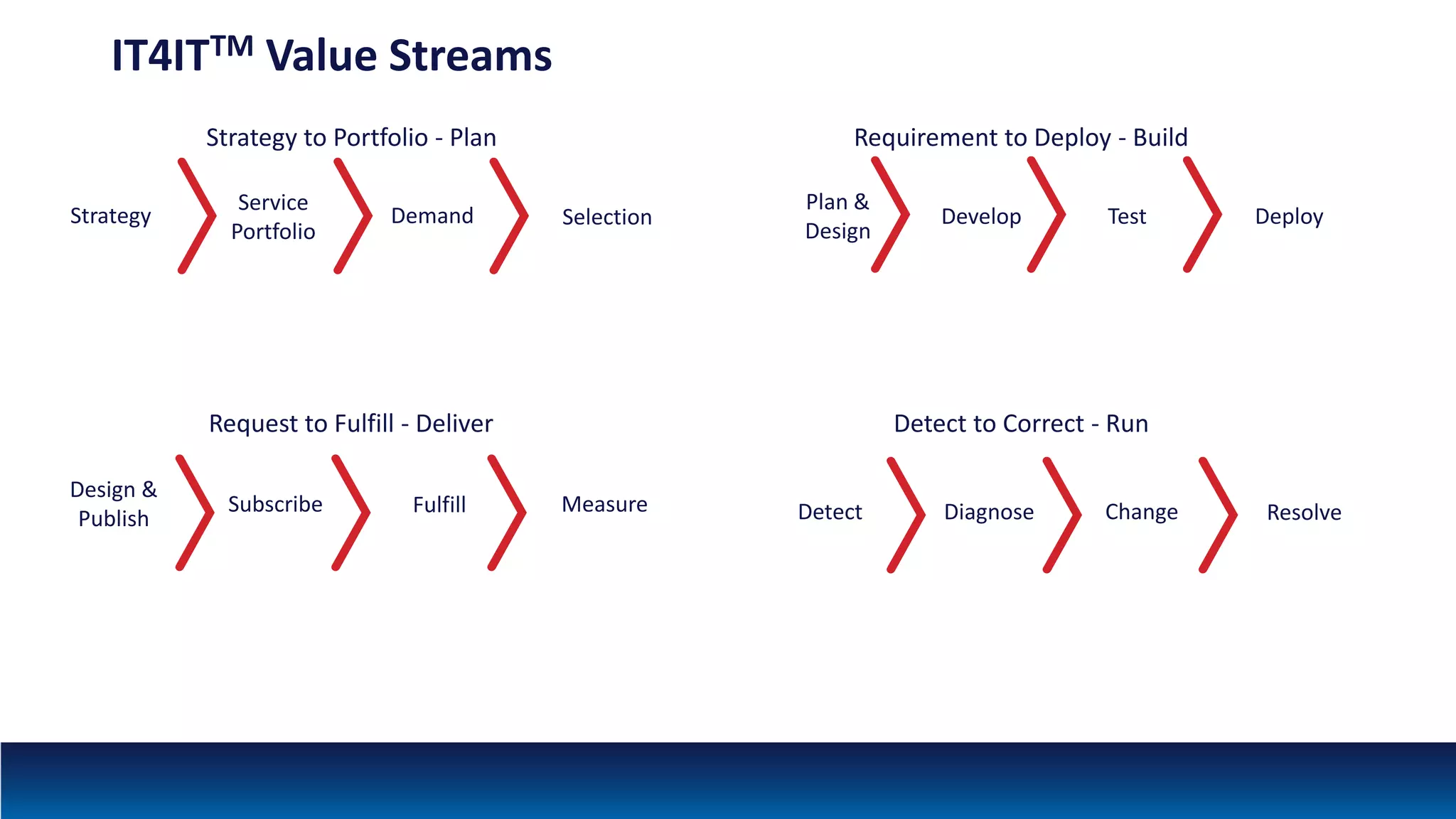
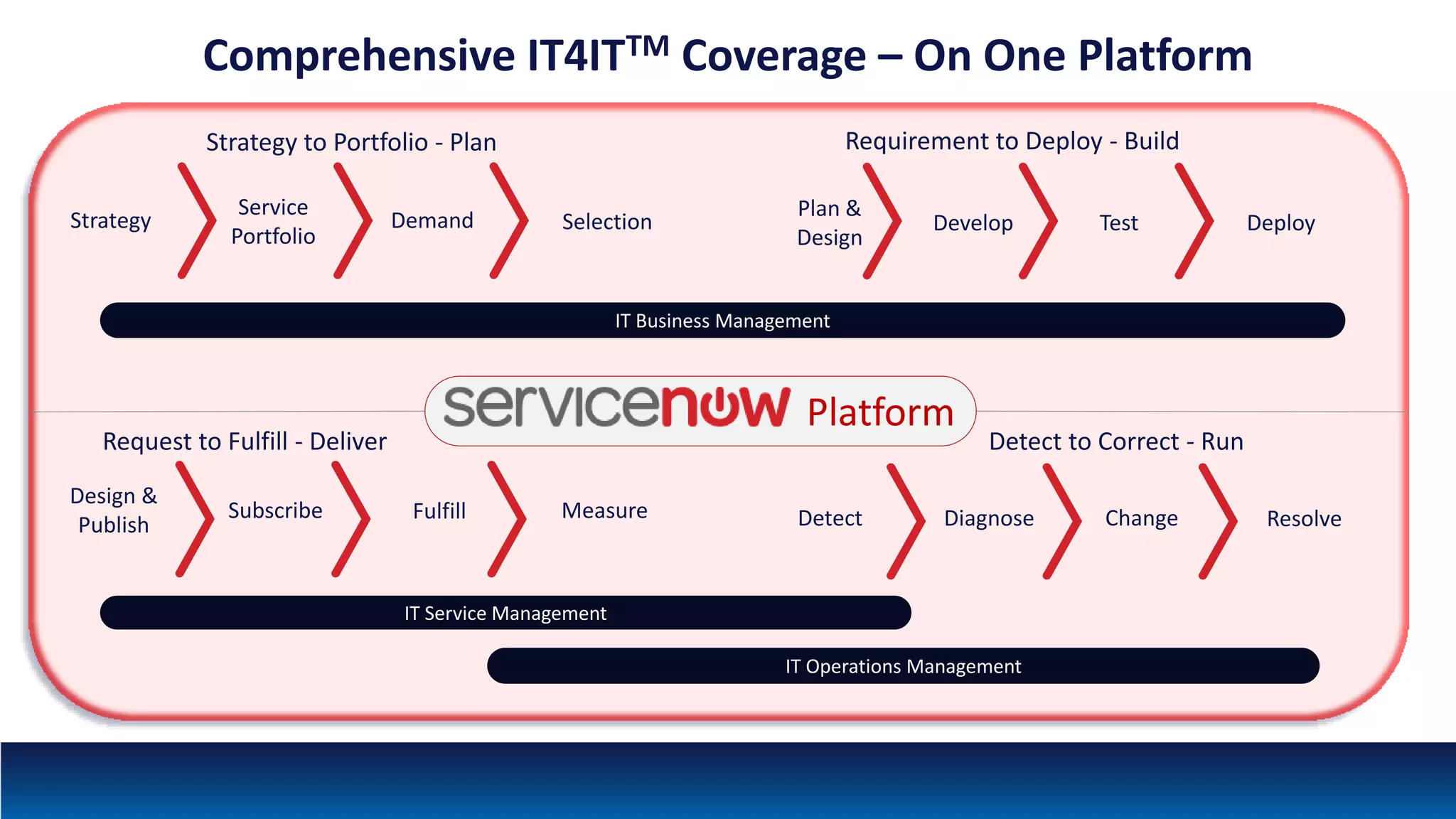
#19 There are 4 steps that make up each of the 4 value-streams
Strategy to portfolio
Requirements to Deploy
Request to Fulfill
Detect to Correct
Service Now delivers the entire value chain on one platform, moving cost for integration towards 0
The ServiceNow products are organized within suites which closely align with the value-streams
Our new IT Business Management suite covers 2/3 of Strategy to Portfolio
Application Development on our platform is 100% covered with integrated testing and deployment capabilities
IT Service Management covers Request to fulfill, it’s the value stream that’s at the core of Service Now’s DNA, who better to teach you how to transform into a service oriented company
IT Operations management suite provides the your operations needs to automate the Detect to Correct Valuestream
#23 There are 4 steps that make up each of the 4 value-streams
Strategy to portfolio
Requirements to Deploy
Request to Fulfill
Detect to Correct
Service Now delivers the entire value chain on one platform, moving cost for integration towards 0
The ServiceNow products are organized within suites which closely align with the value-streams
Our new IT Business Management suite covers 2/3 of Strategy to Portfolio
Application Development on our platform is 100% covered with integrated testing and deployment capabilities
IT Service Management covers Request to fulfill, it’s the value stream that’s at the core of Service Now’s DNA, who better to teach you how to transform into a service oriented company
IT Operations management suite provides the your operations needs to automate the Detect to Correct Valuestream
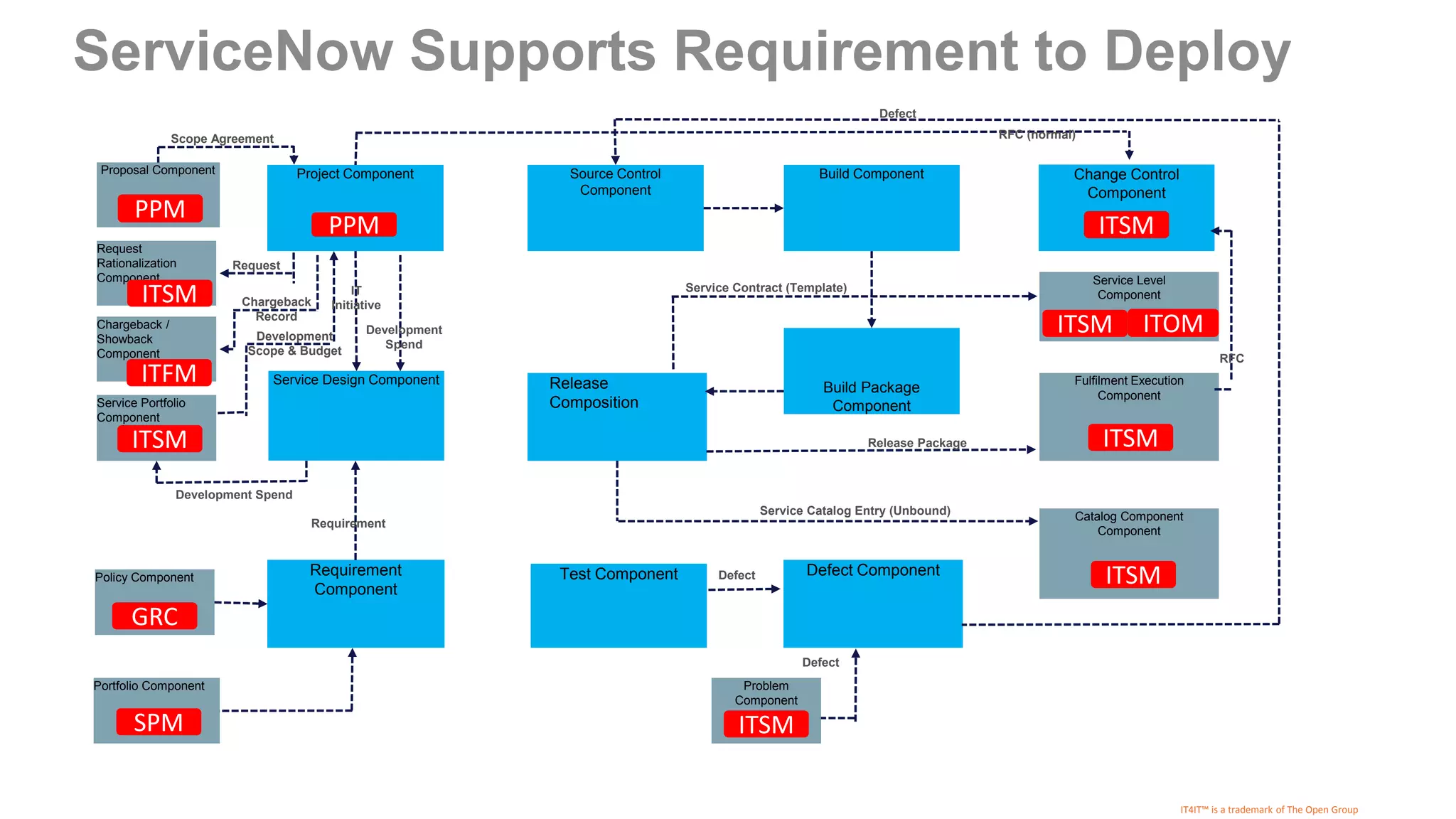
#25 This is the level 2 architecture of Requirement to Deploy – a more detailed view of the components, data elements and relationships. This is the result of a 3 year work to define an open standard and it is still evolving.
As you recall the Requirement to Deploy framework is part of a broader IT4IT value chain framework and as such it is interconnected to the other 3 value streams. I’d like to point out the grey functional components – these are functional components from the other value streams:
- Note how Strategy to Portfolio data artifacts are linked to Requirement to Deploy data artifact on the left:
Scope Agreement to an IT initiative, Policies and Portfolio Backlog items to Requirements and the Conceptual Service to the Logical Service in Service Design.
- A Defect on the bottom right is linked to Incidents and Problems from Detect to Correct, and the Release Composition artifacts are linked to a Catalog Entry and Fulfillment Request from the request to Fulfill value stream.
Along with this diagram, goes a detailed definition of each functional component, data artifacts and the relationships
which you may access through the resources provided at the last slide of this presentation.
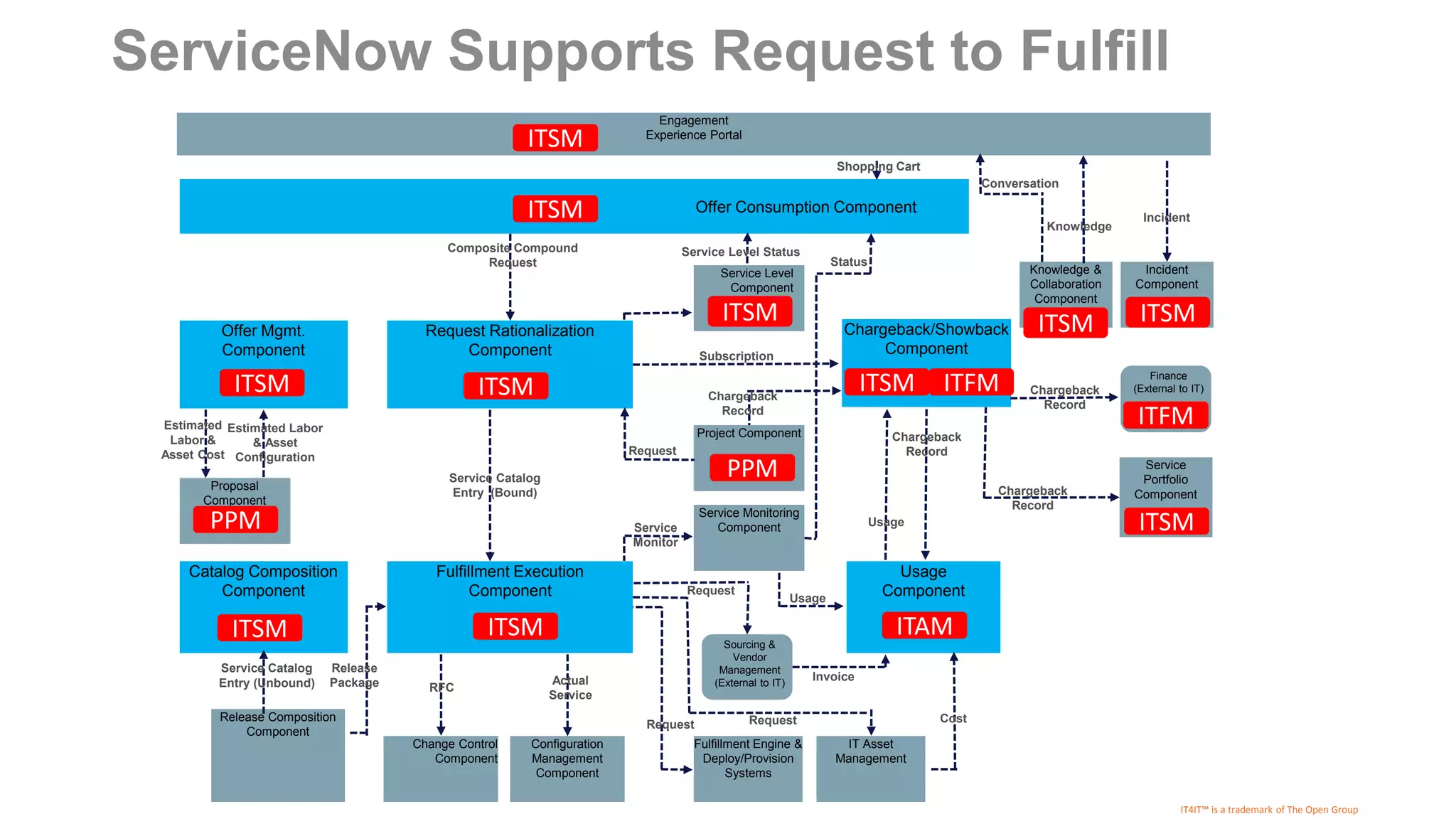
#26 The diagram in this Slide is what we call the Level 2 reference architecture of the Request to Fulfill Value Stream.
In this diagram we go into greater detail with respect to the cardinality of the relationships as well as the different types of interactions, or integrations between the Functional Components.
It is important to mention the grey boxes, which are either an Auxiliary Functional Component, or a supportive Function-
Auxiliary Functional Components are components that are key in another value stream, but not in the current Value Stream.
Supportive Functions are functional components that cross multiple Value Streams (sometimes all 4), but are not easily centered in any 1 Value Stream.
I would like to take the time to specifically discuss the Engagement Experience Portal. This component is a crucial part of the Request to Fulfill architecture.
It is a one stop shop for engaging IT Services and Staff. This Portal provides a unified experience for people to request new services, view their current Services, manage their subscriptions and consume knowledge and collaboration services.
Remembering that Request to Fulfill is one of the four Value Streams that make up the IT Value Chain, the Level 2 diagram details how Request to Fulfill tightly interacts with both Requirement to Deploy and Detect to Correct.
The interaction with Requirement to Deploy focuses around receiving information about the Service in order to properly design the Service Catalog Entry in addition to executing various deployments that may be used in the process of developing the services, such as deploying a test environment.
The interaction with Detect to Correct mainly focuses on making sure that when we instantiate new Service Instances, we are in full sync with the operational aspects.
We deploy the necessary monitors, update the Configuration Management Database, acquire and record the relevant assets and adhere to the Change process.
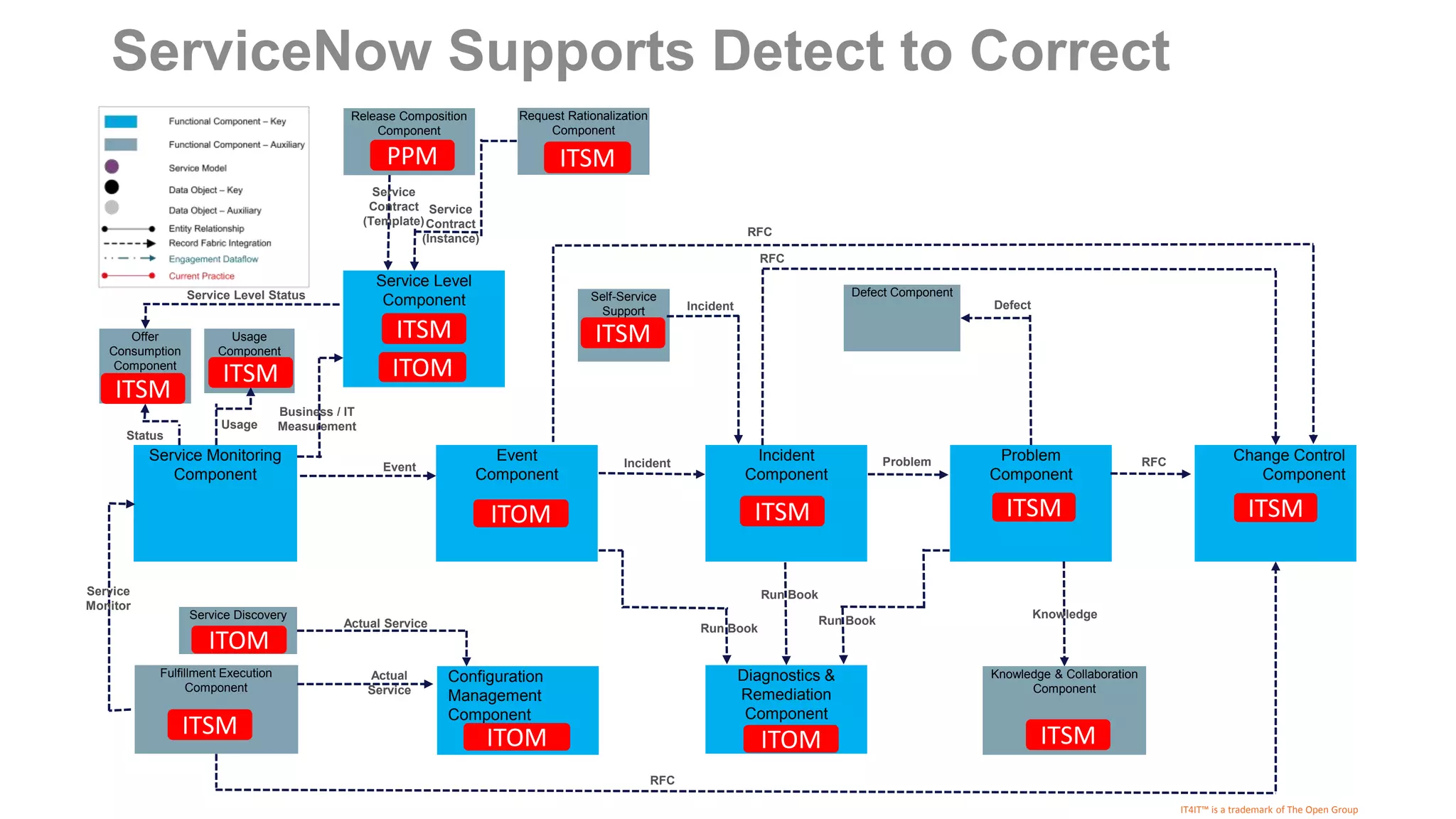
#27 This slide may appear complex at first glance, but it has been carefully constructed.
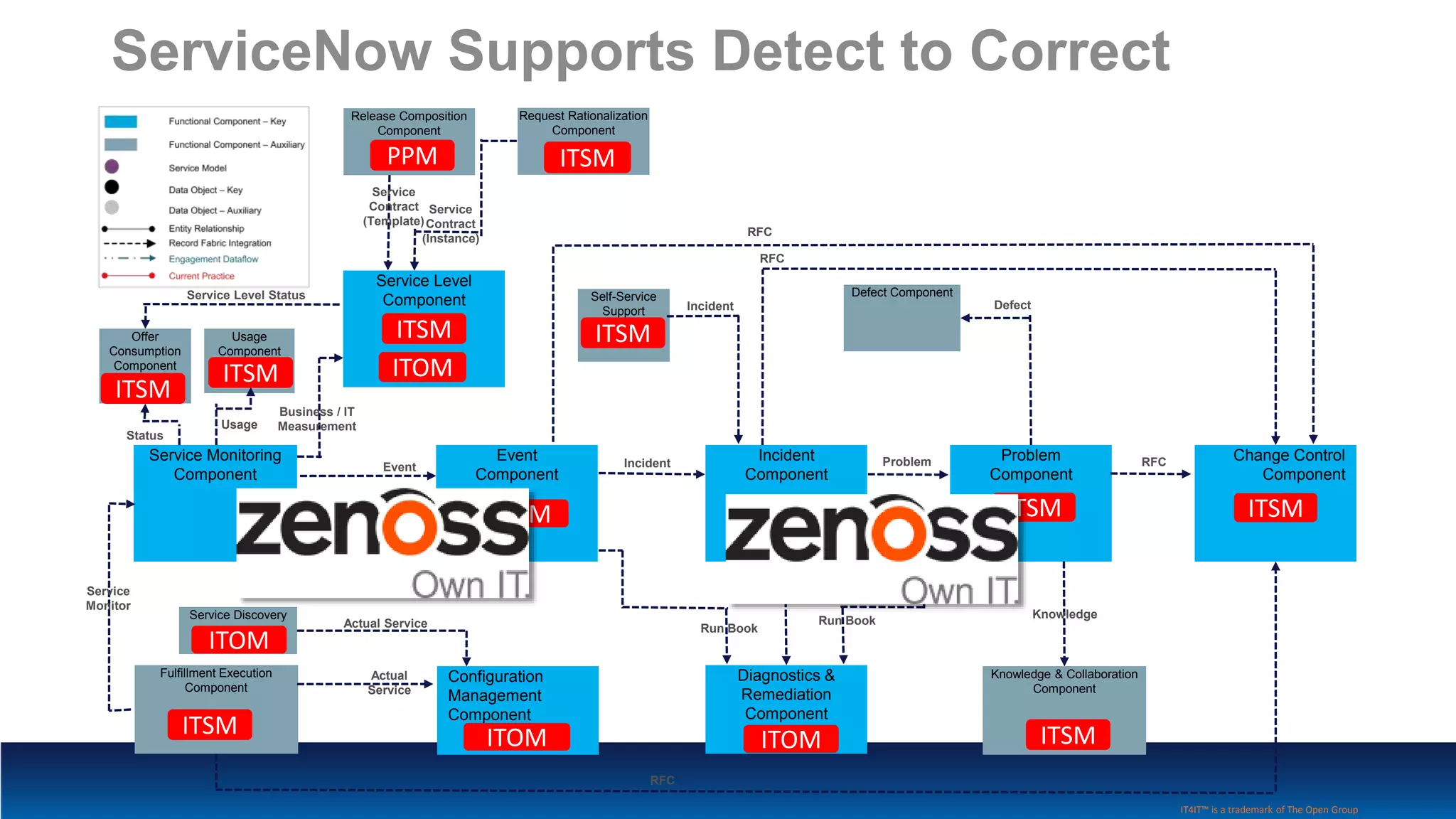
Now that we know what each functional component does in Detect to Correct, let’s look at how they interact between themselves and with other functional components outside Detect to Correct. The blue boxes are the same Detect to Correct functional components we’ve studied in the previous slides. Gray boxes indicate functional components outside Detect to Correct. Note that these gray boxes may or may not an IT4IT Value Stream functional component. This is the result of a 3 year work to define an open standard and it is still evolving.
Service Monitoring is shown at the left and begins the Detect to Correct phase as the final phase of Request to Fulfill, Fulfillment Execution, deploys a service. As discussed in previous slides, Service Monitoring generates events and passes them on to Event Management, which then enriches and distributes events to IT Service Management. IT Service Management is composed of the Incident/Problem/Change functional components. Incident/Problem/Change may
Generate change requests,
Execute automation to take corrective or remediative action,
Open defects, which go back to the R2D value stream, or, my favorite,
Generate Knowledge to be captured, re-used, and formalized to continually improve Detect to Correct KPIs.
Configuration Management helps the other Detect to Correct Functional components keep their services in sync with each other as they act and operate on the service through the operational phases of its life cycle.
#30 This slide may appear complex at first glance, but it has been carefully constructed.
Now that we know what each functional component does in Detect to Correct, let’s look at how they interact between themselves and with other functional components outside Detect to Correct. The blue boxes are the same Detect to Correct functional components we’ve studied in the previous slides. Gray boxes indicate functional components outside Detect to Correct. Note that these gray boxes may or may not an IT4IT Value Stream functional component. This is the result of a 3 year work to define an open standard and it is still evolving.
Service Monitoring is shown at the left and begins the Detect to Correct phase as the final phase of Request to Fulfill, Fulfillment Execution, deploys a service. As discussed in previous slides, Service Monitoring generates events and passes them on to Event Management, which then enriches and distributes events to IT Service Management. IT Service Management is composed of the Incident/Problem/Change functional components. Incident/Problem/Change may
Generate change requests,
Execute automation to take corrective or remediative action,
Open defects, which go back to the R2D value stream, or, my favorite,
Generate Knowledge to be captured, re-used, and formalized to continually improve Detect to Correct KPIs.
Configuration Management helps the other Detect to Correct Functional components keep their services in sync with each other as they act and operate on the service through the operational phases of its life cycle.