9/23/10
3/18/15
JERRY LUFTMAN Ph.D.
luftman@hotmail.com www.globaliim.com
IT Trends & Service
Management
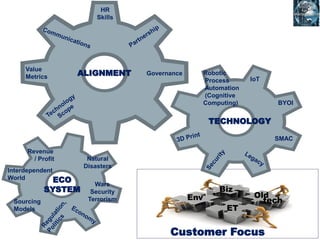
Biz
Env
ET
Old
tech
Customer Focus
Governance
HR
Skills
Value
Metrics
Interdependent
World
Sourcing
Models
Natural
Disasters
Wars
Security
Terrorism
SMAC
IoT
Robotic
Process
Automation
(Cognitive
Computing) BYOI
ALIGNMENT
TECHNOLOGY
ECO
SYSTEM
Revenue
/ Profit
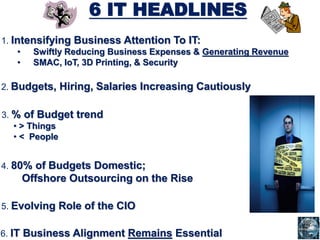
6 IT HEADLINES
1. Intensifying Business Attention To IT:
• Swiftly Reducing Business Expenses & Generating Revenue
• SMAC, IoT, 3D Printing, & Security
5. Evolving Role of the CIO
2. Budgets, Hiring, Salaries Increasing Cautiously
4. 80% of Budgets Domestic;
Offshore Outsourcing on the Rise
6. IT Business Alignment Remains Essential
3. % of Budget trend
• > Things
• < People
BIGGEST
HEADLINE
December 2014
IT IS RESHAPING GLOBAL MARKETS
WHILE RESHAPING ITSELF
AS IT BECOMES THE BUSINESS
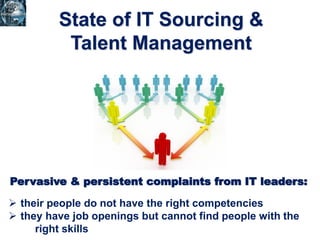
State of IT Sourcing &
Talent Management
Pervasive & persistent complaints from IT leaders:
 their people do not have the right competencies
 they have job openings but cannot find people with the
right skills
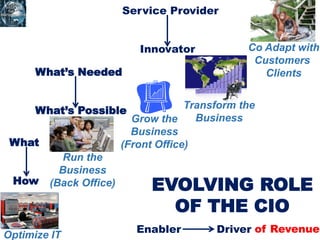
Run the
Business
(Back Office)
Grow the
Business
(Front Office)
Optimize IT
Co Adapt with
Customers
Clients
Transform the
Business
EVOLVING ROLE
OF THE CIO
What
How
What’s Needed
What’s Possible
Service Provider
Innovator
Enabler Driver of Revenue
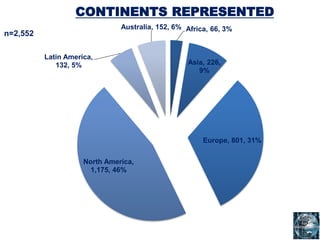
CONTINENTS REPRESENTED
n=2,552
Africa, 66, 3%
Asia, 226,
9%
Europe, 801, 31%
North America,
1,175, 46%
Latin America,
132, 5%
Australia, 152, 6%
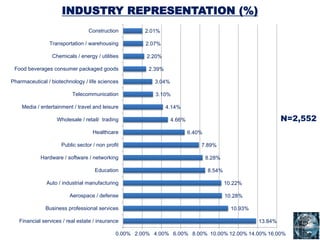
INDUSTRY REPRESENTATION (%)
N=2,552
13.84%
10.93%
10.28%
10.22%
8.54%
8.28%
7.89%
6.40%
4.66%
4.14%
3.10%
3.04%
2.39%
2.20%
2.07%
2.01%
0.00% 2.00% 4.00% 6.00% 8.00% 10.00% 12.00% 14.00% 16.00%
Financial services / real estate / insurance
Business professional services
Aerospace / defense
Auto / industrial manufacturing
Education
Hardware / software / networking
Public sector / non profit
Healthcare
Wholesale / retail/ trading
Media / entertainment / travel and leisure
Telecommunication
Pharmaceutical / biotechnology / life sciences
Food beverages consumer packaged goods
Chemicals / energy / utilities
Transportation / warehousing
Construction
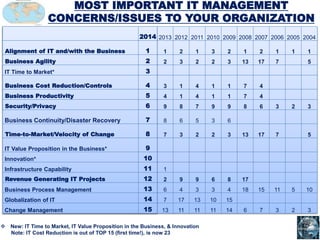
MOST IMPORTANT IT MANAGEMENT
CONCERNS/ISSUES TO YOUR ORGANIZATION
 New: IT Time to Market, IT Value Proposition in the Business, & Innovation
Note: IT Cost Reduction is out of TOP 15 (first time!), is now 23
2014
Alignment of IT and/with the Business 1
Business Agility 2
IT Time to Market* 3
Business Cost Reduction/Controls 4
Business Productivity 5
Security/Privacy 6
2014 2013 2012 2011 2010 2009 2008 2007 2006 2005 2004
Alignment of IT and/with the Business 1 1 2 1 3 2 1 2 1 1 1
Business Agility 2 2 3 2 2 3 13 17 7 5
IT Time to Market* 3
Business Cost Reduction/Controls 4 3 1 4 1 1 7 4
Business Productivity 5 4 1 4 1 1 7 4
Security/Privacy 6 9 8 7 9 9 8 6 3 2 3
Business Continuity/Disaster Recovery 7 8 6 5 3 6
Time-to-Market/Velocity of Change 8 7 3 2 2 3 13 17 7 5
IT Value Proposition in the Business* 9
Innovation* 10
Infrastructure Capability 11 1
Revenue Generating IT Projects 12 2 9 9 6 8 17
Business Process Management 13 6 4 3 3 4 18 15 11 5 10
Globalization of IT 14 7 17 13 10 15
Change Management 15 13 11 11 11 14 6 7 3 2 3
2014
Alignment of IT and/with the Business 1
Business Agility 2
IT Time to Market* 3
Business Cost Reduction/Controls 4
Business Productivity 5
Security/Privacy 6
Business Continuity/Disaster Recovery 7
Time-to-Market/Velocity of Change 8
IT Value Proposition in the Business* 9
Innovation* 10
Infrastructure Capability 11
Revenue Generating IT Projects 12
Business Process Management 13
Globalization of IT 14
Change Management 15
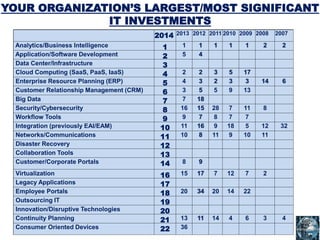
YOUR ORGANIZATION’S LARGEST/MOST SIGNIFICANT
IT INVESTMENTS
2014
Analytics/Business Intelligence 1
Application/Software Development 2
Data Center/Infrastructure 3
Cloud Computing (SaaS, PaaS, IaaS) 4
Enterprise Resource Planning (ERP) 5
Customer relationship management (CRM) 6
Big Data 7
Security/Cybersecurity 8
Workflow Tools 9
Integration (previously EAI/EAM) 10
2014 2013 2012 2011 2010 2009 2008 2007
Analytics/Business Intelligence 1 1 1 1 1 1 2 2
Application/Software Development 2 5 4
Data Center/Infrastructure 3
Cloud Computing (SaaS, PaaS, IaaS) 4 2 2 3 5 17
Enterprise Resource Planning (ERP) 5 4 3 2 3 3 14 6
Customer Relationship Management (CRM) 6 3 5 5 9 13
Big Data 7 7 18
Security/Cybersecurity 8 16 15 28 7 11 8
Workflow Tools 9 9 7 8 7 7
Integration (previously EAI/EAM) 10 11 16 9 18 5 12 32
Networks/Communications 11 10 8 11 9 10 11
Disaster Recovery 12
Collaboration Tools 13
Customer/Corporate Portals 14 8 9
Virtualization 16 15 17 7 12 7 2
Legacy Applications 17
Employee Portals 18 20 34 20 14 22
Outsourcing IT 19
Innovation/Disruptive Technologies 20
Continuity Planning 21 13 11 14 4 6 3 4
Consumer Oriented Devices 22 36
2014
Analytics/Business Intelligence 1
Application/Software Development 2
Data Center/Infrastructure 3
Cloud Computing (SaaS, PaaS, IaaS) 4
Enterprise Resource Planning (ERP) 5
Customer Relationship Management (CRM) 6
Big Data 7
Security/Cybersecurity 8
Workflow Tools 9
Integration (previously EAI/EAM) 10
Networks/Communications 11
Disaster Recovery 12
Collaboration Tools 13
Customer/Corporate Portals 14
Virtualization 16
Legacy Applications 17
Employee Portals 18
Outsourcing IT 19
Innovation/Disruptive Technologies 20
Continuity Planning 21
Consumer Oriented Devices 22
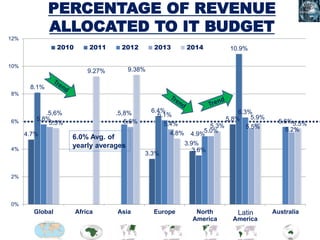
PERCENTAGE OF REVENUE
ALLOCATED TO IT BUDGET
4.7%
3.3%
3.9%
5.8%
8.1%
6.4%
3.6%
10.9%
5.8%
.5,8% 6.1%
4.9%
6.3%
5.6%
.5,6%
5.6% 5.4%
5.0%
5.5% 5.2%
5.5%
9.27% 9.38%
4.8%
5.3%
5.9%
5.5%
0%
2%
4%
6%
8%
10%
12%
Global Africa Asia Europe North
America
South
America
Australia
2010 2011 2012 2013 2014
Latin
6.0% Avg. of
yearly averages
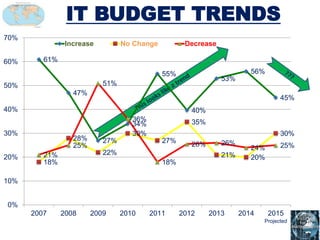
IT BUDGET TRENDS
61%
47%
27%
34%
55%
40%
53%
56%
45%
18%
28%
22%
30%
27%
35%
21% 20%
30%
21%
25%
51%
36%
18%
26% 26%
24% 25%
0%
10%
20%
30%
40%
50%
60%
70%
2007 2008 2009 2010 2011 2012 2013 2014 2015
Increase No Change Decrease
Projected
2015
Projected 2014
PEOPLE
Employees/Internal Staff:
Domestic
19.5% 17.1%
Offshore 10.9% 9.9%
Outsourced Services/Contractors:
Domestic
6.8% 16.9%
Offshore 7.1% 10.5%
Consulting Services 6.1% 6.6%
50.4% 61.0%
THINGS: HARDWARE,
SOFTWARE, FACILITIES
In-house - domestic 12.7% 15.9%
In-house – offshore 11.9% 5.4%
Outsourced - domestic 12.8% 7.3%
Outsourced - offshore 12.2% 10.4%
49.6% 39.0%
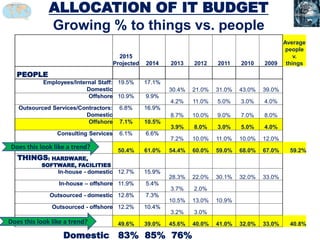
ALLOCATION OF IT BUDGET
Growing % to things vs. people
2015
Projected 2014 2013 2012 2011 2010 2009
Average
people
v.
things
PEOPLE
Employees/Internal Staff:
Domestic
19.5% 17.1%
30.4% 21.0% 31.0% 43.0% 39.0%
Offshore 10.9% 9.9%
4.2% 11.0% 5.0% 3.0% 4.0%
Outsourced Services/Contractors:
Domestic
6.8% 16.9%
8.7% 10.0% 9.0% 7.0% 8.0%
Offshore 7.1% 10.5%
3.9% 8.0% 3.0% 5.0% 4.0%
Consulting Services 6.1% 6.6%
7.2% 10.0% 11.0% 10.0% 12.0%
50.4% 61.0% 54.4% 60.0% 59.0% 68.0% 67.0% 59.2%
THINGS: HARDWARE,
SOFTWARE, FACILITIES
In-house - domestic 12.7% 15.9%
28.3% 22.0% 30.1% 32.0% 33.0%
In-house – offshore 11.9% 5.4%
3.7% 2.0%
Outsourced - domestic 12.8% 7.3%
10.5% 13.0% 10.9%
Outsourced - offshore 12.2% 10.4%
3.2% 3.0%
49.6% 39.0% 45.6% 40.0% 41.0% 32.0% 33.0% 40.8%
Does this look like a trend?
Domestic 83% 85% 76%
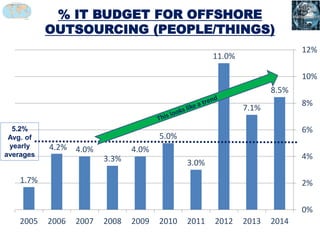
% IT BUDGET FOR OFFSHORE
OUTSOURCING (PEOPLE/THINGS)
8.5%
7.1%
11.0%
3.0%
5.0%
4.0%
3.3%
4.0%4.2%
1.7%
0%
2%
4%
6%
8%
10%
12%
2014201320122011201020092008200720062005
5.2%
Avg. of
yearly
averages
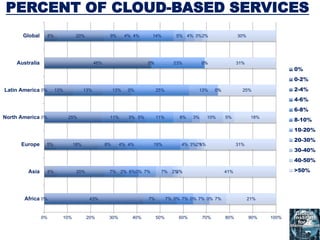
PERCENT OF CLOUD-BASED SERVICES
0%
6%
5%
0%
0%
46%
6%
43%
20%
18%
25%
13%
0%
20%
7%
7%
8%
11%
13%
0%
9%
7%
2%
4%
3%
13%
0%
4%
0%
6%
4%
5%
0%
0%
4%
7%
0%
19%
11%
25%
23%
14%
0%
7%
4%
8%
13%
0%
5%
7%
7%
3%
3%
0%
0%
4%
0%
2%
2%
10%
0%
0%
3%
7%
2%
1%
5%
0%
0%
2%
21%
41%
31%
18%
25%
31%
30%
0% 10% 20% 30% 40% 50% 60% 70% 80% 90% 100%
Africa
Asia
Europe
North America
Latin America
Australia
Global
0%
0-2%
2-4%
4-6%
6-8%
8-10%
10-20%
20-30%
30-40%
40-50%
>50%
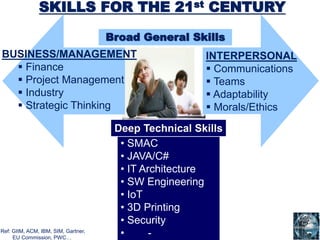
SKILLS FOR THE 21st CENTURY
BUSINESS/MANAGEMENT
 Finance
 Project Management
 Industry
 Strategic Thinking
INTERPERSONAL
 Communications
 Teams
 Adaptability
 Morals/Ethics
Broad General Skills
Deep Technical Skills
• SMAC
• JAVA/C#
• IT Architecture
• SW Engineering
• IoT
• 3D Printing
• Security
• -Ref: GIIM, ACM, IBM, SIM, Gartner,
EU Commission, PWC…
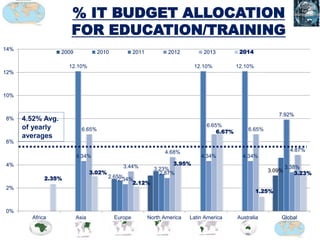
% IT BUDGET ALLOCATION
FOR EDUCATION/TRAINING
3.09%
12.10%
2.65%
3.23%
12.10% 12.10%
7.92%
4.34%
2.34%
2.87%
4.34% 4.34%
3.38%
6.65%
3.44%
4.68%
6.65%
6.65%
4.87%
2.35%
3.02%
2.12%
3.95%
6.67%
1.25%
3.23%
0%
2%
4%
6%
8%
10%
12%
14%
Africa Asia Europe North America Latin America Australia Global
2009 2010 2011 2012 2013 2014
3.09%
12.10%
2.65%
3.23%
12.10% 12.10%
7.92%
4.34%
2.34%
2.87%
4.34% 4.34%
3.38%
6.65%
3.44%
4.68%
6.65%
6.65%
4.87%
2.35%
3.02%
2.12%
3.95%
6.67%
1.25%
3.23%
0%
2%
4%
6%
8%
10%
12%
14%
Africa Asia Europe North America Latin America Australia Global
2009 2010 2011 2012 2013 2014
4.52% Avg.
of yearly
averages
54
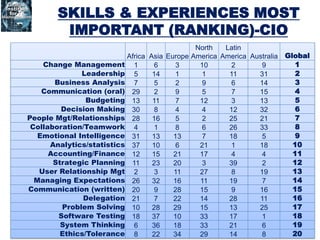
SKILLS & EXPERIENCES MOST
IMPORTANT (RANKING)-CIO
Africa Asia Europe
North
America
Latin
America Australia Global
Change Management 1 6 3 10 2 9 1
Leadership 5 14 1 1 11 31 2
Business Analysis 7 5 2 9 6 14 3
Communication (oral) 29 2 9 5 7 15 4
Budgeting 13 11 7 12 3 13 5
Decision Making 30 8 4 4 12 32 6
People Mgt/Relationships 28 16 5 2 25 21 7
Collaboration/Teamwork 4 1 8 6 26 33 8
Emotional Intelligence 31 13 13 7 18 5 9
Analytics/statistics 37 10 6 21 1 18 10
Accounting/Finance 12 15 21 17 4 4 11
Strategic Planning 11 23 20 3 39 2 12
User Relationship Mgt 2 3 11 27 8 19 13
Managing Expectations 26 32 16 11 19 7 14
Communication (written) 20 9 28 15 9 16 15
Delegation 21 7 22 14 28 11 16
Problem Solving 10 28 29 15 13 25 17
Software Testing 18 37 10 33 17 1 18
System Thinking 6 36 18 33 21 6 19
Ethics/Tolerance 8 22 34 29 14 8 20
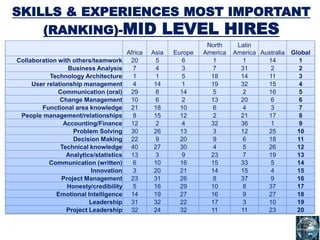
SKILLS & EXPERIENCES MOST IMPORTANT
(RANKING)-MID LEVEL HIRES
Africa Asia Europe
North
America
Latin
America Australia Global
Collaboration with others/teamwork 20 5 6 1 1 14 1
Business Analysis 7 4 3 7 31 2 2
Technology Architecture 1 1 5 18 14 11 3
User relationship management 4 14 1 19 32 15 4
Communication (oral) 29 8 14 5 2 16 5
Change Management 10 6 2 13 20 6 6
Functional area knowledge 21 18 10 6 4 3 7
People management/relationships 8 15 12 2 21 17 8
Accounting/Finance 12 2 4 32 36 1 9
Problem Solving 30 26 13 3 12 25 10
Decision Making 22 9 20 9 6 18 11
Technical knowledge 40 27 30 4 5 26 12
Analytics/statistics 13 3 9 23 7 19 13
Communication (written) 6 10 16 15 33 5 14
Innovation 3 20 21 14 15 4 15
Project Management 23 31 26 8 37 9 16
Honesty/credibility 5 16 29 10 8 37 17
Emotional Intelligence 14 19 27 16 9 27 18
Leadership 31 32 22 17 3 10 19
Project Leadership 32 24 32 11 11 23 20
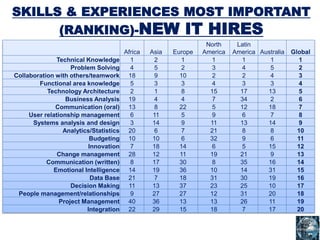
SKILLS & EXPERIENCES MOST IMPORTANT
(RANKING)-NEW IT HIRES
Africa Asia Europe
North
America
Latin
America Australia Global
Technical Knowledge 1 2 1 1 1 1 1
Problem Solving 4 5 2 3 4 5 2
Collaboration with others/teamwork 18 9 10 2 2 4 3
Functional area knowledge 5 3 3 4 3 3 4
Technology Architecture 2 1 8 15 17 13 5
Business Analysis 19 4 4 7 34 2 6
Communication (oral) 13 8 22 5 12 18 7
User relationship management 6 11 5 9 6 7 8
Systems analysis and design 3 14 9 11 13 14 9
Analytics/Statistics 20 6 7 21 8 8 10
Budgeting 10 10 6 32 9 6 11
Innovation 7 18 14 6 5 15 12
Change management 28 12 11 19 21 9 13
Communication (written) 8 17 30 8 35 16 14
Emotional Intelligence 14 19 36 10 14 31 15
Data Base 21 7 18 31 30 19 16
Decision Making 11 13 37 23 25 10 17
People management/relationships 9 27 27 12 31 20 18
Project Management 40 36 13 13 26 11 19
Integration 22 29 15 18 7 17 20
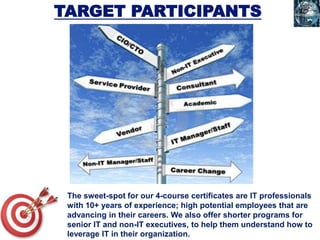
TARGET PARTICIPANTS
The sweet-spot for our 4-course certificates are IT professionals
with 10+ years of experience; high potential employees that are
advancing in their careers. We also offer shorter programs for
senior IT and non-IT executives, to help them understand how to
leverage IT in their organization.
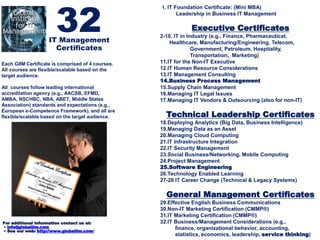
IT Management
Certificates
32
For additional information contact us at:
• info@globaliim.com
• See our web: http://www.globaliim.com/
Each GIIM Certificate is comprised of 4 courses.
All courses are flexible/scalable based on the
target audience.
All courses follow leading international
accreditation agency (e.g., AACSB, EFMD,
AMBA, NSCHBC, NBA, ABET, Middle States
Association) standards and expectations (e.g.,
European e-Competence Framework), and all are
flexible/scalable based on the target audience.
1. IT Foundation Certificate: (Mini MBA)
Leadership in Business IT Management
Executive Certificates
2-10. IT in Industry (e.g., Finance, Pharmaceutical,
Healthcare, Manufacturing/Engineering, Telecom,
Government, Petroleum, Hospitality,
Transportation, Marketing)
11.IT for the Non-IT Executive
12.IT Human Resource Considerations
13.IT Management Consulting
14.Business Process Management
15.Supply Chain Management
16.Managing IT Legal Issues
17.Managing IT Vendors & Outsourcing (also for non-IT)
Technical Leadership Certificates
18.Deploying Analytics (Big Data, Business Intelligence)
19.Managing Data as an Asset
20.Managing Cloud Computing
21.IT Infrastructure Integration
22.IT Security Management
23.Social Business/Networking, Mobile Computing
24.Project Management
25.Software Engineering
26.Technology Enabled Learning
27-28 IT Career Change (Technical & Legacy Systems)
General Management Certificates
29.Effective English Business Communications
30.Non-IT Marketing Certification (CMMP®)
31.IT Marketing Certification (CMMP®)
32.IT Business/Management Considerations (e.g.,
finance, organizational behavior, accounting,
statistics, economics, leadership, service thinking)
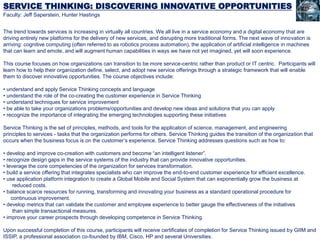
SERVICE THINKING: DISCOVERING INNOVATIVE OPPORTUNITIES
Faculty: Jeff Saperstein, Hunter Hastings
The trend towards services is increasing in virtually all countries. We all live in a service economy and a digital economy that are
driving entirely new platforms for the delivery of new services, and disrupting more traditional forms. The next wave of innovation is
arriving: cognitive computing (often referred to as robotics process automation), the application of artificial intelligence in machines
that can learn and emote, and will augment human capabilities in ways we have not yet imagined, yet will soon experience.
This course focuses on how organizations can transition to be more service-centric rather than product or IT centric. Participants will
learn how to help their organization define, select, and adopt new service offerings through a strategic framework that will enable
them to discover innovative opportunities. The course objectives include:
• understand and apply Service Thinking concepts and language
• understand the role of the co-creating the customer experience in Service Thinking
• understand techniques for service improvement
• be able to take your organizations problems/opportunities and develop new ideas and solutions that you can apply
• recognize the importance of integrating the emerging technologies supporting these initiatives
Service Thinking is the set of principles, methods, and tools for the application of science, management, and engineering
principles to services - tasks that the organization performs for others. Service Thinking guides the transition of the organization that
occurs when the business focus is on the customer’s experience. Service Thinking addresses questions such as how to:
• develop and improve co-creation with customers and become “an intelligent listener”.
• recognize design gaps in the service systems of the industry that can provide innovative opportunities.
• leverage the core competencies of the organization for services transformation.
• build a service offering that integrates specialists who can improve the end-to-end customer experience for efficient excellence.
• use application platform integration to create a Global Mobile and Social System that can exponentially grow the business at
reduced costs.
• balance scarce resources for running, transforming and innovating your business as a standard operational procedure for
continuous improvement.
• develop metrics that can validate the customer and employee experience to better gauge the effectiveness of the initiatives
than simple transactional measures.
• improve your career prospects through developing competence in Service Thinking.
Upon successful completion of this course, participants will receive certificates of completion for Service Thinking issued by GIIM and
ISSIP, a professional association co-founded by IBM, Cisco, HP and several Universities.
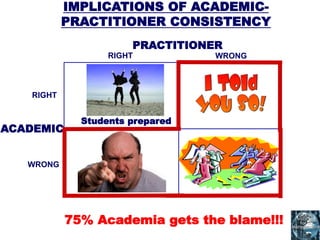
WRONG
WRONG
RIGHT
RIGHT
PRACTITIONER
ACADEMIC
IMPLICATIONS OF ACADEMIC-
PRACTITIONER CONSISTENCY
Students prepared
75% Academia gets the blame!!!
The next
move is
yours

IT Trends & Service Management

  • 1.
    9/23/10 3/18/15 JERRY LUFTMAN Ph.D. luftman@hotmail.comwww.globaliim.com IT Trends & Service Management
  • 3.
  • 4.
    6 IT HEADLINES 1.Intensifying Business Attention To IT: • Swiftly Reducing Business Expenses & Generating Revenue • SMAC, IoT, 3D Printing, & Security 5. Evolving Role of the CIO 2. Budgets, Hiring, Salaries Increasing Cautiously 4. 80% of Budgets Domestic; Offshore Outsourcing on the Rise 6. IT Business Alignment Remains Essential 3. % of Budget trend • > Things • < People
  • 5.
    BIGGEST HEADLINE December 2014 IT ISRESHAPING GLOBAL MARKETS WHILE RESHAPING ITSELF AS IT BECOMES THE BUSINESS
  • 6.
    State of ITSourcing & Talent Management Pervasive & persistent complaints from IT leaders:  their people do not have the right competencies  they have job openings but cannot find people with the right skills
  • 7.
    Run the Business (Back Office) Growthe Business (Front Office) Optimize IT Co Adapt with Customers Clients Transform the Business EVOLVING ROLE OF THE CIO What How What’s Needed What’s Possible Service Provider Innovator Enabler Driver of Revenue
  • 8.
    CONTINENTS REPRESENTED n=2,552 Africa, 66,3% Asia, 226, 9% Europe, 801, 31% North America, 1,175, 46% Latin America, 132, 5% Australia, 152, 6%
  • 9.
    INDUSTRY REPRESENTATION (%) N=2,552 13.84% 10.93% 10.28% 10.22% 8.54% 8.28% 7.89% 6.40% 4.66% 4.14% 3.10% 3.04% 2.39% 2.20% 2.07% 2.01% 0.00%2.00% 4.00% 6.00% 8.00% 10.00% 12.00% 14.00% 16.00% Financial services / real estate / insurance Business professional services Aerospace / defense Auto / industrial manufacturing Education Hardware / software / networking Public sector / non profit Healthcare Wholesale / retail/ trading Media / entertainment / travel and leisure Telecommunication Pharmaceutical / biotechnology / life sciences Food beverages consumer packaged goods Chemicals / energy / utilities Transportation / warehousing Construction
  • 10.
    MOST IMPORTANT ITMANAGEMENT CONCERNS/ISSUES TO YOUR ORGANIZATION  New: IT Time to Market, IT Value Proposition in the Business, & Innovation Note: IT Cost Reduction is out of TOP 15 (first time!), is now 23 2014 Alignment of IT and/with the Business 1 Business Agility 2 IT Time to Market* 3 Business Cost Reduction/Controls 4 Business Productivity 5 Security/Privacy 6 2014 2013 2012 2011 2010 2009 2008 2007 2006 2005 2004 Alignment of IT and/with the Business 1 1 2 1 3 2 1 2 1 1 1 Business Agility 2 2 3 2 2 3 13 17 7 5 IT Time to Market* 3 Business Cost Reduction/Controls 4 3 1 4 1 1 7 4 Business Productivity 5 4 1 4 1 1 7 4 Security/Privacy 6 9 8 7 9 9 8 6 3 2 3 Business Continuity/Disaster Recovery 7 8 6 5 3 6 Time-to-Market/Velocity of Change 8 7 3 2 2 3 13 17 7 5 IT Value Proposition in the Business* 9 Innovation* 10 Infrastructure Capability 11 1 Revenue Generating IT Projects 12 2 9 9 6 8 17 Business Process Management 13 6 4 3 3 4 18 15 11 5 10 Globalization of IT 14 7 17 13 10 15 Change Management 15 13 11 11 11 14 6 7 3 2 3 2014 Alignment of IT and/with the Business 1 Business Agility 2 IT Time to Market* 3 Business Cost Reduction/Controls 4 Business Productivity 5 Security/Privacy 6 Business Continuity/Disaster Recovery 7 Time-to-Market/Velocity of Change 8 IT Value Proposition in the Business* 9 Innovation* 10 Infrastructure Capability 11 Revenue Generating IT Projects 12 Business Process Management 13 Globalization of IT 14 Change Management 15
  • 11.
    YOUR ORGANIZATION’S LARGEST/MOSTSIGNIFICANT IT INVESTMENTS 2014 Analytics/Business Intelligence 1 Application/Software Development 2 Data Center/Infrastructure 3 Cloud Computing (SaaS, PaaS, IaaS) 4 Enterprise Resource Planning (ERP) 5 Customer relationship management (CRM) 6 Big Data 7 Security/Cybersecurity 8 Workflow Tools 9 Integration (previously EAI/EAM) 10 2014 2013 2012 2011 2010 2009 2008 2007 Analytics/Business Intelligence 1 1 1 1 1 1 2 2 Application/Software Development 2 5 4 Data Center/Infrastructure 3 Cloud Computing (SaaS, PaaS, IaaS) 4 2 2 3 5 17 Enterprise Resource Planning (ERP) 5 4 3 2 3 3 14 6 Customer Relationship Management (CRM) 6 3 5 5 9 13 Big Data 7 7 18 Security/Cybersecurity 8 16 15 28 7 11 8 Workflow Tools 9 9 7 8 7 7 Integration (previously EAI/EAM) 10 11 16 9 18 5 12 32 Networks/Communications 11 10 8 11 9 10 11 Disaster Recovery 12 Collaboration Tools 13 Customer/Corporate Portals 14 8 9 Virtualization 16 15 17 7 12 7 2 Legacy Applications 17 Employee Portals 18 20 34 20 14 22 Outsourcing IT 19 Innovation/Disruptive Technologies 20 Continuity Planning 21 13 11 14 4 6 3 4 Consumer Oriented Devices 22 36 2014 Analytics/Business Intelligence 1 Application/Software Development 2 Data Center/Infrastructure 3 Cloud Computing (SaaS, PaaS, IaaS) 4 Enterprise Resource Planning (ERP) 5 Customer Relationship Management (CRM) 6 Big Data 7 Security/Cybersecurity 8 Workflow Tools 9 Integration (previously EAI/EAM) 10 Networks/Communications 11 Disaster Recovery 12 Collaboration Tools 13 Customer/Corporate Portals 14 Virtualization 16 Legacy Applications 17 Employee Portals 18 Outsourcing IT 19 Innovation/Disruptive Technologies 20 Continuity Planning 21 Consumer Oriented Devices 22
  • 12.
    PERCENTAGE OF REVENUE ALLOCATEDTO IT BUDGET 4.7% 3.3% 3.9% 5.8% 8.1% 6.4% 3.6% 10.9% 5.8% .5,8% 6.1% 4.9% 6.3% 5.6% .5,6% 5.6% 5.4% 5.0% 5.5% 5.2% 5.5% 9.27% 9.38% 4.8% 5.3% 5.9% 5.5% 0% 2% 4% 6% 8% 10% 12% Global Africa Asia Europe North America South America Australia 2010 2011 2012 2013 2014 Latin 6.0% Avg. of yearly averages
  • 13.
    IT BUDGET TRENDS 61% 47% 27% 34% 55% 40% 53% 56% 45% 18% 28% 22% 30% 27% 35% 21%20% 30% 21% 25% 51% 36% 18% 26% 26% 24% 25% 0% 10% 20% 30% 40% 50% 60% 70% 2007 2008 2009 2010 2011 2012 2013 2014 2015 Increase No Change Decrease Projected
  • 14.
    2015 Projected 2014 PEOPLE Employees/Internal Staff: Domestic 19.5%17.1% Offshore 10.9% 9.9% Outsourced Services/Contractors: Domestic 6.8% 16.9% Offshore 7.1% 10.5% Consulting Services 6.1% 6.6% 50.4% 61.0% THINGS: HARDWARE, SOFTWARE, FACILITIES In-house - domestic 12.7% 15.9% In-house – offshore 11.9% 5.4% Outsourced - domestic 12.8% 7.3% Outsourced - offshore 12.2% 10.4% 49.6% 39.0% ALLOCATION OF IT BUDGET Growing % to things vs. people 2015 Projected 2014 2013 2012 2011 2010 2009 Average people v. things PEOPLE Employees/Internal Staff: Domestic 19.5% 17.1% 30.4% 21.0% 31.0% 43.0% 39.0% Offshore 10.9% 9.9% 4.2% 11.0% 5.0% 3.0% 4.0% Outsourced Services/Contractors: Domestic 6.8% 16.9% 8.7% 10.0% 9.0% 7.0% 8.0% Offshore 7.1% 10.5% 3.9% 8.0% 3.0% 5.0% 4.0% Consulting Services 6.1% 6.6% 7.2% 10.0% 11.0% 10.0% 12.0% 50.4% 61.0% 54.4% 60.0% 59.0% 68.0% 67.0% 59.2% THINGS: HARDWARE, SOFTWARE, FACILITIES In-house - domestic 12.7% 15.9% 28.3% 22.0% 30.1% 32.0% 33.0% In-house – offshore 11.9% 5.4% 3.7% 2.0% Outsourced - domestic 12.8% 7.3% 10.5% 13.0% 10.9% Outsourced - offshore 12.2% 10.4% 3.2% 3.0% 49.6% 39.0% 45.6% 40.0% 41.0% 32.0% 33.0% 40.8% Does this look like a trend? Does this look like a trend? Domestic 83% 85% 76%
  • 15.
    % IT BUDGETFOR OFFSHORE OUTSOURCING (PEOPLE/THINGS) 8.5% 7.1% 11.0% 3.0% 5.0% 4.0% 3.3% 4.0%4.2% 1.7% 0% 2% 4% 6% 8% 10% 12% 2014201320122011201020092008200720062005 5.2% Avg. of yearly averages
  • 16.
    PERCENT OF CLOUD-BASEDSERVICES 0% 6% 5% 0% 0% 46% 6% 43% 20% 18% 25% 13% 0% 20% 7% 7% 8% 11% 13% 0% 9% 7% 2% 4% 3% 13% 0% 4% 0% 6% 4% 5% 0% 0% 4% 7% 0% 19% 11% 25% 23% 14% 0% 7% 4% 8% 13% 0% 5% 7% 7% 3% 3% 0% 0% 4% 0% 2% 2% 10% 0% 0% 3% 7% 2% 1% 5% 0% 0% 2% 21% 41% 31% 18% 25% 31% 30% 0% 10% 20% 30% 40% 50% 60% 70% 80% 90% 100% Africa Asia Europe North America Latin America Australia Global 0% 0-2% 2-4% 4-6% 6-8% 8-10% 10-20% 20-30% 30-40% 40-50% >50%
  • 17.
    SKILLS FOR THE21st CENTURY BUSINESS/MANAGEMENT  Finance  Project Management  Industry  Strategic Thinking INTERPERSONAL  Communications  Teams  Adaptability  Morals/Ethics Broad General Skills Deep Technical Skills • SMAC • JAVA/C# • IT Architecture • SW Engineering • IoT • 3D Printing • Security • -Ref: GIIM, ACM, IBM, SIM, Gartner, EU Commission, PWC…
  • 18.
    % IT BUDGETALLOCATION FOR EDUCATION/TRAINING 3.09% 12.10% 2.65% 3.23% 12.10% 12.10% 7.92% 4.34% 2.34% 2.87% 4.34% 4.34% 3.38% 6.65% 3.44% 4.68% 6.65% 6.65% 4.87% 2.35% 3.02% 2.12% 3.95% 6.67% 1.25% 3.23% 0% 2% 4% 6% 8% 10% 12% 14% Africa Asia Europe North America Latin America Australia Global 2009 2010 2011 2012 2013 2014 3.09% 12.10% 2.65% 3.23% 12.10% 12.10% 7.92% 4.34% 2.34% 2.87% 4.34% 4.34% 3.38% 6.65% 3.44% 4.68% 6.65% 6.65% 4.87% 2.35% 3.02% 2.12% 3.95% 6.67% 1.25% 3.23% 0% 2% 4% 6% 8% 10% 12% 14% Africa Asia Europe North America Latin America Australia Global 2009 2010 2011 2012 2013 2014 4.52% Avg. of yearly averages
  • 19.
    54 SKILLS & EXPERIENCESMOST IMPORTANT (RANKING)-CIO Africa Asia Europe North America Latin America Australia Global Change Management 1 6 3 10 2 9 1 Leadership 5 14 1 1 11 31 2 Business Analysis 7 5 2 9 6 14 3 Communication (oral) 29 2 9 5 7 15 4 Budgeting 13 11 7 12 3 13 5 Decision Making 30 8 4 4 12 32 6 People Mgt/Relationships 28 16 5 2 25 21 7 Collaboration/Teamwork 4 1 8 6 26 33 8 Emotional Intelligence 31 13 13 7 18 5 9 Analytics/statistics 37 10 6 21 1 18 10 Accounting/Finance 12 15 21 17 4 4 11 Strategic Planning 11 23 20 3 39 2 12 User Relationship Mgt 2 3 11 27 8 19 13 Managing Expectations 26 32 16 11 19 7 14 Communication (written) 20 9 28 15 9 16 15 Delegation 21 7 22 14 28 11 16 Problem Solving 10 28 29 15 13 25 17 Software Testing 18 37 10 33 17 1 18 System Thinking 6 36 18 33 21 6 19 Ethics/Tolerance 8 22 34 29 14 8 20
  • 20.
    SKILLS & EXPERIENCESMOST IMPORTANT (RANKING)-MID LEVEL HIRES Africa Asia Europe North America Latin America Australia Global Collaboration with others/teamwork 20 5 6 1 1 14 1 Business Analysis 7 4 3 7 31 2 2 Technology Architecture 1 1 5 18 14 11 3 User relationship management 4 14 1 19 32 15 4 Communication (oral) 29 8 14 5 2 16 5 Change Management 10 6 2 13 20 6 6 Functional area knowledge 21 18 10 6 4 3 7 People management/relationships 8 15 12 2 21 17 8 Accounting/Finance 12 2 4 32 36 1 9 Problem Solving 30 26 13 3 12 25 10 Decision Making 22 9 20 9 6 18 11 Technical knowledge 40 27 30 4 5 26 12 Analytics/statistics 13 3 9 23 7 19 13 Communication (written) 6 10 16 15 33 5 14 Innovation 3 20 21 14 15 4 15 Project Management 23 31 26 8 37 9 16 Honesty/credibility 5 16 29 10 8 37 17 Emotional Intelligence 14 19 27 16 9 27 18 Leadership 31 32 22 17 3 10 19 Project Leadership 32 24 32 11 11 23 20
  • 21.
    SKILLS & EXPERIENCESMOST IMPORTANT (RANKING)-NEW IT HIRES Africa Asia Europe North America Latin America Australia Global Technical Knowledge 1 2 1 1 1 1 1 Problem Solving 4 5 2 3 4 5 2 Collaboration with others/teamwork 18 9 10 2 2 4 3 Functional area knowledge 5 3 3 4 3 3 4 Technology Architecture 2 1 8 15 17 13 5 Business Analysis 19 4 4 7 34 2 6 Communication (oral) 13 8 22 5 12 18 7 User relationship management 6 11 5 9 6 7 8 Systems analysis and design 3 14 9 11 13 14 9 Analytics/Statistics 20 6 7 21 8 8 10 Budgeting 10 10 6 32 9 6 11 Innovation 7 18 14 6 5 15 12 Change management 28 12 11 19 21 9 13 Communication (written) 8 17 30 8 35 16 14 Emotional Intelligence 14 19 36 10 14 31 15 Data Base 21 7 18 31 30 19 16 Decision Making 11 13 37 23 25 10 17 People management/relationships 9 27 27 12 31 20 18 Project Management 40 36 13 13 26 11 19 Integration 22 29 15 18 7 17 20
  • 23.
    TARGET PARTICIPANTS The sweet-spotfor our 4-course certificates are IT professionals with 10+ years of experience; high potential employees that are advancing in their careers. We also offer shorter programs for senior IT and non-IT executives, to help them understand how to leverage IT in their organization.
  • 24.
    IT Management Certificates 32 For additionalinformation contact us at: • info@globaliim.com • See our web: http://www.globaliim.com/ Each GIIM Certificate is comprised of 4 courses. All courses are flexible/scalable based on the target audience. All courses follow leading international accreditation agency (e.g., AACSB, EFMD, AMBA, NSCHBC, NBA, ABET, Middle States Association) standards and expectations (e.g., European e-Competence Framework), and all are flexible/scalable based on the target audience. 1. IT Foundation Certificate: (Mini MBA) Leadership in Business IT Management Executive Certificates 2-10. IT in Industry (e.g., Finance, Pharmaceutical, Healthcare, Manufacturing/Engineering, Telecom, Government, Petroleum, Hospitality, Transportation, Marketing) 11.IT for the Non-IT Executive 12.IT Human Resource Considerations 13.IT Management Consulting 14.Business Process Management 15.Supply Chain Management 16.Managing IT Legal Issues 17.Managing IT Vendors & Outsourcing (also for non-IT) Technical Leadership Certificates 18.Deploying Analytics (Big Data, Business Intelligence) 19.Managing Data as an Asset 20.Managing Cloud Computing 21.IT Infrastructure Integration 22.IT Security Management 23.Social Business/Networking, Mobile Computing 24.Project Management 25.Software Engineering 26.Technology Enabled Learning 27-28 IT Career Change (Technical & Legacy Systems) General Management Certificates 29.Effective English Business Communications 30.Non-IT Marketing Certification (CMMP®) 31.IT Marketing Certification (CMMP®) 32.IT Business/Management Considerations (e.g., finance, organizational behavior, accounting, statistics, economics, leadership, service thinking)
  • 25.
    SERVICE THINKING: DISCOVERINGINNOVATIVE OPPORTUNITIES Faculty: Jeff Saperstein, Hunter Hastings The trend towards services is increasing in virtually all countries. We all live in a service economy and a digital economy that are driving entirely new platforms for the delivery of new services, and disrupting more traditional forms. The next wave of innovation is arriving: cognitive computing (often referred to as robotics process automation), the application of artificial intelligence in machines that can learn and emote, and will augment human capabilities in ways we have not yet imagined, yet will soon experience. This course focuses on how organizations can transition to be more service-centric rather than product or IT centric. Participants will learn how to help their organization define, select, and adopt new service offerings through a strategic framework that will enable them to discover innovative opportunities. The course objectives include: • understand and apply Service Thinking concepts and language • understand the role of the co-creating the customer experience in Service Thinking • understand techniques for service improvement • be able to take your organizations problems/opportunities and develop new ideas and solutions that you can apply • recognize the importance of integrating the emerging technologies supporting these initiatives Service Thinking is the set of principles, methods, and tools for the application of science, management, and engineering principles to services - tasks that the organization performs for others. Service Thinking guides the transition of the organization that occurs when the business focus is on the customer’s experience. Service Thinking addresses questions such as how to: • develop and improve co-creation with customers and become “an intelligent listener”. • recognize design gaps in the service systems of the industry that can provide innovative opportunities. • leverage the core competencies of the organization for services transformation. • build a service offering that integrates specialists who can improve the end-to-end customer experience for efficient excellence. • use application platform integration to create a Global Mobile and Social System that can exponentially grow the business at reduced costs. • balance scarce resources for running, transforming and innovating your business as a standard operational procedure for continuous improvement. • develop metrics that can validate the customer and employee experience to better gauge the effectiveness of the initiatives than simple transactional measures. • improve your career prospects through developing competence in Service Thinking. Upon successful completion of this course, participants will receive certificates of completion for Service Thinking issued by GIIM and ISSIP, a professional association co-founded by IBM, Cisco, HP and several Universities.
  • 26.
    WRONG WRONG RIGHT RIGHT PRACTITIONER ACADEMIC IMPLICATIONS OF ACADEMIC- PRACTITIONERCONSISTENCY Students prepared 75% Academia gets the blame!!!
  • 27.