Synthetic Datasets for Service System
Innovation
A Whitepaper for the International Society of Service Innovation Professionals (ISSIP)
Authors:
Calvin Tang – Project Lead
An Luu – Data Analyst & Research Lead
Anh NguyenTan – Systems Architect
Orion Sun – Technical Developer
Sydnie Wu – Case Study and Visualization Specialist
Abstract
This project explores the use of synthetic data as a catalyst for accelerating collaborative service
system innovations across academic and professional boundaries. As organizations face growing
challenges surrounding data privacy, accessibility, and security, synthetic datasets have emerged
as a viable alternative for research and development without compromising confidentiality. The
project aims to design, generate, and apply synthetic datasets that simulate real-world service
data using advanced artificial intelligence tools. By developing multiple case studies and open-
source datasets, this initiative demonstrates how synthetic data can drive experimentation,
enhance collaboration, and promote ethical innovation. The deliverables include three case
studies, accompanying synthetic datasets and models, and a white paper documenting findings,
challenges, and implications for future research. This project contributes to ISSIP’s mission of
fostering service innovation while equipping universities and student teams with practical
frameworks for applying synthetic data responsibly and effectively.
Date:
November 2025
Institution:
San José State University (SJSU) – Lucas College of Business, School of Information Systems & Technology
In collaboration with the International Society of Service Innovation Professionals (ISSIP)
Course/Program:
BUS 110B – Information Systems and Service Design
Project Sponsor:
Jim Spohrer – ISSIP Representative
Faculty Advisor:
Ramamurti Sridar – Professor
Citation & Reference:
(Tang, Luu, NguyenTan, Sun, Wu 2025)
Tang C, Luu A, NguyenTan A, Sun O, Wu S (2025)Synthetic Datasets for Service System Innovation. International Society of Service
Innovation Professionals (ISSIP) & San José State University (SJSU) Whitepaper, November 2025. URL: TBD
Introduction: Problem and Importance
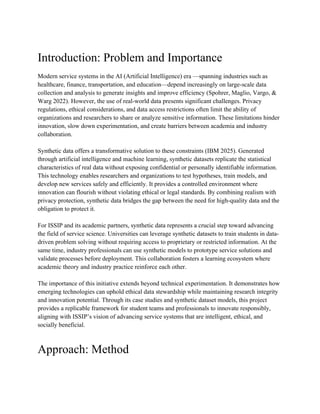
Modern service systems in the AI (Artificial Intelligence) era —spanning industries such as
healthcare, finance, transportation, and education—depend increasingly on large-scale data
collection and analysis to generate insights and improve efficiency (Spohrer, Maglio, Vargo, &
Warg 2022). However, the use of real-world data presents significant challenges. Privacy
regulations, ethical considerations, and data access restrictions often limit the ability of
organizations and researchers to share or analyze sensitive information. These limitations hinder
innovation, slow down experimentation, and create barriers between academia and industry
collaboration.
Synthetic data offers a transformative solution to these constraints (IBM 2025). Generated
through artificial intelligence and machine learning, synthetic datasets replicate the statistical
characteristics of real data without exposing confidential or personally identifiable information.
This technology enables researchers and organizations to test hypotheses, train models, and
develop new services safely and efficiently. It provides a controlled environment where
innovation can flourish without violating ethical or legal standards. By combining realism with
privacy protection, synthetic data bridges the gap between the need for high-quality data and the
obligation to protect it.
For ISSIP and its academic partners, synthetic data represents a crucial step toward advancing
the field of service science. Universities can leverage synthetic datasets to train students in data-
driven problem solving without requiring access to proprietary or restricted information. At the
same time, industry professionals can use synthetic models to prototype service solutions and
validate processes before deployment. This collaboration fosters a learning ecosystem where
academic theory and industry practice reinforce each other.
The importance of this initiative extends beyond technical experimentation. It demonstrates how
emerging technologies can uphold ethical data stewardship while maintaining research integrity
and innovation potential. Through its case studies and synthetic dataset models, this project
provides a replicable framework for student teams and professionals to innovate responsibly,
aligning with ISSIP’s vision of advancing service systems that are intelligent, ethical, and
socially beneficial.
Approach: Method
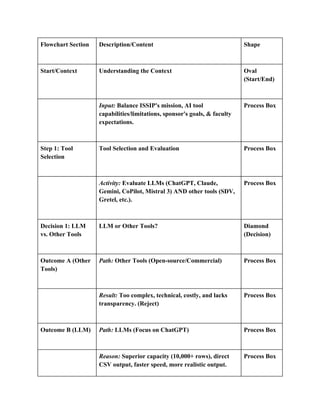
Flowchart Section Description/Content Shape
Start/Context Understanding the Context Oval
(Start/End)
Input: Balance ISSIP's mission, AI tool
capabilities/limitations, sponsor's goals, & faculty
expectations.
Process Box
Step 1: Tool
Selection
Tool Selection and Evaluation Process Box
Activity: Evaluate LLMs (ChatGPT, Claude,
Gemini, CoPilot, Mistral 3) AND other tools (SDV,
Gretel, etc.).
Process Box
Decision 1: LLM
vs. Other Tools
LLM or Other Tools? Diamond
(Decision)
Outcome A (Other
Tools)
Path: Other Tools (Open-source/Commercial) Process Box
Result: Too complex, technical, costly, and lacks
transparency. (Reject)
Process Box
Outcome B (LLM) Path: LLMs (Focus on ChatGPT) Process Box
Reason: Superior capacity (10,000+ rows), direct
CSV output, faster speed, more realistic output.
Process Box
(Select ChatGPT)
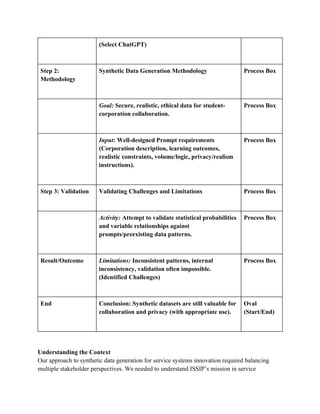
Step 2:
Methodology
Synthetic Data Generation Methodology Process Box
Goal: Secure, realistic, ethical data for student-
corporation collaboration.
Process Box
Input: Well-designed Prompt requirements
(Corporation description, learning outcomes,
realistic constraints, volume/logic, privacy/realism
instructions).
Process Box
Step 3: Validation Validating Challenges and Limitations Process Box
Activity: Attempt to validate statistical probabilities
and variable relationships against
prompts/preexisting data patterns.
Process Box
Result/Outcome Limitations: Inconsistent patterns, internal
inconsistency, validation often impossible.
(Identified Challenges)
Process Box
End Conclusion: Synthetic datasets are still valuable for
collaboration and privacy (with appropriate use).
Oval
(Start/End)
Understanding the Context
Our approach to synthetic data generation for service systems innovation required balancing
multiple stakeholder perspectives. We needed to understand ISSIP’s mission in service
innovation, explore the capabilities and limitations of current synthetic data AI generation tools,
address our mentor’s exploration goals, and meet faculty expectations for disciplinary learning
and real-world project experience.
Tool Selection and Evaluation
We began by evaluating multiple large language models (LLMs) for synthetic data generation,
including ChatGPT, Claude, Gemini, CoPilot, and Mistral 3. Through vigorous testing, we
discovered significant variation in their synthetic data generation capabilities.
ChatGPT emerged as the best LLM for synthetic dataset generation due to several key
advantages. First, it was able to create the largest datasets, being able to generate upwards of
10000+ rows. While a few other LLMs were able to generate a few hundred rows, none of them
came close to ChatGPT’s capacity. Second, ChatGPT provides a direct CSV file output, which is
necessary for streamlining workflow and eliminating manual processes. Even when specifically
prompted, most LLMs do not have the capability to produce a downloadable CSV file. Third,
generation speed was significantly faster, with the output taking less than 30 seconds, while the
other LLMs spent upwards of a minute. Lastly, the output was more realistic, with generated
values better aligning with expected results. These advantages in speed, efficiency, and
reliability demonstrate that ChatGPT is the optimal LLM among the five we tested.
We also looked into other synthetic data set generation tools. These include open-source
frameworks (SDV, YData, DataSynthesizer) and commercial platforms (Gretel, Mostly AI).
However, we found that these tools were complex to set up, highly technical and difficult to
learn, and lacking in transparency. Open-source frameworks currently available require advanced
python and development skills to create a deployable and safe UI for continued use.
Additionally, while many offer privacy features, enterprise differential privacy/certified
guarantees increase the workload and require additional technical knowledge. While commercial
platforms offer plug-and-play, they lack transparency in the data creation process, and are often
quite costly. Based on these issues and shortcomings, we’ve determined that using LLMs is the
most viable solution at the moment.
Synthetic Data Generation Methodology
The primary goal of generating synthetic data is to create a secure, realistic, and ethical data
environment that enables students to collaborate with corporations on real-world problems
without exposing confidential business operations or personal data.
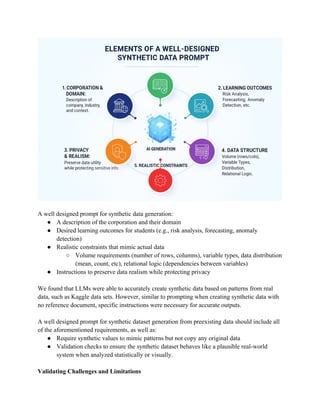
A well designed prompt for synthetic data generation:
● A description of the corporation and their domain
● Desired learning outcomes for students (e.g., risk analysis, forecasting, anomaly
detection)
● Realistic constraints that mimic actual data
○ Volume requirements (number of rows, columns), variable types, data distribution
(mean, count, etc), relational logic (dependencies between variables)
● Instructions to preserve data realism while protecting privacy
We found that LLMs were able to accurately create synthetic data based on patterns from real
data, such as Kaggle data sets. However, similar to prompting when creating synthetic data with
no reference document, specific instructions were necessary for accurate outputs.
A well designed prompt for synthetic dataset generation from preexisting data should include all
of the aforementioned requirements, as well as:
● Require synthetic values to mimic patterns but not copy any original data
● Validation checks to ensure the synthetic dataset behaves like a plausible real-world
system when analyzed statistically or visually.
Validating Challenges and Limitations
Validating synthetic dataset quality proved to be one of our most significant challenges. We
attempted to validate datasets by comparing statistical probabilities against the guidelines
specified in our prompts, or when generating from preexisting datasets, the statistical patterns
present. However, in many cases, it was impossible to concretely verify that the synthetic data
generated followed guidelines/patterns in the preexisting data. While simple statistical measures
such as ranges and averages could be calculated and compared, more complex measures such as
relationships between variables were not able to be assessed. Additionally, even with specific
prompting, synthetic data generated often failed to meet patterns in preexisting data, which was
apparent through a simple comparison between the original dataset and the newly generated
dataset. For example, when creating a synthetic dataset of earthquake information, the depth
column had significantly more decimal values than the original dataset.
These limitations highlight important considerations for individuals using LLM-generated
synthetic dataset:
● Inconsistent data patterns: Generated data may not precisely match requested statistical
measures
● Internal consistency: Variable relationships may not reflect realistic dependencies
● Validation necessity: Synthetic datasets generated by LLMs require validation, which
isn’t always possible
Despite these challenges and limitations, synthetic datasets are still valuable tools for improving
collaboration while respecting privacy and removing data access barriers. When used
appropriately, synthetic datasets can still be used by student collaborators in projects where
extreme levels of data similarity are not necessary.
Timeline of Project:
Week 1 (Sept 24): Get started on project charter and keep in contact with representative
Week 2 (Oct 1): Finish project charter and receive feedback and approval from representative
Week 3 (Oct 8): Start research on synthetic datasets, case studies and models to include in
project
Week 4 (Oct 15): Wrap up research and shift focus onto whitepaper
Week 5 (Oct 22): Draft whitepaper integrating datasets, models, and case studies
Week 6 (Oct 29): Finalize whitepaper and prepare presentation draft
Week 7 (Nov 5): Complete final presentation
Week 8 (Nov 12): Complete final visuals
Week 9 (Nov 19): Submit final deliverables & recording
Progress: Findings & Deliverables
In this section, four case studies that helped inform the exploration of synthetic data are briefly
summarized: (1) National Institute of Standards and Technology (NIST) Differential Privacy
(Near & Darais 2021), (2) Utrecht University Data Privacy Handbook (Utrecht 2025), (3) World
Economic Forum (WEF) Synthetic Data the New Economic Frontier (WEF 2025), (4) San Jose
State University (SJSU) PathGuardian Project (SJSU 2025). The one sentence take away for
ISSIP leadership from each of these studies to help inform future ISSIP industry collaboration
projects is:
(1) TBD
(2) TBD
(3) TBD
(4) TBD
Case Study 1: NIST Blog – “Differentially
Private Synthetic Data”
Source: https://www.nist.gov/blogs/cybersecurity-insights/differentially-private-synthetic-data
Overview & Purpose
The NIST (National Institute of Standards and Technology) blog post “Differentially Private
Synthetic Data” explores the opportunities and challenges of generating synthetic data under
differential privacy assurances. The article situates this approach within NIST’s broader mission
of advancing privacy, data security, and responsible data sharing. Drawing from the 2018 NIST
Differential Privacy Synthetic Data Challenge, it demonstrates how differentially private synthetic
data can balance privacy protection with data utility.
Target Audience
Primary: Policymakers, statisticians, data scientists, and privacy engineers interested in
privacy-preserving data analysis.
Secondary: Technically literate professionals seeking an accessible introduction to differential
privacy concepts.
The tone is professional yet approachable, assuming a moderate level of technical literacy
without requiring deep expertise in privacy theory.
Content & Structure
● Motivation for Synthetic Data: Introduces the risks of sharing real datasets, especially
those containing personally identifiable information (PII).
● Explaining the Concept: Defines synthetic data as data that reproduces the statistical
structure of real datasets without including records of real individuals.
● Integration of Differential Privacy: Describes how formal privacy guarantees reduce
re-identification risks during data generation.
● Issues and Restrictions: Highlights trade-offs between accuracy and privacy, noting
that synthetic datasets often sacrifice precision.
● NIST’s Role and Initiatives: References NIST’s open innovation challenges that
promote the development of differentially private synthetic data methods.
Strengths & Weaknesses
Strengths:
● Highly credible source from a leading government standards body.
● Clear, accessible explanations of complex ideas.
● Balanced perspective addressing both benefits and challenges.
● Grounded in real-world experimentation through the NIST Challenge.
Weaknesses:
● Limited technical depth on key parameters (e.g., privacy budgets).
● Minimal discussion of legal or regulatory implications (e.g., HIPAA, GDPR).
● Static content that may not reflect newer techniques or frameworks.
Key Takeaways & Impact
● Synthetic data acts as a bridge between privacy and utility.
● Differential privacy provides a rigorous mathematical foundation for protection.
● NIST positions itself as a leader in promoting safe data innovation.
This case establishes NIST as both a pioneer and educator in privacy-preserving data
research, offering policymakers and practitioners an accessible introduction to
differential privacy in practice.
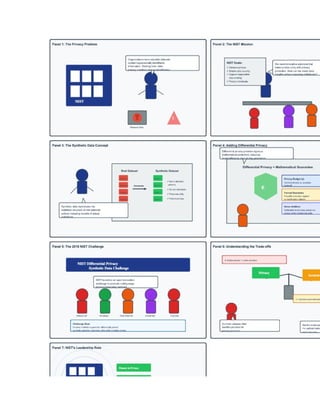
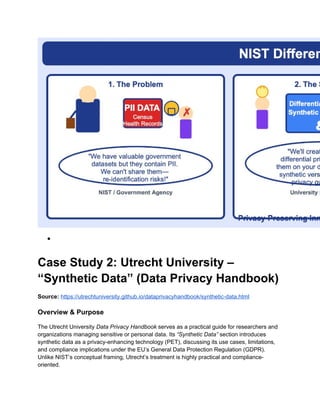
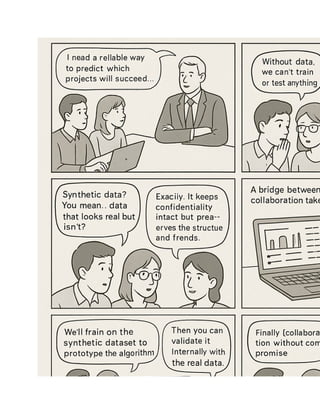
Comic Strip
● Claude AI
●
Case Study 2: Utrecht University –
“Synthetic Data” (Data Privacy Handbook)
Source: https://utrechtuniversity.github.io/dataprivacyhandbook/synthetic-data.html
Overview & Purpose
The Utrecht University Data Privacy Handbook serves as a practical guide for researchers and
organizations managing sensitive or personal data. Its “Synthetic Data” section introduces
synthetic data as a privacy-enhancing technology (PET), discussing its use cases, limitations,
and compliance implications under the EU’s General Data Protection Regulation (GDPR).
Unlike NIST’s conceptual framing, Utrecht’s treatment is highly practical and compliance-
oriented.
Target Audience
Primary: Ethics committee members, privacy officers, data stewards, and academic
researchers.
Secondary: Institutional policymakers and data managers overseeing GDPR compliance.
The section is written in plain, accessible language aimed at helping non-technical audiences
make informed decisions about privacy strategies.
Content & Structure
● Definition and Concept: Clarifies that synthetic data differs from anonymization and
pseudonymization.
● Advantages and Uses: Identifies appropriate contexts (e.g., research data sharing,
model testing, public releases).
● Risk and Privacy Considerations: Notes that while AI-generated data can reduce
privacy risks, it cannot guarantee anonymity.
● Ethical and Legal Background: Links GDPR principles—accountability, data
minimization, lawfulness—to synthetic data use and examines whether synthetic data
may still qualify as “personal data.”
● Citations and Resources: Recommends tools, frameworks, and scholarly sources for
further learning.
Strengths & Weaknesses
Strengths:
● Integrates legal, ethical, and technical considerations.
● Provides actionable, real-world guidance for researchers.
● Maintained openly on GitHub, allowing version control and community input.
● Uses clear, non-technical language.
Weaknesses:
● Limited algorithmic or statistical depth.
● May oversimplify the nuances of model evaluation or privacy guarantees.
● Relies on continuous updates to remain current with evolving research.
Key Takeaways & Impact
● Synthetic data is positioned as part of a broader ethical and compliance toolkit.
● Emphasizes regular risk assessments and context-sensitive privacy protection.
● Reinforces that privacy solutions must be adaptive, not universal.
The Utrecht University handbook operationalizes privacy principles within academic and
research institutions, bridging the gap between theoretical privacy concepts and
institutional governance.
Case Study 3: World Economic Forum –
“Synthetic Data: The New Data Frontier”
Source: https://reports.weforum.org/docs/WEF_Synthetic_Data_2025.pdf
Overview & Purpose
The World Economic Forum (WEF) report “Synthetic Data: The New Data Frontier” provides a
global perspective on how synthetic data can support privacy-preserving innovation and
trustworthy data ecosystems. It defines key concepts, presents practical use cases, and outlines
governance strategies for responsible adoption. The report frames synthetic data as both a
solution to data scarcity and a potential risk if misused, guiding leaders toward responsible,
equitable practices.
Target Audience
Primary: Policymakers, regulators, corporate executives, and AI governance professionals.
Secondary: Data scientists, legal experts, and academic researchers.
It assumes general familiarity with AI and data governance, using clear, policy-oriented
language for decision-makers rather than technical experts.
Content & Structure
● Core Definitions: Differentiates between organic, synthetic, AI-generated, and
simulated data.
● Use Cases: Presents a detailed table of real-world applications across healthcare,
finance, mobility, and crisis simulation, highlighting benefits such as improved privacy,
data availability, and model performance.
● Strategy and Governance: Examines risks such as bias, provenance issues, and
public trust; offers governance recommendations and strategic frameworks.
● Conclusion: Emphasizes the need for cross-sector collaboration to ensure responsible
innovation.
Strengths & Weaknesses
Strengths:
● Cross-sector relevance and global perspective.
● Balanced discussion of opportunities and risks.
● Actionable recommendations for both developers and policymakers.
● Strong emphasis on fairness, transparency, and trust.
Weaknesses:
● Lacks technical detail on data generation algorithms.
● Broad frameworks may need adaptation for specific industries.
● Depends on voluntary compliance rather than enforceable standards.
Key Takeaways & Impact
● Synthetic data is a cornerstone of future data ecosystems, enabling innovation while
safeguarding privacy.
● Responsible governance and transparency are essential for maintaining public trust.
● WEF’s framework connects technical innovation with policy oversight, supporting ethical
AI and data equity.
The report positions synthetic data as a strategic enabler for global digital transformation
—powerful but requiring disciplined governance and accountability.
Case Study 4: SJSU 118-I AI – “Synthetic
Data: PathGuardian”
Source: https://www.canva.com/design/DAGk0qhWGv8/L_ioRtmvk6eNDNXtWyI65w/edit
Overview & Purpose
The PathGuardian project introduces a mobile app prototype designed to enhance urban road
safety for cyclists and pedestrians. It leverages AI-powered computer vision, text generation,
and notification systems to identify, report, and communicate hazards such as blocked bike
lanes, debris, and illegal dumping in real time.
The purpose of this project is to create a data-driven solution that promotes community
engagement, urban safety, and sustainable mobility through responsible technology design.
PathGuardian demonstrates how AI can be used ethically to serve public interests in civic
infrastructure and environmental awareness.
Target Audience
Primary: City planners, transportation departments, and civic technology partners interested in
data-driven safety solutions.
Secondary: Cyclists, pedestrians, and community advocacy groups promoting safer, greener
urban environments.
The presentation assumes a general understanding of urban planning and mobile app
technology, using accessible, community-oriented language aimed at decision-makers and
everyday users rather than technical specialists.
Content & Structure
Problem Statement:
Urban areas frequently experience blocked bike lanes and crosswalks due to obstructions,
creating safety hazards and accessibility issues for cyclists and pedestrians.
Personas:
● Bob – The Civic-Minded Commuter: A daily cyclist who values eco-conscious living
and seeks a simple way to report hazards.
● Maria – The Safety-Conscious Cyclist Mom: A parent who needs reliable route
information and fast hazard reporting while biking or walking with her children.
Solution Statement:
PathGuardian integrates computer vision, text-based AI, and notification systems to detect,
classify, and communicate road hazards in real time. It uses a combination of datasets, APIs,
and AI packages to power intelligent reporting and feedback loops between users and local
authorities.
Ethical Design:
● Data Sharing: Addresses privacy concerns surrounding user location data and potential
misuse by ensuring transparent consent and secure data handling.
● AI Bias & Accuracy: Recognizes potential bias in hazard classification models and
emphasizes fairness, accuracy, and accountability in AI outputs.
Strengths & Weaknesses
Strengths:
● Clear focus on civic impact and community safety.
● Integration of multiple AI functions for practical, real-world application.
● Ethical considerations embedded in system design.
● User personas demonstrate empathy-driven development.
Weaknesses:
● Prototype stage lacks real-world deployment data.
● Requires strong data partnerships for scaling and model accuracy.
● Ethical assurances depend on consistent governance and user compliance.
Key Takeaways & Impact
● AI can empower civic safety by enabling real-time hazard reporting and prevention.
● Ethical data handling and bias mitigation are crucial to maintain public trust and
adoption.
● PathGuardian bridges AI innovation with social good, aligning with the UN
Sustainable Development Goals on sustainable cities and infrastructure.
● The project demonstrates how student-led innovation and public-private
collaboration can promote equitable, safer urban environments.
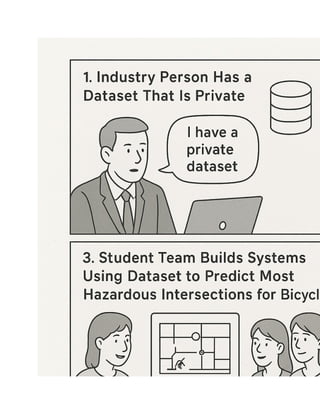
Comic Strips
Option A)
Option B)
Reference: https://chatgpt.com/share/68fedb42-a9cc-80 00-a596-f3333acdaf7d
The final deliverables will be linked to in the ISSIP blog post and inclide: Charter & Plan
(Project charter and weekly plan), Artifact (primary project deliverables - ideally on each student
GitHb account), whitepaper (this document), presentation (based on whitepaper), recording
(based on presentation), and project poster.
Future Directions: Next Steps, Unsolved
Challenges & Limitations
If we had had more time, here is what we would have done… What was hard about this
project?
Looking ahead, this project highlights both promising opportunities for expansion and important
challenges to tackle. With additional time and resources, we would have broadened the scope of
case studies to include more industries such as healthcare, finance, and transportation,
demonstrating how synthetic data can be applied in diverse real-world contexts. We also would
have explored a wider range of approaches for generating synthetic data and compared their
relative strengths and weaknesses.
Another important step would have been to design clearer ways to measure the quality of
synthetic data, including how realistic it appears, how useful it is for testing ideas, and how well
it protects privacy. Beyond classroom work, testing projects with industry partners could have
tested these ideas in practice, while creation of simple guides would have helped future student
teams continue and expand the work.
One of the most persistent issues is inaccuracy: synthetic datasets often sacrifice precision in
order to protect privacy, which can make them less reliable for detailed analysis. As noted in the
NIST case study, there is always a trade-off between privacy and accuracy, and finding the right
balance is difficult. The Utrecht University Data Privacy Handbook emphasizes that while
synthetic data can reduce privacy risks, it does not fully guarantee anonymity. It also cautions
that synthetic datasets may simplify or smooth over the complexity of real-world information,
which can limit their usefulness for certain types of analysis.The World Economic Forum also
emphasized risks around bias and trust, noting that inaccurate or poorly governed synthetic data
could undermine confidence in results. These concerns highlight that while synthetic data is
promising, it is not a perfect substitute for real-world information.
Due to these challenges, many stakeholders remain cautious, questioning whether synthetic data
can truly be trusted for decision-making. Creating high-quality datasets also requires significant
time and resources, and the legal rules surrounding synthetic data remain unclear, making
adoption more complex.
In addition, the project was shaped by certain limitations. The semester timeline restricted how
much we could experiment and refine our datasets. Much of the work remained at the prototype
stage rather than being tested in real-world environments. While we had access to advanced AI
platforms and large language models, which provided powerful tools for generating and
experimenting with synthetic data, we did not have direct access to large-scale proprietary
datasets or high-performance computing resources. This limited our ability to validate synthetic
data against real-world benchmarks at scale. Finally, integrating technical, ethical, and
organizational perspectives proved challenging, requiring more time for collaboration and
reflection.
In conclusion, this initiative demonstrated that synthetic data is more than a technical tool—it is
a catalyst for responsible innovation. While challenges remain, this project with the International
Society of Service Innovation Professionals (ISSIP) laid a foundation for future research, clearer
guidelines, and stronger collaboration between universities, industry, and professional
organizations. With continued effort, synthetic data can evolve from an experimental concept
into a trusted enabler of ethical, scalable, and impactful service innovation.
Concluding Remarks: Summary & Call to Action
The synthesis of research and experimentation across our case studies demonstrates that
synthetic data is not merely a technical workaround but it is a cornerstone of responsible and
inclusive innovation. From NIST’s rigorous approach to differential privacy, to Utrecht
University’s integration of ethical and regulatory frameworks, to the World Economic Forum’s
global governance vision, and finally to SJSU’s PathGuardian project applying synthetic data
for civic good, a clear trajectory emerges: the future of data-driven innovation depends on trust,
transparency, and collaboration.
Yet, realizing this future requires balancing visionary long-term goals with practical short-term
action. Academic institutions must continue to design and test open-source synthetic datasets that
model real-world service systems safely and ethically. Industry leaders should pilot partnerships
where student innovation meets real enterprise needs, transforming theoretical insights into
measurable impact. Policymakers, in turn, must refine governance frameworks to ensure privacy
protection does not become a barrier to progress.
The next chapter of synthetic data research will be defined by interdisciplinary teamwork—
technologists, ethicists, and service innovators co-creating systems that are not only intelligent
but socially beneficial and sustainable. By investing in this collaborative ecosystem, ISSIP and
its partners can pioneer new standards for ethical data use that empower education, safeguard
individuals, and accelerate innovation worldwide.
“The best way to predict the future is to invent it.”
— Alan Kay, computer scientist and visionary
This project calls upon every student, researcher, and industry partner to help invent that future
together, one where synthetic data serves as both a shield for privacy and a bridge for progress.
Acknowledgements: Portions of this whitepaper were created with the help of AI systems; see
Appendix A for some details. We would also like to thank person1 role, person 2 role, person 3
role, etc. All students will earn the ISSIP Digital Certification for Knowledge-Sharing-Eminence
at the end of the project. Students must make sure they are connected to Jim Spohrer on
LinkedIn, and register at the ISSIP website (https://issip.org/register/) free for all participants.
When the project deliverables get uploaded to the ISSIP website (ideally they are also uploaded
to the students GitHub accounts), the ISSIP Digital Credentials are awarded and students can put
them on your LinkedIn Profile. Students who come to the Bay Area in California (San Francisco,
San Jose) should contact Jim Spohrer, if they want a Computer History Museum tour.
References
Hodges (1991) Six (Or So) Things You Can Do With A Bad Model.
https://www.rand.org/content/dam/rand/pubs/notes/2005/N3381.pdf
IBM (2025) What is synthetic data? IBM Think Staff Writer, Rina Diane Caballa URL:
https://www.ibm.com/think/topics/synthetic-data
ISSIP (2024) ISSIP Handbook (2024 Edition).. URL:
https://issip.org/wp-content/uploads/2024/08/ISSIP-Handbook-2024-Edition.pdf
Near J, Darais D (2021) Differentially Private Synthetic Data. NIST Blog May 3, 2021. URL:
https://www.nist.gov/blogs/cybersecurity-insights/differentially-private-synthetic-data
SJSU (2025) PathGuardian Project. San Jose State University (SJSU) Course 118-I AI. Silver
Team: Christopher Barroga, Shaina Ruiz, Fatima Soria, Sheena Kumar, An Luu. URL:
https://www.canva.com/design/DAGk0qhWGv8/L_ioRtmvk6eNDNXtWyI65w/edit
Spohrer J, Maglio PM, Vargo SL, Warg M (2022) Service in the AI Era: Science, Logic, and
Architecture Perspectives. URL: https://www.amazon.com/Service-AI-Era-Architecture-
Perspectives/dp/1637423039
Utrecht (2025) Data Privacy Handbook. Utrecht University. Last updated: 2025-05-06. URL:
https://utrechtuniversity.github.io/dataprivacyhandbook/synthetic-data.html
WEF (2025) Synthetic Data: The New Data Frontier. World Economic Forum (WEF) Briefing
Paper September 2025. URL: https://reports.weforum.org/docs/WEF_Synthetic_Data_2025.pdf
Appendix A
A.1 Tools Used
Jim uses these AI tools, starts with the tool that gave the best response, and then makes
improvements (rewriting and removing sentences, as well as adding elements that are good from
the other tools).
(1) OpenAI ChatGPT: https://chatgpt.com
(2) Anthropic Claude: https://claude.ai/chat/
(3) Google Gemini: https://gemini.google.com/
(4) Microsoft CoPilot: https://copilot.microsoft.com/chats/
(5) DuckDuckAI Chat - Mistral 3: https://duckduckgo.com/chat
(6) Moonshot AI Kimi K2: https://kimi.com
Please remember it is OK to use AI to help with this project. And remember, try this approach:
(1) Always use more than one AI systems, (2) Put the prompt in a text file, ending with "Before
starting, is the task clear? any clarification questions for me before generating the response?"
(prompt design is a key focus of learning), (3) Put the same prompt in multiple AI systems, and
make a decision about which is best response and why (criterion) and which is worst response
and why (criterion), (4) think hard about better and better prompt design.
Points for Jim to clarify in future student team projects:
(1) Jim to do a better job with improved Appendix A – include student team names, LinkedIn
URL, GitHub URL for use in receiving ISSIP digital certification at end of project. Also
each student should sign-up as an ISSIP participation at the website (free).
(2) Jim to do a better description of how to do whitepaper front page, citation & references,
and how to use Google Scholar and websearch to find relevant papers and website to
summarize with multiple AI tools. How to do the research and verification. “NeuronAI
Summary - Why this matters: The researchers propose a middle path: human-agent
teaming. In other words, delegate the readily programmable, repetitive stuff to agents
(where they excel), while you (a human, I presume?) handle tasks requiring visual
judgment, creativity, and verification. In one experiment, this hybrid approach
maintained human-level quality while improving efficiency by 69%.”
(3) Jim to do a better job of explaining that each student individually (with multiple AI
helpers) should do the whole project by themselves as an agile sprint. Only once each
team member (with the help of multiple AI digital workers) has completed the whole
charter and all deliverables should the team decide on individal team roles and specialize
for the polishing stage of the project. This is divide-and-conquer refinement for the AI
age student teams. May also need to discuss with faculty and other industry mentors so
they see the benefit of this AI era approach to team work – but first individual + AI
workers.
(4) Jim to do a better job of having students post deliverables to their GitHubs as part of the
project work. Even if the students are not programmers it is important to know how to
post research to GitHub, how to search GitHub for relevant projects, how to search
Kaggle for relevent data sets, how to search LinkedIn for relevant job roles and
influencers to follow, how to build a network on LinkedIn, and finally and foremost how
to be an individual empowered by multiple AI tools to do research, verification,
refinement, and then do the polishing as the specialized teamwork at the end. T-shaped
professional in the AI era operate as unicorn-entrepreneurs working on the same problem,
and then specialize (go deep in their area of interest or expertise) when the team
combines their work and begins polishing the deliverables.
A.2 Tool Problems
All AI systems today suffer from the 3 E Problems:
1. Energy: AI systems use too much energy.
2. Errors: AI systems make a lot of errors.
3. Ethics: AI system vendors made ethically questionable choices, often violating copyright
by training on material they did not have rights to train upon.
For these reasons (and other reasons), users should limit their use of today’s AI systems and be
very careful when using today’s AI systems for any purpose.
A.2 Prompts for part X of this project
The design of prompts is key. Use Appendix A, to share some of the key prompts used. Jim
recommends that all prompts are of the form: “Please do task X. However, before starting, is the
task clear? Any clarification questions to ask me before starting?” So often Prompt 1 is followed
by Prompt 2 with the clarifications. This leads to better results.
Throughout our research, various AI systems generate different results even with the use of the
same prompt and guidelines.
A.3 Prompt for Ideal Jobs
Prompt 1:
Please create a table with four columns. Column 1 "your academic major". Column 2 "your ideal
job". Column 3 "your ideal big company role". Column 4 "your ideal startup company you
would found." So columns: Major, Ideal Job, Big Company Role, Startup. The rows include
"Industrial Engineering", "Computer Science", “Management of Information Systems",
"Business Analytics (Data Sciences)", and "User Experience (UX, Human-Computer
Interaction)." Please fill in each cell in the table by mimicking what a student today might want
as an ideal job, and be clear about what data and models they would be working with in that job.
Is this task clear? Are there any clarifying questions you have for me before starting this task?
A.4 Prompt for Kaggle Competition
Prompt1:
Please use the uploaded ideal jobs pdf to create a table with three columns. Column 1 “academic
major”, Column 2 “ideal jobs”, Column 3 “Kaggle dataset”. For each academic major
(Industrial Engineering, Computer Science, Management of Information Systems, Business
Analytics (Data Sciences), User Experience (UX, Human-Computer-Interactions) ) include at
least two ideal jobs in Column 2, and between 1-3 example kaggle datasets in Column 3. Please
provide a short description of each Kaggle datasets, mention any associated competitions of
companies. However, before starting, is the task clear? Any clarification questions to ask me
before starting?
Appendix B
In addition to the project deliverables, there are often other intermediate or useful artifacts
created that can be shared in a series of Appendices at the end of the whitepaper.