Is investing in technology having an impact on the education of our students? Why plan for professional development involving the use of technology? Presented by:  Nichol L. Anderson Technology & Teaching
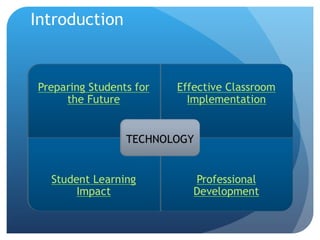
Introduction
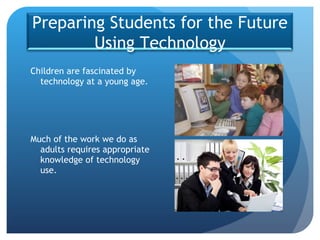
Children are fascinated by technology at a young age. Much of the work we do as adults requires appropriate knowledge of technology use. Preparing Students for the Future Using Technology
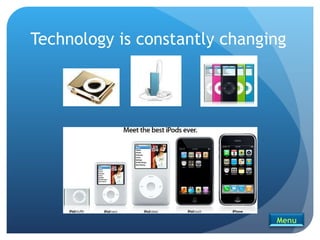
Technology is constantly changing Menu
The Vision How do we get there? How to Effectively Implement Technology in the Classroom
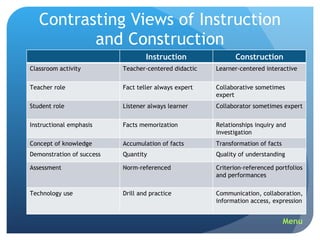
Contrasting Views of Instruction and Construction Menu Instruction Construction Classroom activity Teacher-centered didactic Learner-centered interactive Teacher role Fact teller always expert Collaborative sometimes expert Student role Listener always learner Collaborator sometimes expert Instructional emphasis Facts memorization Relationships inquiry and investigation Concept of knowledge Accumulation of facts Transformation of facts Demonstration of success Quantity Quality of understanding Assessment Norm-referenced Criterion-referenced portfolios and performances Technology use Drill and practice Communication, collaboration, information access, expression
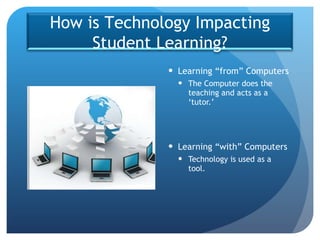
Learning “from” Computers The Computer does the teaching and acts as a ‘tutor.’ Learning “with” Computers Technology is used as a tool. How is Technology Impacting Student Learning?
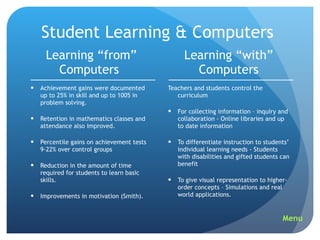
Student Learning & Computers  Learning “from” Computers Achievement gains were documented up to 25% in skill and up to 1005 in problem solving. Retention in mathematics classes and attendance also improved. Percentile gains on achievement tests 9-22% over control groups Reduction in the amount of time required for students to learn basic skills. Improvements in motivation (Smith). Learning “with” Computers Teachers and students control the curriculum For collecting information – inquiry and collaboration - Online libraries and up to date information To differentiate instruction to students’ individual learning needs - Students with disabilities and gifted students can benefit To give visual representation to higher-order concepts – Simulations and real world applications. Menu
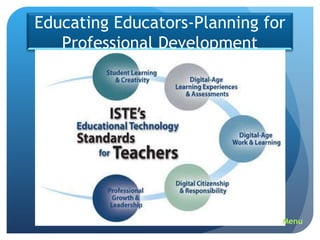
Menu Educating Educators-Planning for Professional Development
“ We must be the change we wish to see in the world.” ~Ghandi Menu Conclusion
Ringstaff, Cathy, and Loretta Kelley. "The Learning Return On Our Educational Technology Investment: A Review of Findings from Research."  WestEd RTEC  (2002): 1-30. Web. 1 Jun 2011. Keengwe, Jared, Grace Onchwari, and Patrick Wachira. "The Use of Computer Tools to Support Meaningful Learning." AACE Journal 16.1 (2008): 77-92. Web. 1 Jun 2011. Williams, Diana, Randall Boone, and Kingsley Karla. "Teacher Beliefs About Educational Software: A Delphi Study." Journal of Research on Technology in Education 36.3 (2004): 213-229. Web. 1 Jun 2011. Harris, Judith, Punya Mishra, and Matthew Koehler. "Teachers' Technological Pedagogical Content Knowledge and Learning Activity Types: Curriculum-based Technology Integration Reframed." Journal of Research on Technology in Education 41.4 (2009): 393-416. Web. 1 Jun 2011. Smith, Anna. "Interactive Whiteboard Evaluation." MirandaNet . MirandaNet Publications, 2000. Web. 1 Jun 2011.  http://www.mirandanet.ac.uk/home.php .  Menu Works Cited

Tech presentation

  • 1.
    Is investing intechnology having an impact on the education of our students? Why plan for professional development involving the use of technology? Presented by: Nichol L. Anderson Technology & Teaching
  • 2.
  • 3.
    Children are fascinatedby technology at a young age. Much of the work we do as adults requires appropriate knowledge of technology use. Preparing Students for the Future Using Technology
  • 4.
  • 5.
    The Vision Howdo we get there? How to Effectively Implement Technology in the Classroom
  • 6.
    Contrasting Views ofInstruction and Construction Menu Instruction Construction Classroom activity Teacher-centered didactic Learner-centered interactive Teacher role Fact teller always expert Collaborative sometimes expert Student role Listener always learner Collaborator sometimes expert Instructional emphasis Facts memorization Relationships inquiry and investigation Concept of knowledge Accumulation of facts Transformation of facts Demonstration of success Quantity Quality of understanding Assessment Norm-referenced Criterion-referenced portfolios and performances Technology use Drill and practice Communication, collaboration, information access, expression
  • 7.
    Learning “from” ComputersThe Computer does the teaching and acts as a ‘tutor.’ Learning “with” Computers Technology is used as a tool. How is Technology Impacting Student Learning?
  • 8.
    Student Learning &Computers Learning “from” Computers Achievement gains were documented up to 25% in skill and up to 1005 in problem solving. Retention in mathematics classes and attendance also improved. Percentile gains on achievement tests 9-22% over control groups Reduction in the amount of time required for students to learn basic skills. Improvements in motivation (Smith). Learning “with” Computers Teachers and students control the curriculum For collecting information – inquiry and collaboration - Online libraries and up to date information To differentiate instruction to students’ individual learning needs - Students with disabilities and gifted students can benefit To give visual representation to higher-order concepts – Simulations and real world applications. Menu
  • 9.
    Menu Educating Educators-Planningfor Professional Development
  • 10.
    “ We mustbe the change we wish to see in the world.” ~Ghandi Menu Conclusion
  • 11.
    Ringstaff, Cathy, andLoretta Kelley. "The Learning Return On Our Educational Technology Investment: A Review of Findings from Research." WestEd RTEC (2002): 1-30. Web. 1 Jun 2011. Keengwe, Jared, Grace Onchwari, and Patrick Wachira. "The Use of Computer Tools to Support Meaningful Learning." AACE Journal 16.1 (2008): 77-92. Web. 1 Jun 2011. Williams, Diana, Randall Boone, and Kingsley Karla. "Teacher Beliefs About Educational Software: A Delphi Study." Journal of Research on Technology in Education 36.3 (2004): 213-229. Web. 1 Jun 2011. Harris, Judith, Punya Mishra, and Matthew Koehler. "Teachers' Technological Pedagogical Content Knowledge and Learning Activity Types: Curriculum-based Technology Integration Reframed." Journal of Research on Technology in Education 41.4 (2009): 393-416. Web. 1 Jun 2011. Smith, Anna. "Interactive Whiteboard Evaluation." MirandaNet . MirandaNet Publications, 2000. Web. 1 Jun 2011. http://www.mirandanet.ac.uk/home.php . Menu Works Cited

Editor's Notes

  • #2 The following slides will answer these two important questions.
  • #3 In this presentation, I will show how investing in technology in classrooms have had a positive impact on students learning in our nation when the proper support for Educators to implement that technology is also invested in through Professional Develop. I will outline four main points to show how equipping classrooms with networks, educational software and equipment such as Interactive Whiteboards, document cameras, word processing, excel spreadsheets, etc. are important resource tools in our schools.
  • #4 The former secretary of education, Richard Riley is quoted at www.creativecareer.com as stating, “The Top 10 in-demand jobs in 2010 may not have existed in 2004.” In this point I will be high lighting the importance that the role of teachers play in preparing students for the future through the use of technology.
  • #5 Technology is always in a state of flux, which means it is continuously changing. How well our district keeps up with these changes will ultimately determine how prepared our students will be for using these new technologies.
  • #6 In a 20-year retrospective on U.S. educational technology policy, Culp, Honey, and Mandinach (2003) describe a mismatch between educational technology leaders’ visions for technology integration and how most practitioners use digital tools (Harris, Mishra, and Koehler 393-416). What issues need to be addressed to make technology use the most effective? Technology is most powerful when used as a tool for problem solving, conceptual development, and critical thinking (Ringstaff and Kelley). Technology should not control the curriculum. Technology is useful for collecting data that is up to date and not found in current textbooks. Technology can be used to tailor instruction to students’’ individual needs (Ringstaff and Kelley). Technology can provide a means for students with special needs to communicate via email Gifted students can work at their own pace
  • #7 To effectively teach with technology, teachers must shift their instructional practices from a teacher-centered lecture approach to a more student centered learning or constructivist approach (Jonassen, 2000) (Keengwe, Onchwari, and Wachira 77-92).
  • #8 There are many conflicting arguments about how technology impacts student learning. It’s important to keep the curricular outcomes in mind when integrating technology into the classroom. There are two types of learning from computers according to Ringstaff and Kelley (2002), learning “from” computers and learning ‘’with” computers. Each type of learning produces different results on student learning outcomes.
  • #9 The impact of technology on Student Learning Learning “from” computers. The computer does the teaching and acts as a ‘tutor.’ According to Ringstaff and Kelley (2002), evaluations in a mathematics study using ‘tutor’ technology showed that students who used a given math tutor outperformed students in a traditional classes. In addition to Ringstaff and Kelley’s findings are Keengwe, Onchwari, and Wachira (2008) who reported positive and significant gains for students who were engaged in technology rich environments. In all subjects, increased achievement and improved attitude toward their own learning and increased self-esteem. Impact on students with disabilities Computers provide diverse tools for children with disabilities that encourage autonomous behaviors as well as increase the probability that they will interact with their learning environment. Learning “with” computers. Technology is used as a tool Students gather, organize, and analyze information, and use that information to solve problems (Ringstaff and Kelley).
  • #10 Technology by itself cannot change the nature of instruction unless teachers and educational leaders are able to evaluate and integrate the use of that technology into the curriculum (Keengwe, Onchwari, and Wachira 77-79). Teachers need to be ale to comfortably and fluently use technology to have confidence with their own use in it within their classrooms. What ISTE (2006) has to say about technology and teachers: “ Today’s classroom teachers must be prepared to provide technology-supported learning opportunities for their students…being prepared to use technology and knowing how that technology can support student learning must be integral skills in every teacher’s professional repertoire,” (Keengwe, Onchwari, Wachira 77-92).