University of Houston ISRC February 21, 2008 This research was made possible by the support of CISR sponsors and patrons. The research team included Cynthia Beath (University of Texas) and Donna Pitteri and Stephanie Woerner (CISR). Architecting Agility
 
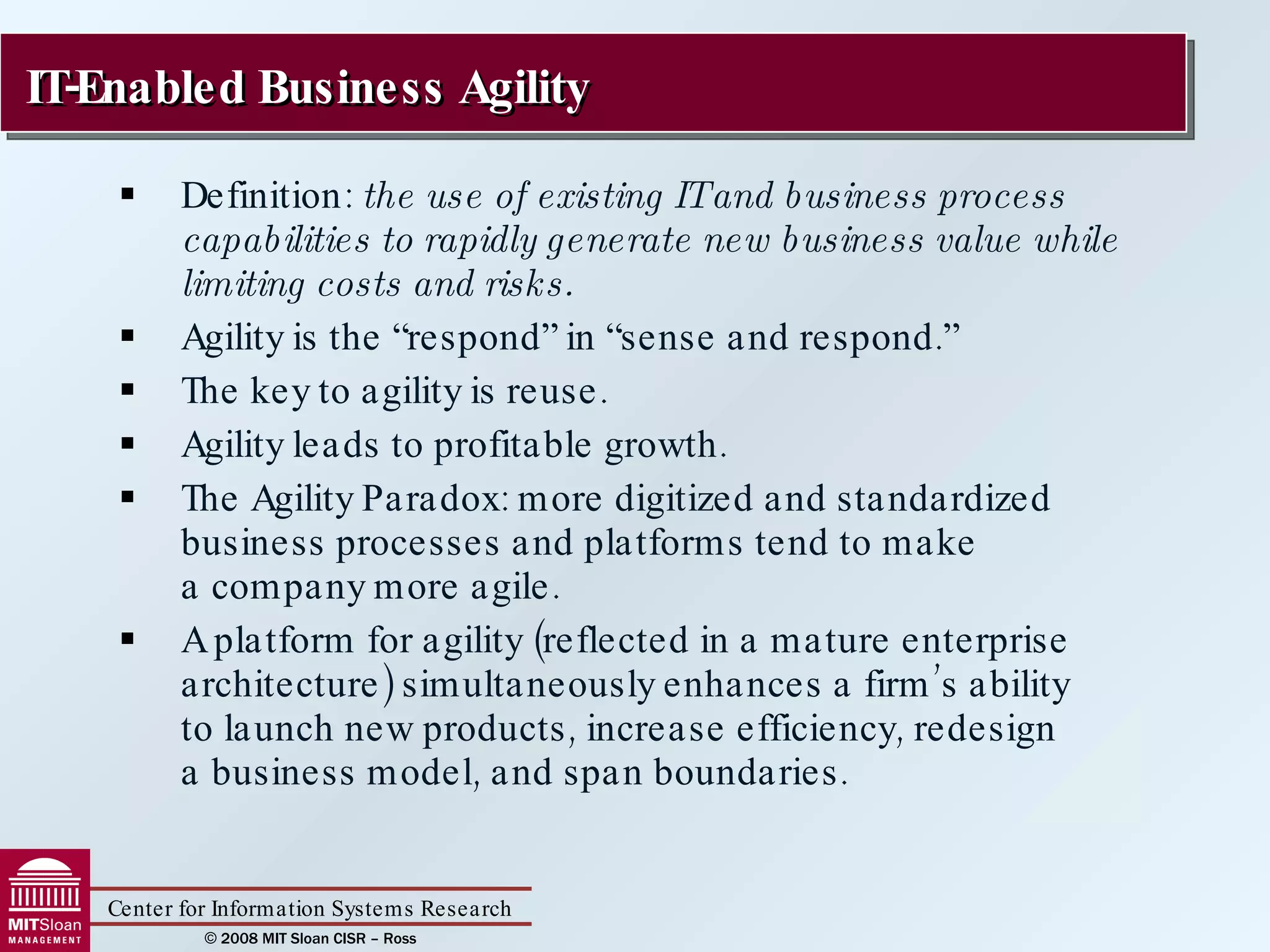
Definition:  the use of existing IT and business process capabilities to rapidly generate new business value while limiting costs and risks. Agility is the “respond” in “sense and respond.”  The key to agility is reuse. Agility leads to profitable growth. The Agility Paradox: more digitized and standardized business processes and platforms tend to make  a company more agile. A platform for agility (reflected in a mature enterprise architecture) simultaneously enhances a firm’s ability  to launch new products, increase efficiency, redesign  a business model, and span boundaries. IT-Enabled Business Agility
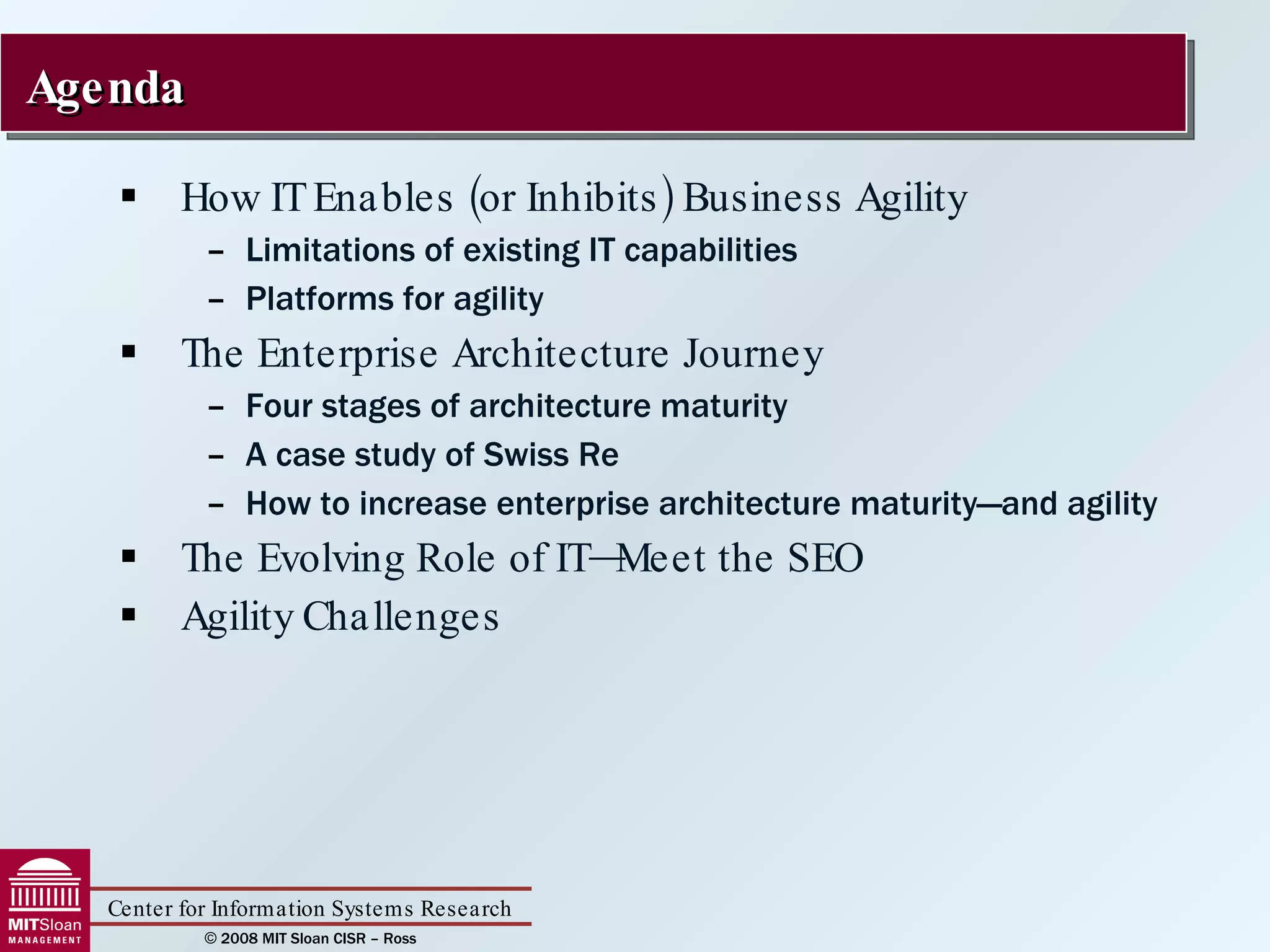
How IT Enables (or Inhibits) Business Agility Limitations of existing IT capabilities Platforms for agility The Enterprise Architecture Journey Four stages of architecture maturity A case study of Swiss Re How to increase enterprise architecture maturity—and agility The Evolving Role of IT—Meet the SEO Agility Challenges Agenda
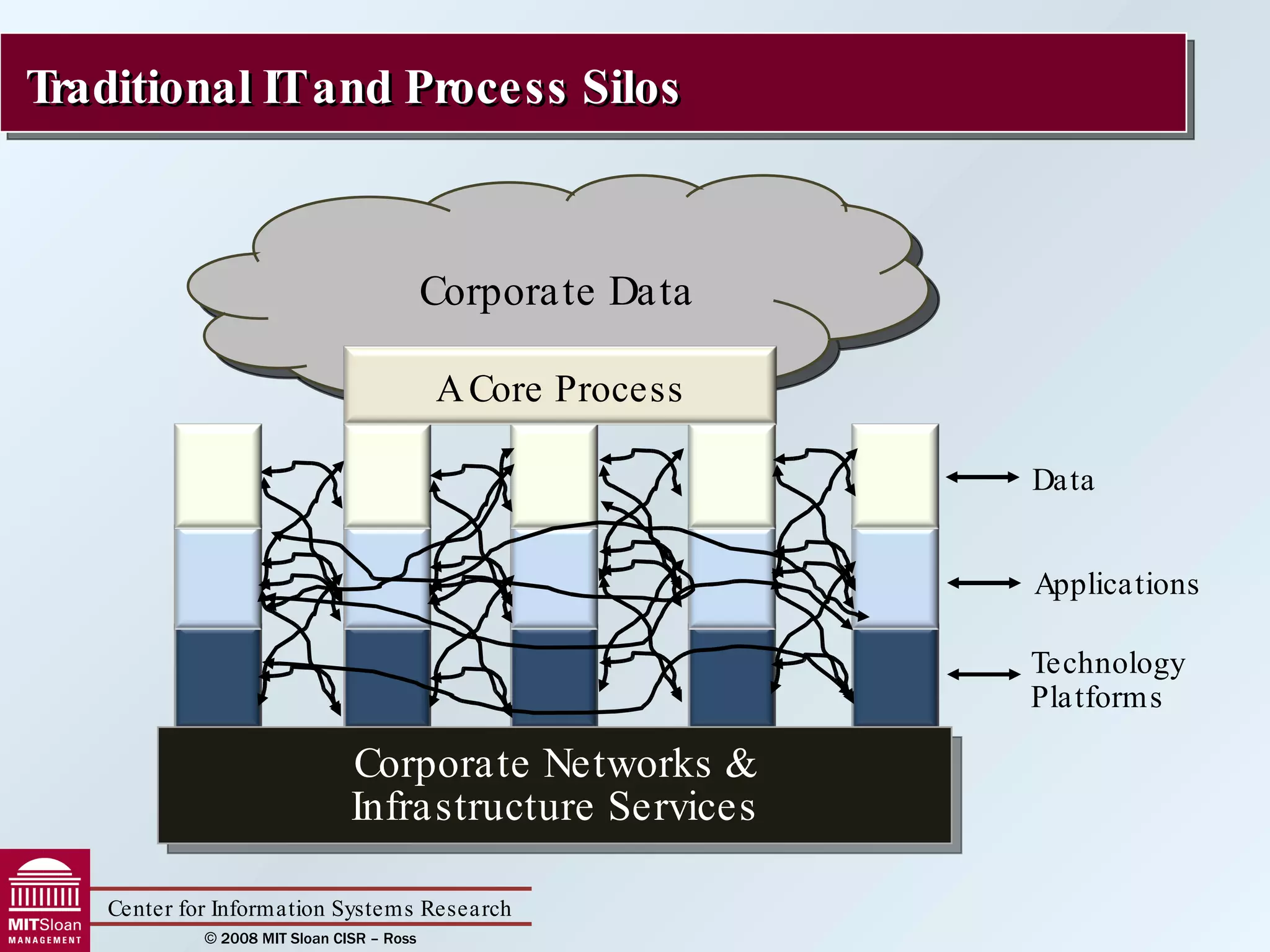
Traditional IT and Process Silos Technology Platforms Applications Data Corporate Data Corporate Networks & Infrastructure Services A Core Process
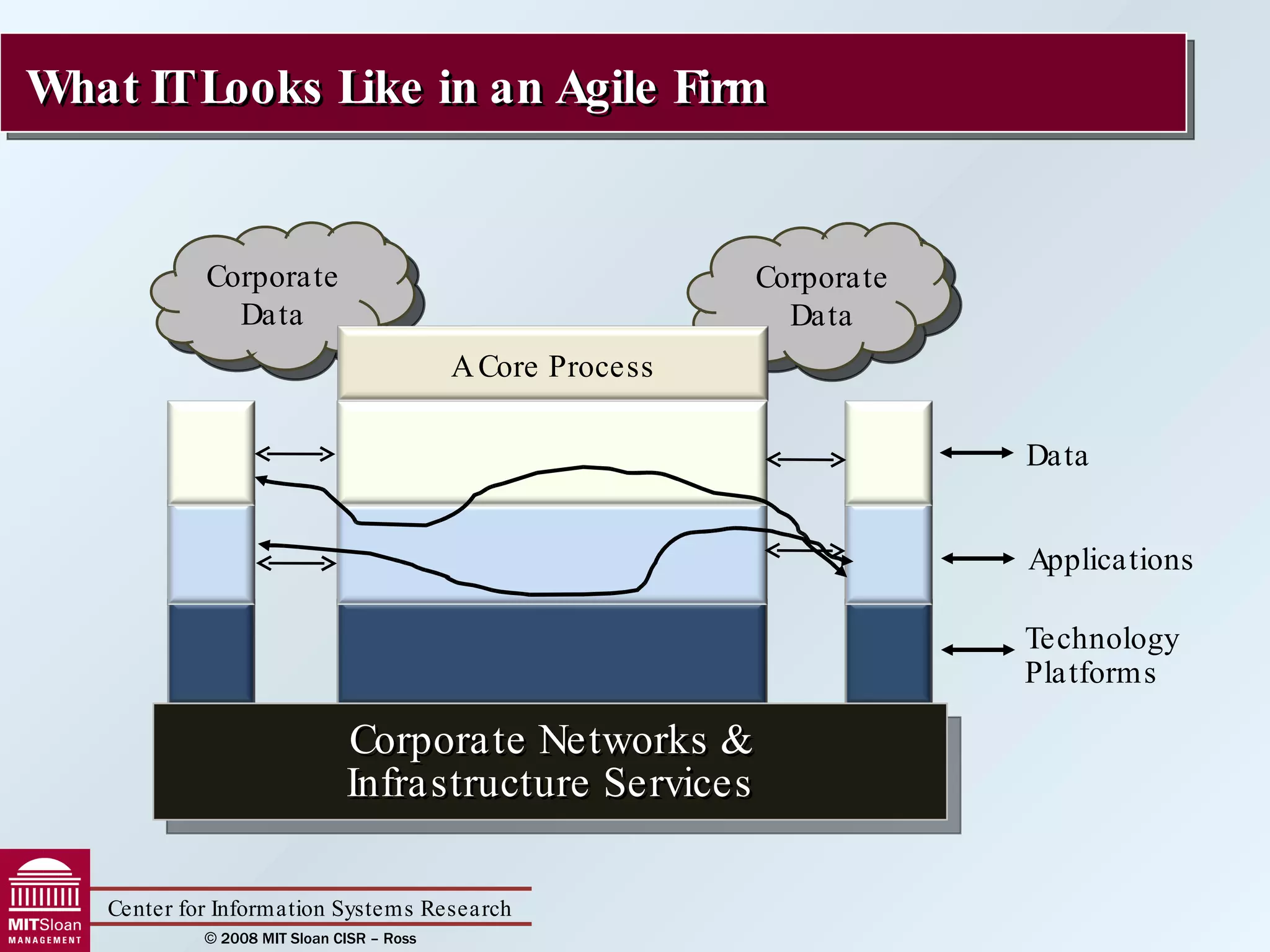
What IT Looks Like in an Agile Firm Technology Platforms Applications Data Corporate Data Corporate Networks & Infrastructure Services Corporate Data A Core Process
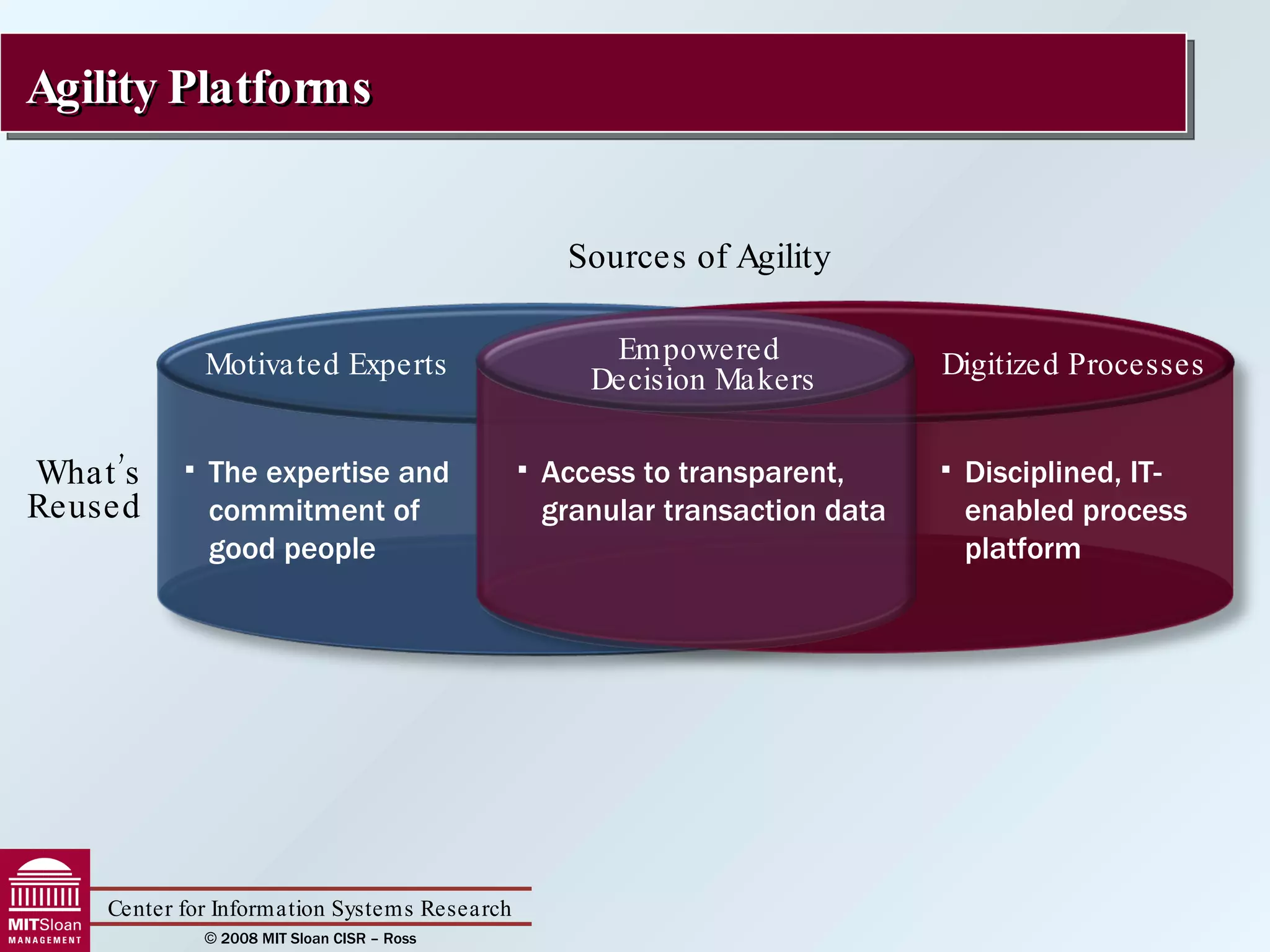
Agility Platforms Sources of Agility What’s Reused Motivated Experts Empowered  Decision Makers Digitized Processes The expertise and commitment of good people Access to transparent,  granular transaction data Disciplined, IT-enabled process platform
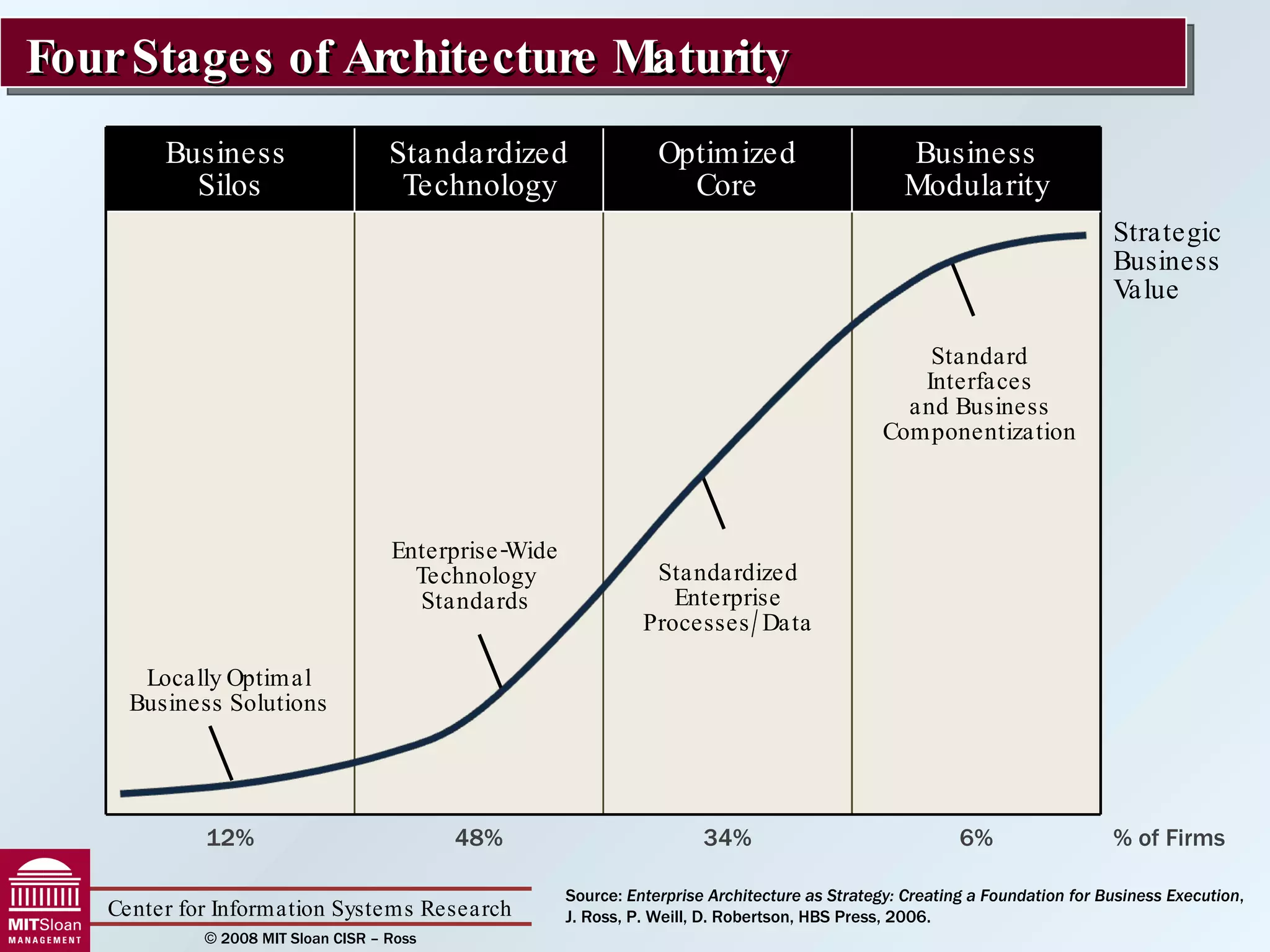
Four Stages of Architecture Maturity Standardized Enterprise Processes/Data Standard Interfaces and Business Componentization Enterprise-Wide Technology Standards Locally Optimal Business Solutions Source:  Enterprise Architecture as Strategy: Creating a Foundation for Business Execution ,  J. Ross, P. Weill, D. Robertson, HBS Press, 2006. Business  Silos Standardized Technology Optimized Core Business Modularity Strategic Business Value 12% 48% 34% 6% % of Firms
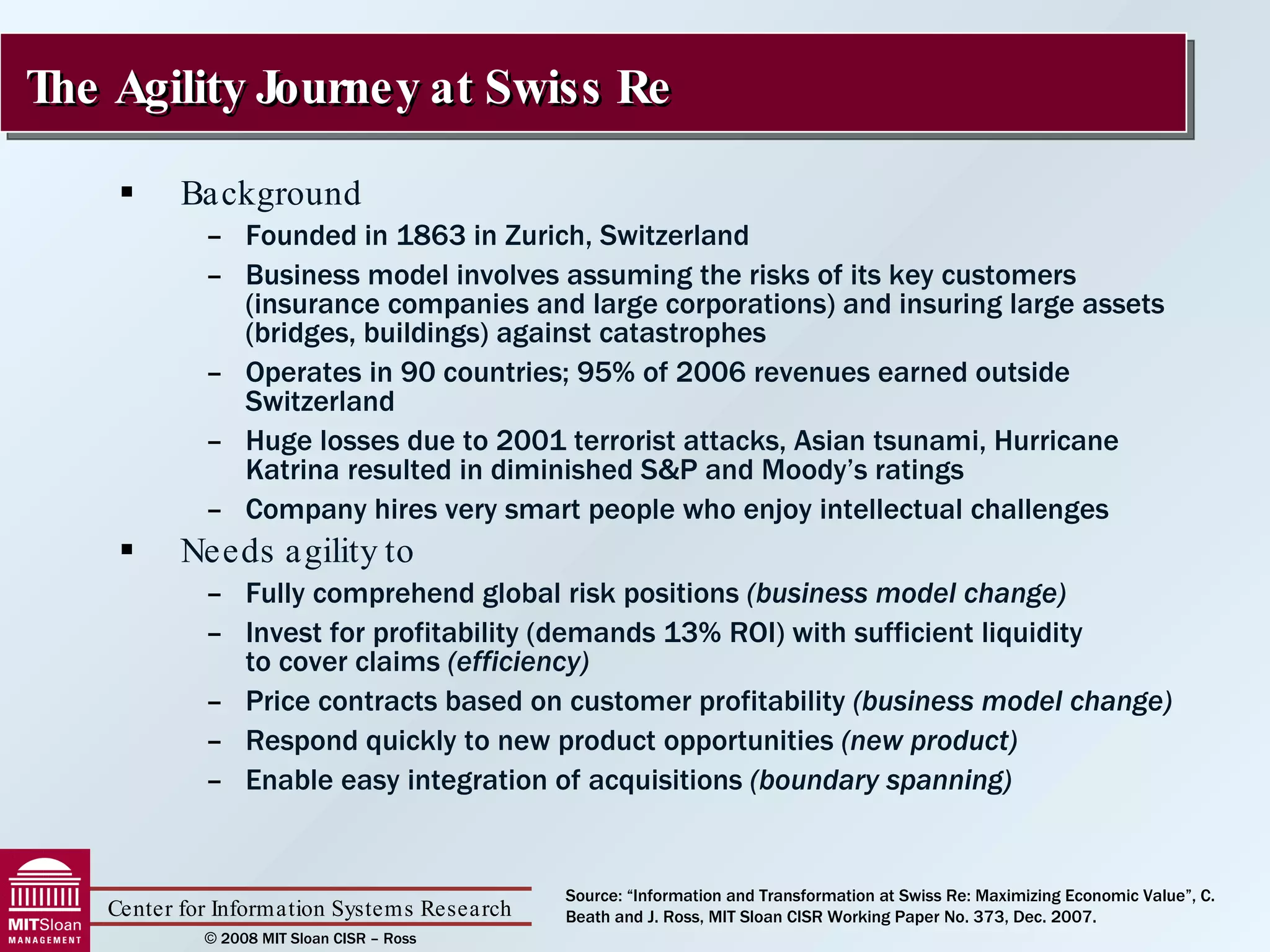
Background Founded in 1863 in Zurich, Switzerland Business model involves assuming the risks of its key customers (insurance companies and large corporations) and insuring large assets (bridges, buildings) against catastrophes Operates in 90 countries; 95% of 2006 revenues earned outside Switzerland Huge losses due to 2001 terrorist attacks, Asian tsunami, Hurricane Katrina resulted in diminished S&P and Moody’s ratings Company hires very smart people who enjoy intellectual challenges Needs agility to Fully comprehend global risk positions  (business model change) Invest for profitability (demands 13% ROI) with sufficient liquidity  to cover claims  (efficiency) Price contracts based on customer profitability  (business model change) Respond quickly to new product opportunities  (new product) Enable easy integration of acquisitions  (boundary spanning) The Agility Journey at Swiss Re Source: “Information and Transformation at Swiss Re: Maximizing Economic Value”, C. Beath and J. Ross, MIT Sloan CISR Working Paper No. 373, Dec. 2007.
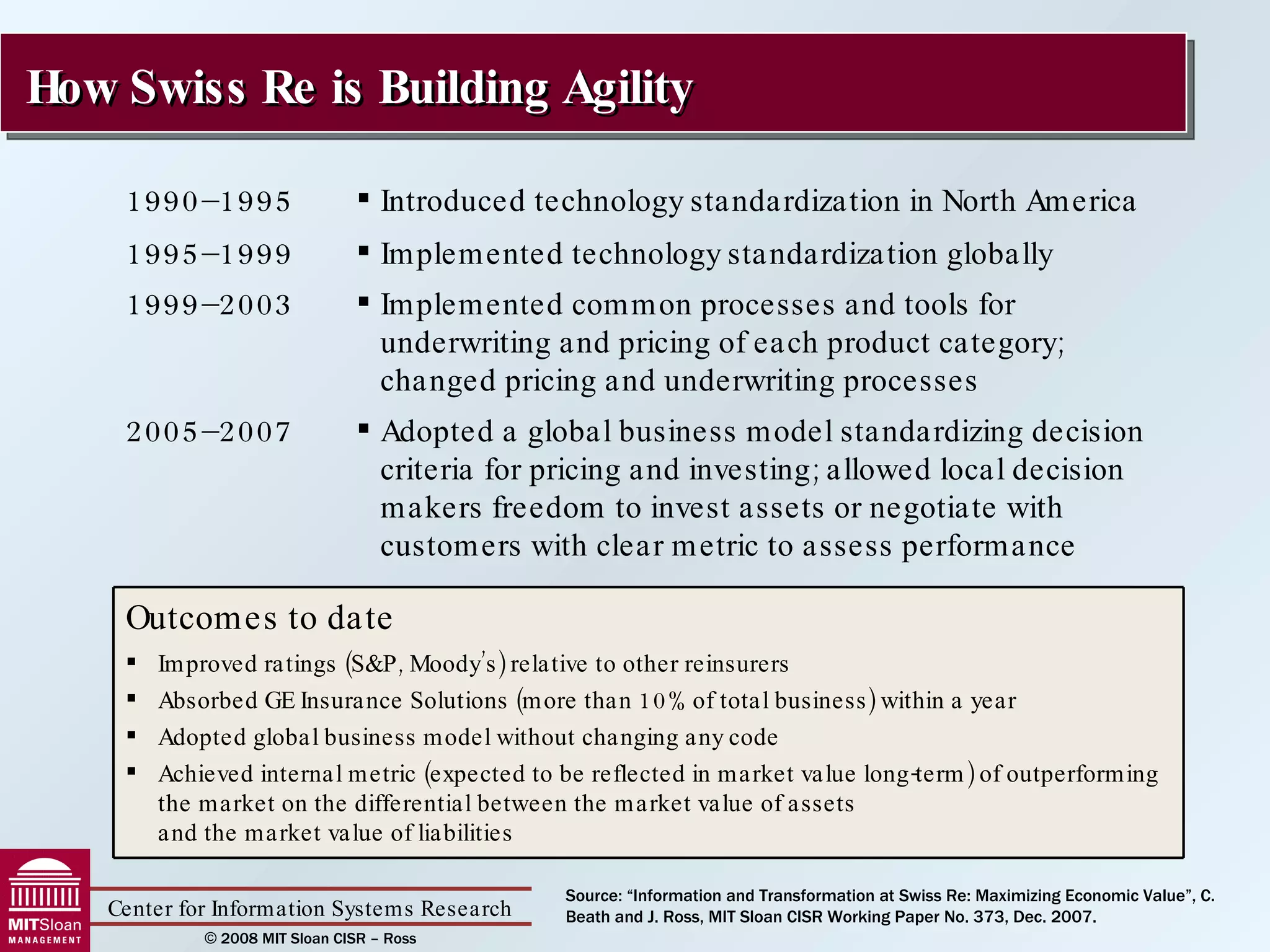
How Swiss Re is Building Agility Source: “Information and Transformation at Swiss Re: Maximizing Economic Value”, C. Beath and J. Ross, MIT Sloan CISR Working Paper No. 373, Dec. 2007. 1990–1995 Introduced technology standardization in North America 1995–1999 Implemented technology standardization globally 1999–2003 Implemented common processes and tools for underwriting and pricing of each product category; changed pricing and underwriting processes 2005–2007 Adopted a global business model standardizing decision criteria for pricing and investing; allowed local decision makers freedom to invest assets or negotiate with customers with clear metric to assess performance Outcomes to date Improved ratings (S&P, Moody’s) relative to other reinsurers Absorbed GE Insurance Solutions (more than 10% of total business) within a year Adopted global business model without changing any code  Achieved internal metric (expected to be reflected in market value long-term) of outperforming the market on the differential between the market value of assets  and the market value of liabilities
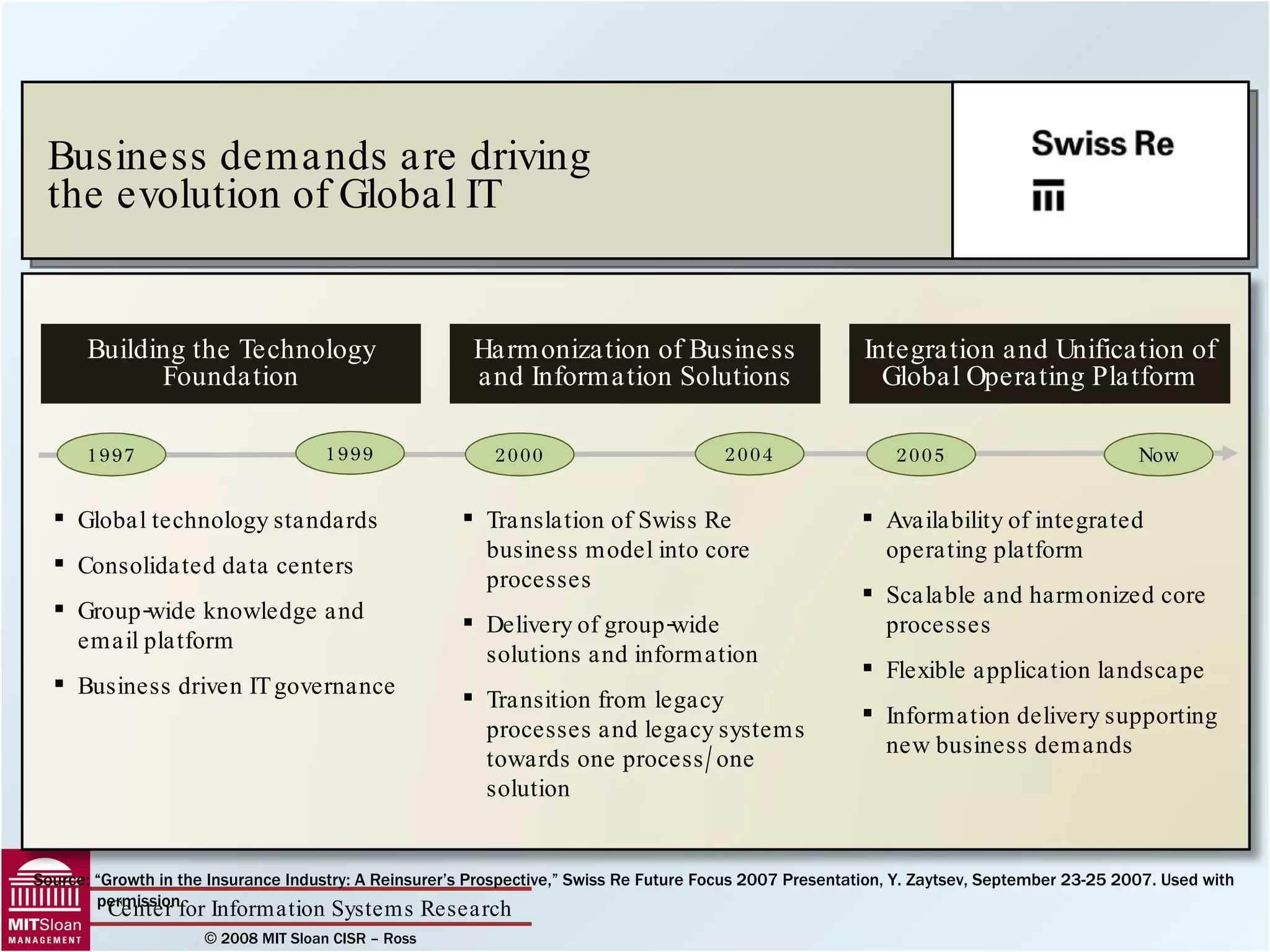
Business demands are driving  the evolution of Global IT Source: “Growth in the Insurance Industry: A Reinsurer’s Prospective,” Swiss Re Future Focus 2007 Presentation, Y. Zaytsev, September 23-25 2007. Used with permission.  1997 1999 2000 2004 2005 Now Building the Technology Foundation Harmonization of Business and Information Solutions Integration and Unification of Global Operating Platform Global technology standards Consolidated data centers Group-wide knowledge and email platform Business driven IT governance Translation of Swiss Re business model into core processes Delivery of group-wide solutions and information Transition from legacy processes and legacy systems towards one process/one solution Availability of integrated operating platform Scalable and harmonized core processes Flexible application landscape Information delivery supporting new business demands
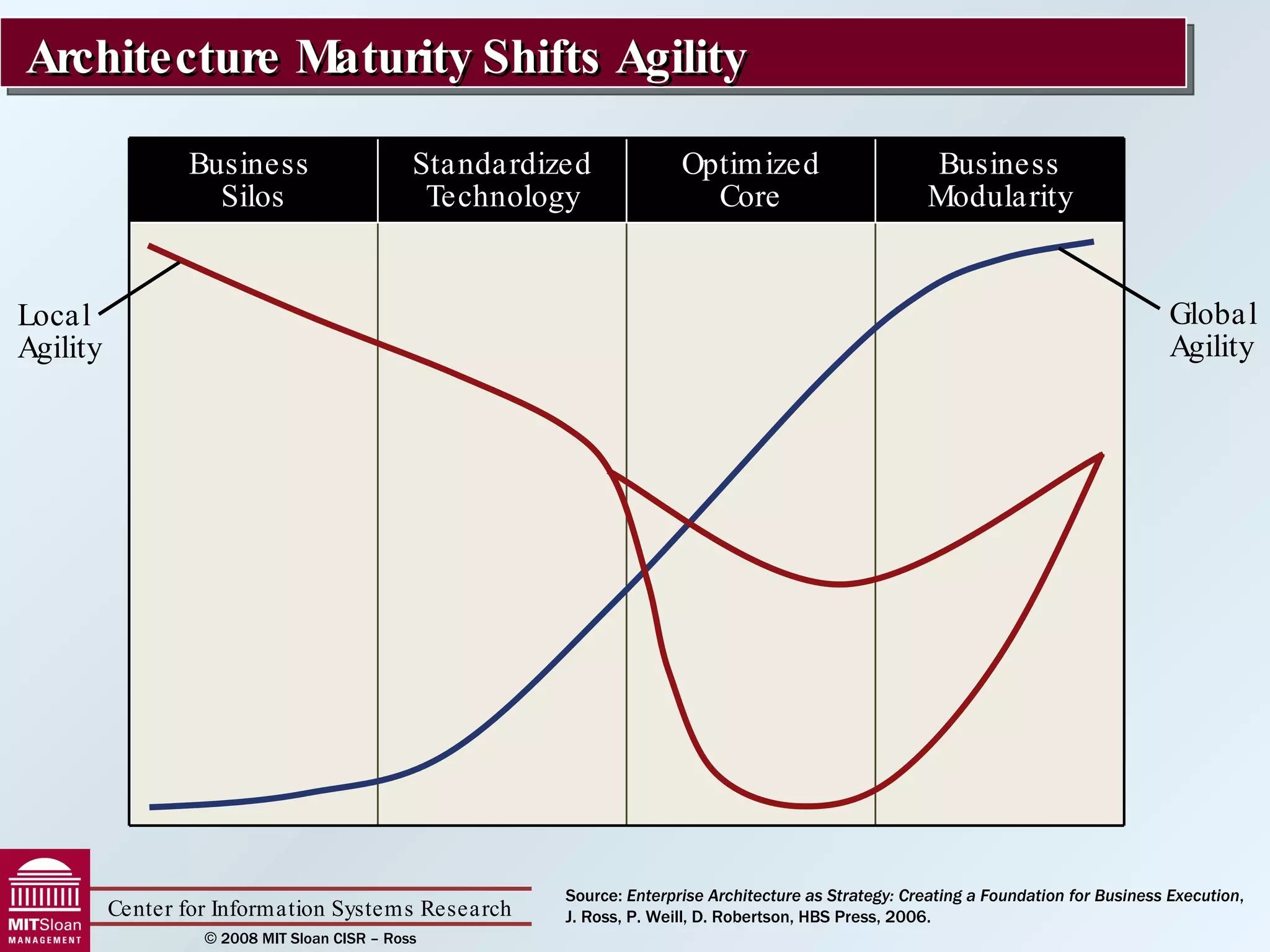
Architecture Maturity Shifts Agility Global Agility Local Agility Source:  Enterprise Architecture as Strategy: Creating a Foundation for Business Execution ,  J. Ross, P. Weill, D. Robertson, HBS Press, 2006. Business  Silos Standardized Technology Optimized Core Business Modularity
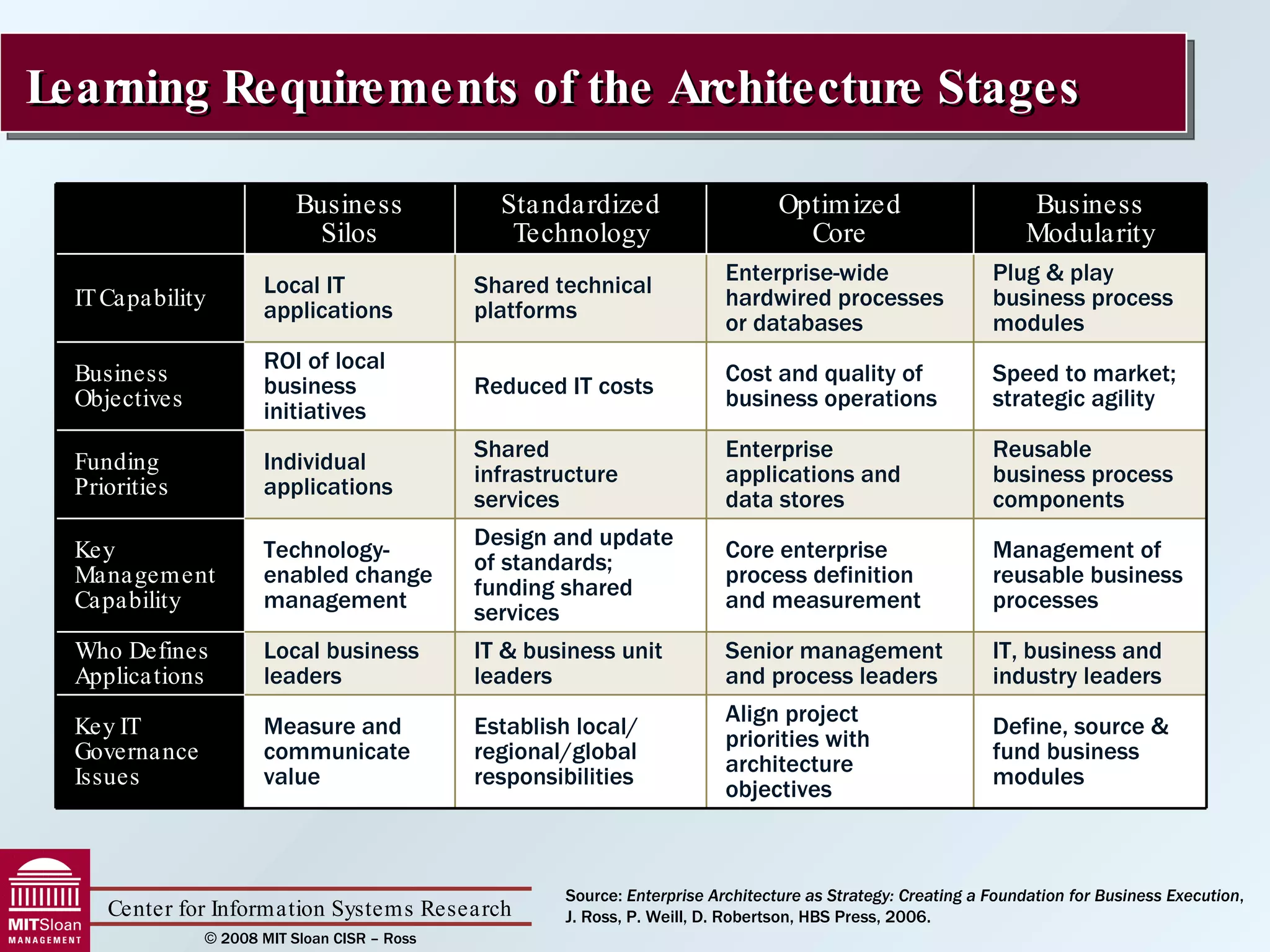
Learning Requirements of the Architecture Stages Source:  Enterprise Architecture as Strategy: Creating a Foundation for Business Execution ,  J. Ross, P. Weill, D. Robertson, HBS Press, 2006. Business Silos Standardized Technology Optimized Core Business Modularity IT Capability Local IT applications Shared technical platforms Enterprise-wide hardwired processes or databases Plug & play business process modules Business Objectives ROI of local business initiatives Reduced IT costs Cost and quality of business operations Speed to market; strategic agility Funding Priorities Individual applications Shared infrastructure services Enterprise applications and data stores Reusable business process components Key Management Capability Technology-enabled change management Design and update of standards; funding shared services Core enterprise process definition and measurement Management of reusable business processes Who Defines Applications Local business leaders IT & business unit leaders Senior management and process leaders IT, business and industry leaders Key IT Governance Issues Measure and communicate value Establish local/ regional/global responsibilities Align project priorities with architecture objectives  Define, source & fund business modules
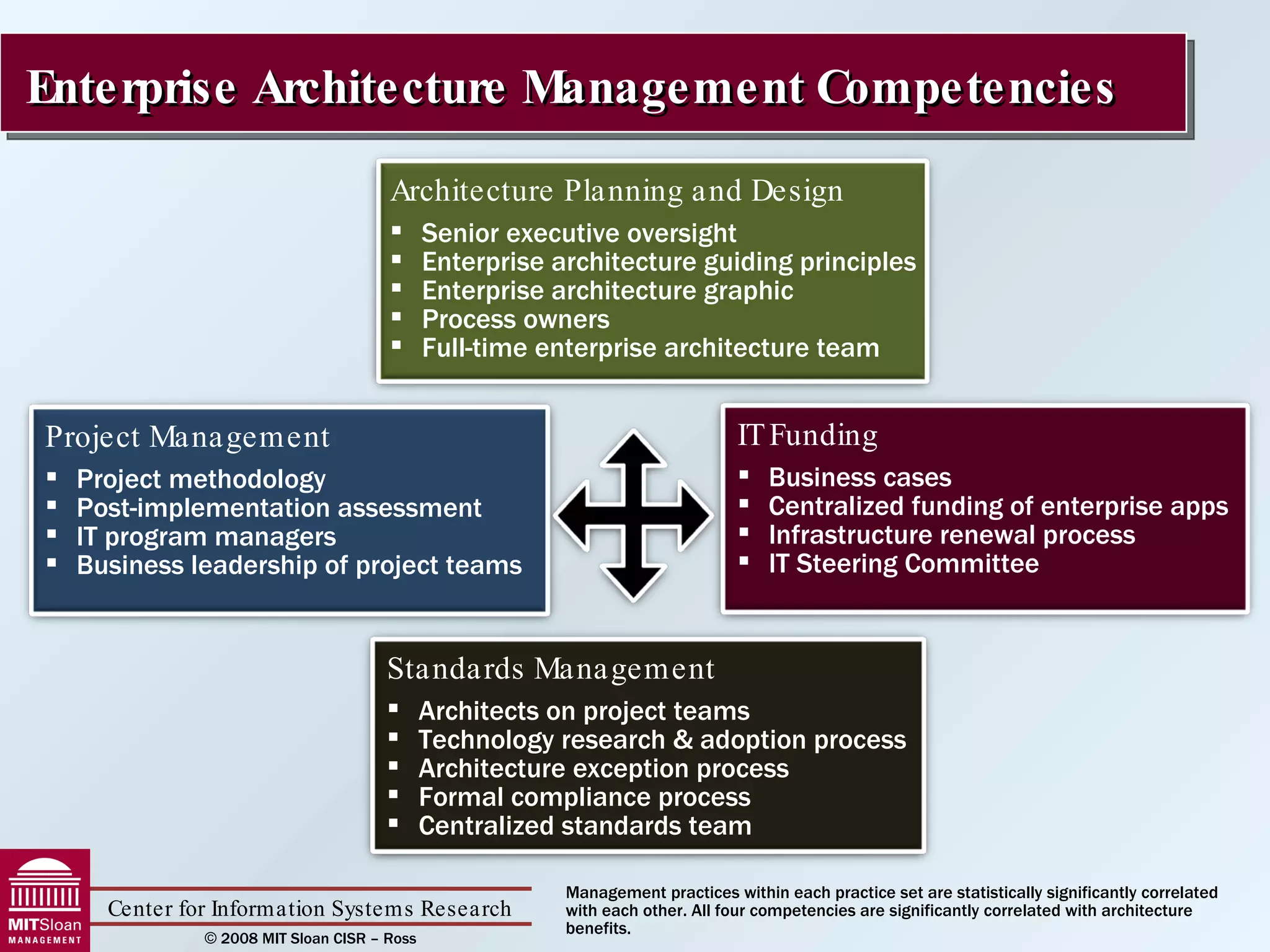
Enterprise Architecture Management Competencies Management practices within each practice set are statistically significantly correlated with each other. All four competencies are significantly correlated with architecture benefits. Architecture Planning and Design Senior executive oversight Enterprise architecture guiding principles Enterprise architecture graphic Process owners Full-time enterprise architecture team Standards Management Architects on project teams Technology research & adoption process Architecture exception process Formal compliance process Centralized standards team IT Funding Business cases Centralized funding of enterprise apps Infrastructure renewal process IT Steering Committee Project Management Project methodology Post-implementation assessment IT program managers Business leadership of project teams
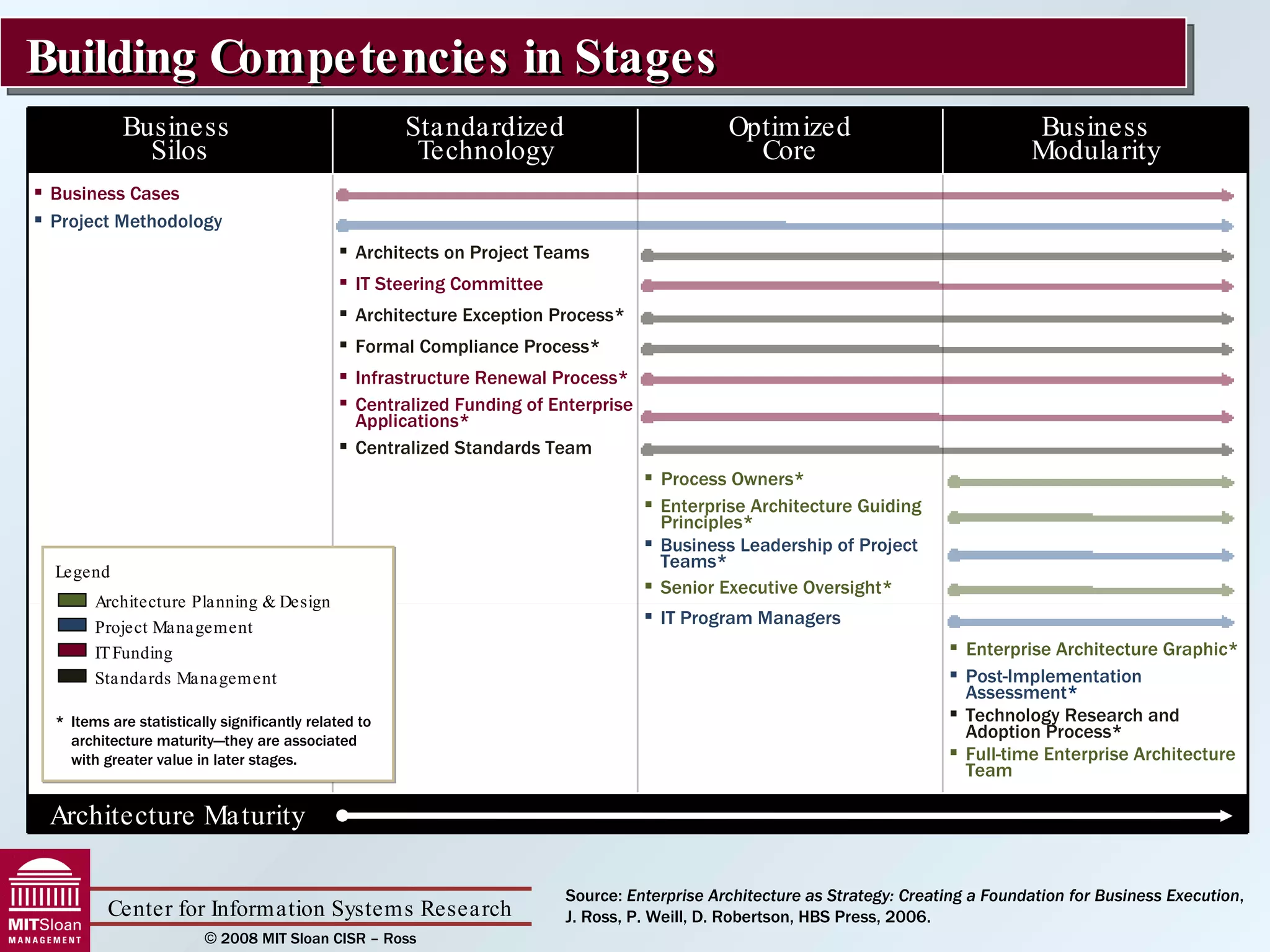
Building Competencies in Stages Legend Architecture Planning & Design Project Management IT Funding  Standards Management * Items are statistically significantly related to architecture maturity—they are associated with greater value in later stages. Source:  Enterprise Architecture as Strategy: Creating a Foundation for Business Execution ,  J. Ross, P. Weill, D. Robertson, HBS Press, 2006. Business  Silos Standardized Technology Optimized Core Business Modularity Business Cases Project Methodology Architects on Project Teams  IT Steering Committee Architecture Exception Process* Formal Compliance Process* Infrastructure Renewal Process* Centralized Funding of Enterprise Applications* Centralized Standards Team Process Owners* Enterprise Architecture Guiding Principles* Business Leadership of Project Teams* Senior Executive Oversight* IT Program Managers  Enterprise Architecture Graphic* Post-Implementation Assessment * Technology Research and Adoption Process* Full-time Enterprise Architecture Team Architecture Maturity
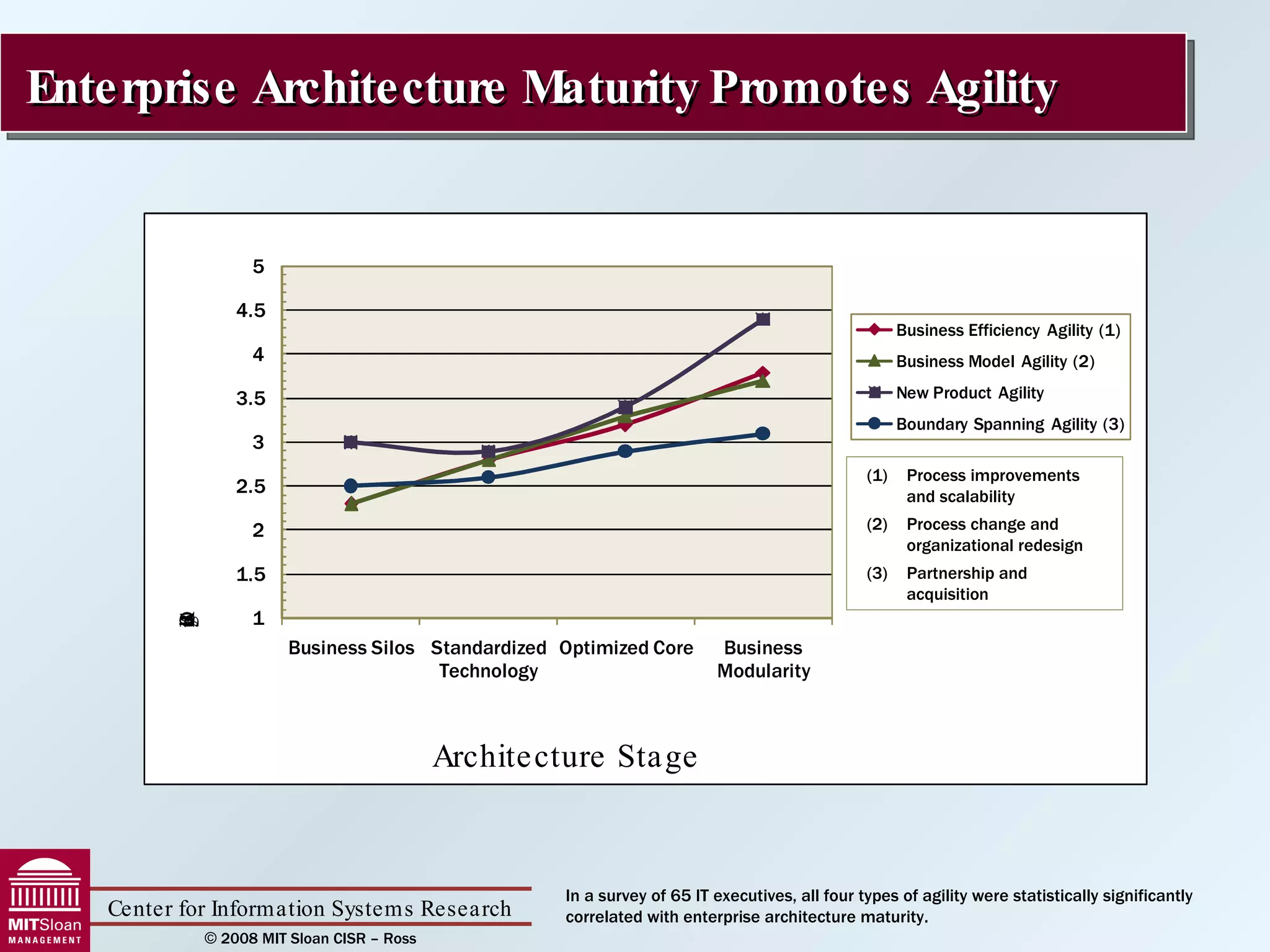
Enterprise Architecture Maturity Promotes Agility (1) Process improvements and scalability (2) Process change and organizational redesign (3) Partnership and acquisition In a survey of 65 IT executives, all four types of agility were statistically significantly correlated with enterprise architecture maturity.
Senior executive accountable for the definition, design, implementation, and, in some cases, use of a firm’s digitized process platform. In most organizations, the CIO is assuming this role, shifting the IT organization from enabler to leader. Definition of the Strategy Execution Officer
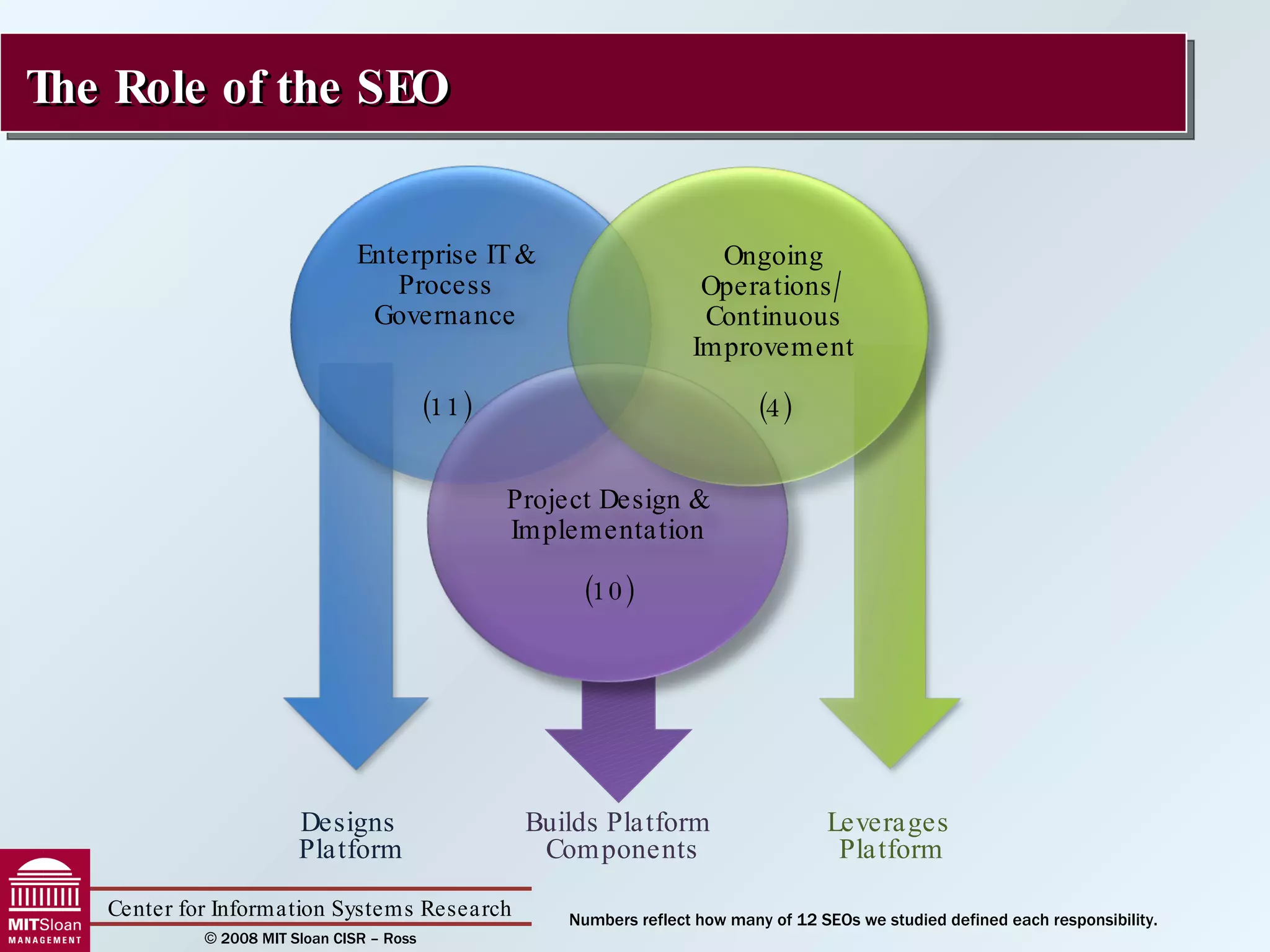
The Role of the SEO Numbers reflect how many of 12 SEOs we studied defined each responsibility. Enterprise IT & Process Governance (11) Project Design & Implementation (10) Ongoing Operations/ Continuous Improvement (4) Designs  Platform Builds Platform  Components Leverages  Platform
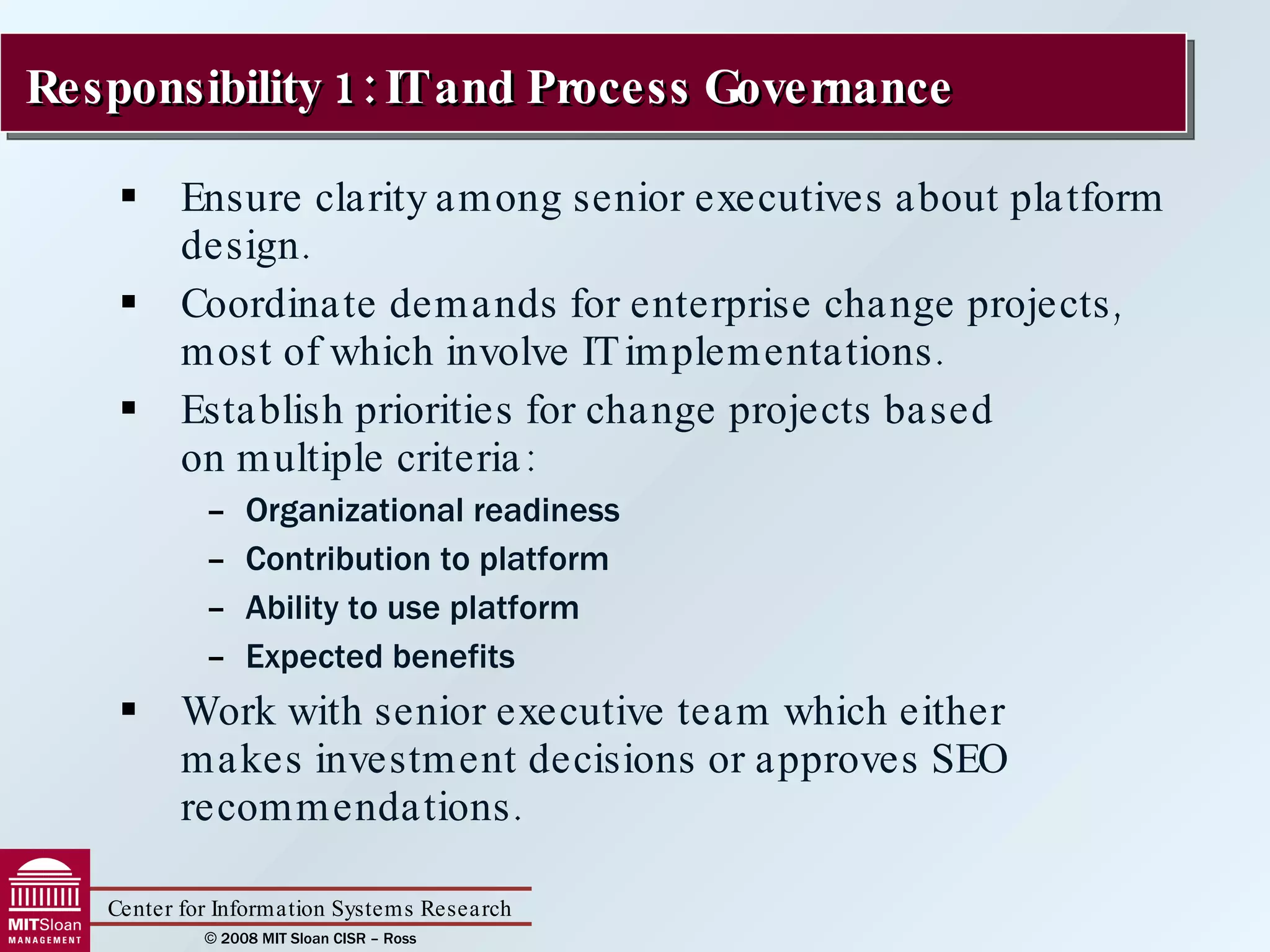
Ensure clarity among senior executives about platform design. Coordinate demands for enterprise change projects, most of which involve IT implementations. Establish priorities for change projects based  on multiple criteria: Organizational readiness Contribution to platform Ability to use platform Expected benefits Work with senior executive team which either  makes investment decisions or approves SEO recommendations. Responsibility 1: IT and Process Governance
Ensure disciplined, effective project methodology. Engage all key stakeholders early and often. Provide expertise on process design. Provide oversight and/or support of change management. Responsibility 2: Project Design/Implementation
Provide enterprise services, usually as a  shared services organization. Accept accountability for continuous improvement  of the platform.  Ensure that the enterprise is driving value  from the platform. Responsibility 3: Ongoing Operations
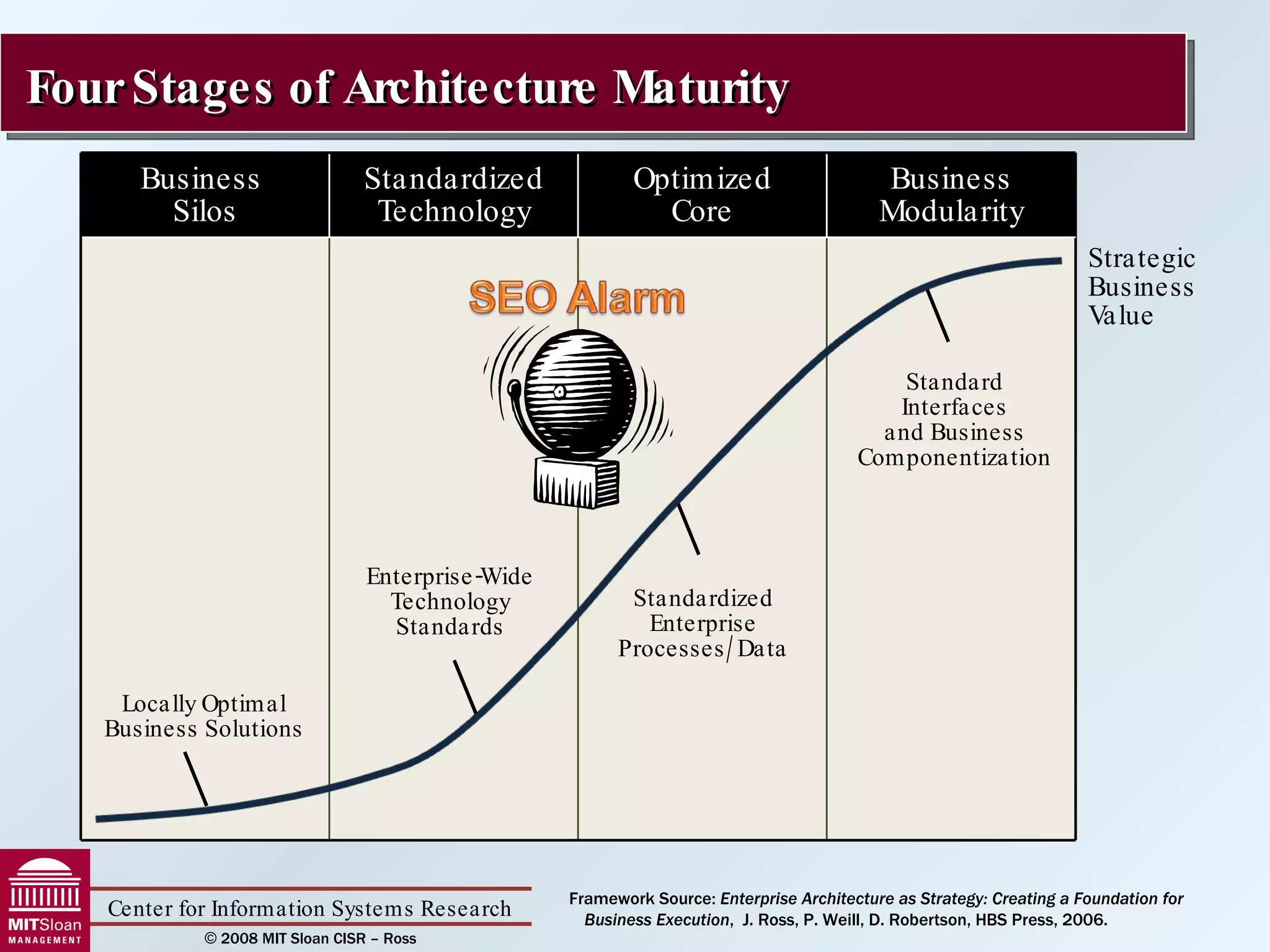
Four Stages of Architecture Maturity Standardized Enterprise Processes/Data Standard Interfaces and Business Componentization Enterprise-Wide Technology Standards Locally Optimal Business Solutions Framework Source:  Enterprise Architecture as Strategy: Creating a Foundation for Business Execution ,  J. Ross, P. Weill, D. Robertson, HBS Press, 2006.  Business  Silos Standardized Technology Optimized Core Business Modularity Strategic Business Value
How do we structure the IT unit to support the  SEO’s responsibilities? Who should own the change resources? (Do I need  an army?) Who should fund enterprise projects? (Do I want  the budget or just influence over the budget?) How can we get buy-in to organizational change efforts? How do we organize to sustain vertical process excellence as we increasingly focus on our horizontal processes?* Questions SEOs Are Asking * Architecture maturity was statistically significantly related to a greater reliance on matrixed structures in a survey of 155 CIOs.
Optimizing the whole often means sub-optimizing the parts. Building momentum requires leaders who demand change. Building a platform requires managing horizontally as well as vertically (the SEO challenge). Profitable growth is visible over long-term but intermediate metrics (e.g., speed to market, cost of end-to-end process) require new benchmarks. Empowerment requires clearly articulated, centrally controlled 1  decision criteria while distributing decision making at the organization’s boundaries. Empowerment is information-dependent. Challenges to Building Business Agility 1 Centrally controlled can refer to an enterprise, business unit, geography, or function.

Isrc Architectingfor Agility J.Ross

  • 1.
    University of HoustonISRC February 21, 2008 This research was made possible by the support of CISR sponsors and patrons. The research team included Cynthia Beath (University of Texas) and Donna Pitteri and Stephanie Woerner (CISR). Architecting Agility
  • 2.
  • 3.
    Definition: theuse of existing IT and business process capabilities to rapidly generate new business value while limiting costs and risks. Agility is the “respond” in “sense and respond.” The key to agility is reuse. Agility leads to profitable growth. The Agility Paradox: more digitized and standardized business processes and platforms tend to make a company more agile. A platform for agility (reflected in a mature enterprise architecture) simultaneously enhances a firm’s ability to launch new products, increase efficiency, redesign a business model, and span boundaries. IT-Enabled Business Agility
  • 4.
    How IT Enables(or Inhibits) Business Agility Limitations of existing IT capabilities Platforms for agility The Enterprise Architecture Journey Four stages of architecture maturity A case study of Swiss Re How to increase enterprise architecture maturity—and agility The Evolving Role of IT—Meet the SEO Agility Challenges Agenda
  • 5.
    Traditional IT andProcess Silos Technology Platforms Applications Data Corporate Data Corporate Networks & Infrastructure Services A Core Process
  • 6.
    What IT LooksLike in an Agile Firm Technology Platforms Applications Data Corporate Data Corporate Networks & Infrastructure Services Corporate Data A Core Process
  • 7.
    Agility Platforms Sourcesof Agility What’s Reused Motivated Experts Empowered Decision Makers Digitized Processes The expertise and commitment of good people Access to transparent, granular transaction data Disciplined, IT-enabled process platform
  • 8.
    Four Stages ofArchitecture Maturity Standardized Enterprise Processes/Data Standard Interfaces and Business Componentization Enterprise-Wide Technology Standards Locally Optimal Business Solutions Source: Enterprise Architecture as Strategy: Creating a Foundation for Business Execution , J. Ross, P. Weill, D. Robertson, HBS Press, 2006. Business Silos Standardized Technology Optimized Core Business Modularity Strategic Business Value 12% 48% 34% 6% % of Firms
  • 9.
    Background Founded in1863 in Zurich, Switzerland Business model involves assuming the risks of its key customers (insurance companies and large corporations) and insuring large assets (bridges, buildings) against catastrophes Operates in 90 countries; 95% of 2006 revenues earned outside Switzerland Huge losses due to 2001 terrorist attacks, Asian tsunami, Hurricane Katrina resulted in diminished S&P and Moody’s ratings Company hires very smart people who enjoy intellectual challenges Needs agility to Fully comprehend global risk positions (business model change) Invest for profitability (demands 13% ROI) with sufficient liquidity to cover claims (efficiency) Price contracts based on customer profitability (business model change) Respond quickly to new product opportunities (new product) Enable easy integration of acquisitions (boundary spanning) The Agility Journey at Swiss Re Source: “Information and Transformation at Swiss Re: Maximizing Economic Value”, C. Beath and J. Ross, MIT Sloan CISR Working Paper No. 373, Dec. 2007.
  • 10.
    How Swiss Reis Building Agility Source: “Information and Transformation at Swiss Re: Maximizing Economic Value”, C. Beath and J. Ross, MIT Sloan CISR Working Paper No. 373, Dec. 2007. 1990–1995 Introduced technology standardization in North America 1995–1999 Implemented technology standardization globally 1999–2003 Implemented common processes and tools for underwriting and pricing of each product category; changed pricing and underwriting processes 2005–2007 Adopted a global business model standardizing decision criteria for pricing and investing; allowed local decision makers freedom to invest assets or negotiate with customers with clear metric to assess performance Outcomes to date Improved ratings (S&P, Moody’s) relative to other reinsurers Absorbed GE Insurance Solutions (more than 10% of total business) within a year Adopted global business model without changing any code Achieved internal metric (expected to be reflected in market value long-term) of outperforming the market on the differential between the market value of assets and the market value of liabilities
  • 11.
    Business demands aredriving the evolution of Global IT Source: “Growth in the Insurance Industry: A Reinsurer’s Prospective,” Swiss Re Future Focus 2007 Presentation, Y. Zaytsev, September 23-25 2007. Used with permission. 1997 1999 2000 2004 2005 Now Building the Technology Foundation Harmonization of Business and Information Solutions Integration and Unification of Global Operating Platform Global technology standards Consolidated data centers Group-wide knowledge and email platform Business driven IT governance Translation of Swiss Re business model into core processes Delivery of group-wide solutions and information Transition from legacy processes and legacy systems towards one process/one solution Availability of integrated operating platform Scalable and harmonized core processes Flexible application landscape Information delivery supporting new business demands
  • 12.
    Architecture Maturity ShiftsAgility Global Agility Local Agility Source: Enterprise Architecture as Strategy: Creating a Foundation for Business Execution , J. Ross, P. Weill, D. Robertson, HBS Press, 2006. Business Silos Standardized Technology Optimized Core Business Modularity
  • 13.
    Learning Requirements ofthe Architecture Stages Source: Enterprise Architecture as Strategy: Creating a Foundation for Business Execution , J. Ross, P. Weill, D. Robertson, HBS Press, 2006. Business Silos Standardized Technology Optimized Core Business Modularity IT Capability Local IT applications Shared technical platforms Enterprise-wide hardwired processes or databases Plug & play business process modules Business Objectives ROI of local business initiatives Reduced IT costs Cost and quality of business operations Speed to market; strategic agility Funding Priorities Individual applications Shared infrastructure services Enterprise applications and data stores Reusable business process components Key Management Capability Technology-enabled change management Design and update of standards; funding shared services Core enterprise process definition and measurement Management of reusable business processes Who Defines Applications Local business leaders IT & business unit leaders Senior management and process leaders IT, business and industry leaders Key IT Governance Issues Measure and communicate value Establish local/ regional/global responsibilities Align project priorities with architecture objectives Define, source & fund business modules
  • 14.
    Enterprise Architecture ManagementCompetencies Management practices within each practice set are statistically significantly correlated with each other. All four competencies are significantly correlated with architecture benefits. Architecture Planning and Design Senior executive oversight Enterprise architecture guiding principles Enterprise architecture graphic Process owners Full-time enterprise architecture team Standards Management Architects on project teams Technology research & adoption process Architecture exception process Formal compliance process Centralized standards team IT Funding Business cases Centralized funding of enterprise apps Infrastructure renewal process IT Steering Committee Project Management Project methodology Post-implementation assessment IT program managers Business leadership of project teams
  • 15.
    Building Competencies inStages Legend Architecture Planning & Design Project Management IT Funding Standards Management * Items are statistically significantly related to architecture maturity—they are associated with greater value in later stages. Source: Enterprise Architecture as Strategy: Creating a Foundation for Business Execution , J. Ross, P. Weill, D. Robertson, HBS Press, 2006. Business Silos Standardized Technology Optimized Core Business Modularity Business Cases Project Methodology Architects on Project Teams IT Steering Committee Architecture Exception Process* Formal Compliance Process* Infrastructure Renewal Process* Centralized Funding of Enterprise Applications* Centralized Standards Team Process Owners* Enterprise Architecture Guiding Principles* Business Leadership of Project Teams* Senior Executive Oversight* IT Program Managers Enterprise Architecture Graphic* Post-Implementation Assessment * Technology Research and Adoption Process* Full-time Enterprise Architecture Team Architecture Maturity
  • 16.
    Enterprise Architecture MaturityPromotes Agility (1) Process improvements and scalability (2) Process change and organizational redesign (3) Partnership and acquisition In a survey of 65 IT executives, all four types of agility were statistically significantly correlated with enterprise architecture maturity.
  • 17.
    Senior executive accountablefor the definition, design, implementation, and, in some cases, use of a firm’s digitized process platform. In most organizations, the CIO is assuming this role, shifting the IT organization from enabler to leader. Definition of the Strategy Execution Officer
  • 18.
    The Role ofthe SEO Numbers reflect how many of 12 SEOs we studied defined each responsibility. Enterprise IT & Process Governance (11) Project Design & Implementation (10) Ongoing Operations/ Continuous Improvement (4) Designs Platform Builds Platform Components Leverages Platform
  • 19.
    Ensure clarity amongsenior executives about platform design. Coordinate demands for enterprise change projects, most of which involve IT implementations. Establish priorities for change projects based on multiple criteria: Organizational readiness Contribution to platform Ability to use platform Expected benefits Work with senior executive team which either makes investment decisions or approves SEO recommendations. Responsibility 1: IT and Process Governance
  • 20.
    Ensure disciplined, effectiveproject methodology. Engage all key stakeholders early and often. Provide expertise on process design. Provide oversight and/or support of change management. Responsibility 2: Project Design/Implementation
  • 21.
    Provide enterprise services,usually as a shared services organization. Accept accountability for continuous improvement of the platform. Ensure that the enterprise is driving value from the platform. Responsibility 3: Ongoing Operations
  • 22.
    Four Stages ofArchitecture Maturity Standardized Enterprise Processes/Data Standard Interfaces and Business Componentization Enterprise-Wide Technology Standards Locally Optimal Business Solutions Framework Source: Enterprise Architecture as Strategy: Creating a Foundation for Business Execution , J. Ross, P. Weill, D. Robertson, HBS Press, 2006. Business Silos Standardized Technology Optimized Core Business Modularity Strategic Business Value
  • 23.
    How do westructure the IT unit to support the SEO’s responsibilities? Who should own the change resources? (Do I need an army?) Who should fund enterprise projects? (Do I want the budget or just influence over the budget?) How can we get buy-in to organizational change efforts? How do we organize to sustain vertical process excellence as we increasingly focus on our horizontal processes?* Questions SEOs Are Asking * Architecture maturity was statistically significantly related to a greater reliance on matrixed structures in a survey of 155 CIOs.
  • 24.
    Optimizing the wholeoften means sub-optimizing the parts. Building momentum requires leaders who demand change. Building a platform requires managing horizontally as well as vertically (the SEO challenge). Profitable growth is visible over long-term but intermediate metrics (e.g., speed to market, cost of end-to-end process) require new benchmarks. Empowerment requires clearly articulated, centrally controlled 1 decision criteria while distributing decision making at the organization’s boundaries. Empowerment is information-dependent. Challenges to Building Business Agility 1 Centrally controlled can refer to an enterprise, business unit, geography, or function.