TIPS TO CREATE AN ACTIONABLE ENTERPRISE
ARCHITECTURE
TIPS
• Define the Value…
• Connect the Dots…
• Represent Business Interests…
• Operate as a Consultant…
• Establish Collaboration…
• Govern for Empowerment…
• Embrace Innovation…
• Establish an Enterprise Repository…
• Establish Principles…
• Communicate…
• Keep it Simple…
• Avoid common EA Pitfalls
WHAT IS ENTERPRISE
ARCHITECTURE
• Alignment of Strategy and Technology
• Big Picture view across teams / divisions / departments
• NOT “Super” Solutions Architect.
• Over time, EA’s lose technical competency but gain
business awareness and collaboration skills.
OBJECTIVE
• An Enterprise Architecture (EA) contains a long-term vision of how
an organization plans to evolve its technology and business process
environment for an organization's vision. For example, the objective
of phasing out an outdated technology platform may be established
and the goal of improving a business process may be established in
this specification.
• An organization believes that an EA can help improve the
business/IT alignment gap, business and technology communication,
and IT project success rate and provide the benefits such as cost
reduction & technology standardization, process improvements, and
strategic differentiation.
• These improvements and advantages do not come for free; they
must be engineered into a solution.
DEFINE THE VALUE…
• Establish a value statement for your EA Program
• Create a community supported mission statement
• Determine critical needs to align strategic goals to initiatives
• Establish Stakeholder Relationships
• Key business visionaries
• Key technology drivers
• Create a community
• Communications plan
• Community of Practice
• Resource commitments
• Communicate
• Roadshows
• Stakeholder interviews
CONNECT THE DOTS…
• Deliver what is needed to connect business goals to IT activities
• Determine points of entry to engage delivery initiatives
• Establish process to align strategy to initiatives
• Target Operating Model
• Principles
• Architecture Patterns
• Reference Implementations
• Initiatives to implement capabilities
• Business Capability Definition
• Common Language
REPRESENT BUSINESS INTERESTS…
• Focus on Business Case and financial opportunities
• Cost Savings
• Revenue Opportunities
• Understand the market position
• Risks
• Competitors
• Industry Trends
OPERATE AS A CONSULTANT…
• Focus on consulting skills
• Presentation Skills
• Demonstrate competency
• the ability to work as part of a team;
• interpersonal and communication (both oral and written) skills;
• creativity and innovation;
• problem-solving and strategic planning ability;
• analytical skills;
• flexibility;
• the ability to cope with pressure and challenges;
ESTABLISH COLLABORATION…
• Share the architecture vision
• Identify participants in the journey
• Appreciate priorities and drivers
• Work within the boundaries of the organizational priorities
• Make EA an Enterprise Function
• Solicit Business / IT Leadership for participation
• Eliminate Business only / IT only dialog
• Provide technology guidance to business & Business
guidance to technology
• Sponsor guest speakers
GOVERN FOR EMPOWERMENT…
• Utilize governance practices to
• Align goals and delivery practices
• Identify areas of risk
• Measure Governance Impact
• Adjustments
• Risks mitigated
• Participation
• Establish Governance Advisory Board
• Determine best practices
• Rate performance
EMBRACE INNOVATION…
• Awareness of innovative opportunities
• Challenge status quo
• Create a backlog of innovative ideas
• Create exploratory channels
• Proof of concept
• Awareness / Education – Promote sponsorship
• Create internal channels
• Blogs
• Podcasts
• Newsletter
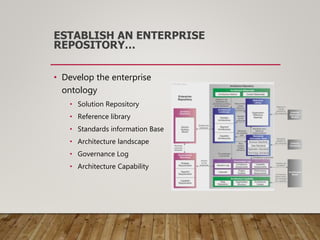
ESTABLISH AN ENTERPRISE
REPOSITORY…
• Develop the enterprise
ontology
• Solution Repository
• Reference library
• Standards information Base
• Architecture landscape
• Governance Log
• Architecture Capability
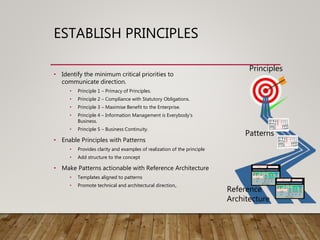
ESTABLISH PRINCIPLES
• Identify the minimum critical priorities to
communicate direction.
• Principle 1 – Primacy of Principles.
• Principle 2 – Compliance with Statutory Obligations.
• Principle 3 – Maximise Benefit to the Enterprise.
• Principle 4 – Information Management is Everybody's
Business.
• Principle 5 – Business Continuity.
• Enable Principles with Patterns
• Provides clarity and examples of realization of the principle
• Add structure to the concept
• Make Patterns actionable with Reference Architecture
• Templates aligned to patterns
• Promote technical and architectural direction,.
Principles
Patterns
Reference
Architecture
COMMUNICATE…
• Awareness
• Desire
• Knowledge
• Acceptance
• Reinforcement
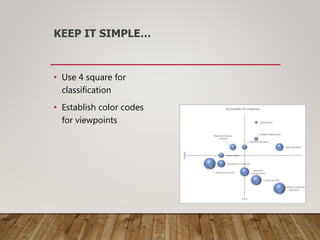
KEEP IT SIMPLE…
• Use 4 square for
classification
• Establish color codes
for viewpoints
AVOID COMMON EA PITFALLS
• Focus on frameworks and process rather than results
• Focus on tools rather than deliverables
• Operationalize Frameworks
• Embrace IT vs Business discussions
• Act as Solution Architects (or engineers)
• Operate in a SILO (no Enterprise Focus)
• Operate in an Ivory Tower (no operational awareness)

Actionable ea

  • 1.
    TIPS TO CREATEAN ACTIONABLE ENTERPRISE ARCHITECTURE
  • 2.
    TIPS • Define theValue… • Connect the Dots… • Represent Business Interests… • Operate as a Consultant… • Establish Collaboration… • Govern for Empowerment… • Embrace Innovation… • Establish an Enterprise Repository… • Establish Principles… • Communicate… • Keep it Simple… • Avoid common EA Pitfalls
  • 3.
    WHAT IS ENTERPRISE ARCHITECTURE •Alignment of Strategy and Technology • Big Picture view across teams / divisions / departments • NOT “Super” Solutions Architect. • Over time, EA’s lose technical competency but gain business awareness and collaboration skills.
  • 4.
    OBJECTIVE • An EnterpriseArchitecture (EA) contains a long-term vision of how an organization plans to evolve its technology and business process environment for an organization's vision. For example, the objective of phasing out an outdated technology platform may be established and the goal of improving a business process may be established in this specification. • An organization believes that an EA can help improve the business/IT alignment gap, business and technology communication, and IT project success rate and provide the benefits such as cost reduction & technology standardization, process improvements, and strategic differentiation. • These improvements and advantages do not come for free; they must be engineered into a solution.
  • 5.
    DEFINE THE VALUE… •Establish a value statement for your EA Program • Create a community supported mission statement • Determine critical needs to align strategic goals to initiatives • Establish Stakeholder Relationships • Key business visionaries • Key technology drivers • Create a community • Communications plan • Community of Practice • Resource commitments • Communicate • Roadshows • Stakeholder interviews
  • 6.
    CONNECT THE DOTS… •Deliver what is needed to connect business goals to IT activities • Determine points of entry to engage delivery initiatives • Establish process to align strategy to initiatives • Target Operating Model • Principles • Architecture Patterns • Reference Implementations • Initiatives to implement capabilities • Business Capability Definition • Common Language
  • 7.
    REPRESENT BUSINESS INTERESTS… •Focus on Business Case and financial opportunities • Cost Savings • Revenue Opportunities • Understand the market position • Risks • Competitors • Industry Trends
  • 8.
    OPERATE AS ACONSULTANT… • Focus on consulting skills • Presentation Skills • Demonstrate competency • the ability to work as part of a team; • interpersonal and communication (both oral and written) skills; • creativity and innovation; • problem-solving and strategic planning ability; • analytical skills; • flexibility; • the ability to cope with pressure and challenges;
  • 9.
    ESTABLISH COLLABORATION… • Sharethe architecture vision • Identify participants in the journey • Appreciate priorities and drivers • Work within the boundaries of the organizational priorities • Make EA an Enterprise Function • Solicit Business / IT Leadership for participation • Eliminate Business only / IT only dialog • Provide technology guidance to business & Business guidance to technology • Sponsor guest speakers
  • 10.
    GOVERN FOR EMPOWERMENT… •Utilize governance practices to • Align goals and delivery practices • Identify areas of risk • Measure Governance Impact • Adjustments • Risks mitigated • Participation • Establish Governance Advisory Board • Determine best practices • Rate performance
  • 11.
    EMBRACE INNOVATION… • Awarenessof innovative opportunities • Challenge status quo • Create a backlog of innovative ideas • Create exploratory channels • Proof of concept • Awareness / Education – Promote sponsorship • Create internal channels • Blogs • Podcasts • Newsletter
  • 12.
    ESTABLISH AN ENTERPRISE REPOSITORY… •Develop the enterprise ontology • Solution Repository • Reference library • Standards information Base • Architecture landscape • Governance Log • Architecture Capability
  • 13.
    ESTABLISH PRINCIPLES • Identifythe minimum critical priorities to communicate direction. • Principle 1 – Primacy of Principles. • Principle 2 – Compliance with Statutory Obligations. • Principle 3 – Maximise Benefit to the Enterprise. • Principle 4 – Information Management is Everybody's Business. • Principle 5 – Business Continuity. • Enable Principles with Patterns • Provides clarity and examples of realization of the principle • Add structure to the concept • Make Patterns actionable with Reference Architecture • Templates aligned to patterns • Promote technical and architectural direction,. Principles Patterns Reference Architecture
  • 14.
    COMMUNICATE… • Awareness • Desire •Knowledge • Acceptance • Reinforcement
  • 15.
    KEEP IT SIMPLE… •Use 4 square for classification • Establish color codes for viewpoints
  • 16.
    AVOID COMMON EAPITFALLS • Focus on frameworks and process rather than results • Focus on tools rather than deliverables • Operationalize Frameworks • Embrace IT vs Business discussions • Act as Solution Architects (or engineers) • Operate in a SILO (no Enterprise Focus) • Operate in an Ivory Tower (no operational awareness)