MIT CIO Summit — Thursday, June 22, 2006
         MIT CIO Summit — Thursday, June 22, 2006


                     The Agility Paradox
                     The Agility Paradox
  Based on research projects with Jeanne Ross and George Westerman


                                                                            Peter Weill
                             Director, Center for Information Systems Research (CISR)
                                                       MIT Sloan School of Management
                                          Phone: (617) 253-2930, Fax: (617) 253-4424
                                            pweill@mit.edu; http://mitsloan.mit.edu/cisr/

Center for Information Systems Research
      © 2006 MIT Sloan CISR — Weill                                                         1
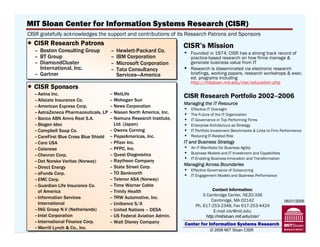
MIT Sloan Center for Information Systems Research (CISR)
CISR gratefully acknowledges the support and contributions of its Research Patrons and Sponsors
  CISR Research Patrons                                                   CISR’s Mission
  – Boston Consulting Group             –   Hewlett-Packard Co.           •   Founded in 1974; CISR has a strong track record of
  – BT Group                            –   IBM Corporation                   practice-based research on how firms manage &
  – DiamondCluster                      –   Microsoft Corporation             generate business value from IT
    International, Inc.                 –   Tata Consultancy              •   Research is disseminated via electronic research
  – Gartner                                 Services—America                  briefings, working papers, research workshops & exec.
                                                                              ed. programs including
                                                                              http://mitsloan.mit.edu/cisr/education.php
  CISR Sponsors
  – Aetna Inc.                             – MetLife
                                                                          CISR Research Portfolio 2002–2006
  – Allstate Insurance Co.                 – Mohegan Sun
                                                                          Managing the IT Resource
  – American Express Corp.                 – News Corporation
                                                                          •   Effective IT Oversight
  – AstraZeneca Pharmaceuticals, LP – Nissan North America, Inc.          •   The Future of the IT Organization
  – Banco ABN Amro Real S.A.               – Nomura Research Institute,   •   IT Governance in Top Performing Firms
  – Biogen Idec                              Ltd. (Japan)                 •   Enterprise Architecture as Strategy
  – Campbell Soup Co.                      – Owens Corning                •   IT Portfolio Investment Benchmarks & Links to Firm Performance
  – CareFirst Blue Cross Blue Shield – PepsiAmericas, Inc.                •   Reducing IT-Related Risk
  – Care USA                               – Pfizer Inc.                  IT and Business Strategy
  – Celanese                               – PFPC, Inc.                   •   An IT Manifesto for Business Agility
  – Chevron Corp.                          – Quest Diagnostics            •   Business Models and IT Investment and Capabilities
                                           – Raytheon Company
                                                                          •   IT-Enabling Business Innovation and Transformation
  – Det Norske Veritas (Norway)
                                           – State Street Corp.           Managing Across Boundaries
  – Direct Energy
                                                                          •   Effective Governance of Outsourcing
  – eFunds Corp.                           – TD Banknorth                 •   IT Engagement Models and Business Performance
  – EMC Corp.                              – Telenor ASA (Norway)
  – Guardian Life Insurance Co.            – Time Warner Cable
    of America                             – Trinity Health                               Contact Information:
                                                                                    3 Cambridge Center, NE20-336
  – Information Services                   – TRW Automotive, Inc.
                                                                                         Cambridge, MA 02142                       06/01/2006
    International                          – Unibanco S/A                       Ph. 617-253-2348, Fax 617-253-4424
  – ING Groep N.V (Netherlands)            – United Nations – DESA                        E-mail cisr@mit.edu;
  – Intel Corporation                      – US Federal Aviation Admin.               http://mitsloan.mit.edu/cisr/
  – InternationalInformation Systems Walt Disney Company
     Center for Finance Corp.              – Research                     Center for Information Systems Research
  – Merrill Lynch & Co., Inc.
             © 2006 MIT Sloan CISR — Weill                                              © 2006 MIT Sloan CISR                              2
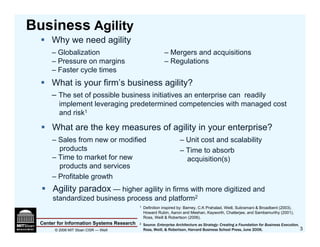
Business Agility
      Why we need agility
      – Globalization                                       – Mergers and acquisitions
      – Pressure on margins                                 – Regulations
      – Faster cycle times
      What is your firm’s business agility?
      – The set of possible business initiatives an enterprise can readily
          implement leveraging predetermined competencies with managed cost
          and risk1

      What are the key measures of agility in your enterprise?
      – Sales from new or modified                                   – Unit cost and scalability
        products                                                     – Time to absorb
      – Time to market for new                                         acquisition(s)
        products and services
      – Profitable growth
       Agility paradox — higher agility in firms with more digitized and
       standardized business process and platform2
                                            1   Definition inspired by: Barney, C.K Prahalad, Weill, Subramani & Broadbent (2003),
                                                Howard Rubin, Aaron and Meehan, Kayworth, Chatterjee, and Sambamurthy (2001),
                                                Ross, Weill & Robertson (2006).
  Center for Information Systems Research   2   Source: Enterprise Architecture as Strategy: Creating a Foundation for Business Execution,
        © 2006 MIT Sloan CISR — Weill           Ross, Weill, & Robertson, Harvard Business School Press, June 2006.                        3
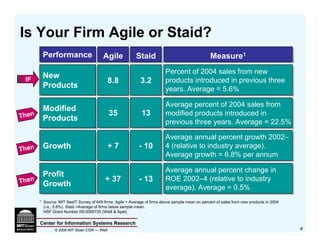
Is Your Firm Agile or Staid?
           Performance
           Performance                     Agile
                                           Agile             Staid
                                                             Staid                                   Measure11
                                                                                                     Measure
                                                                            Percent of 2004 sales from new
                                                                            Percent of 2004 sales from new
 IF
           New
           New                               8.8
                                             8.8               3.2
                                                               3.2          products introduced in previous three
                                                                            products introduced in previous three
           Products
           Products                                                         years. Average = 5.6%
                                                                            years. Average = 5.6%
                                                                            Average percent of 2004 sales from
                                                                            Average percent of 2004 sales from
           Modified
           Modified
Then                                             35
                                                 35            13
                                                               13           modified products introduced in
                                                                            modified products introduced in
           Products
           Products                                                         previous three years. Average = 22.5%
                                                                            previous three years. Average = 22.5%
                                                                            Average annual percent growth 2002–
                                                                            Average annual percent growth 2002–
Then       Growth
           Growth                            +7
                                             +7               -- 10
                                                                 10         4 (relative to industry average).
                                                                            4 (relative to industry average).
                                                                            Average growth = 6.8% per annum
                                                                            Average growth = 6.8% per annum
                                                                            Average annual percent change in
                                                                            Average annual percent change in
           Profit
           Profit
Then                                        + 37
                                            + 37              -- 13
                                                                 13         ROE 2002–4 (relative to industry
                                                                            ROE 2002–4 (relative to industry
           Growth
           Growth                                                           average). Average = 0.5%
                                                                            average). Average = 0.5%
       1   Source: MIT SeeIT Survey of 649 firms: Agile = Average of firms above sample mean on percent of sales from new products in 2004
           (i.e., 5.6%). Staid =Average of firms below sample mean.
           NSF Grant Number IIS-0085725 (Weill & Apel).

       Center for Information Systems Research
                 © 2006 MIT Sloan CISR — Weill                                                                                               4
Seven Types of Agility in Four Categories

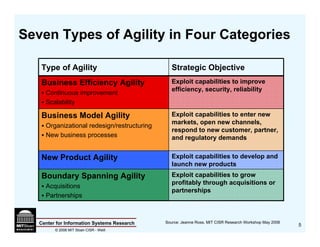
   Type of Agility                              Strategic Objective
   Business Efficiency Agility                  Exploit capabilities to improve
                                                efficiency, security, reliability
     Continuous improvement
     Scalability

   Business Model Agility                       Exploit capabilities to enter new
                                                markets, open new channels,
     Organizational redesign/restructuring
                                                respond to new customer, partner,
     New business processes                     and regulatory demands


   New Product Agility                          Exploit capabilities to develop and
                                                launch new products
   Boundary Spanning Agility                    Exploit capabilities to grow
                                                profitably through acquisitions or
     Acquisitions
                                                partnerships
     Partnerships


   Center for Information Systems Research   Source: Jeanne Ross, MIT CISR Research Workshop May 2006
                                                                                                        5
         © 2006 MIT Sloan CISR - Weill
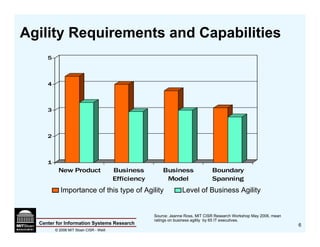
Agility Requirements and Capabilities
     5


     4


     3


     2


     1
          New Product                    Business         Business                Boundary
                                         Efficiency        Model                  Spanning
            Importance of this type of Agility                     Level of Business Agility


                                                      Source: Jeanne Ross, MIT CISR Research Workshop May 2006, mean
                                                      ratings on business agility by 65 IT executives.
  Center for Information Systems Research                                                                              6
         © 2006 MIT Sloan CISR - Weill
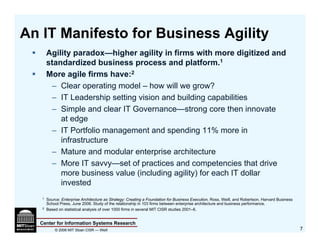
An IT Manifesto for Business Agility
       Agility paradox—higher agility in firms with more digitized and
       standardized business process and platform.1
       More agile firms have:2
        – Clear operating model – how will we grow?
        – IT Leadership setting vision and building capabilities
        – Simple and clear IT Governance—strong core then innovate
           at edge
        – IT Portfolio management and spending 11% more in
           infrastructure
        – Mature and modular enterprise architecture
        – More IT savvy—set of practices and competencies that drive
           more business value (including agility) for each IT dollar
           invested
   1   Source: Enterprise Architecture as Strategy: Creating a Foundation for Business Execution, Ross, Weill, and Robertson, Harvard Business
       School Press, June 2006. Study of the relationship in 103 firms between enterprise architecture and business performance.
   2   Based on statistical analysis of over 1000 firms in several MIT CISR studies 2001–6.


  Center for Information Systems Research
           © 2006 MIT Sloan CISR — Weill                                                                                                         7
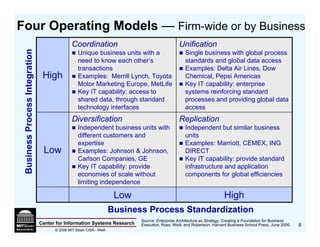
Four Operating Models — Firm-wide or by Business
                                               Coordination                                      Unification
 Business Process Integration

                                                   Unique business units with a                     Single business with global process
                                                   need to know each other’s                        standards and global data access
                                                   transactions                                     Examples: Delta Air Lines, Dow
                                 High              Examples: Merrill Lynch, Toyota                  Chemical, Pepsi Americas
                                                   Motor Marketing Europe, MetLife                  Key IT capability: enterprise
                                                   Key IT capability: access to                     systems reinforcing standard
                                                   shared data, through standard                    processes and providing global data
                                                   technology interfaces                            access
                                               Diversification                                   Replication
                                                   Independent business units with                  Independent but similar business
                                                   different customers and                          units
                                                   expertise                                        Examples: Marriott, CEMEX, ING
                                 Low               Examples: Johnson & Johnson,                     DIRECT
                                                   Carlson Companies, GE                            Key IT capability: provide standard
                                                   Key IT capability: provide                       infrastructure and application
                                                   economies of scale without                       components for global efficiencies
                                                   limiting independence

                                                                       Low                                               High
                                                                      Business Process Standardization
                                                                             Source: Enterprise Architecture as Strategy: Creating a Foundation for Business
                                Center for Information Systems Research      Execution, Ross, Weill, and Robertson, Harvard Business School Press, June 2006.   8
                                      © 2006 MIT Sloan CISR - Weill
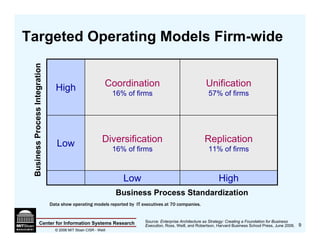
Targeted Operating Models Firm-wide
 Business Process Integration


                                  High                        Coordination                                Unification
                                                                  16% of firms                              57% of firms


                                   Low                       Diversification                              Replication
                                                                  16% of firms                              11% of firms


                                                                     Low                                         High
                                                                   Business Process Standardization
                                Data show operating models reported by IT executives at 70 companies.


                 Center for Information Systems Research                   Source: Enterprise Architecture as Strategy: Creating a Foundation for Business
                                                                           Execution, Ross, Weill, and Robertson, Harvard Business School Press, June 2006. 9
                                  © 2006 MIT Sloan CISR - Weill
Different Standardization Requirements
of the Four Operating Models
                                                    Coordination                             Unification
  Business Process Integration


                                                        Technology                              Technology
                                                        Customer and Product Data               Customer and Product Data
                                                        [Shared Services]                       Shared Services
                                 High                                                           Core Processes such as
                                                                                                Operations, Customer
                                                                                                Service, Logistics [R&D,
                                                                                                Marketing/Sales]

                                                    Diversification                          Replication
                                                        Technology                              Technology
                                                        (Shared Services)                       Shared Services
                                  Low                                                           Core Processes such as
                                                                                                Operations, Customer
                                                                                                Services, Logistics [R&D,
                                                                                                Marketing/Sales]

                                                                   Low                                          High
                                                                 Business Process Standardization
                                                                         Source: Enterprise Architecture as Strategy: Creating a Foundation for Business
                  Center for Information Systems Research                Execution, Ross, Weill, and Robertson, Harvard Business School Press, June 2006.
                                                                                                                                                            10
                                 © 2006 MIT Sloan CISR - Weill
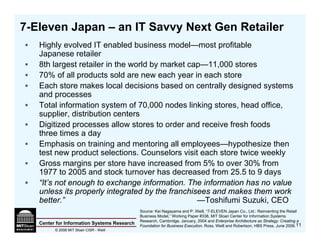
7-Eleven Japan – an IT Savvy Next Gen Retailer
   Highly evolved IT enabled business model—most profitable
   Japanese retailer
   8th largest retailer in the world by market cap—11,000 stores
   70% of all products sold are new each year in each store
   Each store makes local decisions based on centrally designed systems
   and processes
   Total information system of 70,000 nodes linking stores, head office,
   supplier, distribution centers
   Digitized processes allow stores to order and receive fresh foods
   three times a day
   Emphasis on training and mentoring all employees—hypothesize then
   test new product selections. Counselors visit each store twice weekly
   Gross margins per store have increased from 5% to over 30% from
   1977 to 2005 and stock turnover has decreased from 25.5 to 9 days
   “It’s not enough to exchange information. The information has no value
   unless its properly integrated by the franchisees and makes them work
   better.”                                      —Toshifumi Suzuki, CEO
                                             Source: Kei Nagayama and P. Weill, “7-ELEVEN Japan Co., Ltd.: Reinventing the Retail
                                             Business Model,” Working Paper #338, MIT Sloan Center for Information Systems
                                             Research, Cambridge, January, 2004 and Enterprise Architecture as Strategy: Creating a
   Center for Information Systems Research   Foundation for Business Execution, Ross, Weill and Robertson, HBS Press, June 2006. 11
         © 2006 MIT Sloan CISR - Weill
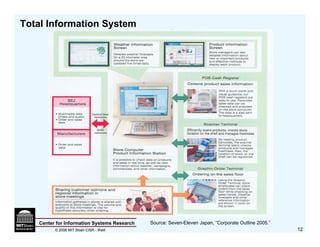
Total Information System


   Center for Information Systems Research   Source: Seven-Eleven Japan, “Corporate Outline 2005.”
         © 2006 MIT Sloan CISR - Weill                                                               12
Supplementary Material


  Center for Information Systems Research
        © 2006 MIT Sloan CISR — Weill       13
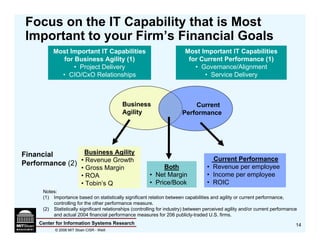
Focus on the IT Capability that is Most
 Important to your Firm’s Financial Goals
          Most Important IT Capabilities                                  Most Important IT Capabilities
            for Business Agility (1)                                       for Current Performance (1)
                • Project Delivery                                           • Governance/Alignment
            • CIO/CxO Relationships                                             • Service Delivery


                                            Business                         Current
                                            Agility                      Performance


Financial        Business Agility
                                                                                       Current Performance
Performance (2) • Revenue Growth                              Both                   • Revenue per employee
                          • Gross Margin
                          • ROA                          • Net Margin                • Income per employee
                          • Tobin’s Q                    • Price/Book                • ROIC
      Notes:
      (1) Importance based on statistically significant relation between capabilities and agility or current performance,
          controlling for the other performance measure.
      (2) Statistically significant relationships (controlling for industry) between perceived agility and/or current performance
          and actual 2004 financial performance measures for 206 publicly-traded U.S. firms.
     Center for Information Systems Research                                                                                    14
           © 2006 MIT Sloan CISR - Weill
IT Portfolios of Top Performers
with Different Strategies
 Information
                           Strategic
                                                            Business Strategy and Top Performance
           Transactional
                                          Average Firm11
                                          Average Firm                          Cost 22
                                                                                 Cost                Balance Cost &
                                                                                                     Balance Cost &                       Agile44
                                                                                                                                           Agile
          Infrastructure                     [n=337]
                                             [n=337]                            [n=22]
                                                                                [n=22]               Agility33 [n=50]
                                                                                                      Agility [n=50]                      [n=22]
                                                                                                                                          [n=22]

                                                                       18%               11%
      IT Portfolio                        17%           11%                                            17%         11%
                                                                                                                                   15%            10%
         Mix of                                                                  27%
                                                                                                                                          24%
                                                 26%                                                         24%
     Investments                                                                  44%
                                                 46%                                                         48%                          51%


  $IT compared to                        Average percent
                                         Average percent                 15% more than
                                                                         15% more than                                                3% less than
                                                                                                                                      3% less than
 industry avg. as %                        of expenses                 industry average
                                                                                                     Industry average
                                                                                                      Industry average             industry average
    of expenses                            of expenses                  industry average                                            industry average


     1   All 337 US stock exchange listed firms in the sample of 640   3   Balanced: middle 50% on % of sales from modified products and top 50% on ROIC
     2   Cost Focus: top 50% on ROIC and bottom 25% on % of            4   Agile: top 50% on revenue growth and top 25% on % sales from modified products.
         sales from modified product.
                                                                 Source: Analysis by MIT CISR (Weill and Johnson) using IT Investment (2003-5 average) and firm
                                                                 performance (2003-4 average). IT Data: Collected from 640 firms using MIT CISR framework.
         Center for Information Systems Research                 Performance data from Compustat. NSF Grant Number IIS-0085725                                15
                 © 2006 MIT Sloan CISR - Weill
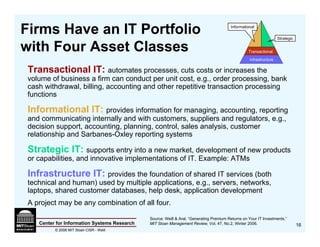
Firms Have an IT Portfolio                                                               Informational

                                                                                                                    Strategic

with Four Asset Classes                                                                            Transactional
                                                                                                   Infrastructure

 Transactional IT: automates processes, cuts costs or increases the
 volume of business a firm can conduct per unit cost, e.g., order processing, bank
 cash withdrawal, billing, accounting and other repetitive transaction processing
 functions

 Informational IT: provides information for managing, accounting, reporting
 and communicating internally and with customers, suppliers and regulators, e.g.,
 decision support, accounting, planning, control, sales analysis, customer
 relationship and Sarbanes-Oxley reporting systems

 Strategic IT: supports entry into a new market, development of new products
 or capabilities, and innovative implementations of IT. Example: ATMs

 Infrastructure IT: provides the foundation of shared IT services (both
 technical and human) used by multiple applications, e.g., servers, networks,
 laptops, shared customer databases, help desk, application development
 A project may be any combination of all four.

                                              Source: Weill & Aral, “Generating Premium Returns on Your IT Investments,”
    Center for Information Systems Research   MIT Sloan Management Review, Vol. 47, No.2, Winter 2006.                          16
          © 2006 MIT Sloan CISR - Weill
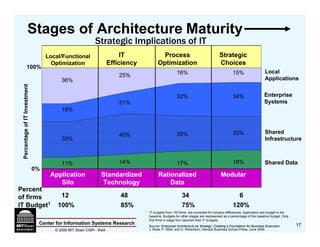
Stages of Architecture Maturity
                                                              Strategic Implications of IT
                                    Local/Functional                        IT                  Process                                 Strategic
                                      Optimization                     Efficiency             Optimization                              Choices
                100%
                                                                                                           16%                                   15%                   Local
                                                                           25%
                                          36%                                                                                                                          Applications
 Percentage of IT Investment


                                                                                                           32%                                   34%                   Enterprise
                                                                           21%                                                                                         Systems
                                          18%


                                                                                                           35%                                   33%                   Shared
                                                                           40%
                                          35%                                                                                                                          Infrastructure


                                          11%                              14%                             17%                                   18%                   Shared Data
                               0%
                                     Application                 Standardized                 Rationalized                               Modular
                                        Silo                      Technology                      Data
Percent
of firms                                 12                                48                                 34                                   6
IT Budget1                              100%                               85%                                75%                                120%
                                                                                    1   IT budgets from 103 firms are corrected for industry differences. Application silo budget is the
                                                                                        baseline. Budgets for other stages are represented as a percentage of the baseline budget. Only
                                                                                        five firms in stage four reported their IT budgets.
                                Center for Information Systems Research                                                                                                                    17
                                                                                        Source: Enterprise Architecture as Strategy: Creating a Foundation for Business Execution,
                                       © 2006 MIT Sloan CISR - Weill                    J. Ross, P. Weill, and D. Robertson, Harvard Business School Press, June 2006.
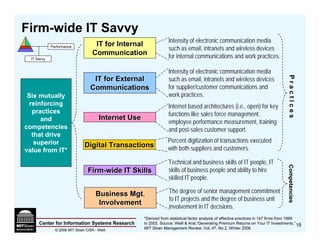
Firm-wide IT Savvy
                                                                    Intensity of electronic communication media
                                     IT for Internal
             Performance
                                                                    such as email, intranets and wireless devices
                                    Communication                   for internal communications and work practices.
  IT Savvy


                                                                    Intensity of electronic communication media


                                                                                                                                      Practices
                                    IT for External                 such as email, intranets and wireless devices
                                   Communications                   for supplier/customer communications and
 Six mutually                                                       work practices.
  reinforcing                                                       Internet based architectures (i.e., open) for key
   practices                                                        functions like sales force management,
      and                               Internet Use
                                                                    employee performance measurement, training
competencies                                                        and post-sales customer support.
   that drive
    superior                                                        Percent digitization of transactions executed
                               Digital Transactions                 with both suppliers and customers.
value from IT*
                                                                    Technical and business skills of IT people, IT


                                                                                                                                      Competencies
                                 Firm-wide IT Skills                skills of business people and ability to hire
                                                                    skilled IT people.

                                      Business Mgt.                 The degree of senior management commitment
                                                                    to IT projects and the degree of business unit
                                       Involvement
                                                                    involvement in IT decisions.
                                                       *Derived from statistical factor analysis of effective practices in 147 firms from 1999
      Center for Information Systems Research          to 2002. Source: Weill & Aral,“Generating Premium Returns on Your IT Investments,” 18
               © 2006 MIT Sloan CISR - Weill           MIT Sloan Management Review, Vol. 47, No.2, Winter 2006.

The Agility Paradox

  • 1.
    MIT CIO Summit— Thursday, June 22, 2006 MIT CIO Summit — Thursday, June 22, 2006 The Agility Paradox The Agility Paradox Based on research projects with Jeanne Ross and George Westerman Peter Weill Director, Center for Information Systems Research (CISR) MIT Sloan School of Management Phone: (617) 253-2930, Fax: (617) 253-4424 pweill@mit.edu; http://mitsloan.mit.edu/cisr/ Center for Information Systems Research © 2006 MIT Sloan CISR — Weill 1
  • 2.
    MIT Sloan Centerfor Information Systems Research (CISR) CISR gratefully acknowledges the support and contributions of its Research Patrons and Sponsors CISR Research Patrons CISR’s Mission – Boston Consulting Group – Hewlett-Packard Co. • Founded in 1974; CISR has a strong track record of – BT Group – IBM Corporation practice-based research on how firms manage & – DiamondCluster – Microsoft Corporation generate business value from IT International, Inc. – Tata Consultancy • Research is disseminated via electronic research – Gartner Services—America briefings, working papers, research workshops & exec. ed. programs including http://mitsloan.mit.edu/cisr/education.php CISR Sponsors – Aetna Inc. – MetLife CISR Research Portfolio 2002–2006 – Allstate Insurance Co. – Mohegan Sun Managing the IT Resource – American Express Corp. – News Corporation • Effective IT Oversight – AstraZeneca Pharmaceuticals, LP – Nissan North America, Inc. • The Future of the IT Organization – Banco ABN Amro Real S.A. – Nomura Research Institute, • IT Governance in Top Performing Firms – Biogen Idec Ltd. (Japan) • Enterprise Architecture as Strategy – Campbell Soup Co. – Owens Corning • IT Portfolio Investment Benchmarks & Links to Firm Performance – CareFirst Blue Cross Blue Shield – PepsiAmericas, Inc. • Reducing IT-Related Risk – Care USA – Pfizer Inc. IT and Business Strategy – Celanese – PFPC, Inc. • An IT Manifesto for Business Agility – Chevron Corp. – Quest Diagnostics • Business Models and IT Investment and Capabilities – Raytheon Company • IT-Enabling Business Innovation and Transformation – Det Norske Veritas (Norway) – State Street Corp. Managing Across Boundaries – Direct Energy • Effective Governance of Outsourcing – eFunds Corp. – TD Banknorth • IT Engagement Models and Business Performance – EMC Corp. – Telenor ASA (Norway) – Guardian Life Insurance Co. – Time Warner Cable of America – Trinity Health Contact Information: 3 Cambridge Center, NE20-336 – Information Services – TRW Automotive, Inc. Cambridge, MA 02142 06/01/2006 International – Unibanco S/A Ph. 617-253-2348, Fax 617-253-4424 – ING Groep N.V (Netherlands) – United Nations – DESA E-mail cisr@mit.edu; – Intel Corporation – US Federal Aviation Admin. http://mitsloan.mit.edu/cisr/ – InternationalInformation Systems Walt Disney Company Center for Finance Corp. – Research Center for Information Systems Research – Merrill Lynch & Co., Inc. © 2006 MIT Sloan CISR — Weill © 2006 MIT Sloan CISR 2
  • 3.
    Business Agility Why we need agility – Globalization – Mergers and acquisitions – Pressure on margins – Regulations – Faster cycle times What is your firm’s business agility? – The set of possible business initiatives an enterprise can readily implement leveraging predetermined competencies with managed cost and risk1 What are the key measures of agility in your enterprise? – Sales from new or modified – Unit cost and scalability products – Time to absorb – Time to market for new acquisition(s) products and services – Profitable growth Agility paradox — higher agility in firms with more digitized and standardized business process and platform2 1 Definition inspired by: Barney, C.K Prahalad, Weill, Subramani & Broadbent (2003), Howard Rubin, Aaron and Meehan, Kayworth, Chatterjee, and Sambamurthy (2001), Ross, Weill & Robertson (2006). Center for Information Systems Research 2 Source: Enterprise Architecture as Strategy: Creating a Foundation for Business Execution, © 2006 MIT Sloan CISR — Weill Ross, Weill, & Robertson, Harvard Business School Press, June 2006. 3
  • 4.
    Is Your FirmAgile or Staid? Performance Performance Agile Agile Staid Staid Measure11 Measure Percent of 2004 sales from new Percent of 2004 sales from new IF New New 8.8 8.8 3.2 3.2 products introduced in previous three products introduced in previous three Products Products years. Average = 5.6% years. Average = 5.6% Average percent of 2004 sales from Average percent of 2004 sales from Modified Modified Then 35 35 13 13 modified products introduced in modified products introduced in Products Products previous three years. Average = 22.5% previous three years. Average = 22.5% Average annual percent growth 2002– Average annual percent growth 2002– Then Growth Growth +7 +7 -- 10 10 4 (relative to industry average). 4 (relative to industry average). Average growth = 6.8% per annum Average growth = 6.8% per annum Average annual percent change in Average annual percent change in Profit Profit Then + 37 + 37 -- 13 13 ROE 2002–4 (relative to industry ROE 2002–4 (relative to industry Growth Growth average). Average = 0.5% average). Average = 0.5% 1 Source: MIT SeeIT Survey of 649 firms: Agile = Average of firms above sample mean on percent of sales from new products in 2004 (i.e., 5.6%). Staid =Average of firms below sample mean. NSF Grant Number IIS-0085725 (Weill & Apel). Center for Information Systems Research © 2006 MIT Sloan CISR — Weill 4
  • 5.
    Seven Types ofAgility in Four Categories Type of Agility Strategic Objective Business Efficiency Agility Exploit capabilities to improve efficiency, security, reliability Continuous improvement Scalability Business Model Agility Exploit capabilities to enter new markets, open new channels, Organizational redesign/restructuring respond to new customer, partner, New business processes and regulatory demands New Product Agility Exploit capabilities to develop and launch new products Boundary Spanning Agility Exploit capabilities to grow profitably through acquisitions or Acquisitions partnerships Partnerships Center for Information Systems Research Source: Jeanne Ross, MIT CISR Research Workshop May 2006 5 © 2006 MIT Sloan CISR - Weill
  • 6.
    Agility Requirements andCapabilities 5 4 3 2 1 New Product Business Business Boundary Efficiency Model Spanning Importance of this type of Agility Level of Business Agility Source: Jeanne Ross, MIT CISR Research Workshop May 2006, mean ratings on business agility by 65 IT executives. Center for Information Systems Research 6 © 2006 MIT Sloan CISR - Weill
  • 7.
    An IT Manifestofor Business Agility Agility paradox—higher agility in firms with more digitized and standardized business process and platform.1 More agile firms have:2 – Clear operating model – how will we grow? – IT Leadership setting vision and building capabilities – Simple and clear IT Governance—strong core then innovate at edge – IT Portfolio management and spending 11% more in infrastructure – Mature and modular enterprise architecture – More IT savvy—set of practices and competencies that drive more business value (including agility) for each IT dollar invested 1 Source: Enterprise Architecture as Strategy: Creating a Foundation for Business Execution, Ross, Weill, and Robertson, Harvard Business School Press, June 2006. Study of the relationship in 103 firms between enterprise architecture and business performance. 2 Based on statistical analysis of over 1000 firms in several MIT CISR studies 2001–6. Center for Information Systems Research © 2006 MIT Sloan CISR — Weill 7
  • 8.
    Four Operating Models— Firm-wide or by Business Coordination Unification Business Process Integration Unique business units with a Single business with global process need to know each other’s standards and global data access transactions Examples: Delta Air Lines, Dow High Examples: Merrill Lynch, Toyota Chemical, Pepsi Americas Motor Marketing Europe, MetLife Key IT capability: enterprise Key IT capability: access to systems reinforcing standard shared data, through standard processes and providing global data technology interfaces access Diversification Replication Independent business units with Independent but similar business different customers and units expertise Examples: Marriott, CEMEX, ING Low Examples: Johnson & Johnson, DIRECT Carlson Companies, GE Key IT capability: provide standard Key IT capability: provide infrastructure and application economies of scale without components for global efficiencies limiting independence Low High Business Process Standardization Source: Enterprise Architecture as Strategy: Creating a Foundation for Business Center for Information Systems Research Execution, Ross, Weill, and Robertson, Harvard Business School Press, June 2006. 8 © 2006 MIT Sloan CISR - Weill
  • 9.
    Targeted Operating ModelsFirm-wide Business Process Integration High Coordination Unification 16% of firms 57% of firms Low Diversification Replication 16% of firms 11% of firms Low High Business Process Standardization Data show operating models reported by IT executives at 70 companies. Center for Information Systems Research Source: Enterprise Architecture as Strategy: Creating a Foundation for Business Execution, Ross, Weill, and Robertson, Harvard Business School Press, June 2006. 9 © 2006 MIT Sloan CISR - Weill
  • 10.
    Different Standardization Requirements ofthe Four Operating Models Coordination Unification Business Process Integration Technology Technology Customer and Product Data Customer and Product Data [Shared Services] Shared Services High Core Processes such as Operations, Customer Service, Logistics [R&D, Marketing/Sales] Diversification Replication Technology Technology (Shared Services) Shared Services Low Core Processes such as Operations, Customer Services, Logistics [R&D, Marketing/Sales] Low High Business Process Standardization Source: Enterprise Architecture as Strategy: Creating a Foundation for Business Center for Information Systems Research Execution, Ross, Weill, and Robertson, Harvard Business School Press, June 2006. 10 © 2006 MIT Sloan CISR - Weill
  • 11.
    7-Eleven Japan –an IT Savvy Next Gen Retailer Highly evolved IT enabled business model—most profitable Japanese retailer 8th largest retailer in the world by market cap—11,000 stores 70% of all products sold are new each year in each store Each store makes local decisions based on centrally designed systems and processes Total information system of 70,000 nodes linking stores, head office, supplier, distribution centers Digitized processes allow stores to order and receive fresh foods three times a day Emphasis on training and mentoring all employees—hypothesize then test new product selections. Counselors visit each store twice weekly Gross margins per store have increased from 5% to over 30% from 1977 to 2005 and stock turnover has decreased from 25.5 to 9 days “It’s not enough to exchange information. The information has no value unless its properly integrated by the franchisees and makes them work better.” —Toshifumi Suzuki, CEO Source: Kei Nagayama and P. Weill, “7-ELEVEN Japan Co., Ltd.: Reinventing the Retail Business Model,” Working Paper #338, MIT Sloan Center for Information Systems Research, Cambridge, January, 2004 and Enterprise Architecture as Strategy: Creating a Center for Information Systems Research Foundation for Business Execution, Ross, Weill and Robertson, HBS Press, June 2006. 11 © 2006 MIT Sloan CISR - Weill
  • 12.
    Total Information System Center for Information Systems Research Source: Seven-Eleven Japan, “Corporate Outline 2005.” © 2006 MIT Sloan CISR - Weill 12
  • 13.
    Supplementary Material Center for Information Systems Research © 2006 MIT Sloan CISR — Weill 13
  • 14.
    Focus on theIT Capability that is Most Important to your Firm’s Financial Goals Most Important IT Capabilities Most Important IT Capabilities for Business Agility (1) for Current Performance (1) • Project Delivery • Governance/Alignment • CIO/CxO Relationships • Service Delivery Business Current Agility Performance Financial Business Agility Current Performance Performance (2) • Revenue Growth Both • Revenue per employee • Gross Margin • ROA • Net Margin • Income per employee • Tobin’s Q • Price/Book • ROIC Notes: (1) Importance based on statistically significant relation between capabilities and agility or current performance, controlling for the other performance measure. (2) Statistically significant relationships (controlling for industry) between perceived agility and/or current performance and actual 2004 financial performance measures for 206 publicly-traded U.S. firms. Center for Information Systems Research 14 © 2006 MIT Sloan CISR - Weill
  • 15.
    IT Portfolios ofTop Performers with Different Strategies Information Strategic Business Strategy and Top Performance Transactional Average Firm11 Average Firm Cost 22 Cost Balance Cost & Balance Cost & Agile44 Agile Infrastructure [n=337] [n=337] [n=22] [n=22] Agility33 [n=50] Agility [n=50] [n=22] [n=22] 18% 11% IT Portfolio 17% 11% 17% 11% 15% 10% Mix of 27% 24% 26% 24% Investments 44% 46% 48% 51% $IT compared to Average percent Average percent 15% more than 15% more than 3% less than 3% less than industry avg. as % of expenses industry average Industry average Industry average industry average of expenses of expenses industry average industry average 1 All 337 US stock exchange listed firms in the sample of 640 3 Balanced: middle 50% on % of sales from modified products and top 50% on ROIC 2 Cost Focus: top 50% on ROIC and bottom 25% on % of 4 Agile: top 50% on revenue growth and top 25% on % sales from modified products. sales from modified product. Source: Analysis by MIT CISR (Weill and Johnson) using IT Investment (2003-5 average) and firm performance (2003-4 average). IT Data: Collected from 640 firms using MIT CISR framework. Center for Information Systems Research Performance data from Compustat. NSF Grant Number IIS-0085725 15 © 2006 MIT Sloan CISR - Weill
  • 16.
    Firms Have anIT Portfolio Informational Strategic with Four Asset Classes Transactional Infrastructure Transactional IT: automates processes, cuts costs or increases the volume of business a firm can conduct per unit cost, e.g., order processing, bank cash withdrawal, billing, accounting and other repetitive transaction processing functions Informational IT: provides information for managing, accounting, reporting and communicating internally and with customers, suppliers and regulators, e.g., decision support, accounting, planning, control, sales analysis, customer relationship and Sarbanes-Oxley reporting systems Strategic IT: supports entry into a new market, development of new products or capabilities, and innovative implementations of IT. Example: ATMs Infrastructure IT: provides the foundation of shared IT services (both technical and human) used by multiple applications, e.g., servers, networks, laptops, shared customer databases, help desk, application development A project may be any combination of all four. Source: Weill & Aral, “Generating Premium Returns on Your IT Investments,” Center for Information Systems Research MIT Sloan Management Review, Vol. 47, No.2, Winter 2006. 16 © 2006 MIT Sloan CISR - Weill
  • 17.
    Stages of ArchitectureMaturity Strategic Implications of IT Local/Functional IT Process Strategic Optimization Efficiency Optimization Choices 100% 16% 15% Local 25% 36% Applications Percentage of IT Investment 32% 34% Enterprise 21% Systems 18% 35% 33% Shared 40% 35% Infrastructure 11% 14% 17% 18% Shared Data 0% Application Standardized Rationalized Modular Silo Technology Data Percent of firms 12 48 34 6 IT Budget1 100% 85% 75% 120% 1 IT budgets from 103 firms are corrected for industry differences. Application silo budget is the baseline. Budgets for other stages are represented as a percentage of the baseline budget. Only five firms in stage four reported their IT budgets. Center for Information Systems Research 17 Source: Enterprise Architecture as Strategy: Creating a Foundation for Business Execution, © 2006 MIT Sloan CISR - Weill J. Ross, P. Weill, and D. Robertson, Harvard Business School Press, June 2006.
  • 18.
    Firm-wide IT Savvy Intensity of electronic communication media IT for Internal Performance such as email, intranets and wireless devices Communication for internal communications and work practices. IT Savvy Intensity of electronic communication media Practices IT for External such as email, intranets and wireless devices Communications for supplier/customer communications and Six mutually work practices. reinforcing Internet based architectures (i.e., open) for key practices functions like sales force management, and Internet Use employee performance measurement, training competencies and post-sales customer support. that drive superior Percent digitization of transactions executed Digital Transactions with both suppliers and customers. value from IT* Technical and business skills of IT people, IT Competencies Firm-wide IT Skills skills of business people and ability to hire skilled IT people. Business Mgt. The degree of senior management commitment to IT projects and the degree of business unit Involvement involvement in IT decisions. *Derived from statistical factor analysis of effective practices in 147 firms from 1999 Center for Information Systems Research to 2002. Source: Weill & Aral,“Generating Premium Returns on Your IT Investments,” 18 © 2006 MIT Sloan CISR - Weill MIT Sloan Management Review, Vol. 47, No.2, Winter 2006.