Planning for
Performance
Enhancing the Effectiveness
of Training
Topics List
 Transfer of Skills
 Implementation Planning
Performance Factors
Roles and Timeframes
 Performance Factors Planning
 Summary
 Questions and Evaluations
Why do we do training or
development?
 To ensure workers have the knowledge
and skills to do the job.
What is Transfer of Skills?
…ensuring that the knowledge and skills
acquired during a learning intervention are
applied on the job…
Why focus on transfer?
 Protects training investments
 Encourages and empowers learners
 Improves accountability for
implementation
 Enhances likelihood that interventions will
target specific needs
 Helps supervisors maintain focus on
performance environment
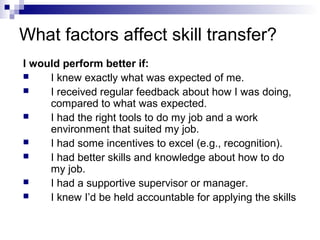
What factors affect skill transfer?
I would perform better if:
 I knew exactly what was expected of me.
 I received regular feedback about how I was doing,
compared to what was expected.
 I had the right tools to do my job and a work
environment that suited my job.
 I had some incentives to excel (e.g., recognition).
 I had better skills and knowledge about how to do
my job.
 I had a supportive supervisor or manager.
 I knew I’d be held accountable for applying the skills
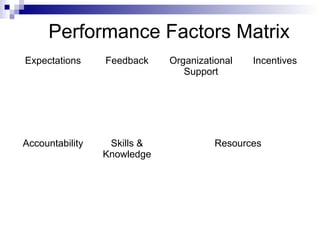
Performance Factors Matrix
Expectations Feedback Organizational
Support
Incentives
Accountability Skills &
Knowledge
Resources
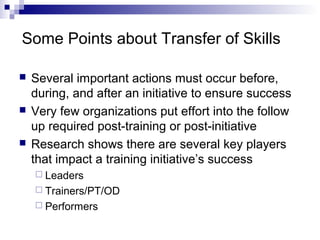
Some Points about Transfer of Skills
 Several important actions must occur before,
during, and after an initiative to ensure success
 Very few organizations put effort into the follow
up required post-training or post-initiative
 Research shows there are several key players
that impact a training initiative’s success
 Leaders
 Trainers/PT/OD
 Performers
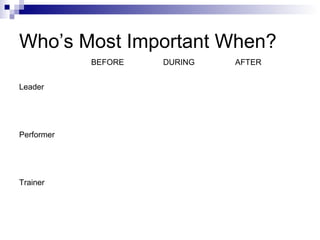
Who’s Most Important When?
BEFORE DURING AFTER
Leader
Performer
Trainer
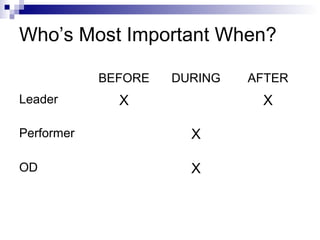
Who’s Most Important When?
BEFORE DURING AFTER
Leader X X
Performer X
OD X
What is the TOS process?
…an interrelated series of tasks performed
by supervisors, performance
technologists, performers and co-workers
before, during and after implementing an
intervention in order to maximize transfer
of knowledge and skills and to improve job
performance…
TOS Applied…
 Customer service initiative
 Goal was to improve patient satisfaction
and decrease patient complaints
 Service Excellence workshop, 12 Service
Basics, discharge survey, Guest
Complaint Tracking System
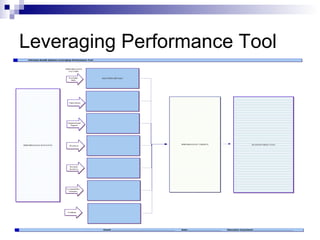
Performance Factors Plan
 Created to engage leadership in planning for
skills transfer
 Provided visual representation of the
interrelation between the service initiative and
business outcomes
 Explained and completed during service
leaders workshop
 Helped track expectations, commitments and
resources
Leveraging Performance Tool
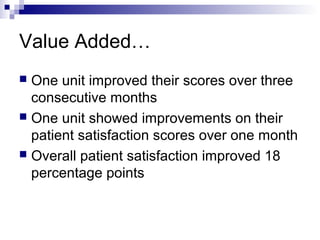
Value Added…
 One unit improved their scores over three
consecutive months
 One unit showed improvements on their
patient satisfaction scores over one month
 Overall patient satisfaction improved 18
percentage points
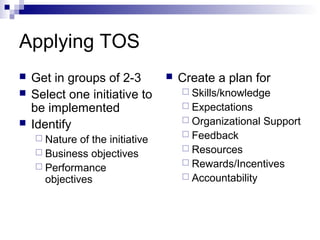
Applying TOS
 Get in groups of 2-3
 Select one initiative to
be implemented
 Identify
 Nature of the initiative
 Business objectives
 Performance
objectives
 Create a plan for
 Skills/knowledge
 Expectations
 Organizational Support
 Feedback
 Resources
 Rewards/Incentives
 Accountability
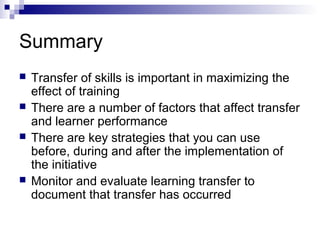
Summary
 Transfer of skills is important in maximizing the
effect of training
 There are a number of factors that affect transfer
and learner performance
 There are key strategies that you can use
before, during and after the implementation of
the initiative
 Monitor and evaluate learning transfer to
document that transfer has occurred

Planning for Performance: Enhancing the Effectiveness of Training

  • 1.
    Planning for Performance Enhancing theEffectiveness of Training
  • 2.
    Topics List  Transferof Skills  Implementation Planning Performance Factors Roles and Timeframes  Performance Factors Planning  Summary  Questions and Evaluations
  • 3.
    Why do wedo training or development?  To ensure workers have the knowledge and skills to do the job.
  • 4.
    What is Transferof Skills? …ensuring that the knowledge and skills acquired during a learning intervention are applied on the job…
  • 5.
    Why focus ontransfer?  Protects training investments  Encourages and empowers learners  Improves accountability for implementation  Enhances likelihood that interventions will target specific needs  Helps supervisors maintain focus on performance environment
  • 6.
    What factors affectskill transfer? I would perform better if:  I knew exactly what was expected of me.  I received regular feedback about how I was doing, compared to what was expected.  I had the right tools to do my job and a work environment that suited my job.  I had some incentives to excel (e.g., recognition).  I had better skills and knowledge about how to do my job.  I had a supportive supervisor or manager.  I knew I’d be held accountable for applying the skills
  • 7.
    Performance Factors Matrix ExpectationsFeedback Organizational Support Incentives Accountability Skills & Knowledge Resources
  • 8.
    Some Points aboutTransfer of Skills  Several important actions must occur before, during, and after an initiative to ensure success  Very few organizations put effort into the follow up required post-training or post-initiative  Research shows there are several key players that impact a training initiative’s success  Leaders  Trainers/PT/OD  Performers
  • 9.
    Who’s Most ImportantWhen? BEFORE DURING AFTER Leader Performer Trainer
  • 10.
    Who’s Most ImportantWhen? BEFORE DURING AFTER Leader X X Performer X OD X
  • 11.
    What is theTOS process? …an interrelated series of tasks performed by supervisors, performance technologists, performers and co-workers before, during and after implementing an intervention in order to maximize transfer of knowledge and skills and to improve job performance…
  • 12.
    TOS Applied…  Customerservice initiative  Goal was to improve patient satisfaction and decrease patient complaints  Service Excellence workshop, 12 Service Basics, discharge survey, Guest Complaint Tracking System
  • 13.
    Performance Factors Plan Created to engage leadership in planning for skills transfer  Provided visual representation of the interrelation between the service initiative and business outcomes  Explained and completed during service leaders workshop  Helped track expectations, commitments and resources
  • 14.
  • 15.
    Value Added…  Oneunit improved their scores over three consecutive months  One unit showed improvements on their patient satisfaction scores over one month  Overall patient satisfaction improved 18 percentage points
  • 16.
    Applying TOS  Getin groups of 2-3  Select one initiative to be implemented  Identify  Nature of the initiative  Business objectives  Performance objectives  Create a plan for  Skills/knowledge  Expectations  Organizational Support  Feedback  Resources  Rewards/Incentives  Accountability
  • 17.
    Summary  Transfer ofskills is important in maximizing the effect of training  There are a number of factors that affect transfer and learner performance  There are key strategies that you can use before, during and after the implementation of the initiative  Monitor and evaluate learning transfer to document that transfer has occurred

Editor's Notes

  • #4 [Ask the participants:] “Why do we do training?” [Take a few suggestions from the participants before advancing the slide to reveal the answer to the question.] The primary reason we do training is to ensure that workers have the required knowledge and skills to do the job. However, training is usually only one part of the solution. Other factors can affect worker performance on the job. On a related note, you may be wondering why we say “transfer of learning” rather than “transfer of training.” We have deliberately chosen the term “learning” to remind us that the focus of the intervention should be on the learners. We are focusing on what the learners need to do their job and how best to assist the learners to gain that knowledge and skill.
  • #5 This is a simple definition of what is meant by the phrase “transfer of learning.” [Read the definition from the slide. Mention that this definition is included in the Transfer of Learning Guide.]   [Ask the participants:] “Have you ever attended a training event and returned to your work but never implemented what you learned?” [Ask for a show of hands.][Tell the participants:] Research has shown that, typically, less than 30% of what people learn is actually ever used on the job.   Ask the participants:] “What do you need to help you use what you learn when you return to work?” [List participants’ suggestions on a flipchart.]
  • #6 Transfer of learning is important for supervisors, trainers, learners and co-workers because:   Transfer of learning is in the best interest of clients. Health care workers participate in a learning event to acquire new knowledge and skills to improve their ability to meet the needs of their clients. Improving the transfer of learning enhances the quality of services—and may lead to increased client satisfaction.   Learning interventions can be expensive. Improving the transfer of learning helps to protect these investments.   Learners are motivated to perform well at their jobs when they are able to apply what they have learned. The support and guidance of supervisors, trainers and co-workers can encourage and empower learners to make changes and improve performance.   Supervisors and learners are more accountable for implementing new knowledge and skills if there is early agreement about what will occur after training. An action plan outlines these agreements.   Investing in the outcome of training helps trainers to prepare interventions that meet the specific needs of learners and health care delivery sites. Although supervisors may not be proficient in all of the clinical services provided by the health workers they supervise, being involved in the transfer of learning process can help them stay up to date.
  • #7 [Display this slide as you facilitate the activity described in the notes pages for slides 7 and 8.] [Activity: What is my greatest performance block? This activity is adapted from Stolovitch HD and EJ Keeps. 1999. Getting Results Through Performance Consulting. (Packet of workshop handouts.) It requires Post-It notes and a flipchart that displays a matrix like the one shown on slide 8.] [Instructions: Give each participant a Post-It Note. Ask the participants to reflect on their own work situations/environments. Ask each participant to complete the following statement using the single most appropriate choice from the six responses listed on slide 7: I would perform better if: (choose only one). Ask the participants to choose one response from 1-6 and write it on their Post-Its.]
  • #8 [Activity Instructions (cont.) When the participants are ready, ask them to place their Post-Its on the prepared flipchart in the cell of the matrix that matches their selection. (Note: If you have more than about 50 participants, you may have to ask participants to raise their hands so you can take a quick vote on each number and then record the numbers on the flipchart.) After the Post-It Notes are in the matching cells, point out to the participants that these six categories relate to the factors most often associated with good performance. Also point out the variety of factors given by the group.] These six categories relate to the factors most often associated with good performance. Depending on the situation, a variety of factors may be identified for the purpose of improving performance. In our field, the vast majority of interventions that are undertaken to improve performance involve training. [Point out that, as evidenced by the group’s responses on the chart, it is obvious that training is not always the most appropriate intervention for improving performance.] From your own experience, you would probably agree that training is not always the most appropriate intervention for improving performance. As much as possible, we must determine the root cause of performance problems and consider a variety of interventions to improve worker performance and use training only when it’s appropriate (that is, for closing knowledge and skills gaps).
  • #9 Not surprisingly, the same factors that affect overall worker performance also affect how well learning is transferred to the job. As we saw on the previous two slides, a number of factors affect worker performance. These same factors influence how well learning transfers to the job. For example, Are there clear job expectations? Do learners know how and under what circumstances they will be expected to apply what they have learned? Do learners receive feedback from their supervisor (and others) on the performance of their new skills? Feedback is especially important if learners are still working toward complete mastery of a new skill. Do learners have the physical environment and tools they need (for example, supplies and instruments) to apply the new knowledge and skills they have acquired during training? Are learners motivated to apply the new skills? Does applying their new skills make their job easier or more satisfying? Have learners acquired knowledge and learned skills that are immediately applicable in the site where they work? Or, on the other hand, are they trying to figure out how to adapt what they have learned to fit the reality of their situation?  Do learners have support from the entire organization to help them implement the new skills and techniques they have learned? Has the administration made the necessary adaptations to processes and procedures to support the changes that they hope to institute through staff training? Well-designed training interventions should consider the impact of these factors. When necessary, tailored non-training interventions should be designed to facilitate and ensure the success of training interventions. Although you and your organization may not have the capability to design and implement specialized non-training interventions, it is important to consider the impact of all performance factors on learners’ ability to apply what they have learned. The key to success for any type of intervention is the support that the organization provides to ensure proper implementation through ongoing monitoring and updates.
  • #12 [Read the definition from the slide. Mention that this definition is included in the Transfer of Learning Guide.] The process is usually presented in a matrix or grid that lists suggested tasks that each stakeholder should perform before, during and after a training intervention.
  • #14 An action plan is a written document that describes the steps that supervisors, trainers, learners and co-workers develop to help maximize the transfer of learning. Action plans can be a tool for keeping track of expectations, commitments and the resources needed to accomplish learning goals.   A preliminary action plan is used before the start of the intervention to ensure agreement about the expectations for the learning intervention for all of the stakeholders including supervisors, trainers, learners, and co-workers.   During the learning intervention, the action plan is refined by the learner and the trainer to document exactly how the new knowledge and skills will be implemented at the work site.   After the intervention, the detailed written document is used to share the plan with supervisors, co-workers and other stakeholders to ensure that everyone is clear about the expectations and about their responsibilities for ensuring that the learners receive the support that they need to be successful. The action plan should be a living document that is revised as necessary to reflect accomplishments and changes to the plan.