By :By :
Vishali PanditaVishali Pandita
MBA (College Roll No: 14060)MBA (College Roll No: 14060)
Guru Nanak Institute of Management,Mullana (Ambala)Guru Nanak Institute of Management,Mullana (Ambala)
INTERNATIONAL ORGANIZATION FOR STANDARDIZATIONINTERNATIONAL ORGANIZATION FOR STANDARDIZATION
WHAT IS ISO?WHAT IS ISO?
• ISO (International Organization for Standardization) is
an independent, non-governmental membership
organization and the
world's largest developer of voluntary International Standard
.
• We are made up of our 165 member countries who are
the national standards bodies around the world, with a
Central Secretariat that is based in Geneva,
Switzerland.
BACKGROUNDBACKGROUND
ISO was formed in February 23, 1947 in Geneva.
The ISO story began in 1946 when delegates from 25
countries met at the Institute of Civil Engineers in London and
decided to create a new international organization ‘to facilitate
the international coordination and unification of industrial
standards’. In February 23 ,1947 the new organisation, ISO,
officially began operations.
Since then, ISO have published over 19 500 International
Standards covering almost all aspects of technology and
manufacturing.
MEMBERSHIPMEMBERSHIP
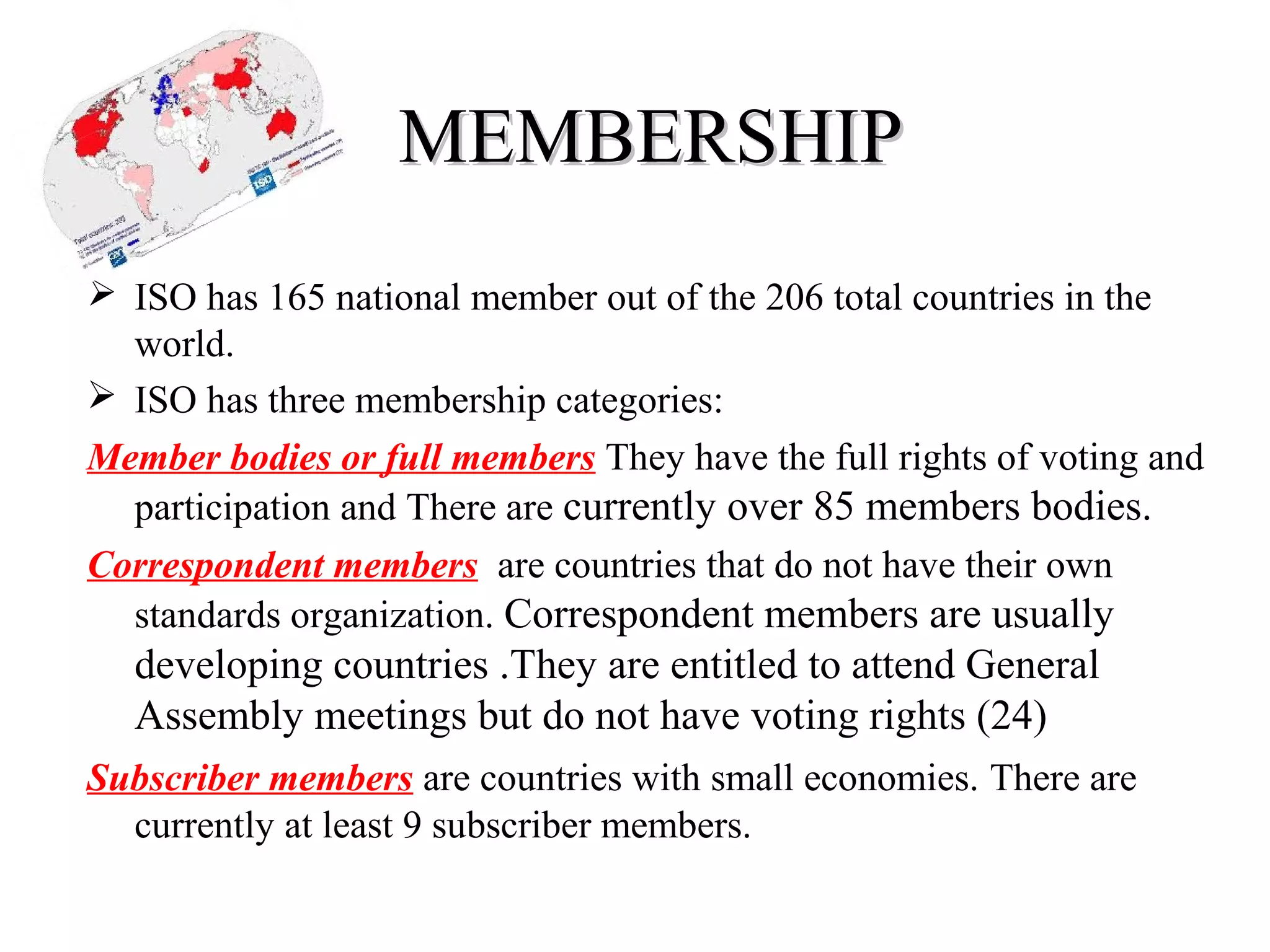
 ISO has 165 national member out of the 206 total countries in the
world.
 ISO has three membership categories:
Member bodies or full members They have the full rights of voting and
participation and There are currently over 85 members bodies.
Correspondent members are countries that do not have their own
standards organization. Correspondent members are usually
developing countries .They are entitled to attend General
Assembly meetings but do not have voting rights (24)
Subscriber members are countries with small economies. There are
currently at least 9 subscriber members.
ISO 9001 and ISO 14001ISO 9001 and ISO 14001
• ISO 9001 and ISO 14001 are among ISO's most well known
standards ever.
• They are implemented by more than a million organizations in
some 175 countries.
• ISO 9001 helps organizations to implement quality
management.
• ISO 14001 helps organizations to implement environmental
management.
QUALITY MANAGEMENTQUALITY MANAGEMENT
(9001)(9001)
• ISO 9001 is for quality management.
• Quality refers to all those features of a product
(or service) which are required by the customer.
• Quality management means what the organization does to
ensure that its products or services satisfy the customer's quality
requirements .
The ISO Survey (9001)The ISO Survey (9001)
The ISO SurveyThe ISO Survey (cont.)(cont.)
The worldwide total of certificates
to ISO 9001:2001 at the end of 2007 was 951 486.
This was increase of 6 % over 2006 when the total
was 896 929 certificates.
ENVIRONMENTALENVIRONMENTAL
MANAGEMENT (14001)MANAGEMENT (14001)
ISO 14001 is for environmental management. This
means what the organization does to:
Minimize harmful effects on the environment caused
by its activities,
Achieve continual improvement of its environmental
performance.
The ISO Survey (14001)The ISO Survey (14001)
The ISO SurveyThe ISO Survey (cont.)(cont.)
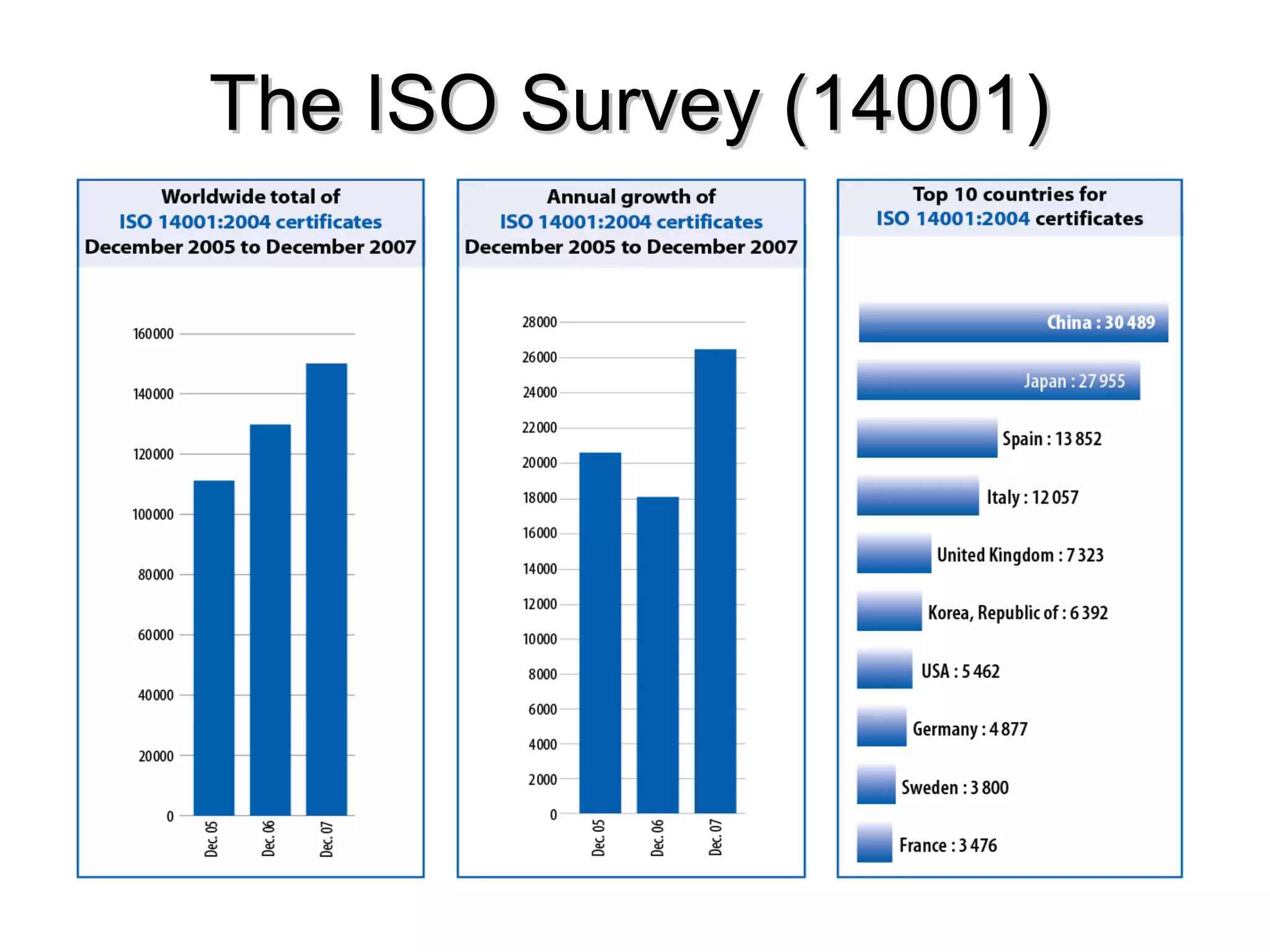
The worldwide total of ISO 14001
certificates at the end of 2007 was 154 572.
This was an increase of 21 % over 2006 when
the total was 128 211.
The ISO Survey of Management System Standard
Certifications – 2011
ISO Secretary-General Rob Steele comments about this survey that : "The results show
significant increases in certification to ISO management system standards for information
security, environmental management, energy management, and the sector-specific areas of food
safety, medical devices and automotive.
• 95% improvement in delivery time
• Reduced defects from 3% to 0.5%
• 85% increase in on-time delivery
• International acceptance and recognition
• Facilitated trade in international markets
• Promoting of safety, reliability and quality
CASE STUDIES SHOWEDCASE STUDIES SHOWED
ISO Registration resulted in:
CERTIFICATIONCERTIFICATION
ISO does not carry out certification and does not
issue or approve certificates.
It means that an independent, external body has
audited an organization's management system and
verified that it conforms to the requirements
specified in the standard (ISO 9001 or ISO 14001).
ISO does not carry out certification and does not
issue or approve certificates.
Benefits Of ISOBenefits Of ISO
1. Product and services are safe ,reliable
and of good quality.
2. They help companies to provide fair
global trade.
3. Increases customer satisfaction .
4. International Standards help reduce
negative impacts on the environment.
CONCLUSIONCONCLUSION
Although it is a private organization, it has had
significant effects on the behavior of businesses
around the world and it has received significant
input and attention from governments around the
world. In the process of globalization of
business,the ISO is playing a significant and vital
role. The ISO is an international organization that
has had and will continue to have significant
effects on business in many areas including, but
not limited to, quality management and
environmental performance.
Iso

Iso

  • 1.
    By :By : VishaliPanditaVishali Pandita MBA (College Roll No: 14060)MBA (College Roll No: 14060) Guru Nanak Institute of Management,Mullana (Ambala)Guru Nanak Institute of Management,Mullana (Ambala) INTERNATIONAL ORGANIZATION FOR STANDARDIZATIONINTERNATIONAL ORGANIZATION FOR STANDARDIZATION
  • 2.
    WHAT IS ISO?WHATIS ISO? • ISO (International Organization for Standardization) is an independent, non-governmental membership organization and the world's largest developer of voluntary International Standard . • We are made up of our 165 member countries who are the national standards bodies around the world, with a Central Secretariat that is based in Geneva, Switzerland.
  • 3.
    BACKGROUNDBACKGROUND ISO was formedin February 23, 1947 in Geneva. The ISO story began in 1946 when delegates from 25 countries met at the Institute of Civil Engineers in London and decided to create a new international organization ‘to facilitate the international coordination and unification of industrial standards’. In February 23 ,1947 the new organisation, ISO, officially began operations. Since then, ISO have published over 19 500 International Standards covering almost all aspects of technology and manufacturing.
  • 4.
    MEMBERSHIPMEMBERSHIP  ISO has165 national member out of the 206 total countries in the world.  ISO has three membership categories: Member bodies or full members They have the full rights of voting and participation and There are currently over 85 members bodies. Correspondent members are countries that do not have their own standards organization. Correspondent members are usually developing countries .They are entitled to attend General Assembly meetings but do not have voting rights (24) Subscriber members are countries with small economies. There are currently at least 9 subscriber members.
  • 5.
    ISO 9001 andISO 14001ISO 9001 and ISO 14001 • ISO 9001 and ISO 14001 are among ISO's most well known standards ever. • They are implemented by more than a million organizations in some 175 countries. • ISO 9001 helps organizations to implement quality management. • ISO 14001 helps organizations to implement environmental management.
  • 6.
    QUALITY MANAGEMENTQUALITY MANAGEMENT (9001)(9001) •ISO 9001 is for quality management. • Quality refers to all those features of a product (or service) which are required by the customer. • Quality management means what the organization does to ensure that its products or services satisfy the customer's quality requirements .
  • 7.
    The ISO Survey(9001)The ISO Survey (9001)
  • 8.
    The ISO SurveyTheISO Survey (cont.)(cont.) The worldwide total of certificates to ISO 9001:2001 at the end of 2007 was 951 486. This was increase of 6 % over 2006 when the total was 896 929 certificates.
  • 9.
    ENVIRONMENTALENVIRONMENTAL MANAGEMENT (14001)MANAGEMENT (14001) ISO14001 is for environmental management. This means what the organization does to: Minimize harmful effects on the environment caused by its activities, Achieve continual improvement of its environmental performance.
  • 10.
    The ISO Survey(14001)The ISO Survey (14001)
  • 11.
    The ISO SurveyTheISO Survey (cont.)(cont.) The worldwide total of ISO 14001 certificates at the end of 2007 was 154 572. This was an increase of 21 % over 2006 when the total was 128 211.
  • 12.
    The ISO Surveyof Management System Standard Certifications – 2011 ISO Secretary-General Rob Steele comments about this survey that : "The results show significant increases in certification to ISO management system standards for information security, environmental management, energy management, and the sector-specific areas of food safety, medical devices and automotive.
  • 13.
    • 95% improvementin delivery time • Reduced defects from 3% to 0.5% • 85% increase in on-time delivery • International acceptance and recognition • Facilitated trade in international markets • Promoting of safety, reliability and quality CASE STUDIES SHOWEDCASE STUDIES SHOWED ISO Registration resulted in:
  • 14.
    CERTIFICATIONCERTIFICATION ISO does notcarry out certification and does not issue or approve certificates. It means that an independent, external body has audited an organization's management system and verified that it conforms to the requirements specified in the standard (ISO 9001 or ISO 14001). ISO does not carry out certification and does not issue or approve certificates.
  • 15.
    Benefits Of ISOBenefitsOf ISO 1. Product and services are safe ,reliable and of good quality. 2. They help companies to provide fair global trade. 3. Increases customer satisfaction . 4. International Standards help reduce negative impacts on the environment.
  • 16.
    CONCLUSIONCONCLUSION Although it isa private organization, it has had significant effects on the behavior of businesses around the world and it has received significant input and attention from governments around the world. In the process of globalization of business,the ISO is playing a significant and vital role. The ISO is an international organization that has had and will continue to have significant effects on business in many areas including, but not limited to, quality management and environmental performance.